Free to Worship

Scripture: Exodus 35-40


Title: Free to Worship


Structure:

  • Introduction
  • Preparation for God’s coming (hope)
  • Worship from the inside out (freedom)
  • Conclusion


Introduction:

Today we conclude our series on Moses in Exodus by looking at the final six chapters – 35 through to 40

  • In this section the people make the tabernacle in accordance with the detailed instructions Yahweh gave them in chapters 25 to 31


The tabernacle, you may recall, is like God’s mobile home – it is a sacred tent for God’s presence

  • The God of Israel is not aloof or detached and He is not fixed in one place
  • Yahweh wants to be present among His people – on the move with them


We don’t have time this morning to read all six chapters – I really just want to draw your attention to some of the main points in view, in particular…

  • Israel’s preparation for God’s coming
  • And their worship from the inside out


Preparation for God’s coming:

As we heard earlier, today is the first Sunday in Advent, which means we are less than a month away from Christmas


Tell me, what are some of the things that you have been doing (or at least need to do) to prepare for Christmas?

  • Write and send Christmas cards
  • Shop for Christmas presents
  • Put up the Christmas tree
  • Decide where you will spend Christmas
  • Buy special food
  • Attend end of year parties


Okay, show of hands, who really enjoys this time of year?

  • And who can’t wait for it all to be over?
  • There is much to do in preparing for Christmas – it is a busy time


Recently, in the last 3 months, we’ve had two new babies born in our congregation – Matthias & Pascal

  • There is quite a bit to do in preparing for the arrival of a new born baby, especially if it’s your first (as it was for Oti & Ann Na)
  • You need to set up the nursery, buy baby clothes, make arrangements for time off work, get a baby seat and maybe get a bigger car


At the beginning of this month Prince Charles paid a visit to Tawa College

  • I imagine there was a fair bit of preparation involved with that visit
  • Communicating to the pupils and the parents what was happening
  • Having some students ready to greet and perform for the prince
  • Liaising with police about security
  • Having some contingency plan if things didn’t quite go as expected
  • I don’t know – I guess there was lots to think of


There is certainly a lot to think of in preparing for a wedding

  • Organising the ceremony itself and then the reception afterwards
  • Inviting guests, buying a dress, hiring a suit, arranging flowers, working through some kind of marriage preparation course with the minister
  • Writing a speech, planning the honey moon – all sorts of details you wouldn’t imagine until you go through the process


Next week’s ‘19 Sleeps to Christmas’ guest service involves lots of preparation too (nearly as much as a wedding)

  • I don’t want to give too much away but there has been quite a bit of planning and work going on in the background for several weeks now
  • At this afternoon’s practice we’ll put it altogether to see how it works


That word Advent (on the front of your newsletters) simply means ‘coming’

  • During Advent we look back to Jesus’ first coming to earth 2000 years ago and we look forward to Christ’s second coming in glory
  • Christmas Advent is meant to be a time of preparation for the arrival of both a special event and a special person


When you read through Exodus chapters 35 to 40 you get a feel for the amount of preparation that went into Yahweh’s coming


There’s lots of detail about joining and fastening and making and then assembling the tabernacle. For example:

  • He made curtains of goats’ hair
  • He joined five curtains by themselves
  • He made the table of acacia wood… and overlaid it with pure gold
  • He cast for it four rings of gold and fastened the rings to the four corners
  • He also made the lampstand of pure gold… and so on


The image presented is not a static one

  • We don’t get a still photo of the completed project
  • We get a series of moving pictures, describing the process of the people’s preparation for the coming of God to dwell in their midst.
  • The community is in Advent mode.’ [1]


Much of the detail in chapters 35 to 40 is repetition of chapters 25 to 31

  • The main difference being that in chapters 25-31 God describes things in order of sacredness – starting with the ark in the most holy place and working His way to the outer courtyard and surrounding curtains
  • Whereas in chapters 35 to 40 we get a works report – so the order follows the practical logic of construction


Why the repetition? (albeit in a different order)

  • Because preparing for the Lord’s coming (His Advent) is important
  • It is not instant coffee or a microwave meal
  • It is not a Bunnings flat pack or ready-made curtains
  • Everything is unique, a one off, custom made and hand crafted


In the Old Testament the tabernacle isn’t just a symbol of God’s presence – it is an actual vehicle for divine presence

  • When God fills the tabernacle in Exodus 40, Moses is unable to enter

In the New Testament Jesus is the actual vehicle of God’s presence – more than just a symbol

  • As the Israelites prepared for Yahweh’s coming so we need to make room for the Christ child – we need to be ready to receive our risen Lord


Being prepared for Christ’s coming gets some attention in the gospels too

  • Jesus told a number of parables about being ready for his return
  • The parable of the 10 virgins – only 5 of whom kept their lamps trimmed
  • The thief in the night
  • The parable of the servants and the talents, and so on
  • This looking forward to Christ’s return is not meant to be an anxious thing – it is supposed to inspire hope – Hope is an attractive energy


Looking at the book of Exodus as a whole, we notice a contrast between the beginning and the end of the book

  • At the start of Exodus the people are despairing – Pharaoh is crushing their spirit under cruel slavery – they have nothing to look forward to
  • But by the end of the book Pharaoh is nowhere in sight and the people are busy preparing for the Lord’s coming – energised by hope


  • Despite the Pharaoh’s of this world and despite Israel’s own failure, God promises to be with His people and that promise fills the people with a sense of joyful anticipation
  • Like the joy and excitement we might feel as we anticipate getting married or as we look forward to the birth of a child or being reunited with loved ones at Christmas


As well as describing Israel’s preparation for God’s coming, Exodus 35 to 40 also shows us the quality and fabric of their worship – from the inside out


Worship from the inside out:

Aesop has a story about the sun and the wind – it’s a classic, worth repeating


The North Wind boasted of great strength.

  • The Sun argued that there was greater power in gentleness.
  • “We shall have a contest,” said the Sun.


Far below, a man travelled a winding road.

  • He was wearing a warm winter coat.
  • “As a test of strength,” said the Sun, “Let us see which of us can take the coat off of that man.”


“It will be quite simple for me to force him to remove his coat,” bragged the Wind.

  • The Wind blew so hard, branches broke off trees. The world was filled with dust and leaves.
  • But the harder the wind blew, the tighter the man clung to his coat.


Then, the Sun came out from behind a cloud, warming the air and the frosty ground.

  • The man on the road unbuttoned his coat.
  • The sun grew slowly brighter and warmer.
  • Soon the man felt so hot, he took off his coat and sat down in a shady spot.


“How did you do that?” said the Wind.

  • “Gently, from the inside out”, said the Sun


Pharaoh was like the wind to Israel – forcing them against their will with threats and whips and external pressures

  • But the way of Yahweh was more like the Sun – warming Israel, wooing them gently, so they were moved of their own volition, freely, naturally, from the inside out


From Exodus 35, verse 4 Moses said to all the congregation of the Israelites:

This is the thing that the Lord has commanded:

Take from among you an offering to the Lord; let whoever is of a generous heart bring the Lord’s offering: gold, silver, bronze… [and so on]


And they came, everyone whose heart was stirred and everyone whose spirit was willing and brought the Lord’s offering to be used for the tent of meeting…

So they came, both men and women; all who were of a willing heart brought brooches and earrings and signet rings and pendants, all sorts of gold…

[and so on]


Willing heart – willing spirit


In this context the ‘heart’ stands for the inner constitution or disposition of a person – their unseen inner reality

  • While the human ‘spirit’ refers to personal energy, gusto or inner drive [2]

The point is, no one was forcing the people to provide valuables for making the tabernacle – they did it freely and willingly, from the inside out

  • God, in His grace, had moved them with the warmth of His loyal love and commitment
  • The people were so generous that they had to be asked to stop giving


The best things in life are simple – Chocolate is a point in case

  • Chocolate only has three ingredients – and two of those ingredients come from the same plant
  • You can add other things to the chocolate like fruit or nuts or some other kind of flavouring but essentially the chocolate itself only has 3 parts
  • Would anyone like to guess what those three ingredients are? [Wait]


Yes, that’s right

  • Cocoa beans (or cocoa mass), cocoa butter and sugar


The cocoa beans give the chocolate that dark look and bitter taste

  • The sugar is needed to balance out the bitterness
  • And the cocoa butter gives it a smooth silky texture


Worship is a bit like chocolate – in that it has three basic ingredients

  • Giving (as in some form of sacrifice or offering)
  • Willingness (as in a willing spirit or a generous heart)
  • And obedience (doing what God asks)

Giving is integral to worship – like cocoa beans are integral to chocolate

  • We can give all sorts of things to God – we might offer songs of praise, money, talents or our time
  • The offering we take up each Sunday isn’t just to cover the church’s expenses – It is primarily an act of worship
  • Likewise, if you volunteer your time on the music team or the property committee or the deacons board or helping with Club Intermed or Youth group or Sunday school or doing the lawns or whatever else you may do
  • Then, so long as you are doing it for the Lord, it is worship


We’ve already heard how the people offered their valuables to God – their gold, silver, fine linen and so forth

  • The other thing they gave was themselves – their time and talents in service to make the tabernacle


Those who were at Doris Lindstrom’s funeral yesterday would have heard a reading from Exodus 35, verse 30…


30 Then Moses said to the Israelites: See, the Lord has called by name Bezalel son of Uri son of Hur, of the tribe of Judah; 31 he has filled him with divine spirit, with skill, intelligence, and knowledge in every kind of craft, 32 to devise artistic designs, to work in gold, silver, and bronze, 33 in cutting stones for setting, and in carving wood, in every kind of craft. 34 And he has inspired him to teach…


The Scriptures go on to say how others joined Bezalel, under his guidance and tuition to build the Lord’s tent and equipment

  • They offered their time and skill


What this means is that work is sacred when it is done as an act of worship for the Lord

  • Your work during the week can be as much an act of worship as singing songs of praise in church on a Sunday morning

As the apostle Paul writes in his letter to the Ephesians

  • Render service with enthusiasm, as to the Lord and not to men or women, knowing that whatever good we do, we will receive the same again from the Lord… [3]

If giving is to worship what cocoa beans are to chocolate, then willingness is like the sugar, making the giving sweet

  • Worship isn’t meant to be an empty ritual
  • Worship is not blindly going through the motions
  • Worship needs to be from the inside out – from a willing heart and with a spirit (or an energy) which really wants to express love and appreciation
  • Without willingness the giving becomes bitter drudgery & loveless duty
  • Without willingness the letting go of sacrifice doesn’t free our heart – it clenches our heart into a fist of resentment


Okay then – if giving is the cocoa beans and willingness is the sugar, then obedience must be the cocoa butter


More than the other two ingredients it is the cocoa butter which determines the quality of the chocolate

  • The cocoa butter is the most expensive of the three ingredients and so cheap chocolate tends to skimp on cocoa butter or substitute it with something else
  • Just as there is no substitute for cocoa butter in quality chocolate, so too there is no substitute for obedience in quality worship
  • Obedience is indispensable to worship


Exodus 35-40 never tires of stating how the divine instructions were carried out in precise detail; there are 18 references to Moses doing as God commanded [4]

  • Obedience – doing what God wants – is more important than giving to charity or anything else we might think of as ‘good works’
  • What is it the Lord says, ‘Obedience is better than sacrifice’


Without cocoa butter it isn’t really chocolate

  • Without obedience it isn’t really worship


The cross was Jesus’ ultimate test of obedience to God

  • We read about it in the accounts of Jesus’ anguished prayer in the Garden of Gethsemane
  • Not my will Father, but Your will be done


Giving God what He wants, willingly, that is true worship


Conclusion:

The book of Exodus finishes one year after the people left Egypt with the presence of God filling the tabernacle

  • Exodus means ‘exit’ or ‘leaving’ – so it’s really about movement
  • It’s about God taking Israel out of Egypt and into the wilderness
  • Out of the known and into the unknown
  • Out of forced labour under Pharaoh to willing worship of Yahweh
  • Out of slavery and into freedom
  • Out of despair and into hope


And it hasn’t been an easy journey for Israel or Yahweh or Moses

  • It’s been a rollercoaster of redemption, failure, forgiveness and faith
  • But through the Lord’s (& Moses’) loyal love, Israel are a new creation


Jesus came for our Exodus – for our redemption – to make us a new creation, free to worship the Lord – free to willingly give God what He wants


Let’s stand and sing about the Lord’s love and faithfulness as we prepare for communion…


[1] Terence Fretheim, Exodus, page 314

[2] Alec Motyer, BST Exodus, page 320.

[3] Ephesians 6:7-8

[4] Terence Fretheim, Exodus, page 313.
YHWH

Scripture: Exodus 34:1-9


Title: YHWH


Structure:

  • Introduction
  • YHWH
  • Moses
  • Conclusion


Introduction:

Today we continue our series on Moses in Exodus

  • You may remember that God made a covenant with Israel – a sacred agreement in which they were committed in loyalty to Yahweh
  • Sadly the people were quick to break this commitment by making and worshipping a golden calf
  • But Moses interceded for the people asking God not to destroy them
  • And God listened to Moses
  • This morning’s reading picks up the part in the story where God is renewing the covenant with Israel – giving them a second chance


Israel didn’t really appreciate what God was offering them in the covenant

  • But now, through their fall and failure, they learn more deeply the extent of God’s steadfast love for them


Today I will be reading from the New Revised Standard Version

  • The words will appear on the wall behind me
  • Exodus chapter 34, verses 1 – 9


The Lord said to Moses, “Cut two tablets of stone like the former ones, and I will write on the tablets the words that were on the former tablets, which you broke. Be ready in the morning, and come up in the morning to Mount Sinai and present yourself there to me, on the top of the mountain.


No one shall come up with you, and do not let anyone be seen throughout all the mountain; and do not let flocks or herds graze in front of that mountain.” So Moses cut two tablets of stone like the former ones; and he rose early in the morning and went up on Mount Sinai, as the Lord had commanded him, and took in his hand the two tablets of stone.


The Lord descended in the cloud and stood with him there, and proclaimed the name, “The Lord.” 6  The Lord passed before him, and proclaimed, “The Lord, the Lord, a God compassionate [merciful] and gracious, slow to anger, and abounding in steadfast love and faithfulness,keeping steadfast love for the thousandth generation, forgiving iniquity and transgression and sin, yet by no means clearing the guilty, but visiting the iniquity of the parents upon the children and the children’s children, to the third and the fourth generation.”


And Moses quickly bowed his head toward the earth, and worshiped. He said, “If now I have found favour in your sight, O Lord, I pray, let the Lord go with us. Although this is a stiff-necked people, pardon our iniquity and our sin, and take us for your inheritance.”


May the Spirit of Jesus illuminate this reading for us


YHWH:

On the wall here we have some text language

  • If you are under the age of 30 then this will probably be easy
  • But if you are over 40 then it might be a bit harder
  • So for those over 40 only – what does BTW mean? [Wait]
  • Yes – that’s right – ‘By The Way’


That was an easy one to get you started

  • What about FWIW? [Wait]
  • ‘For What It’s Worth’


Okay – one more – BOT [Wait]

  • ‘Back On Topic’


You could be forgiven for thinking the title of this morning’s message (on the front page of the newsletter) was text language – YHWH

  • But it’s not – this is God’s name
  • In English it is usually translated simply as LORD, all in capitals
  • But really it is untranslatable
  • We tend to put vowels in to at least make it pronounceable – so it sounds something like ‘Yahweh’
  • In any case there is significant mystery and sacredness in the name

In Exodus 33 Moses had asked to see the Lord’s glory and God had said…

  • I will make my goodness pass before you and will proclaim my name before you …but you cannot see my face… you may see my back.
  • Now in chapter 34 (the passage we read earlier) God does just that


6  The Lord passed before him, and proclaimed, “The Lord, the Lord, a God compassionate [merciful] and gracious, slow to anger, and abounding in steadfast love and faithfulness…


Yahweh is different from the deities of the pagan nations around ancient Israel

  • The gods of the other nations were represented by wooden or metal statues – something the people could see and touch
  • Something that wouldn’t talk back or tell them what to do
  • Something they could control


But Yahweh forbids the people to represent Him in this way

  • Instead Yahweh represents Himself with words: poetry is God’s language
  • Words are like seeds – they are powerful and once buried in the soil of our imagination take root, grow and bear fruit in our actions


The first characteristic or attribute God reveals about Himself here is that He is compassionate (sometimes also translated merciful)


Compassionate and merciful are relatively long words in English

  • The Hebrew root word is quite short – just three letters ‘RHM’
  • As Phyllis Tribble observes, the Hebrew word for ‘compassionate’ or ‘merciful’, when used in relation to Yahweh, is intimately connected to the word for ‘womb’ [1]
  • Compassionate and womb share the same linguistic root


A womb is a sacred and holy part of a woman’s body

  • It is where human life grows and is formed in secret
  • A womb is a powerfully creative thing – a place of nourishment and protection for the child
  • And it is cloaked in mystery – science doesn’t yet understand it


It’s like God is saying in poetic language…

  • ‘My inner most being is sort of like a womb
  • At my core is mystery, power and creative energy
  • I am like a mother to you Israel, carrying and protecting and nourishing you, bringing you into this world at great pain to myself
  • And like a mother I am compassionate


To be compassionate means to receive the other person’s suffering

  • To see their sadness and pain and reach out to accept them so they know they are not alone
  • We don’t have to pretend with God
  • If God asks us how we are we don’t have to say, “I’m fine”, if we are not
  • We can be honest with God – He can handle it


Steve Apirana has a song we sometimes sing in church called, Something Beautiful

  • Something beautiful, something good
  • All my confusion, He understood
  • All I had to offer Him was brokenness and strife
  • But He made something beautiful out of my life


This is really a song about God’s compassion

  • God has the power to receive our pain and suffering
  • To take it into Himself and transform it into something beautiful
  • To do something creative with it so that it serves a good purpose
  • Just like when Joseph’s brothers sold him into slavery
  • God received Joseph’s rejection (his pain & suffering) and used it to save many people, including Joseph’s brothers


In the ‘Gospel for Asia’ magazine which came out this month there is an article – a true story of a 2 day old baby girl who was left in a rubbish bin [2]

  • The doctor had said the baby was abnormal and the parents felt so ashamed they threw the child into a dumpster
  • The sister-in-law of the man who had thrown the child away was a Christian. Her name, Pranaya
  • When Pranaya learned that her wee niece had been put out with the rubbish, she went & found the child, reached into the bin & lifted her up
  • Pranaya carried the baby home, named her Jansi and cared for her
  • Even after Pranaya married and had children of her own, she still accepted Jansi in her family


Pranaya showed compassion, graciousness & steadfast love – she reached out to accept someone else’s suffering – to carry, nurture, protect and nourish Jansi

  • This is what God did for Israel and it’s what He does for each of us


The second word God uses to describe Himself is gracious

  • To be gracious here means that Yahweh acts freely and generously, without need for compensation or hope of benefit
  • God works pro-bono – for free and without agenda
  • God’s graciousness points to His freedom
  • God doesn’t do things for us because He needs something from us
  • God doesn’t need anything – He is able to meet His own needs
  • God does things for us because He wants to and He can


That phrase, slow to anger, literally translates from the Hebrew ‘long of nose’ or ‘long nostrils’ – this is Hebrew idiom which is lost on us to some extent

  • Make the snort of anger noise – that’s a snort of anger
  • To say that God has long nostrils means, it takes a long time for the snort of anger to come through God’s nose


In today’s English idiom we might say ‘God has a long fuse’

  • Someone with a short fuse is someone with a quick temper – they explode in anger at the smallest thing
  • Someone with a long fuse (like God) is not prone to exploding


As we heard last week, anger or wrath is not primary to God

  • It is secondary and temporary
  • If anger is represented by the white ball in a game of pool then the cue which sets the white ball moving is God’s care
  • Like an expert pool player God is in control of His anger


We could say that ‘slow to anger’ basically means God is patient

  • He is not pressured or in a hurry – He measures twice and cuts once


Steadfast love is mentioned two times by Yahweh in today’s passage – so it is given extra emphasis

  • It translates from the Hebrew word hesed
  • Hesed doesn’t have an exact English equivalent
  • Loyal love or covenant love or steadfast love are generally the best translations
  • Steadfast love (Hesed) is not a romantic feeling which waxes and wanes
  • It is not skinny love
  • Steadfast love has substance – backbone
  • It is an unswerving, unbreakable commitment to someone else’s well-being


William Shakespeare was describing something like steadfast love when he wrote…

  • Love is not love which alters when it alteration finds, Or bends with the remover to remove: O no; it is an ever-fixed mark, That looks on tempests, and is never shaken;


In other words, true love is constant – it does not change with the circumstances

  • Steadfast love goes on loving the other person even when that love is not reciprocated
  • The commitment that Noah shows for Ally in the movie the Note Book is steadfast love
  • The commitment Ruth shows to her mother-in-law Naomi (in the Bible) is also steadfast love


Faithfulness is complete trustworthiness and reliability

  • It means Yahweh won’t go back on what He has promised
  • He won’t break His word – His word is truth
  • God does not promise Israel an easy road
  • He promises to go with them – He promises His presence


In verse 7 the Lord continues revealing His character saying He is a God who

  • …keeps steadfast love for the thousandth generation, forgiving iniquity and transgression and sin, yet by no means clearing the guilty, but visiting the iniquity of the parents upon the children and the children’s children, to the third and the fourth generation.”


Now, at first glance this statement sounds contradictory

  • God is saying He forgives people but then in the same breath He also says He doesn’t clear the guilty
  • So which is it: forgiveness or justice? Grace or punishment?
  • Well, it’s not either / or with God – it’s both / and
  • The steadfast love of God requires Him to exercise both forgiveness and just judgement


What we notice is that the judgement – or the just consequence – is limited to 3 or 4 generations, while the steadfast love is unlimited, for 1000’s

  • Wrath is not a continuous aspect of God’s nature
  • Wrath is temporary – a particular response to a historical situation
  • God’s natural inclination, His default setting if you like, is to show steadfast love

But steadfast love does not mean anything goes

  • There is no predictability or inevitability about divine grace
  • We should not presume upon God’s forgiveness
  • We can’t say, ‘Well, I know this is wrong but I’m going to do it anyway because God is my mate, He will forgive me, it’s in His nature.’
  • God is not obligated to forgive us
  • If we are playing Him for fool then He will see through that


The Lord is slow to anger and quick to forgive but that doesn’t mean we have immunity from the consequences of our actions

  • For forgiveness to really happen, something has to die
  • Usually it is our pride and wilfulness which needs to die


Okay, so hopefully that helps you to understand something of the meaning of Yahweh’s name

  • But really we can only know Yahweh through a relationship with Him
  • We can only know Yahweh’s compassion if we suffer
  • We can only know His graciousness if we have empty hands to receive from Him
  • We can only know His steadfast love & faithfulness if we trust Him through thick & thin
  • We can only know His patience and forgiveness if we admit our failure


The other person in this morning’s reading is Moses – let’s take a look at things from his perspective


Moses:

Moses has just experienced a revelation of God’s goodness

  • There is something overwhelming about God’s goodness
  • There is a grandeur and a beauty to it (like a mountain range) which both inspires us and makes us feel inadequate at the same time


God’s goodness infinitely outweighs our goodness – we become aware that we are unworthy, not equal partners in the relationship

Moses responds by bowing before God in worship

  • Worship is the appropriate response to God’s goodness
  • In bowing we are saying, ‘God, You are the bigger, better person here. How can I possibly stand in Your presence.’


Based on Yahweh’s revelation of Himself, Moses goes on to ask three things of the Lord (for the sake of Israel)…

  • Go with us – that’s presence
  • Forgive us – that’s grace
  • And take us as Your inheritance – that’s acceptance
  • Presence, forgiveness and acceptance


One interesting thing we observe here is the way Moses identifies himself with the people in their sinfulness

  • Go with us – forgive us – accept us
  • Moses could have said forgive them – but he doesn’t
  • Moses wasn’t part of the golden calf debacle and yet he stands in solidarity with the people – he wears their shame, he carries their cross
  • Remind you of anyone?


Forgiveness is the key to Yahweh’s relationship with Israel

  • In order for Yahweh to accept Israel and go with Israel, the Lord will need to be prepared to forgive Israel, for they are a stiff necked people
  • Like a mule that won’t be led by its master Israel will fight God and resist Him each step of the way


In verse 10 God answers Moses’ prayer for presence, forgiveness and acceptance by saying: “I hereby make a covenant [with Israel]”

  • Renewal of the covenant is not automatic – Moses must make an admission of guilt on behalf of the people


We are not that different to Israel

  • Forgiveness is key to our relationship with God also
  • Without God’s forgiveness we can’t know His presence or acceptance
  • But forgiveness is not automatic – there needs to be an admission of guilt on our part, otherwise it is not an open or honest relationship

Conclusion:

This morning we’ve heard about the Lord’s name – His character, His values, His nature


As the Son of Man, Jesus is like the new Moses – interceding for humanity before God – carrying the cross of our shame – asking for God’s presence, forgiveness and acceptance for us


And, as the Son of God, Jesus embodies and personifies Yahweh’s name

  • Jesus shows us God’s compassion and graciousness
  • His patience, steadfast love and faithfulness
  • Most of all though Jesus shows us God’s forgiveness on the cross
  • This is not a forgiveness to be presumed upon or treated lightly
  • This is a forgiveness which calls us first to confession and then to the obedience of faith


As a way of responding to the message this morning I would like to lead you in a guided prayer. I invite you to close your eyes as we pray…


Imagine you are in the place of Moses

  • You are up the mountain in the cleft of a rock
  • No one else is with you – just God
  • You can’t see God – you can only hear Him


God speaks His holy name to you

  • It is not like anything you have heard before and you’re not sure if you could even repeat it


God goes on to explain the meaning of His name

  • This is God’s character, His values, His nature


The Lord is compassionate – able to handle your deepest hurt and pain

  • He is gracious – giving generously without expectation of return
  • The Lord is patient – unhurried and completely in control of Himself
  • His love is steadfast – like a mountain range – majestic, immense, ancient
  • There is a strength & reliability in His words which both reassures you & makes you feel uneasy at the same time


This revelation of God’s goodness inspires your trust

  • But it also reveals your own lack of goodness
  • Your lack of compassion
  • Your lack of graciousness
  • Your lack of patience and self-control
  • The skinniness of your love and the lightness of your words


How can you stand in God’s presence – this is not a relationship of equals


God finishes talking and gives you opportunity to respond


What is it you want to say to Him?

  • What is it you want to ask?
  • Take a moment now to quietly speak to the Lord (in your heart)
  • [Wait]


Lord, go with us, forgive us and accept us we pray

  • In Jesus’ name. Amen

[1] Walter Brueggemann, ‘Theology of the Old Testament’, page 216.

[2] Gospel for Asia magazine, November 2015, pages 20-21.

Moses Intercedes

Scripture: Exodus 32:1-14

Title: Moses Intercedes

Key Idea: Moses intercedes for the people by asking God to be true to Himself

Structure:

  • Introduction
  • Israel’s disloyalty (vv.1-6)
  • God’s anger (vv.7-10)
  • Moses’ intercession (vv.11-13)
  • Conclusion – Yahweh repents (v. 14)

Introduction:

The Christian mathematician, Blaise Pascal, famously said…

  • All human evil comes from a single cause, man’s inability to sit still in a room 

With the holidays approaching some of you may be contemplating travelling away for a break

  • Most holidays we go to see family who live about 7 hours north of here
  • When our kids were little they would sleep some of the way but invariably we had to provide some entertainment for most of the trip
  • We might listen to the Wiggles or High Five for a while but by the third or fourth time through the tape that got a bit tiresome
  • We played the classic I spy with my little eye & word association games
  • But my favourite game (and probably their least favourite) was seeing how long they could stay completely quiet and still for
  • Some attempts were more successful than others

Please turn with me to Exodus chapter 32 – page 92 in your pew Bibles

  • Today we continue our series on Moses
  • At this point in the story Moses is up Mount Sinai receiving instructions from Yahweh
  • He has been gone about 6 weeks and the people are growing impatient
  • Like passengers in the back seat of a car, all they had to do was sit still and wait quietly. Sadly, they weren’t able to do this
  • From verse 1 of Exodus 32 we read…

[Read Exodus 32:1-14]


May the Spirit of Jesus illuminate this reading for us

This Scripture passage rather conveniently divides into three parts…

  • Israel’s disloyalty in verses 1-6
  • God’s anger in verses 7-10
  • And Moses’ intercession in verses 11-13

First let us consider Israel’s apostasy – their disloyalty or rejection of Yahweh

Israel’s disloyalty:

As an explanation of the quote we opened today’s sermon with, Blaise Pascal goes on to observe…

“Nothing is so insufferable to man as to be completely at rest, without passions, without business, without diversion, without study. He then feels his nothingness, his forlornness, his insufficiency, his dependence, his weakness, his emptiness.”


Moses has been up the mountain listening to Yahweh for about six weeks

  • All the people had to do was be still and wait, but they couldn’t manage it
  • Moses’ absence had put them in touch with their own nothingness, their insufficiency, weakness and emptiness
  • To overcome these insufferable feelings the people gathered round Aaron and took matters into their own hands, saying to Aaron…

‘We do not know what has happened to this man Moses, who led us out of Egypt; so make us gods to lead us.’

There is quite a bit wrong with this sentence

  • For starters we hear contempt in the phrase, ‘this man Moses’, as if Moses were a stranger to the people

Worse than this though there is a complete denial of God

  • The people credit Moses with leading them out of Egypt when in fact it was the Lord Almighty who led them
  • By pretending God does not exist the people are able to say, ‘make us gods to lead us.’

This request is a blatant disregard of God’s instruction not to make images or idols for worship

  • It amounts to nothing less than a rejection of Yahweh who delivered Israel from slavery – It is a betrayal of the worst kind
  • The people don’t want a God who can think and speak and act
  • They would rather have a lifeless object which they can see and touch and control

An idol isn’t necessarily a statue that people bow down to

  • It could be money in the bank, or our job, or a status symbol, like the clothes we wear or the car we drive
  • An idol is basically any mechanism or device which makes us feel like we are in control
  • By that definition a bomb or a gun could be an idol

We are not in control of course but it makes us feel more powerful, more secure if we can maintain the illusion that we are calling the shots

  • Jesus said that human beings live by faith
  • Which means we are actually more empowered, more secure, when we accept the reality that we are not in control and simply trust God

Apparently Aaron gave little resistance to the people’s demand

  • He asked for the people’s ear rings, melted them and made a gold bull
  • Then the people said, ‘Israel, this is our god, who led us out of Egypt’
  • Aaron went along with this and built an altar in front of the golden bull saying, ‘Tomorrow there will be a festival to honour the Lord (Yahweh)’

What we have here is syncretism

  • Syncretism is the combining of different, often contradictory, beliefs

In the ancient east statues of golden bulls or calves were used by pagans in the worship of Baal

  • Aaron was combining aspects of Baal worship with the worship of Yahweh, the Lord Almighty. That was syncretism
  • It was also the breaking of the third commandment not to take the Lord’s name in vain

[Set up table with water & turps and empty glass]

I have here a jug of water and a bottle of turps together with an empty glass

  • Imagine the empty glass represents the human soul
  • You only have one soul – one container
  • Worshipping the one true God – the Father of our Lord Jesus Christ – is like pouring water into our soul – it refreshes us, it is life to us
  • Idol worship is like pouring turps (or poison) into our soul – it will kill us
  • Syncretism is when someone tries to mix the water and the turps
  • Even a little bit of turps will ruin the water and make it unfit for drinking
  • It doesn’t work to worship God and Buddha at the same time
  • Just like it doesn’t work to follow Jesus and put money or career first

[Return to the pulpit]

From our vantage point in history we might look back and think, how could the Israelites do such a terrible thing?

  • But at the time the people of Israel couldn’t see that it was terrible
  • They probably thought they were doing a virtuous thing – not unlike terrorists who also think they are doing a virtuous thing
  • What’s more Israel were doing it in a democratic way – this was the collective wisdom of the majority. (So much for democracy)

We shouldn’t feel too superior to the Israelites – I’m not sure any of us is so pure in our worship of the Lord

  • That’s the thing about syncretism – we can’t always see it
  • Like turps it appears the same as water
  • Apostasy doesn’t present itself as a red devil with horns
  • It comes as an angel of light – we may think it a good thing at first


Verse 6 tells how the people sacrificed to the golden calf and then sat down to a feast which turned into an orgy of drinking and sex

  • Idolatry (putting ourselves in control) leads to moral chaos and the breakdown of society

So, that’s the people’s disloyalty

  • What about God’s response?
  • Well, God is angry


God’s anger:

My grandad had a pool table and we used to play pool together

  • Pool is basically a game of physics – it’s about the transfer of energy
  • Energy is transferred from the cue to the white ball and onto a numbered (or coloured) ball

Anger is essentially a form of energy

  • Energy is not good or bad – it’s just energy
  • When we are angry we have an intense concentration of energy in us which moves us – sort of like balls in a game of pool are moved

If anger is the white ball (on a pool table) then the numbered (or coloured) balls on the table are the different faces of anger

  • Just as a moving white ball transfers energy to the other balls on the table so too anger expresses itself in a variety of behaviours
  • Perhaps the black 8 ball represents outrage – swearing or yelling or throwing your weight around
  • But outrage isn’t the only face of anger – sometimes people hold the rage in and it becomes sadness, bitterness, resentment, cynicism, or contempt

One common face of anger is sarcasm

  • Some people think sarcasm is funny, but it’s not something I enjoy
  • Sarcasm is a form of anger
  • If you are sarcastic a lot then you have a problem with anger, underneath

God uses sarcasm with Moses in verse 7, where He says…

  • “Go back down at once, because your people, whom you led out of Egypt have sinned and rejected me
  • God is picking up on what the people said earlier about Moses leading them out of Egypt
  • God is angered by the people’s denial of Him and this angry energy is transferred into words of sarcasm – like the white ball transferring energy onto the yellow ball

The other thing to say here is that anger is never a primary emotion – even with God (perhaps especially with God) – anger is always secondary

  • Anger is energy that has been transferred from something deeper
  • The white ball on a pool table doesn’t move by itself
  • The white ball (of anger) moves because it is hit by the cue

So what does the cue in the hands of God represent?

  • The cue represents what we might call care or love or compassion
  • It is precisely because God cares so much that He hits the white ball of His anger
  • If God didn’t care about the people He wouldn’t have been so upset
  • If God hadn’t been so attached to Israel He would have put the cue down and walked away from the game

As I understand it Buddhism is a non-violent religion

  • Jesus also taught non-violence
  • So Buddhism and Christianity appear similar (like turps & water)
  • But when you take a closer look you realise how different they are
  • Buddhism says the way to avoid violence is to not care, to not love and not form attachments
  • Because when you don’t care about anything, you don’t get angry or upset about anything and so you don’t hurt anyone

By contrast Jesus teaches us that we must care, we must form attachments

  • We shouldn’t become attached to money or material objects but we should care about our neighbour and we should love God
  • Of course this means we will inevitably get angry
  • The pool cue of care will set the white ball of our anger in motion
  • Jesus’ intention is that we use the energy of anger for good
  • Release the energy in a controlled way and in a direction which achieves a positive outcome

I think, in hindsight, that my grandad was using the game of pool to teach me lessons for life

  • He was always telling me don’t hit the ball too hard
  • Take your time, line it up right and hit the ball gently because then, even if you miss, at least it will be in place for you to sink next time
  • Hitting the ball hard just makes a mess of things

God was angry with the Israelites because He cares

  • The Good News Translation has God saying to Moses…
  • “Now don’t try to stop me. I am angry with them and I am going to destroy them. Then I will make you [Moses] and your descendants into a great nation.”

Words like this in the mouth of God are difficult for us – especially in light of events in Paris yesterday

  • We have to keep the bigger picture in mind – God’s overarching goal for humanity is, not to destroy but, to save as many as possible

The Good News Bible is usually pretty good but their translation of the opening sentence, ‘Don’t try to stop me’, is a bit misleading

  • God actually does want Moses to stop Him, why else would He tell Moses what He was thinking

A more accurate translation (like the NIV) reads…

  • Now leave me alone so that my anger may burn against them and that I may destroy them. Then I will make you into a great nation.”

This translation makes better sense

  • The fact that God is asking to be left alone with this decision tells us at least two things…

Firstly, that God is in control of His anger

  • He is not about to react in the heat of the moment
  • God is not like David Banner, who could turn into the Incredible Hulk at any time. ‘Don’t make me angry. You wouldn’t like me when I’m angry’ – that’s not God
  • God is taking time to consider His actions – measure twice, cut once

Asking to be left alone also tells us this was not an easy matter for God

  • It’s like finding out that your husband or wife has been cheating on you
  • There is tremendous grief involved for the Lord
  • God wants time on His own to deal with His grief and anger, that’s how deeply affected He is by Israel’s rejection

Now it is important to understand that God’s grief isn’t all about Himself

  • Yes, Israel’s rejection of Him hurts but I reckon God is also grieving for the other nations of the world – for humanity generally
  • The Lord’s intention for Israel was that they be a holy people – a nation of priests who would lead the other nations of the world to God
  • By worshipping the golden calf Israel have pointed the other nations away from the Lord and over a cliff
  • Israel have made it harder for people to come to God and that grieves the Lord’s heart

God doesn’t want to destroy anyone, least of all His beloved people

  • His overarching purpose is to save as many people as possible
  • But what is He to do if Israel rejects Him?
  • He can’t force the people to love Him
  • What choice does He have but to start again with Moses?

Moses’ intercession:

Although God has asked Moses to leave Him alone with His grief and anger, Moses stands His ground and intercedes for the people and for God

With an idol, there is no dialogue – there is just the monologue of our own self talk

  • But with God there is dialogue – our prayers can influence God
  • What we say and do makes a very real difference
  • Which means that to some degree the future is open
  • God’s overall purpose is to save or redeem as many people as possible and, thankfully, we can’t change that
  • But we can influence God’s strategy for how He reaches His goal

To use the metaphor of driving a car…

  • If God is the driver and we are the passengers, and it’s His purpose to travel from Auckland to Wellington, then we can’t change His mind about the destination
  • But we can influence the route He takes in getting there, where He stops and how many people He picks up on the way, that sort of thing

It’s not like life is a movie and we are just playing the roles and reading the lines that have been written for us

  • We are not fated to a particular destiny
  • Christians don’t believe in fate
  • Christians live by faith
  • Faith is not set in stone – it’s organic, it’s interactive, it’s dynamic

When God made humanity He didn’t make us in the image of an idol – a lifeless lump of stone that can’t talk back or change anything

  • God gave us a mind to think with, freewill to choose, emotion to move us and a voice to speak
  • God made us like Himself, in His own image
  • And in doing that the Lord was sharing His power with us

Moses seems to understand this and so when God says, ‘Leave me alone…’, Moses stands his ground and talks back

  • Moses is not disrespectful to God
  • He does not minimise or condone or justify what the Israelites have done in betraying Yahweh
  • And he does not deny the truth of what God is feeling – although he does ask the Lord to put His anger aside

Moses speaks up and appeals to God’s reason, reputation and integrity

  • Moses does not appeal to human rights – he doesn’t say, ‘God, you can’t kill the people because they’ve got rights’
  • We may have rights when it comes to other human beings but when it comes to God we don’t have any rights
  • All we have grace – everything we have is a gift from God
  • Human rights don’t come into it

When we consider what Moses says to God we soon realise that Moses is actually interceding for God Himself, more than the people

  • Moses is asking God to be true to Himself

In verse 11 Moses appeals to the Lord’s reason

  • “Why should your anger burn against your people whom you brought out of Egypt with great power and a mighty hand?”

In other words, Lord, why destroy the people you have just saved – that doesn’t make sense. You’ve got a lot invested with these people. Don’t throw that away


Then in verse 12 Moses appeals to the Lord’s reputation

  • “Why should the Egyptians say, ‘It was with evil intent that he brought them out, to kill them in the mountains and to wipe them off the face of the earth’?”

In other words, Lord, killing the Israelites now will make You look bad so that it will be harder for the other nations of the world to trust You

  • God needs to preserve His reputation if He wants to save as many people as possible


And in verse 13 Moses appeals to the Lord’s integrity

  • Remember your servants Abraham, Isaac and Israel, to whom you swore by your own self: ‘I will make your descendants as numerous as the stars in the sky and I will give your descendants all this land I promised them, and it will be their inheritance forever’.

In other words, remember who You are Lord. You are a God who keeps His promises.

  • If You break Your promise to Abraham You won’t be able to live with Yourself


Conclusion:

Interestingly the text does not record God saying anything else here

  • Moses has the last word on this occasion
  • God listened to Moses – He changed His mind and did not bring on the people the disaster he had threatened
  • The future is open

This is perhaps Moses’ finest hour

  • He saves the people from destruction by asking God to stay true to Himself

Outtakes

Moses knows all about anger

  • He knows all about caring too much
  • And he also knows the sting of rejection

Remember how Moses (as a younger man) killed the Egyptian slave driver who was beating a Hebrew slave

  • And then the next day when Moses tried to settle a dispute between two fellow Israelites, the man answered sarcastically…
  • ‘Who made you ruler and judge over us? Are you thinking of killing me as you killed the Egyptian?’

God Goes Camping

Scripture: Exodus 25-31

Title: God Goes Camping

Key Idea: The tabernacle is a sacred tent through which God mediates His holy presence within Israel


Structure:

  • Introduction
  • God dwells among His people
  • God’s tent
  • Conclusion

Introduction:

On the wall here we have a picture. Can anyone tell me what this is? [Wait]

  • Yes, that’s right. A hub
  • A hub is at the centre of things – it holds everything together and gives shape and coherence to the whole, while also allowing movement
  • It isn’t just wheels which have hubs.
  • People, families & communities have hubs too

For many busy people these days the hub of their life is their smart phone – it is the central connecting point holding all the strands & loose ends together

  • For some, the hub may be their family – so being near to parents or children or grandchildren is important to them
  • For others their hub may be found at work or in the pub or their local sports club or RSA – anywhere they might connect with others
  • For those who are Christians though, Jesus and His church are the hub

This morning we continue our series on Moses by focusing on Exodus chapters 25 to 31

  • This is where God gives Moses some quite detailed instructions for the making of a tabernacle
  • The tabernacle, in the context of Exodus, is essentially a sacred tent through which God mediates His holy presence within Israel

Terence Frethiem notes that…

  • In their journey through the wilderness God gives Israel two basic institutions, the Law and the Tabernacle.
  • Both are portable
  • Both are designed to bring order to disorder
  • And both give shape to life when the centre has trouble holding
  • The Law provides an ethical shape and the Tabernacle provides a liturgical shape [1] 

Or said another way the Law and the Tabernacle were the hub of Israel’s life

  • The Law and the Tabernacle were the centre, holding the nation together and allowing movement
  • They were designed to keep Israel distinctive from the nations around them – to prevent Israel from conforming to the pattern of this world and enabling them to follow God’s pattern

God dwells among His people:

One of the distinctive things about God and His pattern is that He comes to dwell among His people

  • Yahweh is not aloof or removed like the gods of other nations – He is present with His people, living with them

Art is good for the soul

  • It helps us to reflect on our experience and find meaning in our pain
  • Art has the potential to put us in touch with beauty and goodness
  • It can inspire us, challenge us and help us to feel more connected

Normally if you want to view paintings or sculptures you would go to an art gallery – a special purpose built facility containing art works

  • Galleries are usually found in cities and so if you are a child and your parents won’t take you, or if you live out the back of nowhere, you might not ever get to see fine art


Some years ago a NZ couple came up with the idea of a portable art gallery called the Real Art Road Show

  • The Real Art Road Show is basically a truck which travels the country displaying art work to school kids
  • Rather than going to a gallery, the gallery comes to you

The truck opens up and school pupils walk through it

  • We had this Art Truck set up in our church car park a few years ago and kids from Tawa School came through

Why am I telling you this?

  • Well, as I said before, the tabernacle is a sacred tent through which God mediates His holy presence within Israel
  • It is basically a mobile home for Yahweh – the Lord God
  • Sort of like the concept of the Real Art Road Show truck
  • Rather than God’s presence being contained in an immovable temple or a fixed place like a mountain – God will be on the move with His people
  • Unlike the pagan religions around them, Israel’s God does not expect His people to come to Him
  • Rather, Yahweh comes to dwell among His people
  • Just as they are living in tents in the wilderness, so too the Lord will dwell in a tent with them

Seven (plus) chapters is a lot of space to devote to this subject – which indicates the tabernacle was pretty significant to God and Israel

  • Because the purpose of the tabernacle is to mediate God’s presence to the people, the Lord refers to it as ‘the tent of my presence’ or ‘the tent of meeting’. At the end of chapter 29 the Lord says to Moses…
  • “…at the entrance of the tent of my presence… I will meet my people and speak to you. There I will meet the people of Israel and the dazzling light of my presence will make the place holy…
  • …I will live among the people of Israel and I will be their God. They will know that I am the Lord their God who brought them out of Egypt so that I could live among them…”

In saying that He will live among the people of Israel, God is not forcing Himself into the community

  • Israel has a choice about whether they will receive God or not
  • God could have made the tent Himself and plonked it down in the middle of the camp, but He doesn’t
  • God is respectful of human freewill
  • He entrusts the making of His mobile home to the Israelites
  • If they don’t want God living among them then they simply don’t make the tent. By making the tent Israel are accepting Yahweh’s presence

We see God’s vulnerability, in giving the people the option to reject Him, at the beginning of Exodus 25 where the Lord says to Moses…

  • “Tell the Israelites to bring me an offering. You are to receive the offering for me from each man whose heart prompts him to give.”
  • God wants His people to give willingly and freely – because they love Him and value His presence with them

Now while God comes to dwell among His people, God still maintains certain boundaries

  • Boundaries are important in relationships
  • Without appropriate boundaries the wheel of community falls apart
  • God’s tent is a holy place – it is made sacred and special by His presence
  • The people need to respect God’s holiness by keeping a certain distance

Holiness in the Old Testament is a dangerous thing – like fire

  • It provides warmth and light but if you get too close it will harm you
  • It’s not like people could casually drop by for a cuppa & a chat with God
  • In more than one place in these chapters God makes it clear, ‘You can’t touch this’

Only certain people (like the priests, Aaron and his sons) were allowed to approach the tabernacle and then only in a respectful and prescribed way

  • God devotes a whole chapter to instructions for the consecration of priests
  • Just as it took God seven days to consecrate the cosmos so too it takes seven days to ordain a priest
  • God’s holiness is a serious matter

It’s interesting to me that people outside the church often have a better sense of God’s holiness than we Christians do

  • We can be a bit casual in our approach to the Lord, while those who are less familiar with God may be more cautious

I remember when Robyn and I invited my grandfather to our wedding

  • He asked where the ceremony would be held and we said in a church
  • He then replied, ‘The church would fall down if I walked into it’
  • He was joking but there is usually a kernel of truth in people’s humour
  • His point was, ‘A church building is where God is worshipped and so it is a holy place. I’m not holy. How can I approach God?’

If you think about it, God’s holiness actually lends a certain dignity & honour to humanity who are made in His image

  • In verse 2 of Exodus 28 the Lord says, “Make sacred garments for your brother Aaron, to give him dignity and honour”
  • The rest of the chapter goes on to detail what the priest’s vestments will look like

The priest represented the people before God – he was sort of like the nation in one person

  • So by dressing the priest in a special way God was basically communicating to the people that His holy presence clothed all of Israel with dignity & honour
  • They were to be different from the nations around them and did not need to be ashamed of who they were

Okay then, God comes to dwell among His people Israel

  • His dwelling with them is not to be forced but freely accepted
  • Nor is His dwelling with them to be a casual thing, for God’s presence is holy, giving dignity & honour
  • What about the tabernacle itself – what can we learn about God’s tent?

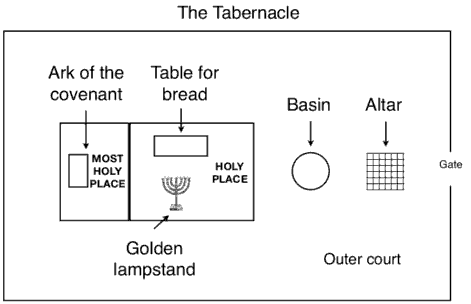
 Tabernacle - plan

God’s Tent

On the wall here is a sketch of the tabernacle together with the surrounding courtyard and equipment (it’s also on the back of your newsletters)

  • This is not to scale and it doesn’t convey anything of the beauty or fine art prescribed by God – but it does give us an overall picture

[Take my Russian dolls and set them out on a table]


I have here my Russian dolls to help us understand something of the layout of God’s tent

  • On other occasions I have used these Russian dolls as a metaphor for the different layers of our human self
  • Today though, I am not using these dolls to describe our personality, much less God’s personality
  • God is mystery and He can’t be reduced to a set of dolls
  • I’m simply using these Babushkas to help us understand the layout of God’s tent (His mobile home)

From verse 10 of chapter 25 God begins His instructions with a plan for making what we call the ‘Ark of the Covenant’ or the ‘Ark of the Testimony’

  • Interestingly God starts with the smallest doll
  • He begins with the core or the heart of His mobile home

At the very core of God’s tent – in the most holy place – we find His covenant with Israel

  • As we heard last week a covenant is more than just a contract
  • A covenant is a sacred agreement for attachment
  • At the very heart of God’s house is not a TV, but a reminder of His commitment to Israel’s well being
  • We might call this commitment – this covenant – loyal love

After giving the dimensions for this ark (or chest), God then says in verse 17 of Exodus 25…

  • “Make an atonement cover of pure gold…” to go over the top of the ark

Some versions of the Bible translate this verse ‘mercy seat’

  • Essentially the atonement cover or the mercy seat represents forgiveness
  • God provides a covering for Israel’s sin and that covering is forgiveness
  • Forgiveness is the second smallest doll in the tabernacle

God is so good – He does not require us to deny our imperfection

  • He provides for our imperfection and shows a willingness to re-enter the relationship with us when we fail

The most holy place is separated from the holy place by a veil or a curtain

In Luke 23, verse 45 we read that when Jesus died on the cross the curtain in the temple – the curtain into the most holy place – was torn in two

  • Jesus’ sacrifice on the cross reveals God’s forgiveness, His atonement for our sin

The next doll (or the holy place) is where we find the table with the bread of the presence and the lamp stand – bread & light

  • Perhaps bread is the strength to serve and light is the wisdom to see by
  • Strength and wisdom is found with God
  • What did Jesus say?
  • I am the light of the world. I am the bread of life

Moving out of the tent itself to the outer courtyard we find a basin for the priests to wash their hands and two altars

  • This diagram only shows one altar but Exodus describes two
  • One for burning incense, a symbol of the people’s prayers rising to heaven and the other for burning sacrifices

The main altar, for burning sacrifices, was basically like an incinerator

  • It wasn’t like a table with a top on it
  • It was open at the top with a grate part way down
  • This is where animals were offered to God

The message seems to be it is not a cheap or easy thing to come near to God

  • There is sacrifice and purity involved

The courtyard is fenced off with a curtain around the perimeter

  • There is only one entrance to the courtyard and that faces to the east – toward the sunrise
  • (What was it Jesus said? No one comes to the Father except by me. Jesus is the gate to God the Father.)
  • Verse 16 of Exodus 27 tells how there is to be a curtain made of fine linen embroidered with blue, purple and scarlet yarn, at the entrance to the courtyard

So the impression given to the people looking from the outside is one of beauty

  • The outer doll is attractive
  • Or to put it another way, God’s presence – His holiness – is beautiful
  • This stands in contrast to our society which generally tends to associate beauty with youth, novelty and permissiveness

In saying that the outer doll is attractive and beautiful and fascinating in its intricate design and detail I don’t mean that God is pimping His mobile home

  • God is not making His tent look flashy
  • If anything He is toning it down so as not to embarrass His neighbours
  • When you think about it the really precious stuff is hidden inside God’s tent where most people don’t get to see it

The metals used inside the tent are gold & silver – whereas the metal used outside is predominantly bronze

  • There may be practical reasons for this but I can’t help thinking of the poetry of it all – God is modest and often comes to us in ordinary ways
  • He doesn’t put the gold on the outside of His tent – He puts it on the inside
  • He doesn’t bring out the best wine first and then save the poorer quality wine for later – No, He saves the best till last
  • The longer we are in relationship with Him, the more we get to know Him and the deeper we go, the better it gets

When we put all that together, from the inside out we have…

  • Loyal (covenant) love at the very core of God’s tent, the smallest doll
  • Then forgiveness or mercy
  • Then light & bread or wisdom to see by and strength to serve
  • Then the outer court, a place of purity & sacrifice
  • And then the largest doll – the curtain at the entrance – humble beauty, the beauty of holiness

As I mentioned before, quite a bit of space is devoted to the Tabernacle in Exodus

  • We may wonder why there is so much detail
  • Well, later in Israel’s history Solomon would build a temple
  • In many ways the temple was modelled off the tabernacle, except the temple wasn’t portable like a tent
  • God moved into the temple but you get the sense He was uneasy with it
  • I think He preferred His mobile home

Some centuries after Solomon the temple in Jerusalem was destroyed and the survivors of Israel carried off to exile in Babylon

  • While in exile they didn’t have a temple
  • But they did have the elaborate description of the tabernacle which they could read about and picture in their mind’s eye
  • What a comfort it would have been to the exiles to be reminded that God is not fixed in one place – that God is able to move with them

Conclusion:

Ultimately though, the instructions for the tabernacle point to Christ

  • Jesus is the incarnation of God – He is Emmanuel – God with us
  • In the person of Jesus God didn’t just set up a tent among His people
  • God’s Word actually became a man and lived life as one of God’s people
  • Holiness rubbed shoulders with humanity

As we read at the beginning of John’s gospel…

  • The Word became flesh and made his dwelling among us. We have seen his glory, the glory of the One and Only, who came from the Father, full of grace and truth

Now God lives among His people by His Spirit

  • Today the Christian Church is the tabernacle of God
  • We, the Lord’s people, are God’s mobile home, made to mediate His presence in the world
  • This is a mystery too profound to explain – the best we can do is remain present to it (present to God’s presence, among us and through us)

Let us pray…

[1] Terence Frethiem, Exodus, page 277.

Covenant

Scripture: Exodus 24:1-11

Title: Covenant

Key Idea: A covenant is a sacred agreement for attachment


Structure:

  • Introduction
  • Communication
  • Commitment
  • Communion
  • Conclusion

Introduction:

[Display slide 1]


On the wall here we have three images…

  • Some rope, a paper clip and a mother & baby having a cuddle
  • One word connects them. Can anyone tell me that word? [Wait]
  • Yes, that’s right – attachment

[Stop displaying slide 1]

This morning we are talking about covenant

  • A covenant is a sacred agreement for attachment
  • A covenant connects people – it holds relationships together

Please turn with me to Exodus chapter 24, page 85 in your pew Bibles

  • Today we continue our series on Moses
  • Last week we heard about the Decalogue – God’s 10 words in Exodus 20
  • These words of instruction are His recipe for living well
  • This week, in Exodus 24, we are still at Mt Sinai where the covenant between God & Israel is formalised. From verse 1 we read…

Read Exodus 24:1-11


May we be aware of God’s presence with us now

Today’s reading describes how the covenant between God & Israel was formalised

  • More than just a regular contract a covenant is a sacred agreement for attachment
  • A covenant goes above and beyond a regular contract to bind relationships together
  • There are three aspects to a covenantal agreement, each of which support attachment. They are: Communication, commitment and communion

Communication:

Cell phones – it is difficult for many of us to remember how we ever got on without them

  • They are so convenient and helpful for keeping us in contact with each other. It’s the same with the internet
  • Cell phones & internet give us a feeling of attachment
  • It’s not real attachment – it’s only virtual – but we can still get a bit anxious if someone doesn’t reply to our text or email quickly enough

Of course to be able to use a cell phone or the internet you need a network provider – whether that’s 2 Degrees or Spark or Vodafone or whatever

  • There isn’t much loyalty with network providers these days – we tend to go with whoever happens to be offering the best deal at the time
  • You might be on a contract with some company but a contract is different from a covenant
  • With a covenant both parties to the agreement have a sense of loyalty to each other
  • So a covenant is more permanent – less fickle – than a contract

As I mentioned before one of the key aspects of a covenant is communication

  • Communication supports attachment by creating a shared understanding, which in turn enables an agreement to be reached

What we see in the Bible is that God initiates the communication

  • From chapter 19 of the book of Exodus God has been communicating the terms of His offer to Moses
  • Now in verses 3-8 of Exodus 24 Moses leads the people through a ritual of communication & commitment to formalise the covenant

The ritual of communication begins with Moses telling the people all the Lord’s commands & instructions and the people respond by giving a verbal agreement

  • Then Moses puts it in writing
  • So far it is looking very much like a regular commercial contract
  • Except the way you seal a covenant is different from the way you seal a contract
  • You seal a contract by signing it – with your signature
  • But you don’t sign a covenant – you cut a covenant
  • Sealing a covenant, therefore, involves the shedding of blood

Blood is an interesting thing to use for sealing the deal

  • Unlike ink, blood is potent – it represents life
  • If you have a wound or an infection in some part of your body, it is the flow of blood which heals it – without blood flow the wound won’t heal
  • Using blood to seal the agreement gives the covenant more weight, more significance, more meaning
  • This covenant between God & Israel is a sacred agreement for life and healing

To cut this covenant, Moses gets some fit young men to sacrifice some animals

  • He takes half the blood and sets it aside in bowls
  • Then he takes the other half of the blood and throws it against the altar
  • This is messy stuff – but essentially the blood on the altar represents God’s signature – His part in cutting the deal

Before getting the people’s signature though, Moses first reads the book of the covenant to the Israelites

  • This details the terms of the agreement – both God’s promises to them and their responsibilities to God and each other

Commitment:

When you attach a trailer to a car you don’t just tie it on with rope or stick it on with masking tape – that would never hold

  • You need something strong, firm and able to take the weight, like a tow bar bolted (or welded) to the frame of your car
  • The coupling at the pointy end of the trailer is attached to the tow ball with a clasp, a bolt to hold the clasp in place and a safety chain

The genius of the tow bar and trailer arrangement is the capacity for movement

  • The attachment to the tow ball allows some pivoting from side to side so you can turn corners and back the trailer
  • If the attachment was completely rigid, allowing no movement at all, something would break or you’d never make it around a bend

The second aspect of covenant is commitment

  • A covenant commitment is firm and strong like a tow bar
  • But it’s not completely rigid
  • There is some room for movement in the commitment

After hearing God’s offer and terms read aloud the people say…

  • “We will obey the Lord and do everything that he has commanded”
  • This shows us the people entered into the agreement knowingly & freely

Then Moses took the blood in the bowls and threw it on the people

  • He said, “This is the blood that seals the covenant which the Lord made with you when he gave you these commands”
  • In other words, ‘This is your signature which seals the deal’
  • Now the people are officially attached by their commitment to Yahweh as He is attached and committed to them

One of the key differences between a covenant and a contract is the strength of the commitment

  • The commitment inherent in a covenant is far greater than the commitment stipulated in a contract
  • The strength of a contract is like masking tape compared to the strength of a covenant, which is like a tow bar

A contractual commitment tends to be limited

  • It is usually for a fixed period of time (like a lease agreement)
  • Or until one of the parties decides they want out (like an employment agreement)
  • But a covenantal commitment is more open ended – it doesn’t have an expiry date
  • A covenant is till death do us part (like with marriage)

This is not to say there is no room for movement with a covenant

  • Like a trailer on a tow ball there is capacity to turn corners and make minor adjustments
  • The point is, a covenant is stronger and more fit for purpose when it comes to carrying anything of weight or substance

The sacrifices made in verse 5 aren’t just a way of obtaining blood to seal the deal – they are also an acted out parable or a visual symbol of the commitment required by the people

  • The message is: Being in a covenant relationship with God will cost you
  • Moses is up front about that cost and so is Jesus
  • ‘Pick up your cross and follow me’, is what Christ said

The Israelites did two things in particular to remember their commitment to God’s covenant

  • The first was male circumcision – cutting the foreskin and shedding the blood of sons at eight days old
  • This was like adding your signature to the covenant in a personal way
  • The second sign of the covenant, for Israel, was keeping the Sabbath
  • Dedicating one day in seven to the Lord by stopping to rest

We Christians also do two things to remember God’s new covenant with us through Christ

  • We commit initially (and personally) by being baptised in water
  • And we remember the covenant on-going by sharing communion together


Communion:

Perhaps my favourite image of attachment is that of tree roots in the ground

  • Not only do the roots keep the tree firmly in place through all sorts of weather, they also draw up water & nutrients from the soil to feed the tree
  • There is an organic closeness between the roots and the soil

The third aspect of covenant present in today’s reading from Exodus is communion

  • After the ritual of communication and commitment, Moses, Aaron, Nadab, Abihu and the 70 elders of Israel went up the mountain and communed with God

Verse 10 tells us they saw God and beneath His feet was what looked like a pavement of sapphire, as blue as the sky

This verse is shrouded in mystery

  • We don’t get a description of what God looks like, God is indescribable
  • The most we get is a description of God’s footpath

God does not say anything here – He just lets the men gaze in awe and wonder

  • They saw God and then they ate and drank together
  • It is unclear whether this means the men actually ate with God or whether they simply ate with each other after seeing God
  • Either way we know they enjoyed a unique communion with the Lord, for God did not harm these leading men of Israel

Communion – this is perhaps the most important difference between a covenant and a contract

  • The primary purpose of a contract is to protect the parties from each other
  • By contrast the purpose of a covenant is not to protect but to share
  • With a contract the different parties to the agreement are trying to maintain their separateness – this is mine, this is yours
  • But with a covenant the parties are aiming for oneness – what’s mine is yours – like tree roots in the soil
  • Marriage is a covenant in which the two become one

God’s covenant with Israel at Sinai is similar to marriage in that both God and Israel are agreeing to work together (as one) for the same purpose, with each other’s well-being in mind

Conclusion:

This morning we’ve heard how a covenant is a sacred agreement for attachment

  • A covenant holds relationships together with communication, commitment and communion
  • It combines strength with movement – like a tow bar
  • And it allows closeness and sharing – like tree roots in soil

Not every agreement we enter into needs to be a covenant

  • In fact, because covenants are so demanding, we human beings can only handle 1 or 2 at a time
  • Those two being marriage and our relationship with God through Christ

Jesus came to establish a new covenant between God and humanity

  • It is a covenant in which God’s words are written on our heart so that we internalise them and obey God from the inside out
  • It is a covenant in which Jesus is sacrificed on the cross so that His blood seals the deal
  • And it is a covenant which makes communion or closeness with God and each other possible, so that we may share in God’s life

In a few minutes we will remember the new covenant made possible through Christ as we share together in the living ritual of communion

  • To help us prepare let’s stand and sing, ‘Only by grace can we enter…’
  • I ask the communion stewards to come forward at the end of the song

https://www.biblegateway.com/passage/?search=Exodus+24%3A1-11&version=GNT