Not Want

Scripture: Psalm 23:1b

Key Idea: I shall not want

Structure:

  • Introduction
  • I shall not want
  • Conclusion

Introduction:

This morning we continue our series on Psalm 23

  • The plan (God willing) is to look at one aspect of the psalm each week
  • Over the past two weeks we have looked at the opening phrase…
  • The Lord is my shepherd
  • Today we focus on the second part of verse 1: I shall not want
  • To give us some context though I will read the whole Psalm…


The Lord is my shepherd, I shall not want.

He makes me lie down in green pastures,

He leads me beside still waters, He restores my soul.

He guides me in paths of righteousness for his name’s sake.

Even though I walk through the valley of the shadow of death,

I will fear no evil, for you are with me;

your rod and your staff they comfort me.

You prepare a table before me in the presence of my enemies.

You anoint my head with oil; my cup overflows.

Surely goodness and love will follow me all the days of my life

And I will dwell in the house of the Lord forever.


May the Lord illuminate His word for us


Over the past couple of weeks we’ve heard that: the Lord is my shepherd means, the Lord is my personal security

  • God looks after me like a shepherd looks after his sheep
  • When we truly believe the Lord is my shepherd then we can truly say…
  • I shall not want


I shall not want:

There are some things in life that we take for granted to be true

  • The technical name for these things is: a priori assumptions
  • Something we assume to be true without need of further proof


Some common examples of a priori assumptions include…

  • The sun always rises in the East
  • What goes up must come down
  • We need money to be happy
  • You can’t lose by investing in property
  • If I say what people want to hear I will be accepted
  • It is always windy in Wellington
  • My wife is always right
  • There is no greater honour than to play for the All Blacks
  • Eating this piece of chocolate will make me feel better
  • Working longer and harder will bring me rest
  • Owning the latest technology will make my life easier
  • My parents don’t know anything
  • Or, my children have nothing to teach me, and so on

The problem with a priori assumptions is they are not tested

  • The underlying assumptions upon which we base our life are not necessarily true just because we take it for granted they are


I was at the cricket with Bruce last Monday watching the Australians beat NZ

  • And from where we were sitting in the Vance Stand we could see Government House – where the Governor General is based
  • Bruce was telling me how the architects (back in England) designed Government House the wrong way around – to be south facing instead of north facing
  • In the Northern hemisphere the a priori assumption is that houses should be designed to face south to optimise the sunshine
  • Of course, in the Southern hemisphere everything is upside down
  • The Northern hemisphere a priori assumption doesn’t work down under
  • In NZ a house needs to be north facing to optimise the sunshine


The point I’m trying to make here is that we all hold a priori assumptions

  • Some of our assumptions are reliable – they hold true all of the time – like, ‘the sun always rises in the east’
  • While other assumptions are only true some of the time – like, ‘my wife is always right’
  • And then there are those assumptions which are completely false, even though we take it for granted they are true – like, ‘working longer and harder will bring me rest’

When I was younger I studied economics (among other things) and learned that one of the a priori assumptions on which our society is based is scarcity

  • The underlying assumption is: resources are limited – there isn’t enough to go around and so (at some point) I shall want, (I shall go without)


Any way this underlying belief in scarcity is responsible for demand & supply and the regulation of prices

  • The greater the demand for something, the more you will pay for it
  • And, conversely, the greater the supply, the less its (perceived) value


My observation (and my experience) is that an underlying assumption of scarcity creates quite a bit of anxiety and insecurity

  • We can never be sure that we will have enough or that what we have to offer will be worth much
  • ‘Resources are limited, therefore (at some point) I shall want’


This assumption of scarcity and the fear that it generates can drive us to compete with our neighbour for resources, rather than cooperate or share resources


So, is the assumption of scarcity true or is our economy and our society based on a lie?


Well, let me answer that by saying: David, the author of Psalm 23, had a different a priori assumption

  • David’s underlying belief was…


The Lord is my shepherd [therefore] I shall not want

  • David’s a priori assumption was abundance, not scarcity
  • Whether David would have enough wasn’t determined by the available resources
  • Nor did it depend on David’s ability to get his hands on those resources
  • Having enough – getting what he wanted – was determined by the Lord God, his shepherd


Now at this point I need to clarify, The Lord is my shepherd, I shall not want, does not mean that God is like Santa Claus fulfilling our every wish & whim

  • And David is not like Veruca Salt (of Charlie & Chocolate Factory),
  • He is not a spoiled child producing a never ending list of demands


As Kenneth Bailey observes…

  • Our entire economic system is built on creating and then satisfying as many perceived wants as possible. Television advertising is deliberately fashioned to catch the viewer’s attention and create a sense of ‘I must have this medication or that electronic gadget’ in order to be healthy, entertained, happy and successful… [1]


No – David’s list of wants is fairly basic

  • He is not greedy or over the top
  • His list of wants is moderate and life-giving
  • David is not asking for an ever-rising mountain of material possessions
  • There is no hint of any desire for power or control
  • Nor is David expecting to be constantly entertained [2]


The rest of Psalm 23 goes on to expound David’s wants and how the Lord provides for these…

  • The Lord provides food, water & rest
  • The Lord provides rescue when I’m lost
  • And guidance when I’m not sure where to go
  • The Lord provides His presence & protection in difficult situations
  • The Lord is my friend, when no one else is, He surrounds me with goodness and love when I’m surrounded by enemies
  • Not only that but the Lord gives me a home (a place to belong) in this world and the next
  • David’s list of wants could be summed up in one word: security


When we truly believe in our heart of hearts that the Lord is our shepherd – then our list of wants starts to look like David’s, a picture of simplicity

  • When I know the Lord is my security I realise I don’t actually need or want all that stuff they are trying to sell me on TV
  • God is satisfaction enough – He is my delight, my joy


There is a lightness and a buoyancy to Psalm 23 – David is worry free

  • More than just an assumption, his experience is that God knows what is good for him and is faithful to provide the right thing at the right time


On the wall here is a picture of the late John Stott

  • John Stott lived from 1921 to 2011
  • He was an Anglican minister at All Souls Church in London and from what I’ve heard he was an outstanding preacher – very clear
  • He was also a world-wide leader of the evangelical movement


John Stott was single and celibate all his life

  • He lived simply – in a one bedroom apartment above someone’s garage and his favourite relaxation was bird watching
  • He was also a prolific author publishing over 50 books
  • The proceeds of John’s books went to training preachers in the developing world – so he could have been rich but he gave most of it away, strategically
  • He was convinced by the gospel


John Stott is credited with saying (and I paraphrase a little here)…

  • There are two things most Christians disagree with Jesus on
  • Two things we are determined to prove the Lord wrong about


Firstly, in Matthew 6, verse 24 – Jesus says…


No one can be a slave of two masters; he will hate one and love the other; he will be loyal to one and despise the other. You cannot serve both God and money.


For most people the a priori assumption is that

  • We can serve two masters
  • We can have our cake and eat it too
  • We can love both God and money


Now we might not actually think that consciously but it’s often how we behave

  • That’s the thing about a priori assumptions
  • We aren’t always aware of them – they are in our shadow, where we can’t see them


The reason we might try to serve both God and money is we are afraid that God won’t (or can’t) take care of us – we have bought into the lie of scarcity

When our a priori assumption is ‘The Lord is my shepherd, I shall not want’, we are not worried about the future – we are able to take one day at a time without getting too far ahead of ourselves

  • An underlying assumption of I shall want (scarcity) creates anxiety
  • But an underlying assumption of I shall not want (abundance) creates security


So that’s the first thing we fight Jesus on: ‘You can’t serve God and money’

  • The second is: ‘Apart from me you can do nothing’


In John 15 Jesus said…

  • I am the vine and you are the branches. Whoever remains in me and I in him, will bear much fruit; for you can do nothing apart from me


Just as we are convinced that we can serve God and money

  • Many of us are also convinced that we can be fruitful apart from Christ – without abiding in Him


It is possible to call ourselves a Christian, to be involved in church activities, to read our Bible daily and not really let Jesus in


John Stott was born in London

  • His father was a doctor and an agnostic
  • An agnostic doesn’t really believe in God but also doesn’t rule out the possibility either
  • Stott’s mother was a Lutheran, but she attended the local Anglican church
  • Stott was sent off to boarding school, first to Oakley Hall and then later to Rugby School
  • ‘Rugby’ was the name of the school (like Tawa College) – it wasn’t a school entirely devoted to learning how to play rugby


While at Rugby School in 1938, Stott heard Eric Nash deliver a sermon called “What Then Shall I Do with Jesus, Who Is Called the Christ?”

  • After this talk, Nash pointed Stott to Revelation 3:20,
  • “Behold, I stand at the door, and knock: if any man hear my voice, and open the door, I will come in to him, & will sup with him, & he with me.”


Stott later described the impact this verse had on him as follows:


“Here, then, is the crucial question which we have been leading up to. Have we ever opened our door to Christ? Have we ever invited him in? This was exactly the question which I needed to have put to me. For, intellectually speaking, I had believed in Jesus all my life, on the other side of the door. I had regularly struggled to say my prayers through the key-hole. I had even pushed pennies under the door in a vain attempt to pacify him. I had been baptized, yes and confirmed as well. I went to church, read my Bible, had high ideals, and tried to be good and do good. But all the time, often without realising it, I was holding Christ at arm’s length, and keeping him outside. I knew that to open the door might have momentous consequences. I am profoundly grateful to him for enabling me to open the door. Looking back now over more than fifty years, I realise that that simple step has changed the entire direction, course and quality of my life. [3]


Stott was mentored by Nash, who wrote a weekly letter to him, advising him on how to develop and grow in his Christian life.


If we try to be a Christian without abiding in Christ

  • If we try to make things happen for Jesus without letting him in – keeping him at arms – then we will be found wanting
  • But if we remain in Christ then we shall not want – we will bear much fruit


Conclusion:

When the Lord is my shepherd, my underlying assumption is: I shall not want

  • I shall not want means I am content to live simply
  • It means I am not anxious for the future because I know God will provide
  • When we abide in Christ – when we let him in – then we are not found wanting, then we become fruitful


Let’s finish now with the words of Jesus – from Matthew 6…


25 ‘Therefore I tell you, do not worry about your life, what you will eat or drink; or about your body, what you will wear. Is not life more than food, and the body more than clothes?

26 Look at the birds of the air; they do not sow or reap or store away in barns, and yet your heavenly Father feeds them. Are you not much more valuable than they? 27 Can any one of you by worrying add a single hour to your life?


28 ‘And why do you worry about clothes? See how the flowers of the field grow. They do not labour or spin. 29 Yet I tell you that not even Solomon in all his splendour was dressed like one of these. 30 If that is how God clothes the grass of the field, which is here today and tomorrow is thrown into the fire, will he not much more clothe you – you of little faith?


31 So do not worry, saying, “What shall we eat?” or “What shall we drink?” or “What shall we wear?” 32 For the pagans run after all these things, and your heavenly Father knows that you need them. 33 But seek first his kingdom and his righteousness, and all these things will be given to you as well.


34 Therefore do not worry about tomorrow, for tomorrow will worry about itself. Each day has enough trouble of its own.


May the Word of Christ be welcome in our hearts

[1] Kenneth Bailey, ‘The Good Shepherd’, pages 38-39.

[2] Kenneth Bailey, ‘The Good Shepherd’, page 39.
[3] https://en.wikipedia.org/wiki/John_Stott

My Shepherd

Scripture: Psalm 23:1a

Key Idea: The Lord is my shepherd

Structure:

  • Introduction
  • The Lord is my shepherd
  • Conclusion

Introduction:

In a moment we are going to read a psalm together

  • A psalm is basically a song or a poem
  • The words of the psalm will appear on the wall
  • I invite the men to read the words in plain type and the women to respond by reading the words in italics
  • From Psalm 23 we read…


The Lord is my shepherd,

I shall not want.

He makes me lie down in green pastures,

He leads me beside still waters,

He restores my soul. He guides me in paths of righteousness

for his name’s sake.

Even though I walk through the valley of the shadow of death,

I will fear no evil,

for you are with me;

your rod and your staff they comfort me.

You prepare a table before me in the presence of my enemies.

You anoint my head with oil; my cup overflows.

Surely goodness and love will follow me all the days of my life

And I will dwell in the house of the Lord forever.


May the Lord illuminate His word for us


Today we continue our new sermon series on Psalm 23

  • The plan (God willing) is to look at one aspect of the psalm each week
  • Last week we began with the opening phrase of the psalm – perhaps the most well-known verse in the Bible: The Lord is my shepherd,
  • And so you might expect this week’s message to focus on the second part of that verse, I shall not want
  • But that will have to wait till next week because we still haven’t finished with the Lord is my shepherd


The Lord is my shepherd:

Last Sunday we considered the meaning of the word ‘shepherd’

  • What did King David (the author of the psalm) mean when he called the Lord God his shepherd?
  • Well, very briefly, he meant the Lord is my security
  • God looks after me like a shepherd looks after his sheep


This week the focus is on the Lord as my shepherd – with the emphasis on my


Don’t you find it interesting that thousands of people in the world suffer every day, in a whole variety of ways, and yet for the most part that suffering doesn’t really touch us or affects us?

  • It’s only when we know someone personally, when we have an attachment to them, that their suffering moves us


We can watch children starving on the TV news and feel sad and maybe even send some money to help them

  • But if we knew those kids personally – if they were our own children – then we wouldn’t just send money
  • We would get on a plane with some Weetbix, find them, feed them and bring them home with us
  • That’s the difference a personal connection makes
  • Personal relationship has a powerful influence on our soul


It is quite striking really that David says, The Lord is my shepherd – singular

  • We would expect David to say, The Lord is our shepherd – plural
  • After all, sheep normally get taken care of as part of a flock, together with other sheep – it doesn’t make sense (economically) to have one shepherd for each individual sheep
  • Not only that but in Middle Eastern culture, where this psalm was written, people are far more community minded – they are more inclined to think in terms of we as opposed to me
  • Generally speaking in the west today we are the opposite – the focus for us tends to be more on the individual


It’s not that one way is right and the other is wrong, we need to value the importance of both the community and the individual at the same time

  • There might not be an ‘i’ in ‘team’ but there is an ‘i’ in ‘community’


Anyway, David, who was brought up in a culture where the sense of community was so strong that the importance of the individual could be neglected, [1] he says, The Lord is my shepherd

  • In other words, I have a personal relationship with the Lord
  • I know, from my own personal experience, that God can be trusted to take care of me
  • This was something David knew to be true, not just because he read it in a book or inherited the idea from his parents or the society he grew up in, but because he lived it and owned it for myself


So when Goliath challenged the army of Israel, David’s default setting was, “I’m not afraid of this Philistine. The Lord is my security”

  • And when Saul was trying to kill David, David did not get scared and take matters into his own hands – David trusted the Lord with his future
  • And when the Ark of the Covenant was brought into Jerusalem, David didn’t worry about what people thought of him
  • He danced before the Lord in worship because his security was in the Lord, not in public opinion
  • David wasn’t perfect as we know, but he did trust in the Lord


Sometimes in science fiction movies the characters learn new skills, new languages, new ideas simply by having the information downloaded into their mind with a computer

  • So in the film The Matrix, Neo learned Kung Fu in a matter of minutes by being plugged into a computer and having software fed into his brain
  • But in the real world, that we live in, learning is a process which takes time – often years
  • David learned to put his security in the Lord the hard way – through real life experiences – not just through a download of information
  • It’s the same for us – simply listening to a sermon isn’t enough to make God your personal security


Bloom's Learning Taxonomy


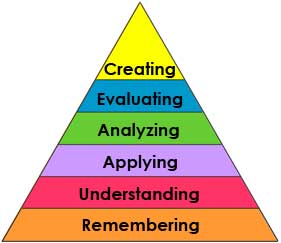
In the 1950’s an educational psychologist by the name of Benjamin Bloom did some research and found there are different categories of learning – some learning happens at a deeper level than others

  • For example: memorising something so you can remember it and repeat it by rote is a superficial form of learning
  • Understanding what you remember and being able to apply it, is a deeper level of learning again


A person might remember that the 23rd Psalm starts with the words, The Lord is my shepherd, and still not understand what those words mean

  • If you listen carefully to the sermon you might gain some understanding and learn that The Lord is my shepherd means The Lord is my security
  • If you are really keen you might go home and analyse the psalm yourself and discover other nuggets of meaning
  • The ultimate form of learning though is doing something creative with the psalm
  • Perhaps finding a new and inventive way of teaching the psalm to a group of Flock Sunday school kids
  • Or becoming less anxious in life as you place more trust in the Lord


Benjamin Bloom’s classification of learning has undergone a number revisions and adaptions over the past 60 years

  • Here’s another way of looking at it…
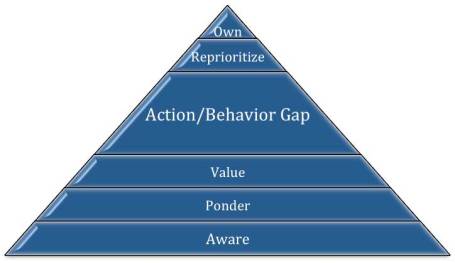
  •  Learning Pyramid

[2]


This version shows the different stages of learning to integrate a new idea or a new belief into your life


The first stage is simply becoming aware of the new idea

  • ‘Hmm, the Lord is my security, that’s interesting. I hadn’t thought of Psalm 23 in that way before’


The second stage is pondering the idea, finding out more about it, getting to grips with it in your head

  • This might involve going home after the service and meditating on the psalm in light of that word security
  • You might get your Bible out and look for the word shepherd in the index and consider other passages where the shepherding metaphor is used
  • Or you might do some other form of research into security and risk


The third stage is valuing the idea – agreeing with it, perhaps even telling others it’s a good idea.

  • Stage 3 normally begins with great enthusiasm for the new concept
  • ‘Wow, the Lord is my security, that’s so cool. That means I don’t have to worry because God has got my back. I feel really good knowing that.’
  • What we notice here is there is often a gap between agreeing this is a good idea and acting on it
  • There’s a gap between talking about it and doing it


Although stage 3 (the valuing stage) often starts with great enthusiasm, it normally ends with a deep sense of conviction – a feeling of guilt & remorse

  • Eventually this new idea that we are so excited about bumps up against reality – it is tested
  • ‘The Lord is my security’ is easy to say when things are going well
  • But when we experience some kind of loss, that’s when we really discover whether the Lord is my security or not
  • I might think the Lord is my security but then I might lose my job and start to worry about how I will pay the mortgage
  • I might also lose my confidence and not try applying for other jobs
  • At that point I realise, ‘actually my job was giving me a greater sense of security than the Lord was’
  • Not a nice feeling to be humbled like that but it’s the beginning of stage 4


Now, losing a job is just a random example

  • We could use other examples too – like losing health, or losing a loved one, or leaving home, or a marriage break-up, or anything else that might challenge our sense of security


The fourth stage is when we start to apply the idea

  • We reprioritise our life so the new idea actually becomes integrated with a new lifestyle and new behaviour


In the case of losing my job, reprioritising so the Lord is my security, and not my work, could mean…

  • Not allowing fear to rush me into things, but pausing long enough to commit my way to God in prayer
  • Reprioritising could also mean reviewing my expenditure and setting a new budget
  • Or not measuring my worth by how many job interviews I get
  • Reminding myself that I am valued by God and was loved by Him before I was born – that is, before I had achieved anything

The final stage (at the top of the pyramid there) is when we own the new idea or belief

  • Owning it means it is properly integrated into my daily life
  • So all my decisions & actions are based on this new idea – this new belief
  • The hard work of re-prioritising is over and I have a new default setting.
  • When I own the belief that the Lord is my security, I’m not concerned about being fully employed or unemployed
  • I’m not worried whether other people think I’m a success or a failure
  • I am content with little and with much


Why am I telling you all this – you may be wondering

  • Well, we can’t hide behind someone else’s faith – whether that’s the faith of our parents or our spouse or the faith of one of the pastors or whoever
  • We can’t assume that simply coming to church and listening to sermons will make the Lord my security
  • If we are going to follow Jesus (the good shepherd) then each of us must integrate the practice of trusting Christ into our lives
  • Each of us must be able to say honestly: ‘The Lord is my personal security’


This process of learning to own something isn’t just a modern idea

  • The process may have been articulated in the 1950’s but it’s been around a lot longer
  • We see it in the gospels over and over again
  • People don’t normally get what Jesus is saying straight away
  • It takes time for God’s word to sink in
  • And even more time for it to bear fruit in our lives


Take Nicodemus for example [3]

  • Nic, as he was known to his friends, was an important man
  • He was a member of the Sanhedrin – sort of like a Member of Parliament
  • He was one of the leaders of the people
  • He was also a Pharisee – a learned and morally upright man
  • Highly respected and not inclined to suffer fools gladly
  • Nic was in a very secure position in his society – or so he thought


One day Nic became aware of a young Rabbi in his 30’s teaching the people with real wisdom and performing all sorts of miraculous deeds – healing the sick, casting out demons and making people freer in themselves


Nic ponders this & eventually concludes that this Jesus fellow must be from God – how else could he perform all those miraculous signs?

  • The idea that Jesus is sent from God is thrilling to Nic – he gets a bit excited by it and in his enthusiasm goes to meet Jesus
  • The problem is Nic’s Pharisee mates don’t like Jesus much and so Nic decides the most prudent thing is to visit Jesus by night – in private
  • That way no one will find out about it – after all he does have his reputation to think about
  • At this point Nic is at stage 3 of the learning process – he values the idea (in his head) but isn’t ready to change his life for it


Nic opens the conversation with Jesus by sharing his belief that Jesus must be from God

  • Jesus then challenges Nic to act on this new belief saying…
  • No one can see the kingdom of God without being born again
  • This confuses Nic
  • He had been born and raised a Jew, one of God’s chosen people,
  • Wasn’t he automatically accepted into God’s kingdom because he was a descendant of Abraham?
  • What does Jesus mean by being ‘born again’?


Jesus goes on to say, “For God so loved the world that he gave his only Son, so that everyone who believes in him may not perish but have eternal life.”

  • In other words, ‘Nic, your security is misplaced. You think being a Jew and being a Pharisee makes you secure (safe), but it doesn’t
  • You can’t rely on the faith of Abraham to save you
  • And you can’t rely on your good deeds to save you either
  • You must have your own personal faith in the Son of God to be saved.’


Nic had come to Jesus like a triumphant school boy, certain he had solved a difficult problem and Jesus just seemed to be giving him more homework

  • Apparently there was a gap between what Nic said he believed about Jesus and what he was prepared to do about it


As time passed the hostility toward Jesus increased

  • Most of Nic’s Pharisee mates didn’t think Jesus was from God, like Nic did – they saw Jesus as a threat & wanted to arrest him
  • But Nic tried to stand up for Jesus saying…
  • “Our law does not judge people without first giving them a hearing to find out what they are doing”
  • The other Pharisees shouted him down though


Nic wasn’t ready yet to re-prioritise his life around his new found belief that Jesus was from God

  • He wasn’t prepared to completely abandon his career as a Pharisee
  • But it was a first tentative step in that direction
  • Nic was attempting to bridge the gap from stage 3 (valuing) to stage 4 (re-prioritising)


Eventually the Jewish leaders had their way with Jesus

  • They manipulated the Roman governor and the crowd to have Jesus crucified
  • Nic didn’t go along with it – but there was nothing he could do to stop it
  • I imagine he felt a deep sense of conviction at this point
  • I imagine he felt guilty and ashamed at what his mates had done


Jesus was dead and so Nic went with Joseph of Arimathea to claim Jesus’ body for burial

  • Finally Nic ‘came out’ and identified himself with the crucified Jesus
  • This was a huge risk – to show support for Christ in his death
  • Not even Jesus’ closest friends were prepared to do that
  • Nicodemus finally owned his belief that Jesus was from God
  • He made Christ his security


Conclusion:

Today is the first Sunday in Lent

  • Lent is the 40 days (or so) leading up to Easter
  • It is a time when we re-prioritise our life in order to follow Jesus more closely
  • Lent is about bridging the gap between stage 3 (talking about it) and stage 4 (actually doing it).


What idea or belief do you personally need to integrate into your life?

  • What is it you need to re-prioritise in order to follow Jesus more closely?


Let us pray…

[1] Kenneth Bailey, The Good Shepherd, page 38.

[2] Peter Scazzero uses this adaption of Bloom’s taxonomy in his book ‘The Emotionally Healthy Leader’ page 44

[3] Refer to John 3:1-21; John 7:50-52 & John 19:38-42

Security

Scripture: Psalm 23:1


Title: Security


Structure:

  • Introduction
  • The Lord is my security
  • Conclusion


Introduction:

Today we begin a new sermon series on Psalm 23

  • Some of the inspiration for this series comes from Kenneth Bailey’s book The Good Shepherd
  • The plan (God willing) is to focus on just one verse or one aspect of the Psalm each week
  • Today’s focus is the first part of verse 1: The Lord is my shepherd,
  • But, to get us into gear, let’s read the whole Psalm together, antiphonally
  • Which means I will read the words in plain type and you are invited to respond by reading the words in bold italics
  • From Psalm 23 we read…


The Lord is my shepherd,

I shall not want.

He makes me lie down in green pastures,

He leads me beside still waters,

He restores my soul. He guides me in paths of righteousness

for his name’s sake.

Even though I walk through the valley of the shadow of death,

I will fear no evil,

for you are with me;

your rod and your staff they comfort me.

You prepare a table before me in the presence of my enemies.

You anoint my head with oil; my cup overflows.

Surely goodness and love will follow me all the days of my life

And I will dwell in the house of the Lord forever.


May the Lord illuminate His word for us


The Lord is my security:

NZ has changed a lot in the last 40 years or so

  • It seems to me we have become a more anxious society


When I was a kid growing up in the 70’s it was nothing to disappear for the day with my mates and not turn up again until dinner time

  • My parents didn’t worry about me or need me to text them – cell-phones weren’t invented
  • Some of the stuff we got up to was semi-dangerous I suppose by today’s standards but consequence is a great teacher
  • When I was five I walked to school 2 or 3 kilometres by myself – no worries
  • On holiday my cousins and I would walk to the beach by ourselves to go swimming & fishing – no sun block, little (if any) adult supervision
  • It wasn’t that our parents didn’t care – they did care very much – it’s just that people felt more secure, safer somehow
  • We didn’t feel the need to lock our houses or our cars during the day
  • And we didn’t have ads on TV every 10 minutes warning us to avoid some kind of danger


Don’t get me wrong – NZ is still a great place to live – it’s probably safer in many respects than most other parts of the world

  • It just seems that despite our advances in technology people are more anxious and less secure on the whole
  • These days there seems to be a lot more fear around
  • People are generally less trusting and less inclined to take risks
  • In fact we have a lower tolerance for risk

We try to eliminate risk in a whole variety of ways

  • Security cameras
  • Security lights
  • Security guards
  • Security alarms
  • Security clearance
  • Cyber security, anti-virus software & fire walls
  • Police checks
  • Warrant of Fitness checks and code of compliance certificates
  • Occupational safety & health procedures
  • Hazard management plans
  • Road safety messages
  • Insurance and so on


These things aren’t bad in themselves, they are quite sensible really – but I’m not convinced they make us any more secure – not deep down where it matters


Psychologically speaking security is a fundamental human need

  • We need to feel safe and secure in order to be able to function properly
  • Interestingly the Bible has quite a bit to say about security


As Kenneth Bailey notes, the predominant image of God found in the psalms is one of security.

  • Many psalms describe God using words like: shield, high tower, fortress, refuge, rock, stronghold or horn of salvation.
  • Psalm 18 includes many of these images…


I love you, O Lord, my strength. The Lord is my rock and my fortress and my deliverer, my God, my rock, in whom I take refuge, my shield and the horn of my salvation, my stronghold. I call upon the Lord, who is worthy to be praised and I am saved from my enemies...   [1]


These images are understandable in an ancient Middle Eastern context where living out in the open made one very vulnerable.

  • People naturally felt a compelling need to reside in a well-fortified enclosure on the top of a hill to provide some security against Bedouin raiders or an invading army.
  • Yet overuse of such ‘homeland security’ language could produce paranoia and a siege mentality. [2]
  • And so the psalter offers other (less common) images of God which inspire security without the paranoia
  • One of those images is God as a Shepherd


Yes, the security God gives can be likened to something hard and unyielding like a high tower or a fortress or a rock or a shield

  • But God (and the security He offers) can also be understood in more personal, relational terms, like a shepherd


As New Zealanders we probably think we know all about sheep but actually the way we care for sheep is quite different from the way shepherds operate in the Middle East

  • In NZ our sheep are relatively safe
  • They are fenced in on farms and don’t normally face that many threats
  • But in Palestine sheep are far more vulnerable
  • They are literally led out into the wilderness to find pasture
  • In those trackless, fenceless open spaces the shepherd and his sheep are alone and at risk of bandits, wild animals, snakes and extreme weather
  • The shepherd and the sheep are without police protection [3]
  • It is a more dangerous environment than a NZ farm


The various kings of Israel throughout the Old Testament were referred to as the ‘shepherds’ of Israel

  • Why?
  • Because it was the king’s job to take care of the people – like a shepherd takes care of sheep
  • As head of the army the king was head of security for the country


Psalm 23 is attributed to King David

  • Before becoming the shepherd (or the king) of all Israel
  • That is, before becoming the guy in charge of security for his country, David was a shepherd of actual sheep
  • So he had a very grass roots insight into shepherding


When David writes, “The Lord is my shepherd…

  • What he means is, The Lord God is my King
  • Yahweh is my security
  • The Lord isn’t just my security when I’m behind the well-fortified walls of Jerusalem
  • He is my security in those situations where I must leave the safety of the fortified city and journey through the wilderness, unprotected


In other words, as my shepherd the Lord gives me the sense of security or the confidence to step out of my comfort zone and to go into new and unfamiliar environments – wilderness places where I am not in control


The Lord is my security when I step out into the unknown

  • The Lord is my security when my employment is uncertain
  • The Lord is my security when my health is uncertain
  • The Lord is my security when I start a new school and I don’t know anyone
  • The Lord is my security when I leave home for the first time
  • The Lord is my security when I have to leave my homeland to settle in a new country and the language is different and the customs and different
  • The Lord is my security when I become a parent and there is no manual
  • The Lord is my security when I leave a comfortable lifestyle to follow God’s call on my life


Let me tell you a story – about a guy named Pete [4]

  • Pete was a fisherman
  • He wasn’t the sharpest tool in the shed but he was honest
  • You always knew where you stood with him
  • Pete didn’t have a filter – he had an unfortunate tendency to speak before thinking and it got him into trouble on occasion


One time he was out in a boat with his mates, at night, and it was getting pretty rough

  • As a fisherman Pete was used to a bit of chop but this was different – this was scary, even for him
  • This was a wilderness experience – a situation in which they had no control over the environment


As they were fighting against the wind and the waves, people in the boat began to notice this figure, walking across the water

  • Seeing someone walking on water was something completely outside their experience and so they didn’t know how to interpret it
  • I’m not sure about you but when I’m faced with something new and unfamiliar I tend to think the worst – Pete & his mates were no different
  • They jumped to the conclusion that they were seeing a ghost
  • Not Casper the friendly ghost but something more sinister
  • Some kind of omen of death
  • They were hysterical


The figure on the water was actually Jesus

  • Pete and his mates followed Jesus wherever he went
  • Jesus taught them how to be human – that is, how to trust God
  • In an attempt to calm them down Jesus said…
  • “Courage. It is I. Do not be afraid”


At which point Pete spoke without thinking…

  • “Lord, if it is really you, order me to come out on the water to you.”


Really?

  • He had to say that?
  • Couldn’t he have said something less risky like…
  • ‘Lord, if it’s really you, tell me what’s the first thing you ever said to me’.
  • Or something else no one but the real Jesus would know
  • Instead he had to risk his life by saying, ‘order me to come out on the water’


Perhaps I’m being a bit tough on Pete

  • Perhaps his first instinct was good
  • Perhaps this shows he was willing to think the best in this situation


In any case, Jesus liked where Pete’s head was at and said…

  • ‘Sweet – do it – come to me’


At this point Pete had a choice – either he could step out of the safety of the boat or he could stay put


In his book, ‘Take the Risk’, Dr Ben Carson (a gifted surgeon) assesses the risk in any given situation using four simple questions: [5]


  • What is the best thing that can happen if I do this?
  • What is the worst thing that can happen if I do this?
  • What is the best thing that can happen if I don’t do it?
  • What is the worst thing that can happen if I don’t do it?


(In many ways this is similar logic to Pascal’s wager)


The best thing that could happen, if Pete stepped out of the boat to walk on the water, is that he wouldn’t sink – he would know it was Jesus and everything would be alright again


The worst thing that could happen, if Pete stepped out of the boat, is that he could drown and his mates in the boat could drown as well


The best thing that could happen, if he stayed in the boat, is that he would survive but have to live with the shame of making an offer he couldn’t follow through on


The worst thing that could happen, if he stayed in the boat, is that he and all his mates would still drown anyway


Clearly, by this best / worst analysis, not taking the risk and staying in the boat was a worse option than taking the risk and leaving the boat


I don’t know if Pete thought it through like this or not but in the end he made a good choice – a courageous choice

  • On some level Pete had the imagination to believe that Jesus could do this
  • He had the faith to hope for the best and so he stepped out of the boat


At first things went well – Pete actually did walk on water

  • But when he took his eyes off Jesus and paid more attention to the strong wind he lost his confidence – he became afraid and began to sink
  • Interesting thing, even though he was sinking Pete still hoped for the best
  • He still believed this figure standing on the waves was Jesus and he said,
  • ‘Save me Lord”
  • So Jesus reached out to grab hold of Peter


Now the thing about Jesus is that grace & truth go together

  • You can’t have one without the other
  • The grace of saving Peter came with words of truth
  • “How little faith you have. Why did you doubt?”


This seems like an unkind thing for Jesus to say

  • I mean, it was a big deal for Peter to get out of the boat
  • He put his life on the line, not just to satisfy his own curiosity but for the sake of his mates as well
  • If Peter didn’t have much faith then the other disciples had even less – no one else was prepared to take the risk
  • I imagine Jesus’ words would have stung a bit – not just Peter but everyone else in the boat too, because they had all doubted


Jesus wasn’t being unkind though – he was simply being real, being honest

  • The truth is their faith (plural) was small
  • No point in pretending otherwise
  • Another word for lack of faith is insecurity
  • The wound of their insecurity had to be cleansed with the antiseptic of truth


Conclusion:

To say ‘the Lord is my shepherd’ and really mean it is to say that our security is in Christ – that we trust him in every situation – including those times & places when we are not in control of the environment


Please understand me – stepping out of the boat, leaving your comfort zone is not always appropriate

  • There are times when we need a fortress, a safe place, a refuge
  • But there are other times when we are better off to take the risk
  • Learning to trust Jesus as our shepherd (our security) takes time – it’s a process
  • Fortunately for us the Lord is patient

[1] Psalm 18:1-3

[2] Kenneth Bailey, “The Good Shepherd”, page 36.

[3] Kenneth Bailey, ‘The Good Shepherd’, page 37

[4] Refer Matthew 14:22-31

[5] Ben Carson, Take the Risk, page 105.

Light

Scripture: Matthew 5: 14-16

Title: Light

Structure:

  • Introduction
  • Goodness
  • Security
  • Hope
  • Community
  • Visible
  • Conclusion

Introduction:

This morning we are talking about light

In Matthew 5 Jesus said to his disciples…

“You are the light of the world. A city built on a hill cannot be hidden. Neither do people light a lamp and put it under a bowl. Instead they put it on its stand, and it gives light to all in the house. In the same way, let your light shine before others, so that they may see your good deeds and give glory to your Father in heaven.”


May the Spirit of Jesus illuminate our hearts with God’s word


What is light?

  • And what does it mean for Jesus to say, ‘You are the light of the world’?


Goodness:

If you Google a definition for light you will probably get a scientific answer

  • Something like, ‘Light is a kind of energy’
  • On one level this is true – light is a kind of energy
  • In fact, these days it is considered a very environmentally friendly energy
  • Unlike other forms of energy (like coal or gas or oil), solar energy is carbon zero and therefore not harmful to the planet
  • Light is a good kind of energy


The people of Jesus’ day didn’t have a scientific mind-set like we do but they would still have associated light with goodness (as opposed to evil) and so there is a connection here between the ancient world and the modern world

  • When Jesus says to his followers, ‘You are the light of the world’
  • We can take it to mean, ‘You are the goodness of the world’, in the sense that you are life-giving to the world
  • You are the good energy, the positive energy, the clean energy in this world


In verse 16 Jesus goes on to say, “…let your light shine before others so that they may see your good deeds and give glory to your Father in heaven.”


To my mind our good deeds are not the light

  • The light shines on the good deeds
  • Our good deeds are a product of the light
  • Just as sunlight (or photosynthesis) gives plants the good energy they need to grow and bear fruit
  • So too the light of God’s goodness causes good deeds to spring up everywhere


Letting your light shine doesn’t mean showing off your good deeds

  • When people put on an act or make a show of doing good works to make themselves look good – that’s not light, that’s darkness
  • But when God’s goodness shines out of us then people will see our actions in that light and praise God


You see, we don’t produce the light ourselves

  • God produces the light and we are His light bearers
  • In one of his letters to the Corinthians the apostle Paul writes…


For God who said, ‘Let light shine out of darkness’, made his light shine in our hearts to give us the light of the knowledge of the glory of God in the face of Christ. But we have this treasure in jars of clay to show that this all-surpassing power is from God and not from us. [1]


In other words, Jesus is the light showing us what God is like

  • To know Jesus is to know God and to know God is to know you are loved
  • God produces the light and we are His light bearers


So, we the followers of Christ are the bearers of light (or good energy) in this world

  • How exactly does this good energy manifest itself?
  • Well, one thing light does is to provide security


Security:

These days many people have security lights outside their homes

  • So when it is dark and someone walks up to their house a sensor is triggered and the security light goes on
  • This helps the home owner to feel safer, more secure


Although, Jesus’ original audience of 2000 years ago didn’t have security lights like we might, light was still a source of security to them

  • Where there is light evil cannot hide
  • Where there is light things can be seen as they are and fear cannot play on the imagination


And so, ‘You are the light of the world’, can mean ‘You are the security of the world.’

  • In others words, the followers of Jesus are like a warning light
  • When there is movement and change in the world we shed light on that change
  • Not all change is bad of course, some change is good
  • The point is, being the light of the world means we (the church) have a role when it comes to interpreting the events in our world
  • We have something to say about whether the change is friend or foe
  • Whether it should be welcomed or warned against


What we note here is that the security light is truth or wisdom

  • God’s government is different to the governments of this world
  • Most governments try to make their country secure by military might
  • The security Jesus offers is not found in armies or missiles
  • The security Jesus gives is found in the light of truth & wisdom


Hope:

Another function of light is to guide people

  • Traffic lights serve as a kind of guide when you drive your car
  • They tell you when to stop, when to slow down and when to go
  • They enable us to make safe passage – saving us from accidents


In the ancient world they didn’t have traffic lights, but they did use the light of the stars to guide them in their travels, whether on land or sea


The prophet Isaiah says of the servant of the Lord…

  • “I will make you a light for the Gentiles, that you may bring my salvation to the ends of the earth” [2]


‘You are the light of the world’ therefore means Jesus’ followers are the hope of the world – because we possess the knowledge of salvation


In the 1950’s a scientist by the name of Curt Richter took some rats and put them into a high-sided bucket of water that they couldn’t escape from and timed how long it took for the rats to drown.

  • It wasn’t long – an average of 15 minutes for the rats to give up, stop swimming, and sink.
  • He then repeated the experiment with a new group of rats and a new twist
  • In the second instance, he “rescued” the rats just after they had given up swimming, again, at around the 15 minute mark.
  • He let them dry off, he fed them some food, allowed them to recuperate
  • And then he threw them back into the bucket of water.
  • The amazing result was that these rats were then able to swim for up to 60 hours before giving up.
  • That’s a big difference – 15 minutes compared to 60 hours.


Curt Richter attributed the rat’s new found stamina and survival skills to “hope”

  • The experience of being saved gave the rats energy to hang on longer
  • Because they had been saved once they expected to be saved again


Now this little illustration could be misunderstood

  • We are not rats and God is not a scientist doing experiments on us
  • We are human beings and God is a loving Father to us
  • The point is, the experience of salvation gives us human beings hope
  • It gives us the energy not to give up but to carry on


The thing I find most interesting about Curt Richter’s experiment is that the rats were saved at the point of giving up

  • It was when hope had died that they were pulled out of the bucket
  • The experience of being saved after they had given up had the effect of resurrecting hope
  • And resurrected hope is far stronger than ordinary hope


Have you ever noticed how God’s timing is very last minute, perhaps even after we think it’s too late

  • You remember how Jesus waited four days before raising his friend Lazarus from the dead
  • He could have prevented Lazarus from dying in the first place – but he didn’t – Jesus waited until people had given up hope
  • Why – perhaps he wanted to resurrect their hope at the same time as raising Lazarus. Resurrected hope is far stronger than ordinary hope


What was it Jesus said?

  • Blessed are the poor in spirit for theirs is the kingdom of heaven
  • Or as Eugene Peterson puts it…
  • You’re blessed when you’re at the end of your rope. With less of you there is more of God and His rule.


In John 8, verse 12, Jesus says of Himself…

  • “I am the light of the world. Whoever follows me will never walk in darkness, but will have the light of life.”


The light of life is hope

  • To walk in darkness is to have no hope


The followers of Jesus are the hope of the world, at least in the sense that we possess the light of the knowledge of salvation

  • Once we have experienced God’s salvation – once we have lost hope and had God resurrect it again – we become a beacon of hope to others, the light of life guiding people to God


If you follow Jesus then you are the light of the world

  • You are the good energy of the world
  • You are the security of the world – a security based on wisdom & truth
  • You are also the hope of the world – the light of life
  • More than all this though, you (plural) are the presence of Christ in the world


Community:

Earlier in the service we sang a classic church anthem…

  • “This little light of mine, I’m going to let it shine”
  • There is much about this song which is good and true
  • But it can also mislead us into thinking that we shine our light in isolation, as individuals


Straight after saying, ‘You are the light of the world’, Jesus follows with two images of light bearing: a city on a hill and a lamp in a house

  • The image of a city gives the impression of a community of lights shining in the darkness
  • While the image of a lamp in a house gives the impression of a family sharing light together


Yes, the light of Christ does need to shine in our heart personally

  • But Jesus does not intend for us to shine our light by ourselves, in isolation from other Christians
  • As followers of Jesus we are not a solitary candle in the wind
  • We are the light of the world together


So we don’t just let ‘my little light shine’ – we let our light shine as a community of faith

  • We model goodness, security and hope in our relationships with each other
  • We love one another – for by this will all men know you are Christ’s disciples


Visible:

Jesus uses the images of a city of lights on a hill and a lamp in a house, to encourage us to let our light shine – not to hide it

  • After all, the purpose of light is to be seen – to stand out in the darkness


Most evangelical preachers will say at this point that, ‘as Christians we are to be in the world but not of it’

  • We are not to assimilate ourselves to the values of this world
  • Our values and therefore our behaviour should be distinctive
  • But nor are we to isolate ourselves from the world either
  • We should mix with people while staying true to who we are


While all of that’s true I think Jesus had more in mind than simply our function as light bearers to the world

  • By telling us to, ‘let our light shine’, I think Jesus wanted to give us a defence against shame


Last Wednesday Robyn went to the College with pretty much every other teacher in Tawa to participate in a restorative practice training day

  • During one of the workshops she attended, Mark Corrigan spoke about brain development and shame


Mark said that shame thrives on three things:

  • Secrecy, silence and stigma
  • The way to kill shame is to break the silence
  • When you reveal your secret with someone and they show you empathy, then shame loses its power – empathy kills shame


While Mark Corrigan didn’t relate this to the gospel – I saw a connection with the message I was preparing for this Sunday

  • Just before Jesus tells his disciples that they are the ‘salt of the earth’ and the ‘light of the world’, he says…


“Blessed are you when people insult you, persecute you and falsely say all kinds of evil against you because of me. Rejoice and be glad, because great is your reward in heaven, for in the same way they persecuted the prophets who were before you.”


Jesus seems to be saying here, ‘Look, people are going to try to shame you because of me. Don’t give in to that shame by hiding away’

  • Shame thrives on secrecy, silence and stigma
  • Shame can’t stand the light
  • So let your light shine
  • Don’t keep your relationship with Jesus a secret


Do you remember that story in the gospels of the woman who had a problem with bleeding for 12 years [3]

  • She was so ashamed she crept up behind Jesus and touched the hem of his cloak quietly, secretly, in the hope of being healed
  • And she was healed of her bleeding in that instant – but not of her feelings of shame


Do you remember what Jesus did next?

  • He invited her to let her light shine
  • Jesus stopped and said, ‘Who touched me? I felt power go out from me.’
  • At first the woman was silent but Jesus was patient and waited
  • Eventually she came forward & confessed to having touched Jesus’ cloak
  • And Jesus said, ‘Your faith has healed you. Go in peace.’


Jesus didn’t do that to embarrass her

  • Jesus gave her the opportunity to rid herself of the feeling of shame by breaking the silence and letting the light of her faith shine
  • And when she did speak up Jesus demonstrated empathy and honoured her publicly by commending her for her faith
  • Empathy kills shame


Conclusion:

If you follow Jesus then you are the light of the world

  • You are the good energy, the security and the hope of the world
  • You are not the light on your own but through the power of God and in community with other believers – like a city of lights on a hill
  • Although some in this world will misunderstand our light and try to make us feel ashamed of it, we must let our light shine, without shame


Let us pray…


[1] 2 Corinthians 4:6-7

[2] Isaiah 49:6 (see also Isaiah 42:6-7)

[3] Luke 8:40-48