Artesian Wells

Scripture: Ephesians 1:1-14

Title: Artesian Wells

Structure:

  • Introduction
  • Praise for God’s blessings
  • Blessings in the heavenly realms
  • Blessings in Christ
  • Blessings by God’s will
  • Conclusion

Introduction:

When Robyn and I were sent from Welcome Bay Baptist (in Tauranga) to train for ministry in Auckland, one of the members of our sending church (a guy called Dave) said to me, ‘Look for artesian wells’

–         It was said with love and out of a concern for our well-being

–         Dave was using the term ‘artesian wells’ as a metaphor of something that is deep and ancient and life sustaining

–         An artesian well is different from a regular well in that the water rises to the surface by internal pressure, so you don’t need a bucket or a pump to draw the water out

The water in an artesian well is trapped between layers of rock and consequently is under pressure so that when a hole is drilled in the upper layer of rock the water trapped underneath rises to the surface

–         The pressure may be created by a glacier or snow melt from a mountain which feeds the underground aquifer – and the well acts like a pressure release valve

Artesian wells were named after the former province of ‘Artois’ in France, where many artesian wells were drilled by Carthusian monks around 1126AD

–         The monks found the well water was a lot safer to drink than river water, because it had been filtered over centuries

Water from a flowing artesian well, therefore, is deep and ancient and pure

This morning we begin a new sermon series in the book of Ephesians

–         Ephesians reminds me of an artesian well

–         It is such a pure and positive letter – Paul is not writing to the Ephesians to correct some problem in the church and so it has quite a different tone to many of his other letters which are dealing with problems

–         More than this though, Paul has tapped into the goodness of God and it bubbles up naturally to the surface of his writing

Our focus this morning is Ephesians 1, verses 1-14

–         Verses 3-14 are an outpouring of praise to God for his goodness to us in Christ – technically known as a doxology

–         Paul’s praise is rising, like water from an artesian well, from a deep aquifer of spirit. From verse 1, in the NIV we read…

Paul, an apostle of Christ Jesus by the will of God, To the saints in Ephesus, the faithful in Christ Jesus: Grace and peace to you from God our Father and the Lord Jesus Christ.
Praise be to the God and Father of our Lord Jesus Christ, who has blessed us in the heavenly realms with every spiritual blessing in Christ. For he chose us in him before the creation of the world to be holy and blameless in his sight. In love he predestined us to be adopted as his sons through Jesus Christ, in accordance with his pleasure and will—to the praise of his glorious grace, which he has freely given us in the One he loves.  In him we have redemption through his blood, the forgiveness of sins, in accordance with the riches of God’s grace that he lavished on us. With all wisdom and understanding, he made known to us the mystery of his will according to his good pleasure, which he purposed in Christ, to be put into effect when the times reach their fulfilment—to bring all things in heaven and on earth together under one head, even Christ. In him we were also chosen, having been predestined according to the plan of him who works out everything in conformity with the purpose of his will, in order that we, who were the first to put our hope in Christ, might be for the praise of his glory. And you also were included in Christ when you heard the word of truth, the gospel of your salvation. Having believed, you were marked in him with a seal, the promised Holy Spirit, who is a deposit guaranteeing our inheritance until the redemption of those who are God’s possession—to the praise of his glory.

May the Spirit of Jesus illuminate this Scripture for us


Praise for God’s blessings:

There’s a lot being said in these verses – they are thick & rich with meaning like condensed milk

–         What we need to keep in mind, as we wade through the words, is that this is worship – it is primarily adoration of God

–         Verse 3 says it plainly:  Praise be to the God and Father of our Lord Jesus Christ…

–         Paul goes on to punctuate his doxology three more times with the phrase: …to the praise of his glory…

–         In the original Greek this effusion of praise, in verses 3-14, is one long sentence – It’s like Paul is surfing a wave of God’s goodness and the wave is carrying him the length of the beach

What makes this even more remarkable is that Paul is under house arrest – he is chained to a Roman soldier while writing this letter

–         Physically he isn’t free but internally (his mind and his spirit) are soaring on wings like eagles

–         Most people in Paul’s situation would not be happy but Paul is worshipping God like he’s on cloud nine.

–         How is Paul able to do this?

Well, Paul can do this because the aquifer of his spirit is fed by the thought of how God has blessed us in the heavenly realms with every spiritual blessing in Christ.


Blessings in the heavenly realms:

That phrase, ‘heavenly realms’, refers to the spiritual realm

–         The spiritual realm is sort of like another dimension all around us that we don’t normally see

–         We live in a materialistic society – so many of us have a bias toward physical, material things that we can touch and see

–         We tend to be less aware of spiritual realities, even though the spiritual world is just as real as the physical

Dogs can’t see orange or green, like we do, but they can see blue and yellow, so the same picture looks quite washed out in their eyes

–         If you throw a bright orange ball across the lawn they will struggle to see it because the orange & green look the same greyish colour to them

–         When it comes to the spiritual realm we are a bit like dogs (no offence)

–         We don’t see all the colours – spiritual things are camouflaged to us

–         This means there is more to reality than meets the eye

–         The heavenly realm or spiritual realm is still real even if it is beyond what we can perceive with our five senses

In 2nd Kings, chapter 6, the prophet Elisha and his servant are surrounded by an army of Arameans, with their chariots and horses, all there to capture him

–         The servant is shaking in his boots and says to Elisha, “Oh my lord, what shall we do?”

–         “Don’t be afraid”, Elisha answered. “Those who are with us are more than those who are with them.”

–         And Elisha prayed, “O Lord, open his eyes so he may see.”

–         Then the Lord opened the servant’s eyes and he looked and saw the hills full of horses and chariots of fire all around Elisha.

–         Elisha could see the spiritual realm – the Lord’s army right there to protect them


You know, it’s that time of year again when I look at the church’s attendance statistics and write my contributions for the annual report

–         The last few years’ attendance has been a bit discouraging

–         We need to remember there is more to the picture than meets the eye

–         There is a spiritual audience all around us which we don’t see

–         In many ways the church is like an ice-berg with a lot happening under the surface – God is doing more than our statistics can measure


When we read Paul’s letter to the Ephesians we might imagine some kind of large and thriving church that has it altogether and enjoys a wonderful relationship with the community around it – but that wasn’t the historical reality

–         The church in Ephesus was quite small by our standards – only about 12 men and I suppose their families, if the men were married

–         And most of the wider community of Ephesus didn’t like the Christians all that much because they were bad for business

–         Ephesus was famous for making silver idols and Christians are against idol worship

–         But as small and as unpopular as they were, God was at work through the Ephesian believers to achieve his purpose

–         In Christ they were making waves in the spiritual realm

The other thing we need to keep in mind is that Paul’s letter was read aloud to the believers as they gathered in people’s homes for a church service

–         In a way Paul’s letter to the Ephesians functioned like a liturgy

–         Paul was leading the people in worship through his writing

–         They may have felt small and extremely vulnerable but I imagine Paul’s artesian well of adoration and praise refreshed them

–         It had the power to lift their eyes off the here & now and remind them of the spiritual reality

–         They might feel pretty insignificant and at odds with the world around them but in spiritual terms they had it made


Blessings in Christ:

One of the things Paul is at pains to emphasise it that God’s many blessings for the Ephesian believers (and for us) are ‘in Christ’

–         That expression ‘in Christ’ crops up 11 times in 14 verses, in the original Greek, although you won’t find it that many times in English translations

–         Paul describes the Ephesians as faithful in Christ – verse 1

–         They (and we) have every spiritual blessing in Christ – verse 3

–         God chose us in Christ to be holy and blameless – verse 4

–         We are given grace in Christ – verse 6

–         In Christ we have redemption, the forgiveness of our sins – verse 7

–         God revealed his will and purpose to us in Christ – verse 9

–         Again, we are chosen in Christ – verse 11

–         We put our hope in Christ – verse 12

–         We are included in Christ when we believe the gospel – verse 13

–         And we are marked in Christ with the seal of the Holy Spirit – verse 13

Clearly the key to God’s many blessings is being ‘in Christ’

–         What then does it mean to be in Christ?

–         Well, it can mean different things depending on the context

–         But generally speaking, being in Christ refers to being in a particular spiritual environment

The environment in which we live (the geography, the climate, the values, the history and so on) shapes and defines who we are as a person

–         If someone lives underwater then they are a fish and not a person

–         Or if someone works in the countryside they have quite a different outlook to someone who works in the city

–         Or if someone grew up in middle class society this shapes them differently to someone who grew up in poverty

–         If you have been immersed in Maori culture then you will think in a different way from someone immersed in Pakeha culture

–         I grew up in 1970’s New Zealand and in many ways that has shaped me, just as my family have shaped me and the church too

–         If I had grown up in Russia or Iran or Germany or Venezuela I would be shaped by a different cultural and political reality

When our family became Christians in the 1980’s, spiritually speaking, we entered a different environment – we went from a pagan materialistic environment to being in Christ, and this required us to learn a whole new way of thinking and living


Being in Christ shapes and defines who we are – it informs our outlook

–         We live in Christ like a fish lives in water – Jesus is our natural environment, we belong in Jesus

We are in Christ like someone granted citizenship – Jesus becomes our new country, with all the rights and responsibilities that entails.

–         When we enter a new country we don’t impose our own culture on that country, we learn the local language and obey the laws of the land

–         When we become a Christian we cross a spiritual border, we enter Christ

–         That means we leave our old way of life behind – we don’t try to colonise Christ by imposing an ungodly culture on him

–         We learn his language of grace & truth and we follow his law of love & forgiveness

We are in Christ like a lock in a rugby scrum, or a first five in the back row – we are not just individuals, we are in Jesus’ team, we wear his colours

We are in Christ like a child adopted into God’s family – which means the history of God’s people becomes our history, our story, our whakapapa

–         Being adopted into God’s family also means Jesus is our older, kinder brother who looks out for us

We are in Christ like we are in a premium Kiwi Saver scheme – Jesus is our eternal security.

–         Yes, we make some contributions to the scheme but really God, our employer, contributes far more than we do

We are in Christ like being in a good job – God is our boss and discipleship is our career

We are in Christ like a business in profit – Jesus has saved us from bankruptcy and liquidation

–         He has turned the business of our lives around by paying our debts and making us prosper, so we are free to be generous

We are in Christ like survivors in a life boat – God has provided the means for our rescue

We are in Christ like a branch grafted into a vine – Jesus makes our lives fruitful for God’s glory

We are in Christ like being included in someone’s will or estate – we stand to inherit the kingdom of God

We are in Christ like a fine artwork in a collector’s possession – God values us and appreciates us and he won’t sell us at any price

We are in Christ like a reader who has finished a book – we know how the story ends

–         I could go on but you get the point: God blesses us in many, many ways but all of those ways are in Christ


Ok – so we’ve heard how the opening verses of Ephesians are an artesian well of praise and adoration for God

–         This worship is the natural overflow of God having blessed us in the spiritual realm and in Christ

–         The other idea that comes through strongly in our Bible reading this morning is that of God’s will, his purpose, his plan

–         We are blessed by the will of God


Blessings by the will of God:

In verse 1 Paul says he is an apostle of Christ Jesus by the will of God

In verse 5 he says, God predestined us to be adopted as his sons (and daughters) through Jesus Christ, in accordance with his pleasure and will

In verse 9, God made known to us the mystery of his will according to his good pleasure 

And in verse 11 we read, In Christ we were also chosen, having been predestined according to the plan of him who works out everything in conformity with the purpose of his will

Paul wants to make it very clear that all these wonderful spiritual blessings are happening by the will of God

–         They are not happening by fate or chance or karma or by anything we do

–         They are happening according to God’s purpose and plan

–         What’s more they are not happening because God is under any sort of obligation – God is acting freely, his hand is not forced

–         These blessings are happening (and indeed have happened) because it gives God pleasure – he wants to bless us generously, lavishly


Now some people hear the word ‘predestination’, which appears twice in our reading today, and they get themselves tied up in knots

–         They start thinking things like, ‘So we get no choice. God chooses some people to be saved and others miss out. That doesn’t seem very fair’

–         Or they think, ‘I go to church. I must be predestined for heaven. It’s all arranged and so I don’t need to do anything. I don’t need to worry about people who don’t yet know about Jesus because their fate is already decided. And I don’t need to worry too much about my own behaviour either because I’m already in’

–         That sort of thinking completely misunderstands what Paul is saying here

–         The whole tone of this passage is adoration, not calculation [1]

–         God is good – he is generous and thoughtful and kind and fair

–         God is looking for ways to include people in His plan of salvation


Our thinking is shaped by our society which, generally speaking, is very individualistic – Paul is talking in collective terms, not individual terms

–         So it’s not that God decides beforehand this person is in and this one is out – it’s not a fait a accompli

–         Christ is the one who was predestined by God before the creation of the world – Christ is the one God has elected to save and bless

–         Therefore if we are in Christ we too are saved and blessed


If you can imagine being at sea in the middle of the Pacific Ocean and the boat you are on is sinking – it was damaged in a storm and despite your best efforts to keep it afloat you know it’s just a matter of time before it goes under

–         Jesus is the rescue boat prepared by God, before the storm, to save us

–         When God’s rescue boat comes our way we have a choice – we can either stay on our own leaky boat or get on board with Jesus and go looking for others who are about to go under

–         To be in Christ is to be in the rescue boat with others with a mission


Eugene Peterson provides a helpful comment on this issue of predestination

–         He notes how the verb ‘destine’ (as in predestine) derives from the noun ‘boundary’ – so when it talks about God having predestined us in Christ, it means God has marked out the boundaries in which we live

–         In other words, Christ defines the boundaries for life – sort of like a rescue boat defines the boundaries for our survival

–         More than just surviving though, Christ is the environment in which we get the most out of life

–         If we are in Christ then we are in a good environment for spiritual life

–         But if we are not in Christ, who holds us and supports our life, then we’re overboard treading water to delay the inevitable


Having said we are blessed and saved in Christ, we need to remember it’s not all about us

–         Verse 10 tells us God’s purpose is to bring all things in heaven and on earth together under one head, even Christ

–         God cares for all of his creation, not just human beings

–         ‘All things’ includes the physical that we can see and the spiritual that we can’t see

–         It includes the land and the sea, the animals, birds, fish, insects and plant life, as well as the angels and other spiritual beings

–         The scope of God’s plan is both comprehensive and beyond our comprehension


Conclusion:

When was the last time you spontaneously burst into praise for God’s goodness and blessings? Maybe it’s been a while.

–         Perhaps the only time you offer God adoration and praise is at church on a Sunday morning

–         Is your spiritual life feeling a bit dry – a bit empty

–         Look for artesian wells

–         Find ways to tap into the aquifer of God’s blessings in Christ


Questions for discussion or reflection:

1.)    What stands out for you in reading this Scripture and/or in listening to the sermon?

–         Why do you think this stood out to you?

2.)    Why do you think Paul starts his letter to the Ephesians with an outpouring of praise?

3.)    What awareness do you have of the spiritual realm?

–         Where does this awareness come from?

4.)    What affect do you think Paul’s description of God’s activity in the spiritual realm would have had on the Ephesian believers who were relatively small in number and at odds with many of the people in their community?

5.)    What does it mean to be ‘in Christ’?

6.)    Why does God choose to bless us?

7.)    Where might you find an artesian well (spiritually speaking)?

–         How might you tap into the aquifer of God’s goodness to us in Christ?


[1] This is my paraphrase of something Markus Barth said
Salt & Light

Scripture: Matthew 5:13-16

Title: We’re making a difference

Structure:

  • Introduction
  • Salt & Light
  • Conclusion

Introduction:

Last Friday night I found myself standing on the corner of Courtney Place and Allen Street

–         Like most people I normally walk along a busy city street in my own little bubble – not making eye contact, not engaging with anyone at all

–         It’s funny how we do that in cities – we’re there but we’re not really involved, we’re just passing through

Anyway, last Friday I did something different and stood still on the footpath

–         After a few minutes of just standing there, a man came up to me and started talking – complete stranger, never seen him before in my life

–         We had a conversation for quite a while, and he probably would have talked all night, before the person I was waiting for came along and I had to excuse myself

On reflection afterwards, it occurred to me the way we often pass through this world without really getting involved in it

–         This stranger who spoke to me was actually present in a way that most people aren’t – he was involved


Today we continue our series for Self Denial

–         The overall theme for this year’s campaign is Where God Leads

–         Last week we heard from Jonah who spoke to us about how God led him to preach a message of repentance to his enemies

–         This morning we are thinking about making a difference

–         Earlier in the service we saw a video which showed some of the things our Baptist missionaries overseas are doing to make a difference in Asia

–         Now let’s turn to the Scriptures to consider how we can make a difference. From Matthew 5, verses 13-16 we read the words of Jesus… 

“You are the salt of the earth. But if the salt loses its saltiness, how can it be made salty again? It is no longer good for anything, except to be thrown out and trampled underfoot.

“You are the light of the world. A town built on a hill cannot be hidden. Neither do people light a lamp and put it under a bowl. Instead they put it on its stand, and it gives light to everyone in the house. In the same way, let your light shine before others, that they may see your good deeds and glorify your Father in heaven.

May the Spirit of Jesus illuminate this Scripture for us

Salt & Light:

We make a difference, in the world, by being distinctive & involved

The one thing that salt & light have in common is that they are distinctive

  • – Salt is different from the food it is sprinkled on just as light is distinct from darkness
  • – The power of salt & light is not in its quantity but in its quality – it’s distinctiveness
  • – You don’t need a lot of salt or a lot of light to make a difference


Obviously for the salt to have any effect it needs to be in contact with the meat of the world

  • – Likewise, for light to be effective it needs to be revealed and not hidden

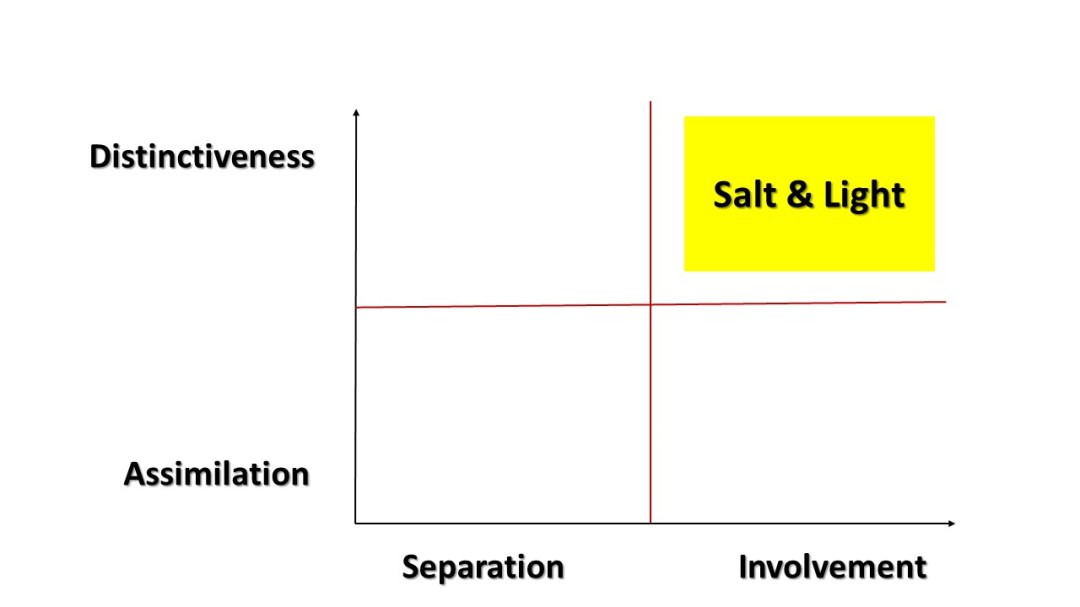
Salt and light graph


If you imagine a graph with distinctiveness on the y axis and involvement in the world on the x axis then we are aiming for the yellow quadrant

  • – The followers of Jesus are not to assimilate to the world’s values nor live separately from the world
  • – We make a difference by being distinctive, in a good way, and involved, not just passing through in our own little bubble

But the kind of distinctiveness that is in view here is not an aesthetic or cosmetic difference – rather it is a difference of being or character

  • – In the ancient world salt was associated with purity because it came from the purest of all things – the sun and the sea
  • – Because of its association with purity salt was rubbed on sacrifices
  • – Salt had a holy or sacramental use

One of the primary functions of salt is to preserve things, to arrest decay

  • – Before freezers people used to put salt on meat to make it last longer
  • – In saying, ‘You are the salt of the earth’ Jesus is calling his disciples to remain pure and be a moral disinfectant in a world where standards of morality are low

Another function of salt is to bring out the flavour in food – salt lends flavour to things

  • – As Christians, therefore, we should bring out the best in people, through our example, through our conversation and through our very presence


So, Jesus wants us to be like salt, pure but not bland

Being the salt of the earth comes with a warning: we shouldn’t lose our saltiness

  • – In other words, we shouldn’t lose our purity,
  • – We shouldn’t let our standards slip
  • – We mustn’t assimilate to the values of our society nor conform to the patterns of this world
  • – The world needs us to resist and subvert evil with the grace God gives us

To retain our saltiness (our flavour) we must maintain our distinctiveness

  • – So how do we do that – how do we maintain our distinctive Christ flavour?
  • – Well, as I’ve already alluded to, we don’t do it by dressing differently or living separately – we do it by staying close to Jesus
  • – It is the Spirit of Jesus who makes us salty
  • – It is the Spirit of Jesus who gives us light to share with others


In verse 16 Jesus says, “…let your light shine before men [and women], that they may see your good deeds and praise your Father in heaven.”

  • – (The term ‘men’ is gender inclusive – as in humankind)
  • – This verse tells us our light reveals our good deeds – perhaps a bit like sunshine causes flower petals to open

The image of light is rich in interpretive possibility – light represents a number of things at once

  • – For example, light could be wisdom – so this verse can mean, let your wisdom shine before men that they may see your good deeds and praise your Father in heaven
  • – When we do our good deeds in a way that is smart, that doesn’t create dependencies or cause other problems downstream, then people look at those good deeds and praise God
  • – One of the wisest things a missionary can do is learn the language and culture of the people they are sent to and then, having become familiar with the culture, translate the Scriptures into the people’s own language

As well as representing wisdom, light characterises the first day of creation, so light could equate to creativity – as in, let your creativity shine…

  • – Therefore, when you do your good deeds, whether that’s making a meal for someone or preparing a Sunday school lesson, or coaching a kids’ sports team, or buying a gift or whatever, don’t be boring – be creative
  • – Do that good work in a way that is fresh and unique and expresses who God made you to be

Light is also associated with joy – so it’s like Jesus is saying, let your joy shine…

  • – Therefore, when you do your good deeds, don’t do them grudgingly or out of a sense of loveless duty – do them with good humour, have fun
  • – Guys, when you’re making breakfast in bed for your wife she doesn’t want you to approach the task with a heavy heart
  • – “Oh, not mothers’ day again. How do you want your eggs?”
  • – Most mothers of small children want to sleep in but when you do make her breakfast she’ll want you to want to do it and she’ll also want you to clean up the mess afterwards
  • – What I’m saying is that when you do your good deeds don’t make the other person feel bad about it
  • – Our good deeds are just a vehicle for what we are trying to communicate, God’s love
  • – If you make the breakfast with joy then your wife will feel loved
  • – But if you make it like a martyr she will probably feel stink


Wisdom, creativity and joy are just some of the things light represents

  • – Light has other positive connotations as well but you get the point:
  • – Light illuminates our good deeds, it sets our good deeds apart in a special way, it gives them a winsome quality

Elsewhere in the gospels Jesus describes himself as the light of the world – which points to Jesus as the source of our inner light

  • – More than just reflecting the light of Christ we actually hold the light of Christ’s wisdom, creativity and joy within us
  • – Or to say it another way, we are the lightbulb and the Spirit of Jesus is the electricity or power enabling us to shine
  • Let your light shine then means let people see the Spirit of Jesus in you
  • – Let them see love, joy, peace, patience, gentleness, self-control and all the other fruits of the Spirit in your good deeds

Now some of you may be thinking to yourself…

  • – “I’m not wise. I feel like I’m bumbling my way through life
  • – Nor am I joyful, in fact I feel pretty miserable most of the time.
  • – And I’m not that creative or patient or peaceful
  • – So what does that say about me?
  • – Does that mean I’m not a person of light?”
  • – Well no. Being light doesn’t mean having a perfect life
  • – You don’t have to have it altogether to be light
  • – Just before these verses about being salt & light, Jesus said this,
  • Blessed are the poor in spirit… Blessed are those who mourn…
  • Blessed are those who hunger for righteousness… and so on
  • – Jesus is not describing here people who have their life together
  • – He’s describing people who are broken, wounded, hurting and hungry
  • – People who don’t feel wise or happy or creative but who, through their weakness, display the wisdom and creativity of God in redeeming humankind

Jesus uses the image of a lamp giving light, not the image of a star

  • – A lamp has a warm and inviting glow, you can get close to a lamp
  • – Stars give off light but you can’t get close to a star
  • – The poor in spirit and the meek are not stars – they are humble & down to earth – like an old style lamp with an open flame, giving comfort & joy
  • – Or to put it more plainly, being the light of the world isn’t always about what we do when we feel at our best
  • – Light is more often about what God is doing when we are at our worst
  • – In that case, “Let your light shine”, means be open, be honest – let people get close enough to see God’s goodness & grace at work in your life


So, what might it look like (practically) to be salt & light in the world? Well, it depends on the situation to some degree…

If everyone in the room is raising their voice and pushing their own agenda, then being salt & light (being different in a good way) might mean listening

  • – Listening reveals patience and gentleness

Or, if you are in a meeting at work and everyone in the room is saying ‘yes’ to a decision that will increase profits at the expense of peoples’ welfare, then being salt & light might mean saying ‘no’ – and offering a better alternative – one that shines with the light of Christ’s wisdom and compassion

Or, if you are in a conversation and people are maligning someone else behind their back, then being distinctive might sound like disagreeing with them and shining a light on that person’s better qualities

  • – It might cause some short term tension to disagree but longer term it will build trust

Or, when everyone is filling their lives with busy-ness and activity and the stress that accompanies that, being salt & light might mean slowing down and taking time out for prayer, corporate worship or spiritual retreat

  • – Enjoying Sabbath rest is a positive way of subverting the impatience and greed of our consumerist society
  • – The world needs us to be different in a good way – it needs us to subvert evil with grace & truth

Now, you need to know I’m being a bit easy on you – my examples of being salt & light don’t set the bar very high

  • – If Jesus was standing here preaching to you now, I imagine he would be saying some very difficult things
  • – For example, being salt & light (being distinctive & involved in the world) means not retaliating when someone punches you in the face but turning the other check
  • – Being salt & light means loving your enemies and lending to people who can’t afford to repay you
  • – It means you will respond to abuse and prejudice with joy
  • – It means you won’t do things to promote yourself or make yourself look good – you’ll do things in a way that makes God look good
  • – Being salt & light means you will do what you say even when it is no longer convenient to you
  • – It also means you won’t worry about the future – you’ll live in the present
  • – I’m not making this up, by the way, I’m getting it all from Matthew 5, 6 & 7 – the sermon on the mount

So that we don’t feel too overwhelmed though we need to remember that being salt & light is not something we do on our own

  • – When Jesus said to his disciples, “You are the salt of the earth” and “You are the light of the world” the “You” is plural, not singular
  • – And when Jesus says in verse 14, “A city on a hill cannot be hidden”, this indicates a community of lights – not just a single house
  • – Sometimes we might be the only one in the room saying the unpopular salty thing but we do that in the knowledge we are not acting alone
  • – We are acting as Christ’s representative and as a member of his body, the community of the church


A couple of real life examples of what it means to be salt & light

  • – The first is from New Zealand history and the second is from the Bible

Those who were at the Salvation Army for the Easter Sunday service a few weeks ago may remember the story of Piripi Taumata-a-Kura

  • – Jay Ruka retells Piripi’s story in his book, Huia Come Home
  • – Piripi came from the Ngati Porou tribe on the East Cape
  • – He was captured in the 1820’s by a Nga Puhi raiding party and taken away as a slave
  • – While he was in Waimate, Piripi met the missionary Henry Williams who taught him to read & write and introduced him to the gospel of Jesus
  • – Long story short, Piripi was returned to his tribe on the East Cape about 10 years later, where he shared the gospel with his own people before any Pakeha arrived in the area

One situation in particular demonstrates the salt & light influence Piripi had on his world. …

When asked to fight with his people against another tribe, Piripi was reluctant at first

  • – Eventually though he was persuaded, but only after he convinced his fellow warriors to adopt a code of conduct which reflected Christian ideas of compassion towards enemies
  • – There was to be no cannibalism and no destroying the enemy’s crops
  • – In agreement to these conditions he entered the battle
  • – Legend says he defied the bullets whizzing around him and emerged unscathed
  • – His bravery and trust in God captured the imagination of his people [1]

Obviously the ideal is a world without war, but we don’t live in an ideal world

  • – If Piripi had refused to fight the outcome for his enemies would have been worse
  • – So when peace wasn’t an option Piripi found a way to be salt & light, to remain involved and make a positive difference


Our second story of what it means to be salt & light comes from the book of Exodus, chapter 1

  • – The people of Israel were living in Egypt and they were thriving
  • – This made Pharaoh paranoid and he began to oppress the Israelites with slave drivers to crush their spirits
  • – But the more the Egyptians oppressed the Israelites the more they increased in number
  • – So the king of Egypt called the Hebrew midwives, Shiphrah and Puah to his palace for a chat
  • – “When you help the Hebrew women in childbirth and observe them on the delivery stool, kill the baby if it is a boy, but let it live if it is a girl.”

This put the midwives in a difficult position

  • – If they did what Pharaoh wanted they would be in trouble with God
  • – And if they did what God wanted they would be in trouble with Pharaoh
  • – Some people may have abdicated their responsibility by resigning their position but not Shiphrah and Puah – they were made of sterner stuff
  • – If they weren’t involved some other midwives with little or no conscience might take their place and then they would have blood on their hands
  • – Better to stay involved and have some influence for good

Ultimately the midwives were more afraid of God than Pharaoh, so they let the boys live. But they were clever about it

  • – They didn’t make placards and stand in protest outside Pharaoh’s palace
  • – That might work in a democracy but not in a dictatorship
  • – They were as wise as serpents and as innocent as doves
  • – They subverted Pharaoh’s authority quietly and discreetly

On learning that his plan wasn’t working the king of Egypt summoned Shiphrah & Puah back for another meeting and asked them…

  • – “Why have you done this? Why have you let the boys live?”
  • – Pharaoh wasn’t the sharpest knife in the draw so Shiphrah & Puah said to him, “Hebrew women are not like Egyptian women; they are vigorous and give birth before we arrive.”

This wasn’t true of course – it was a lie – and while it is not ideal to speak falsely, we don’t live in an ideal world

  • – If the midwives had been completely honest they would have put the king in a position where he felt obliged to kill them to save face
  • – God didn’t seem to mind the midwives deceit though – they were simply being salt & light – staying involved in the world and making a positive difference as they were able
  • – God protected Shiphrah & Puah and gave them children of their own
  • – The midwives’ subversive tactics worked and Pharaoh had to find another way to carry out his plan of genocide

When I think about the situations that Piripi and Shiphrah & Puah found themselves in, I imagine the pressures would have been huge

  • – But they didn’t cave
  • – They didn’t run away or assimilate
  • – They found a way to stay involved and make a positive difference


Conclusion:

Mission isn’t just something that happens overseas

  • – Opportunities for Christian mission are all around us, right here in NZ
  • – Jesus said, ‘You are the salt of the earth… You are the light of the world’
  • – Jesus means for us to have a positive influence where we are
  • – We are to be pure but not bland
  • – We are to be different but not separate
  • – We are to be open and not pass through life in our own little bubble

Having said that we do well to remember our saltiness and our light comes from our union with Christ

  • – This means we can’t be in the world all the time
  • – To stay salty and keep the lamp burning we need to guard against busy-ness and make time, apart from the world, to take care of our relationship with Jesus – reading our Bible, praying, gathering for worship and so on
  • – If you want good fruit you need to take care of the root.


Questions for discussion or reflection:

1.)    What stands out for you in reading this Scripture and/or in listening to the sermon? Why do you think this stood out to you?

2.)    What do salt & light share in common?

3.)    What does it mean to be the salt of the earth?

4.)    What does it mean to be the light of the world?

5.)    Where would you place yourself on the graph below? Why?

Salt and light graph

6.)     How might we move from assimilation to distinctiveness?

–         How might we move from separation to involvement?

7.)    Piripi and Shiphrah & Puah provide good examples of people who acted as salt & light in their respective worlds. Can you think of any other examples from your own experience or from history or the Scriptures, where people have been salt & light? (I.e. made a positive difference through their involvement in a less than ideal situation.)


[1] Jay Ruka, Huia Come Home, page 48.

Does God care about these people?

Scripture: Jonah

Title: Does God care about these people?

Structure:

  • Introduction
  • Jonah 1
  • Jonah 3
  • Jonah 4
  • Conclusion


Introduction:

Are you a glass half empty or a glass half full person?

–         For a long time I was a glass half empty sort of person


Forgive me, I’m forgetting my manners – allow me to introduce myself…

–         My name is Jonah, son of Amittai – you may have heard about me in Sunday school

–         I was born nearly 800 years before Christ, which makes me about 2,800 years old now

–         I know what you’re thinking – I look good for my age

–         Some of you may be wondering, ‘Why is he wearing that outfit?’

–         Well, I’m a prophet – this is what the future looks like baby

–         I’m just kidding – I wear it because it’s comfortable

–         Although, when you’ve lived as long as I have, you notice fashion does keep going around in circles


Anyway, as I was saying, I used to be a glass half empty person – in fact my wife would say I was a bit grumpy and cantankerous, on a good day

–         All I wanted was the quiet life – to be left in peace with my work, to ignore my neighbours and make an appearance at the synagogue just often enough to avoid a visit from the local Rabbi

–         As you can see, by the way I’m dressed, I don’t like to draw attention to myself – I have no interest in public speaking either

–         God knew this of course – he knew how much I valued my privacy and yet he completely disregarded all that and called me to be a missionary prophet


Sounds a bit grand, even wonderful, to say ‘I am a missionary prophet’ but I can tell you the reality is far from it

–         Being a prophet is an incredibly lonely life

–         It makes you famous & poor, which is a combination you want to avoid

–         The messages God gives are usually unpopular – warnings of judgement if you don’t change your wicked ways

–         In a society like yours where people are always bowing down to the idol of individualism and your media insists personal freedom be worshipped, no one likes to be criticised for the way they live their life

–         And on those rare occasions when I do get to bring a message of hope, people are usually so despondent they refuse to believe it

–         It takes a great deal of courage to risk hope when you’ve lost nearly everything


Jonah 1

That’s why I did a runner when the Word of the Lord came to me

–         Don’t ask me how I knew it was God speaking – some things you just know to be true in the core of your being

–         God said to me, “Go to the great city of Nineveh and preach against it, because its wickedness has come up before me.”


My first reaction was to ignore God, pretend like I didn’t hear

–         But there is an inevitability about God’s Word – it gets under your skin – the more you try to ignore it the more it irritates you

–         It becomes an itch that just has to be scratched

–         I tried distracting myself by keeping busy but that didn’t work so, even though God was leading me to Nineveh, I set off in the opposite direction for Spain – that’s how much I didn’t want to do this


What you need to understand is that Nineveh was the capital city of Assyria, which you probably know as northern Iraq

–         The Assyrians were our enemies – I won’t go into it all but they did some terrible things to our people

–         And God wanted me to go to them as a missionary prophet, when I wasn’t even prepared to cross the street to give them the time of day


Now you might be thinking, ‘Surely Jonah you would jump at the chance to tell your enemies how rotten they are’

–         Well, you’re wrong. I knew God well enough to know his true motivation

–         God was sending me to Nineveh because deep down he really cares about them – why else would he give them a warning?

–         God likes to give people second and third and fourth chances – it’s just the way he is

–         I know this about God because he has been giving my people (Israel) hundreds of second chances for centuries

–         God is gracious and compassionate, slow to anger and rich in love

–         He doesn’t want anyone to perish but wants everyone to be saved

–         Which is a real pain in the backside – because it means mugs like me get sent on a fool’s errand

–         I knew how it was going to turn out and that’s why I ran away

I guess I thought I would get away with it – I reasoned that if I didn’t go God would send someone else

–         I mean it’s not like I was anyone special – there were plenty of people more capable, more eloquent, more sociable, more charming than me

–         The Lord could use one of them

–         For a moment there I managed to convince myself that I was actually doing God a favour – I would probably stuff it up anyway

–         It never occurred to me that he would interfere with the weather


There I was, below deck, sleeping like a baby, while all hell was breaking loose above me

–         The men on board were seasoned sailors and they were scared for their lives, which tells you just how bad it was

–         As soon as they woke me I knew I was to blame

–         At that moment the psalmist’s words returned to me,

–         Where can I go from your Spirit? Where can I flee from your presence?

–         Still I wasn’t ready to give in – I thought, ‘God cares about these men, he isn’t going to let them drown because of me.’

–         It was like I was playing chicken with God and the lives of everyone on the ship – that’s how reckless I had become


Eventually they caste lots (which is like throwing dice or drawing straws) and my number came up

–         That’s one of the differences between you people today and the ancients

–         They didn’t believe in chance like you do

–         Nothing was random to them – everything had a purpose and a meaning

–         The spiritual realm was everywhere – the hands of the gods were directing fate. Nothing happened by accident

–         You call it superstition or luck and your post enlightenment, hyper-rational mind-set rules out the possibility of divine involvement

–         People today close their eyes to what they don’t want to see

–         No wonder you are starved for meaning

–         Your society may be rich, in material terms, but it’s spiritually poor


Anyway, enough about you, let’s get back to me – as I was saying, my number came up and I had to fess up

–         The storm was caused by my God – the same God who made the land and the sea – a God far more powerful than any other

–         And the Lord was doing this because I was running away from him

–         I told the sailors it was my fault and that if they picked me up and threw me into the sea it will become calm again

–         But they didn’t want to do it – they tried to save me by rowing to shore

–         There was I, a son of Abraham, one of God’s chosen people

–         I had grown up being taught the ways of the one true, living God, and I took my Godly heritage for granted, despised it even

–         These sailors didn’t even know the Lord – and yet they were risking their lives to save mine

–         Their religion was based on a lie (they worshipped idols) but their humanity was true

–         They loved me like a brother and they hardly knew me

–         I can’t tell you how much their actions touched me – as lonely as I was


When the storm got even worse, and they realised I was right, they reluctantly threw me overboard. The water became dead flat in an instant

–         Jesus did the same thing on a lake in Galilee 800 years later

–         People these days have no idea how powerful the Lord is – if you did you would show him more respect than you do


As providence would have it I met one of those sailors years later and he explained how profound his conversion experience was at the moment the waters became still

–         It occurred to him just how gracious and wise God is, turning my failure, my disobedience, into their salvation

–         If I hadn’t run away those sailors may never have known the power of God’s goodness

–         The old sailor’s eyes misted up when he told me that and I was humbled to silence

Of course that humility came years later with the benefit of hindsight – at the moment of being thrown overboard and hitting the water I was terrified

–         You New Zealanders are surrounded by the sea – you love going to the beach and swimming in the waves – but I’m a Hebrew, a land-lover

–         The sea reminds you of summertime and holidays but for me the sea represents chaos and death


I hadn’t been thrashing around in the ocean for long when a huge fish swallowed me up

–         Now I know that many people today struggle to believe this

–         Your culture holds up this ideal of being broad minded & inclusive and yet your imagination is too small to include this possibility

–         I’m not going to waste my time trying to convince you – arguments about the fish are a distraction


The point is: God is sovereign – he is in control of the outcome

–         He is able to work all things for good

–         I thought I was a gonna when that fish swam up

–         Funny how sometimes the things we fear most, the things we think will destroy us, actually turn out to be our salvation

–         It’s like that famous hymn writer William Cowper said…

–         God moves in a Mysterious way, His Wonders to perform,
He plants his Footsteps in the Sea, and rides upon the Storm.

–         Ye fearful saints, fresh courage take; the clouds ye so much dread
Are big with mercy and shall break in blessings on your head.   

–         I knew William Cowper – he was a glass half empty person, like me

–         During his lifetime he never really grasped how deeply God cared for him

–         But I’m not sure any of us do


I was three days and three nights in that fish and, after I had calmed down from the initial shock, it gave me time to think

–         I wrote a song of my own, which didn’t make it into the charts but did make it into the Bible.  Suffering is the mid-wife of art


Jonah 3

After the fish had spat me out on the beach the Word of the Lord came to me a second time: “Go to the great city of Nineveh and proclaim to it the message I give you.”

–         So this time I obeyed the Word of the Lord and went to Nineveh

–         Now, getting to Nineveh is not easy – it’s a journey of hundreds of miles on foot. There were no cars or aeroplanes 2,800 years ago

–         It actually took me weeks to get there, and I had to rely on the kindness of strangers the whole way


Naturally I thought a lot about what had happened to me

–         How God had given me a second chance and persevered with me despite my stubbornness

–         How he didn’t trade me in for a more reliable, lower maintenance missionary prophet

–         How his Word to me the second time was different from the first time

–         The first time he told me to ‘preach against the city’, but now his message was more open ended, more flexible – simply: ‘Proclaim the message I give you’ – which could be anything

–         I wondered what he might ask me to say – I guess that’s faith isn’t it, walking in trust, not knowing what the future holds

–         Which doesn’t suit me at all – I want to know beforehand, I want to be prepared


When I finally arrived in Nineveh it was as bad as I had imagined – domestic violence, child abuse, women treated shamelessly, bribery and corruption in the justice system, a huge gap between rich & poor and an economy fuelled by war mongering – How can people live like that?


The message God gave me was simple: “Forty more days and Nineveh will be overturned.”

–         It had to be simple really – I spoke a different language to them and, as I said before, I don’t enjoy public speaking. None of that mattered though

–         Even though I must have looked a pitiful picture to them the people believed my message – don’t ask me how

–         I guess some things you just know to be true in the core of your being.

–         The people believed God and showed remorse for their wrong doing by fasting and wearing sackcloth

Fasting is when you go without food – it is an act of self-denial

–         Fasting is the opposite of celebrating

–         When you fast you have more time to pray and listen to God

–         Wearing sack cloth is a way of putting appearances aside

–         When someone puts on sackcloth they are saying I am spiritually poor and I’m not going to hide my poverty

The people of Nineveh were serious about their repentance – the king even issued a proclamation telling everyone to call on God for mercy and give up their violent ways. And the people did

–         When God saw they had turned away from evil, he had compassion and did not bring upon them the destruction he had threatened


Jonah 4

And they all lived happily ever after – except for me – I was not happy

–         Like I said before, I knew God was sending me to Nineveh because he really cares about them

–         It was God’s hope all along that the Assyrians would repent

–         God is gracious and compassionate, slow to anger and rich in love

–         He doesn’t want anyone to perish but wants everyone to be saved

–         God will jump at the chance to let people off the hook, if they are genuinely sorry


I was so gutted I said, “Now, O Lord, take away my life, for it is better for me to die than to live.”

–         I did tell you I was a ‘glass half empty’ kind of person – but at that moment it seemed to me like the glass was completely empty

–         Not only did I have to live with the indignity of having my prediction unfulfilled (God didn’t make my words come true) – I just couldn’t face returning to my family and community

–         I knew people personally who had family members killed, crops destroyed and their homes burned to the ground by the Assyrians

–         How could I live with the shame of having helped my enemies

–         It was too much to bear – I felt like a traitor

And you know what God said to me?

–         “[Jonah], have you any right to be angry?”


Sullen and brooding I decided to give God the silent treatment

–         I wanted to put some distance between myself and the city, and between myself and God, so I walked East, even further away from the temple in Jerusalem

–         Have I any right to be angry? How could he ask that? Of course I do

–         Grace is fine when it’s for me and the people I care about, but mercy for the people of Nineveh, after all the suffering they had caused?

–         Where was the Lord’s sense of justice?

–         Cleary he cared about them but he didn’t seem to care about Israel, or about me.  I felt betrayed by God – whose side was he on?


God has a way of getting us to talk, even when we don’t want to

–         The Lord caused a vine, a leafy plant, to grow up beside me – it was incredible, sprang up overnight

–         The plant gave me shade from the sun – it was a comfort to me, my only comfort actually

–         Next day though God provides a worm to kill the plant

–         So that was my reward for obedience

–         I felt like Job – the Lord gives and takes away

–         The wind and sun was particularly bad that day – and I knew it was Him who was doing it

By this stage I could see the plant had been a real and living parable

–         You know you’re in trouble when God gives you a parable

–         Parables irritate you, they get under your skin and become an itch that has to be scratched – so I broke my silence and said again,

–         “It would be better for me to die than to live.”

–         I didn’t really want to die – I just didn’t want to be in pain anymore

–         I wanted to get off this nightmare carnival ride I was on

–         I wanted to get out of my head and feel good again

–         I wanted my cup to be full to overflowing

–         So God said to me, really softy and gently, “[Jonah], do you have a right to be angry about the vine?”

–         He was trying to help me feel better but I couldn’t see that yet. I replied,

–         “I do have a right to be angry. I am angry enough to die.”

–         I wanted God to feel my pain, to understand

–         He sits on his throne in heaven, makes his plans, gives his orders and expects us to carry them out, but does he know how difficult this life is, how hard it is to be human?


The Lord said to me: “You have been concerned about this plant, though you did not tend it or make it grow. It sprang up overnight and died overnight. And should I not have concern for the great city of Nineveh, in which there are more than a hundred and twenty thousand people who cannot tell their right hand from their left—and also many animals?”

It was an argument from the lesser to the greater

–         I cared about that plant, even though I had done nothing to create it or look after it – how much more then should God care about 120,000 people (and their livestock) who he did create and who are far more valuable than a single vine

–         There was nothing I could say in reply to that – God had the last word


Conclusion:

Will asked me to preach today because my story fits with the theme of your self-denial campaign: ‘Where God leads’

–         Well, God led me hundreds of miles away from home to preach a message of repentance to my enemies

–         And why did he do that?

–         Because his purpose (his mission) is not all about me – and it’s not all about Israel either

–         God cares about my enemies (and yours)

–         Think about the person you care the least for in this world – God loves them – their life is precious to him

–         In fact he cares for all of his creation – not just human life


I said before that I wanted God to feel my pain, to understand, to know how hard it is to be human

–         Well, 800 years after I was born, he did just that

–         God became a man in the person of Jesus Christ of Nazareth

–         And he suffered terribly – he felt my pain alright, and then some

–         His cup was emptied completely and after he had tasted death, his cup was filled to overflowing with eternal life

Jesus’ experience was my experience

–         I used to be a glass half empty sort of person – then the Lord emptied me completely, but only so he could fill me again with something far better

–         Jesus’ coming fulfilled the purpose of my life

–         He can fill your glass too but first he’ll probably want to empty it and make you wait – and that’s the hard part

–         Hold on to God through the emptying and the waiting – it’s worth it in the end


Where is God leading you?

–         Maybe overseas but more likely just over the fence to your neighbour or to someone in your own family

–         Peace be with you.

Questions for discussion or reflection:

1.)    What stands out for you in reading this Scripture and/or in listening to the sermon?

–         Why do you think this stood out to you?

2.)    Are you a glass half empty or a glass half full person?

3.)    Why did God call Jonah to preach against the city of Nineveh?

–         Why do you think Jonah ran away?

4.)    Has God ever asked you to do something you really didn’t want to?

–         What happened?

5.)    How did God work Jonah’s disobedience for good?

6.)    Why do you think Jonah was angry after God relented from destroying Nineveh?

–         How did God handle Jonah’s anger?

7.)    Think of someone you don’t like or don’t care about

–         Take some time to imagine God’s love and care for the one(s) you don’t like

–         Ask God to bless your enemies

8.)    In what ways does Jonah’s story point to Jesus?

9.)    Where is God leading you?