The Big Reveal

Scripture: Ephesians 3:1-13

Title: The Big Reveal

Structure:

  • Introduction
  • God reveals his plan
  • Paul preaches Christ
  • The church reveals God’s wisdom
  • Conclusion

Introduction:

Walk on to stage with a blindfold on: I can’t see. Can anyone help me?

  • Wait for someone to tell me to take the blindfold off
  • That’s better – now all is revealed

The goodness of God, the providence of God, the grace of God, the beauty of God, the thoughtfulness of God, the wisdom of God, the kindness of God, the plan & purpose of God is all around us

  • But we don’t always see it because we haven’t removed our blindfold


This morning we continue our series in Ephesians by focusing on chapter 3, verses 1-13

  • In chapter 2 Paul had been talking about our salvation in Christ, both our personal salvation and the salvation of the group
  • Now, in chapter 3, Paul is about to pray for the Ephesians when he gets side tracked for a few moments talking about the work God has given him to do – this is essentially the work of revealing God’s eternal plan
  • Paul’s job is to help remove the blindfold by preaching Jesus
  • From Ephesians 3, verse 1, we read…

For this reason I, Paul, the prisoner of Christ Jesus for the sake of you Gentiles — Surely you have heard about the administration of God’s grace that was given to me for you, that is, the mystery made known to me by revelation, as I have already written briefly. In reading this, then, you will be able to understand my insight into the mystery of Christ, which was not made known to people in other generations as it has now been revealed by the Spirit to God’s holy apostles and prophets. This mystery is that through the gospel the Gentiles are heirs together with Israel, members together of one body, and sharers together in the promise in Christ Jesus. I became a servant of this gospel by the gift of God’s grace given me through the working of his power. Although I am less than the least of all the Lord’s people, this grace was given me: to preach to the Gentiles the boundless riches of Christ, and to make plain to everyone the administration of this mystery, which for ages past was kept hidden in God, who created all things. His intent was that now, through the church, the manifold wisdom of God should be made known to the rulers and authorities in the heavenly realms, according to his eternal purpose that he accomplished in Christ Jesus our Lord. In him and through faith in him we may approach God with freedom and confidence. I ask you, therefore, not to be discouraged because of my sufferings for you, which are your glory.

May the Spirit of Jesus illuminate this Scripture

Following Paul’s train of thought can a little difficult at times – like a braided river Paul’s stream of consciousness is complex and intertwined

  • We need to step back to try and see the bigger picture – where is this braided river heading?
  • Well, Paul is essentially talking about the revelation of God’s eternal plan
  • In Ephesians 3 Paul describes the revelation of God’s plan like this…

By his Spirit, God reveals the mystery of his plan to Paul and the other apostles

  • Paul (and the other apostles) then reveal God’s plan of salvation to humanity by preaching the gospel of Jesus Christ
  • As a result of their preaching people find peace with God and with each other – communities of like-minded believers become the church
  • And, through the church, God reveals his wisdom to the unseen (non-human) spiritual beings
  • So that’s the big picture of this passage – now let’s look at the different braids of Paul’s thought
  • First let’s consider the mystery of God’s plan revealed to Paul

God reveals his plan:

Hold up a USB stick. I have here, in my hand, a USB stick

  • No one here (but me) knows what secrets are held in this device
  • And none of you, just by looking at it, can know – not without plugging it in to a computer – but even then you might not understand it

In verses 2-5 of Ephesians 3 Paul talks about the mystery of God’s plan revealed to him

  • In this context a ‘mystery’ is a truth known only by divine revelation
  • In some ways the Old Testament Scriptures were sort of like a USB stick – they contained a secret, the mystery of God’s plan, but no one knew how to properly access the Scriptures to reveal the contents
  • Jesus and the Holy Spirit unlock the USB of the Scriptures to reveal God’s plan
  • Paul, and the other apostles of the first century, got to see the contents because God showed them – he opened their minds with insight to understand
  • Therefore, the writings of the New Testament achieve the status of holy Scripture because they are a record of God’s revelation to human beings

When we were kids we would go to birthday parties and almost always we would play a game of pass the parcel

  • Sitting in a circle we would pass the present around and each time the music stopped the person holding the present would remove a layer of paper. Pass the parcel was exciting because it was full of mystery
  • No one knew when the music would stop or how many layers of paper there were or what present was waiting inside
  • The mystery of God’s plan is a bit like the present hidden inside layers of paper in a pass the parcel game
  • Each generation removed a layer and got a bit closer to revealing the mystery inside but it was Paul’s generation who were at the right time and place in history to open the final layer

So what is God’s mystery plan then? Well, it was a gift no one expected. Paul spells it out in verse 6…

This mystery is that through the gospel the Gentiles are heirs together with Israel, members together of one body, and sharers together in the promise in Christ Jesus.

Notice here the repetition of the word ‘together’

  • Paul is talking about God’s creation of the church in this verse

Those of us who have grown up in NZ probably don’t realise how incredible and audacious God’s plan is because most of us haven’t been close to the kind of Jewish / Gentile hostility that Paul was in touch with

  • But we do have some idea. Throughout our lifetime we have watched news reports of the ongoing conflict between Israel and the Palestinians and Israel’s other Gentile neighbours
  • God’s mystery plan is to bring the Jews & Gentiles together, in peace, and make us one in Christ
  • And it’s the church’s purpose to model that togetherness – it is the church which embodies the hope of that peace
  • But God’s plan goes beyond mere reconciliation – God’s plan is to give believing Jews & Gentiles equal status in Christ
  • While the Old Testament does talk about the Gentiles turning to the God of Israel no one thought we would be included on an equal footing with the Jews, as members of God’s family – no one foresaw the Christian church hidden in the USB of the Hebrew Bible


Paul preaches Christ:

Having received the revelation of God’s plan, Paul then shares it with others by preaching Christ to people – he realises he can’t keep it to himself

  • If you are a scientist and you discover a cure for cancer you don’t keep it to yourself – you share it with the world
  • Evangelism, sharing the good news, is just one beggar telling another beggar where to find bread

In verses 8-9 Paul says…

  • Although I am less than the least of all the Lord’s people, this grace was given me: to preach to the Gentiles the boundless riches of Christ, and to make plain to everyone the administration of this mystery…

Paul hasn’t forgotten how he used to persecute the followers of Christ and so he refers to himself as less than the least of all the Lord’s people

Paul describes the preaching task he has been given as a ‘grace’ – that is, a gift, a privilege, something beautiful that God has given him

  • As well as being a privilege preaching is also hard work and it can get you in trouble
  • Preaching that it was God’s plan to include the Gentiles on an equal footing with the Jews got Paul arrested and jailed
  • He was under house arrest when writing this because of the message he preached, but his eyes weren’t on his chains
  • His eyes were on the privilege of being the one who got to unwrap the final layer of God’s parcel of truth to share with others

The content of Paul’s preaching is the boundless riches of Christ

  • Paul has already touched on the nature of these riches in the first two chapters of Ephesians – let me refresh your memory…
  • Christ’s riches include: resurrection from death,
  • Enthronement with Jesus in the heavenly realms,
  • Reconciliation with God and peace with other believers
  • Citizenship in the Kingdom of God
  • Adoption into God’s family
  • And intimacy with God – becoming a part of God’s new temple, where his Spirit dwells

In verse 12 of Ephesians 3 Paul describes another one of the riches of Christ

  • In Christ and through faith in him we may approach God with freedom and confidence.
  • This connects with what Paul had been saying at the end of chapter 2 when he talked about us being part of God’s family and indeed his temple
  • This access of all Christian people to God through Christ is what the sixteenth century reformers termed ‘the priesthood of all believers’ [1]
  • In Old Testament times, only the descendants of Aaron could serve as priests in the temple but through faith in Christ we too can draw near to God as his priests

So it’s not like Daryl & I are the only priests here, you also are priests

  • The role of a priest is to help people in their relationship with God
  • When you intercede in prayer for others you are acting as a priest
  • When you listen with compassion to someone at work and encourage them to find the right path you are acting as a priest
  • When you say a blessing over your children at home and proclaim the goodness of God to them you are acting as a priest
  • When you sacrifice your time and your money for the sake of God’s church and God’s purpose in the world you are acting as a priest

Paul’s message to everyone also includes the administration of this mystery

  • In verse 2 Paul talks about the administration of God’s grace
  • Two ways of referring to the same thing – God’s plan of salvation
  • Paul’s use of the word administration is quite refreshing
  • Normally we associate administration with tedious paper work but Paul associates it with the mystery of God’s grace
  • Medicine might be administered in the form of a pill or by an injection
  • And the payment of money might be administered by cash or eftpos
  • But the mystery of God’s grace is administered by faith in Christ and by preaching

When I was reflecting on this passage over the past week or so I was reminded of Joseph, the son of Jacob, who was an administrator of God’s grace

  • Sold into slavery in Egypt, Joseph proved to be a good manager and, through the revelation and insight God gave him to interpret Pharaoh’s dreams, Joseph rose to the position of Prime Minister where he administered God’s grace in the form of food security

We, like Paul and Joseph, can also administer God’s grace at least to the extent that we have received it

  • What grace or gift has God given you as one of his priests?
  • Is it the grace to be present and listen – who would God have you come alongside?
  • Is it the grace to speak words of encouragement into the lives of others – what would God have you say?
  • Is it the grace of being in a position to help people with your influence or your resources – who would God have you empower?
  • Is it the grace to remove someone’s blindfold so they can see God’s goodness in the world around us – who can you help to see the good news?
  • There are many other gifts of course but the question is: What grace has God given you to share as one of his priests?

God revealed his plan to Paul and Paul didn’t keep it to himself – he preached Christ to all kinds of people because Christ is the key to God’s plan, Christ opens God’s USB


The church reveals God’s wisdom:

But there is another level of revelation going on that we can’t see and might not even be aware of: The church reveals God’s wisdom, not to humankind necessarily but to non-human spiritual beings in the heavenly realms

A tapestry has two sides – a top side and an underside

  • The underside of the tapestry usually looks like a mess – you can barely tell from the underside what’s going on up top
  • The physical / material world in which we live is like the underside of the tapestry, while the spiritual world is like the top
  • From our perspective (in the upside down, from underneath) we can’t see things as they really are in the spiritual realm

In verse 10 of Ephesians 3 Paul writes…

  • His intent was that now, through the church, the manifold wisdom of God should be made known to the rulers & authorities in the heavenly realms,

God’s wisdom is manifold – it is multi-faceted, with many different threads forming a coherent and beautiful picture

  • The rulers and authorities in the heavenly realms is most likely a reference to spiritual (non-human) creatures like angels and demons
  • The main idea here is that God reveals his wisdom to these spiritual beings through the church on earth
  • From our perspective below, the church doesn’t always seem beautiful or gracious or perfectly ordered – it often looks and feels a bit messy
  • But when angels & demons look at the church they see the topside of the tapestry and they are in awe of what God has done through Christ

We might wonder why God would do this – using a church comprised of imperfect human beings to reveal his wisdom to the spiritual realm

  • I don’t think it is just to make himself look good
  • More likely God does it to redeem his non-human creation
  • It is, after all, God’s plan and purpose to reconcile all things to himself through Christ – ‘all things’ includes the creatures of the spiritual realm

Now, if you think about it, this places a very high value and meaning on church

  • The church isn’t just about us – it’s also about a whole dimension of reality that we can’t see
  • When we gather for worship each Sunday our audience is greater than we might imagine


Conclusion:

This morning we’ve heard how God, by his Spirit, reveals the mystery of his plan to Paul and the other apostles

  • Paul (and the other apostles) then reveal God’s plan of salvation to humanity by preaching the gospel of Jesus Christ
  • As a result of their preaching people find peace with God and with each other – communities of like-minded believers become the church
  • And, through the church, God reveals his wisdom to the unseen (non-human) spiritual beings

This morning’s reading finishes with Paul saying…

  • I ask you, therefore, not to be discouraged because of my sufferings for you, which are your glory.
  • The reason Paul was in prison was that he believed Gentiles now have the same access to God that Jews have
  • Paul’s suffering tells us that he really loved the Gentiles and believed in God’s plan for them
  • ‘Glory’ is a weighty word, it refers to something substantial and meaningful, something lasting
  • Paul’s suffering for the Gentiles gives real weight and substance to his message and it gives glory to his Gentile readers also
  • Paul’s suffering says people like us matter to God
  • You might not feel that glorious – you might not think your life is that significant but Paul’s suffering for us says otherwise
  • You are glorious, your life is significant, you do matter to God
  • We matter to God


Questions for discussion or reflection:

  • What stands out for you in reading this Scripture and/or in listening to the sermon?
    • Why do you think this stood out to you?
  • Have you ever had a significant ‘aha’ moment, when God revealed to you a deeper insight about himself and his purpose?
    • What happened? What was the revelation you received? How did you respond?
  • What revelation did God give Paul?
    • How did Paul respond?
  • Why do you think Paul describes the task of preaching as a ‘grace’?
    • What grace (or gift) has God given you to share with (or administer to) others?
    • In what ways can you act as a priest?
  • Discuss / reflect on / give thanks for the boundless riches of Christ
  • What are the implications of Ephesians 3:10 for us?
    • How might this verse inform our attitude and behaviour regarding church?
  • Take some time to reflect on Paul’s suffering for preaching the gospel to the Gentiles.
    • How do you feel knowing that Paul (and others) have paid a high price so that you/we can be included in God’s family?
    • How might you/we honour Paul’s sacrifice?


[1] John Stott, The Message of Ephesians, page 124.
Included

Scripture: Ephesians 2:11-22

Title: Included

Structure:

  • Introduction
  • A new access
  • A new humanity
  • A new temple
  • Conclusion

Introduction:

As well as being Trinity Sunday, today is also Disability Awareness Sunday

–         My first job after leaving university was with a community organisation who worked with people with disabilities, in Tauranga

–         I was 23 at the time and had very little disability awareness – so they made me a disability awareness educator

–         Nothing like being thrown in the deep end

My job was to help people with disabilities to be included in the community by educating the community

–         For many years people with disabilities were excluded from mainstream society – they were locked away in institutions and this proved to be quite harmful, both to the people locked away and to mainstream society

–         One of the challenges people with disabilities faced, when they were released from institutions, was the prejudice of others

–         I soon learned that disability isn’t so much a deficit with an individual person, it’s actually more a deficit with our society

–         It is our society which disables people

–         If the only means of access into a building is stairs, then it’s not the person in the wheelchair who is disabled, it’s the building

–         If someone pokes fun at a person because they can’t hear then the problem is not with the person who is deaf

Unless you’ve been excluded (or spent meaningful time with people who are excluded) then you don’t really see the barriers that exist in our society

–         The world we live in says, in a thousand ways, that our value is based on our ability – but the Bible says that isn’t true

–         The truth is our value comes from God who made us and loves us

This morning we continue our series in Ephesians

  • – Our focus today is Ephesians 2, verses 11-22
  • – We could summarise this passage by saying: ‘We were excluded, but in Christ we have now been included, reconciled and brought home’
  • – In today’s reading Paul traces the movement from division to unity
  • – From alienation to reconciliation
  • – From hostility to peace
  • – From despair to hope
  • – And from being excluded to being included
  • – From Ephesians 2, verse 11, in the NIV we read…

Therefore, remember that formerly you who are Gentiles by birth and called “uncircumcised” by those who call themselves “the circumcision” (which is done in the body by human hands)— remember that at that time you were separate from Christ, excluded from citizenship in Israel and foreigners to the covenants of the promise, without hope and without God in the world. But now in Christ Jesus you who once were far away have been brought near by the blood of Christ. For he himself is our peace, who has made the two groups one and has destroyed the barrier, the dividing wall of hostility, by setting aside in his flesh the law with its commands and regulations. His purpose was to create in himself one new humanity out of the two, thus making peace, and in one body to reconcile both of them to God through the cross, by which he put to death their hostility. He came and preached peace to you who were far away and peace to those who were near. For through him we both have access to the Father by one Spirit. Consequently, you are no longer foreigners and strangers, but fellow citizens with God’s people and also members of his household, built on the foundation of the apostles and prophets, with Christ Jesus himself as the chief cornerstone. In him the whole building is joined together and rises to become a holy temple in the Lord. And in him you too are being built together to become a dwelling in which God lives by his Spirit.

May the Spirit of Jesus illuminate this Scripture for us

In our message last week we heard about three aspects of our personal salvation

  • – This week’s reading is about the salvation of the group
  • – In and through Christ we have a new access to God, a new humanity under God and we become part of God’s new temple
  • – First let’s consider the new access we have in Christ


A new access:

When I was a boy we used to visit my great aunt Avis in Auckland

–         She has passed on now but in her day she was a very capable woman

–         Avis’ fulltime job was as PA for Mr Gladding, the general manager of South Auckland Motors

–         In addition to her day job Avis attended St Philip’s Congregational Church in Papatoetoe where she taught Sunday school for many years and also served as the church secretary for a while

During the 1950’s my aunt studied by correspondence to earn her lay preacher’s license

–         It was quite a significant qualification involving Greek, theology, Biblical exegesis and so on

–         The minister, a man named Ted Tabor, was supportive of my aunt and included her by providing opportunities for her to preach in church

–         Having no family of her own the church became her family – she was warmly included

Then in the early 1960’s Avis applied to become a minister within the Congregational denomination

–         Despite her qualifications, her professional skills, her church ministry experience & the support of her minister, the denominational hierarchy turned her down

–         No reason was given but it appears my aunt didn’t make the cut because she was a single woman

–         Now I don’t want to be unfair to the people that made that decision

–         Attitudes in NZ society were different then – maybe they thought they were doing what was best for her and the church at the time

–         But my aunt didn’t see it that way

–         Although Avis had access to the Bible in its original language and although she had proven herself to be a faithful servant of the church for many years, she was denied access to fulltime pastoral ministry

–         Sadly this was not her first rejection in life

–         She decided to stop attending church after that

In some ways my aunt’s experience was similar to that of many people – a mixture of being included and excluded

–         Although she wasn’t excluded from God’s people or from lay preaching, she received the message, ‘you can come this far but no further’


In verses 11-12 of Ephesians 2, Paul reminds his non-Jewish readers how, previously, they were excluded from God’s people and God’s promises, having no hope in the world

Now for most of us, who are used to being included, these verses are water off a ducks back – they don’t penetrate the surface, we don’t really appreciate them

–         But if you have been systematically excluded and de-valued over a long period of time you will be very sensitive to what Paul is saying here

When I was working with and for people with disabilities there was one guy (with cerebral palsy) who knew I was a Christian and took a crack at my faith

–         He found some verses in Leviticus 21 which talk about how people with disabilities can’t draw near to offer sacrifices – how they are kept at arm’s length and don’t have the same access as able bodied people

–         He was quoting Scripture out of context – so I tried to explain how that was in the time of the Old Testament but now, because of Jesus, we have a new access to God – we go from being excluded to being included

–         Or, as Paul says in verse 13, now in Christ Jesus you who once were far away have been brought near by the blood of Christ (that is, by Christ’s sacrifice)

–         Unfortunately my friend with cerebral palsy was too angry to listen – and after the hurt and rejection he had experienced in life it was no wonder

–         Having said that, we don’t do ourselves any favours by holding on to our hurt

There is a temptation when we are rejected or excluded to feel sorry for ourselves – but when that happens we still have a choice

–         We can either carry on feeling sorry for ourselves and wind up polishing the bar with a hard luck story

–         Or we can find a way to forgive the hurt and move on

–         I don’t mean to sound brutal but sooner or later everyone suffers – no one gets through life unscathed

–         Everyone sins and everyone is sinned against – so we have to learn to forgive, because without forgiveness we can’t have peace


Returning to the story of my aunt for a moment…

–         Some years later a minister from the Congregational church went to visit Avis. When he heard her story he apologised (although it wasn’t his fault) and asked her to return. Sounds like he was trying to bring reconciliation

–         Although my aunt didn’t go back to church I never heard her speak ill of the church – we only learned about her experience through a couple at St Philips who stayed in touch with her after she left

–         The fact that Avis didn’t bad mouth the church and kept her friendship with people in the church, suggests to me that she did forgive and find some peace


We are talking about salvation in a corporate or group sense

–         In and through Christ we Gentiles, who were excluded, now have a new access to God

–         More than this though, in and through Christ, God creates a new humanity


A new humanity:

The Rohingya people are a stateless ethnic group who reside in Rakhine State, Myanmar. The majority are Muslim while a minority are Hindu

–         Described by the United Nations as one of the most persecuted minorities in the world, the Rohingya are denied citizenship under the 1982 Myanmar Nationality Law

–         Although Rohingya history in the region can be traced back to the 8th Century, Myanmar law does not recognize the ethnic minority as one of the eight national indigenous races

–         They are also restricted from freedom of movement, state education and civil service jobs.

–         Because of persecution hundreds of thousands of Rohingya refugees, have crossed the border into Bangladesh from Myanmar

–         The Kutupalong refugee settlement, in Bangladesh, has grown to become the largest of its kind in the world, with more than 600,000 people living in an area of just 13 square kilometres

I don’t really understand the situation or how God might work his purpose in it – but clearly the Rohingya have suffered hostility and are excluded


The sort of hostility the Rohingya have experienced is foreign to most of us but it wasn’t foreign to the people of Paul’s day

–         For centuries Jews and Gentiles had been at each other’s throats

–         When we read the Old Testament we see that Israel is almost constantly in a state of war with the surrounding nations

–         But Jesus came to bring peace between Jews and Gentiles

–         In fact he came to make the two groups one

–         In Ephesians 2 verse 14, Paul writes of Christ…

For he himself is our peace, who has made the two groups one and has destroyed the barrier, the dividing wall of hostility, by setting aside in his flesh the law with its commands and regulations.

This verse requires some explanation

  • – The ‘two groups’, as I’ve already alluded to, are the Jews and Gentiles
  • – Generally speaking both sides hated each other
  • – The Jewish temple of Jesus’ & Paul’s day had a literal wall which Gentiles were not allowed to go past – you can go this far but no further
  • – In fact there was a sign on the wall that basically said, ‘Gentile trespassers will be executed’ – not ‘prosecuted’ but ‘executed’
  • – The temple in Jerusalem wasn’t literally destroyed by the Romans until AD70 – but spiritually speaking Jesus destroyed the dividing wall decades before that


With his death on the cross Jesus also set aside the law with its commands and regulations

  • – Now those who are familiar with Matthew 5 will see a red flag here, because in his sermon on the mount Jesus said, ‘Do not think I have come to do away with the law – no, I’ve come to fulfil it’
  • – John Stott helps to give clarity on this point
  • – When Paul talks about the law in Ephesians 2 he means the ceremonial law, not the moral law
  • – But when Jesus talks about the law in Matthew 5 he means the moral law

The ceremonial law is that part, in Leviticus for example, which says people with disabilities can’t draw near to the altar to offer sacrifices

  • – Jesus’ coming makes the ceremonial law unnecessary because we don’t approach God by offering sacrifices in the temple in Jerusalem anymore
  • – Jesus’ sacrifice on the cross does away with the need for animal sacrifice
  • – We now approach God through Jesus and anyone can come to Jesus
  • – In distinction from the ceremonial law, the moral law includes things like the 10 commandments – don’t steal, don’t murder, don’t covet, that sort of thing
  • – Jesus doesn’t do away with the moral law – rather he fulfils it so we are no longer condemned by it

I have in my hand a walnut. To eat this walnut I must first remove the shell

  • – The shell is like a dividing wall – it is useful for a time, to protect the nut inside – but once the shell has been broken we no longer need the wall
  • – The Law of Moses is like a walnut
  • – The outer shell represents the ceremonial law, while the nut inside represents the moral law
  • – Jesus came to fulfil the moral law – in other words he came to crack open the shell and remove the dividing wall of the ceremonial law so we could eat the moral nut inside


In verses 15 & 16 Paul continues talking about what Christ did…

–         His purpose was to create in himself one new humanity out of the two, thus making peace, and in one body to reconcile both of them to God through the cross, by which he put to death their hostility.  

This is mind blowing stuff – Jesus takes two groups of people who for centuries have been trying to kill each other, and reconciles them to God and to each other so they become one body of people at peace

–         To give you an idea of the sort of reconciliation Jesus achieves here, it would be like getting Donald Trump to apologise to Hilary Clinton and Hilary Clinton accepting it

–         It would be like having the people of Myanmar welcoming the Rohingya home with full citizenship

–         Or like seeing the National Rifle Association lobby for stricter gun laws

–         Or, closer to home, like seeing the Treaty of Waitangi honoured


Jesus came with a message of peace for those, like us, who were far away – the Gentiles, women, people with disabilities, the Rohingya and so on

–         And he preached peace to those who were near – able bodied Jewish males, like Paul

–         For through Christ we both have access to the Father by one Spirit

–         Here we notice the Trinity : Father, Son & Holy Spirit

–         Paul is saying that in and through Christ we are able to participate in the very life of God – a bit like Abraham & Sarah participated in the life of God when they received the three visitors in Genesis 18 and soon after Sarah became pregnant


As a consequence those who were once far away and excluded are now brought near and included as citizens of God’s kingdom & members of God’s household

–         In other words, in Christ the excluded become part of God’s family

–         But wait there’s more – in Christ we actually become a new temple for God’s presence

A new temple:

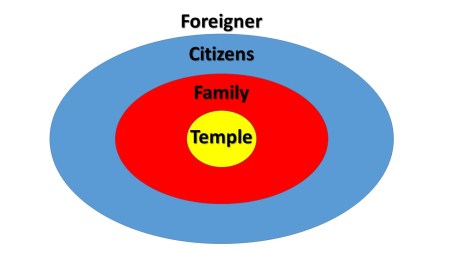
Bullseye - 16 Jun 2019

This diagram on the wall here (which looks like a bullseye) shows the three images of inclusion Paul uses in verses 19 to 21

–         Being a citizen in God’s kingdom (the outer ring) is closer to God than being a foreigner

–         Being a member of God’s family (the next ring in) is closer again than being a citizen

–         But being part of God’s temple (the bullseye) is the closest one can get to God, because to be God’s temple is to have the presence of God inside you

From verse 20 Paul expands on the new temple image

The foundation of the new temple is the apostles and prophets – essentially the teachings of the New Testament

–         As John Stott observes: the church’s foundation documents are the New Testament Scriptures. And just as a foundation cannot be tampered with once it has been laid and the structure is being built on top, so too the New Testament… can’t be changed by additions, subtractions or modifications [1]

–         If we try to build something outside the footprint of the New Testament then it won’t last


Verse 20 tells us Jesus is the cornerstone of the new temple – the one who holds the whole building together

Those who were here for the all-age Christmas service last year may remember these verses and how we built a wall out of shoe boxes at the front

–         Neville explained how a cornerstone, in Biblical times, was the largest, most solid stone in a building. It gave the building its shape and size.

–         If you took the cornerstone away, the whole building would fall down

–         More recently, buildings have cornerstones on each corner, supporting all the smaller bricks. The idea is the same.

–         As a cornerstone, Jesus is like a solid rock supporting us, a friend beside us who we can rely on – the one from whom we get our plumb line

That makes us the bricks (or living stones) of God’s new temple

–         In Christ we too are being built together to become a dwelling in which God lives by his Spirit.

–         Again we notice the Trinity in this image and our participation in the life of the Trinity

–         God the Son, is the cornerstone, we are the bricks and God the Father lives in us by his Spirit

This means the Christian church replaces the Jerusalem temple, which was destroyed by the Romans in AD70

–         We don’t replace Israel as such, but we do replace the temple building

–         So wherever you go in the world, particularly when you go with another believer, you take the presence of God with you

–         Although my aunt stopped going to church the church didn’t abandon her

–         One couple from the church, who loved Avis, stayed in touch with her and supported her through a difficult time

–         This couple embodied God’s presence for my aunt – they literally took the temple to Avis by visiting her and showing care for her

–         Is there someone you can take the presence of God to?


Conclusion:

This morning we’ve heard how Christ includes people in the very life of God

–         Through Christ we have a new access to God

–         Through Christ we become a new humanity under God

–         And through Christ we become a new temple for the presence of God


Questions for discussion or reflection:

1.)    What stands out for you in reading this Scripture and/or in listening to the sermon?

–         Why do you think this stood out to you?

2.)    Have you ever been excluded in a significant way?

–         What was this like for you?

–         Have you been able to forgive the hurt and move on?

3.)    Do you know what it is to be included (&/or reconciled) in a significant way?

–         What was this like for you?

–         Have you been able to include others too?

4.)    What is the difference (or relationship) between the ceremonial law and the moral law?

–         What does Jesus destroy and what does he fulfil?

5.)    Where do we see the Trinity in Ephesians 2:11-22?

–         What is our relationship to the Trinity, in Christ?

6.)    Looking at the bullseye, in the sermon notes above, where are you in relation to God?

–         Ask someone close to you if they agree. Where do they see you in relation to God?

–         Where would Paul say you were in relation to God?

7.)    Reflect on (or discuss) the various aspects of the temple image in verses 20-22. That is, the foundation, the cornerstone, the bricks, God’s Spirit

–         What are the practical implications with each of these aspects?

–         Is there someone you can take the presence of God to?


[1] John Stott, BST Commentary on Ephesians, page 107.

Once were Zombies

Scripture: Ephesians 2:1-10

Title: Once were Zombies

Structure:

  • Introduction
  • Once were Zombies
  • God’s salvation

o   God’s salvation changes our relationship with Him

o   God’s salvation changes our spiritual environment

o   God’s salvation changes our condition

  • Conclusion – God’s character


Introduction:

On the wall here we have a list of movie titles

–         28 Days Later

–         Black Sheep

–         World War Z

–         I am Legend

–         Pathogen (and)

–         Warm Bodies

–         Can anyone tell me what these movies share in common?

That’s right – they all have Zombies in them

–         A Zombie is a fictional creature – they don’t exist except in the movies

–         Zombies used to be human but have lost their humanity (usually through a virus) and essentially become the walking dead

The script for most Zombie films that I’ve seen (and to be fair I haven’t seen that many) usually involves a remnant of people who are struggling to survive the Zombie apocalypse

–         And survival normally involves lots of guns and shooting – with the human survivors destroying the Zombies to save themselves

But the better Zombie films usually try to create some redemption and hope by having the hero and heroine find a cure to reverse the Zombie virus or at least give people immunity from it


This morning we continue our series in Ephesians by focusing on chapter 2, verses 1-10

–         In this section Paul talks about God’s salvation of us

–         Paul contrasts the way the Ephesians believers used to be, before God acted to save them, with the way they are now

–         Before believing in Christ’s death & resurrection we were essentially like Zombies – the walking dead

–         But with Christ we are raised to new life and our humanity is restored

–         From Ephesians 2, verse 1, we read…

As for you, you were dead in your transgressions and sins, in which you used to walk when you followed the ways of this world and of the ruler of the kingdom of the air, the spirit who is now at work in those who are disobedient. All of us also lived among them at one time, gratifying the cravings of our flesh and following the desires of body and mind. Like the rest, we were by nature objects of wrath. But because of his great love for us, God, who is rich in mercy, made us alive with Christ even when we were dead in transgressions—it is by grace you have been saved. And God raised us up with Christ and seated us with him in the heavenly realms in Christ Jesus, in order that in the coming ages he might show the incomparable riches of his grace, expressed in his kindness to us in Christ Jesus. For it is by grace you have been saved, through faith—and this is not from yourselves, it is the gift of God— not by works, so that no one can boast. For we are God’s handiwork, created in Christ Jesus for good works, which God prepared beforehand, that we should walk in them.

May the Spirit of Jesus illuminate this Scripture for us

This reading is essentially about God’s salvation of us

Once were Zombies:

Paul begins by describing our situation before God saved us – we were once Zombies – the walking dead

–         In verse 1 Paul says we were dead in our transgressions and sins

–         We tend to think of death in physical terms – when someone’s heart stops beating and their brain function ceases

–         But that’s not what Paul means here by death

–         Often when the Bible talks about death it refers to spiritual death

–         If eternal life is union with God, or intimacy with God, then death is separation, or alienation, from God

–         Someone might still be breathing and walking around, (even able to run marathons) apparently going about their life like normal, but if they are estranged from God then they are dead, spiritually speaking

We see this in Genesis – God told Adam & Eve they would die if they disobeyed Him by eating the forbidden fruit

–         Then, after they ate the fruit, God sent them away from the Garden of Eden and they lost their close connection with the Lord

–         Adam & Eve didn’t die physically for a long time – but they lost the intimacy they previously had with God

–         Sin was the virus that entered the human race and made us Zombies so that we lost an important part of our humanity, our connection with God

–         That’s not to say we have completely lost our humanity but we have missed the mark God intended for us – we have gone astray

The word ‘sin’ actually means to miss the mark and the word ‘transgression’ means to cross a boundary that shouldn’t be crossed, to leave the path and lose our way


One of the things about Zombies is that they don’t know they are Zombies

–         Their self-awareness isn’t working all that well – they are obtuse

–         Zombies are driven by an insatiable desire which they can’t control

–         Zombies are consumers in the extreme, following their own cravings without regard for anyone else. We live in a consumerist society.


In vs. 2 Paul continues to describe the situation we were in before God saved us

–         We followed the ways of this world

–         We followed the ways of the ruler of the air (i.e. Satan)

–         And, in verse 3, we followed the desires of our mind and body

–         The old fashioned expression for that unholy trinity is ‘the world, the flesh and the devil’

–         Like Bob Dylan said, ‘You gotta serve somebody’

–         If we don’t follow God (if we don’t serve Him) then we will end up serving something far less – the world, the flesh and the devil

–         And when that happens we essentially become slaves to evil


In verse 3 Paul continues his summary of our situation before God saved us by saying, ‘Like the rest, we were by nature objects of wrath.’

–         ‘Like the rest’ says we are not better than anyone else, the ground at the foot of the cross is level, we all have the same zombie pedigree

–         ‘By nature’ describes what we become when left to our own devices

–         ‘By nature’ stands in contrast to ‘by grace’ which we’ll come to shortly

To be an ‘object of wrath’ means to be destined for the garbage heap or headed for destruction

–         If I make a mistake on a piece of paper I might screw it up and throw it in the bin – the paper is an object of wrath

–         Or if my car keeps breaking down and costs too much to keep on the road then I might sell it to the wreckers – the car becomes an object of wrath

–         I’m not necessarily angry with the paper or the car, it’s just that they are headed for destruction

Now the word ‘wrath’, in the English language at least, has associations with powerful and destructive anger

–         Wrath makes us think of someone flying off the handle or losing their rag, going into a rage

–         We need to distinguish human wrath from God’s wrath

–         Although Paul doesn’t attach God’s name to the wrath in this context, God’s wrath seems to be implied – certainly Paul isn’t shy about talking of God’s wrath in other letters he wrote

–         It is important to understand that God’s wrath is not an arbitrary reaction, nor an impersonal process, like human wrath can be

–         God doesn’t fly off the handle in a rage or lose his rag

–         John Stott describes God’s wrath as his ‘constant hostility to evil, his settled refusal to compromise with it and his resolve to condemn it’

–         The idea of God’s wrath shouldn’t scare us – it should comfort us

–         God’s wrath is an appropriate and measured response to injustice

–         God’s wrath means that God won’t abide evil, at least not forever

–         God’s wrath means evil will ultimately be destroyed but first God wants to redeem his good, albeit damaged and fallen, creation

In a nutshell then, we were once like zombies – dead in our sins, slaves to the world, the devil and the desires of our own mind & body and, because of our union with evil, we were objects of wrath on a path to destruction


Now, as someone who didn’t grow up in a Christian household, and who still feels an affinity with non-Christians, I’m a bit uncomfortable with the strength of Paul’s language in these verses

–         To say your non-Christian friends and family are akin to zombies is kind of offensive – it makes me cringe

–         And although Paul doesn’t exactly use the word ‘zombie’, that’s pretty much what he is describing when he talks about the walking dead

Three things I would like to say in Paul’s defence…

–         Firstly, Paul himself is very quick to point out that Christian believers are in no position to look down on unbelievers

–         In no way can we claim to be superior or ‘holier than thou’ because we have all been like zombies at some point in our life, to some degree

–         What’s more Paul emphasises the fact we are saved by God’s grace, not by any virtue or merit on our part – therefore we cannot boast

–         We may be luckier than some but we’re not better

–         The second thing is that Paul, more than most, had a genuine desire to see people of all creeds and races come to faith in Christ

–         Paul suffered greatly so that zombies like me could become human again

–         And the third thing to say in Paul’s defence is that his language is accurate – Paul doesn’t mean to be offensive – he’s simply being honest

–         To really appreciate what God has done to save us, in Christ, we must first realise how bad the problem was

–         Sin created a zombie apocalypse and God provided the remedy in Christ


God’s salvation:

Okay, so we were once zombies, before God saved us

–         What then does it mean to be saved by God?

–         Well, it means a number of things – God’s salvation is not one dimensional, there are many facets to God’s salvation

–         Three dimensions in particular to be aware of from today’s reading…

o   Salvation brings about a change in our relationship with God

o   A change in our spiritual environment

o   And a change in our condition

–         First let’s consider salvation as a change in our relationship with God

God’s salvation changes our relationship with God:

In verses 4 & 5 we read that God, who is rich in mercy, made us alive with Christ even when we were dead in transgressions

–         Remember to be dead, in a spiritual sense, means to be separated from God – therefore to be made alive means to have our union with God restored

–         Eternal life isn’t just about living forever – eternal life describes a certain quality of relationship with God

One of the things about zombies is they don’t talk – they don’t have any means of communication and so they aren’t capable of real intimacy

Intimacy is about being close with someone – it’s about sharing yourself with them and letting them share themselves with you

–         Intimacy requires us to trust the other person – to lower our defences and make ourselves vulnerable

–         It also requires honesty and a deep respect for the other person who is putting their trust in us

–         With intimacy we let the other person in and a common understanding forms, an understanding too deep to express with words

–         Intimacy is the antidote to loneliness and alienation

–         One of the biggest diseases (killers) in our society today is loneliness and the feeling of alienation that comes with it

Now the important thing to note here is that we are made alive with Christ

–         When God raised Christ from the dead all those who believe in Christ were raised from spiritual death too

–         So it’s through Christ and His Spirit that God restores the communication and intimacy with us

Imagine you’ve been walking around, lost in the desert for days – your water bottle has run out and you’re extremely dehydrated

–         As a consequence you are having hallucinations and seeing mirages

–         You’re just not sure what is real anymore

–         Eventually you fall down, unable to go any further, and as you lie on the ground panting for breathe, a man rides up to you on a camel

–         He gets off his animal, bends down and offers you a drink

–         At this point you have a choice – you can either trust that he is real and not another hallucination, accept his kindness, drink the water and live

–         Or you can refuse to believe he is real, not trust his water and die

–         We are raised with Christ – we are saved by believing that Jesus’ resurrection is real and accepting his Spirit for our parched soul

–         You see, the real thirst of our soul is to be close to God – to share in His life, to drink His Spirit


God’s salvation changes our spiritual environment:

Another dimension to God’s salvation is that it changes our spiritual environment. In verse 6 of Ephesians 2 we read…

–         And God raised us up with Christ and seated us with him in the heavenly realms in Christ Jesus…

Last week we celebrated Jesus’ Ascension. Forty days after his death & resurrection Jesus ascended to the heavenly realms

–         The ‘heavenly realms’ refer to the spiritual realm – which we can’t see or hear or measure but which is still very real

–         Paul is saying that what is true for Christ is true also for those who believe in Christ

–         Just as Christ ascended, so too we who are in Christ have ascended to another spiritual realm

–         Physically we are still here on earth, but spiritually we have changed sphere’s or environments

For those who watch the Netflix show, ‘Stranger Things’, it’s like we used to live in the ‘upside down’ (spiritually speaking) but God saved us by transferring us to the world above

Or if Charles Dickens is more your thing, it’s like we used to live in a slum with a gang of pick pockets who answered to a criminal called Fagin but now we have been delivered to a better, healthier environment – one in which we are not forced to steal to survive

Or if fiction is not your thing, then it’s like we used to live in a refugee camp but now we have been granted citizenship to live in a land which is free of poverty and injustice

Or it’s like we were soldiers, fighting in a war overseas we wanted nothing to do with, but now we have been released from our tour of duty and are free to return home to live in peace

Or it’s like we were born in prison, where might is right and it is survival of the fittest, but now we have been released into a society where weakness is met with compassion and the measure of success is how well we treat the least

As I said a couple of weeks’ ago – Christian conversion is ‘in Christ’

–         When we become a Christian we are entering a new spiritual realm

–         We leave the realm of Satan and enter the realm of Christ – and Jesus is a far kinder and more just ruler than the devil


In Paul’s mind salvation means a restored relationship with God and entry into a new spiritual environment, one in which we can thrive

–         God’s salvation also changes our condition, our self


God’s salvation changes our condition:

If we were once zombies then God’s salvation is the process of restoring our humanity to its fullness

–         God originally made us in His image and he declared us to be ‘very good’

–         We became infected by sin and the image of God was damaged – we lost something of our humanity and became like the walking dead

–         God’s salvation includes re-creating us in His image

In verse 10 Paul writes…

–         For we are God’s handiwork, created in Christ Jesus for good works, which God prepared beforehand, that we should walk in them.

Again we note that the environment in which God creates us is ‘in Christ’

–         Just as God creates a baby inside a woman’s womb, so too we are created inside Christ

And our creation is meaningful (not accidental) – we are created for a purpose

–         Previously we walked in sin, but now we are to walk in good works

–         To walk in ‘good works’ means we live our life in a way that points to God and reflects His image

–         Paul is quite clear (in verse 9 and other places) that ‘good works’ are not the means of our salvation but rather the outcome

–         Twice in our reading today Paul says we are ‘saved by grace’

–         In other words God’s salvation is a gift – we don’t do anything to earn it

–         God’s grace is the root of our salvation, good works are the fruit


Conclusion:

So God’s salvation changes our relationship with him, it changes our spiritual environment and it changes our condition


We may well ask, why did God save us? After all, as zombies, we had nothing to offer – we were not at all attractive and we were powerless to save ourselves

–         God saved us because that’s who he is – saving us was simply Him being true to His character – to not save us would be a denial of Himself


Verses 4-10 of Ephesians 2 are peppered with words which describe God’s character and motivation

–         Verse 4 tells us, God made us alive with Christ because of his great love for us, and because, He is rich in mercy

–         Verse 7 tells us, God raised us up with Christ and seated us with him in the heavenly realms…to show the incomparable riches of his grace, expressed in his kindness to us in Christ Jesus.

–         And verse 10, For we are God’s handiwork, created in Christ Jesus…

–         God is a craftsman, an artist, who enjoys making things

–         So God saves us because He is loving, merciful, gracious, kind & creative

As creatures made in God’s image – we are to emulate God’s character

–         Like God, our good work (the way we live our lives) is to be loving, merciful, gracious, kind and creative.


Questions for discussion or reflection:

1.)    What stands out for you in reading this Scripture and/or in listening to the sermon?

–         Why do you think this stood out to you?

2.)    Do you have a favourite Zombie movie? What is it and why do you like it?

3.)    What was our situation / condition before God saved us?

–         What does Paul mean by death in Ephesians 2:1?

4.)    What is God’s wrath?

–         Why is God’s wrath a comfort to us?

5.)    What does it mean to be ‘made alive with Christ’?

6.)    What does it mean to be ‘raised with Christ and seated with him in the heavenly realms’?

7.)    What does it mean that we are ‘God’s handiwork, created in Christ Jesus for good works’?

8.)    Take some time this week to reflect on the words Paul uses to describe God’s character

–         How might we emulate God’s character in our daily lives?

Knowing

Scripture: Ephesians 1:15-23

Title: Knowing

Structure:

  • Introduction
  • Know the hope of God’s calling
  • Know the glory of God’s inheritance
  • Know the greatness of God’s power
  • Conclusion

Introduction:

Knowledge is K.E.Y. – Knowledge Empowers You

–         I may have the latest computer with 10 terabytes of memory, all the latest application software and lightning fast broadband, but if I don’t know how to turn it on (let alone use it) then it’s wasted on me

–         I may own a luxury launch equipped with satellite TV, full kitchen facilities and a spa pool, but if I don’t know where I am in relation to land then I’m lost at sea

–         I may have access to the finest library in the world, all the books, journals and source documents I could wish for, but if I can’t read then I’m just guessing


This morning we continue our series in Paul’s letter to the Ephesians

–         Last week we looked at verses 3-14 which, in the original Greek, are one long sentence of praise to God for his blessings for us in Christ

–         This morning we focus on chapter 1, verses 15-23, which is another long sentence, only this time it’s a prayer

–         Paul follows his praise of God with a prayer for the Ephesian believers

–         After thanking God for their faith and love Paul prayers for wisdom and revelation for them – he asks for the eyes of their heart to opened so they would know God better – because knowing God is KEY

–         Knowing God empowers you.

From Ephesians 1:15-23, in the New International Version, we read…

For this reason, ever since I heard about your faith in the Lord Jesus and your love for all God’s people, I have not stopped giving thanks for you, remembering you in my prayers. I keep asking that the God of our Lord Jesus Christ, the glorious Father, may give you the Spirit of wisdom and revelation, so that you may know him better. I pray that the eyes of your heart may be enlightened in order that you may know the hope to which he has called you, the riches of his glorious inheritance in his holy people, and his incomparably great power for us who believe. That power is the same as the mighty strength he exerted when he raised Christ from the dead and seated him at his right hand in the heavenly realms, far above all rule and authority, power and dominion, and every name that is invoked, not only in the present age but also in the one to come. And God placed all things under his feet and appointed him to be head over everything for the church, which is his body, the fullness of him who fills everything in every way.

May the Spirit of Jesus open the eyes of our heart to know God better


In some ways our faith is like a puppy

–         When it is born its eyes are closed over – it is blind

–         But as it grows its eyes are opened

–         Enlightenment is when the eyes of our heart (our inner being) are opened and our faith begins to see God’s blessings

In this prayer Paul asks that the Ephesians would know God better

–         This knowing isn’t just an intellectual head knowledge – it is the deeper kind of knowing that comes with relationship and experience

–         I might have read lots of books on parenting and attended all sorts of helpful courses, but I don’t really know what it is to be a parent until I care for a child through all the ages and stages of their development

–         It’s this kind of long and deep experiential, relational knowledge that Paul is praying for the Ephesians

–         It’s a knowledge of God born of faith & love as well as vulnerability and suffering – it’s a knowledge not given lightly

In particular Paul asks that the Ephesian believers would know… [1]

–         The hope of God’s calling

–         The glory of God’s inheritance

–         And the greatness of God’s power

If you can imagine a bridge anchored at one end by God’s call and at the other by God’s inheritance, with God’s great power spanning the chasm in between

–         It’s the hope of God’s call and the strength of God’s power that gets us to the other side, the glory of his inheritance

–         First lets us consider the hope of God’s call

The hope of God’s call:

When we applied for ministry training one of the things they wanted us to be sure about was God’s call – how well did we know God’s call on our lives?

–         Knowing the hope of God’s call on your life is important for all Christian believers, in whatever capacity you might serve

–         Knowing deep within that God has called you to himself and to a greater purpose in Christ, provides a firm foothold when the going gets tough

–         God’s call often comes with some kind of promise which inspires hope

The Bible is full of stories of God calling people

–         For example, when God called Abram to leave his homeland he promised to bless Abraham and make him into a great nation

–         And that promise sustained Abraham with hope for a journey of a lifetime

When God called Moses to lead the Israelites out of slavery he promised to be with Moses, to give him the words and power needed for the task

–         And that call, from the burning bush, guided Moses as he led the people of Israel for 40 years in the wilderness

When God called Isaiah to be a prophet he gave Isaiah a vision of His splendour and touched Isaiah’s lips with a coal saying, ‘Your guilt is gone, your sins are forgiven.’

–         And that vision informed Isaiah’s message even as he preached to a people who refused to listen

When Jesus called Simon Peter, Andrew, James and John to be his disciples he said, ‘Come follow me and I’ll make you fishers of men.’

–         And that promise was fulfilled as the disciples became witnesses of Jesus’ death, resurrection & ascension in a hostile environment

When Jesus called Zacchaeus (the tax collector) he did so by inviting himself over for dinner, which gave great honour to Zacchaeus in his culture

–         And, as Zacchaeus opened his home to Jesus in hospitality, the little tax collector realised God’s call to be fair and generous despite being hated by the community

God’s call can come in any number of different ways

–         It may come quietly while you are alone, as it did for Samuel at Shiloh

–         Or it may come very publicly, as it did for Zacchaeus in front of a crowd

–         It may come while you are at church, as it did for Zechariah in the temple

–         Or it may come while you at work, as it did for Matthew the tax collector

–         It may come all of a sudden, as it did for Saul on the road to Damascus

–         Or it may develop slowly over a period of time, like the growing seed in Jesus’ parable

–         It may be a call to leave, as it was for the Israelites in Egypt

–         Or it may be a call to stay and bear witness where you are, as it was for the man delivered from a legion of demons

–         It may be a call to a particular vocation or task, as it was for king David and the prophets of old

–         Or it may be a call, not so much to do something for God but, simply to receive something from God, as it was for so many of those whom Jesus healed – Unless we let Jesus wash our feet we have no part in him

God’s call on your life is likely to be unique – so we can’t measure the call we receive with the call others have received

–         We don’t all get a burning bush like Moses


Now some of you may be thinking, ‘I don’t know what my calling is. How do I find out?’

I like what Frederick Beuchner says…

–         The place God calls you to, is the place where your deep gladness and the world’s deep hunger meet.

–         This tells us at least two things:

–         God’s call fits who you are – it goes with the grain of your soul

–         So God is not going to call you to a place or a vocation that you are not suited to – he has made you a certain way for a certain purpose

–         The other thing this tells us is that God’s call is not all about us – it’s about others and their deep need

Some couples would be deeply glad to become parents but for whatever reason they aren’t able to have children

–         There are many kids out there who have a deep hunger for a loving home

–         The Open Home Foundation are always looking for couples to foster kids

–         The place God calls you to, is the place where your deep gladness and the world’s deep hunger meet.


Often we have already been called and we aren’t aware of it or we’ve forgotten

–         If that’s the case for you then ask God to make you aware of His call and the hope which comes with it.


The glory of God’s inheritance:

Okay, so Paul prays for the Ephesians to know the hope of God’s call and the glory of God’s inheritance

–         What then does it mean to know the glory of God’s inheritance?

Well, God’s inheritance could mean either the inheritance God receives or the inheritance God bestows

–         If it means the inheritance God receives then, according to the Old Testament, God’s people are his inheritance

–         But, if we follow Colossians 1:12, it means the inheritance God gives us – that is eternal life

–         Either way God’s inheritance amounts to the same thing – enjoying abundant life with the Lord forever

Now, this side of Christ’s second coming, we can’t fully comprehend what the inheritance of eternal life is like – it is hidden in the realm of mystery

–         But we can catch a glimpse of it in the here & now

–         And perhaps this is what Paul wants for the Ephesians, that the glory of God’s inheritance wouldn’t be some pie in the sky a way off in the future

–         But rather they (and we) would experience now the sort of closeness and union with God, in Christ, that is the essence of eternal life

–         Because, at its core, that’s what eternal life is – union with God


Please turn with me to Luke 14, verse 15 – page 99 toward the back of your pew Bibles

–         In Luke 14 Jesus tells a parable which I think speaks to this idea of God’s glorious inheritance in the saints and of our need to not be so focused on the temporary things of this world that we miss the eternal

–         From Luke 14, verses 15-24 we read…

15 When one of the guests sitting at the table heard this, he said to Jesus, “How happy are those who will sit down at the feast in the Kingdom of God!”

16 Jesus said to him, “There was once a man who was giving a great feast to which he invited many people. 17 When it was time for the feast, he sent his servant to tell his guests, ‘Come, everything is ready!’ 18 But they all began, one after another, to make excuses. The first one told the servant, ‘I have bought a field and must go and look at it; please accept my apologies.’ 19 Another one said, ‘I have bought five pairs of oxen and am on my way to try them out; please accept my apologies.’ 20 Another one said, ‘I have just gotten married, and for that reason I cannot come.’ 21 The servant went back and told all this to his master. The master was furious and said to his servant, ‘Hurry out to the streets and alleys of the town, and bring back the poor, the crippled, the blind, and the lame.’ 22 Soon the servant said, ‘Your order has been carried out, sir, but there is room for more.’ 23 So the master said to the servant, ‘Go out to the country roads and lanes and make people come in, so that my house will be full. 24 I tell you all that none of those who were invited will taste my dinner!’”

May the Spirit Jesus open the eyes of our heart to know God better

Jesus uses the image of a great feast (a party) to point to God’s glorious inheritance in the saints

–         Some of those who were invited declined the invitation because they didn’t know the importance of it

–         Paul wants his readers to understand the eternal significance of God’s invitation in Christ


Again I’d like to quote Frederick Beuchner…

Whatever you do with your life – whatever you end up achieving or not achieving – the great gift you have in you, to give to the world, is the gift of who you alone are; your way of seeing things, and saying things, and feeling about things, that is like nobody else’s. If so much as a single one of you were missing, there would be an empty place at the great feast of life that nobody else in all creation could fill.

This life is not all there is – beyond this life God is planning a party and there is room for you

–         Sadly not everyone accepts God’s invitation, perhaps because they don’t know the one who is calling them or the inheritance to which they are called


Paul prays for the Ephesians to know the hope of God’s call, the glory of God’s inheritance and the greatness of God’s power


The greatness of God’s power:

God’s great power bridges the gap between the hope of his call and the glory of his inheritance

Power is the ability to do something

–         Paul describes God’s power (His ability to make things happen) as beyond compare

–         The message is, no matter what obstacles we might face, no matter how weak or inadequate we might feel in our circumstances, God’s power is all sufficient for those who believe

The interesting thing here is that Paul is writing from prison

–         Ironically Paul writes about enlightenment while he is in a dark place

–         And he writes about God’s power in exalting Christ while he is powerless

–         Paul’s confidence in God’s power is not wishful thinking – it is not based on blind (puppy) faith

–         Paul’s claim about God’s power is based on the historical facts of Jesus’ resurrection from the dead and ascension to heaven 

When Jesus was at his weakest – when he was dead and buried in the tomb – God’s power was evident, raising Jesus from the dead

–         But God’s power at work in Christ did not stop there

–         Because after God had raised Jesus from the dead, He exalted Jesus to his right hand in the spiritual realm

–         To be seated at God’s right hand means to be given the highest honour, the highest authority and the most power of all

–         Paul is saying that Jesus is above all powers

John Stott sums it up nicely when he writes…

–         The resurrection and ascension were a decisive demonstration of divine power. For if there are two powers which human beings cannot control, but which hold us in bondage, they are death and evil. Human beings are mortal; we cannot avoid death. Human beings are fallen; we cannot overcome evil. But God, in Christ, has conquered both and therefore can rescue us from both.


God’s power, in Jesus, does not necessarily mean the absence of evil

–         Nor does the presence of evil in the world in any way discount Jesus’ power or authority over evil

–         If evil exists in the world it is only because Jesus (in his ultimate wisdom) allows it for a time – but he won’t allow it forever

–         At the end of the age evil will be uprooted and destroyed

–         In the meantime Jesus gives the strength we need to live with it


Okay, so God is more powerful than anyone or anything else and he shares that power with Jesus – but knowing God is all powerful doesn’t necessarily give me comfort, unless I also know that God’s intentions toward me are good 

In verse 22 of Ephesians 1, Paul says that God… appointed Jesus to be head over everything for the church, which is his body…

–         This tells us that God’s power is for our good

–         Jesus exercises power as someone who himself knows first-hand what it is be powerless and oppressed

–         Jesus exercises power from a place of understanding and compassion and love toward us

Let me give you an analogy

–         At the same time that Jacinda Ardern is the Prime Minister of NZ, she is also the mother of Neve

–         Neve has a mum with more political clout than anyone else in her kindergarten or neighbourhood

At the same time that Jesus is head over all things, he is also head of the church and so we Christians have a leader with more clout than anyone else

–         Jesus isn’t our mother but, spiritually speaking, he is our older brother if we believe in him

–         Which means we have a special relationship with the one who is above all powers

To say the church is the body of Christ, means that we are closely connected to Jesus and to each other

–         So, if something happens to us – if we suffer in some way for example – then Christ (who is head over all) feels that and is moved by it

–         And knowing this is what gives us comfort and strength in this life


Conclusion:

Knowledge is key – knowledge empowers you

–         When we know the hope of God’s call on our life, we have purpose to sustain us when life is difficult

–         When we know the glory of God’s inheritance that awaits us, we can keep our perspective when others are losing theirs

–         And when we know the greatness of God’s power for us, we are released from fear and free to love


Questions for discussion or reflection:

1.)    What stands out for you in reading this Scripture and/or in listening to the sermon?

–         Why do you think this stood out to you?

2.)    Why do you think Paul prays for the Ephesians to know God better?

–         What kind of ‘knowing’ is Paul praying for?

3.)    Are you aware of God’s call on your life?

–         If so, what is that call and how did you become aware of it?

–         If not, how might you become aware of it?

4.)    Why is it important that we know the hope of God’s call?

–         How does this help us?

5.)    What is meant by God’s inheritance?

6.)    Why is it important that we know the glory of God’s inheritance?

–         How does this help us?

7.)     How did Paul know that God’s power is great beyond compare?

8.)    Why is it important that we know the greatness of God’s power?

–         How does this help us?


[1] The structure for the sermon (taken from the text) aligns with John Stott’s view, in his BST commentary on Ephesians, page 55ff.