Have you ever noticed how good things often come in threes?
There are three primary colours from which all other colours can be made.
There are only three bones in the human ear, all of which are needed for us to hear.
A chair or a table needs at least three legs to stand.
A triangle, the strongest geometric shape, has three sides.
There are three feet in a yard, three dimensions in the physical world, three wickets in a hat trick, three Bronte sisters and three main ingredients in a BLT sandwich (apart from the bread).
What’s more, there are three things needed to decide any kind of dispute: rock, paper, scissors.
Today’s message is based on Luke chapter 1, verses 46-55. This is Mary’s song of praise, sung while she was still pregnant with Jesus. From Luke 1, verse 46 we read…
46 And Mary said: “My soul glorifies the Lord 47 and my spirit rejoices in God my Saviour, 48 for he has been mindful of the humble state of his servant. From now on all generations will call me blessed, 49 for the Mighty One has done great things for me—holy is his name.
50 His mercy extends to those who fear him,from generation to generation. 51 He has performed mighty deeds with his arm; he has scattered those who are proud in their inmost thoughts.
52 He has brought down rulers from their thrones but has lifted up the humble. 53 He has filled the hungry with good things but has sent the rich away empty. 54 He has helped his servant Israel, remembering to be merciful 55 to Abraham and his descendants forever, just as he promised our ancestors.”
May the Spirit of Jesus illuminate God’s word for us.
In these verses, Mary is basically saying three things about God…
God is mindful, God is mighty and God is merciful.
These three attributes of God are like the three bones in your ear, or the three primary colours or the three legs of a table or the three sides of a triangle. We need them all. We need to know God is mindful, mighty and merciful.
God is mindful:
According to the Mental Health Foundation of New Zealand, mindfulness means paying attention to what is presently occurring, with kindness and curiosity.
The idea with mindfulness is to bring some order and control to our patterns of thinking. Not let our thoughts run away from us. Not allow ourselves to think the worst, nor set ourselves up for disappointment by manufacturing unhelpful expectations. Just breathe and stay present in the moment.
In verse 48, of Luke 1, Mary says that God has been mindful of the humble state of his servant.
I’m not sure that our human definition of mindfulness is transferable to God exactly, but Mary (the mother of Jesus) is certainly mindful that God is paying attention to her present situation with kindness.
Mary had quite a bit to worry about. What would people think of her being pregnant and not married? How would she tell her fiancé Joseph and what would Joseph do?
But Mary doesn’t go down that path in her mind. Instead Mary enjoys the moment. She focuses on what God has done for her and how blessed she is.
The past couple of years have been difficult. Change is the only constant. We are all pretty tired and feeling over it. Maybe our thoughts are running ahead to next year and what the future might hold.
Try not to go there. Today is Christmas. Now is the time to be mindful of what God has done in sending his Son Jesus. This is the day to be aware that God is thinking of you personally and of his world collectively.
God has not forgotten. God understands the losses you have suffered, the pressures you feel and the burdens you carry.
God is mindful and God is mighty.
God is mighty:
Some of you may be planning to do one of New Zealand’s great walks this summer. Perhaps the Routeburn or the Abel Tasman or the Milford Track.
If you are spending time in the bush you might come across some predator traps. For many years now our native birds have been under threat from rats and stoats and possums. Conservationists have been seeking to restore the balance by culling as many of these introduced predators as they can.
Mindfulness can be helpful, as far as it goes, but if you are a Kiwi or a Kōkako or a Black Robin, then you don’t need people to just be thinking about you. You need humans to build a predator proof fence to stop stoats from raiding your nest.
In verse 49 Mary says, the Mighty One has done great things for me, and in verse 51 she says, He has performed mighty deeds with his arm… he has scattered the proud… but has lifted up the humble.
If God were only mindful of you, what good would that do? If you are homeless then you don’t need a sympathy card. No, you need affordable housing. More than that, you need someone with the might (as in the wisdom and power) to make the system more just so you can get into your own home.
As a young woman in a male dominated society, Mary was somewhere near the bottom of the social ladder. She didn’t have much power or influence. She was vulnerable, like a Kiwi or a Kākāpō.
But God, the Mighty One, has done great things for her. He has lifted her up, as humble as she is, by making her the mother of the Messiah.
In some ways, the nation of Israel was a bit like Mary in that they were relatively poor and vulnerable compared with other nations. Israel were oppressed by the Romans and needed God’s mighty power to save them.
Like Mary and like Israel, New Zealand is not mighty. We don’t have an arsenal of nuclear weapons or a huge navy or the latest in drone strike technology. We need God to defend our free land.
God’s might (his power) goes hand in hand with his mercy.
God is merciful:
Recently the United Nations (in Geneva) discussed the issue of Lethal Autonomous Weapons (or killer robots). Most countries were against the sort of technology where humans are not in control and decisions are outsourced to computers. But the bigger more powerful nations didn’t want rules around it.
Lethal Autonomous Weapons maybe mighty but they are hardly mindful, much less merciful. The world has enough problems without introducing more.
In verse 50 Mary says that God’s mercy extends to those who fear him and in verse 54 she says that God has helped his servant Israel, remembering to be merciful…
Mercy is essentially about using your power or might to help someone else.
Power comes in many forms: for example, money & wealth, knowledge & skill, physical strength, political leverage and so on. When you use the power you have, to help someone who is in a weaker position than you, that’s mercy.
If someone is having a heart attack and you know CPR, then mercy is stopping to help them. If someone owes you money and can’t repay you, then mercy is forgiving the debt. If someone is marginalised or an outsider and you are well connected, then mercy is including them in your community.
By definition God is the mightiest being there is. Fortunately for us, God chooses to use his power for the benefit of those who fear him. That is, those who respect and reverence God, those who hold the Lord in high regard.
As one who was relatively powerless, Mary was very mindful of God’s mercy. Usually it is when we are at our weakest and feeling vulnerable that we are most conscious of God’s mercy.
Conclusion:
For some, Christmas is a time of happiness and fun and good feelings. For others though, Christmas is a time that just seems to highlight what we have lost and how far from ideal our lives are.
Whatever you are feeling today, may you know that God is thinking of you with love, that nothing is too difficult for him and that he wants to use his power and might for our wellbeing.
Although her situation in life was far from ideal, Mary rejoiced because of God’s mindfulness, might and mercy for her personally.
She also rejoiced because the child she was carrying, Jesus the Christ, embodies the mindfulness, might and mercy of God for the world. That’s what we celebrate at Christmas.
In his book, A Night the Stars Danced for Joy, Bob Hartman imagines a shepherding family sitting under the night sky making wishes.
The shepherd father, who has fought a few battles with wild animals and Romans, wishes for someone to save him from the violence and greed of others.
The shepherd mother, who nurses regrets over things said in anger, wishes for peace of mind and a chance to redeem the past.
While the son (a young boy), who is feeling a bit bored, wishes for fun and excitement, something to sing and dance about.
In some ways our wishes reflect what we don’t have. They point to the emptiness and the loss we feel inside.
Part of praying involves sharing our wishes with God. God is not like a genie in a bottle who grants our every wish, no. But God is still interested in hearing what we wish for. God wants to restore the loss and fill the emptiness we feel with his goodness and love. That’s why Jesus came.
Praying is a bit like a zipper. You know the way a zip merges together, or the way traffic on the road merges together when two lanes become one lane. Prayer is sort of like that.
Prayer is a mystery in which God’s wishes merge with our wishes.
In prayer we don’t just bulldoze our way forward regardless.
In prayer we slow down. We listen to what God is saying he wants (his will) and we let God know what we want. Then we trust the outcome to him.
In prayer we are ready to give way to God’s purpose.
As it turned out the wishes of the shepherds in the story fitted perfectly with God’s wishes. Like the shepherd father, God also wants to see an end to violence and greed. Just as he wants us to have peace of mind and release from the hurts of our past. And God is delighted to give his children something exciting to sing and dance about.
Jesus is the key. Jesus comes to make God’s wishes come true on earth.
The wonderful thing about God’s wishes is they are even better than anything we could have wished for or imagined.
What is it you wish for? What emptiness do you need God to fill? What loss do you need him to restore? I wonder what it is God wishes for you personally. I wonder what God wants for all of us together.
Worship:
Bob Hartman’s story is loosely based on the gospel account of the angels and shepherds. In Luke 2, verse 20, after the shepherds had seen Jesus, Mary and Joseph, we read…
The shepherds returned, glorifying and praising God for all the things they had heard and seen, which were just as they had been told.
According to Luke, the shepherds were buzzing with excitement, telling everyone they met what they had been told about Jesus. They responded in praise & worship to God. Their worship looked and sounded like a party.
We might not always think of worship as a party or a celebration. We might be more inclined to think of worship as a sombre sacrifice and sometimes it is. Or we might think of worship as a duty (something we do in obedience to God). And, while that is true, we must not lose sight of the fact that, at its heart, praise & worship is a joyful response to God for what he has done and will do.
In a few moments we are going to sing the Christmas carol, Hark the herald angels sing, as a response of worship to God. During this song we encourage you to dance and express yourself as you sing.
For those who may not feel much like dancing, we have some really cool (and very easy) actions you can do. You don’t have to remember all these actions. Just do what you feel comfortable with.
The first action is the New Zealand Sign Language word for peace, which goes like this. Super easy to remember and low key. Jesus is the Prince of peace.
The next action is the New Zealand sign language word for party. To say party in NZSL you make the hang loose sign with both hands like this. Worship is meant to be a party. Jesus’ coming to the earth is good news. So when we are singing, let’s party.
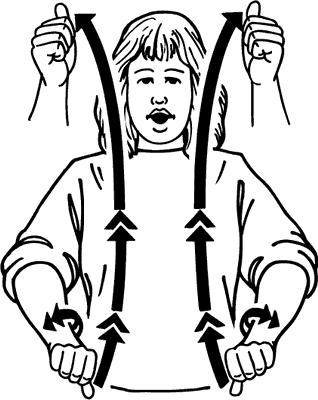
Another action that fits for Hark the herald is glory. When we worship God in a genuine way we bring him glory. The New Zealand Sign Language word for glory looks like this. Have your thumbs pointing down by your waist and then raise your arms above your head, waving your thumbs as you do.
You can really go to town with this one. Glory, glory to God in the highest.
So, as a response of worship, let’s sing and celebrate God’s gift of Jesus:
Today, because it is the third Sunday in Advent, our message focuses on joy. Joy is a positive energy, one which usually gives us a pleasant feeling and inevitably finds expression in our words and actions.
Isaiah chapter 12 has some things to say about joy. In particular joy is the product of God’s salvation and presence. From verse 1, of Isaiah 12, we read…
In that day you will say: “I will praise you, Lord. Although you were angry with me, your anger has turned away and you have comforted me. 2 Surely God is my salvation; I will trust and not be afraid. The Lord, the Lord himself, is my strength and my defence; he has become my salvation.” 3 With joy you will draw water from the wells of salvation. 4 In that day you will say: “Give praise to the Lord, proclaim his name; make known among the nations what he has done, and proclaim that his name is exalted. 5 Sing to the Lord, for he has done glorious things; let this be known to all the world. 6 Shout aloud and sing for joy, people of Zion, for great is the Holy One of Israel among you.”
May the Spirit of Jesus illuminate God’s word for us.
These verses from Isaiah 12 fit neatly into two parts. The prophet quite conveniently introduces each of the two parts with the phrase, In that day you will say, (Isaiah uses this sentence in verse 1 and then repeats it in verse 4).
This tells us Isaiah is picturing some day in the distant future. Like I said a couple of weeks ago, first the judgement, then the hope. First the demolition of Israel, then the rebuild. First the invasion by Assyria, then the restoration by Yahweh. First the grief, then the joy.
As I see it, verses 1-3 are about the joy of God’s salvation, which calls for personal acceptance.
While verses 4-6 are about the joy of God’s presence, which calls for public celebration.
The joy of God’s salvation – personal acceptance:
In the ancient world most people could not read or write. Communication was largely by the spoken word, rather than the written word. It was an oral culture.
This meant people had to be good listeners and good at remembering. It also meant if someone wanted to make their message clear they had to repeat key words. Repetition was like highlighting or underlining what you wanted to say.
When we look at the first three verses of Isaiah 12 we see quite clearly the word salvation repeated three times. We also notice the words comforted, defence and strength, which all describe different aspects of God’s salvation.
The other thing we notice is the high frequency of singular personal pronouns like I, me and my.
You have comforted me. God is my strength, my defence, my salvation.
To someone in the ancient world, the first half of Isaiah 12 is talking about God’s salvation in a very personal way. You can hardly miss it.
So what is this salvation that Isaiah is at pains to highlight?
Well, salvation denotes an act of deliverance, like when God delivered the Israelites from slavery in Egypt or when Jesus delivered the disciples from a storm on the lake.
God’s salvation is a vehicle. It is that which takes a person from a bad state of being to a good state of being. Salvation, then, is God’s means of transport.
There’s a funny line in the movie, Kung Fu Panda, where Panda finds himself at the bottom of a mountain and he says, ‘My old enemy, stairs’. Salvation for Panda, in that instance, would be an elevator. Something that would transport him to the top of the mountain easily.
Or, if you happen to find yourself in a burning plane, then salvation is a parachute. The parachute transports you safely out of a bad situation.
And of course, there is the famous salvation of Star Trek. Whenever Captain Kirk found himself in trouble on an alien planet he simply said, ‘Beam me up Scotty’, and in seconds he was transported to the safety of his ship.
You may sometimes hear Christians using the word rapture. Perhaps you have had that panicky feeling when you find yourself alone, with no one else around, and you start to wonder, ‘has everyone been raptured and I’ve been left behind’.
The word rapture has two meanings. Rapture means intense joy and it also means transport. Rapture, in a Christian understanding, is the idea that Jesus will one day transport us to where he (and God) are. This is cause for great joy. To be raptured is our salvation, our ‘beam me up Lord’ moment.
The name Isaiah actually means Yahweh is salvation.[1]God’s salvation, his means of transport from a bad situation to a good situation is multifaceted. God’s ride comes in many different forms.
As verse 1 (of Isaiah 12) makes plain, the salvation in view is the removal of God’s anger. God had been angry with Israel because of their immoral behaviour. But God’s anger does not last forever. His anger is not divorced from his care. God comes to Israel’s rescue. His salvation will eventually transport the people from a state of wrath to a state of comfort.
For the Jewish exiles, reading Isaiah’s prophecy in a foreign land, salvation meant being transported out of exile back to Zion, to Jerusalem their homeland.
What does God’s salvation mean for you, personally? What sticky, unpleasant, perhaps painful situation, do you find yourself in? What transport do you need right now?
Do you feel guilty because of something bad you’ve done? Or ashamed because of something good you haven’t done? Then the vehicle of salvation you need is forgiveness and redemption.
Do you feel hurt or angry because of some injustice or loss you have suffered? Then the vehicle of salvation you need is vindication and restoration.
Do you feel alone in a crowd, misunderstood, a stranger and out of place? Then the vehicle of salvation you need is friendship and intimacy.
Whatever your situation, the Lord knows it and he sees your heart. He understands perfectly the transport you need.
One thing I would say about God’s salvation: we don’t decide what form the transport will take. It might be a Mercedes Benz or it might be a skate board. Either way, our job is to accept God’s vehicle of salvation however he chooses to provide it.
In verse 2 we read: Surely God is my salvation; I will trust and not be afraid.
The key to accepting God’s salvation is trust. The trust that is meant here is practical not just theoretical. Trust doesn’t just say, ‘the train exists’. Trust gets on the train and allows the train to transport you. Trust believes that you will reach your destination, even though the train may go through some pretty long and dark tunnels at times.
Trust doesn’t just say, ‘God exists’. Trust holds on to Jesus and walks with him, day by day. Trust accepts the fact that Jesus will bring you home to God, even though you can’t physically see Jesus or always feel his presence.
Verse 3 gives us a wonderful metaphor: With joy you will draw water from the wells of salvation.
In the ancient middle east, people didn’t have running water coming out of a tap in their kitchen. They couldn’t jump in the shower to get clean or flush a toilet.
In the ancient world, people had to go to a communal well, a hole in the ground, and draw water out with a bucket. It was time consuming, physically demanding and a bit of a chore. Not really enjoyable. But people still did it because of necessity. You can’t live very long without water.
Verse 3 says that this mundane, labourious task will be done with joy. You are going to have energy for it. You are going to want to do it. Why? Because you are thirsty and the water of God’s salvation is good, the best you will ever taste. Salvation then is something we are drawn to by our need.
The image of wells of salvation, suggests that salvation is something we imbibe. It is something we take into ourselves. Something that is life giving. Something that sustains us and our transport.
Pilgrims travelling through the wilderness might ride a camel or a donkey or a horse. Or at least they would have an animal to carry all their stuff. At strategic points along the way they would stop at a well to let their animals drink. Sort of like we might stop to fill up our car at a petrol station.
The implication here seems to be that God’s salvation involves a journey.
Earlier in the service we read a passage from John 4 (in the New Testament) where Jesus had a conversation with a Samaritan woman at a well.
The Samaritans came about as a consequence of the Assyrian invasion that Isaiah had predicted. The Jews of that area intermarried with the Gentiles and a new race came into being. The Samaritans were sort of half Jew, half Gentile.
Historically Jews and Samaritans hated each other. But Jesus tried to find some common ground. Jesus makes himself vulnerable and asks this Samaritan woman for some water from the well.
The woman doesn’t realise that Jesus is the primary well of God’s salvation. The water Jesus has to offer is the Holy Spirit. For those who believe, Jesus and his Spirit are the means of transport home to God.
Joy is the product of God’s salvation and presence. The joy of God’s salvation calls for personal acceptance, while the joy of God’s presence calls for public celebration.
The joy of God’s presence – public celebration:
In his book, A Different Drum, Scott Peck tells the story of a monastery that had fallen on hard times. Over the years its ranks had dwindled until there were only five monks left.
In the woods near the monastery was a small hut where the Rabbi, from the local town, would sometimes go for retreat. The Abbot went to visit the Rabbi to see if he had any advice to save the monastery.
“I know how it is”, said the Rabbi. “The spirit has gone out of the people. Very few come to the synagogue anymore. The old Rabbi and the old Abbot sat in silence for a while, feeling the weight of the years, then spoke quietly of deep things.
When the time came for the Abbot to leave, they embraced and he asked the Rabbi, “Have you any advice that might save the monastery?”
The Rabbi answered, “No, I’m sorry. The only thing I can say is that the Messiah is among you.”
When the other monks heard the Rabbi’s words, they wondered what this could mean. “The Messiah is among us, here at the monastery? Do you suppose he meant the Abbot? Of course, he has been the leader for so long. On the other hand, he might have meant Brother Thomas. Thomas is so kind. Certainly he could not have meant Brother Elrod because he is often grumpy. But then again, Brother Elrod is also very wise.”
As they contemplated in this way, the old monks began to treat each other with extraordinary respect, on the off chance one of them might be the Messiah. They also thought about themselves differently.
Every human person carries the dignity of being made in God’s image. And every Christian believer carries the Spirit of the Messiah.
Because the monastery was on the edge of a beautiful forest, people occasionally came to have a look. They sensed the extraordinary respect and love between the five aging monks. The Spirit of the Messiah was indeed among them, in the way they related with each other.
Visitors became more frequent and stayed to talk with the monks. There was a real peace in the atmosphere. The brothers’ simple joy, the positive energy people felt just by being with the monks, was contagious. After a while one young man asked if he could join and then another and another. Within a few years the monastery became a thriving order once again.
Verse 6 talks about the joy of God’s presence, where it describes the Holy One of Israel being among you.
Isaiah is looking forward to that time in the future when the Lord God will walk among his people again, like God walked with Adam and Eve in the Garden of Eden. Before that could happen though, the people would feel the pain of God’s absence.
In the gospel of John, chapter 1:14, we read how Jesus fulfilled this prophecy of Isaiah. The apostle writes: The Word [that is, Jesus] became flesh and made his dwelling among us. We have seen his glory, the glory of the One and Only who came from the Father, full of grace and truth.
After Jesus had completed his work on earth he ascended to heaven and sent his Holy Spirit to be present with his church on earth. While we do not see Jesus physically in the present, we have the words of Jesus who said: ‘wherever two or three are gathered in my name, there I am among them’. The Lord also said, ‘By your love for one another will all people know you are my disciples.’
And so, the Messiah is among us now, by his Spirit.
But wait, there’s more. The Christian belief is that one day, when Jesus returns in glory to establish heaven on earth, the Lord will again dwell among us in person. In Revelation 21, the second to last chapter in the Bible, we read…
Then I saw “a new heaven and a new earth,”for the first heaven and the first earth had passed away, and there was no longer any sea. 2 I saw the Holy City, the new Jerusalem, coming down out of heaven from God, prepared as a bride beautifully dressed for her husband. And I heard a loud voice from the throne saying, “Look! God’s dwelling place is now among the people, and he will dwell with them. They will be his people, and God himself will be with them and be their God. ‘He will wipe every tear from their eyes. There will be no more death’or mourning or crying or pain, for the old order of things has passed away.”
Isaiah foresaw a time, at the fulfilment of human history, when God would live with his people. A time of great joy. Not just an inner feeling of personal joy or contentment but a public celebration of communal joy.
Verses 4-5 of Isaiah talk about the public celebration that is called for with the joy of God’s presence on earth…
4 In that day you will say: “Give praise to the Lord, proclaim his name; make known among the nations what he has done, and proclaim that his name is exalted. 5 Sing to the Lord, for he has done glorious things; let this be known to all the world.
In that day it won’t be just the thought that the Messiah is among us. We will actually see Jesus face to face.
Conclusion:
That day has not been realised in its fullness yet. Joy is the product of God’s salvation and presence. Isaiah 12 is big picture stuff. It gives a long range, Hubble telescope, view of the future.
In the meantime, what can we do to put ourselves in the path of joy…
We can take one day off in seven, a Sabbath day to rest and to renew our perspective through worship. We can also maintain regular patterns of sleep and not leave it too long between holidays.
We can make good moral decisions, choosing a lifestyle that is in line with our values. We can think about the needs of others and find ways to show kindness, without embarrassing people or leaving them in our debt.
We can carve out time for simple pleasures like losing ourselves in a good book or hanging out with friends or spending time in our garden or going for a walk. Whatever it is that helps you to let go of the pressures and worries of life.
Probably the most important thing to remember though, is that we cannot expect to feel joyful or happy all the time. It is completely normal to feel sad sometimes or angry or tired.
Some of you may have become Christians under the false expectation that, in order to be a good witness, you must always be up, always smiling, always positive, always playing the glad game. Nothing will empty you of joy quicker than pretending to be something you’re not. If the psalms teach us anything it is to be honest with ourselves and with God.
My sense is that many people in our community are feeling quite weary at present. I imagine some here don’t feel much like celebrating this Christmas. Joy may seem a long way off. But the truth is, Jesus could return for our rapture at any moment. Things can change very quickly.
Let us pray…
Father God, Lord Jesus, Holy Spirit, you are the source of our joy. Thank you for your salvation and your presence among us. Give us eyes to see the transport you provide and hearts to trust you, even in the darkness. Renew our strength and lead us in the path of peace, for your name’s sake we pray. Amen.
Questions for discussion or reflection:
What stands out for you in reading this Scripture and/or in listening to the sermon? Why do you think this stood out to you?
What is your experience of joy?
What is God’s salvation? Have you experienced God’s transport from a bad state of being to a good state of being? What happened? How did you feel? How did you accept God’s vehicle of salvation in that situation?
Discuss/reflect on the metaphor, wells of salvation. What are the implications for us?
How is the presence of the Messiah made real among us today? Can you think of a moment or a relationship in which Jesus has been real for you recently?
What can you do (practically) to put yourself in the path of joy?
Take some time this week to bring to mind the things you are thankful for. Do something to celebrate (with others) the things that have gone well.
[1] Refer John Goldingay’s NIBC on Isaiah, page 89.
Have you ever noticed how many dystopian movies there are these days? Dystopia is a term used to describe a highly dysfunctional society, in contrast to utopia which refers to an ideal society.
A dystopian film is usually set in the future with a government that is evil or corrupt. As a consequence, the people suffer in a nightmarish society, ruled by violence and fear and injustice.
Examples of the dystopian genre include The Divergent Series, The Hunger Games Trilogy, The Matrix series, Gattaca, The Running Man, Snowpiercer and Escape from New York.
The main function of these dystopian films is to critique our present day society. It’s like these movies are giving a prophetic message of what could happen if we don’t fix the problems we have now.
The Bible also critiques contemporary society but it does so without giving in to despair. The Bible critiques the present day and inspires hope by imagining a good future.
Today is the second Sunday in Christmas Advent, traditionally associated with peace. Advent is a time of consciously waiting for the peace only Jesus can bring. Jesus is the Prince of Peace. Our message this morning focuses on Isaiah 11:1-9. In this passage the prophet paints a picture of a utopian future, one of universal peace. From verse 1 of Isaiah 11, we read…
A shoot will come up from the stump of Jesse; from his roots a Branch will bear fruit. 2 The Spirit of the Lord will rest on him – the Spirit of wisdom and of understanding, the Spirit of counsel and of might, the Spirit of the knowledge and fear of the Lord – 3 and he will delight in the fear of the Lord. He will not judge by what he sees with his eyes, or decide by what he hears with his ears; 4 but with righteousness he will judge the needy, with justice he will give decisions for the poor of the earth. He will strike the earth with the rod of his mouth; with the breath of his lips he will slay the wicked. 5 Righteousness will be his belt and faithfulness the sash around his waist. 6 The wolf will live with the lamb, the leopard will lie down with the goat, the calf and the lion and the yearlingtogether; and a little child will lead them. 7 The cow will feed with the bear, their young will lie down together, and the lion will eat straw like the ox. 8 The infant will play near the cobra’s den, and the young child will put its hand into the viper’s nest. 9 They will neither harm nor destroy on all my holy mountain, for the earth will be filled with the knowledge of the Lord as the waters cover the sea.
May the Spirit of Jesus illuminate God’s word for us.
This passage from Isaiah is about the Messiah, God’s anointed King. The Messiah is empowered with a wise Spirit. He is a righteous judge. And, through his wise and just rule, the Messiah will ultimately bring about universal peace.
The Jews of Isaiah’s day were not sure who this ideal king would be, but they could be sure his wisdom and righteousness were a critique of many of Israel’s previous kings who were far from wise or just.
Christians believe that Jesus is the Messiah, the Christ. We believe Jesus will one day usher in universal, lasting peace.
Wise Spirit:
In verse 1 of chapter 11, Isaiah gives us this metaphor for the Messiah:
A shoot will come up from the stump of Jesse;from his roots a Branch will bear fruit.
Jesse was the father of king David. David’s descendants sat on the throne of Israel for many years. Some of those kings were good but many of them were rotten. God was patient but there is only so much he will tolerate.
Eventually God decided enough was enough and he brought an end to the Davidic monarchy. He cut the descendants of David off from the throne, like cutting down a tree and leaving only the stump.
In chapter 11, Isaiah foresees the day when a new king (a descendant of Jesse and David) will be restored to the throne. This new king will be different to any of the kings that went before. He will bear good fruit, the fruit of righteousness.
Two things we notice about this metaphor. Firstly, the new shoot (or the new Messiah) grows out of something considered long dead. This is a miracle of resurrection.
Secondly, waiting for this new Messiah will require some patience. What God has planned is not going to happen overnight. It will take many years for the new shoot to appear, grow and bear fruit.
In verse 2, Isaiah describes the special power and authority of this new Messiah, saying: 2 The Spirit of the Lord will rest on him – the Spirit of wisdom and of understanding, the Spirit of counsel and of might, the Spirit of the knowledge and fear of the Lord.
In other words, the Messiah will be empowered with the Spirit of God.
Wisdom, in a Biblical understanding, isn’t so much about head knowledge or being book smart. Wisdom doesn’t necessarily come from having a PhD. Wisdom is more practical than that. Wisdom is about making good moral choices and the way one lives their life day to day.
Understanding suggests being able to join the dots correctly. So, someone with good understanding can see how general principles apply in specific situations. Understanding also suggests an awareness of how people tick.
Jesus demonstrated wisdom and understanding on numerous occasions, especially when questioned by the religious leaders. One time they asked Jesus, ‘Teacher, is it right to pay taxes to Caesar or not?’
But Jesus, knowing their evil intent, said, “…why are you trying to trap me? Show me the coin used for paying the tax… Whose portrait is this? And whose inscription? …Give to Caesar what is Caesar’s and to God what is God’s.”
Wisdom and understanding you see. Jesus understood the hearts or intentions of his questioners. He also had the wisdom to know how to apply the spirit of God’s law to a specific situation, which wasn’t necessarily detailed in God’s law.
Returning to our passage from Isaiah. The Messiah will also have the Spirit of counsel and of might. Counsel here is about the right kind of strategic advice. Drawing on last week’s message, the Messiah will be a wonderful counsellor (or wonder planner), good at chess.
Might is associated with power but, in this context, it’s not so much the power of brute force. More the power of thinking smarter and having the will or courage to follow through on your convictions.
Jesus also fits the bill when it comes to counsel and might. Jesus’ counsel, if someone hits you, is to turn the other cheek. Incredibly difficult to do but an excellent strategy for minimising violence.
Not only was Jesus’ teaching on this point smart, Jesus also had the might, or the strength, to turn the other cheek and not respond with violence when he was physically beaten at his trial.
Knowledge of the Lord, means knowing God through relationship and experience. Knowledge doesn’t just mean knowing facts about God. Knowledge comes from tasting and seeing that the Lord is good. Knowledge of God is the basis of trust in God.
Fear of the Lord has to do with awe and reverence and respect for God. As Proverbs tells us, ‘the fear of the Lord is the beginning of wisdom’.
The Messiah will delight in the fear of the Lord. I quite like Abraham Heschel’s rendering of verse 3: Through the fear of the Lord he [the Messiah] will have supreme sensitivity.
Sensitivity speaks of discernment. When a woman caught in adultery was brought before Jesus, in John 8, the Lord showed supreme sensitivity in his dealing with the angry crowd and the frightened woman.
Righteous Judge:
In ancient times, if people wanted to settle a serious dispute, they might go to the king for a resolution. King Solomon, who lived many years before Isaiah, was renowned for His wisdom. People brought their disputes before him.
Famously, two women came to Solomon one day. They both lived in the same house and both had infant sons. One of the sons had died, but both women claimed the surviving child was theirs.
Solomon ordered one his soldiers to cut the living boy in two and give half to each woman. One of the women just shrugged her shoulders, she was pretty unmoved by this command. But the other woman begged the king to spare the child’s life and give the baby to her rival.
Solomon had no intention of harming the baby. It was a test to see which of the women was the true mother. Obviously the child belonged to the woman who was prepared to give up her baby to save his life.
In Isaiah 11, verses 3-4, we read…
He will not judge by what he sees with his eyes, or decide by what he hears with his ears; 4 but with righteousness he will judge the needy, with justice he will give decisions for the poor of the earth.
These verses are basically saying that the wise Messiah will be a righteous judge. He won’t give preferential treatment to someone just because they happen to be rich and powerful.
There is a famous statue of lady justice holding scales in one hand and a sword in the other. The balanced scales represent fairness and equity. While the sword represents punishment for wrong doing.
The interesting thing is that lady justice is wearing a blind fold. The message with the blindfold is that justice does not take into account a person’s race or religion or wealth or position in society. Whatever your demographic, whatever your background, your case will be decided on the evidence, not on who your parents are or how much money you have.
The inspiration for lady justice comes from passages like Isaiah 11. The Messiah will not judge by outward appearances. He will look deeper, to the heart of the issue, because things are not always as they first appear.
For example, if a widow steals a loaf of bread to feed her hungry children, then the righteous judge (who is also the king) will acknowledge the law has been broken but also look deeper as to the cause. Why is this woman so poor that she has to steal bread to feed her family?
Is it because her landlord is charging too much rent? Is it because her boss isn’t paying her enough? Or is it because someone has a monopoly on bread making and can charge whatever they want?
If the woman stole bread because the system is broken, then it’s not fair to punish her for something she has no control over. This righteous judge is also the king of the land. His word is law. He controls the system. So he can fix whatever the larger problem (with society) is.
So that’s the main idea with these verses in Isaiah 11. The Messiah is a righteous judge who looks at the heart of the matter in order to make his kingdom (his society) a fair place for everyone. A place in which widows don’t need to resort to stealing.
But let me develop this idea a bit more, because I don’t want to leave you with the false impression that the rich are evil and the poor are saints. We all know that people are more complex than that. Nor should we think that every act of wrong doing can be blamed on a faulty system. Individuals still have to take some responsibility.
The point we need to keep hold of here is that God’s Messiah does not judge by outward appearances. Sometimes needy people are hidden in plain sight.
Sometimes they are businessmen wearing suits and a thin smile to hide the emptiness they feel inside. Or they may be lampooned politicians who everyone loves to criticise. Or the tired, busy (and somewhat invisible) parent sacrificing their own needs and wants for their family.
No one liked Zacchaeus the tax collector. They all thought he was a corrupt businessman who got rich by robbing decent hard working folks. But that was more of a prejudice. They did not see his loneliness or feel his hurt at the comments people made at his expense.
Jesus did not judge Zacchaeus by what he saw or heard people say. Jesus looked deeper, beneath the outward appearance, and saw a generosity and faithfulness in Zacchaeus that was just waiting to be released. Jesus honoured Zacchaeus and the whole community was blessed, particularly the poor.
You know sometimes we judge ourselves by outward appearances. Maybe we look in the mirror and we don’t like what we see. We wish we were a different shape, with better skin or better hair or a bit taller. All superficial things, most of which we have little or no control over.
Or perhaps we get to our middle years and look back at our life, wondering what have I accomplished? What difference have I made in the world? What if I had climbed a different ladder?
In 1946, Frank Capra directed a movie called It’s a wonderful life. It’s a Christmas movie, although probably not that well known in New Zealand today.
The main character, George Bailey (played by Jimmy Stewart) is a kind man who always puts others first, at his own expense. He is a regular middle class guy, a businessman, who helps people with their finances.
His generosity to others puts him in a vulnerable position. He reaches a low point in his life and his nemesis, Mr Potter, rubs salt in the wound. Potter tells George that he is worth more dead than alive, and George believes him.
George is ready to throw in the towel but then a guardian angel comes along and shows George the good news about himself. Clarence, the angel, shows George the positive difference his hard work and kindness has made in the lives of others.
Maybe you can identify with George. Maybe you do your best to help but still end up feeling like it’s not enough somehow. That your life and efforts have fallen short of the mark. Don’t judge yourself or your efforts. You don’t know how God will use your life for good. What we do know is that God does not waste anything done in love.
Having a Messiah who is a righteous judge, saves us from judging ourselves.
Or, to put it more strongly, you have no right to judge yourself. You are not qualified. You can’t see deep enough or far enough, like Jesus can. You will either think too much of yourself (like Mr Potter) or too little (like George).
Returning to Isaiah 11. The poetry in verses 4 & 5 is vivid. It points to a Messiah (a king) with divine power.
He will strike the earth with the rod of his mouth; with the breath of his lips he will slay the wicked. 5 Righteousness will be his belt and faithfulness the sash around his waist.
The King, Isaiah has in mind, can slay the wicked with his words. That’s how wise and powerful he is.
Accountants get a bit of a hard time. I know this because I used to be one. But actually accountants have quite a bit of power to do good. You would be surprised by how helpful accounting is in pastoral ministry.
Many of us tend to like movies where the hero takes out the bad guy with a fist or a gun. The movie sets us up to hate the villain with a sense of righteous indignation. Then it satisfies our desire to see revenge.
In real life, it doesn’t necessarily play out that way. In the 1930’s it wasn’t Batman or Wonder Woman or Dirty Harry or Bruce Willis who dealt a blow to the mafia. It was actually the work of an accountant, Frank J. Wilson, who finally brought Al Capone to justice.
The Messiah pictured in Isaiah 11 doesn’t carry a gun or a sword. He doesn’t need to swing his fists. He is more like an accountant, who uses his head. The Messiah’s weapons are righteousness, faithfulness and words of truth. Possibly also a calculator (although Isaiah doesn’t mention the calculator in these verses).
Universal Peace:
God’s promised King, foreseen by Isaiah, has a wise spirit, he is a righteous judge who ushers in universal peace. In verses 6-8 we read of a utopian future…
6 The wolf will live with the lamb, the leopard will lie down with the goat, the calf and the lion and the yearlingtogether; and a little child will lead them. 7 The cow will feed with the bear, their young will lie down together, and the lion will eat straw like the ox. 8 The infant will play near the cobra’s den, and the young child will put its hand into the viper’s nest.
In this metaphor we have the hunters and the hunted; the weak and the strong; the deadly and the vulnerable; the cunning and the innocent. Each of these pairs of opposites is living together in peace, safely and without fear. When everyone knows the fear of the Lord they feel secure and are not afraid of their neighbours.
John Goldingay sums up the meaning well when he says: ‘Harmony in the animal world is a metaphor for harmony in the human world. The strong and powerful live together with the weak and powerless because the weak and powerless can believe that the strong and powerful are no longer seeking to devour them.’ [1]
Verses 6-8 are a metaphor about how the world will be when the fruit of the Messiah’s reign is realised in its fullness. It is life as it will be when Jesus returns in glory. This is paradise on earth, at the dawn of a new age.
For this utopian future to be realised, the hearts and minds of the whole world need to be transformed by experiential knowledge of the Lord. Verse 9 reads…
9 They will neither harm nor destroy on all my holy mountain, for the earth will be filled with the knowledge of the Lord as the waters cover the sea.
This is telling us something that is hard to believe – that the peace will be universal. The peace is not limited to a particular holy place. The peace fills the whole earth, like the waters cover the sea. Think about that for a moment. The waters of the sea of peace are deep, inexhaustible and full of life.
In that day preachers, like me, will be out of a job. We won’t need to explain the Scriptures to you because the reality to which the Scriptures point (that is, Jesus the Messiah) will be real in people’s lived experience.
Conclusion:
Sadly, this is not life as we experience it now. This utopian vision of universal peace is a critique of the present world in which weak and vulnerable people are often taken advantage of by ruthless and greedy individuals. This world is still a dangerous place. So don’t go putting your hand in a snake’s nest.
Although universal peace is not a reality for us yet, personal peace with God is possible now through faith in Jesus. Jesus’ death on the cross and his resurrection from the dead opens the door to friendship with God.
Grace and peace be yours in abundance.
Questions for discussion or reflection:
What stands out for you in reading this Scripture and/or in listening to the sermon? Why do you think this stood out to you?
Do you have a favourite dystopian film? What is it and why do you like it? What critique might this film be making about our society today?
What does Isaiah’s metaphor of a shoot growing out of a dead stump reveal about God’s promised Messiah?
What does Isaiah have in mind when he talks about the Spirit of wisdom, counsel, understanding, might and fear of the Lord? Can you think of examples from the gospels where Jesus demonstrates this Spirit of wisdom?
Do you judge yourself? Where does this lead? Why is it important to leave judgement (of ourselves and others) to Jesus?
Discuss / reflect on the metaphor of the animals in verses 6-8. What is Isaiah saying with this word picture? Can you imagine a world like that?
[1] Refer John Goldingay’s commentary on Isaiah, page 85.


 Tawa Baptist