Scripture: 1st Thessalonians 5:1-11
Video Link: https://youtu.be/N0JwN1MmGmc
Structure:
- Introduction
- Take a long view
- Be prepared
- Conclusion
Introduction:
Good morning everyone.
As many of you know there is a residential care facility (a home) for older people at the southern end of Tawa called Longview. Originally it was a facility for people who were blind.
When you sit in one of the north facing lounges, the name makes sense. Situated as it is, on a hill, you can see right down the valley. You do in fact get a long view, as the name suggests.
Thinking metaphorically, the term long view describes an approach to a problem or situation that emphasises long range factors.
People who save for their retirement take a long view of their life.
People who plant native trees strategically, take a long view of the environment.
A government that invests wisely in education is taking a long view of the country’s future.
We can take a long view of the Covid pandemic by reminding ourselves that these sorts of things come around every 100 years or so and normally run their course after 3 or 4 years.
Today we continue our series in Paul’s letter to the Thessalonians, focusing on chapter 5, verses 1-11. Last week we heard how Paul reassured the Thessalonian believers who were concerned about those who died before Jesus’ second coming. Paul said they would not be disadvantaged in any way.
This week’s passage continues the theme of Jesus’ second coming with the same tone of reassurance. In these verses Paul encourages the Thessalonians to take a long view and to be prepared. From chapter 5, verse 1 we read…
Now, brothers and sisters, about times and dates we do not need to write to you, 2 for you know very well that the day of the Lord will come like a thief in the night. 3 While people are saying, “Peace and safety,” destruction will come on them suddenly, as labour pains on a pregnant woman, and they will not escape.
4 But you, brothers and sisters, are not in darkness so that this day should surprise you like a thief. 5 You are all children of the light and children of the day. We do not belong to the night or to the darkness. 6 So then, let us not be like others, who are asleep, but let us be awake and sober.
7 For those who sleep, sleep at night, and those who get drunk, get drunk at night. 8 But since we belong to the day, let us be sober, putting on faith and love as a breastplate, and the hope of salvation as a helmet. 9 For God did not appoint us to suffer wrath but to receive salvation through our Lord Jesus Christ. 10 He died for us so that, whether we are awake or asleep, we may live together with him. 11 Therefore encourage one another and build each other up, just as in fact you are doing.
May the Spirit of Jesus illuminate God’s word for us.
Paul is using a lot of metaphors in these verses. If we boil it all down though, his message seems to be that when it comes to waiting for Jesus to return, we need to take a long view and we need to be prepared.
Or said another way, taking a long view helps us to be prepared for Christ’s return.
Take a long view:
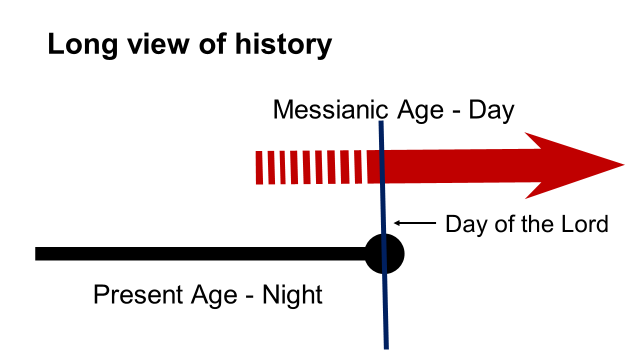
The Bible thinks of history in two ages or two epochs. The first epoch of history is the present age, which is characterised by evil. And the second epoch we might call the Messianic age, which is characterised by the reign of King Jesus.
Paul uses the metaphor of night and day (darkness and light) to describe these two ages. The present age is like night time and the Messianic age is like the new day.
There is an overlap between the present age of darkness and the Messianic age of light. The Messianic age started with Jesus’ coming 2000 years ago and will continue eternally. The present age is still going but will eventually come to an end with the return of Jesus.
We live in the overlap between Jesus’ first coming and his second coming. During this time of overlap, the Kingdom of God is sometimes described as ‘now but not yet’. Or, ‘now, but not fully realised’.
We might catch glimpses of heaven on earth but generally speaking this world (the time in which we live) is a bit of a mixed bag really. The best is yet to come for those who are in Christ.
The point at which Jesus returns and the present age ends is sometimes called the Day of the Lord.
In verses 2-3 Paul writes…
2 for you know very well that the day of the Lord will come like a thief in the night. 3 While people are saying, “Peace and safety,” destruction will come on them suddenly, as labour pains on a pregnant woman, and they will not escape.
‘The day of the Lord’ is a phrase borrowed from the Old Testament. It describes a period of time (not necessarily 24 hours) in which God intervenes in human history to save and to judge.
So the day of the Lord is both a day of salvation and a day of judgment. A day of deliverance for some but also a day of destruction for others. Like when God saved the people of Israel from slavery in Egypt. That was a time of deliverance for Israel, but a time of death and destruction for Egypt.
Or going back further to the time of the great flood. That was a time when God intervened to judge the people of the earth for their evil deeds. But it was also the beginning of a new day, a new start for creation, with Noah and his family.
Paul’s words, in these opening verses from Thessalonians 5, echo the words of Christ. Jesus talked about his return coming like a thief in the night. No one knows the day or the hour.
There are two images in these verses; that of a thief and that of a pregnant woman. Burglars don’t make an appointment to rob people’s houses. So the image of a thief tells us that Jesus’ second coming will happen at a time when people least expect it. It will take people by surprise.
The image of a pregnant woman adds a different nuance. Labour pains, for a pregnant woman, are expected. They are certain and unavoidable. When a woman is heavily pregnant there is no turning back. The baby has to come out one way or another.
Put the two images together and the thought is: the day of the Lord (when Jesus returns) will certainly happen (no one can escape it) but it will happen at a time when no one expects.
Now, this idea that the day of the Lord means salvation for some people and destruction for others can be a little unsettling. It raises the question, what will happen to me and the people I love? Because you don’t want to be on the wrong side of the Lord when he returns.
Both John the Baptist and Jesus preached a message of repentance. They said, the day of the Lord is certainly coming and so you need to get your life in order. You need to make sure that your hearts and minds and way of living are acceptable to God, so that you are not destroyed along with evil.
But Paul’s purpose is not to frighten the Thessalonians. His purpose is to encourage them. They were persecuted. They were getting a hard time from their pagan neighbours. Paul is not telling the believers to repent. They have already done that. He is reminding them to take a long view of history.
The fact that the day of the Lord is certainly coming is a comfort to the beleaguered church. It means they will be delivered from the pagans who are treating them unfairly.
It’s like that famous line preached by Martin Luther King: The arc of the moral universe is long, but it bends towards justice. That’s good news if you are oppressed. But it’s bad news for the oppressors.
From verse 4 Paul reassures the Thessalonian believers that they are on the right side of the Lord…
4 But you, brothers and sisters, are not in darkness so that this day should surprise you like a thief. 5 You are all children of the light and children of the day. We do not belong to the night or to the darkness.
For those who are in Christ, the day of the Lord is not like a thief. Rather Jesus’ return is like the dawn of a new day.
Paul says: you are all children of the light and children of the day. ‘Light’ is an image for God. Paul is saying you are all children of God. To be a child of God is to belong to God’s family and to get our identity from Him. To bear his image.
The word ‘day’ in these verses refers to the new day, the new epoch, the Messianic age, when the kingdom of God is realised in its fullness. To be ‘children of the day’, therefore, means that anyone who is in Christ belongs to the Messianic age and will not be destroyed.
Paul is comforting the Thessalonians by showing them a long view of history. Taking a long view helps us to be prepared.
Be prepared:
The Thessalonians are children of the day in more than name only. Being children of the day carries with it a responsibility to conduct ourselves in a way that is appropriate to daytime behaviour. From verse 6 we read…
6 So then, let us not be like others, who are asleep, but let us be awake and sober. 7 For those who sleep, sleep at night, and those who get drunk, get drunk at night. 8 But since we belong to the day, let us be sober,
Once again Paul is using metaphors or word images to get his idea across. It’s not that the Thessalonians were alcoholics. They did not need to be reprimanded about their drinking habits.
When a person is drunk they are not in control of themselves. By saying, don’t be like those who get drunk and fall asleep, but be sober and awake, Paul is saying exercise self-control.
We can’t control what other people do, nor can we control when the Lord will return. The best we can do is control ourselves so we are prepared for Jesus’ coming.
Getting drunk is also about excess. So the idea here is to avoid excess of any kind (not just excess alcohol). As we wait in the overlap, the now but not yet, we want to live a balanced life.
On one level, living a balanced life is about making sure our rhythms of work, play and sleep are in order. Making sure we pay attention to the needs of our body and soul. Looking after ourselves. Building fun and enjoyment into our lives and not always being a slave to duty. Making sure we get the mix of solitude and social interaction right for our personality and stage of life.
On another level, living a balanced life is about managing our thoughts and feelings and not becoming too fixated on just one thing. Children of the light avoid getting stuck in a rut with the same old patterns of thought.
When Paul says, don’t be asleep but be awake, he is talking figuratively. He doesn’t mean we should not get a good night’s sleep. He means, be prepared for Christ’s coming. (Incidentally, good rhythms of literal sleep actually support us to be awake and prepared.)
I like Gordon Fee’s turn of phrase in relation to these verses. He says (and I paraphrase), being prepared is not about living up-tightly but living uprightly. [1]
Did you get that? Being prepared is not about living up-tightly but living uprightly. If we are always on edge, thinking: ‘I must be good, I must be good. Jesus could comeback at any moment. I don’t want to be left behind’, then we will end up having a nervous breakdown.
There is enough anxiety in the world without adding to it. Paul doesn’t want the Thessalonians to be fearful or uptight. He is well aware of the present difficulties they are facing and, with that in mind, he is urging them to be prepared; to live righteously and without fear of what the future holds.
Getting prepared for the day of the Lord is not something we can leave to the last minute. John Stott offers some helpful illustrations for guiding our understanding of what it means to be prepared…
It’s too late to prepare for an exam at the moment the exam paper is set in front of you. You have to put in hours of study before that. Likewise, it is too late to prepare for a marathon when the starting pistol goes off. It takes months of training and discipline to get ready for a marathon.
And, living in Wellington, we might add: it is too late to prepare for an emergency when the earthquake strikes. You need to have your emergency water supply and canned foods in place before that happens.
In verse 8 Paul brings out another metaphor for how believers are to prepare for Jesus’ return, saying…
8 But since we belong to the day, let us be sober, putting on faith and love as a breastplate, and the hope of salvation as a helmet.
The first thing we notice here is the triad of faith, love and hope. Paul had talked about these three at the beginning of his letter. Faith, love and hope are at the core of what it means to be a follower of Christ.
Paul uses this image of Christians equipping themselves for spiritual battle in a couple of other letters as well. Most likely he is drawing on Isaiah 59 where the Lord God (Yahweh) dresses himself in military armour as he sets out to achieve justice in the world.
A breastplate protects your heart and a helmet protects your head. They are defensive, not offensive. Paul is not encouraging the Thessalonians to attack their enemies. He is encouraging them to be prepared for when they come under attack.
Living in the overlap is a dangerous place to be, spiritually speaking. We might not suffer persecution like the Thessalonians, but the world in which we live is not altogether friendly to the followers of Christ either.
What then does it mean to put on the armour of faith, love and hope. Well, armour doesn’t put itself on. It’s not like Iron Man’s suite of armour which automatically wraps itself around Robert Downey Junior. To get dressed in military equipment we must be intentional. It won’t happen by itself.
One tried and true method by which Christians have equipped themselves with faith, love and hope is something called a rule of life. A rule of life is a schedule or rhythm of practices that one carries out each day and each week.
This rule of life is designed to train our bodies and our minds to be more like Christ. You might tailor your rule of life to suit your spiritual needs or the shape of your soul, much like a personal trainer at the gym might tailor a work-out programme to meet your fitness goals.
A rule of life could include things like starting each day with prayer and Bible reading.
Taking one day off in seven to rest and worship.
Drinking alcohol in moderation or not drinking at all.
Opening your home in hospitality to others on a regular basis.
Ending each day by writing in your thankfulness journal.
Not having any screen time 2 hours before going to sleep at night.
Getting 40 minutes of physical exercise each day.
Taking half an hour to be completely still and silent, three or four times a week.
Meeting weekly with other believers to pray and share and study the Bible.
Some form of service to the community.
Devoting a certain percentage of your income in worship to God.
Trying not to work more than 50 hours a week in your paid job.
And, if you are married, setting aside regular time to listen to your spouse
And, if you have children in your life, reading to them.
The thing about a rule of life is that you follow the rule even when you don’t feel like it, so that you develop moral and spiritual fitness. In this way we are prepared for being at odds with the world and we are ready for Jesus’ return.
Whatever your rule of life is, it needs to include times and places when you can take your armour off and relax a bit. We each need to find sanctuary, or safety, with other believers, when we can let down our guard and allow others in.
Do you have an intentional rule of life? If you don’t, then make it your goal this week to develop a plan for one.
Now, please don’t feel burdened by this. That was never Paul’s intention. To the contrary, Paul was wanting to lighten the Thessalonians’ burden (and ours) by encouraging us to take a long view and by reminding us that our salvation does not depend entirely on us.
From verse 9 Paul says…
9 For God did not appoint us to suffer wrath but to receive salvation through our Lord Jesus Christ. 10 He died for us so that, whether we are awake or asleep, we may live together with him.
We might hear the word wrath and immediately alarm bells go off so that we don’t hear what follows. But if we pay attention to what Paul is saying, the main thought is that our salvation does not depend on our performance or the shifting sands of our feelings. It depends on God.
Our salvation is by God’s initiative and through Jesus’ sacrifice. Therefore, we don’t have to live up-tightly, we are free to live uprightly.
With the phrase, God did not appoint us to suffer wrath, we need to be careful not to take Paul’s words in a direction he never intended. It is not that we human beings have no choice in the matter. It’s not that God chooses for some people to suffer wrath and others to be saved.
God wants all people to be saved but, at the same time, he respects the choices people make, even if that choice is to reject him.
Like I’ve said in other sermons, God’s wrath is not an emotional or uncontrolled flare up of anger. God’s wrath is measured and fair. God’s wrath is his settled and righteous opposition to evil.
God’s love means that he cannot tolerate evil indefinitely. The long view is that, ultimately, God intends to destroy evil. That is good news. God is the one who bends the arc of the moral universe toward justice.
The words in verse 10, about being awake or asleep, are metaphors for being alive or dead when Christ returns. They refer back to the concerns Paul dealt with at the end of chapter 4. For believers, it makes little difference whether we are alive or dead at Jesus’ second coming, for we will all be reunited with him.
Conclusion:
Paul finishes this section of his letter by saying…
11 Therefore encourage one another and build each other up, just as in fact you are doing.
This tells us that Paul’s purpose in sharing this stuff about the Day of the Lord is not to scare people but to give believers courage to carry on.
Life was tough for the Thessalonians because they identified with Jesus. It was important that they looked out for one another and had each other’s backs.
Life is tough for us at times too. Not in the same way exactly, but it can still be a grind as we wait for our salvation to be realised in its fullness. The opposition we face today is perhaps more subtle, less overt.
In any case, it is important that we look out for each other too. To do this we need keep in touch with one another regularly and not neglect meeting together. But I hardly need to tell you to build each other up with kind words and expressions of trust, for you are already doing that.
Let us pray…
Almighty God, you see the beginning from the end. Thank you for including us in your plan of salvation. Thank you for the forgiveness that is ours through faith in Christ. Grant us the grace to take the long view that we would be prepared when Jesus returns. Help us to live uprightly, not up-tightly. Through Jesus we pray. Amen.
Questions for discussion or reflection:
- What stands out for you in reading this Scripture and/or in listening to the sermon? Why do you think this stood out to you?
- What does it mean to take a long view? When is it helpful to take a long view?
- What is the day of the Lord? How does the day of the Lord make you feel? (E.g. comforted or full of dread, or indifferent, or something else.) Why is that do you think?
- Discuss / reflect on the two epochs / ages of history. How might this long view of history shape our thinking and behaviour in the present?
- What practical things can we do to be prepared for Jesus’ return? Do you have an intentional rule of life? If so, what is your rule of life? If not, how might you go about developing a rule of life?
- Why did Paul write about the Day of the Lord (Jesus’ second coming) in his letter to the Thessalonians?
- How might we encourage one another and build each other up, as Paul instructs in verse 11?
[1] Gordon Fee’s NICNT The First and Second Letters to the Thessalonians, page 200.

 Tawa Baptist