The Prophet

Scripture: Deuteronomy 18:9-22

Video Link: https://youtu.be/auVnpWoDedM

Structure:

  • Introduction
  • Choose a future with hope
  • Listen to God’s prophet
  • Conclusion

Introduction:

Good morning everyone.

What would you give to know the future?

If you knew exactly when an earthquake or fire was going to destroy your property, you would get insurance cover for that period, but you wouldn’t bother getting cover for the rest of the time.

Likewise, if you knew someone was going to be involved in a car accident tomorrow, you would hide their keys and keep them home for a day. 

What would you give to know the future?

Today we continue our series in Deuteronomy, focusing on chapter 18. In this passage Moses deals with the question of how God’s people are to manage themselves in the face of an unknown future. From Deuteronomy 18, verses 9-22 we read… 

When you enter the land the Lord your God is giving you, do not learn to imitate the detestable ways of the nations there. 10 Let no one be found among you who sacrifices their son or daughter in the fire, who practices divination or sorcery, interprets omens, engages in witchcraft, 11 or casts spells, or who is a medium or spiritist or who consults the dead. 12 Anyone who does these things is detestable to the Lord; because of these same detestable practices the Lord your God will drive out those nations before you. 13 You must remain completely loyal to the Lord your God.  14 The nations you will dispossess listen to those who practice sorcery or divination. But as for you, the Lord your God has not permitted you to do so. 15 The Lord your God will raise up for you a prophet like me from among you, from your fellow Israelites. You must listen to him. 16 For this is what you asked of the Lord your God at Horeb on the day of the assembly when you said, “Let us not hear the voice of the Lord our God nor see this great fire anymore, or we will die.” 17 The Lord said to me: “What they say is good. 18 I will raise up for them a prophet like you from among their fellow Israelites, and I will put my words in his mouth. He will tell them everything I command him. 19 I myself will call to account anyone who does not listen to my words that the prophet speaks in my name. 20 But a prophet who presumes to speak in my name anything I have not commanded, or a prophet who speaks in the name of other gods, is to be put to death.” 21 You may say to yourselves, “How can we know when a message has not been spoken by the Lord?” 22 If what a prophet proclaims in the name of the Lord does not take place or come true, that is a message the Lord has not spoken. That prophet has spoken presumptuously, so do not be alarmed.

May the Spirit of Jesus illuminate God’s word for us.

There are two halves to today’s message: The first half is about choosing a future with hope. And the second half is about listening to God’s prophet. Let’s start by choosing a future with hope. 

Choose a future with hope:

Another question for you to consider: Is the future fixed?

There are some who believe the future is fixed and there’s nothing we can do to change it. These people think the future is up to fate.

Believing the future is set in stone comes with a number of problems. For one thing, it undermines hope and creates a sense of apathy or despair in the person who thinks this way.

If you really believe the future is pre-determined and there’s nothing you can do about it, then you will be inclined to care less. A fixed future is devoid of any ethical considerations. If I can’t change the future, then my actions in the present don’t matter. I may as well do whatever makes me feel good. You become reckless and lose your sense of responsibility. A rebel without a cause.

At the other extreme, there are those who don’t believe the future is fixed at all. They think we create our own future. These people have a strong belief in themselves and their own abilities. They tend to be quite driven or intense.

If you really believe the future depends entirely on you, then that’s a lot of pressure. That comes with heaps of worry and not much peace. Human beings need some freedom but total freedom is a terrifying thing. If you go sky diving you don’t want to be free of your parachute, that would be disastrous.  

The person who believes the future is totally on them tends to take on too much responsibility. They don’t leave room for God to do something unexpected.

Just as there is no hope in thinking it is all up to fate, there is no real hope in thinking it is all up to you either. Because when you fail yourself, and everyone does fail eventually, you have no safety net.  

We are asking the question: is the future fixed? Somewhere in the middle of the spectrum are those who answer both ‘yes’ and ‘no’. Some things are fixed but not everything. We can have some influence over the future, but there are other things we have no control over and simply have to accept.

Hope is the capacity to imagine a better future, a good future, the best is yet to come. If you believe the choices you make matter in shaping the future, but that it doesn’t depend entirely on you, that ultimately God will work it all for good, then you have hope.

There are of course those who might say, I don’t know whether the future is fixed or not. That might be because they are too lazy to wrestle with the hard questions. Or it might be because the future has ambushed them and they are not sure of anything at the moment.    

Deuteronomy believes that ultimately God is in control of the meta-narrative of human history, but the choices human beings make still influence the course the future takes. God uses our choices in shaping the future. To obey God, in faith, is to choose abundant life. To receive Christ, in faith, is to choose a heavenly future, beyond this life.  

In verses 10-11 of Deuteronomy 18, Moses lists several things the Israelites are not to do. No divination, no magic, no witchcraft, no child sacrifice, no consulting the dead and so on. This list illustrates the sorts of things people sometimes do in order to try and know the future or even control the future.

There are still people today, in New Zealand, who do this kind of stuff. People who try to predict the future by reading tarot cards or tea leaves or the stars. Or, maybe they try to control the future by casting spells or sacrificing the wellbeing of their children in order to pursue a love affair or some other fantasy.

These people either believe the future is fixed and cannot change or they believe they create their own future. Either way, their hope is not in God. The Lord hates all this witchy poo stuff because it is based on a lie and it destroys people’s capacity for hope. It’s takes away people’s freedom. It is not good for the human soul.

There may be some here who have dabbled in this sort of thing, or maybe you’ve got in over your head. Perhaps you were at a fair ground one day and out of curiosity you got your palm read by Madam Zelda. Or maybe you were grieving for a loved one and went to a medium to try and contact them. Or perhaps you and your friends had too much to drink one night and tried a séance. Or maybe you’ve done worse.   

Does this mean you are excluded from God’s people forever? Is there no hope for you? Well, not necessarily.

Your future is not yet set in concrete. You have some influence over your future. You can choose not to do that sort of thing anymore. You can choose life and trust your future to Jesus. God, who loves you very much, has the power to deliver you from your past.  

The message of Deuteronomy is summed up in verse 13, which reads…

You must remain completely loyal to the Lord your God.

We must not divide our loyalty between God and anything else. We can’t say, in God we trust, and then rely on horoscopes or gazing into a crystal ball. 

Verse 13 is another way of saying, Love the Lord your God with all your heart, with all your soul and with all your strength. This is how we choose life and a future with hope for ourselves.

Okay, that’s first part of our message, choose a future with hope. The second part is about listening to God’s prophet. God, in his grace, provides an alternative to airy fairy magic. God is willing to reveal the future through his chosen spokesperson.  

Listen to God’s prophet:

In verse 15 of Deuteronomy 18, Moses says: The Lord your God will raise up for you a prophet like me from among you, from your fellow Israelites. You must listen to him.                                                          

Israel did not need to go to a medium or a spiritist to find out the future. God sent his own messenger. In fact, God raised up a series of prophets throughout the Old Testament who spoke His messages to the people as they needed it. Men and women like Samuel, Deborah, Nathan, Isaiah, Huldah, Micah, Jeremiah, Amos, Ezekiel, Daniel and so on. These prophets had a special role in keeping the nation accountable to the Law and their covenant with Yahweh.

In a healthy democracy the government’s powers are not concentrated in one person or one institution. Rather, power is separated, so the people who make the law are not the same as the people who enforce the law or decide disputes.

Traditionally, a democracy has three official institutions:

There is the legislature, which is the people who make the laws (for example, our Members of Parliament).

Then there is the judiciary, which are the people who adjudicate disputes (the courts and the judges).

And thirdly, there is the executive, which are the people who enforce the law (that would be the police).

There is another (unofficial) institution known as the fourth estate. We call it the news media; that is, journalists or the press. It is the job of the news media to report the facts concerning parliamentary, police and court proceedings, in a balanced and unbiased way, keeping the governing authorities accountable

In some ways our modern democracy, with its four estates, has its roots in the structure of government Moses prescribed for Israel. Yahweh (and Moses) recommended a separation of power in government.

Yahweh gave the Law through Moses. Judges were appointed in a democratic way to adjudicate disputes between people. And the Levites and priests had a role in enforcing the law.

The king (as we heard last week) was an optional extra. It wasn’t his job to make the law. His main job was to be a good example in keeping the law. He might also support the judges and the priests in making sure justice was done.

But it was the role of the prophets to be the fourth estate. The prophets were like credible investigative journalists who reported the facts in order to keep the king, the judges and the priests accountable to God’s law. Staying loyal to Yahweh was the key to life and a future with hope.

Now, in using this analogy, I do not mean to imply that journalists today are the contemporary prophets of our world. God can choose whoever he wants to be his spokesperson.

We might also think of God’s prophet as a doctor, diagnosing illness in the nation. If you have diabetes, you don’t want the doctor fudging your results and saying you will be fine. You need to understand clearly what the problem is and how best to manage your health going forward, so you have a future with hope.

Likewise, if God’s people are losing their saltiness and conforming to the pattern of this world, then they need God’s prophet to diagnose their spiritual illness and prescribe the right treatment to restore them.

Asking the prophet for advice was sort of like phoning a friend. If something was amiss and the king or the priests or the judges were unsure what to do next, they could inquire of God through his chosen prophet.

Of course, the prophet also passed on messages from God when no one had asked for his input. Like when the prophet Nathan confronted David after the king had murdered Uriah and committed adultery with Bathsheba. 

God’s prophet was a friend to Israel, but he (or she) was not in the king’s pocket. The prophet was a step removed, operating outside official government channels, able to give an unpopular minority report.

In verse 18 of Deuteronomy 18, the Lord says concerning his prophet, I will put my words in his mouth. This naturally raises questions for us: how did God do that? How did the Lord communicate with the prophets?

Reading through the Old Testament we notice the Lord spoke to the prophets in a variety of ways. It appears that God spoke to Moses and Samuel in a clear, audible voice. Other prophets, like Daniel & Ezekiel, received dreams or visions. Some may have interacted with angels. Elijah heard God not in earthquake, wind or fire but in a still small voice, like a whisper.

I’m not a prophet. I can’t tell you what the future holds specifically. I don’t know when the war in Ukraine will end. Nevertheless, there are times when I sense the word of the Lord has come to me. Not in an audible voice as such. More like a thought planted in my mind.

I know the thought is not my own because it is a better quality thought than the usual rubbish that flows through my brain and it is not a thought I’ve had before. It hasn’t come from any book I’ve read or any TV show I’ve watched.

It is new to me and it feels whole. It fits for the circumstances I’m in. Like the missing piece of a jigsaw puzzle, it creates connections and makes sense of other things. God’s word brings order to my thinking.

When the word of the Lord comes, I have to take myself off somewhere quiet and write, because writing helps me to listen to the virgin thought. 

There are times when I’m preaching in church and a stillness comes over the congregation. A kind of holy hush. (I’m sure it happens for other preachers too.) The traffic noise dies down, the rustling of lolly wrappers ceases and people stop coughing or whispering among themselves. I love those moments. In that stillness it seems to me the word of God is at work among us, in our hearts.

I believe the word of the Lord can come to any Christian believer, just not always in the same way. God made us with the capacity to receive his word, to sense his presence touching our spirit.

We cannot control when or how the word of the Lord comes but when it does come we need to pause and listen. Receive it into ourselves.

I wonder how the word of the Lord comes to you.

As God’s spokesperson, the Lord’s chosen prophet held quite a bit of influence in Israel. So there would inevitably be a few pretenders for the role, despite the severe punishment for taking the Lord’s name in vain. How then could you tell who was a bona fide, God authorised prophet and who was a fake? Well, there were three main tests…

Firstly, a true prophet of God speaks in the name of Yahweh and not in the name of some other god. Secondly, the message they preach comes true. And thirdly, they don’t say anything that contradicts the Law of Moses.

The first test, speaking in the name of Yahweh, is the test of clarity. Reading tea leaves or interpreting the entrails of a bird are pretty ambiguous and unclear signs. In contrast to this, the Lord’s prophets are clear about who they represent and what their message is.

Although the poetry and signs of the prophets of old may seem strange to us, their metaphors were not difficult for the people of that time to decipher, even if the prophet’s message was difficult to accept.

John the Baptist, the last of the Old Testament prophets, was very clear in his message of repentance, calling the religious leaders of his day a brood of vipers. Despite this clarity, many religious leaders hardened their hearts and chose not to believe John’s testimony concerning Jesus.

The second test, proclaiming a message that comes true, indicates the prophet’s words are verifiable. God’s messages are ‘evidenced based’, in other words. The truth of God’s word is worked out in human history.

We know Jeremiah was legit because his message came true in history. While other self-proclaimed prophets at the time were saying, “Don’t be afraid of Babylon, God will save Jerusalem”, Jeremiah was giving the very unpopular message of, “Don’t resist Babylon, you can’t win”. God upheld Jeremiah’s words because Jeremiah’s words were actually God’s words.     

Centuries later, Jesus (like Jeremiah) wept over Jerusalem when he could see history about to repeat itself. In Luke 19, Jesus predicted the Romans laying siege to the holy city and destroying it. This happened, as Jesus said, in AD 70.

There is a small catch with the verifiable test though. Sometimes true prophets are killed before their predictions can be verified.

The third test of a true prophet, that their message does not contradict the Law of Moses, is the test of consistency. God’s word is consistent. God does not contradict himself.

Jesus criticised the religious leaders for making their man made rules more important than God’s Law. The Pharisees had become so bogged down in the details they couldn’t see the wood for the trees. They were more loyal to their own tradition than they were to God himself and so, like the true prophet he is, Jesus called them out on their blindness.

As you have probably deduced by now, Jesus is the ultimate prophet to succeed Moses. Jesus fulfils the Law and the prophets. Through faith in Jesus, we can know the truth from God and we can choose a future with hope.

Does that mean then, that we have no further need for prophets? Well, no. In his letters to various churches the apostle Paul writes about the gift of prophecy. For Paul it was one of the more important spiritual gifts.

Of course, if someone claims to bring a word of prophecy, we (the church) still need to test that word and discern together if it is legitimate. The threefold test is similar. A true prophet speaks clearly in the name of Jesus. Their message is verifiable and it is consistent with the teachings of Jesus.

The Spirit of Jesus is a Spirit of grace & truth, so we would expect the prophets of Jesus to embody the same Spirit of grace & truth.

Conclusion:

At the beginning of this message I asked the question: What would you give to know the future?

A better question to ask is: What would you give to know Jesus?

I say that’s a better question because Jesus is the future, the eternal future. Jesus is the goal of humanity. He is our hope. If you want to know the future, get to know Jesus. Most of us know Jesus to some degree but none of us knows him completely or fully yet. May we grow deeper in our knowledge of and trust in Christ.

Let us pray… 

Father God, we thank you for not leaving us in the dark. We thank you for revealing your will to us through Jesus. We thank you too for offering us a future with hope. May you empower us by your Spirit to be completely loyal to Christ, for your glory and our own salvation. Amen.         

Questions for discussion or reflection:

What stands out for you in reading this Scripture and/or in listening to the sermon? Why do you think this stood out to you?

  • What would you give to know the future? What is it you would want to know and why?
  • Where would you place yourself on the spectrum between a fixed future and a fluid future? What are the implications of thinking the future is fixed? What are the implications of thinking we create our own future?
  • How do we choose life and foster a future with hope?
  • Why does Moses outlaw discerning the future through magic, reading omens, consulting the dead, etc.?
  • Has the word of the Lord ever come to you? What happened? What did the Lord say? How did you respond?
  • How might we test / know whether a prophecy is true or not?   
Servant King

Scripture: Deuteronomy 17:14-20

Video Link: https://youtu.be/nCG_TxxcEk0

Structure:

  • Introduction
  • Optional
  • Secure
  • Exemplary
  • Conclusion

Introduction:

Good morning everyone.

Did you know there are currently 29 monarchs in the world today? That is, 29 kings or queens who rule over 44 countries.

Only three of these monarchs have absolute power over their country. The Sultan of Oman, the King of Saudi Arabia and the Pope who is king of the city state of the Vatican.

Most of the monarchies are constitutional, which means the king or queen has their power restrained by law. So, for example, King Charles III can’t do whatever he wants.   

Today we continue our series in Deuteronomy. In chapter 17, Moses outlines some requirements for Israel’s king. These are like constitutional rules to moderate the powers of the king. The kings, in ancient Israel, had more power than the King of England does today but they did not have absolute power.  From Deuteronomy 17, verses 14-20 we read…

14 When you enter the land the Lord your God is giving you and have taken possession of it and settled in it, and you say, “Let us set a king over us like all the nations around us,” 15 be sure to appoint over you a king the Lord your God chooses. He must be from among your fellow Israelites. Do not place a foreigner over you, one who is not an Israelite. 16 The king, moreover, must not acquire great numbers of horses for himself or make the people return to Egypt to get more of them, for the Lord has told you, “You are not to go back that way again.” 17 He must not take many wives, or his heart will be led astray. He must not accumulate large amounts of silver and gold. 18 When he takes the throne of his kingdom, he is to write for himself on a scroll a copy of this law, taken from that of the Levitical priests. 19 It is to be with him, and he is to read it all the days of his life so that he may learn to revere the Lord his God and follow carefully all the words of this law and these decrees 20 and not consider himself better than his fellow Israelites and turn from the law to the right or to the left. Then he and his descendants will reign a long time over his kingdom in Israel.

May the Spirit of Jesus illuminate God’s word for us.

Three words to organise our thoughts on this passage: optional, secure and exemplary. Israel’s human king is optional, not compulsory. He is to be secure in the Lord, not anxious. And he is to be exemplary, not a law unto himself. Let’s start with this idea that the king is optional not compulsory.  

Optional:

I’m guessing almost everyone listening to this has a TV or some other device for watching TV in their home. TV’s are an optional extra. They may feel like a necessity but in actual fact they are optional.

You can go through your whole life without watching TV and be quite okay. Human beings survived without TV’s for thousands of years. In fact, TV’s weren’t invented until the 1930’s and they didn’t become common place in people’s homes until the 1950’s and 60’s.  

If you have young children living with you, then you probably want to delay TV watching for them as long as you can. Eventually though, they will go to school or to a friend’s house, become aware that TV’s exist and not want to miss out.

When that day comes, and you are no longer able to withhold the flat screen, as parents you will want to decide how much TV your kids watch and what programmes they view.

The king in ancient Israel was a bit like a TV. The king was optional, not compulsory. Israel did not actually need a human king. The Lord God, Yahweh, was their King and he had provided all the infrastructure the nation needed to function without a human monarch.

The Lord had given the law. He had prescribed a justice system with judges to sort out people’s disputes. And he had appointed priests to teach the law and facilitate worship. The Lord’s leadership structure was flat and power was democratised, spread among the people, not concentrated in one person.      

God and Moses wanted to delay the introduction of a human king as long as possible, especially while the nation was young. But the Lord and Moses knew the day would come when the people would insist on a king like the other nations around them.  

When that day came the Lord, in his grace, would accommodate Israel’s wishes but God wanted to choose the king and moderate his behaviour. Much like a responsible parent wants to manage their child’s TV watching.

Where it says, the king must be a fellow Israelite and not a foreigner, this is a safe guard against outside religious forces that might introduce foreign gods or foreign ways of worshipping. Sort of like a parent wouldn’t let their six year-old watch an R16 movie.

Moving forward in Israel’s history, we read in 1st Samuel chapter 8 that once the people were settled in the land, they did in fact ask for a king like the other nations around them. The prophet Samuel was displeased with this request so he prayed to the Lord and God said to him…

“Listen to everything the people say to you. You are not the one they have rejected; I am the one they have rejected as their king. Ever since I brought them out of Egypt, they have turned away from me and worshiped other gods; and now they are doing to you what they have always done to me. So then, listen to them, but give them strict warnings and explain how their kings will treat them.”

God appointed Saul to be Israel’s king and when that didn’t work out the Lord appointed David. David was a king after God’s own heart but most of the human kings were rat bags and made life more difficult for the people.

The human king in ancient Israel was optional, not compulsory. But once Israel got on that roller coaster, there was no getting off for several centuries.

Ideally, Israel’s king was to be secure in the Lord and not anxious.

Secure:

Imagine you are taking a walk in the wilderness. This particular tramp will likely take all day and you don’t know if there will be any streams or watering holes along the way. So you need to take some water with you.

Do you carry the water cupped in your hands or do you take it in a bottle? [Wait] That’s right, you put the water in a bottle. If you try to carry the water in your hands it will soon spill out, plus you won’t have your hands free.

If the water in this little parable represents your security, then putting your security in God is like putting the water in the bottle, it’s a far better option. The king needs to put his security in God and not try to handle it all by himself. 

Another question you might ask yourself, before you go on this walk, is how much water will you carry? Two or three litres should be enough for the day. But a hundred litres wouldn’t make any sense. Not only do you not need a hundred litres, it would be too heavy to carry. You wouldn’t make it very far.

Sometimes we try to make ourselves more secure by accumulating more stuff. And while some stuff is helpful and necessary, too much stuff tends to make us less secure and less effective.

In verses 16-17 of Deuteronomy 17, we learn how the king needs to put his security in the Lord and not try to secure the future through his own efforts or by accumulating power, influence and wealth for himself. In other words, the king must not acquire too many horses, too many wives or too much gold & silver.

Horses, in the context, were essentially weapons of war. Horses and chariots were symbols of military power, like tanks and fighter jets. The king is allowed to have some military equipment but not at the expense of relying on Yahweh to fight for Israel.

King David, one of Israel’s most successful military commanders, did not rely on horses and chariots. He relied on the Lord, famously defeating the Philistine Goliath with a stone and a sling shot. 

The danger with too many royal wives isn’t so much to do with sex. It’s more to do with idolatry. Kings don’t always marry for love. They often marry to secure political alliances with other nations. If the king’s harem is stacked with women who worship foreign gods, then he will be tempted to start worshipping other gods alongside Yahweh.

Just as too many wives will alienate the king from God, too much wealth will alienate the king from the people he is there to serve. Money is not evil in itself. We need some financial resources to get by in this world. The problem is, that too much money (or too little) can distort our perspective.

If you own a huge mansion, seven rental houses, four cars, two boats and a helicopter, with plenty of spare cash in the bank, then it is easy to lose touch with the reality faced by someone who is renting one of your houses and taking the bus to a minimum wage job every day.

So the king should put his security in God, not in the accumulation of weapons, wives and wealth.

There is a reference in verse 16 to not going back to Egypt. Egypt was a land of slavery for the people of Israel. The inference seems to be that if the king makes it his business to expand his military power, his harem and his portfolio of assets, then that will result in a heavy burden of taxation on the people, essentially making the nation slaves to the king’s ambition.

Deuteronomy 17 provides a critique of king Solomon. In 1st Kings 10 & 11 we read of Solomon’s many wives, weapons and wealth and how he turned away from the Lord. Solomon may have been wise and successful but he was not always faithful.

The financial burden his household placed on the people of Israel became intolerable. Solomon broke all the rules for Israelite kings and the people suffered for it.

Returning to our water metaphor, it was like Solomon forced the nation to carry a hundred litres of water for a day’s walk, when he only needed two or three litres. As his reign extended, Solomon’s security was not in the Lord.  

In Matthew 6, in the context of talking about wealth and worry, Jesus says this:

28 “And why do you worry about clothes? See how the flowers of the field grow. They do not labour or spin. 29 Yet I tell you that not even Solomon in all his splendour was dressed like one of these. 30 If that is how God clothes the grass of the field, which is here today and gone tomorrow…, won’t he be all the more sure to clothe you?

It is interesting that Jesus talks about king Solomon alongside worry and anxiety. Is Jesus suggesting that, despite all his wealth and splendour, Solomon was actually quite anxious and insecure? [1]  

Ironically, the more stuff a person accumulates, the more worry they create for themselves. Not that poverty is the answer. Being poor creates anxiety too. Better to aim for moderation. Give us this day our daily bread.

King David had his head on straight. As we read in David’s psalm, The Lord is my shepherd… In other words, the Lord God is my security.

The point is, Israel’s king needs to find his security in the Lord and not be anxious. If the king puts his security in military power or political marriage alliances or material wealth, then he will always be wanting more.

But when the king puts his security in God, he sets the right kind of example for his people and the nation is better off.

Exemplary:

After her coronation Oath, Queen Elizabeth was presented with a Bible and these words: ‘Our gracious Queen: to keep your majesty ever mindful of the law and the Gospel of God as the Rule for the whole life and government of Christian Princes, we present you with this Book, the most valuable thing that this world affords.’

This idea of giving Queen Elizabeth a copy of the Bible to read, came from Deuteronomy 17. In verses 18-19 Moses instructs the king to copy out the law himself and to keep that copy handy, reading from it daily throughout his reign.

The point of copying and reading the law like this is to shape the king’s thinking in the ways of the Lord, so the king will make decisions that keep Israel’s covenant with God. The Lord wants the king to be exemplary, to set a good example for the nation.

Kings of other nations made laws to protect their own interests and to regulate the conduct of their subjects. But Israel’s king was to be different. Israel’s king was to regulate himself in accordance with God’s law.

In verse 20 we read how the king is not to consider himself better than his fellow Israelites. This means the king is not above the law. He is first among equals. He is not to change the law or make new laws to suit himself. The king is to be exemplary in keeping the law. The king is to lead by example, in other words.   

Looking a bit deeper we see one of the character traits a king needs is humility. The king needs to keep his feet on the ground and maintain a right understanding of himself in relation to others. Being king does not automatically make him a better person than anyone else. It is important the king does not believe the hype surrounding himself.

The instruction to not accumulate too many weapons, wives or wealth (in verses 16-17) makes sense in light of verse 20. Because it is hard to remain humble, it’s hard to keep your feet on the ground, when your ego is constantly being inflated by the trappings of status and worldly success.

Not many of Israel’s kings managed to follow Moses’ instructions in Deuteronomy 17. King Hezekiah and king Josiah were given special mention as good kings, better than most, but none of the kings really nailed it.

Most of Israel and Judah’s kings led the people astray by their example and as a consequence Jerusalem was conquered by the Babylonians and the survivors were sent into exile.

We might wonder how Deuteronomy 17 applies today. Can we, for example, use these verses as a guide when voting for our political leaders? Well, maybe, but we would be hard pressed to find any politician today who measured up to the ideal leader in Scripture.

Having said that, if a political leader is super rich or a philanderer or arrogant or a poor example of a human being, then that raises some red flags and we probably shouldn’t support them with our vote.

We do better to apply the principles outlined in Deuteronomy 17 to ourselves, whether we are in a leadership position or not. We could, for example, ask ourselves questions like…

Where is my security placed? Is my security in God or is it in my own strength or my own ability? Is my security based on my career or my bank balance or my reputation or my youthful good looks?

Can I honestly say with David; The Lord is shepherd (my security)? Or am I compensating for my insecurity with a flash car or by criticising others or with some other self-promoting strategy? 

Humility (keeping your feet on the ground) is a key indicator that your security is well placed in the Lord.

Thinking of how today’s passage applies to us personally, another question we might ask ourselves is, how often do I read my Bible? And, by extension, do I make life decisions with reference to God’s moral law in the Bible? For example, do I consider what God might want when buying and selling stuff or making career decisions or taking care of my family?

Is the lifestyle I lead a good example to others or is it a stumbling block? Children are always learning. They are always on. And their main teacher is the example of the adults around them.

Conclusion:

Of course, Deuteronomy 17 is not primarily about us or our political leaders. These verses are first and foremost about Jesus. Deuteronomy 17 describes what God’s true Messiah looks like and Jesus fits the bill perfectly.

Jesus had no horses or chariots. He did not care for military power. Jesus walked the path of non-violence, making himself vulnerable instead.

Jesus had no wife and was not at all interested in creating political alliances. He said, ‘My kingdom is not of this world’.

Likewise, Jesus did not accumulate gold and silver for himself. He is humble in heart, near to the poor and broken hearted. Jesus understands how hard life can be and he cares for you.

Jesus is 100% secure in God his Father, willing to wash his disciples’ feet and able to say: the greatest among you is the servant of all.  

Not only did Jesus know the law, he also fulfilled the law in a way that no one before him or after him has ever been able to do.   

Jesus is the ideal King, the prime example of what it means to remain faithful and obedient to God, even unto death on a cross. Jesus is our servant King.

Let us pray…

Father God, you are sovereign over all the earth. You are our security. We pray for the earthly leaders you have appointed to govern in this world. Give them wisdom and courage to serve your purpose. We pray for ourselves. Help us to follow the example of Jesus, our eternal King, for your glory. Amen.   

Questions for discussion or reflection:

What stands out for you in reading this Scripture and/or in listening to the sermon? Why do you think this stood out to you?

  • Why does Moses discourage the king from accumulating too many weapons, wives and wealth?
  • Where is your security placed? How do you know where your security is placed?
  • How often do you read the Bible? In what ways do you (or can you) make life decisions with reference to God’s moral law in the Bible? (E.g. when buying or selling something, how you spend your time, how you treat your family, career decisions, etc.)
  • Discuss / reflect on the ways Jesus meets God’s requirements of a king, as detailed in Deuteronomy 17.   
  • Who has set a good example for you in life? What in particular was helpful about the example they set? What kind of example do you set for others?

[1] As Walter Brueggemann observes, it is not an accident that Solomon is cited by Jesus as the quintessential anxious one who, in all his power and wealth, turned out to be second rate. C.f. Walter Brueggemann, Deuteronomy, page 187.

Food for Thought

Scriptures: Deuteronomy 14:2-21 and Mark 7:14-23

Video Link: https://youtu.be/iBoegaDmB8s

Structure:

  • Introduction
  • Relationship first
  • Choose life
  • Follow Jesus
  • Conclusion

Introduction:

Good morning everyone.

For several years I attended a school with a fairly strict dress code. Everyone had to wear the correct uniform in the right way. You couldn’t be found with your shirt hanging out or your socks down.

What’s more you couldn’t start the day with dirty shoes. Every morning, during winter, we lined up for an inspection and if your shoes were not clean enough you had to polish them before you were allowed to go to assembly or class.

Having dirty shoes is not a moral offense, like lying or stealing. It is more of a ceremonial offense making one unfit to participate in school life. It wasn’t that moral concerns were irrelevant. You still got in trouble for lying or stealing. But being well presented was part of the brand of the school. Muddy shoes and untucked shirts went against that brand.      

Today we continue our series in Deuteronomy. Much of what we have looked at in Deuteronomy so far has been to do with moral concerns, like the ten commandments. In today’s passage the concern is less moral and more ceremonial. From Deuteronomy 14, verse 1 we read…

You are the children of the Lord your God. Do not cut yourselves or shave the front of your heads for the dead, for you are a people holy to the Lord your God. Out of all the peoples on the face of the earth, the Lord has chosen you to be his treasured possession. Do not eat any detestable thing. These are the animals you may eat: the ox, the sheep, the goat, the deer, the gazelle, the roe deer, the wild goat, the ibex, the antelope and the mountain sheep.  You may eat any animal that has a divided hoof and that chews the cud. However, of those that chew the cud or that have a divided hoof you may not eat the camel, the rabbit or the hyrax. Although they chew the cud, they do not have a divided hoof; they are ceremonially unclean for you. The pig is also unclean; although it has a divided hoof, it does not chew the cud. You are not to eat their meat or touch their carcasses. Of all the creatures living in the water, you may eat any that has fins and scales. 10 But anything that does not have fins and scales you may not eat; for you it is unclean. 11 You may eat any clean bird. 12 But these you may not eat: the eagle, the vulture, the black vulture, 13 the red kite, the black kite, any kind of falcon, 14 any kind of raven, 15 the horned owl, the screech owl, the gull, any kind of hawk, 16 the little owl, the great owl, the white owl, 17 the desert owl, the osprey, the cormorant, 18 the stork, any kind of heron, the hoopoe and the bat. 19 All flying insects are unclean to you; do not eat them. 20 But any winged creature that is clean you may eat. 21 Do not eat anything you find already dead. You may give it to the foreigner residing in any of your towns, and they may eat it, or you may sell it to any other foreigner. But you are a people holy to the Lord your God. Do not cook a young goat in its mother’s milk.

May the Spirit of Jesus illuminate God’s word for us.

The Old Testament contains some weird and wonderful stuff and the verses I just read fall into the weird category. Weird from our point of view at least. Before we go any further let me say straight off the bat, these rules about what you can and can’t eat do not apply to us today.

They are not moral laws for all people at all times. They are ceremonial rules intended specifically for ancient Israel. Why then are we bothering with these verses? Well, if you look beyond the letter of the law you find its spirit. It’s not primarily about diet. First and foremost, it’s about Israel’s relationship with God.

Relationship first:

If you are invited to someone’s house for a meal, out of respect for your host, you might take off your shoes before entering their home.

There is nothing morally wrong with wearing shoes inside, it’s simply a polite protocol that shows respect for the host. You don’t want to transfer any dirt from outside onto their carpet. You take off your shoes to take care of the relationship.

Likewise, if your host offers you a range of food choices, buffet style, you choose something you like from the buffet and eat that. You don’t turn your nose up at what is offered and order in some Uber Eats KFC instead. That would be rude. It’s not about the food, it’s about your relationship with the host.

In the context of Deuteronomy, the Lord God (Yahweh) is the host and the nation of Israel is his special guest. Deuteronomy 14 spells out what’s on the menu and what’s not. As Yahweh’s guests, Israel is to respond to the Lord’s gracious invitation by sticking to the things on the menu.

This idea that Israel’s relationship with God comes first is clearly shown in verses 1-3. These verses (among others) describe Israel’s relationship with the Lord God. The people of Israel are God’s children. They are a holy people, set apart for Yahweh. They are a chosen people. God invited Israel into relationship with himself. And Israel are the Lord’s treasured possession, a special toanga.

Here’s the thing. Israel are accepted by Yahweh before they obey any of the laws. Yahweh’s acceptance of and relationship with Israel comes first. If the law of Moses is the cart, then Israel’s relationship with Yahweh is the horse that pulls the cart. 

Following the dietary requirements of Deuteronomy 14 was part of Israel’s right response to Yahweh’s gracious invitation. By following the Lord’s rules about what they could and could not eat, Israel was behaving like a respectful guest and receiving Yahweh’s hospitality in an appropriate way.

So, every time an Israelite household sat down to share a kosher meal, they were reaffirming their close and special relationship with Yahweh.

Through the death and resurrection of Jesus, we too are able to participate in the family of God. In and through Christ we too are God’s treasured possession. Whenever we share communion we affirm our close and special relationship with the Lord (and with each other).

Not only is Deuteronomy 14 about Israel’s special relationship with Yahweh, it’s also about choosing life, not death. 

Choose life:

Although it was before my time, people who lived in the 1950’s and 60’s tell me that Christians in general (and Baptists in particular) were not allowed to do certain things. For example, you could not drink alcohol, you could not play cards, you could not go to the movies and above all you could never dance.

Most Christians these days don’t have a problem with those sorts of activities, provided the drinking is in moderation, the card playing is for fun, the movie isn’t R18 and the dancers have some rhythm (or at least don’t twerk).

When we read through the first 21 verses of Deuteronomy 14 we see this list of things the Israelites were not allowed to eat (in red). But we might overlook the list of the things they can eat (in green).

Moses gets quite specific about all the varieties of birds that cannot be eaten, then takes a broad brush strokes approach with the birds that can be eaten. Basically, there were far more birds the Israelites could eat. The smorgasbord of food options available to the Israelites was pretty wide and varied. God is generous.

In all of this we need to remember that ceremonially unclean does not mean morally bad, it means something like common or taboo. The hawk is not an evil creature. It is part of God’s good creation. We need the bio-diversity that hawks bring. Likewise, an owl is not intrinsically bad. Without owls we might be overrun with rats and mice. Owl’s serve God’s creative purpose too.

Experts have offered a variety of reasons why a particular animal was deemed unfit for eating. Was it because some of the taboo foods were associated with Canaanite religion? Maybe, but then some of the kosher foods were also associated with Canaanite religion.

Perhaps some of the animals carried disease and were not good for people’s health? Then again, the other nations seemed to be okay eating pork.

The Bible doesn’t explicitly state why God forbade the consumption of some animals but allowed others to be eaten. So any conclusions we draw need to be held loosely. The will of God is inscrutable.

That being said, we can infer from the text that the most likely reason an animal was forbidden for Jewish consumption is because of its association with death. One of the overarching messages of Deuteronomy is ‘choose life’.

Lloyd Jones wrote a novel called Mr Pip, which was made into a film. The story is set in 1989 during the Bougainville civil war in Papua New Guinea. Mr Pip stays behind in PNG, the only white man left, and becomes a school teacher to the local children.

Long story short, Mr Pip is captured by some soldiers, killed and fed to the village pigs. After the soldiers leave, the local people kill the pigs and bury them. They can’t eat the pigs because the pigs have eaten their beloved Mr Pip.

Most of the creatures designated as unclean, in Deuteronomy 14, are carnivores or scavengers that feed on dead carrion or they are ground creatures in constant contact with unclean matter, and so they are associated with death. Israel could not eat vultures because who knows what the vulture may have eaten.

At the same time, most of the animals that are designated as clean are in fact the same sort of creatures the Israelites used as sacrifices to Yahweh. So they were associated with redemption and life (or right relationship) with God.

Some of you may be curious as to the meaning of verse 21, where it says:

…Do not cook a young goat in its mother’s milk.

We can’t be sure exactly how to interpret this but, if the context is about choosing life, then it has something to do with giving new life a chance and not being wasteful with food.

Don’t kill a baby animal just to satisfy your appetite. Let the mother and its new born simply enjoy each other for a while. To cook a young goat in its mother’s milk is unnecessary, self-indulgent and a bit cruel really.

Perhaps the message here is that, when it comes to food and what you eat, exercise some self-control and show some care for the other creatures God has made. Thinking of the welfare of animals these days might mean buying free range eggs, for example. Or it might mean eating more plant based meals.

In keeping with this theme of ‘choosing life’ and not associating with death, we read in verse 1: You are the children of the Lord your God. Do not cut yourselves or shave the front of your heads for the dead,  

People in the ancient world could be quite superstitious. Some cultures believed the dead had a kind of power over the living. The Canaanites, for example, lacerated themselves or shaved the hair off the front of their heads as a way of gaining favourable influence with their departed ancestors. [1]

Moses is laying that superstition to rest. Moses is saying, you are God’s children. You are set apart for life. The dead cannot touch you. Do not be afraid. Do not harm yourselves to appease the dead and do not try to contact them.

‘Shaving the front of your heads’ sounds a bit like getting a mullet haircut. Business up front, party out the back. Most people these days don’t get a mullet haircut for the dead. It is simply a fashion choice. So, you don’t need to feel guilty if you ever had a mullet.

Likewise, Deuteronomy’s understanding of self-harm is quite different from our contemporary understanding. It’s not the same thing. These days, people don’t usually cut themselves to make peace with the dead. They are driven by other compulsions and need compassionate, skilled help. They don’t need judgment.

Okay, so Deuteronomy 14 isn’t just about food. It’s first and foremost about Israel’s special relationship with Yahweh and it is about choosing life, not associating with death. But we are not ancient Israelites. We are Christians. We follow Jesus. What then did Jesus have to say on this subject?

Follow Jesus:

From Mark 7, verse 18, we read…

…“Don’t you see that nothing that enters a person from the outside can defile them? 19 For it doesn’t go into their heart but into their stomach, and then out of the body.” (In saying this, Jesus declared all foods clean.) 20 He went on: “What comes out of a person is what defiles them. 21 For it is from within, out of a person’s heart, that evil thoughts come—sexual immorality, theft, murder, 22 adultery, greed, malice, deceit, lewdness, envy, slander, arrogance and folly. 23 All these evils come from inside and defile a person.”

Clearly, Jesus was more concerned with morality than he was ceremony.   

The radicalness of Jesus’ teaching here is lost on us to a large degree. We can’t really appreciate how important the kosher food regulations were for Jews. Deuteronomy 14 wasn’t just a menu for them. It was a matter of cultural identity, not to mention religious integrity.

The prophet Daniel and his friends refused to eat any meat while they were in exile in Babylon. They became vegetarians so they wouldn’t unwittingly break the Lord’s ceremonial food law.

Not eating bacon was part and parcel of what it meant to be Jewish. So when Jesus comes along and says, you can eat whatever you want, he must have sounded like a heretic to his Jewish audience or at least unpatriotic.

It appears Jesus’ words didn’t really penetrate straight away. In Acts 10, some years after Jesus’ death & resurrection, the apostle Peter needed some convincing (in the form of a threefold vision) before he would accept the fact that it was okay to eat non-kosher food.

Why the change? Well, the Jewish food laws were a barrier for Gentiles coming to Christ. The first Christians were Jews and if they couldn’t eat with Gentiles then the gospel wouldn’t spread. It had always been God’s intention that people of all nations be saved and included in his household, through Christ.    

This means the people of God are no longer defined by the food they eat. We find our identity in Christ. The Jesus’ way (of grace & truth, love & morality) is our brand.

Does this mean then, that the whole of the Old Testament can be set aside? No. The moral aspects of the law (like the ten commandments) still apply. But much of the ceremonial aspects, like food laws and animal sacrifice, no longer apply because they have been fulfilled by Jesus.

Think of it like this: when you pour concrete the cement is runny so you need boxing to contain the slurry. Boxing is the wooden frame around the edges which holds the wet cement in place. Once the concrete has set, you can take the boxing away because it has served its purpose and is no longer needed.   

If the moral law (the ten commandments) is like the cement foundation, then the ceremonial food laws are sort of like the boxing. A necessary framework, for a time, while the moral law sets.

But, with the coming of Christ, the boxing of the ceremonial law has served its purpose and can be removed. However, the foundation of the moral law still remains.

Or take our church car park as another example. There is currently a barrier at the entrance of the carpark, restricting access. This is because the asphalt hasn’t been laid yet. The barrier might seem a bit inconvenient or even unwelcoming, but it is necessary to protect the base course. Once the tar seal is firmly in place we can remove the barrier.

The ceremonial food laws were sort of like a barrier. Necessary for a time but with the coming of Christ, a new seal was laid and the purpose of the food law barrier was fulfilled.

In saying the ceremonial law can be removed, we need to be careful not to throw the baby out with the bathwater. The baby in this metaphor is the moral law and the bathwater is the ceremonial law. The kosher food laws may no longer apply but what Jesus says does still apply. We follow Jesus.  

What we see, when we look at Jesus’ words in Mark 7, is a continuity between the Old & New Testaments. Jesus goes beyond the letter of the law to find its spirit. When it comes to questions of clean and unclean, kosher and common, it is the state of a person’s heart that matters, more than the food they eat.

The heart in this context is a metaphor for a person’s inner life. Not the blood pump in your chest but rather your mind & emotions, your thoughts & desires.

The Old Testament often talks about the importance of your heart. God looks at the heart while human beings judge by outward appearances.

As Moses says in Deuteronomy 10: Circumcise your heart, which is a graphic way of saying dedicate your heart to God. Don’t fake your worship. Love God genuinely, from the inside out.

Jesus’ words also line with up Deuteronomy’s message to choose life. Theft, murder, greed, envy, arrogance and all the other evils Jesus mentions, represent death and dysfunctional relationships. We choose life not so much by avoiding bacon but rather by avoiding evil thoughts and wrong doing.

It’s not that the food we eat is unimportant. A healthy balanced diet helps to support a healthy functioning mind. The point is, we need to guard our heart from even the thought of evil.

Two things you can do to guard your heart. Firstly, watch what you feed your mind on. If your diet of TV and internet is heavy in violence and sex, then you make a pure thought life more difficult for yourself.

Secondly, watch who you spend your time with? If you hang out a lot with people who only care about money and reputation, then your heart is at greater risk of greed and envy.

Conclusion:

Choose life. Choose that which will lift your mind to higher things. As the apostle Paul says: …whatever is true, whatever is noble, whatever is right, whatever is pure, whatever is lovely, whatever is admirable—if anything is excellent or praiseworthy—think about such things. 

Let us pray…

Father God, we thank you for Jesus, in whom we become your special people. Guard our hearts and minds we ask. Help us to choose life, that we would walk in freedom and righteousness. Amen.

Questions for discussion or reflection:

What stands out for you in reading these Scriptures and/or in listening to the sermon? Why do you think this stood out to you?

  • What is the difference between the moral law and the ceremonial law? How does the ceremonial law support the moral law?
  • What is the spirit (or purpose) of the food laws?
  • Why does our relationship with God need to come first (before attempting to follow his law / way)?
  • What does it mean for us today to choose life? What kinds of death related activities should we avoid?
  • Discuss / reflect on the continuity between Jesus’ teaching in Mark 7 and Moses’ teaching in Deuteronomy.
  • Why do the ancient food laws no longer apply? What does still apply?
  • What specific things can you do to guard your heart?

[1] Refer Daniel Block, NIVAC, page 344.

Discipleship – by Becca

Scripture: Deuteronomy 6:5-9

Good morning everyone!

When Will asked me to speak, I planned to talk about the passages where Jesus invites the children to come to him. As I read and planned, it kept changing and eventually I ended up focusing on verses from Deuteronomy which fits in perfectly for our current sermon series. Will actually covered these verses as part of one of his sermons back in July, so they should be familiar to you all.

Deuteronomy 6:5-9 reads, “Love the Lord your God with all your heart, with all your soul, and with all your strength. Never forget these commands that I am giving you today. Teach them to your children. Repeat them when you are at home and when you are away, when you are resting and when you are working. Tie them on your arms and wear them on your foreheads as a reminder. Write them on the doorposts of your houses and on your gates.”

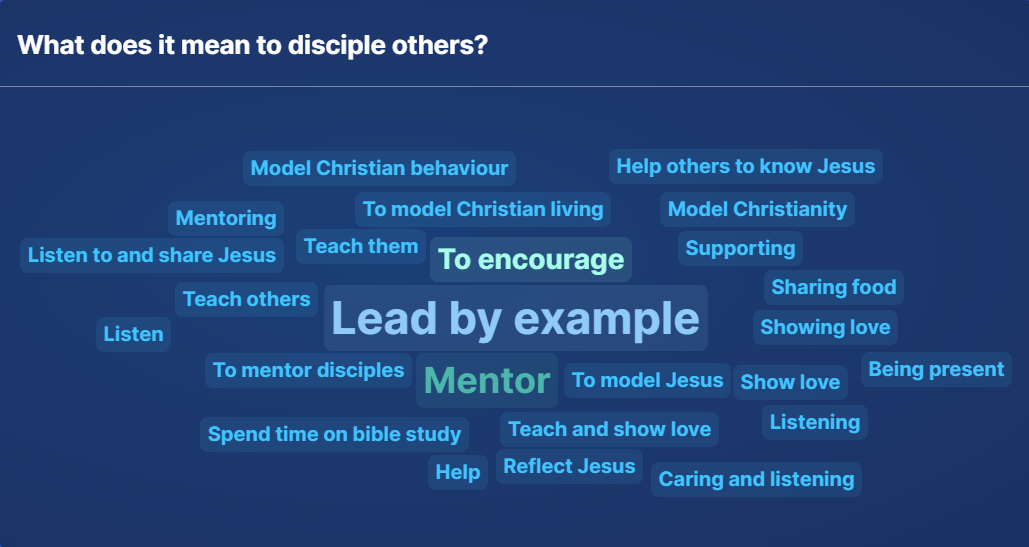
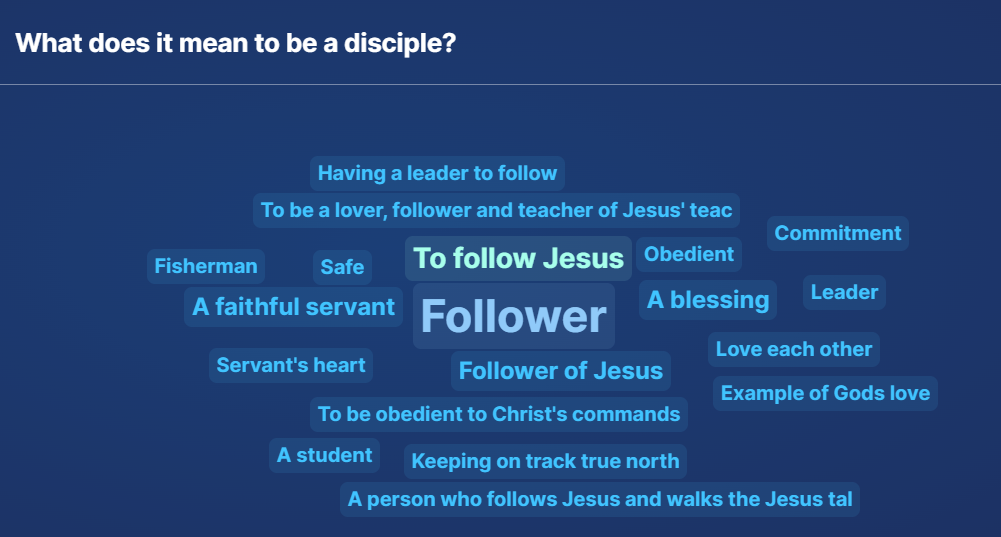
These verses are really about discipleship. The Greek word used in the Bible for discipleship, mathēteuō has two definitions, to be a disciple of someone, and to make a disciple of someone, and both meanings are included in these verses. 

To be a disciple means being a student, someone who adheres to and follows a particular doctrine.  It’s not about being the best Christian. Being a disciple of Jesus isn’t some status level that we can attain, like Gold status for flying a certain number of times with Air New Zealand. We often hear of the 12 disciples, Jesus’ closest friends and students, but in Acts, anybody who comes to know and believe in Jesus as God’s Son is called a disciple. 

Jesus’ 12 disciples stayed with him, they learnt and studied and lived life together. Disciples study and remember a teacher’s words, but more than that, they learn by imitating the teacher’s entire way of life. 

For Christians, being a disciple is about loving God with all of our being and constantly striving to imitate Jesus. We are told by Moses in Deuteronomy, and by Jesus in the Gospels, to love God with everything we have. With all our energies, and with all our efforts, and with all our understanding. That is a big ask, especially when we are trying to manage everything else going on in our lives – our work, families, children, homes, friendships, volunteering roles and so on. Putting God first, above all of that is hard!

Reflection question – I have a few of these questions throughout, they are things that have challenged me and may be a challenge to you as well. Where are your energies going? What are your priorities? Are you loving God with all of your heart, soul, and strength?

—————

The next part of our passage in Deuteronomy goes on to say, “Never forget these commands.” This is another aspect of being a disciple. Later on in the chapter, Moses warns the Israelites not to forget God when they are rich and don’t have to rely on him anymore. 

“When the Lord your God brings you into the land he swore to your fathers, to Abraham, Isaac and Jacob, to give you a land with large, flourishing cities you did not build, houses filled with all kinds of good things you did not provide, wells you did not dig, and vineyards and olive groves you did not plant – then when you eat and are satisfied, be careful that you do not forget the Lord, who brought you out of Egypt, out of the land of slavery.”

How often do we call out to God when we need him, but kind of ignore him through the good times? Or maybe we find it easy to have faith when life is going well, but feel abandoned or alone when things get tough? It can be challenging to be a follower of Christ in all situations, in all aspects of our lives, particularly in a society which often looks down on Christians. But these verses remind us that being a disciple is a full-time job and requires us to commit to following God all of the time, never forgetting his commands.

—————

In the next verses, Moses gives the Israelites, and us, ideas for how we can ensure we don’t forget or put aside God and his commands. “Repeat them when you are at home and when you are away, when you are resting and when you are working. Tie them on your arms and wear them on your foreheads as a reminder. Write them on the doorposts of your houses and on your gates.” 

Some Orthodox Jews put tefllins, these prayer boxes, on their heads and wrists when they pray, to acknowledge these verses. However, you’ll be pleased to know that most commentaries on these passages agree that the instructions to tie God’s commands on our arms and foreheads are not meant to be literal, but rather an example of what we can do to remember God’s Word.

Before we can remember God’s Word though, we need to make sure we are reading it! My Nana is one of those people who can recall a Bible verse or story for just about any situation. You could be stuck up a tree and she’d tell you the story of Zaccheus, or you could be talking about a friend, and she would recite a verse from Proverbs or Ecclesiastes about the importance of friendships, or you hit a pothole as you’re driving, and she’d tell you about the part in Numbers where the earth opened up and swallowed a whole bunch of people. 

As long as I can remember, she’s had amazing habits for reading her Bible and doing studies – every day she sets aside time to read, pray, and learn about God. I’m not sure what she did when she was younger and had a busy family, but when we’ve stayed with her, it’s pretty common to wake up and come out to the kitchen and see her sitting in her dressing gown, with her Bible and study open, while she drinks her morning cup of tea. I am still working on building those habits myself, but I’m so inspired by people like her, and Will and Daryl and I’m sure many others here, who have so much Scripture committed to heart.

Reflection – We need to think about our own Bible reading, and what our own personal, modern version of these verses could be. Do you set aside a time to spend with God and his Word each day? What’s your version of tying God’s Word to your arms or writing it on your doorpost? Is it wearing a cross necklace, or a bracelet engraved with a special verse? Is it having a Bible verse as the screensaver on your phone or a Bible app on your homescreen? Is it a meaningful poster/photo/verse on your wall at home? What can we do to remind ourselves to follow God all throughout the day?


—————

Jesus’ last words on earth are known as the Great Commission. “Therefore, go and make disciples of all nations, baptising them in the name of the Father and of the Son and of the Holy Spirit, and teaching them to obey everything I have commanded you. And surely I am with you always, to the very end of the age.”

Discipling others largely refers to teaching or mentoring, both in word and by example. 

In our Deuteronomy passage, we come back to the “Teach them to your children” instruction. That is the one sentence in this passage which gives explicit instruction on discipling others. It’s as if making disciples is actually a part of being a disciple. 

The Bible makes it clear that teaching our children about God and his Word is an important part of our role as parents.

  • Ephesians 6:4 says, Fathers, do not exasperate your children; instead, bring them up in the training and instruction of the Lord.  (I love the part about not exasperating your children – every time I read it I see myself as a teenager, rolling my eyes at my Dad’s lame jokes!)
  • Proverbs 22:6 – Train up a child in the way he should go, and when he is old he will not depart from it. 
  • And in 2 Timothy 1:5, where Paul is writing to Timothy, he says: I am reminded of your sincere faith, which first lived in your grandmother Lois and in your mother Eunice and, I am persuaded, now lives in you also. 

This last verse shows us the importance of grandparents and wider whanau in teaching children. 

The Barna group, a well-regarded research group in the US, found that 95% of children’s ministry workers believed that the primary, that is the main source of children’s discipling should be their home (i.e. their parents and families), while only 49% of parents with children at church believed that they were the primary source, with 51% saying that church should be the primary source of discipling for their kids. 

The same study found that only 50% of church parents said their children pray at least once a week at home, and 42% said their children hear the gospel at least once a week. If we are to believe that parents have the primary role of discipling their children, since they have the most time with them and know their child the best, then church needs to be there as a support for the parents, discipling the parents as they disciple their children.

Discipling children isn’t just the role of parents, however. In the book of Mark, Jesus tells off the people who try to keep the children away and welcomes the children to come to him. He didn’t say, “nope those kids aren’t my problem, it’s up to their parents to sort them out”, but rather brought them in to be blessed and be part of the group. I know there are many, many people in our church who are like Jesus in the way they treat children at Tawa Baptist, and I have always felt like my own two girls are welcomed and loved here. 

Going back to our Deuteronomy verses once more, and the sentence, “Teach them to obey my commands.” Many of the same tools suggested for parents and churches to disciple children are also useful for discipling other adults. Discipling other adults may mean teaching unbelievers or very new believers; it might mean mentoring someone in our church or working with other Christians. Jesus did all of those things as part of his discipleship, and we can too. Here are three key things we can all do to disciple others, whether they are our own children or someone else.

First, knowing our Bibles. We’ve already covered this but if you are trying to teach someone about God’s Word, it’s really handy to know what you are talking about. Little kids are especially good at asking the hard questions, like “Who made God?” and “How did God make the world if he doesn’t have hands?” When Tillie was two, we were heading to her first dentist appointment. On the way, we were talking about how God is everywhere. She asked, “will God even be at the dentist’s office?” and, trying to be a good mum and reassure her, I said “of course!” We walked into the dentist office, and she took one look at the female receptionist and in a very loud voice, as Tillie generally uses, asked, “Is that God?!” When I told her no, she persisted, “But how do you know that’s not God?” I have to admit, that was a time I didn’t have a great answer.


Another example of how knowing our Bibles is important can be seen in the story of Apollos, Priscilla and Aquila, in Acts 18:24-26. “At that time a Jew named Apollos came to Ephesus. He was an educated man from Alexandria. He knew the Scriptures very well. Apollos had been taught the way of the Lord. He spoke with great power. He taught the truth about Jesus. But he only knew about John’s baptism. He began to speak boldly in the synagogue. Priscilla and Aquila heard him. So they invited him to their home. There they gave him a better understanding of the way of God.” – Priscilla and Aquila were able to help Apollos because they had good scripture knowledge themselves, and they discipled Apollos, who was then able to go and preach widely to others.

A second tool for discipling others is building relationships. 

One of the special things about our church logo is the different people represented. There’s a family with children, single people, an elderly couple, and so on. Having good relationships is a key tool in discipleship. Children who have meaningful relationships with adults in the church stay around at church, and in their faith, at a far higher rate than those who don’t have those relationships. This is also true for adults as well – would you be more likely to keep coming to a new church if you were seeing strangers who only talk to each other, or people who you were starting to build friendships and relationships with? 

Intergenerational relationships are important as well. Children need to hear about Jesus from people outside their own families. Titus 2 calls for older women and men to teach and train the younger generation, while 1 Timothy 4:12 calls on young people to “be an example for the believers in speech, in conduct, in love, in faith and in purity.” 

Hebrews 10:24-25 talks about all the church members coming together: “And let us consider how we may spur one another on toward love and good deeds, not giving up meeting together, as some are in the habit of doing, but encouraging one another.”

The third and final tool for discipling others is sharing about Jesus. Obvious, right? While explicit formal teaching of God’s Word is important when discipling our children and other people, it’s just as important to include God in our everyday conversations. 

One of the ways we learn is by watching other people and then having a go ourselves. The Parenting for Faith course talks about using “windows” or little moments for children to get glimpses into our relationship with Jesus. It’s about going about our everyday lives and showing our children how we include God as a part of that. For example, letting your children see you study your Bible, or pray in a difficult moment, or thank God for a rainbow and the promise of hope. 

The book Sticky Faith: Everyday Ideas to Build Lasting Faith in Your Kids highlights an important truth: “The greatest gift you can give your children is to let them see you struggle and wrestle with how to live a lifetime of trust in God.” This doesn’t happen once a week or overnight. Showing children your relationship with Jesus, imperfect, messy, and difficult as it may be, is one of the best ways to help them develop their own relationships. And as our own relationships with God deepen, sharing these moments with our children becomes more natural.

For people who have grown up children, the Parenting for Faith course suggests that even though your children aren’t living at home with you, they are still learning from you what older, wiser life looks like with God. Even if they seem uninterested, they will still be watching you and learning from you whenever they see you – even if they don’t say so. The same goes for discipling others, Christian or not, – just living our lives and being open about our relationship with God can make a big difference. 

Reflection questions… Who in our lives are you or could you be discipling? What is your role in discipleship within the church?

————

This morning we’ve talked about being a disciple and discipling others. Let’s finish off by re-reading Deuteronomy 6:5-9 one more time: “Love the Lord your God with all your heart, with all your soul, and with all your strength. Never forget these commands that I am giving you today. Teach them to your children. Repeat them when you are at home and when you are away, when you are resting and when you are working. Tie them on your arms and wear them on your foreheads as a reminder. Write them on the doorposts of your houses and on your gates.”

Reflection questions:

  • Deuteronomy 6:5 says “Love the Lord your God with all your heart, with all your soul, and with all your strength.” Where are your energies going? What are your priorities? Are you loving God with all of your heart, soul, and strength?
  • Verses 7-9 tell us to remember God’s commands. How much time do you spend with God and His Word? What can you do to remind yourself throughout the day?
  • Verse 7 encourages us to teach God’s commands to our children, and Jesus’ last words were telling us to make disciples of all the nations. Who in your life are you or could you be discipling? What is your role in discipleship within the church?