Scripture: Deuteronomy 6:5-9
Good morning everyone!
When Will asked me to speak, I planned to talk about the passages where Jesus invites the children to come to him. As I read and planned, it kept changing and eventually I ended up focusing on verses from Deuteronomy which fits in perfectly for our current sermon series. Will actually covered these verses as part of one of his sermons back in July, so they should be familiar to you all.
Deuteronomy 6:5-9 reads, “Love the Lord your God with all your heart, with all your soul, and with all your strength. Never forget these commands that I am giving you today. Teach them to your children. Repeat them when you are at home and when you are away, when you are resting and when you are working. Tie them on your arms and wear them on your foreheads as a reminder. Write them on the doorposts of your houses and on your gates.”
These verses are really about discipleship. The Greek word used in the Bible for discipleship, mathēteuō has two definitions, to be a disciple of someone, and to make a disciple of someone, and both meanings are included in these verses.
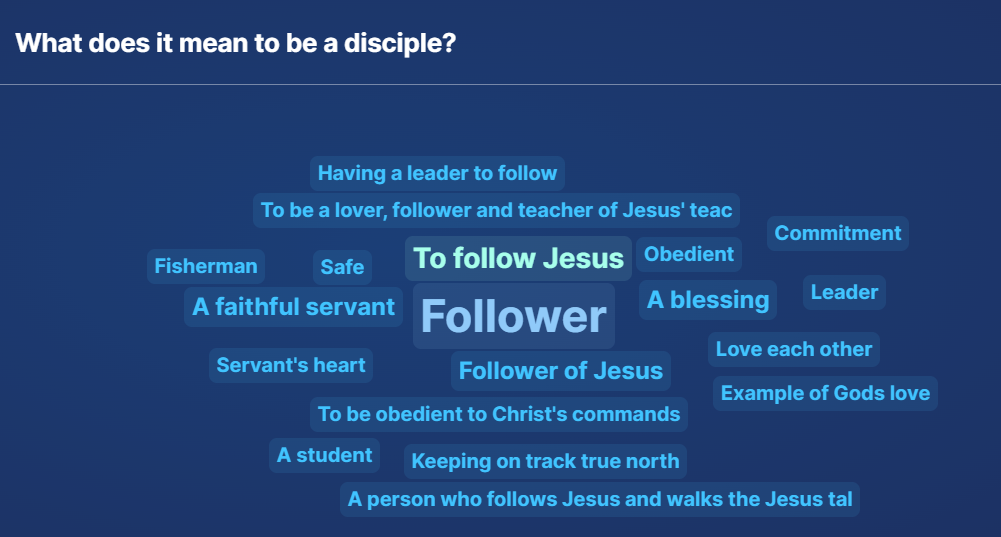
To be a disciple means being a student, someone who adheres to and follows a particular doctrine. It’s not about being the best Christian. Being a disciple of Jesus isn’t some status level that we can attain, like Gold status for flying a certain number of times with Air New Zealand. We often hear of the 12 disciples, Jesus’ closest friends and students, but in Acts, anybody who comes to know and believe in Jesus as God’s Son is called a disciple.
Jesus’ 12 disciples stayed with him, they learnt and studied and lived life together. Disciples study and remember a teacher’s words, but more than that, they learn by imitating the teacher’s entire way of life.
For Christians, being a disciple is about loving God with all of our being and constantly striving to imitate Jesus. We are told by Moses in Deuteronomy, and by Jesus in the Gospels, to love God with everything we have. With all our energies, and with all our efforts, and with all our understanding. That is a big ask, especially when we are trying to manage everything else going on in our lives – our work, families, children, homes, friendships, volunteering roles and so on. Putting God first, above all of that is hard!
Reflection question – I have a few of these questions throughout, they are things that have challenged me and may be a challenge to you as well. Where are your energies going? What are your priorities? Are you loving God with all of your heart, soul, and strength?
—————
The next part of our passage in Deuteronomy goes on to say, “Never forget these commands.” This is another aspect of being a disciple. Later on in the chapter, Moses warns the Israelites not to forget God when they are rich and don’t have to rely on him anymore.
“When the Lord your God brings you into the land he swore to your fathers, to Abraham, Isaac and Jacob, to give you a land with large, flourishing cities you did not build, houses filled with all kinds of good things you did not provide, wells you did not dig, and vineyards and olive groves you did not plant – then when you eat and are satisfied, be careful that you do not forget the Lord, who brought you out of Egypt, out of the land of slavery.”
How often do we call out to God when we need him, but kind of ignore him through the good times? Or maybe we find it easy to have faith when life is going well, but feel abandoned or alone when things get tough? It can be challenging to be a follower of Christ in all situations, in all aspects of our lives, particularly in a society which often looks down on Christians. But these verses remind us that being a disciple is a full-time job and requires us to commit to following God all of the time, never forgetting his commands.
—————
In the next verses, Moses gives the Israelites, and us, ideas for how we can ensure we don’t forget or put aside God and his commands. “Repeat them when you are at home and when you are away, when you are resting and when you are working. Tie them on your arms and wear them on your foreheads as a reminder. Write them on the doorposts of your houses and on your gates.”
Some Orthodox Jews put tefllins, these prayer boxes, on their heads and wrists when they pray, to acknowledge these verses. However, you’ll be pleased to know that most commentaries on these passages agree that the instructions to tie God’s commands on our arms and foreheads are not meant to be literal, but rather an example of what we can do to remember God’s Word.
Before we can remember God’s Word though, we need to make sure we are reading it! My Nana is one of those people who can recall a Bible verse or story for just about any situation. You could be stuck up a tree and she’d tell you the story of Zaccheus, or you could be talking about a friend, and she would recite a verse from Proverbs or Ecclesiastes about the importance of friendships, or you hit a pothole as you’re driving, and she’d tell you about the part in Numbers where the earth opened up and swallowed a whole bunch of people.
As long as I can remember, she’s had amazing habits for reading her Bible and doing studies – every day she sets aside time to read, pray, and learn about God. I’m not sure what she did when she was younger and had a busy family, but when we’ve stayed with her, it’s pretty common to wake up and come out to the kitchen and see her sitting in her dressing gown, with her Bible and study open, while she drinks her morning cup of tea. I am still working on building those habits myself, but I’m so inspired by people like her, and Will and Daryl and I’m sure many others here, who have so much Scripture committed to heart.
Reflection – We need to think about our own Bible reading, and what our own personal, modern version of these verses could be. Do you set aside a time to spend with God and his Word each day? What’s your version of tying God’s Word to your arms or writing it on your doorpost? Is it wearing a cross necklace, or a bracelet engraved with a special verse? Is it having a Bible verse as the screensaver on your phone or a Bible app on your homescreen? Is it a meaningful poster/photo/verse on your wall at home? What can we do to remind ourselves to follow God all throughout the day?
—————
Jesus’ last words on earth are known as the Great Commission. “Therefore, go and make disciples of all nations, baptising them in the name of the Father and of the Son and of the Holy Spirit, and teaching them to obey everything I have commanded you. And surely I am with you always, to the very end of the age.”
Discipling others largely refers to teaching or mentoring, both in word and by example.
In our Deuteronomy passage, we come back to the “Teach them to your children” instruction. That is the one sentence in this passage which gives explicit instruction on discipling others. It’s as if making disciples is actually a part of being a disciple.
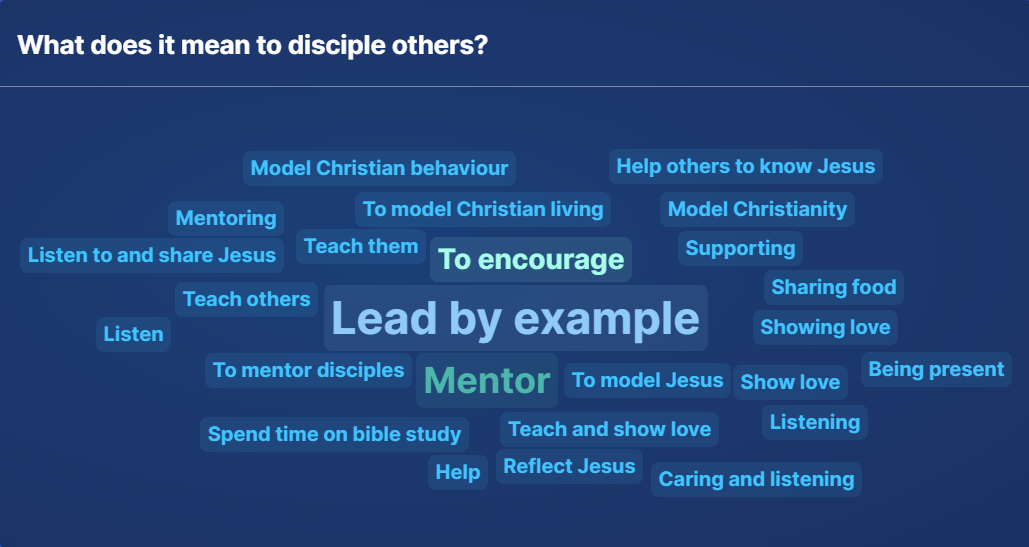
The Bible makes it clear that teaching our children about God and his Word is an important part of our role as parents.
- Ephesians 6:4 says, Fathers, do not exasperate your children; instead, bring them up in the training and instruction of the Lord. (I love the part about not exasperating your children – every time I read it I see myself as a teenager, rolling my eyes at my Dad’s lame jokes!)
- Proverbs 22:6 – Train up a child in the way he should go, and when he is old he will not depart from it.
- And in 2 Timothy 1:5, where Paul is writing to Timothy, he says: I am reminded of your sincere faith, which first lived in your grandmother Lois and in your mother Eunice and, I am persuaded, now lives in you also.
This last verse shows us the importance of grandparents and wider whanau in teaching children.
The Barna group, a well-regarded research group in the US, found that 95% of children’s ministry workers believed that the primary, that is the main source of children’s discipling should be their home (i.e. their parents and families), while only 49% of parents with children at church believed that they were the primary source, with 51% saying that church should be the primary source of discipling for their kids.
The same study found that only 50% of church parents said their children pray at least once a week at home, and 42% said their children hear the gospel at least once a week. If we are to believe that parents have the primary role of discipling their children, since they have the most time with them and know their child the best, then church needs to be there as a support for the parents, discipling the parents as they disciple their children.
Discipling children isn’t just the role of parents, however. In the book of Mark, Jesus tells off the people who try to keep the children away and welcomes the children to come to him. He didn’t say, “nope those kids aren’t my problem, it’s up to their parents to sort them out”, but rather brought them in to be blessed and be part of the group. I know there are many, many people in our church who are like Jesus in the way they treat children at Tawa Baptist, and I have always felt like my own two girls are welcomed and loved here.
Going back to our Deuteronomy verses once more, and the sentence, “Teach them to obey my commands.” Many of the same tools suggested for parents and churches to disciple children are also useful for discipling other adults. Discipling other adults may mean teaching unbelievers or very new believers; it might mean mentoring someone in our church or working with other Christians. Jesus did all of those things as part of his discipleship, and we can too. Here are three key things we can all do to disciple others, whether they are our own children or someone else.
First, knowing our Bibles. We’ve already covered this but if you are trying to teach someone about God’s Word, it’s really handy to know what you are talking about. Little kids are especially good at asking the hard questions, like “Who made God?” and “How did God make the world if he doesn’t have hands?” When Tillie was two, we were heading to her first dentist appointment. On the way, we were talking about how God is everywhere. She asked, “will God even be at the dentist’s office?” and, trying to be a good mum and reassure her, I said “of course!” We walked into the dentist office, and she took one look at the female receptionist and in a very loud voice, as Tillie generally uses, asked, “Is that God?!” When I told her no, she persisted, “But how do you know that’s not God?” I have to admit, that was a time I didn’t have a great answer.
Another example of how knowing our Bibles is important can be seen in the story of Apollos, Priscilla and Aquila, in Acts 18:24-26. “At that time a Jew named Apollos came to Ephesus. He was an educated man from Alexandria. He knew the Scriptures very well. Apollos had been taught the way of the Lord. He spoke with great power. He taught the truth about Jesus. But he only knew about John’s baptism. He began to speak boldly in the synagogue. Priscilla and Aquila heard him. So they invited him to their home. There they gave him a better understanding of the way of God.” – Priscilla and Aquila were able to help Apollos because they had good scripture knowledge themselves, and they discipled Apollos, who was then able to go and preach widely to others.
A second tool for discipling others is building relationships.
One of the special things about our church logo is the different people represented. There’s a family with children, single people, an elderly couple, and so on. Having good relationships is a key tool in discipleship. Children who have meaningful relationships with adults in the church stay around at church, and in their faith, at a far higher rate than those who don’t have those relationships. This is also true for adults as well – would you be more likely to keep coming to a new church if you were seeing strangers who only talk to each other, or people who you were starting to build friendships and relationships with?
Intergenerational relationships are important as well. Children need to hear about Jesus from people outside their own families. Titus 2 calls for older women and men to teach and train the younger generation, while 1 Timothy 4:12 calls on young people to “be an example for the believers in speech, in conduct, in love, in faith and in purity.”
Hebrews 10:24-25 talks about all the church members coming together: “And let us consider how we may spur one another on toward love and good deeds, not giving up meeting together, as some are in the habit of doing, but encouraging one another.”
The third and final tool for discipling others is sharing about Jesus. Obvious, right? While explicit formal teaching of God’s Word is important when discipling our children and other people, it’s just as important to include God in our everyday conversations.
One of the ways we learn is by watching other people and then having a go ourselves. The Parenting for Faith course talks about using “windows” or little moments for children to get glimpses into our relationship with Jesus. It’s about going about our everyday lives and showing our children how we include God as a part of that. For example, letting your children see you study your Bible, or pray in a difficult moment, or thank God for a rainbow and the promise of hope.
The book Sticky Faith: Everyday Ideas to Build Lasting Faith in Your Kids highlights an important truth: “The greatest gift you can give your children is to let them see you struggle and wrestle with how to live a lifetime of trust in God.” This doesn’t happen once a week or overnight. Showing children your relationship with Jesus, imperfect, messy, and difficult as it may be, is one of the best ways to help them develop their own relationships. And as our own relationships with God deepen, sharing these moments with our children becomes more natural.
For people who have grown up children, the Parenting for Faith course suggests that even though your children aren’t living at home with you, they are still learning from you what older, wiser life looks like with God. Even if they seem uninterested, they will still be watching you and learning from you whenever they see you – even if they don’t say so. The same goes for discipling others, Christian or not, – just living our lives and being open about our relationship with God can make a big difference.
Reflection questions… Who in our lives are you or could you be discipling? What is your role in discipleship within the church?
————
This morning we’ve talked about being a disciple and discipling others. Let’s finish off by re-reading Deuteronomy 6:5-9 one more time: “Love the Lord your God with all your heart, with all your soul, and with all your strength. Never forget these commands that I am giving you today. Teach them to your children. Repeat them when you are at home and when you are away, when you are resting and when you are working. Tie them on your arms and wear them on your foreheads as a reminder. Write them on the doorposts of your houses and on your gates.”
Reflection questions:
- Deuteronomy 6:5 says “Love the Lord your God with all your heart, with all your soul, and with all your strength.” Where are your energies going? What are your priorities? Are you loving God with all of your heart, soul, and strength?
- Verses 7-9 tell us to remember God’s commands. How much time do you spend with God and His Word? What can you do to remind yourself throughout the day?
- Verse 7 encourages us to teach God’s commands to our children, and Jesus’ last words were telling us to make disciples of all the nations. Who in your life are you or could you be discipling? What is your role in discipleship within the church?

 Tawa Baptist