Paul in Rome

Scripture: Acts 28:16-31

Video Link: https://youtu.be/VwbRDZnsO7g

Structure:

  • Introduction
  • Paul’s perseverance
  • Israel’s denial
  • Jesus’ sovereignty
  • Conclusion

Introduction:

Good morning everyone.

You may have heard of the phrase, “Once more unto the breach, dear friends, once more.”

This comes from William Shakespeare’s play, Henry V, in a scene where the king rallies his troops to attack through a gap in the city walls of Harfleur. It is a call to action in the face of overwhelming odds. It means, ‘let us try one more time’. “Once more unto the breach…” is about perseverance and not giving up.   

In Shakespeare’s play, the king ends up defeating his enemies despite being greatly outnumbered.

Today we conclude our three week series in the book of Acts in support of the Arotahi Renew Together campaign. Arotahi is the missions arm of New Zealand Baptists. Once a year we renew our commitment to pray for and support the work of spreading the gospel in New Zealand and overseas. 

Two weeks ago we heard about Paul in Athens. Then last week we learned about Paul’s mission in Ephesus. This week’s sermon focuses on Acts chapter 28, where we find the apostle Paul in the capital city of Rome, under house arrest.

After the better part of 30 years, Paul is still persevering in proclaiming the gospel. Time and time again he faces opposition, but every time he obeys the call of King Jesus, once more unto the breach dear friend, once more.

From Acts 28, verse 16, we read

16 When we got to Rome, Paul was allowed to live by himself, with a soldier to guard him. 17 Three days later he called together the local Jewish leaders. When they had assembled, Paul said to them: “My brothers, although I have done nothing against our people or against the customs of our ancestors, I was arrested in Jerusalem and handed over to the Romans. 18 They examined me and wanted to release me, because I was not guilty of any crime deserving death. 19 The Jews objected, so I was compelled to make an appeal to Caesar. 

I certainly did not intend to bring any charge against my own people. 20 For this reason I have asked to see you and talk with you. It is because of the hope of Israel that I am bound with this chain.” 21 They replied, “We have not received any letters from Judea concerning you, and none of our people who have come from there has reported or said anything bad about you. 22 But we want to hear what your views are, for we know that people everywhere are talking against this sect.” 23 They arranged to meet Paul on a certain day, and came in even larger numbers to the place where he was staying. He witnessed to them from morning till evening, explaining about the kingdom of God, and from the Law of Moses and from the Prophets he tried to persuade them about Jesus. 24 Some were convinced by what he said, but others would not believe. 25 They disagreed among themselves and began to leave after Paul had made this final statement: “The Holy Spirit spoke the truth to your ancestors when he said through Isaiah the prophet: 26 “‘Go to this people and say, “You will be ever hearing but never understanding; you will be ever seeing but never perceiving.” 27 For this people’s heart has become calloused; they hardly hear with their ears, and they have closed their eyes. Otherwise they might see with their eyes, hear with their ears, understand with their hearts and turn, and I would heal them.’ 28 “Therefore I want you to know that God’s salvation has been sent to the Gentiles, and they will listen!” 29 After he said this, the Jews left, arguing vigorously among themselves. 30 For two whole years Paul stayed there in his own rented house and welcomed all who came to see him. 31 He proclaimed the kingdom of God and taught about the Lord Jesus Christ—with all boldness and without hindrance!

May the Spirit of Jesus illuminate God’s word for us.

This morning I want to highlight three things from these closing words in the book of Acts: Paul’s perseverance, Israel’s denial and Jesus’ sovereignty.

Let us begin with Paul’s perseverance.

Paul’s perseverance:

One day a farmer’s donkey fell down an unused well. The farmer could not think of any way to get his donkey out and did not care much for the donkey anyway, so he decided to bury the poor animal where it had fallen.

As he started shovelling dirt into the well, the donkey cried in distress, but before long the crying stopped. After about 20 minutes of backfilling the farmer took a break and looked into the hole to see his progress. To his amazement the farmer saw the donkey had not been buried.

With every shovelful of dirt that hit his back the donkey would shake it off and take a step up. The farmer kept shovelling and soon the donkey was able to step out and walk away. [1]

Paul was a bit like the donkey. He was in a hole so to speak, chained to a Roman guard under house arrest. The Jewish religious leaders of Jerusalem had kept throwing dirt on him. They wanted to bury him. But with each shovelful Paul shook it off and took a step up. Paul did not give in, he persevered.

You may be wondering how Paul came to be in Rome under house arrest.

Well, after a fruitful time in Ephesus, Paul made his way to Jerusalem. The Jews there plotted against him and he was arrested. Paul stood trial in Jerusalem and then later in Caesarea.

The Jewish leaders were trying to use the Romans to execute Paul, much like they used Pilate to execute Jesus. But none of the charges against Paul would stick. The Romans found Paul innocent

Due to a corrupt governor, however, Paul remained in prison in Caesarea for two years, after which he stood trial before the Romans yet again. To avoid being handed over to the Jews, Paul was forced to appeal to the Emperor. That meant being transported to Rome by ship.

The journey from Caesarea to Rome was fraught with difficulty. Paul’s ship was wreaked in a storm and the passengers and crew were forced to swim ashore on the island of Malta. They were stranded on Malta for three months before boarding another ship to Italy.

When Paul eventually did arrive in Rome, he was allowed to stay in a rented house, chained by the wrist to a Roman soldier 24-7. The guards took it in shifts to mind Paul. Paul had a captive audience. I’m sure every one of those guards heard the gospel about Jesus.     

Just three days after arriving in Rome, Paul called together the local Jews to explain why he was there. Paul wanted to reassure them that he did not mean them any harm. He was there because he was compelled to appeal to Caesar to save his own life.

The Jews were probably relieved to hear this. Some years earlier the Emperor Claudius had temporarily banned all Jews from living in Rome because of disputes between the Jews and Christians. Paul wants the Jews to know he is not there to make trouble for them.  

Paul is also keen to talk with people about the hope of Israel. The hope of Israel is code for the Messiah. Paul wants to share the good news about Jesus the Messiah.

Now when you think about all that Paul has suffered because of the Jews,

all the dirt they had thrown on him, all the floggings he endured, all the false accusations and trials, not to mention all those years in prison, it is a wonder that Paul would risk even more rejection by setting up a meeting with the Jews of Rome. Who knows what people had been saying about him behind his back.

Jesus teaches us to turn the other cheek and forgive others as often as they need it. The Jews had not sought Paul’s forgiveness and yet he shakes off their condemnation and continues to face them with grace and courage. Paul perseveres in his love for those who mean him harm. He keeps on trying to reach his fellow Israelites with the truth about Jesus.

In reply, the Jewish leaders said they had not heard any bad reports about Paul. This seems unlikely. Some commentators think the Jews here were pretending to be ignorant about Paul because it was politically expedient. If the Jews started throwing more dirt on Paul and Paul gained a favourable hearing from Caesar, they might be expelled from Rome again or worse.

The Jews arranged to meet with Paul on a certain day to hear what he had to say. Even more people turned up the second time. Paul talked with them all day about the kingdom of God. He tried to persuade them that Jesus is the Messiah using the common ground of the Hebrew Scriptures.    

Some were convinced by Paul, others would not believe. As usual the gospel about Jesus confronts people with the truth; it compels people to choose. Will we accept the reality of our situation or will we live in denial of the problem.

Israel’s denial

In 1915 the Mexican boll weevil came to Alabama and destroyed 60% of the cotton crop. In desperation the farmers turned to planting peanuts and then diversified into other crops. The diversification saved the local economy.

Had it not been for the boll weevil, the farmers may not have stumbled across a better crop. In gratitude, the people of the town put up a statue of the boll weevil together with a plaque which reads: “In profound appreciation of the boll weevil and what it has done as the herald of prosperity.”

Personally, I think the boll weevil got too much credit. It was really the people’s willingness to face the reality of their situation that saved them. Had the farmers denied there was a weevil problem and refused to change from planting cotton to growing peanuts, the people would have been ruined.

To those Jews who rejected his message about Jesus, Paul quoted the prophet Isaiah…

26 “‘Go to this people and say, “You will be ever hearing but never understanding; you will be ever seeing but never perceiving.” 27 For this people’s heart has become calloused; they hardly hear with their ears, and they have closed their eyes. Otherwise they might see with their eyes, hear with their ears, understand with their hearts and turn, and I would heal them.’    

These verses from Isaiah are talking about Israel’s refusal to believe.

The prophet is saying the people are living in denial of reality. They have closed their hearts and minds to the truth of the situation.

Unlike the cotton farmers of Alabama, they don’t want to admit they have a problem. But if they did, God would heal them.

So what exactly is the problem Paul’s compatriots are denying? The problem is this: they killed Jesus, God’s Messiah. To admit that Jesus is the Messiah is to admit they got it terribly wrong when they crucified Jesus.

As painful as the Jews’ rejection of Jesus is, Paul sees an opportunity for those outside of Israel. Pauls says: “God’s salvation has been sent to the Gentiles, and they will listen!”  

When Paul tells his fellow Jews they are living in denial of the Messiah, they leave arguing vigorously among themselves. Clearly, Paul’s words have hit a raw nerve. They know Paul is right, but they don’t want to admit it.   

Now at this point I need to say that Israel do not have the monopoly on denial. We are all prone to denial in our own way, regardless of our cultural heritage.

Indeed, when we find ourselves protesting too much, that is often a sign that we are denying an inconvenient truth about ourselves.

So what is the cure for the blindness of denial? Well, for the cotton farmers it came in the form of the boll weevil which destroyed their crops. Sometimes God’s cure for stubborn denial is suffering and loss. The kind of suffering that wakes us up to the reality of our situation. The kind of loss that makes us aware of our need for God.

Jesus said, blessed are the poor in spirit, for theirs is the kingdom of heaven.

The poor in spirit are those who are at the end of their rope. They have suffered loss and humiliation. They are under no illusions about the reality of their situation. They have been cured of their denial and they know their need for God’s grace.  

You see, to be able to enjoy a meal, you must first become hungry. To be able to receive the salvation God offers, your hands must first be empty. To be able to experience the good news of Jesus, you must first face the bad news about yourself and the world. I wish there was an easier way, but there isn’t.   

The other thing we note here is that there are limits to Paul’s perseverance.

As much as Paul valiantly attempts to reach his own people time and time again with the gospel, if the Jews in a particular place refuse to believe, if they persist in their denial, Paul shakes it off and moves on to those who will listen.

Okay, so we have heard about Paul’s perseverance in reaching people with the gospel. And we have heard about Israel’s denial of Jesus the Messiah. What about Jesus’ sovereignty. How does that fit with today’s reading.

Jesus’ sovereignty:   

A sovereign is a king, a ruler. Someone with power and authority to reign.

One of the undercurrents running throughout the book of Acts is the idea that Jesus is sovereign; he is in control of the events that transpire. Nothing hinders Jesus’ purpose of salvation.

This idea of Jesus’ sovereignty may be lost in translation for us. For us a sovereign is someone like Queen Elizabeth or King Charles. A figure head, a wealthy monarch with no real power. But Jesus is not a King like that. Jesus is more than a figure head. Jesus has real power. Power over life and death. Power to heal, deliver and redeem.  

Again, we should not confuse Jesus’ power with the kind of political power we are familiar with. Political leaders in our world tend to use a carrot and stick approach to get what they want. Carrots represent rewards and the stick represents punishments; things like tariffs and tanks.     

Jesus does not exercise his power in the same way earthly rulers do. Jesus does not coerce or manipulate people. Jesus’ power often flies under the radar; it operates at a deeper level. Jesus, the King in heaven, exercises his power on earth through the Holy Spirit at work in and among human beings.

In the freezing waters around Greenland there are countless icebergs. Some are small, others large. If you watch them carefully, you notice that the smaller ice floes often move in one direction, while the big ones flow in another direction.

Surface winds drive the little ones, whereas the larger icebergs are carried along by deep ocean currents.

When we consider all that Paul suffered and indeed when we consider our own trials and tragedies, it may be helpful to see our lives as being subject to two forces: surface winds and deeper ocean currents.

The surface winds represent that which is changeable, unpredictable and distressing. The manipulations of men and the wielding of political power for example. Or the slings and arrows of personal misfortune and poor health.

But operating simultaneously, with the gusts and gales, is another more powerful force. The sure movement of God’s wise and sovereign purpose.

The deep flow of his unchanging love. [2]     

In the book of Acts we see both the surface winds of human opposition and the deeper movement of God’s Spirit.

Right at the beginning of Acts, the risen Jesus made plain the sovereign movement of God’s plan of salvation, when he said to his apostles…

You will receive power when the Holy Spirit comes on you; and you will be my witnesses in Jerusalem and in all Judea and Samaria and to the ends of the earth.    

The book of Acts starts in Jersualem and finishes in Rome, the capital of the empire. And from Rome the gospel moves outward to all corners of the earth.

The deeper current of God’s love and Spirit carries the gospel message to the whole world.

Paul had no control over how people responded to his preaching about Jesus. Some believed, others did not. Some reacted violently, with the result that Paul found himself standing trial before the authorities.

These negative reactions were surface winds, which the Spirit of God was able to use in service to Jesus’ sovereign purpose. Every time Paul stood trial, whether before a Roman official or the Jewish leadership, he gave his testimony about Christ. Paul spoke gospel truth to those in power.

Paul’s two years under house arrest in Rome was not wasted time. During those years Paul wrote letters to the Philippians, the Ephesians, the Colossians and to Philemon. These letters are still with us today and contain some of our richest insights about Jesus and his purpose. In Philippians Paul writes…

I want you to know, brothers and sisters, that what has happened to me has really served to advance the gospel. As a result, it has become clear throughout the whole palace guard and to everyone else that I am in chains for Christ. Because of my chains, most of the brothers in the Lord have been encouraged to speak the word of God more courageously and fearlessly.

The fickle surface winds of human opposition do not alter the deep movement of Jesus’ sovereign purpose.

Conclusion:

The book of Acts finishes on a note of triumph: 30 For two whole years Paul stayed there in his own rented house and welcomed all who came to see him. 31 He proclaimed the kingdom of God and taught about the Lord Jesus Christ—with all boldness and without hindrance!

Paul may have been a prisoner, but the sovereign purpose of Jesus remained free and prospered.

Let us pray…

Gracious God, give us strength to persevere in your purpose for us. Give us grace to face the truth without denial. And when we feel buffeted by the surface winds of trial and opposition, keep us mindful of your deeper sovereign purpose. Through Jesus we pray. Amen.  

Questions for discussion or reflection:

  1. What stands out for you in reading this Scripture and/or in listening to the sermon? Why do you think this stood out to you?
  2. Why did Paul persevere is the face of opposition and hardship? When did Paul stop persevering and move on to tell others about Jesus? How might we know when to keep persevering and when to shake it off and move on? 
  3. How did God use Paul’s trials and suffering to forward the work of the gospel?
  4. Why did the Jews have such a difficult time accepting Paul’s message that Jesus is the Messiah?
  5. What is denial? How might we know we are in denial about something? Have there been times in your life when you struggled with denial? What happened? How did God deliver you?
  6. Discuss / reflect on Jesus’ sovereignty. How is Jesus’ power different from earthly rulers’ power?
  7. What surface winds of difficulty and opposition have you experienced lately? Can you discern Jesus’ deeper sovereign purpose at work in your life? If so, how? 

[1] Adapted from a story in J. John and Mark Stibbe’s book, ‘A Barrel of Fun’, page 116.

[2] Adapted from an excerpt in J. John and Mark Stibbe’s book, ‘A Barrel of Fun’, page 194.
Paul in Ephesus

Scripture: Acts 19:1-12

Video Link: https://youtu.be/k3K5R935iaQ

Structure:

  • Introduction
  • Christian initiation
  • Evangelism strategy
  • Conclusion

Introduction:

Good morning everyone.

In his book, ‘That they may have life’, Sri Lankan pastor, Daniel Niles writes: “Evangelism is witness. It is one beggar telling another beggar where to find food.”

Evangelism comes from a Greek word meaning ‘good news’. For Christians evangelism is telling others the good news about Jesus Christ. Evangelism can be as simple as one person telling another person how Jesus has helped them.

Evangelism is as necessary for life and survival as eating food. Evangelism is not a top-down thing, it’s a side-by-side thing. Those who do the evangelising are not better than those being evangelised, both need the bread of salvation.

Evangelism can be quite challenging in our society because most people do not think of themselves as beggars. Most people are not aware of their spiritual need.      

Today we continue our three week series in the book of Acts in support of the Arotahi Renew Together campaign. Arotahi is the missions arm of New Zealand Baptists. Once a year we renew our commitment to pray for and support the work of spreading the gospel in New Zealand and overseas. 

This week’s sermon focuses on Acts chapter 19, verses 1-12, where we learn how the apostle Paul did evangelism in the city of Ephesus. From Acts 19, verse 1, we read…

While Apollos was at Corinth, Paul took the road through the interior and arrived at Ephesus. There he found some disciples and asked them, “Did you receive the Holy Spirit whenyou believed?”

They answered, “No, we have not even heard that there is a Holy Spirit.”

So Paul asked, “Then what baptism did you receive?”

“John’s baptism,” they replied.

Paul said, “John’s baptism was a baptism of repentance. He told the people to believe in the one coming after him, that is, in Jesus.” On hearing this, they were baptized in the name of the Lord Jesus. When Paul placed his hands on them, the Holy Spirit came on them, and they spoke in tonguesand prophesied. There were about twelve men in all. Paul entered the synagogue and spoke boldly there for three months, arguing persuasively about the kingdom of God. But some of them became obstinate; they refused to believe and publicly maligned the Way. So Paul left them. He took the disciples with him and had discussions daily in the lecture hall of Tyrannus. 10 This went on for two years, so that all the Jews and Greeks who lived in the province of Asia heard the word of the Lord. 11 God did extraordinary miracles through Paul, 12 so that even handkerchiefs and aprons that had touched him were taken to the sick, and their illnesses were cured and the evil spirits left them.

May the Spirit of Jesus illuminate God’s word for us.

There are two halves to our message today. In the first half we consider Christian initiation; that is, what’s involved in becoming a Christian.

And in the second half we observe Paul’s strategy of evangelism; in other words, how Paul went about reaching people with the gospel of Jesus. We begin with Christian initiation.

Christian Initiation:

For seeds to germinate they need the right amount of four things: water, oxygen, temperature and light.

Water is essential for seed germination. A baptism in water softens the seed so it swells and ruptures. Most seeds need to absorb between 25% and 50% of their weight in water before they will germinate.

Oxygen provides the energy the seed needs to grow. If seeds are planted too deep in the soil, they might not get the oxygen they need to sprout.

The temperature has to be right too. Different seeds germinate at different temperatures, but most activate between 16 and 25 degrees Celsius.

The fourth requirement for seed germination is the right amount of light or, in the case of some plants, the right amount of darkness.

In the same way the germination of a seed involves the right amount of water, oxygen, temperature and light, so too Christian initiation involves four things: repentance, faith in Jesus, baptism in water and the gift of the Holy Spirit.

Repentance means turning away from sin. Repentance is a change of mind that leads to a positive change in behaviour. Repentance is when we stop walking away from God and start walking towards him.

Faith in Jesus means trusting our lives and our eternity to Jesus. Believing in his death and resurrection. Relying on Jesus’ righteousness and not our own. Holding to the sure hope that Jesus will save us.

Faith in Jesus is made possible by the work of the Holy Spirit. Without God’s Spirit, we cannot truly believe in Jesus or start walking toward God.

Baptism in water is an outward and visible sign of our faith in Jesus.

Water is a symbol of the Holy Spirit. To be baptised then is to signify that you have begun to follow Jesus with the help of the Holy Spirit.     

In the New Testament, repentance, faith in Jesus, baptism and the Holy Spirit are always present when someone becomes a Christian. The order in which these things happen may vary, but all four belong together when it comes to Christian initiation.

When Paul arrived in Ephesus he found some disciples. As he talks with them Paul notices something is off. These men seem to be missing something.

So Paul asks them, “Did you receive the Holy Spirit whenyou believed?”     

They answered, “No, we have not even heard that there is a Holy Spirit.”

Now, that cannot be right. The Holy Spirit is mentioned many times throughout the Hebrew Scriptures and during his earthly ministry Jesus promised the Holy Spirit to his followers. Clearly, there is a gap in these disciples’ understanding of what it means to follow Jesus.

Paul knows that no one can truly believe in Jesus without the Holy Spirit, so he asks, “Then what baptism did you receive?”

“John’s baptism,” they replied. Now everything becomes clear. They are not disciples of Jesus; they are disciples of John the Baptist. 

 Paul explains, “John’s baptism was a baptism of repentance. He told the people to believe in the one coming after him, that is, in Jesus.”

These 12 men could not have been Christian before meeting Paul, because they had not believed in Jesus up to that point. They were aware of their sin and committed to repentance, but they did not know Jesus personally, through the Holy Spirit.  

From verse 5 we read: On hearing this, they were baptized in the name of the Lord Jesus. When Paul placed his hands on them, the Holy Spirit came on them, and they spoke in tonguesand prophesied.

As I understand it, the Ephesian disciples received the Spirit and believed in Jesus on the same day they were baptised. When Paul laid his hands on them to baptise them in water, they received the Spirit as a gift from Jesus.

How were you initiated into the Christian faith? As I reflect on the Ephesians’ experience, I’m conscious of how different it was from my own experience of Christian initiation. When I came to faith in the early 1980’s, there seemed to be three stages to becoming a Christian.

Praying the sinners’ prayer and asking Jesus into your heart, stage one.

Then, after some time had passed, getting baptised in water, stage two.

And then after some more waiting, being prayed for to receive the Holy Spirit.   

Others of you may have a had different experience again. Perhaps you were baptised as a baby, then later confirmed your faith in Jesus as a young person.   

This idea of Christian initiation involving two or three separate events over a period of years was a foreign concept to Paul and the other apostles. Must Christian initiation conform to the pattern we read of in the book of Acts?

Hmmm. We should not be too dogmatic about how the Spirit of God brings people to faith in Jesus. The Holy Spirit does not have to conform to our rules and formulas. Our part is to be open to the work of the Spirit and to trust and obey Jesus out of love for God.

What we can say with confidence is that Christian initiation, both now and then, involves repentance, faith in Jesus, baptism in water and the gift of the Holy Spirit. But the order and timing may vary from person to person. Are any of these four aspects missing for you? What might God be saying?

Another question we may stew over is how do we know we have received the gift of the Holy Spirit? Repentance can be measured and baptism in water can be seen, but it may be more difficult to sense the Spirit.

Verse 6 says the Ephesians spoke in tongues and prophesied when they received the Holy Spirit. Does that mean tongues and prophecy are the signs you have received the Spirit? Well, they can be. But not always.

The Holy Spirit gives all sorts of different gifts. Not everyone who receives the Spirit speaks in tongues or utters words of prophesy like the Ephesians did.

So if you don’t speak in tongues, then don’t worry. The Spirit may give you assurance of your salvation in other ways. Some may feel their heart strangely warmed. Others may be filled with a profound sense of peace.

For me, the Spirit sometimes comes with tears. It is the feeling of being overwhelmed by grace. Humbled by God’s goodness so I cannot talk. Speechless in the presence of the Lord.

Whether you have had a special experience or not, the primary sign of the Spirit is faith in Jesus. You know the Holy Spirit has been given to you when you trust in Jesus. The Spirit makes Jesus close and real.

The question remains for each one of us, do we believe in Jesus? Believing in Jesus is not just a one-off event. Faith in Jesus is on-going, the journey of a lifetime. Therefore, we need to go on being filled with the Holy Spirit to keep faith with Jesus. Don’t stop believing.   

Evangelism strategy:

Okay, that is Christian initiation. Now let us consider Paul’s strategy for evangelism. How did Paul share the good news about Jesus with the people of Ephesus?

You’ve probably heard of the story of the three little pigs. You know the one. The first pig built his house out of straw and the big bad wolf blew his house down and ate the little pig. The second pig built his house out of sticks and the wolf blew his house down and ate him too.

But the third little pig built her house out of bricks and no matter how much the wolf blew, he could not blow her house down.

I suppose the moral of the story is this: to keep the wolf from your door you need to be prepared. It may take longer to build your house out of bricks and it may cost more, but it will be worth it in the end.

In line with the wisdom of being prepared, there’s a Chinese proverb which says: “If you are planning for a year, plant rice. If you are planning for a decade, plant trees. If you are planning for a lifetime, educate people.”

When Paul went about evangelising, he planned for a lifetime. Paul invested a lot of time and energy educating people in the way of Jesus, so their faith would be brick house strong, built to last.

When Paul arrived in Ephesus, he started in the Jewish synagogue. Paul spoke boldly about the kingdom of God, using reason to persuade people that Jesus is the Messiah and therefore people should repent and believe in him.

Starting with the Jews was good evangelism strategy. There was already common ground; Paul did not have to start from scratch. Jesus and Paul were both Jewish and the Hebrew Scriptures point to Jesus.    

Despite the common ground though, some of the Jews refused to believe Paul’s message and started to bad mouth the Way. The Way is code for the way of Christ. Jesus is the way, the truth and the life. No one comes to the Father except through Jesus the Son.

Being maligned and rejected by his own people grieved Paul deeply. It was no easy thing for him walk away. In Acts 20, verse 19, Paul says of his time in Ephesus: “I served the Lord with great humility and with tears, although I was severely tested by the Jews”. 

When Paul’s evangelism was rejected, Paul did not waste energy fighting those who were entrenched and stuck in their ways. He left the synagogue and took the disciples he had baptised with him.

Paul then carried on educating people about Jesus and the kingdom of God in the lecture hall of Tyrannus. This lecture hall was neutral ground. It was a public space that anyone (Jew or Greek) could access.

Paul did not just give lectures though. Paul held discussions, he dialogued with people, using reasoned arguments to educate and persuade. The Alpha Course is a contemporary version of evangelism modelled off Paul’s strategy of reasoned discussion and persuasion. Alpha is worth doing.

Not everyone goes down the Alpha path though. Some come to faith in Jesus after hearing an emotional appeal. The music plays, the smoke machine purrs, the mood lighting comes on and the speaker pulls on everyone’s heart strings (or guilt strings). Then, in the heat of the moment, people come forward to make a commitment to Jesus.

These sorts of emotionally based commitments don’t usually last, unless followed up by someone who intentionally comes alongside the new believer to nurture and disciple them.   

Paul did not build his house with the straw and sticks of raw emotion and stage tricks. Paul built his house with the bricks and reinforcing steel of sound argument and truth. Paul planned for a lifetime.

Verse 10 tells us; this went on for two years so that all the Jews and Greeks who lived in the province of Asia heard the word of the Lord.       

Ephesus was like a hub for the province of Asia in the first century. People from the surrounding towns came to Ephesus to do their shopping, visit their family or watch the games. While in Ephesus they got to hear the gospel through Paul.

Some took what they heard back home with them. And so the gospel spread by word of mouth.  

In Acts 20, verse 20, we learn that Paul also went house to house telling people to repent and have faith in Jesus. A strong work ethic was woven through Paul’s evangelism strategy. And the Spirit of God was clearly with Paul, upholding and empowering him every step of the way.

In verses 11 and 12 of Acts 19, we read how God did extraordinary miracles through Paul. The people of ancient Ephesus were spiritually aware. Some dabbled in magic and the occult. When people saw the power of God to heal and deliver, many turned away from sorcery and the dark arts to follow Jesus.

The miraculous signs and wonders done by God, verified Paul’s gospel message as authentic and true. If you read on in Acts 19 you will see how Paul’s evangelism eventually divided the city. People were confronted with the truth about Jesus and had to choose a side. Evangelism takes ground for God’s kingdom.

Although it is not covered in our reading today, an important part of Paul’s evangelism strategy was establishing an organisational structure to take care of the young church after he was gone. In Acts 20 we learn that Paul had appointed pastors and elders to protect and care for the new believers.

In verse 28 Paul says to the elders of the church at Ephesus: Keep watch over yourselves and all the flock of which the Holy Spirit has made you overseers. 

Be shepherds of the church of God, which he bought with his own blood.

Perhaps the most important part of any evangelism strategy is love. Persuasive arguments and intelligent apologetics only get you so far. If we do not love the people we are trying to reach, the message won’t sound true.

Paul’s love for the Ephesians and their love for him is evident in Paul’s farewell speech to them in Acts 20. From verse 37 we read: They all wept as they embraced him and kissed him. 38 What grieved them most was his statement that they would never see his face again. 

Conclusion:

Paul’s Herculean efforts of evangelism are intimidating. It may feel like too much of a leap to try and imitate Paul exactly. Let me offer a few practical strategies for evangelism which most Christians can attempt…

Look for people of peace. That is, people who are open to talking about faith and friendly in their attitude to things Christian. Paul started with the disciples of John the Baptist, people of peace. He did not start with the witches and gangsters of Ephesus.    

Pray for someone who does not yet know Jesus. Pray for them by name, daily, that the Holy Spirit would make Jesus close and real for them.

Know what you believe. Educate yourself. Read your Bible and think about how Jesus has been good for you personally. Be ready, prepared to talk about what Jesus means to you and what you really believe.

Love others. To love others means being kind and fair.  Listening generously. Showing up when you are needed. Doing no harm. Being patient and respectful.

And when you are given the opportunity to talk about Jesus, be brave without being arrogant. Don’t be ashamed or embarrassed. Be straight up. Own your faith with humility. Stand by it and trust your testimony to the Holy Spirit.

Let us pray…    

Gracious God, you love those who don’t yet know you. May the good news about Jesus be real for each of us, personally. Give us wise words and a winsome Spirit to tell others about Christ. Glorify yourself we pray. Amen.   

Questions for discussion or reflection:

  1. What stands out for you in reading this Scripture and/or in listening to the sermon? Why do you think this stood out to you?
  2. Who first told you about Jesus? How did they do this?
  3. What is evangelism? Why is evangelism important?
  4. How were you initiated into the Christian faith? Are any of the four aspects of Christian initiation missing for you? If so, which aspect(s)? What might God be saying to you?
  5. How do we know we have received the gift of the Holy Spirit? How does the Spirit make Jesus close and real for you?
  6. Discuss / reflect on Paul’s evangelism strategy in Ephesus.
  7. What can you do to share the love and truth of Jesus with others?

Paul in Athens

Scripture: Acts 17:22-34

Video Link: https://youtu.be/mhKLM8nneqs

Structure:

  • Introduction
  • Context
  • Ignorance
  • Orthodoxy
  • Conclusion – Response

Introduction:

Good morning everyone.

What would you say if someone asked you to explain your faith? What are the most important things to communicate and what is your best point of connection, the way in, so your listeners can hear and understand?  

Today we begin a short (three week) series in the book of Acts in support of the Arotahi Renew Together campaign. Arotahi is the missions arm of New Zealand Baptists. Once a year we renew our commitment to pray for and support the work of spreading the gospel in New Zealand and overseas.  

This week’s sermon focuses on Acts chapter 17, verses 22-34, where the apostle Paul is asked to explain the Christian faith to a group of intellectuals who know nothing about Jesus or the Bible. From Acts 17, verse 22, we read…

22 Paul then stood up in the meeting of the Areopagus and said: “Men of Athens! I see that in every way you are very religious. 23 For as I walked around and looked carefully at your objects of worship, I even found an altar with this inscription: to an unknown god. So you are ignorant of the very thing you worship—and this is what I am going to proclaim to you. 24 “The God who made the world and everything in it is the Lord of heaven and earth and does not live in temples built by human hands. 25 And he is not served by human hands, as if he needed anything. Rather, he himself gives everyone life and breath and everything else. 26 From one man he made all the nations, that they should inhabit the whole earth; and he marked out their appointed times in history and the boundaries of their lands. 27 God did this so that they would seek him and perhaps reach out for him and find him, though he is not far from any one of us. 28 ‘For in him we live and move and have our being.’As some of your own poets have said, ‘We are his offspring.’ 29 “Therefore, since we are God’s offspring, we should not think that the divine being is like gold or silver or stone—an image made by human design and skill. 30 In the past God overlooked such ignorance, but now he commands all people everywhere to repent. 31 For he has set a day when he will judge the world with justice by the man he has appointed. He has given proof of this to everyone by raising him from the dead.” 32 When they heard about the resurrection of the dead, some of them sneered, but others said, “We want to hear you again on this subject.” 33 At that, Paul left the Council. 34 Some of the people became followers of Paul and believed. Among them was Dionysius, a member of the Areopagus, also a woman named Damaris, and a number of others.

May the Spirit of Jesus illuminate God’s word for us.

Context:

Screws come with a variety of different heads. It’s no good trying to use a flat head screwdriver on a Philips screw. You’ll just end up wreaking the screw.

A Philips screw needs a Philips screwdriver. You need to use the right tool for the job.

The first thing Paul does when he comes to Athens is look and listen. He walks around the city and gets a feel for the culture. He seeks to understand the context, the people and the place. What type of screw head (metaphorical speaking) does the city of Athens have?    

Well, the city of Athens was full of idols, statues of wood and stone which people worshipped. Most of the people of Athens had no background in the Hebrew Scriptures and no real understanding of the God of Israel, much less any knowledge of the person of Jesus or the work of the Spirit.

Just as it won’t work to use a flat head screwdriver on a Philips screw, so too in the city of Athens it won’t work to explain the gospel using Old Testament symbols. Paul can see this and adapts to his context, presenting the gospel in a way which connects with his listeners, without compromising the truth.

Athens was made famous by men like Socrates and Plato and Aristotle. The sort of old guys you might study in a Classics class at university. So Paul uses the screwdriver of logic and philosophy to reason with the people of Athens, much like Socrates did before him.        

In verse 18 we read how a group of Epicurean and Stoic philosophers began debating with Paul in the marketplace. We might think of these philosophers like professors or university lecturers.

Epicureans believed the gods existed but were remote and uninterested in human beings, so there was no need to worry about them. For Epicureans all life is random, determined by chance. They did not believe in the after-life nor in a day of judgement.

The Epicureans believed in enjoying pleasure and escaping the pains and stresses of this life. They did this by not caring too much about anything.

They reasoned, if this life is all there is, then it’s best to avoid suffering by disengaging and not getting carried away by your passions.  

Stoics had a different philosophy. They believed the universe was god and that all life was fated or predetermined by the universe, so nothing happened by chance. In their minds the universe had everything rigged.

Stoics thought you cannot change the hand you are dealt, so the best thing is to submit to your fate. For stoics, enduring pain with a stiff upper lip was virtue and hope was folly.

Stoic philosophy probably had a greater influence on first century Athens than Epicureanism. These days we still see traces of Stoic and Epicurean belief in secular society.

Both these schools of thought are a long way from the Jewish / Christian understanding of a just and compassionate God who cares deeply about his creation and intervenes to save people.

These learned men of Athens had not heard the gospel before. Paul’s ideas were all new to them. Some were curious. Others may have viewed Paul as entertainment. So they invited Paul to the Areopagus (also known as Mars Hill) to hear what he had to say.  

Paul selects the right screwdriver. Paul begins with something familiar in their context, an altar to an unknown god.

Many in the ancient world lived in fear and anxiety of what the gods might do to them. So, as a kind of insurance policy against unintentionally offending a god they did not know about, the Athenians put up an altar to an unknown god, to cover all their bases.

Ignorance:

Paul does not flatter his audience in any way. He points out that their worship of an unknown god is evidence of their ignorance and therefore of their need to learn. It’s a brave man who tells a group of intellectuals they are ignorant.

But in a way this builds trust. Paul’s listeners would likely smell a rat if Paul was too smooth or complementary.

Sometimes we Christians can be too nice, too accommodating, too eager to please people of other faiths or no faith. But not Paul. The apostle is respectful of others but also confident of what he believes. He is humble, without pandering to people’s egos. Grace and truth, that’s the Spirit of Jesus.  

The philosophers of ancient Athens were ignorant and pretending otherwise is not going to help. Paul means to give them a better understanding of God.     

A couple of weeks ago our gas heater stopped working at home. We have had this heater for over 20 years. We know how it is supposed to sound when you turn it on. This time it made a different sound. I guessed it was a problem with the ignition, but I wasn’t sure.

I’m not an electrician or a gas fitter. I’m ignorant about the inner workings of our gas heater. I could have blindly experimented with the wires to try and fix it myself but decided not to take the risk of blowing myself up. Instead, I phoned Fergus and he took a look.

Turned out my instinct was right; it was a problem with the ignition. One of the wires had come loose and needed to be reconnected.

Now the heater is working again. I did not know which wire to look for or where to reconnect it, but after seeing Fergus fix it, I have the right knowledge. Not that I’m ready to give up preaching and become a gas fitter. Please don’t ask me to fix your heater. Call Fergus, he’s the expert.  

The people of ancient Athens knew that things were not right with the world. They correctly guessed the problem was spiritual, something to do with humanity’s relationship with God.

But they did not have the right knowledge. They were ignorant. They were groping in the dark, experimenting with different spiritual wires or connections to see what might work. The result was hit and miss, mostly miss.

Paul was like a spiritual gas fitter for the Athenians. Paul could see the problem and knew how to make the right connection with God, through Jesus. 

Orthodoxy:

You may have heard of the word orthodoxy. Orthodoxy comes from two Greek words. Ortho meaning right or true, and doxy meaning praise or worship. Therefore, orthodoxy means right praise or true worship.

As religious as they were, the Athenians’ praise and worship of God was not right or true. They had got their wires crossed so there was no real connection with God and consequently no warmth.

Paul is trying to help his listeners to realise God’s goodness and love so they can praise God in an orthodox way, in a way that is right and true.

The unknown god serves as a segue to talking about God almighty, the Lord of heaven and earth.  

In verse 24 Paul says, The God who made the world and everything in it is the Lord of heaven and earth and does not live in temples built by human hands.

Paul is correcting the Stoic belief here that the universe is god. The universe is not god. God created the universe but he is not the same as the universe.

Given that God created the universe he must be bigger than the universe and therefore cannot be contained in a temple built by human hands.

Scientists are not sure how big the universe is. From what we can see so far, it appears to be about 93 billion light years across. But there is probably more to the universe than we can see. How big is your vision of God?  It’s probably too small. We cannot put God in a box.

Paul goes on to say that God our creator gives life and breath and everything else we need. In other words, we depend on God’s goodness, whether we know it or not. God sustains our lives. He does not need anything from us.

This means we cannot domesticate God. We cannot tame him or bring him under our control.

In verses 26-27 Paul makes the point that God is involved with his creation, steering the course of history. Indeed, God is near to us. This corrects the Epicurean idea that the gods are distant and uninterested in human affairs.

Our lives do not unfold at the whim of randomness and chance. God has a plan and he is in control.

God’s plan and control of human history is not the same as the Stoics’ idea of fatalism though. God’s plan and purpose is not rigid like a brick wall.

It is flexible like a backbone. When you pray, God listens and he may sometimes bend to accommodate your soul’s desire, where that aligns with his will.   

In verse 28 Paul quotes the words of other pagan philosophers who the Athenians knew and respected. There was no point in quoting the Hebrew Scriptures. This would mean nothing to the intellectuals of Athens.

‘For in him we live and move and have our being’, is a quote from the sixth century BC poet Epimenides of Crete. And ‘We are his offspring’, is a quote from the third century BC Stoic philosopher Aratus of Cilicia. [1]

Paul is quoting the Athenians’ own poets to support his argument that they are wrong to worship idols. Hoisted on their own petard.

29 “Therefore, since we are God’s offspring, we should not think that the divine being is like gold or silver or stone—an image made by human design and skill. 30 In the past God overlooked such ignorance, but now he commands all people everywhere to repent. 

Paul does not compromise or dilute the inconvenient truth. The Athenians’ idolatry is wrong and Paul uses logic to prove it. Paul is not trying here to be clever just to win an argument. He is being compassionate to win souls and minds.

If the intellectuals of the city are convinced idol worship is wrong and repent, they will in turn influence the thinking and behaviour of the rest of the city.   

In verse 31 Paul talks about the day of judgement, when God will judge the world with justice. This truth provides a critique of both Stoic and Epicurean philosophies.

The Epicureans did not believe in judgement day. They thought the gods did not care what people did. Paul is saying the Epicureans are wrong on this count. God does care how people live their lives and will call us to account.

The Stoics believed life is fated or predetermined. If that is the case, then freewill is meaningless and people’s choices make no difference. Paul is saying the Stoics are wrong too. The fact there is a day of judgement shows that human freewill is meaningful and the choices we make do matter.

But notice how God will judge the world: by the man he has appointed.

The man appointed by God is Jesus. We will be judged by our response to Jesus the Christ. If we accept Jesus, God will accept us. If we reject Jesus, God will reject us. This means there is hope for everyone who puts their trust in Jesus.

God has given proof of this by raising Jesus from the dead. The resurrection of Jesus is the foundation of the Christian faith. Our hope, our meaning, our purpose, our joy, our very identity as Christians rests on the belief that God raised Jesus from the dead.  

The resurrection of Jesus confronts us with an important decision.

Will we believe in the risen Christ, even though resurrection is outside of our experience? Will we believe in the risen Christ, even though others ridicule our belief? Will we believe in the risen Christ, even in the face of death?

Conclusion – Response:

There are basically three responses to Paul’s message in Acts 17.

Unable to find a flaw in Paul’s logic, some sneered, too proud to admit Paul was right. Sneering is an angry, dismissive response. People sneer when they are frustrated, when they know they are wrong but don’t want to admit it.

Not everyone sneered though. Others said, “We want to hear you again on this subject.” That is a more honest response. Even though it is sitting on the fence, at least it leaves the door open.

The third response was the response of faith. Some became followers of Paul and believed. It takes humility to admit when we are wrong and faith to believe Jesus still accepts us. Belief in Jesus is an orthodox response, a response that leads to right praise and true worship of God.

What is our response to Jesus? Do we become angry when Jesus points out we are wrong in some way? Or do we keep the door open, sitting on the fence?

Or do we have the courage and humility to accept the truth about ourselves and still believe that Jesus accepts us?

Among those who believed was Dionysius, a member of the Areopagus, 

As a member of the Areopagus, Dionysius was probably somewhere near the top of the social ladder in Athens. He was one of the academic elite.

This shows us the Christian faith has intellectual integrity. You don’t have to check your brain out when you become a Christ follower. If anything, Christian faith is a catalyst to stimulate our thinking and enhance our understanding.    

A woman named Damaris, was also among those who believed Paul’s message about Jesus. We don’t know much about Damaris. As a woman in Athenian society, she was probably somewhere near the bottom of the social ladder.

Damaris was wise to believe in Jesus, but she would never be allowed to mix in the intellectual circles that Dionysius did. This shows us Jesus is for everyone, from the least to the greatest. You don’t have to be a university professor to believe in Jesus. In fact, being super smart may get in the way of faith.    

In Matthew 18, Jesus says: “Truly I tell you, unless you change and become like little children, you will never enter the kingdom of heaven.”

Let us pray…

Wise and gracious God, you are far greater than we can imagine. Thank you for your love and care for all creation. Fill us with your Holy Spirit and with understanding that we would be able to proclaim the risen Christ with sensitivity and confidence. Through Jesus we pray. Amen.  

Questions for discussion or reflection:

  1. What stands out for you in reading this Scripture and/or in listening to the sermon? Why do you think this stood out to you?
  2. What would you say if someone asked you to explain your faith? What are the most important things to say? What is your best point of connection, the way in, so your listeners hear and understand? 
  3. Discuss / reflect on Stoic and Epicurean philosophies. Do you see remnants of these philosophies in our contemporary society? In what ways? How is Christian faith different from Stoic and Epicurean philosophies?
  4. Why is it important to understand the culture we live in? How is Christian belief different from the predominant worldview of the society we live in today? How has the culture we live in shaped your framework of belief? 
  5. How big is your vision of God?
  6. Why does God judge the world? Why is belief in a day of judgement important? How does God judge the world?
  7. What do you believe about the resurrection of Jesus? What is your response to Jesus?

[1] Refer John Stott’s commentary on Acts, page 286.

Steering Wheel Prayer

Scripture: Luke 18:1-14

Video Link: https://youtu.be/FTbBKTCQdT0

Structure:

  • Introduction
  • The persistent widow
  • The pharisee and the tax collector
  • Conclusion

Introduction:

Good morning everyone.

Corrie Ten Boom asks the question, “Is prayer your steering wheel or your spare tyre?”

A steering wheel is what we use to control the car. A steering wheel keeps us on course and headed in the right direction. When you are driving, you never take your hands off the steering wheel.

By contrast, a spare tyre is only ever used in emergencies. The rest of the time it is forgotten baggage.

Prayer is how we steer our life. Are we in conversation with God, daily seeking his will, or do we only ever call on God in emergencies?

As mentioned earlier in the service, we have a focus on prayer this week while we carry the Pou Karakia (the prayer baton). With this in view our sermon today is based on Jesus’ twin parables about prayer, in Luke 18.

We will start with the parable of the persistent widow, before considering the parable of the pharisee and the tax collector. From Luke 18, verse 1, we read…  

Then Jesus told his disciples a parable to show them that they should always pray and not give up. He said: “In a certain town there was a judge who neither feared God nor cared what people thought. And there was a widow in that town who kept coming to him with the plea, ‘Grant me justice against my adversary.’ “For some time he refused. But finally he said to himself, ‘Even though I don’t fear God or care what people think, yet because this widow keeps bothering me, I will see that she gets justice, so that she won’t eventually wear me out!’” And the Lord said, “Listen to what the unjust judge says. And will not God bring about justice for his chosen ones, who cry out to him day and night? Will he keep putting them off? I tell you, he will see that they get justice, and quickly. However, when the Son of Man comes, will he find faith on the earth?”

Is prayer your steering wheel or your spare tyre?

The persistent widow

The Chinese pianist and composer, Liu Shikun, was born in 1939, just before the second world war. He began his piano training at the age of three and started performing in public at the age of five.

He placed highly in prestigious international piano competitions in 1956 and 1958, while still a teenager. Liu became one of China’s top concert performers. Sadly, with the cultural revolution in 1966, western music was banned and Liu, along with many other artists, was arrested and sent to prison for eight years.

During his whole time in prison, Liu was denied access to a piano. Soon after his release though, in the 1970’s, he was back on tour. Critics were astonished that after eight years without a piano, Liu’s musicianship was better than ever.

‘How did you do this?’ one critic asked. ‘You had no chance to practise for eight years.’

‘I did practise’, Liu replied. ‘Every day I rehearsed every piece I ever played, note by note, in my mind.’ [1]

It seems Liu never gave up hope. He kept faith that he would one day be released and allowed to play piano again. And his faith was rewarded.

As followers of Jesus, the disciples would soon be mistreated and denied justice. So Jesus gave his disciples the parable of the persistent widow to show them they should always pray and not give up.  

There are two people in Jesus’ parable. The first is a wicked judge who does not fear God and does not care what people think. Most likely this judge was accustomed to taking bribes. He wasn’t concerned with doing what is right; he had no shame. The wicked judge is not like God at all.

The second person is a widow. If the judge is the villain, then the widow is the heroine. In a society which generally devalued women, Jesus makes a woman the hero of his story.   

In first century Jewish culture women did not normally get involved in legal matters. The magistrate’s court was the domain of men. The fact that this widow has to advocate for herself shows she is socially powerless, with no one to come to her rescue.

Although she is most likely too poor to offer the judge any sort of bribe, she is persistent. For her, prayer is the steering wheel. She kept coming to the judge with the plea, ‘Grant me justice against my adversary.’

The widow was in the right. She was not asking for special treatment. She just wanted a fair go. Hers was a reasonable request.

For some time the judge refused, but eventually he gave her justice, not because he cared about her or God, but because he wanted some peace for himself.

Jesus is reasoning from the lesser to the greater. If an unjust, uncaring judge can be persuaded to vindicate the widow, just to get some peace, then how much more will God (who is gracious and compassionate) vindicate the followers of Jesus when we are denied justice.

After Jesus’ death the disciples would find themselves in a similar position to the poor widow and Liu Shikun; treated unjustly and essentially powerless from a social and political point of view.

Prayer is one thing no one can take away from you. Whatever our situation we are to keep our hands on the steering wheel of prayer, just as the widow continued to ask for justice and just as Liu Shikun continued to practice music.

Indeed, prayer is to Christians, what practising the piano is to a concert musician. We must remain faithful in prayer if we are to go the distance.

Is prayer your steering wheel or your spare tyre?

Verse 8 says that God’s people will get justice quickly. Justice came relatively quickly for Jesus. It was less than three days between Jesus’ crucifixion and his resurrection from the dead. The resurrection being God’s vindication of Jesus.

From our human perspective though, justice does not always feel quick. More often it feels like a slow train coming. So how are we to understand this verse?

In his commentary on Luke, Bible scholar Darrell Bock offers two thoughts here. Perhaps Jesus meant our vindication comes in the form of protection that God offers his own. Even though God’s people may suffer injustice, they do not perish and that is the sign of their vindication.

Another way to understand verse 8 is to say that our vindication as believers in Christ will come very quickly upon Jesus’ return in glory. [2] In the meantime, however, it may be a long wait.

In relation to unanswered prayer, Fred Craddock asks the question…

‘Is the petitioner being hammered, through long days and nights of prayer, into a vessel that will be able to hold the answer when it comes?’ [3]

Sometimes being made to wait is one of the ways God shapes us. From my own experience of seemingly unanswered prayer, I have learned my place. I am not in charge. I do not call the shots. Jesus is Lord and master and I am his servant.

I might have my hands on the steering wheel, but the Spirit of Jesus is telling me which way to turn.  

How has prayer shaped your soul and spirit?

In all of this we should not lose sight of the main point of the parable. God is greater than any obstacle we may face. He is stronger than any opponent we might confront. More than that, God loves us. He is just and merciful and does not need convincing to do the right thing.  

Jesus encourages the believer to persist in prayer, but if God says ‘no’ to our request or offers a solution other than the one we asked for, the faithful person is expected to respond with, “Your will be done God”.

Accepting God’s will is part of prayer. You don’t take your hands off the wheel every time there’s a bump in the road.  

Jesus finishes the parable with a question: “However, when the Son of Man comes, will he find faith on earth?” Jesus is referring to his second coming here.

History is not random or without purpose, rather it moves toward a goal. The future is secured for those who are in Christ. God will vindicate those who put their trust in Jesus.

But will we be found with our hands on the steering wheel of prayer when Jesus returns in glory?

Personally, I think it is a brave thing to call on God for justice. A prayer for justice isn’t just a call for others to get what they deserve. It’s a call for us to get what we deserve as well. I would prefer not to get what I deserve but rather what I need, which is God’s grace – His mercy.

The pharisee and tax collector

Which brings us to Jesus’ second parable of the pharisee and the tax collector. From Luke 18, verse 9 we read…

To some who were confident of their own righteousness and looked down on everyone else, Jesus told this parable: 10 “Two men went up to the temple to pray, one a Pharisee and the other a tax collector. 11 The Pharisee stood by himself and prayed: ‘God, I thank you that I am not like other people—robbers, evildoers, adulterers—or even like this tax collector. 12 I fast twice a week and give a tenth of all I get.’ 13 “But the tax collector stood at a distance. He would not even look up to heaven, but beat his breast and said, ‘God, have mercy on me, a sinner.’ 14 “I tell you that this man, rather than the other, went home justified before God. For all those who exalt themselves will be humbled, and those who humble themselves will be exalted.”

Is prayer your steering wheel or your spare tyre?

This parable of the Pharisee and the tax collector shares a number of things in common with the parable of the persistent widow. Both parables are about prayer and both are about who God vindicates or accepts.

In the first parable, the widow asks for justice and gets it. In the second parable, the pharisee asks for nothing and gets nothing, while the tax collector asks for mercy and goes home justified before God.    

Verse 9 tells us that Jesus told this parable to some who were confident of their own righteousness and looked down on everybody else.

In the Bible a righteous person is someone who has been given a special relationship of acceptance in the presence of God. This acceptance is a gift, it is unearned. The relationship is then maintained by acting in loyalty to God.

Righteousness, in this sense, is sort of like getting an invitation to a royal wedding. You cannot buy an invitation, you must be asked by the royal couple. But once you have received the invitation you have a special relationship of acceptance in the presence of the royal family. And you maintain that relationship by acting in loyalty to your hosts.

There were some people in Jesus’ day (and indeed in our day as well) who got things around the wrong way. They thought they had earned righteousness (or acceptance with God) by fulfilling a certain ethical code. It is to these people that Jesus directs his parable.

Jesus’ parable contrasts two people who go to the temple to pray. A Pharisee and a tax collector. The temple is a place of worship and prayer. It is also a place of reconciliation, where people go to make their peace with God.  

The Pharisees were a religious sect that focused on the Law of Moses. In their zealousness for the Law, they added a whole lot of their own rules to stop people breaking Moses’ rules. This of course made life more difficult.

Jesus wasn’t picking on the Pharisees here. They weren’t all bad. The Pharisee in this parable represents anyone who looks down on others in self-righteous contempt. So, if we look down on the Pharisee in this parable we are behaving just like him and the parable is meant for us.

Anyway, this pharisee stands apart from others because he thinks he is better than everyone else. And then he prays; except his words are not really a prayer, they are more of an advertisement, a self-promotion.

Prayer isn’t just the words we say. It can be the tears we shed and the groans and sighs from deep within our spirit. Prayer is the soul’s sincere desire. Said another way, prayer is our yearning for God. In prayer we are basically asking God to be God and provide for us and others in accordance with his will. Prayer is an attitude of dependence on God.

But the pharisee in Jesus’ parable does not ask anything of God. He is self-possessed and self-satisfied. This pharisee does not have his hands on the steering wheel of prayer. He is looking at himself in the rear vision mirror. 

The pharisee compares himself to other people who he considers to be bad.

If we must measure ourselves then it should not be against other people but alongside God’s standard.

And what is God’s standard? That we love him and love our neighbour.  

It appears the Pharisee in this parable did not do either, although he did do things that God did not require, like fasting twice a week for example. God does not ask us to do that.

The Pharisee in Jesus’ parable went away without being justified by God because he did not think he needed God.  

But the tax collector approached God with an entirely different attitude.

Tax collectors had a bad reputation in Jesus’ day. They were hated by their own people because they sided with the Romans for personal gain.

They were considered dishonest, taking more than was necessary in order to line their own pockets. Not all tax collectors were like this, but many were. 

In any case, the tax collector in this parable represents anyone who is aware of their need for God and approaches Him with a contrite and broken heart.  

Like the Pharisee, the tax collector also stands apart but not because he thinks he is better than anyone else. The tax collector does not compare himself with others at all. He measures himself alongside God’s standard. He stands at a distance because he knows he has failed miserably to meet God’s law of love.

Unlike the Pharisee, the tax collector’s prayer is not an exercise in self-promotion. The tax collector’s soul sincerely desires God’s grace and so he prays: God, have mercy on me, a sinner.

The tax collector is clinging to the steering wheel of prayer, desperately aware of his need for God. He is deeply grieved by his own sins and wants to have his relationship with God restored and made right again. He is seeking atonement.

For this reason, the tax collector (and not the Pharisee) goes away justified (or accepted) by God. For all those who exalt themselves will be humbled, and those who humble themselves will be exalted.

At some point we have all taken our hands off the steering wheel of prayer.

We have all done things in our lives that we are not proud of, things we know don’t measure up to God’s standard. The good news is that Jesus went to the cross for our atonement. We are justified or made right with God, not by what we have done, but by trusting in what Jesus has done on our behalf.

Conclusion:

In both of today’s parables, the heroes pray for themselves. It’s okay to pray for yourself. But this week, while we carry the Pou Karakia, we are encouraging you to take the steering wheel of prayer for others. Let me finish then with a little story about praying for others…

Two men were travelling by sea when their boat was hit by a storm and wrecked on a deserted island. To increase their chances of being found, they decided to stay on opposite sides of the island looking out for passing ships. But before leaving each other, they agreed to pray to God for help every day.

After relocating to the far side of the island and waking up hungry, the first man prayed saying, “O Lord, let fruit trees and vegetables grow on this side of the island, so I can satisfy my hunger.” God heard his prayer and the next day food bearing plants appeared. It was a miracle.

After eating his fill, he sat down and prayed again, “Lord, I need a house to live in, please give me house.” Soon, a shipping container washed ashore with all the tools and materials needed to build a modest shelter.

When the man realised his prayers were being answered, he thought, why not ask God for a way off this island. So he prayed, “Lord, please give me a boat with a GPS so I can find my way back to the mainland.”

The next day he saw a boat floating in his bay. He boarded the boat and found it abandoned but seaworthy. Having become accustomed to using prayer like a spare tyre, the man decided to leave the island right away. He had lost his sense of spiritual direction.

Just then he heard a voice from heaven, “Will you not take your friend with you?”

The man replied, “My blessings are mine alone since I was the one who prayed for them. His prayers were unanswered so he must not deserve to be saved.”

The voice said, “You are mistaken. Your friend had only one prayer. Without his prayer you would not have received any of my blessings.”

“Tell me”, the man asked, “what did he pray for that I should owe him anything?”

And the voice from heaven replied, “He prayed that all your prayers would be answered.” [4]

May the Lord bless you as you intercede for others this week.

Questions for discussion or reflection:

  1. What stands out for you in reading this Scripture and/or in listening to the sermon? Why do you think this stood out to you?
  2. When do you pray? Why do you pray? How do you pray? Is prayer your steering wheel or your spare tyre?
  3. Why did Jesus give his disciples the parable of the persistent widow? What is the main point of the story?
  4. Have there been times in your life when God seemed slow to answer your prayers? Conversely, have there been times when God was quick to answer your prayers? Either way, what affect did this have on you? How has God shaped your soul and spirit through prayer?
  5. Why did Jesus tell the parable of the pharisee and the tax collector? What is the main point of the story?
  6. What is the heart of prayer? How does the tax collector exemplify genuine prayer?
  7. Compare and contrast the two parables in Luke 18:1-14. How are they similar? How are they different?
  8. Make time this week to pray for others.

[1] Liu Shikun story references: Wikipedia and ‘A Bundle of Laughs’ by J. John and Mark Stibbe, page 142.

[2] Refer Darrell Bock’s NIVAC on Luke, page 455.

[3] Refer Fred Craddock’s Interpretation commentary on Luke, pages 209-210.

[4] (Adapted from J. John and Mark Stibbe’s book, ‘A Bundle of Laughs’, page 159.)

Connections

Scripture: Matthew 14:13-21

Video Link: https://youtu.be/4V8DB8BO2FE

Structure:

  • Introduction
  • Jesus’ leadership
  • Jesus’ faith
  • Conclusion

Introduction:

Good morning everyone.

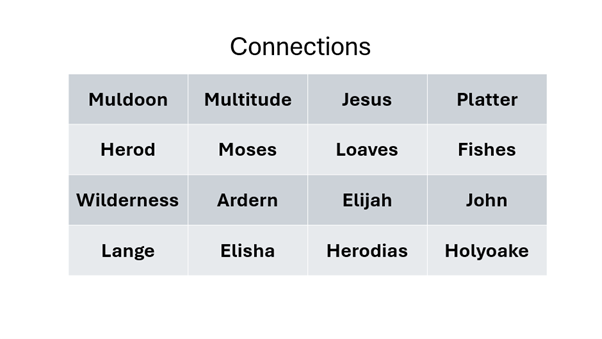
Most nights Robyn and I do some of the New York Times word puzzles. There’s Wordle of course, but we normally start with the lesser known Connections.

With Connections you are given 16 words; that is, four sets of four words which are related in some way. The object is to find the right connections.   

For example, among the 16 words you are given, you might have four names like Holyoake, Muldoon, Lange and Ardern. The connection there is pretty obvious. They are all former Prime Ministers of New Zealand.    

What about Multitude, Wilderness, Loaves and Fishes? What connection do you see with those words? Yes, Jesus’ feeding of the 5000. Today our message focuses on Matthew 14, verses 13-21, which describes Jesus’ miracle of feeding a multitude with just a handful of loaves and fishes.

This event is recorded in all four gospels and it finds multiple connections with the Old Testament as well. The feeding of the 5000 is a nexus point of Biblical connections. From Matthew 14, verse 13 we read…

13 When Jesus heard what had happened, he withdrew by boat privately to a solitary place. Hearing of this, the crowds followed him on foot from the towns. 14 When Jesus landed and saw a large crowd, he had compassion on them and healed their sick. 15 As evening approached, the disciples came to him and said, “This is a remote place, and it’s already getting late. Send the crowds away, so they can go to the villages and buy themselves some food.”

16 Jesus replied, “They do not need to go away. You give them something to eat.” 17 “We have here only five loaves of bread and two fish,” they answered. 18 “Bring them here to me,” he said. 19 And he directed the people to sit down on the grass. Taking the five loaves and the two fish and looking up to heaven, he gave thanks and broke the loaves. Then he gave them to the disciples, and the disciples gave them to the people. 20 They all ate and were satisfied, and the disciples picked up twelve basketfuls of broken pieces that were left over. 21 The number of those who ate was about five thousand men, besides women and children.

May the Spirit of Jesus illuminate God’s word for us.

Two main things I want to draw your attention to in this passage:

Jesus’ leadership and Jesus’ faith. We begin with Jesus’ leadership. The light of Jesus’ leadership shines brightly against the darkness of Herod’s reign.  

Leadership:

When you see (or hear) the words, Herod, platter, John and Herodias, what do you think of? Surely the beheading of John the Baptist.

John was the forerunner to Jesus, the prophet who came to prepare the way for the Messiah. John was Jesus’ ally, his wing man if you like. More than that, they were cousins.

In Matthew 14, verses 1-12, we read how Herod Antipas had John the Baptist killed. Herod was the puppet ruler of Galilee during the time of Jesus. He was a ruthless and depraved man.

When John the Baptist called Herod out on some of the bad stuff he was doing, Herod had John thrown in prison. Then when the daughter of Herodias danced for Herod, he promised to give her whatever she wanted. Herodias told her daughter to ask for John’s head on a platter.

After John had been beheaded, John’s disciples buried his body and told Jesus what had happened.

Given these facts, Jesus’ response to Herod is interesting. Jesus did not confront Herod; he did not organize a protest outside Herod’s palace or lead a revolt against Herod. Jesus did not seek revenge. Instead, Jesus quietly withdrew to a solitary place. Why?

Well, there was probably more than one reason. Perhaps Jesus did not want to inflame an already volatile situation. What Herod had done was a gross injustice. Anger and outrage are the natural response to injustice.

If Jesus confronted Herod or led a protest against him, it would have resulted in more violence. A calm head and a strategic withdrawal were necessary for the sake of peace. This was not a time for Jesus to be distracted from his core mission.

It appears too that Jesus needed some alone time; a short spiritual retreat to deal with his own feelings arising from John’s murder, but also to commune with God and seek his Father’s will on what his next move should be.   

With God, small things can make a big difference. Seeking solitude may seem like a small thing, but (in the context of Matthew 14) it accomplished much good and avoided even greater evil.

I wonder if Jesus had Psalm 37 in mind when he chose to put distance between himself and Herod. In verse 7, David writes…

Be still before the Lord and wait patiently for him; do not fret when people succeed in their ways, when they carry out their wicked schemes. Refrain from anger and turn from wrath; do not fret—it leads only to evil. For those who are evil will be destroyed, but those who hope in the Lord will inherit the land.

Jesus had faith that God Almighty would deal with Herod, and the Lord did deal with him. Some years later, in Acts 12, we read how an angel of the Lord struck Herod down. He was eaten by worms and died. God is just.

When the crowds worked out where Jesus was headed, they walked around the lake on foot and met him on the other side, in the wilderness. Seeing the large crowd, Jesus had compassion on them and healed their sick.

Compassion is the key word here. Compassion, in this context, is that deep feeling of empathy which moves a person to acts of kindness. Compassion speaks of an intimate connection, a heart and hand response to others in need. Compassion puts aside any thought of personal convenience or comfort for the sake of another person’s wellbeing.

Seeing all those people lost and confused, by what Herod had done to John, evoked a gut response from Jesus. The Lord was deeply moved in the core of his being. Rather than venting his spleen at Herod, Jesus used his emotional energy to heal and feed people.

By putting the account of Herod’s murder of John the Baptist alongside the account of Jesus’ compassion for the people, we (the reader) are invited to compare and contrast Herod’s leadership with Jesus’ leadership.

Herod was self-indulgent, brutal and destructive. Herod threw wild parties at the expense of the poor. He showed no restraint and it resulted in him taking the life of a righteous man. Herod’s leadership was toxic to the people.

In contrast, Jesus shows compassion for the poor. Jesus heals the sick, feeds the hungry and protects the vulnerable. Jesus demonstrates the kind of good shepherd leadership God wants for his people.

Those who are familiar with the Old Testament will see here a connection between Jesus and God’s word through the prophet Ezekiel…  

11 “I, the Sovereign Lord, tell you that I myself will look for my sheep and take care of them 12 in the same way as shepherds take care of their sheep that were scattered and are brought together again. … 14 I will let them graze in safety in the mountain meadows and the valleys and in all the green pastures of the land of Israel. 15 I myself will be the shepherd of my sheep, and I will find them a place to rest. I, the Sovereign Lord, have spoken.

By caring for the people in the wilderness, Jesus was acting as the divine shepherd leader of Israel, who has compassion on his people.

Okay, so we have talked about Jesus’ leadership, in contrast to Herod’s abuse of power. We also notice Jesus’ faith. Jesus models for us complete trust in God the Father.

Jesus’ faith:

The story is told of a soldier who was separated from his unit. The fighting had been intense, and in the smoke and the confusion, he had lost touch with his mates.

Alone in the jungle, he could hear enemy soldiers coming in his direction. Scrambling for cover, he found his way up a ridge to several small caves in the rock. Quickly he crawled inside one of the caves.

Although safe for the moment, he realized that once the enemy soldiers swept up the ridge, they would quickly search all the caves and he would be killed.

As he waited, he prayed, “Lord, if it be your will, please protect me. Whatever your will though, I love you and trust you. Amen.”

After praying, he lay quietly listening to the enemy begin to draw close.

He thought, “Well, I guess the Lord isn’t going to help me out of this one.”

Just then he saw a spider begin to build a web over the front of his cave. As he watched, listening to the enemy searching for him, the spider layered strand after strand of web across the opening of the cave.

“Hah” he thought, “what I need is a brick wall and what the Lord has sent me is a spider web. God does have a sense of humour.”

As the enemy drew closer, he watched from the darkness of his hideout and could see them searching, one cave after another. When they came to his cave, he got ready to face his end. To his amazement, though, they moved on.

Suddenly, he realized that with the spider web over the entrance, his cave looked as if no one had entered it for quite a while.

“Lord, forgive me,” the soldier prayed, “I had forgotten that in you a spider’s web is stronger than a brick wall.”

With God, small things can make a big difference. 

Take plankton for example. Plankton are small. Many types of plankton are microscopic in fact, smaller than a human blood cell, and yet they feed whales, the largest of mammals.

More than simply being a food source though, phytoplankton produce somewhere between 50% and 80% of the earth’s oxygen. God supports life on earth using tiny plankton.

Phytoplankton also absorb carbon dioxide helping to regulate the earth’s climate by removing greenhouse gas, from circulation.

With God, small things can make a big difference.  

Returning to Matthew 14. Jesus (the shepherd leader) had been ministering to people most of the day. It was getting late, so the disciples suggested to Jesus that he send the crowd away to the nearby villages to buy some food for themselves.

Given there were well over 5000 people present, this was not really a practical solution. It is unlikely the surrounding villages could cater for that number of people.

Jesus has another idea. ‘You give them something to eat’, he tells his disciples.

The disciples raise the obvious objection that they only have five loaves and two fish.  

In the gospel of John, we learn that these five loaves and two fish belonged to a boy. The loaves were made from barley. Barley bread was the food of the poor and the fish was probably small and pickled (like sardines).

It appears this boy was not well connected. He did not come from a wealthy family and his lunch was pretty ordinary.

Jesus is not phased though. He says, ‘bring them here to me’. And he directed the people to sit down on the grass. Green grass does not grow all year round in the middle east, like it does in New Zealand. The mention, therefore, that there is grass tells us it is springtime, Passover season.  

The Jewish Passover celebrates God’s deliverance of Israel from slavery in Egypt. We (the reader) are meant to see a connection here between God’s deliverance under Moses and the deliverance God brings under Jesus’ leadership.

In verse 19 we read how Jesus took the five loaves and the two fish and looking up to heaven, he gave thanks and broke the loaves. Then he gave them to the disciples, and the disciples gave them to the people. 

Here we see Jesus acting in faith that God would provide. As one commentator puts it, Jesus simply gave thanks for the food, confident that he represents the Father’s will.

In Jesus’ hands those five loaves and two fish fill the bellies of well over 5000 people, so that everyone had more than enough to eat.

Some people try to explain this miracle away, in various rational ways, but doing that empties this event of its meaning, robbing us of wonder and hope in the process. Jesus trusted God his Father completely and the Father honoured Jesus’ faith.

With God, small things can make a big difference.

Looking at our game of Connections once again we see there are four words left, names actually: Jesus, Moses, Elijah and Elisha. What do these four men share in common?

They were all prophets of the living God, offering spiritual leadership for the people. More than that, they all trusted God to provide for their needs and consequently participated in a feeding miracle. 

When the people of Israel cried out to Moses for food in the Sinai desert, Moses did not try to engineer a solution himself. He turned to God in prayer and the Lord God provided an abundance of manna and quail.

When God told the prophet Elijah to hide in the wilderness east of the Jordan, with no supermarket in sight, Elijah obeyed the Lord in faith, and God had ravens bring bread to feed him.

When a man brought the prophet Elisha 20 loaves of barley bread, Elisha told the man (in faith) to give the bread to the people. The 20 loaves fed 100 men and there was some left over.  

So, when we read how Jesus had faith in God to multiply five loaves and two fish to feed over 5000 people in the wilderness of Galilee, we see that in Jesus someone greater than Moses, Elijah and Elisha has come. Jesus is more than a prophet.

With God, small things can make a big difference.

Now in saying this, I do not mean to imply that we can be stingy with God, giving him our scrapes. The boy who offered his five loaves and two fish, gave Jesus everything he had. The boy was generous.

The point is, even when we give our best and our all, it may seem like a drop in the bucket. Our best and our all will usually fall short of the ocean of human need. But that is no reason to give up in despair. We can only do what is in our power to do and trust God with the outcome.   

Hearing this miracle story of Jesus feeding the multitudes is lovely and inspiring, but when we watch the news, we become painfully aware of the millions in our world today who are starving. Why doesn’t God feed them?

Well, God has provided enough to feed everyone on the planet. It’s not a production problem; it’s a distribution problem. Human greed and fear often get in the way.

Jesus trusted his disciples to distribute the food to the multitude and the disciples were faithful in carrying out the task Jesus gave them. In the end, there were 12 basketfuls left over, one for each of the disciples.  

Conclusion:

This morning we have observed multiple connections, all orbiting around Jesus and the miraculous feeding of the 5000 in the wilderness. There’s just one more connection we need to make. This too finds its fulfilment in Christ.

Centuries before Jesus came, the Lord God gave the prophet Isaiah a glimpse of a future heavenly banquet, with food far richer than barley bread and pickled fish. From Isaiah 25 we read…

On this mountain the Lord of hosts will make for all peoples a feast of rich food, a feast of well-aged wine, of rich food full of marrow, of aged wine well refined. And he will swallow up on this mountain the shroud that is cast over all peoples, the veil that is spread over all nations. He will swallow up death forever; and the Lord God will wipe away tears from all faces, and the reproach of his people he will take away from all the earth, for the Lord has spoken.

Jesus is the one who removes the shroud of death. It is through faith in Jesus (his death and resurrection) that we have sure hope of participating in God’s heavenly banquet.

Let us pray…

Gracious God, you know our every need and you care for us. Thank you for Jesus, the good shepherd, who leads us in paths of righteousness and restores our soul. Grant us the grace to follow Jesus all the days of our life and enjoy you forever. Amen.   

Questions for discussion or reflection:

  1. What stands out for you in reading this Scripture and/or in listening to the sermon? Why do you think this stood out to you?
  2. Why did Jesus withdraw to a solitary place after hearing how Herod had killed John? What good did Jesus’ retreat accomplish? (What evil did it prevent?)
  3. What is compassion? What (or who) moves you to acts of kindness?
  4. Compare and contrast Jesus’ shepherd leadership with Herod’s abuse of power. How do you experience Jesus’ care and provision?
  5. Discuss / reflect on the connections you notice between Jesus’ feeding of the 5000 in Matthew 14 and other feeding miracles in the Bible. How are these miracles similar? How are they different?
  6. In what ways do we see Jesus’ faith operating in Matthew 14?
  7. What small thing can you do (in faith) to show God’s love and care for others?