Included

Scripture: Ephesians 2:11-22

Title: Included

Structure:

  • Introduction
  • A new access
  • A new humanity
  • A new temple
  • Conclusion

Introduction:

As well as being Trinity Sunday, today is also Disability Awareness Sunday

–         My first job after leaving university was with a community organisation who worked with people with disabilities, in Tauranga

–         I was 23 at the time and had very little disability awareness – so they made me a disability awareness educator

–         Nothing like being thrown in the deep end

My job was to help people with disabilities to be included in the community by educating the community

–         For many years people with disabilities were excluded from mainstream society – they were locked away in institutions and this proved to be quite harmful, both to the people locked away and to mainstream society

–         One of the challenges people with disabilities faced, when they were released from institutions, was the prejudice of others

–         I soon learned that disability isn’t so much a deficit with an individual person, it’s actually more a deficit with our society

–         It is our society which disables people

–         If the only means of access into a building is stairs, then it’s not the person in the wheelchair who is disabled, it’s the building

–         If someone pokes fun at a person because they can’t hear then the problem is not with the person who is deaf

Unless you’ve been excluded (or spent meaningful time with people who are excluded) then you don’t really see the barriers that exist in our society

–         The world we live in says, in a thousand ways, that our value is based on our ability – but the Bible says that isn’t true

–         The truth is our value comes from God who made us and loves us

This morning we continue our series in Ephesians

  • – Our focus today is Ephesians 2, verses 11-22
  • – We could summarise this passage by saying: ‘We were excluded, but in Christ we have now been included, reconciled and brought home’
  • – In today’s reading Paul traces the movement from division to unity
  • – From alienation to reconciliation
  • – From hostility to peace
  • – From despair to hope
  • – And from being excluded to being included
  • – From Ephesians 2, verse 11, in the NIV we read…

Therefore, remember that formerly you who are Gentiles by birth and called “uncircumcised” by those who call themselves “the circumcision” (which is done in the body by human hands)— remember that at that time you were separate from Christ, excluded from citizenship in Israel and foreigners to the covenants of the promise, without hope and without God in the world. But now in Christ Jesus you who once were far away have been brought near by the blood of Christ. For he himself is our peace, who has made the two groups one and has destroyed the barrier, the dividing wall of hostility, by setting aside in his flesh the law with its commands and regulations. His purpose was to create in himself one new humanity out of the two, thus making peace, and in one body to reconcile both of them to God through the cross, by which he put to death their hostility. He came and preached peace to you who were far away and peace to those who were near. For through him we both have access to the Father by one Spirit. Consequently, you are no longer foreigners and strangers, but fellow citizens with God’s people and also members of his household, built on the foundation of the apostles and prophets, with Christ Jesus himself as the chief cornerstone. In him the whole building is joined together and rises to become a holy temple in the Lord. And in him you too are being built together to become a dwelling in which God lives by his Spirit.

May the Spirit of Jesus illuminate this Scripture for us

In our message last week we heard about three aspects of our personal salvation

  • – This week’s reading is about the salvation of the group
  • – In and through Christ we have a new access to God, a new humanity under God and we become part of God’s new temple
  • – First let’s consider the new access we have in Christ


A new access:

When I was a boy we used to visit my great aunt Avis in Auckland

–         She has passed on now but in her day she was a very capable woman

–         Avis’ fulltime job was as PA for Mr Gladding, the general manager of South Auckland Motors

–         In addition to her day job Avis attended St Philip’s Congregational Church in Papatoetoe where she taught Sunday school for many years and also served as the church secretary for a while

During the 1950’s my aunt studied by correspondence to earn her lay preacher’s license

–         It was quite a significant qualification involving Greek, theology, Biblical exegesis and so on

–         The minister, a man named Ted Tabor, was supportive of my aunt and included her by providing opportunities for her to preach in church

–         Having no family of her own the church became her family – she was warmly included

Then in the early 1960’s Avis applied to become a minister within the Congregational denomination

–         Despite her qualifications, her professional skills, her church ministry experience & the support of her minister, the denominational hierarchy turned her down

–         No reason was given but it appears my aunt didn’t make the cut because she was a single woman

–         Now I don’t want to be unfair to the people that made that decision

–         Attitudes in NZ society were different then – maybe they thought they were doing what was best for her and the church at the time

–         But my aunt didn’t see it that way

–         Although Avis had access to the Bible in its original language and although she had proven herself to be a faithful servant of the church for many years, she was denied access to fulltime pastoral ministry

–         Sadly this was not her first rejection in life

–         She decided to stop attending church after that

In some ways my aunt’s experience was similar to that of many people – a mixture of being included and excluded

–         Although she wasn’t excluded from God’s people or from lay preaching, she received the message, ‘you can come this far but no further’


In verses 11-12 of Ephesians 2, Paul reminds his non-Jewish readers how, previously, they were excluded from God’s people and God’s promises, having no hope in the world

Now for most of us, who are used to being included, these verses are water off a ducks back – they don’t penetrate the surface, we don’t really appreciate them

–         But if you have been systematically excluded and de-valued over a long period of time you will be very sensitive to what Paul is saying here

When I was working with and for people with disabilities there was one guy (with cerebral palsy) who knew I was a Christian and took a crack at my faith

–         He found some verses in Leviticus 21 which talk about how people with disabilities can’t draw near to offer sacrifices – how they are kept at arm’s length and don’t have the same access as able bodied people

–         He was quoting Scripture out of context – so I tried to explain how that was in the time of the Old Testament but now, because of Jesus, we have a new access to God – we go from being excluded to being included

–         Or, as Paul says in verse 13, now in Christ Jesus you who once were far away have been brought near by the blood of Christ (that is, by Christ’s sacrifice)

–         Unfortunately my friend with cerebral palsy was too angry to listen – and after the hurt and rejection he had experienced in life it was no wonder

–         Having said that, we don’t do ourselves any favours by holding on to our hurt

There is a temptation when we are rejected or excluded to feel sorry for ourselves – but when that happens we still have a choice

–         We can either carry on feeling sorry for ourselves and wind up polishing the bar with a hard luck story

–         Or we can find a way to forgive the hurt and move on

–         I don’t mean to sound brutal but sooner or later everyone suffers – no one gets through life unscathed

–         Everyone sins and everyone is sinned against – so we have to learn to forgive, because without forgiveness we can’t have peace


Returning to the story of my aunt for a moment…

–         Some years later a minister from the Congregational church went to visit Avis. When he heard her story he apologised (although it wasn’t his fault) and asked her to return. Sounds like he was trying to bring reconciliation

–         Although my aunt didn’t go back to church I never heard her speak ill of the church – we only learned about her experience through a couple at St Philips who stayed in touch with her after she left

–         The fact that Avis didn’t bad mouth the church and kept her friendship with people in the church, suggests to me that she did forgive and find some peace


We are talking about salvation in a corporate or group sense

–         In and through Christ we Gentiles, who were excluded, now have a new access to God

–         More than this though, in and through Christ, God creates a new humanity


A new humanity:

The Rohingya people are a stateless ethnic group who reside in Rakhine State, Myanmar. The majority are Muslim while a minority are Hindu

–         Described by the United Nations as one of the most persecuted minorities in the world, the Rohingya are denied citizenship under the 1982 Myanmar Nationality Law

–         Although Rohingya history in the region can be traced back to the 8th Century, Myanmar law does not recognize the ethnic minority as one of the eight national indigenous races

–         They are also restricted from freedom of movement, state education and civil service jobs.

–         Because of persecution hundreds of thousands of Rohingya refugees, have crossed the border into Bangladesh from Myanmar

–         The Kutupalong refugee settlement, in Bangladesh, has grown to become the largest of its kind in the world, with more than 600,000 people living in an area of just 13 square kilometres

I don’t really understand the situation or how God might work his purpose in it – but clearly the Rohingya have suffered hostility and are excluded


The sort of hostility the Rohingya have experienced is foreign to most of us but it wasn’t foreign to the people of Paul’s day

–         For centuries Jews and Gentiles had been at each other’s throats

–         When we read the Old Testament we see that Israel is almost constantly in a state of war with the surrounding nations

–         But Jesus came to bring peace between Jews and Gentiles

–         In fact he came to make the two groups one

–         In Ephesians 2 verse 14, Paul writes of Christ…

For he himself is our peace, who has made the two groups one and has destroyed the barrier, the dividing wall of hostility, by setting aside in his flesh the law with its commands and regulations.

This verse requires some explanation

  • – The ‘two groups’, as I’ve already alluded to, are the Jews and Gentiles
  • – Generally speaking both sides hated each other
  • – The Jewish temple of Jesus’ & Paul’s day had a literal wall which Gentiles were not allowed to go past – you can go this far but no further
  • – In fact there was a sign on the wall that basically said, ‘Gentile trespassers will be executed’ – not ‘prosecuted’ but ‘executed’
  • – The temple in Jerusalem wasn’t literally destroyed by the Romans until AD70 – but spiritually speaking Jesus destroyed the dividing wall decades before that


With his death on the cross Jesus also set aside the law with its commands and regulations

  • – Now those who are familiar with Matthew 5 will see a red flag here, because in his sermon on the mount Jesus said, ‘Do not think I have come to do away with the law – no, I’ve come to fulfil it’
  • – John Stott helps to give clarity on this point
  • – When Paul talks about the law in Ephesians 2 he means the ceremonial law, not the moral law
  • – But when Jesus talks about the law in Matthew 5 he means the moral law

The ceremonial law is that part, in Leviticus for example, which says people with disabilities can’t draw near to the altar to offer sacrifices

  • – Jesus’ coming makes the ceremonial law unnecessary because we don’t approach God by offering sacrifices in the temple in Jerusalem anymore
  • – Jesus’ sacrifice on the cross does away with the need for animal sacrifice
  • – We now approach God through Jesus and anyone can come to Jesus
  • – In distinction from the ceremonial law, the moral law includes things like the 10 commandments – don’t steal, don’t murder, don’t covet, that sort of thing
  • – Jesus doesn’t do away with the moral law – rather he fulfils it so we are no longer condemned by it

I have in my hand a walnut. To eat this walnut I must first remove the shell

  • – The shell is like a dividing wall – it is useful for a time, to protect the nut inside – but once the shell has been broken we no longer need the wall
  • – The Law of Moses is like a walnut
  • – The outer shell represents the ceremonial law, while the nut inside represents the moral law
  • – Jesus came to fulfil the moral law – in other words he came to crack open the shell and remove the dividing wall of the ceremonial law so we could eat the moral nut inside


In verses 15 & 16 Paul continues talking about what Christ did…

–         His purpose was to create in himself one new humanity out of the two, thus making peace, and in one body to reconcile both of them to God through the cross, by which he put to death their hostility.  

This is mind blowing stuff – Jesus takes two groups of people who for centuries have been trying to kill each other, and reconciles them to God and to each other so they become one body of people at peace

–         To give you an idea of the sort of reconciliation Jesus achieves here, it would be like getting Donald Trump to apologise to Hilary Clinton and Hilary Clinton accepting it

–         It would be like having the people of Myanmar welcoming the Rohingya home with full citizenship

–         Or like seeing the National Rifle Association lobby for stricter gun laws

–         Or, closer to home, like seeing the Treaty of Waitangi honoured


Jesus came with a message of peace for those, like us, who were far away – the Gentiles, women, people with disabilities, the Rohingya and so on

–         And he preached peace to those who were near – able bodied Jewish males, like Paul

–         For through Christ we both have access to the Father by one Spirit

–         Here we notice the Trinity : Father, Son & Holy Spirit

–         Paul is saying that in and through Christ we are able to participate in the very life of God – a bit like Abraham & Sarah participated in the life of God when they received the three visitors in Genesis 18 and soon after Sarah became pregnant


As a consequence those who were once far away and excluded are now brought near and included as citizens of God’s kingdom & members of God’s household

–         In other words, in Christ the excluded become part of God’s family

–         But wait there’s more – in Christ we actually become a new temple for God’s presence

A new temple:
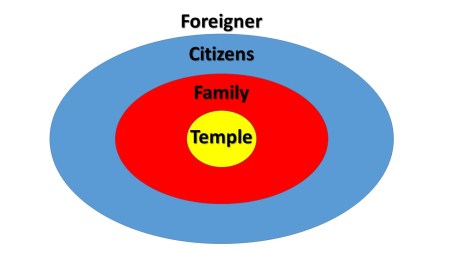
Bullseye - 16 Jun 2019

This diagram on the wall here (which looks like a bullseye) shows the three images of inclusion Paul uses in verses 19 to 21

–         Being a citizen in God’s kingdom (the outer ring) is closer to God than being a foreigner

–         Being a member of God’s family (the next ring in) is closer again than being a citizen

–         But being part of God’s temple (the bullseye) is the closest one can get to God, because to be God’s temple is to have the presence of God inside you

From verse 20 Paul expands on the new temple image

The foundation of the new temple is the apostles and prophets – essentially the teachings of the New Testament

–         As John Stott observes: the church’s foundation documents are the New Testament Scriptures. And just as a foundation cannot be tampered with once it has been laid and the structure is being built on top, so too the New Testament… can’t be changed by additions, subtractions or modifications [1]

–         If we try to build something outside the footprint of the New Testament then it won’t last


Verse 20 tells us Jesus is the cornerstone of the new temple – the one who holds the whole building together

Those who were here for the all-age Christmas service last year may remember these verses and how we built a wall out of shoe boxes at the front

–         Neville explained how a cornerstone, in Biblical times, was the largest, most solid stone in a building. It gave the building its shape and size.

–         If you took the cornerstone away, the whole building would fall down

–         More recently, buildings have cornerstones on each corner, supporting all the smaller bricks. The idea is the same.

–         As a cornerstone, Jesus is like a solid rock supporting us, a friend beside us who we can rely on – the one from whom we get our plumb line

That makes us the bricks (or living stones) of God’s new temple

–         In Christ we too are being built together to become a dwelling in which God lives by his Spirit.

–         Again we notice the Trinity in this image and our participation in the life of the Trinity

–         God the Son, is the cornerstone, we are the bricks and God the Father lives in us by his Spirit

This means the Christian church replaces the Jerusalem temple, which was destroyed by the Romans in AD70

–         We don’t replace Israel as such, but we do replace the temple building

–         So wherever you go in the world, particularly when you go with another believer, you take the presence of God with you

–         Although my aunt stopped going to church the church didn’t abandon her

–         One couple from the church, who loved Avis, stayed in touch with her and supported her through a difficult time

–         This couple embodied God’s presence for my aunt – they literally took the temple to Avis by visiting her and showing care for her

–         Is there someone you can take the presence of God to?


Conclusion:

This morning we’ve heard how Christ includes people in the very life of God

–         Through Christ we have a new access to God

–         Through Christ we become a new humanity under God

–         And through Christ we become a new temple for the presence of God


Questions for discussion or reflection:

1.)    What stands out for you in reading this Scripture and/or in listening to the sermon?

–         Why do you think this stood out to you?

2.)    Have you ever been excluded in a significant way?

–         What was this like for you?

–         Have you been able to forgive the hurt and move on?

3.)    Do you know what it is to be included (&/or reconciled) in a significant way?

–         What was this like for you?

–         Have you been able to include others too?

4.)    What is the difference (or relationship) between the ceremonial law and the moral law?

–         What does Jesus destroy and what does he fulfil?

5.)    Where do we see the Trinity in Ephesians 2:11-22?

–         What is our relationship to the Trinity, in Christ?

6.)    Looking at the bullseye, in the sermon notes above, where are you in relation to God?

–         Ask someone close to you if they agree. Where do they see you in relation to God?

–         Where would Paul say you were in relation to God?

7.)    Reflect on (or discuss) the various aspects of the temple image in verses 20-22. That is, the foundation, the cornerstone, the bricks, God’s Spirit

–         What are the practical implications with each of these aspects?

–         Is there someone you can take the presence of God to?


[1] John Stott, BST Commentary on Ephesians, page 107.

Ruth & Boaz

Scripture: Ruth 2


Title: Boaz & Ruth


Structure:

  • Introduction
  • Safe Access
  • Warm Understanding
  • Community Connection
  • Conclusion


Introduction:

Earlier in the service I stood on a table and tried to give someone a hand up so they could stand on the table with me – It didn’t work

–         But when I stood on the ground and gave them a hand up from alongside, it worked much better

–         I want you to keep that picture, of a hand up from alongside, in your mind as you listen to today’s message


This morning we continue our sermon series on intergenerational relationships in the Bible

–         An intergenerational relationship is a relationship between two people from different generations, someone older and someone younger

–         We find a number of intergenerational relationships in the Bible

–         For example: Moses and Joshua, the aging priest Eli and the young prophet Samuel, King Saul and King David

–         As well as the apostle Paul and his protégé Timothy


Our focus this morning though is on the relationship between Ruth and Boaz

–         We don’t know the age difference between Boaz & Ruth, only that Boaz was somewhat older than Ruth, maybe between 10 & 25 years older

–         Setting aside the romantic attachment that developed between them, Boaz demonstrates for us a number of things that those who are older can do to come alongside those who are younger and give them a hand up


Boaz gives Ruth access, understanding and connection

–         We also can do these things for those who are younger than us


Setting the scene:

We touched on Ruth’s story 3 Sundays ago when we looked at the inter-generational friendship between Naomi and Ruth

–         But in case you missed that I’ll give you a quick overview to set the scene


The story takes place during the time of the Judges in ancient Israel – which is after Joshua and before Saul & David

–         In many ways it was the worst of times – when men behaved badly

–         But it brought out the best in certain people

–         There was a famine in the land and Naomi’s husband and two sons were forced to leave Bethlehem to try and find food in Moab, the land of their enemies – they were essentially refugees – displaced people


While they were in Moab, Naomi’s husband died and her two sons married Moabite girls: Orpah and Ruth

–         Ten years passed in Moab before Naomi’s two sons died also

–         Despite 10 years of marriage Orpah & Ruth had no children


When Naomi hears that God has provided food for his people in Israel, she decides to return to Bethlehem

–         Long story short – Orpah stays in Moab, while Ruth goes with Naomi saying…


“…Where you go I will go, and where you stay I will stay. Your people will be my people and your God my God…”


Ruth wholeheartedly commits herself to Naomi, to Naomi’s people and to Naomi’s God. This was a huge leap of faith and a great act of hesed or loyalty on Ruth’s part


Ruth & Naomi return to Bethlehem just in time for the barley harvest


The Law of Moses was written with the poor and vulnerable in mind, using a hand up, not a hand out, approach


One of the safety nets provided by the Law was a practice called gleaning

–         With gleaning, the poor were allowed to follow behind the harvesters picking up the grain left behind

–         The harvesters were to ensure there was adequate left overs for the gleaners to pick up by not harvesting the edges of their fields and not going over the ground twice

–         Gleaning was not a ‘hand out’ because the gleaners had to work for their grain

–         Having said that, gleaning by itself wasn’t enough to lift someone out of poverty – but it did at least save people from starvation


So they wouldn’t starve, Ruth respectfully asks to go gleaning in the fields and, as providence would have it, she finds herself in Boaz’ field

–         I say, ‘as providence would have it’ because Boaz does three things to help Ruth:

o   He grants her safe access to his field for gleaning

o   He shows Ruth warm understanding

o   And he connects her with others in the community

–         Safe access, warm understanding and community connection


These three things that Boaz does for Ruth are things that we can do for those who are younger than us


Safe Access:

Firstly, Boaz grants Ruth safe & generous access to his field


When Boaz turns up to see how his harvesters are getting on he notices this young women working in his field, so he asks his foreman who this mystery gleaner is, and the foreman replies…


“She is the Moabitess who came back from Moab with Naomi. She said, ‘Please let me glean and gather among the sheaves behind the harvesters’. She went into the field and has worked steadily from morning till now, except for a short rest in the shelter.”


There’s a few points to note here:


Firstly, the foreman doesn’t seem to know Ruth’s name – he identifies her as the ‘Moabitess from Moab’

–         In other words, she’s not one of us, she’s an outsider

–         Despite the fact that Ruth was an outsider the foreman still granted her access to glean in Boaz’ field

–         Apparently word had got around of Ruth’s hesed (or loyalty) to Naomi


Secondly, Ruth asks permission to glean in the field, even though the Law of Moses already says she can

–         This tells us that Ruth doesn’t come with any sense of entitlement

–         She approaches the foreman with respect and humility


Thirdly, the foreman says how Ruth has ‘worked steadily’

–         This indicates Ruth’s virtue

–         She’s not lazy, she’s not looking for a hand out, she’s not there to pick up a man – she’s there to provide for herself & Naomi and for this the foreman respects her


Boaz comes alongside Ruth and says to her…


“My daughter, listen to me. Don’t go and glean in another field… Stay here with my servant girls. Watch the field where the men are harvesting and follow along after the girls. I have told the men not to touch you. And whenever you are thirsty, go and get a drink from the water jars the men have filled.”


Although immigrants like Ruth (who embraced the God of Israel and his covenant) were provided for and protected under the Law, this didn’t guarantee their safety

–         The time of the Judges was a bit of a dodgey time in Israel’s history when people tended to do what was best in their own eyes

–         Consequently finding people who kept the Law was rare

–         Boaz was one of those who did keep God’s Law but he was well aware that many of his countrymen didn’t

–         Had Ruth gone to glean in another field she could have been driven away or worse, assaulted

–         That’s why Boaz encourages Ruth to stay in his field where she won’t be molested


Boaz is in a position of power – he is careful not to abuse his power, but rather to use it to help Ruth, to empower her by granting safe access to his field

–         Granting safe access to those young people who embrace Christ (as Ruth had embraced the God of Israel) is something we can do also


At a recent deacons meeting Daryl gave a devotion from the Fuller Institute’s book “Growing Young”

–         In this book we find the following true story…


Remember your first set of keys?

–         Stephen — who goes by “Stretch” — received his first set of keys when he was 16.

–         His town handed him a driver’s license, and his parents handed him the key to the family car.

–         Heart pounding with excitement, he climbed behind the wheel and pulled out of his driveway for the first time on his own.

–         Stretch couldn’t believe the newfound freedom and responsibility he had been given.

–         He took a step away from childhood and a step closer to adulthood.


As Stretch pulled onto the street and began to accelerate, he faced an important and practical question. Where should I go?

–         Within a moment he knew the answer. Over the past several years, his church had become like a second home to him. There he felt known, accepted and valued. So naturally, he headed in that direction.


As he drove into the parking lot, the church’s childcare was wrapping up for the day.

–         One of the coordinators who knew Stretch noticed him driving the car.

–         Given a recent shortage of childcare workers and seeing that he now had transportation, she asked if he was interested in helping after school.


She was only halfway through the question before Stretch knew his answer. He would get to hang out at the church, spend time with kids, and on top of it all … he would get paid. This day couldn’t get any better!

–         Until a few minutes later, when she returned from the church office and handed him a key to the church. “If you’re going to help us, there will be times when we’ll need you to lock up,” she explained.


Stretch was staring so intently at the key that he barely heard her words.

–         The pastor had this key.

–         His Sunday school teacher had this key.

–         Other adults who were mature — who had power — had this key.

–         But him? It was like he had been waiting on the sidelines during the big game and was now being called to step onto the playing field.


Life was truly as good as it could be. Until it got even better.


A week later, while Stretch was working in the childcare center, the youth pastor dropped by. “You know, Stretch,” he said, “if you have your license and are already at the church, would you be willing to stock the soda machine for me? The job comes with all the Mountain Dew you can drink.”

–         Key to the car. Check.

–         Key to the church. Check.

–         Key to the soda machine. Check.

–         Stretch knew he had arrived.


Later that night, Stretch received the final “key” that forever changed the course of his life. Standing alone in the empty church, he heard God speak to him — not audibly but distinctly.

–         “You like to be here, don’t you?” God asked.

–         “Yes, I do,” Stretch answered.

–         “Well, get comfortable, because you’re going to be here a lot.”


From that day on, Stretch knew that both his future and his vocation were closely tied to church ministry.

–         Leaders he deeply respected had entrusted him with access and authority by giving him keys, both literally and figuratively.

In the several decades that followed, others continued to entrust him with the keys of leadership & he’s now been a youth pastor for over 20 years [1]


That’s a good news story

–         The more mature adults in the church put faith in Stretch, they trusted him and gave him access

–         And Stretch, for his part, was respectful of the trust (the keys) he had been given – he didn’t take it for granted, nor did he have any sense of entitlement – he was simply grateful for the faith others showed in him


Keys provide access

–         Granting access is really about trusting people and empowering them


We let our young people (who embrace Christ) have access in a number ways

–         Sometimes literal access to the church buildings by giving keys

–         But also access to opportunities for service & leadership, through the music team or through Sunday school, Club Intermed, youth group and night church

–         The next generation may do things differently to the previous generation but that’s okay – so long as each generation holds to Christ


It seems to me that Daryl is very good at trusting the young people in his care by giving them access to the church and opportunities for service

–         But it’s not just Daryl – our deacons and our congregation as a whole want to continue seeing the next generation participating in church life

–         By the same token we are fortunate to have young people who (like Ruth and Stretch) are respectful and responsible with the keys we give them


Warm Understanding:

Not only does Boaz grant Ruth safe access to his fields, he also shows Ruth warm understanding

–         When Ruth asks Boaz why he is showing her such favour, Boaz replies…


“I’ve been told all about what you have done for your mother-in-law since the death of your husband – how you left your father and mother and your homeland and came to live with a people you did not know before… May you be richly rewarded by the Lord, the God of Israel, under whose wings you have come for refuge.”


To which Ruth replies…

–         “…You have given me comfort and spoken kindly to your servant…”


Ruth’s reply indicates there is real warmth in what Boaz says here

–         He is showing her, with his words, that he understands and appreciates what she has been through and what she has given up for Naomi’s sake

–         Consequently Ruth feels comforted by his words


What’s more, by saying, I’ve been told all about what you have done for your mother-in-law, Boaz is making it clear to Ruth that the rumour mill is positive

–         She doesn’t have to worry about how others are perceiving her

–         He’s not the only one who knows about her hesed (her loyalty) to Naomi


Sometimes when we are young we can feel a bit unsure of ourselves

–         We might not have worked out who we are or where we fit just yet

–         One of the things older people can give younger people is encouragement – kind words communicated warmly, not cold words of criticism

–         You don’t have to be over the top with complements or embarrass people by doing it publicly – just a few gentle words on the quiet at the right time to show you are on their side


Mother Teresa once said:

–         Loneliness and the feeling of being unwanted is the most terrible poverty


The thing about warmth & understanding is that it stops people from feeling alone and unwanted – it keeps their demons at bay

–         When you feel that someone really gets you, really understands you, then you feel more at peace, more at home with yourself and with others


The 24-7 youth work that Jo & Thomas do at Tawa College is about warmth and understanding

–         It’s about coming alongside and being present to listen so young people don’t feel alone


A few weeks ago I attended the Baptist Lead conference in Lower Hutt

–         One of the speakers there, Tricia Hendry, told a story of a boy who was sent to live with his gran

–         The boy began wagging school, not just once or twice, but regularly


When his gran found out he’d been wagging she didn’t react straight away

–         She took a deep breath and considered how to approach the situation

–         Her grandson was respectful to her at home and so it was a bit puzzling why he would do this


In the end the gran decided to take him out to KFC for dinner – he loved KFC

–         On the way the boy asked, ‘Why are you taking me to KFC gran?’

–         ‘Because you’ve had a rough time lately and I wanted to do something nice for you.’

–         They sat in the restaurant and ate their KFC – the grandmother didn’t say anything about the boy wagging school


After they’d eaten the gran drove the boy home, but she took the long way.

–         They were sitting side by side in the car, not face to face, and so the posture was not top down or confrontational, it was alongside

–         The boy asked, ‘Why are we taking the long way home?

–         And his gran replied, ‘I want to ask you a question. When you are not at school are you keeping yourself safe?’

–         The gran’s question let the boy know two things:

o   That his gran was aware he was wagging, so he didn’t need to hide or keep that secret anymore (the truth sets us free)

o   And secondly, that she cares – there’s no judgement, no threat of punishment, just warmth and a genuine desire to understand


The boy says, ‘Yes gran. I am looking after myself. I go to my mother’s work and sit outside her window so I can be there to help her if she needs me.’

–         You see the reason that boy was sent to live with his gran was that his father was being violent to his mother

–         The boy just wanted to protect his mum


What a wise gran – full of truth and grace


Sometimes older people think they have nothing to offer.

–         That’s not true

–         If you are older then you have experience and you can show warmth and understanding to those who are younger

–         (You can be a surrogate grand-parent)


Now I’m conscious there are a lot of teachers here, some of whom may have to deal with students who wag school

–         I’m not suggesting you take them all out to KFC – a teacher’s role is quite different to the role of a grandparent

–         Besides, not all kids wag for good reasons like the boy in that story

–         The point is, whether you are a teacher or a parent or a grandparent or whoever, warm understanding is usually a more helpful place to start than cold criticism


Tawa College is great with their restorative practice – it’s a warm understanding approach


Community Connection:

Okay – so far we’ve heard how Boaz gives Ruth a hand up (not a hand out) by:

–         Granting her safe access to his property

–         And by communicating with warmth and understanding

–         The other thing Boaz does for Ruth (in chapter 2) is he creates connections for her in the community

–         He does this by inviting her to eat lunch with him and his workers


At mealtime Boaz said to Ruth, “Come over here. Have some bread and dip it in the wine vinegar.” When she sat down with the harvesters he offered her some roasted grain. She ate all she wanted and had some left over.”


By sharing a meal together the workers got to know Ruth a bit so that she wasn’t just the Moabitess from Moab – she wasn’t a stranger anymore

–         And by giving Ruth more than she could eat Boaz is underlining Ruth’s status as a person to be valued and accepted by others

–         Boaz is modelling for his workers how he expects them to treat Ruth, with generosity and respect


Sometimes you find yourself in a conversation with someone who says something like: ‘Young people these days are terrible’

–         If you do then don’t abide that – put them straight

–         Model for them a positive way to talk about young people

–         Tell them about the young people you know who are good

–         Most young people are good these days – certainly better than I was


A few things we do to help foster relational connections in the life of the church include: tea & coffee after the morning service, ‘Count Me In’ lunches, small group Bible studies and all-age (intergenerational) services from time to time

–         Those things in themselves don’t guarantee community connections – they are a hand up (from alongside), not a hand out

–         So some effort to talk to someone new and get to know others is still needed on our part


There’s heaps more we could say about creating community connections but that’s enough for today


Conclusion:

Boaz gives Ruth a hand up by granting her access to his field, warm understanding and community connection

–         These are things we can do also


Boaz points us to Jesus

–         Jesus came down from heaven and became human to be alongside us and give us a hand up


For those who may identify with Boaz…

–         Is there someone you can come alongside to offer a hand up?


And for those who identify more with Ruth…

–         What can you do to help yourself?


Let us pray…

[1] https://www.nae.net/unlock-keychain-leadership/