Discipleship – by Becca

Scripture: Deuteronomy 6:5-9

Good morning everyone!

When Will asked me to speak, I planned to talk about the passages where Jesus invites the children to come to him. As I read and planned, it kept changing and eventually I ended up focusing on verses from Deuteronomy which fits in perfectly for our current sermon series. Will actually covered these verses as part of one of his sermons back in July, so they should be familiar to you all.

Deuteronomy 6:5-9 reads, “Love the Lord your God with all your heart, with all your soul, and with all your strength. Never forget these commands that I am giving you today. Teach them to your children. Repeat them when you are at home and when you are away, when you are resting and when you are working. Tie them on your arms and wear them on your foreheads as a reminder. Write them on the doorposts of your houses and on your gates.”

These verses are really about discipleship. The Greek word used in the Bible for discipleship, mathēteuō has two definitions, to be a disciple of someone, and to make a disciple of someone, and both meanings are included in these verses. 
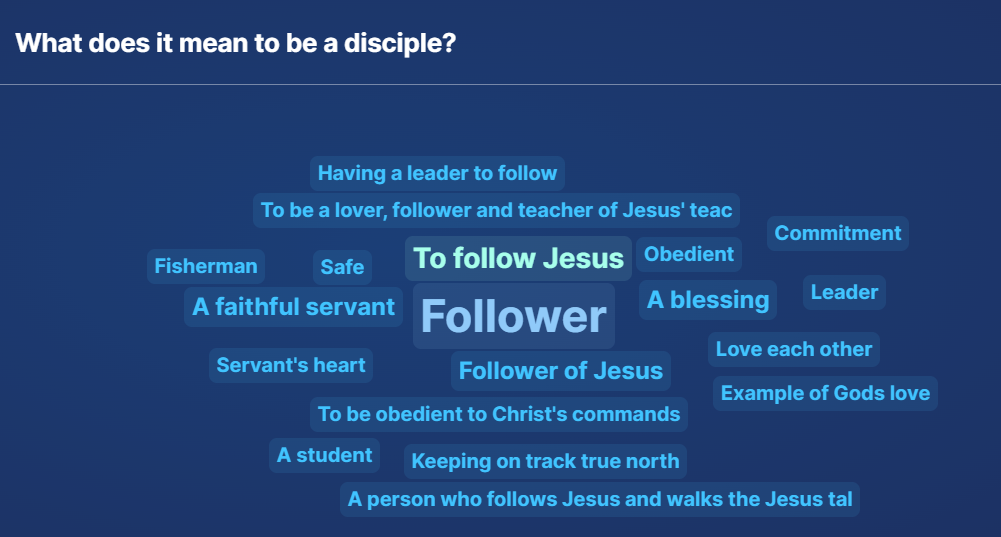
To be a disciple means being a student, someone who adheres to and follows a particular doctrine.  It’s not about being the best Christian. Being a disciple of Jesus isn’t some status level that we can attain, like Gold status for flying a certain number of times with Air New Zealand. We often hear of the 12 disciples, Jesus’ closest friends and students, but in Acts, anybody who comes to know and believe in Jesus as God’s Son is called a disciple. 

Jesus’ 12 disciples stayed with him, they learnt and studied and lived life together. Disciples study and remember a teacher’s words, but more than that, they learn by imitating the teacher’s entire way of life. 

For Christians, being a disciple is about loving God with all of our being and constantly striving to imitate Jesus. We are told by Moses in Deuteronomy, and by Jesus in the Gospels, to love God with everything we have. With all our energies, and with all our efforts, and with all our understanding. That is a big ask, especially when we are trying to manage everything else going on in our lives – our work, families, children, homes, friendships, volunteering roles and so on. Putting God first, above all of that is hard!

Reflection question – I have a few of these questions throughout, they are things that have challenged me and may be a challenge to you as well. Where are your energies going? What are your priorities? Are you loving God with all of your heart, soul, and strength?

—————

The next part of our passage in Deuteronomy goes on to say, “Never forget these commands.” This is another aspect of being a disciple. Later on in the chapter, Moses warns the Israelites not to forget God when they are rich and don’t have to rely on him anymore. 

“When the Lord your God brings you into the land he swore to your fathers, to Abraham, Isaac and Jacob, to give you a land with large, flourishing cities you did not build, houses filled with all kinds of good things you did not provide, wells you did not dig, and vineyards and olive groves you did not plant – then when you eat and are satisfied, be careful that you do not forget the Lord, who brought you out of Egypt, out of the land of slavery.”

How often do we call out to God when we need him, but kind of ignore him through the good times? Or maybe we find it easy to have faith when life is going well, but feel abandoned or alone when things get tough? It can be challenging to be a follower of Christ in all situations, in all aspects of our lives, particularly in a society which often looks down on Christians. But these verses remind us that being a disciple is a full-time job and requires us to commit to following God all of the time, never forgetting his commands.

—————

In the next verses, Moses gives the Israelites, and us, ideas for how we can ensure we don’t forget or put aside God and his commands. “Repeat them when you are at home and when you are away, when you are resting and when you are working. Tie them on your arms and wear them on your foreheads as a reminder. Write them on the doorposts of your houses and on your gates.” 

Some Orthodox Jews put tefllins, these prayer boxes, on their heads and wrists when they pray, to acknowledge these verses. However, you’ll be pleased to know that most commentaries on these passages agree that the instructions to tie God’s commands on our arms and foreheads are not meant to be literal, but rather an example of what we can do to remember God’s Word.

Before we can remember God’s Word though, we need to make sure we are reading it! My Nana is one of those people who can recall a Bible verse or story for just about any situation. You could be stuck up a tree and she’d tell you the story of Zaccheus, or you could be talking about a friend, and she would recite a verse from Proverbs or Ecclesiastes about the importance of friendships, or you hit a pothole as you’re driving, and she’d tell you about the part in Numbers where the earth opened up and swallowed a whole bunch of people. 

As long as I can remember, she’s had amazing habits for reading her Bible and doing studies – every day she sets aside time to read, pray, and learn about God. I’m not sure what she did when she was younger and had a busy family, but when we’ve stayed with her, it’s pretty common to wake up and come out to the kitchen and see her sitting in her dressing gown, with her Bible and study open, while she drinks her morning cup of tea. I am still working on building those habits myself, but I’m so inspired by people like her, and Will and Daryl and I’m sure many others here, who have so much Scripture committed to heart.

Reflection – We need to think about our own Bible reading, and what our own personal, modern version of these verses could be. Do you set aside a time to spend with God and his Word each day? What’s your version of tying God’s Word to your arms or writing it on your doorpost? Is it wearing a cross necklace, or a bracelet engraved with a special verse? Is it having a Bible verse as the screensaver on your phone or a Bible app on your homescreen? Is it a meaningful poster/photo/verse on your wall at home? What can we do to remind ourselves to follow God all throughout the day?


—————

Jesus’ last words on earth are known as the Great Commission. “Therefore, go and make disciples of all nations, baptising them in the name of the Father and of the Son and of the Holy Spirit, and teaching them to obey everything I have commanded you. And surely I am with you always, to the very end of the age.”

Discipling others largely refers to teaching or mentoring, both in word and by example. 

In our Deuteronomy passage, we come back to the “Teach them to your children” instruction. That is the one sentence in this passage which gives explicit instruction on discipling others. It’s as if making disciples is actually a part of being a disciple. 
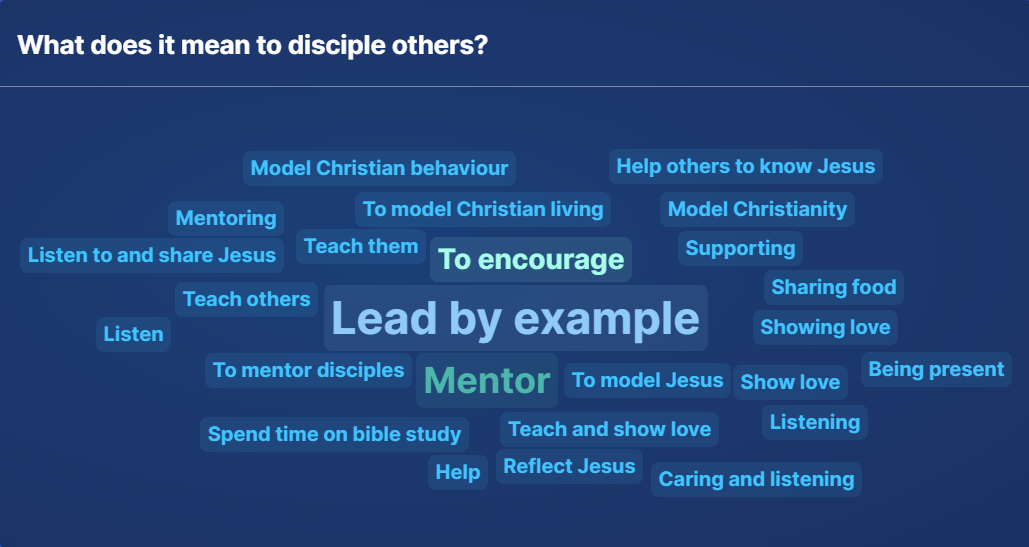
The Bible makes it clear that teaching our children about God and his Word is an important part of our role as parents.

  • Ephesians 6:4 says, Fathers, do not exasperate your children; instead, bring them up in the training and instruction of the Lord.  (I love the part about not exasperating your children – every time I read it I see myself as a teenager, rolling my eyes at my Dad’s lame jokes!)
  • Proverbs 22:6 – Train up a child in the way he should go, and when he is old he will not depart from it. 
  • And in 2 Timothy 1:5, where Paul is writing to Timothy, he says: I am reminded of your sincere faith, which first lived in your grandmother Lois and in your mother Eunice and, I am persuaded, now lives in you also. 

This last verse shows us the importance of grandparents and wider whanau in teaching children. 

The Barna group, a well-regarded research group in the US, found that 95% of children’s ministry workers believed that the primary, that is the main source of children’s discipling should be their home (i.e. their parents and families), while only 49% of parents with children at church believed that they were the primary source, with 51% saying that church should be the primary source of discipling for their kids. 

The same study found that only 50% of church parents said their children pray at least once a week at home, and 42% said their children hear the gospel at least once a week. If we are to believe that parents have the primary role of discipling their children, since they have the most time with them and know their child the best, then church needs to be there as a support for the parents, discipling the parents as they disciple their children.

Discipling children isn’t just the role of parents, however. In the book of Mark, Jesus tells off the people who try to keep the children away and welcomes the children to come to him. He didn’t say, “nope those kids aren’t my problem, it’s up to their parents to sort them out”, but rather brought them in to be blessed and be part of the group. I know there are many, many people in our church who are like Jesus in the way they treat children at Tawa Baptist, and I have always felt like my own two girls are welcomed and loved here. 

Going back to our Deuteronomy verses once more, and the sentence, “Teach them to obey my commands.” Many of the same tools suggested for parents and churches to disciple children are also useful for discipling other adults. Discipling other adults may mean teaching unbelievers or very new believers; it might mean mentoring someone in our church or working with other Christians. Jesus did all of those things as part of his discipleship, and we can too. Here are three key things we can all do to disciple others, whether they are our own children or someone else.

First, knowing our Bibles. We’ve already covered this but if you are trying to teach someone about God’s Word, it’s really handy to know what you are talking about. Little kids are especially good at asking the hard questions, like “Who made God?” and “How did God make the world if he doesn’t have hands?” When Tillie was two, we were heading to her first dentist appointment. On the way, we were talking about how God is everywhere. She asked, “will God even be at the dentist’s office?” and, trying to be a good mum and reassure her, I said “of course!” We walked into the dentist office, and she took one look at the female receptionist and in a very loud voice, as Tillie generally uses, asked, “Is that God?!” When I told her no, she persisted, “But how do you know that’s not God?” I have to admit, that was a time I didn’t have a great answer.


Another example of how knowing our Bibles is important can be seen in the story of Apollos, Priscilla and Aquila, in Acts 18:24-26. “At that time a Jew named Apollos came to Ephesus. He was an educated man from Alexandria. He knew the Scriptures very well. Apollos had been taught the way of the Lord. He spoke with great power. He taught the truth about Jesus. But he only knew about John’s baptism. He began to speak boldly in the synagogue. Priscilla and Aquila heard him. So they invited him to their home. There they gave him a better understanding of the way of God.” – Priscilla and Aquila were able to help Apollos because they had good scripture knowledge themselves, and they discipled Apollos, who was then able to go and preach widely to others.

A second tool for discipling others is building relationships. 

One of the special things about our church logo is the different people represented. There’s a family with children, single people, an elderly couple, and so on. Having good relationships is a key tool in discipleship. Children who have meaningful relationships with adults in the church stay around at church, and in their faith, at a far higher rate than those who don’t have those relationships. This is also true for adults as well – would you be more likely to keep coming to a new church if you were seeing strangers who only talk to each other, or people who you were starting to build friendships and relationships with? 

Intergenerational relationships are important as well. Children need to hear about Jesus from people outside their own families. Titus 2 calls for older women and men to teach and train the younger generation, while 1 Timothy 4:12 calls on young people to “be an example for the believers in speech, in conduct, in love, in faith and in purity.” 

Hebrews 10:24-25 talks about all the church members coming together: “And let us consider how we may spur one another on toward love and good deeds, not giving up meeting together, as some are in the habit of doing, but encouraging one another.”

The third and final tool for discipling others is sharing about Jesus. Obvious, right? While explicit formal teaching of God’s Word is important when discipling our children and other people, it’s just as important to include God in our everyday conversations. 

One of the ways we learn is by watching other people and then having a go ourselves. The Parenting for Faith course talks about using “windows” or little moments for children to get glimpses into our relationship with Jesus. It’s about going about our everyday lives and showing our children how we include God as a part of that. For example, letting your children see you study your Bible, or pray in a difficult moment, or thank God for a rainbow and the promise of hope. 

The book Sticky Faith: Everyday Ideas to Build Lasting Faith in Your Kids highlights an important truth: “The greatest gift you can give your children is to let them see you struggle and wrestle with how to live a lifetime of trust in God.” This doesn’t happen once a week or overnight. Showing children your relationship with Jesus, imperfect, messy, and difficult as it may be, is one of the best ways to help them develop their own relationships. And as our own relationships with God deepen, sharing these moments with our children becomes more natural.

For people who have grown up children, the Parenting for Faith course suggests that even though your children aren’t living at home with you, they are still learning from you what older, wiser life looks like with God. Even if they seem uninterested, they will still be watching you and learning from you whenever they see you – even if they don’t say so. The same goes for discipling others, Christian or not, – just living our lives and being open about our relationship with God can make a big difference. 

Reflection questions… Who in our lives are you or could you be discipling? What is your role in discipleship within the church?

————

This morning we’ve talked about being a disciple and discipling others. Let’s finish off by re-reading Deuteronomy 6:5-9 one more time: “Love the Lord your God with all your heart, with all your soul, and with all your strength. Never forget these commands that I am giving you today. Teach them to your children. Repeat them when you are at home and when you are away, when you are resting and when you are working. Tie them on your arms and wear them on your foreheads as a reminder. Write them on the doorposts of your houses and on your gates.”

Reflection questions:

  • Deuteronomy 6:5 says “Love the Lord your God with all your heart, with all your soul, and with all your strength.” Where are your energies going? What are your priorities? Are you loving God with all of your heart, soul, and strength?
  • Verses 7-9 tell us to remember God’s commands. How much time do you spend with God and His Word? What can you do to remind yourself throughout the day?
  • Verse 7 encourages us to teach God’s commands to our children, and Jesus’ last words were telling us to make disciples of all the nations. Who in your life are you or could you be discipling? What is your role in discipleship within the church?

Honour

Scripture: Ephesians 6:1-4

Structure:

  • Introduction
  • Christ among us
  • Children honour
  • Fathers nourish
  • Conclusion

Introduction:

Today we continue our series in Ephesians

  • Ordinarily we would be up to chapter 5 by now but, because it’s Fathers’ Day, we are jumping forward to chapter 6 where Paul talks about how children and parents are to relate with each other
  • From Ephesians 6, verses 1-4, in the NIV we read…

Children, obey your parents in the Lord, for this is right. “Honour your father and mother”—which is the first commandment with a promise — “so that it may go well with you and that you may enjoy long life on the earth.” Fathers, do not exasperate your children; instead, bring them up in the training and instruction of the Lord.

May the Spirit of Jesus illuminate God’s word for us


Christ among us:

There was once an old monastery secluded in a forest, miles from any towns or cities

  • People used to travel out of their way to spend time in this monastery
  • In recent years though fewer and fewer people made the effort to come

The Abbot of the monastery was in the habit of meeting with his good friend, a retired Jewish Rabbi, for a game of chess on the first Monday of each month

  • Noticing that the Abbot was a bit distracted (taking longer between moves) the Rabbi asked, ‘What are you in touch with my friend?’
  • So the Abbot poured out the contents of his soul…
  • ‘Our monastery used to be a place of peace. I remember there was a warmth and stillness there that healed the soul. You could see a visible change in the people who came for spiritual retreat. I don’t see that change anymore. We used to be a well that people would come to for refreshment, but it seems now the well is dry’
  • The old Rabbi listened to the Abbot’s heart and when the Abbot had finished speaking he paused for a few moments
  • After the silence had done its work the Rabbi said to the Abbot, ‘Last night I received a vision. In my vision I saw the Messiah among the brothers in the monastery. Christ is among you.’

After their game of chess, the Abbot returned to the monastery, the Rabbi’s words resting softly in his mind

  • One among their own was the Messiah! Who could it be? He knew it wasn’t himself, but who?
  • When he shared the Rabbi’s vision with the other monks a stillness descended as they looked into each other’s faces. Was this one the Messiah?

From that day on the mood in the monastery changed. Joseph and Ivan forgave the past and started talking again

  • Peter, who always seemed to find his way out of doing chores, started helping others with theirs
  • Naidu, who was often heard complaining about the Abbot behind his back, started appreciating the Abbot’s better qualities
  • The monks began smiling more, singing more and looking for opportunities to help passers by
  • They treated each other with greater reverence and respect, as to the Lord

When one traveler, then another, found their way to the monastery word soon spread about the remarkable spirit of the place.

  • People once again took the journey to the brothers and found themselves renewed and transformed.
  • The well had been filled, all because those monks knew that Christ was among them.

In Ephesians 5 & 6 Paul encourages his readers to live in light of the fact that Jesus, the Messiah, is among them

  • As Eugene Peterson observes, the repeated phrase that redefines who we are in all the complexities of household and workplace is ‘as to the Lord’ and ‘in the Lord’… [1]
  • When we love Jesus and realise that he is in our relationships with others, and therefore affected by the way we relate with each other, it causes us to treat people with greater reverence and respect, as it did the monks


There are essentially two aspects to this morning’s reading from Ephesians

  • There is Paul’s instruction to children as to how they are to relate to their parents and there is Paul’s instruction to fathers as to how they are to relate with their children
  • In both cases it is ‘in the Lord’ or ‘with the Lord’


Children honour:

Who knows how to play the game ‘Simon Says’?

  • Good. For those who need a reminder, whenever I say ‘Simon says…’ you follow the instruction but if I don’t say ‘Simon says’ then you don’t do what I say. Let’s see if we can do this
  • Simon says put your hands on your head
  • Simon says put your finger on your nose
  • Simon says put your hands in the air
  • Simon says shake your hands
  • Fold your arms
  • You are too good


In verse 1 of Ephesians 6 Paul says, ‘Children obey your parents in the Lord, for this is right.’

To the people of Paul’s day, whether Christian or not, it was standard wisdom for children to obey their parents – nothing strange or counter cultural about that

  • The idea here is that parents have a delegated authority from God so, in the normal course of events, it is right for children to obey their parents because parents are God’s representatives
  • Parents are there to protect and provide for their children therefore, most of the time, obeying your parents is in your interests
  • Luke 2, verse 51, tells us how a 12 year old Jesus was obedient to his parents, Mary & Joseph, and that Jesus grew in wisdom and stature and in favour with God and man
  • It is God’s design that children obey their parents


But does this mean, children should always obey their parents no matter what?

  • Well, not necessarily. There are exceptions to the rule
  • Paul qualifies the cultural norm of his day by saying ‘obey your parents in the Lord
  • In the Lord is sort of like Simon says
  • Whenever parents ask their child to do something that is within what Christ wants, that’s like saying ‘Simon says’ – you do it
  • But if a parent asks their child to do something which is outside of what Christ wants then that’s like dropping the ‘Simon says’ – it’s not binding
  • The idea here is that while children have a duty to obey their parents they have a greater responsibility to Christ


In verses 2 & 3 Paul continues his instruction to children saying, Honour your father and mother – which is the first commandment with a promise – so that it may go well with you and that you may enjoy long life on the earth.


God’s command to honour our parents is the fifth of the ten commandments

  • The Jews divided the ten commandments into two sets of five
  • The first five commandments are about our duty to God and the second five are about our duty to our neighbour
  • Honouring our mum and dad, therefore, is part of our duty to God
  • Irrespective of whether we think our parents did a good job or not, we still honour them out of respect for God
  • It’s not easy being a parent. God doesn’t want us to add to our parents’ grief; He wants us to add to their peace and joy


Now we are best to understand the promise there, about things going well with you and enjoying long life, in a general or collective sense

  • The promise of long life and well-being is not so much to individuals
  • The promise relates to the social stability that a community enjoys when children collectively honour their parents
  • A strong family life leads to a healthy society [2]


To honour our parents is not exactly the same thing as obeying them, although there is some overlap

  • When our parents ask us to do something that is ‘in Christ’, like take care of your little brother, then obeying them is honouring them
  • But if they ask us to do something that is outside of Christ, like conceal or collude with some kind of evil, then we honour them by not obeying them
  • It is unlikely though that a parent would ask a child to do something evil


In the normal course of events honouring our parents has to do with the way we speak to them, the way we talk to others about them and the way care for them, especially as they get older

  • The ideal is to care for our elderly parents ourselves, as they become less able; this might mean supporting them to live in their own home or having them come to stay with us
  • But when that isn’t possible (or wise) we must do the best we can to ensure someone else cares for them, and that includes staying in touch; making time to phone and visit in person
  • We see the way Jesus honoured his mother, Mary, even as he hung on the cross, giving responsibility for her care to someone he trusted, his disciple John


Now everyone’s situation is different

  • If your parents were abusive to you and it became unwise or unsafe for you to remain close to them, then what does honour look like?
  • Well, in a word, forgiveness
  • Forgiveness does not mean pretending the abuse never happened
  • Forgiveness requires us to face the truth of what happened, without denial and without exaggeration
  • Forgiveness also requires us to face the truth about ourselves – children can hurt their parents too – we have to take the log out of own eye in order to see clearly
  • Forgiveness does not mean you have to automatically trust the person who hurt you
  • For trust to be restored the other person must change and we can’t change other people, only God can do that
  • Forgiveness is essentially about release – letting go of the hurt and ill feeling we have toward the person who has harmed us
  • Most of the hurts we sustain in family life are small (little cuts) which, if untreated can become infected
  • Whatever the nature of the hurt, there is honour in forgiving it and, where possible, being reconciled
  • Forgiveness honours our parents, it honours our soul and it honours God


Let me tell you a story to illustrate what honouring your parents, honouring your soul and honouring God might look like. [3]

  • This story is about a 15 year-old boy we’ll call Jim
  • Jim’s family had never stepped inside a church but Jim had a friend who invited him to youth group
  • Jim enjoyed youth group, mainly because of the food and the girls
  • Then he went to Easter camp. It sounded like it would be fun and his parents were happy to get him out of their hair for the weekend
  • While he was at Easter camp Jim had an encounter with Jesus and became a Christian

The day after he got home Jim said to his parents, ‘Mum and Dad. I’ve met Jesus and I’d like to get baptised.’

  • His parents were alarmed to hear this and told him with raised voices, ‘That’s not going to happen while you live under our roof.’
  • So, in an act of defiance, Jim stomped out of the house and went straight to church

It was the Tuesday following Easter and the youth pastor happened to be there, drying out tents and washing the bus

  • Jim didn’t say anything at first but the youth pastor (as tired as he was after a long weekend with not much sleep) could see the storm on Jim’s face and asked if everything was okay
  • ‘Not really’, said Jim. ‘I told my mum and dad that I wanted to get baptised and they spat the dummy. They think I want to join a cult. I don’t know what to do?’
  • The youth pastor stood still for a moment, looked Jim in the eye and said,
  • “Jim, your parents love you. They might not understand the experience you had at camp, but they still love you.
  • It is good that you want to be baptised but why don’t you wait for a bit; respect their wishes for now, give them a chance to get used to the idea
  • Don’t get baptised in anger against them. Build trust with them. Let them see Jesus in you. Who knows, maybe in a few years they’ll come round. But if not, you can always get baptised when you are bit older.”

Jim wasn’t quite sure he understood everything the pastor was saying, after all he was only 15, but he followed the pastor’s advice, went home (feeling a bit calmer) and respected his parents’ wishes

  • A few weeks later the youth pastor visited Jim’s parents and this gave them assurance that their son wasn’t being brainwashed
  • Jim found it hard to articulate his faith in words to his parents but the new respect he showed them spoke volumes
  • Three years later, at the age of 18, Jim was baptised and his parents and sister came to the service in support
  • During the service Jim gave his testimony and in it he paid tribute to his parents, thanking them for their love and care for him over the years
  • Both his mum and his dad were choking back tears
  • Jim honoured his father & mother, he honoured God and he honoured his own soul


Children at any age (whether minors or adults) are to honour their parents and parents (especially fathers) are to nourish their children.


Fathers nourish:

I was very fortunate as a child to have both sets of grandparents and I got to spend a fair bit of time with them

  • One Saturday I was at my Nana and Pop’s house and a child (who we didn’t know) came to the door
  • This kid may have been selling raffle tickets or asking to be sponsored for something at school, I don’t remember now, but I do remember my Pop supporting whatever it was they were doing
  • When the child had left my Pop turned to me and said, ‘You never knock a child back’
  • My Pop had received a lot of knocks, as a kid, and it had made him compassionate with children

On another occasion I was at the dairy with my other grandfather – he was buying me an ice-cream

  • While we were there my grandfather noticed a kid waiting outside the door – he was obviously part way through his paper round
  • Even though the paper boy was a complete stranger, my grandfather bought him an ice cream too, a really big one
  • I think my grandfather saw something of himself in the paper boy and wanted to take care of him, to nourish his spirit, to encourage him
  • Now you probably wouldn’t be able to do that today (people might think you were bit creepy) but in the 1970’s that was still an acceptable thing to do, it was considered a kindness

Neither of my grandfather’s went to church (at least when I knew them) and yet they both treated children as the Messiah among us


In Ephesians 6, verse 4, Paul changes the focus from the children’s responsibility to the father’s responsibility


Fathers, do not exasperate your children; instead, bring them up in the training and instruction of the Lord.


Paul’s advice for children to honour and obey their parents was not counter cultural – it was the accepted wisdom of the day

  • But his advice to fathers did challenge the culture
  • William Barclay tells how a Roman father of the first century had complete power over his children [4]
  • He could decide whether they lived or died, he could sell them as slaves or put them to work for himself
  • What’s more, a Roman son never came of age; they were subject to their father’s rule as long as he lived
  • This is not to say that all Roman fathers were abusive – I’m sure some (perhaps most) treated their children with care and consideration
  • The point is, in Paul’s day, fathers held all the power and power invites corruption and abuse
  • Paul’s instruction to fathers is to limit their own power; to control themselves and treat their kids with fairness and tenderness


Our society owes a great debt to the influence of Christ and Paul and the church. Without Jesus’ teaching we would probably still be treating children like the Romans did


If you are a father, being ‘in Christ’ means not provoking your children to anger, not exasperating them by being unfair.

  • Children have a built in sense of justice – they know instinctively when something isn’t fair
  • Parents are God’s representatives to their children – we need to do all we can to show our kids the goodness of God
  • If we mistreat our children, then we are misrepresenting God to them – we are taking the Lord’s name in vain


Now, as I reflect on the cultural context, it occurs to me how different it is to be a father today in NZ, compared with first century Ephesus

  • Roman fathers may have had complete power over their families but NZ dads don’t
  • There has been rapid social change in NZ over the past few decades and, as a consequence, men have had to reconsider (and redefine) their identity and role in the family and in society
  • What does it mean to be a man and what does it mean to be a father?


What would Paul say to fathers in NZ today?

  • Perhaps he would say: don’t abdicate your responsibility, don’t bail out, don’t abandon your family, don’t leave it all to mum or the internet
  • You have an important role to play – your kids need you and what they need from you will change as they grow and develop
  • Be present, be patient. Listen to your kids but be honest with them too
  • They need to learn that it is not all about them
  • The Spirit of Jesus is a Spirit of grace and truth; your kids need you to embody that grace & truth


The verb ‘bring them up’, in the original Greek, literally means to nourish or to feed. Paul is saying, it is a father’s responsibility to nourish their children so they grow well

  • ‘Nourish’ means feeding a child’s body with wholesome food but it also means feeding a child’s mind with wisdom and their spirit with encouragement (in the right direction)
  • Don’t knock a child back with bad advice or caustic criticism


The training and instruction is to be ‘of the Lord’

  • In a nut shell this means parents are to teach their children to love God and to love their neighbour as they love themselves
  • Jesus Christ is the one who shows us how to do this


There is another challenge to the cultural norms of Paul’s day in verse 4

  • Notice that Paul uses the gender neutral term children
  • Most writers of Paul’s day would have said ‘bring up your sons’ because girls did not normally receive a formal education; girls were taught household duties
  • Paul was encouraging fathers to teach their daughters as well as their sons at a time when girls were not valued by society
  • In doing this Paul was following the example of Jesus who encouraged equal opportunity, in education, for women
  • In Luke 10 Jesus made room for Mary & Martha to sit at his feet and learn like the men


Conclusion:

This morning we’ve heard how children are to honour and obey their parents, while parents (particularly fathers) are to nourish their children, body, soul and spirit

  • But we can’t do that on our own – we need God’s help
  • God has provided help in the form of His Son Jesus
  • We need to keep before us a vision of Christ in community
  • We need to understand that the Messiah is among us


Questions for discussion or reflection:

  1. What stands out for you in reading this Scripture and/or in listening to the sermon? Why do you think this stood out to you?

2. What difference does it make to realise, the Messiah is among us?

3. Why does Paul say it is right for children to obey their parents?

  • When should we obey our parents?
  • When should we not obey our parents?

4. What does it mean to honour our parents?

  • How did Jesus honour his parents?
  • How do you (personally) honour your parents?

5. Is there a wound in the relationship with your parents (or children)?

  • Do you need to forgive your parents (or children)?
  • Do you need your parents (or children) to forgive you?
  • How might we release the hurt and cleanse the wound?

6. Do you have a story of something good (something nourishing to the soul) that your father or grandfather did? Share your story with someone you trust.

7. What is the role and responsibility of fathers today?


[1] Eugene Peterson, ‘Practise Resurrection’, page 233.

[2] Refer John Stott, Ephesians, page 241.

[3] John Stott’s examples in his commentary on Ephesians (page 242) provided the inspiration for the story about Jim

[4] William Barclay’s commentary on Ephesians, page 208.