Paul in Ephesus

Scripture: Acts 19:1-12

Video Link: https://youtu.be/k3K5R935iaQ

Structure:

  • Introduction
  • Christian initiation
  • Evangelism strategy
  • Conclusion

Introduction:

Good morning everyone.

In his book, ‘That they may have life’, Sri Lankan pastor, Daniel Niles writes: “Evangelism is witness. It is one beggar telling another beggar where to find food.”

Evangelism comes from a Greek word meaning ‘good news’. For Christians evangelism is telling others the good news about Jesus Christ. Evangelism can be as simple as one person telling another person how Jesus has helped them.

Evangelism is as necessary for life and survival as eating food. Evangelism is not a top-down thing, it’s a side-by-side thing. Those who do the evangelising are not better than those being evangelised, both need the bread of salvation.

Evangelism can be quite challenging in our society because most people do not think of themselves as beggars. Most people are not aware of their spiritual need.      

Today we continue our three week series in the book of Acts in support of the Arotahi Renew Together campaign. Arotahi is the missions arm of New Zealand Baptists. Once a year we renew our commitment to pray for and support the work of spreading the gospel in New Zealand and overseas. 

This week’s sermon focuses on Acts chapter 19, verses 1-12, where we learn how the apostle Paul did evangelism in the city of Ephesus. From Acts 19, verse 1, we read…

While Apollos was at Corinth, Paul took the road through the interior and arrived at Ephesus. There he found some disciples and asked them, “Did you receive the Holy Spirit whenyou believed?”

They answered, “No, we have not even heard that there is a Holy Spirit.”

So Paul asked, “Then what baptism did you receive?”

“John’s baptism,” they replied.

Paul said, “John’s baptism was a baptism of repentance. He told the people to believe in the one coming after him, that is, in Jesus.” On hearing this, they were baptized in the name of the Lord Jesus. When Paul placed his hands on them, the Holy Spirit came on them, and they spoke in tonguesand prophesied. There were about twelve men in all. Paul entered the synagogue and spoke boldly there for three months, arguing persuasively about the kingdom of God. But some of them became obstinate; they refused to believe and publicly maligned the Way. So Paul left them. He took the disciples with him and had discussions daily in the lecture hall of Tyrannus. 10 This went on for two years, so that all the Jews and Greeks who lived in the province of Asia heard the word of the Lord. 11 God did extraordinary miracles through Paul, 12 so that even handkerchiefs and aprons that had touched him were taken to the sick, and their illnesses were cured and the evil spirits left them.

May the Spirit of Jesus illuminate God’s word for us.

There are two halves to our message today. In the first half we consider Christian initiation; that is, what’s involved in becoming a Christian.

And in the second half we observe Paul’s strategy of evangelism; in other words, how Paul went about reaching people with the gospel of Jesus. We begin with Christian initiation.

Christian Initiation:

For seeds to germinate they need the right amount of four things: water, oxygen, temperature and light.

Water is essential for seed germination. A baptism in water softens the seed so it swells and ruptures. Most seeds need to absorb between 25% and 50% of their weight in water before they will germinate.

Oxygen provides the energy the seed needs to grow. If seeds are planted too deep in the soil, they might not get the oxygen they need to sprout.

The temperature has to be right too. Different seeds germinate at different temperatures, but most activate between 16 and 25 degrees Celsius.

The fourth requirement for seed germination is the right amount of light or, in the case of some plants, the right amount of darkness.

In the same way the germination of a seed involves the right amount of water, oxygen, temperature and light, so too Christian initiation involves four things: repentance, faith in Jesus, baptism in water and the gift of the Holy Spirit.

Repentance means turning away from sin. Repentance is a change of mind that leads to a positive change in behaviour. Repentance is when we stop walking away from God and start walking towards him.

Faith in Jesus means trusting our lives and our eternity to Jesus. Believing in his death and resurrection. Relying on Jesus’ righteousness and not our own. Holding to the sure hope that Jesus will save us.

Faith in Jesus is made possible by the work of the Holy Spirit. Without God’s Spirit, we cannot truly believe in Jesus or start walking toward God.

Baptism in water is an outward and visible sign of our faith in Jesus.

Water is a symbol of the Holy Spirit. To be baptised then is to signify that you have begun to follow Jesus with the help of the Holy Spirit.     

In the New Testament, repentance, faith in Jesus, baptism and the Holy Spirit are always present when someone becomes a Christian. The order in which these things happen may vary, but all four belong together when it comes to Christian initiation.

When Paul arrived in Ephesus he found some disciples. As he talks with them Paul notices something is off. These men seem to be missing something.

So Paul asks them, “Did you receive the Holy Spirit whenyou believed?”     

They answered, “No, we have not even heard that there is a Holy Spirit.”

Now, that cannot be right. The Holy Spirit is mentioned many times throughout the Hebrew Scriptures and during his earthly ministry Jesus promised the Holy Spirit to his followers. Clearly, there is a gap in these disciples’ understanding of what it means to follow Jesus.

Paul knows that no one can truly believe in Jesus without the Holy Spirit, so he asks, “Then what baptism did you receive?”

“John’s baptism,” they replied. Now everything becomes clear. They are not disciples of Jesus; they are disciples of John the Baptist. 

 Paul explains, “John’s baptism was a baptism of repentance. He told the people to believe in the one coming after him, that is, in Jesus.”

These 12 men could not have been Christian before meeting Paul, because they had not believed in Jesus up to that point. They were aware of their sin and committed to repentance, but they did not know Jesus personally, through the Holy Spirit.  

From verse 5 we read: On hearing this, they were baptized in the name of the Lord Jesus. When Paul placed his hands on them, the Holy Spirit came on them, and they spoke in tonguesand prophesied.

As I understand it, the Ephesian disciples received the Spirit and believed in Jesus on the same day they were baptised. When Paul laid his hands on them to baptise them in water, they received the Spirit as a gift from Jesus.

How were you initiated into the Christian faith? As I reflect on the Ephesians’ experience, I’m conscious of how different it was from my own experience of Christian initiation. When I came to faith in the early 1980’s, there seemed to be three stages to becoming a Christian.

Praying the sinners’ prayer and asking Jesus into your heart, stage one.

Then, after some time had passed, getting baptised in water, stage two.

And then after some more waiting, being prayed for to receive the Holy Spirit.   

Others of you may have a had different experience again. Perhaps you were baptised as a baby, then later confirmed your faith in Jesus as a young person.   

This idea of Christian initiation involving two or three separate events over a period of years was a foreign concept to Paul and the other apostles. Must Christian initiation conform to the pattern we read of in the book of Acts?

Hmmm. We should not be too dogmatic about how the Spirit of God brings people to faith in Jesus. The Holy Spirit does not have to conform to our rules and formulas. Our part is to be open to the work of the Spirit and to trust and obey Jesus out of love for God.

What we can say with confidence is that Christian initiation, both now and then, involves repentance, faith in Jesus, baptism in water and the gift of the Holy Spirit. But the order and timing may vary from person to person. Are any of these four aspects missing for you? What might God be saying?

Another question we may stew over is how do we know we have received the gift of the Holy Spirit? Repentance can be measured and baptism in water can be seen, but it may be more difficult to sense the Spirit.

Verse 6 says the Ephesians spoke in tongues and prophesied when they received the Holy Spirit. Does that mean tongues and prophecy are the signs you have received the Spirit? Well, they can be. But not always.

The Holy Spirit gives all sorts of different gifts. Not everyone who receives the Spirit speaks in tongues or utters words of prophesy like the Ephesians did.

So if you don’t speak in tongues, then don’t worry. The Spirit may give you assurance of your salvation in other ways. Some may feel their heart strangely warmed. Others may be filled with a profound sense of peace.

For me, the Spirit sometimes comes with tears. It is the feeling of being overwhelmed by grace. Humbled by God’s goodness so I cannot talk. Speechless in the presence of the Lord.

Whether you have had a special experience or not, the primary sign of the Spirit is faith in Jesus. You know the Holy Spirit has been given to you when you trust in Jesus. The Spirit makes Jesus close and real.

The question remains for each one of us, do we believe in Jesus? Believing in Jesus is not just a one-off event. Faith in Jesus is on-going, the journey of a lifetime. Therefore, we need to go on being filled with the Holy Spirit to keep faith with Jesus. Don’t stop believing.   

Evangelism strategy:

Okay, that is Christian initiation. Now let us consider Paul’s strategy for evangelism. How did Paul share the good news about Jesus with the people of Ephesus?

You’ve probably heard of the story of the three little pigs. You know the one. The first pig built his house out of straw and the big bad wolf blew his house down and ate the little pig. The second pig built his house out of sticks and the wolf blew his house down and ate him too.

But the third little pig built her house out of bricks and no matter how much the wolf blew, he could not blow her house down.

I suppose the moral of the story is this: to keep the wolf from your door you need to be prepared. It may take longer to build your house out of bricks and it may cost more, but it will be worth it in the end.

In line with the wisdom of being prepared, there’s a Chinese proverb which says: “If you are planning for a year, plant rice. If you are planning for a decade, plant trees. If you are planning for a lifetime, educate people.”

When Paul went about evangelising, he planned for a lifetime. Paul invested a lot of time and energy educating people in the way of Jesus, so their faith would be brick house strong, built to last.

When Paul arrived in Ephesus, he started in the Jewish synagogue. Paul spoke boldly about the kingdom of God, using reason to persuade people that Jesus is the Messiah and therefore people should repent and believe in him.

Starting with the Jews was good evangelism strategy. There was already common ground; Paul did not have to start from scratch. Jesus and Paul were both Jewish and the Hebrew Scriptures point to Jesus.    

Despite the common ground though, some of the Jews refused to believe Paul’s message and started to bad mouth the Way. The Way is code for the way of Christ. Jesus is the way, the truth and the life. No one comes to the Father except through Jesus the Son.

Being maligned and rejected by his own people grieved Paul deeply. It was no easy thing for him walk away. In Acts 20, verse 19, Paul says of his time in Ephesus: “I served the Lord with great humility and with tears, although I was severely tested by the Jews”. 

When Paul’s evangelism was rejected, Paul did not waste energy fighting those who were entrenched and stuck in their ways. He left the synagogue and took the disciples he had baptised with him.

Paul then carried on educating people about Jesus and the kingdom of God in the lecture hall of Tyrannus. This lecture hall was neutral ground. It was a public space that anyone (Jew or Greek) could access.

Paul did not just give lectures though. Paul held discussions, he dialogued with people, using reasoned arguments to educate and persuade. The Alpha Course is a contemporary version of evangelism modelled off Paul’s strategy of reasoned discussion and persuasion. Alpha is worth doing.

Not everyone goes down the Alpha path though. Some come to faith in Jesus after hearing an emotional appeal. The music plays, the smoke machine purrs, the mood lighting comes on and the speaker pulls on everyone’s heart strings (or guilt strings). Then, in the heat of the moment, people come forward to make a commitment to Jesus.

These sorts of emotionally based commitments don’t usually last, unless followed up by someone who intentionally comes alongside the new believer to nurture and disciple them.   

Paul did not build his house with the straw and sticks of raw emotion and stage tricks. Paul built his house with the bricks and reinforcing steel of sound argument and truth. Paul planned for a lifetime.

Verse 10 tells us; this went on for two years so that all the Jews and Greeks who lived in the province of Asia heard the word of the Lord.       

Ephesus was like a hub for the province of Asia in the first century. People from the surrounding towns came to Ephesus to do their shopping, visit their family or watch the games. While in Ephesus they got to hear the gospel through Paul.

Some took what they heard back home with them. And so the gospel spread by word of mouth.  

In Acts 20, verse 20, we learn that Paul also went house to house telling people to repent and have faith in Jesus. A strong work ethic was woven through Paul’s evangelism strategy. And the Spirit of God was clearly with Paul, upholding and empowering him every step of the way.

In verses 11 and 12 of Acts 19, we read how God did extraordinary miracles through Paul. The people of ancient Ephesus were spiritually aware. Some dabbled in magic and the occult. When people saw the power of God to heal and deliver, many turned away from sorcery and the dark arts to follow Jesus.

The miraculous signs and wonders done by God, verified Paul’s gospel message as authentic and true. If you read on in Acts 19 you will see how Paul’s evangelism eventually divided the city. People were confronted with the truth about Jesus and had to choose a side. Evangelism takes ground for God’s kingdom.

Although it is not covered in our reading today, an important part of Paul’s evangelism strategy was establishing an organisational structure to take care of the young church after he was gone. In Acts 20 we learn that Paul had appointed pastors and elders to protect and care for the new believers.

In verse 28 Paul says to the elders of the church at Ephesus: Keep watch over yourselves and all the flock of which the Holy Spirit has made you overseers. 

Be shepherds of the church of God, which he bought with his own blood.

Perhaps the most important part of any evangelism strategy is love. Persuasive arguments and intelligent apologetics only get you so far. If we do not love the people we are trying to reach, the message won’t sound true.

Paul’s love for the Ephesians and their love for him is evident in Paul’s farewell speech to them in Acts 20. From verse 37 we read: They all wept as they embraced him and kissed him. 38 What grieved them most was his statement that they would never see his face again. 

Conclusion:

Paul’s Herculean efforts of evangelism are intimidating. It may feel like too much of a leap to try and imitate Paul exactly. Let me offer a few practical strategies for evangelism which most Christians can attempt…

Look for people of peace. That is, people who are open to talking about faith and friendly in their attitude to things Christian. Paul started with the disciples of John the Baptist, people of peace. He did not start with the witches and gangsters of Ephesus.    

Pray for someone who does not yet know Jesus. Pray for them by name, daily, that the Holy Spirit would make Jesus close and real for them.

Know what you believe. Educate yourself. Read your Bible and think about how Jesus has been good for you personally. Be ready, prepared to talk about what Jesus means to you and what you really believe.

Love others. To love others means being kind and fair.  Listening generously. Showing up when you are needed. Doing no harm. Being patient and respectful.

And when you are given the opportunity to talk about Jesus, be brave without being arrogant. Don’t be ashamed or embarrassed. Be straight up. Own your faith with humility. Stand by it and trust your testimony to the Holy Spirit.

Let us pray…    

Gracious God, you love those who don’t yet know you. May the good news about Jesus be real for each of us, personally. Give us wise words and a winsome Spirit to tell others about Christ. Glorify yourself we pray. Amen.   

Questions for discussion or reflection:

  1. What stands out for you in reading this Scripture and/or in listening to the sermon? Why do you think this stood out to you?
  2. Who first told you about Jesus? How did they do this?
  3. What is evangelism? Why is evangelism important?
  4. How were you initiated into the Christian faith? Are any of the four aspects of Christian initiation missing for you? If so, which aspect(s)? What might God be saying to you?
  5. How do we know we have received the gift of the Holy Spirit? How does the Spirit make Jesus close and real for you?
  6. Discuss / reflect on Paul’s evangelism strategy in Ephesus.
  7. What can you do to share the love and truth of Jesus with others?

Steering Wheel Prayer

Scripture: Luke 18:1-14

Video Link: https://youtu.be/FTbBKTCQdT0

Structure:

  • Introduction
  • The persistent widow
  • The pharisee and the tax collector
  • Conclusion

Introduction:

Good morning everyone.

Corrie Ten Boom asks the question, “Is prayer your steering wheel or your spare tyre?”

A steering wheel is what we use to control the car. A steering wheel keeps us on course and headed in the right direction. When you are driving, you never take your hands off the steering wheel.

By contrast, a spare tyre is only ever used in emergencies. The rest of the time it is forgotten baggage.

Prayer is how we steer our life. Are we in conversation with God, daily seeking his will, or do we only ever call on God in emergencies?

As mentioned earlier in the service, we have a focus on prayer this week while we carry the Pou Karakia (the prayer baton). With this in view our sermon today is based on Jesus’ twin parables about prayer, in Luke 18.

We will start with the parable of the persistent widow, before considering the parable of the pharisee and the tax collector. From Luke 18, verse 1, we read…  

Then Jesus told his disciples a parable to show them that they should always pray and not give up. He said: “In a certain town there was a judge who neither feared God nor cared what people thought. And there was a widow in that town who kept coming to him with the plea, ‘Grant me justice against my adversary.’ “For some time he refused. But finally he said to himself, ‘Even though I don’t fear God or care what people think, yet because this widow keeps bothering me, I will see that she gets justice, so that she won’t eventually wear me out!’” And the Lord said, “Listen to what the unjust judge says. And will not God bring about justice for his chosen ones, who cry out to him day and night? Will he keep putting them off? I tell you, he will see that they get justice, and quickly. However, when the Son of Man comes, will he find faith on the earth?”

Is prayer your steering wheel or your spare tyre?

The persistent widow

The Chinese pianist and composer, Liu Shikun, was born in 1939, just before the second world war. He began his piano training at the age of three and started performing in public at the age of five.

He placed highly in prestigious international piano competitions in 1956 and 1958, while still a teenager. Liu became one of China’s top concert performers. Sadly, with the cultural revolution in 1966, western music was banned and Liu, along with many other artists, was arrested and sent to prison for eight years.

During his whole time in prison, Liu was denied access to a piano. Soon after his release though, in the 1970’s, he was back on tour. Critics were astonished that after eight years without a piano, Liu’s musicianship was better than ever.

‘How did you do this?’ one critic asked. ‘You had no chance to practise for eight years.’

‘I did practise’, Liu replied. ‘Every day I rehearsed every piece I ever played, note by note, in my mind.’ [1]

It seems Liu never gave up hope. He kept faith that he would one day be released and allowed to play piano again. And his faith was rewarded.

As followers of Jesus, the disciples would soon be mistreated and denied justice. So Jesus gave his disciples the parable of the persistent widow to show them they should always pray and not give up.  

There are two people in Jesus’ parable. The first is a wicked judge who does not fear God and does not care what people think. Most likely this judge was accustomed to taking bribes. He wasn’t concerned with doing what is right; he had no shame. The wicked judge is not like God at all.

The second person is a widow. If the judge is the villain, then the widow is the heroine. In a society which generally devalued women, Jesus makes a woman the hero of his story.   

In first century Jewish culture women did not normally get involved in legal matters. The magistrate’s court was the domain of men. The fact that this widow has to advocate for herself shows she is socially powerless, with no one to come to her rescue.

Although she is most likely too poor to offer the judge any sort of bribe, she is persistent. For her, prayer is the steering wheel. She kept coming to the judge with the plea, ‘Grant me justice against my adversary.’

The widow was in the right. She was not asking for special treatment. She just wanted a fair go. Hers was a reasonable request.

For some time the judge refused, but eventually he gave her justice, not because he cared about her or God, but because he wanted some peace for himself.

Jesus is reasoning from the lesser to the greater. If an unjust, uncaring judge can be persuaded to vindicate the widow, just to get some peace, then how much more will God (who is gracious and compassionate) vindicate the followers of Jesus when we are denied justice.

After Jesus’ death the disciples would find themselves in a similar position to the poor widow and Liu Shikun; treated unjustly and essentially powerless from a social and political point of view.

Prayer is one thing no one can take away from you. Whatever our situation we are to keep our hands on the steering wheel of prayer, just as the widow continued to ask for justice and just as Liu Shikun continued to practice music.

Indeed, prayer is to Christians, what practising the piano is to a concert musician. We must remain faithful in prayer if we are to go the distance.

Is prayer your steering wheel or your spare tyre?

Verse 8 says that God’s people will get justice quickly. Justice came relatively quickly for Jesus. It was less than three days between Jesus’ crucifixion and his resurrection from the dead. The resurrection being God’s vindication of Jesus.

From our human perspective though, justice does not always feel quick. More often it feels like a slow train coming. So how are we to understand this verse?

In his commentary on Luke, Bible scholar Darrell Bock offers two thoughts here. Perhaps Jesus meant our vindication comes in the form of protection that God offers his own. Even though God’s people may suffer injustice, they do not perish and that is the sign of their vindication.

Another way to understand verse 8 is to say that our vindication as believers in Christ will come very quickly upon Jesus’ return in glory. [2] In the meantime, however, it may be a long wait.

In relation to unanswered prayer, Fred Craddock asks the question…

‘Is the petitioner being hammered, through long days and nights of prayer, into a vessel that will be able to hold the answer when it comes?’ [3]

Sometimes being made to wait is one of the ways God shapes us. From my own experience of seemingly unanswered prayer, I have learned my place. I am not in charge. I do not call the shots. Jesus is Lord and master and I am his servant.

I might have my hands on the steering wheel, but the Spirit of Jesus is telling me which way to turn.  

How has prayer shaped your soul and spirit?

In all of this we should not lose sight of the main point of the parable. God is greater than any obstacle we may face. He is stronger than any opponent we might confront. More than that, God loves us. He is just and merciful and does not need convincing to do the right thing.  

Jesus encourages the believer to persist in prayer, but if God says ‘no’ to our request or offers a solution other than the one we asked for, the faithful person is expected to respond with, “Your will be done God”.

Accepting God’s will is part of prayer. You don’t take your hands off the wheel every time there’s a bump in the road.  

Jesus finishes the parable with a question: “However, when the Son of Man comes, will he find faith on earth?” Jesus is referring to his second coming here.

History is not random or without purpose, rather it moves toward a goal. The future is secured for those who are in Christ. God will vindicate those who put their trust in Jesus.

But will we be found with our hands on the steering wheel of prayer when Jesus returns in glory?

Personally, I think it is a brave thing to call on God for justice. A prayer for justice isn’t just a call for others to get what they deserve. It’s a call for us to get what we deserve as well. I would prefer not to get what I deserve but rather what I need, which is God’s grace – His mercy.

The pharisee and tax collector

Which brings us to Jesus’ second parable of the pharisee and the tax collector. From Luke 18, verse 9 we read…

To some who were confident of their own righteousness and looked down on everyone else, Jesus told this parable: 10 “Two men went up to the temple to pray, one a Pharisee and the other a tax collector. 11 The Pharisee stood by himself and prayed: ‘God, I thank you that I am not like other people—robbers, evildoers, adulterers—or even like this tax collector. 12 I fast twice a week and give a tenth of all I get.’ 13 “But the tax collector stood at a distance. He would not even look up to heaven, but beat his breast and said, ‘God, have mercy on me, a sinner.’ 14 “I tell you that this man, rather than the other, went home justified before God. For all those who exalt themselves will be humbled, and those who humble themselves will be exalted.”

Is prayer your steering wheel or your spare tyre?

This parable of the Pharisee and the tax collector shares a number of things in common with the parable of the persistent widow. Both parables are about prayer and both are about who God vindicates or accepts.

In the first parable, the widow asks for justice and gets it. In the second parable, the pharisee asks for nothing and gets nothing, while the tax collector asks for mercy and goes home justified before God.    

Verse 9 tells us that Jesus told this parable to some who were confident of their own righteousness and looked down on everybody else.

In the Bible a righteous person is someone who has been given a special relationship of acceptance in the presence of God. This acceptance is a gift, it is unearned. The relationship is then maintained by acting in loyalty to God.

Righteousness, in this sense, is sort of like getting an invitation to a royal wedding. You cannot buy an invitation, you must be asked by the royal couple. But once you have received the invitation you have a special relationship of acceptance in the presence of the royal family. And you maintain that relationship by acting in loyalty to your hosts.

There were some people in Jesus’ day (and indeed in our day as well) who got things around the wrong way. They thought they had earned righteousness (or acceptance with God) by fulfilling a certain ethical code. It is to these people that Jesus directs his parable.

Jesus’ parable contrasts two people who go to the temple to pray. A Pharisee and a tax collector. The temple is a place of worship and prayer. It is also a place of reconciliation, where people go to make their peace with God.  

The Pharisees were a religious sect that focused on the Law of Moses. In their zealousness for the Law, they added a whole lot of their own rules to stop people breaking Moses’ rules. This of course made life more difficult.

Jesus wasn’t picking on the Pharisees here. They weren’t all bad. The Pharisee in this parable represents anyone who looks down on others in self-righteous contempt. So, if we look down on the Pharisee in this parable we are behaving just like him and the parable is meant for us.

Anyway, this pharisee stands apart from others because he thinks he is better than everyone else. And then he prays; except his words are not really a prayer, they are more of an advertisement, a self-promotion.

Prayer isn’t just the words we say. It can be the tears we shed and the groans and sighs from deep within our spirit. Prayer is the soul’s sincere desire. Said another way, prayer is our yearning for God. In prayer we are basically asking God to be God and provide for us and others in accordance with his will. Prayer is an attitude of dependence on God.

But the pharisee in Jesus’ parable does not ask anything of God. He is self-possessed and self-satisfied. This pharisee does not have his hands on the steering wheel of prayer. He is looking at himself in the rear vision mirror. 

The pharisee compares himself to other people who he considers to be bad.

If we must measure ourselves then it should not be against other people but alongside God’s standard.

And what is God’s standard? That we love him and love our neighbour.  

It appears the Pharisee in this parable did not do either, although he did do things that God did not require, like fasting twice a week for example. God does not ask us to do that.

The Pharisee in Jesus’ parable went away without being justified by God because he did not think he needed God.  

But the tax collector approached God with an entirely different attitude.

Tax collectors had a bad reputation in Jesus’ day. They were hated by their own people because they sided with the Romans for personal gain.

They were considered dishonest, taking more than was necessary in order to line their own pockets. Not all tax collectors were like this, but many were. 

In any case, the tax collector in this parable represents anyone who is aware of their need for God and approaches Him with a contrite and broken heart.  

Like the Pharisee, the tax collector also stands apart but not because he thinks he is better than anyone else. The tax collector does not compare himself with others at all. He measures himself alongside God’s standard. He stands at a distance because he knows he has failed miserably to meet God’s law of love.

Unlike the Pharisee, the tax collector’s prayer is not an exercise in self-promotion. The tax collector’s soul sincerely desires God’s grace and so he prays: God, have mercy on me, a sinner.

The tax collector is clinging to the steering wheel of prayer, desperately aware of his need for God. He is deeply grieved by his own sins and wants to have his relationship with God restored and made right again. He is seeking atonement.

For this reason, the tax collector (and not the Pharisee) goes away justified (or accepted) by God. For all those who exalt themselves will be humbled, and those who humble themselves will be exalted.

At some point we have all taken our hands off the steering wheel of prayer.

We have all done things in our lives that we are not proud of, things we know don’t measure up to God’s standard. The good news is that Jesus went to the cross for our atonement. We are justified or made right with God, not by what we have done, but by trusting in what Jesus has done on our behalf.

Conclusion:

In both of today’s parables, the heroes pray for themselves. It’s okay to pray for yourself. But this week, while we carry the Pou Karakia, we are encouraging you to take the steering wheel of prayer for others. Let me finish then with a little story about praying for others…

Two men were travelling by sea when their boat was hit by a storm and wrecked on a deserted island. To increase their chances of being found, they decided to stay on opposite sides of the island looking out for passing ships. But before leaving each other, they agreed to pray to God for help every day.

After relocating to the far side of the island and waking up hungry, the first man prayed saying, “O Lord, let fruit trees and vegetables grow on this side of the island, so I can satisfy my hunger.” God heard his prayer and the next day food bearing plants appeared. It was a miracle.

After eating his fill, he sat down and prayed again, “Lord, I need a house to live in, please give me house.” Soon, a shipping container washed ashore with all the tools and materials needed to build a modest shelter.

When the man realised his prayers were being answered, he thought, why not ask God for a way off this island. So he prayed, “Lord, please give me a boat with a GPS so I can find my way back to the mainland.”

The next day he saw a boat floating in his bay. He boarded the boat and found it abandoned but seaworthy. Having become accustomed to using prayer like a spare tyre, the man decided to leave the island right away. He had lost his sense of spiritual direction.

Just then he heard a voice from heaven, “Will you not take your friend with you?”

The man replied, “My blessings are mine alone since I was the one who prayed for them. His prayers were unanswered so he must not deserve to be saved.”

The voice said, “You are mistaken. Your friend had only one prayer. Without his prayer you would not have received any of my blessings.”

“Tell me”, the man asked, “what did he pray for that I should owe him anything?”

And the voice from heaven replied, “He prayed that all your prayers would be answered.” [4]

May the Lord bless you as you intercede for others this week.

Questions for discussion or reflection:

  1. What stands out for you in reading this Scripture and/or in listening to the sermon? Why do you think this stood out to you?
  2. When do you pray? Why do you pray? How do you pray? Is prayer your steering wheel or your spare tyre?
  3. Why did Jesus give his disciples the parable of the persistent widow? What is the main point of the story?
  4. Have there been times in your life when God seemed slow to answer your prayers? Conversely, have there been times when God was quick to answer your prayers? Either way, what affect did this have on you? How has God shaped your soul and spirit through prayer?
  5. Why did Jesus tell the parable of the pharisee and the tax collector? What is the main point of the story?
  6. What is the heart of prayer? How does the tax collector exemplify genuine prayer?
  7. Compare and contrast the two parables in Luke 18:1-14. How are they similar? How are they different?
  8. Make time this week to pray for others.

[1] Liu Shikun story references: Wikipedia and ‘A Bundle of Laughs’ by J. John and Mark Stibbe, page 142.

[2] Refer Darrell Bock’s NIVAC on Luke, page 455.

[3] Refer Fred Craddock’s Interpretation commentary on Luke, pages 209-210.

[4] (Adapted from J. John and Mark Stibbe’s book, ‘A Bundle of Laughs’, page 159.)

Connections

Scripture: Matthew 14:13-21

Video Link: https://youtu.be/4V8DB8BO2FE

Structure:

  • Introduction
  • Jesus’ leadership
  • Jesus’ faith
  • Conclusion

Introduction:

Good morning everyone.

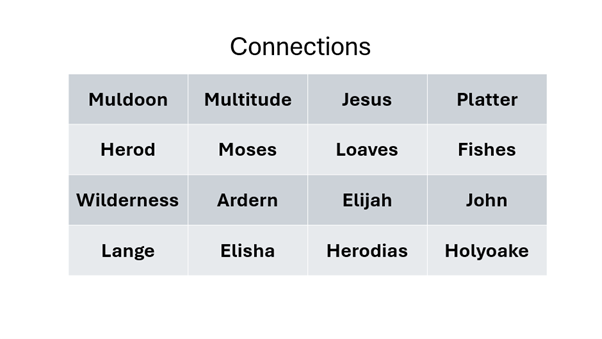
Most nights Robyn and I do some of the New York Times word puzzles. There’s Wordle of course, but we normally start with the lesser known Connections.

With Connections you are given 16 words; that is, four sets of four words which are related in some way. The object is to find the right connections.   

For example, among the 16 words you are given, you might have four names like Holyoake, Muldoon, Lange and Ardern. The connection there is pretty obvious. They are all former Prime Ministers of New Zealand.    

What about Multitude, Wilderness, Loaves and Fishes? What connection do you see with those words? Yes, Jesus’ feeding of the 5000. Today our message focuses on Matthew 14, verses 13-21, which describes Jesus’ miracle of feeding a multitude with just a handful of loaves and fishes.

This event is recorded in all four gospels and it finds multiple connections with the Old Testament as well. The feeding of the 5000 is a nexus point of Biblical connections. From Matthew 14, verse 13 we read…

13 When Jesus heard what had happened, he withdrew by boat privately to a solitary place. Hearing of this, the crowds followed him on foot from the towns. 14 When Jesus landed and saw a large crowd, he had compassion on them and healed their sick. 15 As evening approached, the disciples came to him and said, “This is a remote place, and it’s already getting late. Send the crowds away, so they can go to the villages and buy themselves some food.”

16 Jesus replied, “They do not need to go away. You give them something to eat.” 17 “We have here only five loaves of bread and two fish,” they answered. 18 “Bring them here to me,” he said. 19 And he directed the people to sit down on the grass. Taking the five loaves and the two fish and looking up to heaven, he gave thanks and broke the loaves. Then he gave them to the disciples, and the disciples gave them to the people. 20 They all ate and were satisfied, and the disciples picked up twelve basketfuls of broken pieces that were left over. 21 The number of those who ate was about five thousand men, besides women and children.

May the Spirit of Jesus illuminate God’s word for us.

Two main things I want to draw your attention to in this passage:

Jesus’ leadership and Jesus’ faith. We begin with Jesus’ leadership. The light of Jesus’ leadership shines brightly against the darkness of Herod’s reign.  

Leadership:

When you see (or hear) the words, Herod, platter, John and Herodias, what do you think of? Surely the beheading of John the Baptist.

John was the forerunner to Jesus, the prophet who came to prepare the way for the Messiah. John was Jesus’ ally, his wing man if you like. More than that, they were cousins.

In Matthew 14, verses 1-12, we read how Herod Antipas had John the Baptist killed. Herod was the puppet ruler of Galilee during the time of Jesus. He was a ruthless and depraved man.

When John the Baptist called Herod out on some of the bad stuff he was doing, Herod had John thrown in prison. Then when the daughter of Herodias danced for Herod, he promised to give her whatever she wanted. Herodias told her daughter to ask for John’s head on a platter.

After John had been beheaded, John’s disciples buried his body and told Jesus what had happened.

Given these facts, Jesus’ response to Herod is interesting. Jesus did not confront Herod; he did not organize a protest outside Herod’s palace or lead a revolt against Herod. Jesus did not seek revenge. Instead, Jesus quietly withdrew to a solitary place. Why?

Well, there was probably more than one reason. Perhaps Jesus did not want to inflame an already volatile situation. What Herod had done was a gross injustice. Anger and outrage are the natural response to injustice.

If Jesus confronted Herod or led a protest against him, it would have resulted in more violence. A calm head and a strategic withdrawal were necessary for the sake of peace. This was not a time for Jesus to be distracted from his core mission.

It appears too that Jesus needed some alone time; a short spiritual retreat to deal with his own feelings arising from John’s murder, but also to commune with God and seek his Father’s will on what his next move should be.   

With God, small things can make a big difference. Seeking solitude may seem like a small thing, but (in the context of Matthew 14) it accomplished much good and avoided even greater evil.

I wonder if Jesus had Psalm 37 in mind when he chose to put distance between himself and Herod. In verse 7, David writes…

Be still before the Lord and wait patiently for him; do not fret when people succeed in their ways, when they carry out their wicked schemes. Refrain from anger and turn from wrath; do not fret—it leads only to evil. For those who are evil will be destroyed, but those who hope in the Lord will inherit the land.

Jesus had faith that God Almighty would deal with Herod, and the Lord did deal with him. Some years later, in Acts 12, we read how an angel of the Lord struck Herod down. He was eaten by worms and died. God is just.

When the crowds worked out where Jesus was headed, they walked around the lake on foot and met him on the other side, in the wilderness. Seeing the large crowd, Jesus had compassion on them and healed their sick.

Compassion is the key word here. Compassion, in this context, is that deep feeling of empathy which moves a person to acts of kindness. Compassion speaks of an intimate connection, a heart and hand response to others in need. Compassion puts aside any thought of personal convenience or comfort for the sake of another person’s wellbeing.

Seeing all those people lost and confused, by what Herod had done to John, evoked a gut response from Jesus. The Lord was deeply moved in the core of his being. Rather than venting his spleen at Herod, Jesus used his emotional energy to heal and feed people.

By putting the account of Herod’s murder of John the Baptist alongside the account of Jesus’ compassion for the people, we (the reader) are invited to compare and contrast Herod’s leadership with Jesus’ leadership.

Herod was self-indulgent, brutal and destructive. Herod threw wild parties at the expense of the poor. He showed no restraint and it resulted in him taking the life of a righteous man. Herod’s leadership was toxic to the people.

In contrast, Jesus shows compassion for the poor. Jesus heals the sick, feeds the hungry and protects the vulnerable. Jesus demonstrates the kind of good shepherd leadership God wants for his people.

Those who are familiar with the Old Testament will see here a connection between Jesus and God’s word through the prophet Ezekiel…  

11 “I, the Sovereign Lord, tell you that I myself will look for my sheep and take care of them 12 in the same way as shepherds take care of their sheep that were scattered and are brought together again. … 14 I will let them graze in safety in the mountain meadows and the valleys and in all the green pastures of the land of Israel. 15 I myself will be the shepherd of my sheep, and I will find them a place to rest. I, the Sovereign Lord, have spoken.

By caring for the people in the wilderness, Jesus was acting as the divine shepherd leader of Israel, who has compassion on his people.

Okay, so we have talked about Jesus’ leadership, in contrast to Herod’s abuse of power. We also notice Jesus’ faith. Jesus models for us complete trust in God the Father.

Jesus’ faith:

The story is told of a soldier who was separated from his unit. The fighting had been intense, and in the smoke and the confusion, he had lost touch with his mates.

Alone in the jungle, he could hear enemy soldiers coming in his direction. Scrambling for cover, he found his way up a ridge to several small caves in the rock. Quickly he crawled inside one of the caves.

Although safe for the moment, he realized that once the enemy soldiers swept up the ridge, they would quickly search all the caves and he would be killed.

As he waited, he prayed, “Lord, if it be your will, please protect me. Whatever your will though, I love you and trust you. Amen.”

After praying, he lay quietly listening to the enemy begin to draw close.

He thought, “Well, I guess the Lord isn’t going to help me out of this one.”

Just then he saw a spider begin to build a web over the front of his cave. As he watched, listening to the enemy searching for him, the spider layered strand after strand of web across the opening of the cave.

“Hah” he thought, “what I need is a brick wall and what the Lord has sent me is a spider web. God does have a sense of humour.”

As the enemy drew closer, he watched from the darkness of his hideout and could see them searching, one cave after another. When they came to his cave, he got ready to face his end. To his amazement, though, they moved on.

Suddenly, he realized that with the spider web over the entrance, his cave looked as if no one had entered it for quite a while.

“Lord, forgive me,” the soldier prayed, “I had forgotten that in you a spider’s web is stronger than a brick wall.”

With God, small things can make a big difference. 

Take plankton for example. Plankton are small. Many types of plankton are microscopic in fact, smaller than a human blood cell, and yet they feed whales, the largest of mammals.

More than simply being a food source though, phytoplankton produce somewhere between 50% and 80% of the earth’s oxygen. God supports life on earth using tiny plankton.

Phytoplankton also absorb carbon dioxide helping to regulate the earth’s climate by removing greenhouse gas, from circulation.

With God, small things can make a big difference.  

Returning to Matthew 14. Jesus (the shepherd leader) had been ministering to people most of the day. It was getting late, so the disciples suggested to Jesus that he send the crowd away to the nearby villages to buy some food for themselves.

Given there were well over 5000 people present, this was not really a practical solution. It is unlikely the surrounding villages could cater for that number of people.

Jesus has another idea. ‘You give them something to eat’, he tells his disciples.

The disciples raise the obvious objection that they only have five loaves and two fish.  

In the gospel of John, we learn that these five loaves and two fish belonged to a boy. The loaves were made from barley. Barley bread was the food of the poor and the fish was probably small and pickled (like sardines).

It appears this boy was not well connected. He did not come from a wealthy family and his lunch was pretty ordinary.

Jesus is not phased though. He says, ‘bring them here to me’. And he directed the people to sit down on the grass. Green grass does not grow all year round in the middle east, like it does in New Zealand. The mention, therefore, that there is grass tells us it is springtime, Passover season.  

The Jewish Passover celebrates God’s deliverance of Israel from slavery in Egypt. We (the reader) are meant to see a connection here between God’s deliverance under Moses and the deliverance God brings under Jesus’ leadership.

In verse 19 we read how Jesus took the five loaves and the two fish and looking up to heaven, he gave thanks and broke the loaves. Then he gave them to the disciples, and the disciples gave them to the people. 

Here we see Jesus acting in faith that God would provide. As one commentator puts it, Jesus simply gave thanks for the food, confident that he represents the Father’s will.

In Jesus’ hands those five loaves and two fish fill the bellies of well over 5000 people, so that everyone had more than enough to eat.

Some people try to explain this miracle away, in various rational ways, but doing that empties this event of its meaning, robbing us of wonder and hope in the process. Jesus trusted God his Father completely and the Father honoured Jesus’ faith.

With God, small things can make a big difference.

Looking at our game of Connections once again we see there are four words left, names actually: Jesus, Moses, Elijah and Elisha. What do these four men share in common?

They were all prophets of the living God, offering spiritual leadership for the people. More than that, they all trusted God to provide for their needs and consequently participated in a feeding miracle. 

When the people of Israel cried out to Moses for food in the Sinai desert, Moses did not try to engineer a solution himself. He turned to God in prayer and the Lord God provided an abundance of manna and quail.

When God told the prophet Elijah to hide in the wilderness east of the Jordan, with no supermarket in sight, Elijah obeyed the Lord in faith, and God had ravens bring bread to feed him.

When a man brought the prophet Elisha 20 loaves of barley bread, Elisha told the man (in faith) to give the bread to the people. The 20 loaves fed 100 men and there was some left over.  

So, when we read how Jesus had faith in God to multiply five loaves and two fish to feed over 5000 people in the wilderness of Galilee, we see that in Jesus someone greater than Moses, Elijah and Elisha has come. Jesus is more than a prophet.

With God, small things can make a big difference.

Now in saying this, I do not mean to imply that we can be stingy with God, giving him our scrapes. The boy who offered his five loaves and two fish, gave Jesus everything he had. The boy was generous.

The point is, even when we give our best and our all, it may seem like a drop in the bucket. Our best and our all will usually fall short of the ocean of human need. But that is no reason to give up in despair. We can only do what is in our power to do and trust God with the outcome.   

Hearing this miracle story of Jesus feeding the multitudes is lovely and inspiring, but when we watch the news, we become painfully aware of the millions in our world today who are starving. Why doesn’t God feed them?

Well, God has provided enough to feed everyone on the planet. It’s not a production problem; it’s a distribution problem. Human greed and fear often get in the way.

Jesus trusted his disciples to distribute the food to the multitude and the disciples were faithful in carrying out the task Jesus gave them. In the end, there were 12 basketfuls left over, one for each of the disciples.  

Conclusion:

This morning we have observed multiple connections, all orbiting around Jesus and the miraculous feeding of the 5000 in the wilderness. There’s just one more connection we need to make. This too finds its fulfilment in Christ.

Centuries before Jesus came, the Lord God gave the prophet Isaiah a glimpse of a future heavenly banquet, with food far richer than barley bread and pickled fish. From Isaiah 25 we read…

On this mountain the Lord of hosts will make for all peoples a feast of rich food, a feast of well-aged wine, of rich food full of marrow, of aged wine well refined. And he will swallow up on this mountain the shroud that is cast over all peoples, the veil that is spread over all nations. He will swallow up death forever; and the Lord God will wipe away tears from all faces, and the reproach of his people he will take away from all the earth, for the Lord has spoken.

Jesus is the one who removes the shroud of death. It is through faith in Jesus (his death and resurrection) that we have sure hope of participating in God’s heavenly banquet.

Let us pray…

Gracious God, you know our every need and you care for us. Thank you for Jesus, the good shepherd, who leads us in paths of righteousness and restores our soul. Grant us the grace to follow Jesus all the days of our life and enjoy you forever. Amen.   

Questions for discussion or reflection:

  1. What stands out for you in reading this Scripture and/or in listening to the sermon? Why do you think this stood out to you?
  2. Why did Jesus withdraw to a solitary place after hearing how Herod had killed John? What good did Jesus’ retreat accomplish? (What evil did it prevent?)
  3. What is compassion? What (or who) moves you to acts of kindness?
  4. Compare and contrast Jesus’ shepherd leadership with Herod’s abuse of power. How do you experience Jesus’ care and provision?
  5. Discuss / reflect on the connections you notice between Jesus’ feeding of the 5000 in Matthew 14 and other feeding miracles in the Bible. How are these miracles similar? How are they different?
  6. In what ways do we see Jesus’ faith operating in Matthew 14?
  7. What small thing can you do (in faith) to show God’s love and care for others?     

Oneness

Scripture: Ephesians 4:1-6

Video Link: https://youtu.be/7ScfYPCmH4s

Structure:

  • Introduction
  • Oneness
  • Conclusion

Introduction:

Good morning everyone.

Today, for Campbell’s baptismal service, I have chosen a Scripture reading from Paul’s letter to the Ephesians. In the book of Ephesians, Paul explores the mystery and wonder of the Christian church. From Ephesians chapter 4, verses 1-6, Paul writes…

As a prisoner for the Lord, then, I urge you to live a life worthy of the calling you have received. Be completely humble and gentle; be patient, bearing with one another in love. Make every effort to keep the unity of the Spirit through the bond of peace. There is one body and one Spirit, just as you were called to one hope when you were called; one Lord, one faith, one baptism; one God and Father of all, who is over all and through all and in all.

May the Spirit of Jesus illuminate God’s word for us.

Oneness:

The largest living organism on the planet is a tree, known as Pando. On the surface Pando looks like a forest of individual trees, but underneath it is connected by one huge root system. Pando is, in fact, one tree with 47,000 stems.

Pando stands as a parable for the Christian church. On the surface, the church appears like a forest of individual trees, but underneath it is connected by one huge root system. The church is, in fact, one giant living organism with hundreds of thousands of congregations.

In verses 4-6 of Ephesians 4 we come across 7 ones: one body, one Spirit, one hope, one Lord, one faith, one baptism, one God and Father of all.

These 7 ones are not separate or independent of each other; they are all inter-related. The 7 ones are one. Paul is reminding us here of the root system all believers share in common.

The one body is the church universal, all Christians everywhere throughout history. The church may seem fragmented and divided from our perspective, with all its different denominations and controversies, but from God’s perspective the church is one, like a tapestry with many different coloured threads, or like a human body with many different parts.

Baptism is entry to the church. By being baptised we become part of the body of Christ, one of the stems growing from the ancient root system of the church.

There is one Spirit, the Holy Spirit who gives life and breath to the body. Indeed, the Greek word for Spirit also means breath. As believers in Jesus, we all breathe the same air, the same Spirit of God. The Spirit gives life to the body of Christ. Without the Spirit the church is dead.

Baptism is a sign of life, a new beginning, made possible by the Spirit of Jesus.  

There is one hope. Jesus is our hope. Because God raised Jesus from the dead, we have hope of eternal life, through faith in Jesus. No more suffering, no more sickness, no more tears.  

Baptism is a parable of resurrection. Going down under the water is a picture of dying to our old way of life. And coming up out of the water anticipates our resurrection when Jesus returns in glory.

There is one Lord, that is the Lord Jesus Christ. To say that ‘Jesus is Lord’ means that Jesus has authority over all things in heaven and on earth. Jesus has conquered sin and death. He is worthy of our love and obedience.

Baptism is submission to Christ. We no longer live for ourselves. We live for Jesus and God’s kingdom purpose. 

Because there is one Lord it naturally follows there is one faith.

Jesus is the object of our faith. Jesus is the way, the truth and the life. No one comes to God the Father except through Jesus the Son.

Baptism is an act of trust. We don’t know where our journey of faith will take us. We don’t know what the future holds, but we trust Jesus to be present with us wherever he leads.

There is one baptism. Although different Christian denominations practice baptism in different ways (for example some sprinkle and some immerse),

we are all baptised into the same person, that is into Jesus Christ.

Regardless of the amount of water, baptism is a commitment to learn from Jesus. To be baptised in the name of Jesus Christ is to become a disciple of Jesus, his apprentice.  

The seventh ‘one’, in Paul’s list, is the one God and Father of all. God is our creator; we are made in His image. Although we appear different or separate, we (who believe in Jesus) all stem from the same root.

With this in mind, we are called to unity, to oneness. Our unity comes from God. God the Father, Son and Holy Spirit are one.

But unity also requires some effort on our part. We need to be humble, gentle and patient, bearing with one another in love.

Baptism is an important step in responding to God’s call to unity.

Campbell, we are blessed and encouraged by your baptism today. You are not alone. You are one with us and you are in Christ. Remain in him.

Let us pray…

Gracious God, help us to keep the unity of the Spirit through the bond of peace. In Jesus’ name we pray. Amen.

Distraction

Scripture: Acts 6:1-7

Video Link: https://youtu.be/E0fq28Wa49A

Structure:

  • Introduction
  • The problem
  • The proposal
  • The growth
  • Conclusion

Introduction:

Good morning everyone.

Most weeks we find a police car in our church car park watching the roundabout. Or at least I think they are watching the roundabout. They might be staking the church out for criminal activity. Brodie’s name is known to the police.

Sometimes I talk to the police. Once I asked them what they were looking out for and they said, people using their cell phones while driving. Driving while distracted is a major contributor to car accidents in New Zealand.

Driver distractions include things like talking with passengers, using cell phones, looking at scenery, eating, smoking, or searching for objects in the car.       

According to transport New Zealand statistics, in 2023 there were 15 fatal crashes, 98 serious injury crashes, and 796 minor injury crashes where driver distraction was to blame. Distraction can be a dangerous thing, not just with driving, but in life generally.  

Today our message focuses on Acts chapter 6, verses 1-7. The book of Acts tells Luke’s account of the early church and the spread of the gospel. In Acts 6 we read how the apostles avoided distraction and saved the church from crashing.

From Acts 6, verse 1 we read…

In those days when the number of disciples was increasing, the Hellenistic Jewsamong them complained against the Hebraic Jews because their widows were being overlooked in the daily distribution of food. So the Twelve gathered all the disciples together and said, “It would not be right for us to neglect the ministry of the word of God in order to wait on tables. Brothers and sisters, choose seven men of good standing from among you who are known to be full of the Spirit and wisdom. We will turn this responsibility over to them and will give our attention to prayer and the ministry of the word.”

This proposal pleased the whole group. They chose Stephen, a man full of faith and of the Holy Spirit; also Philip, Procorus, Nicanor, Timon, Parmenas, and Nicolas from Antioch, a convert to Judaism. They presented these men to the apostles, who prayed and laid their hands on them. So the word of God spread. The number of disciples in Jerusalem increased rapidly, and a large number of priests became obedient to the faith.

May the Spirit of Jesus illuminate God’s word for us.

There’s a lot going on in Acts 6:1-7; it would be easy to become distracted.

To give you a road map, the church in Acts 6 faced a problem. The apostles came up with a proposal to sort the problem and the outcome was growth.

Let us begin with the problem.

The problem:

One person you almost never see on an airplane flight is the pilot. If the captain in charge of the plane started walking down the aisle handing out boiled sweets, the passengers would likely feel quite disturbed, and rightly so. If the pilot is in the back with us, who’s flying this plane?

Although the pilot is the person in charge, they don’t usually fly the plane by themselves. The co-pilot supports the captain and the navigator makes sure the plane stays on course. 

It is important for the pilot to not be distracted while flying, especially when taking off and landing. Those in the cockpit also need to keep an eye on all the dials and gauges to make sure fuel levels, cabin pressure and other vital systems are as they should be.

The pilot could not do their job without the flight attendants. It’s the role of the flight attendants to ensure the safety and comfort of the passengers. If the passengers have a problem, then the flight attendants deal with it.

Say for example, one of the passengers had a medical emergency. The flight attendant would help that person. If the pilot had to respond to the medical emergency themselves, that would put the lives of everyone else on board at risk. The pilot cannot afford to be distracted.

In Acts 6, verse 1, we read how the early church had a problem. The church was growing quickly, which was a good thing. But fast growth also comes with challenges.

The apostles were not aware of the problem at first. It only came to their attention when frustration boiled over into complaint and grumbling. There were at least three aspects to the problem. An organisational aspect, a cultural aspect and a welfare aspect.

The cultural aspect was the deeper underlying issue. Before addressing the organisational and welfare concerns, the apostles had to deal with the cultural disconnect.

At this point the Christian church was almost entirely comprised of people of Jewish descent. However, not all Jews of the first century were the same.

There were basically two cultures in the early Jerusalem church. The Hebraic Jews and the Hellenistic Jews. Hebraic as in Hebrew and Hellenistic as in Greek.

The Hebraic Jews were those Israelites who had been born and raised as Hebrews living in Palestine. They mainly spoke Aramaic. Jesus and the apostles were Hebraic Jews.

The Hellenistic Jews were those Israelites who had been born and raised outside of Palestine. They grew up speaking Greek and had been immersed in Greek culture for most of their lives.

The members of the Jerusalem church may have all been descended from Abraham, but they did not think or communicate in the same way. I suppose in contemporary terms it would be like the difference between Middle Eastern Jews and American Jews. Same ancestry, different culture.

The Greek speaking Jewish widows were being overlooked in the daily distribution of food. The daily distribution of food was sort of like a food bank for those in poverty. This was the welfare aspect of the problem.

Widows were especially vulnerable in the first century. There was no social security benefit from the government and work opportunities were often limited for women. If a widow did not have a way of supporting herself or if her family wasn’t able to help, then the church provided for her.  

That the Hellenistic widows were being overlooked was probably unintentional. The disconnect was likely caused by a cultural misunderstanding. Some cultures have no difficulty speaking up for themselves, while other cultures feel it is rude or impolite to ask for help or to put themselves forward.

Perhaps the Hellenistic Jews expected the Hebraic Jews to read between the lines and see what was needed without having to be explicitly told. When that didn’t happen, tensions rose.

The twelve apostles were like the pilots of the plane; they could not afford to be distracted from their work of bearing witness to the risen Jesus. They could not deal with this concern themselves without putting the whole church at risk. This was the organisational aspect of the problem.

What would they do? It is to the apostles’ proposal we turn now.

The proposal:

A hospital is a complex organisation. There are many different jobs needing to be done by different people, all of them vital to the health and wellbeing of the patients.

The surgeon’s role is essential of course. What is a hospital without doctors.

It is imperative that surgeons not be distracted from their work, especially while in theatre. And when they are not in theatre, surgeons are often on call, needing to be ready to respond to emergencies. 

It would not be right for the surgeon to spend their time and energy changing bed sheets or emptying bed pans. That would be a waste of their training and skill. More good can be achieved if the surgical team are allowed to focus on doing operations.

This is not to imply that the role of nurses, orderlies and cleaners is somehow less. If no one changed sheets or cleaned up bodily fluids, disease would spread, patients would suffer and the doctors’ work would be undermined.

In verse 2 we read how the apostles called all the disciples together to address the problem. They did not react defensively when people complained. Nor did they sweep the problem under the carpet or minimise it. They faced the problem with humility and wisdom, dealing with it in a timely manner.

Another thing we notice here is the way the twelve apostles functioned as a team. Just as it takes a team of people to fly a plane and a team of people to perform a surgery, so too it requires a team of people to lead a church. 

Notice too how the whole church was asked to come together. Now, it is not necessary or wise to involve the whole church with every pastoral problem. As a rule, you address the issue with those who are affected.  If just two or three people are affected, then the whole church doesn’t need to know about it.

But the situation in Acts 6 did affect the whole church and so the apostles wisely included everyone in discussing their proposal. This was a big deal. If left alone the issue threatened to split the church, which would not be good for anyone.

Jesus said, “By this everyone will know that you are my disciples, if you love one another.” The church’s greatest witness for Christ is the way its members relate with each other. 

The apostles start by saying to the congregation, “It would not be right for us to neglect the ministry of the word of God in order to wait on tables.”

Ministry is simply another word for service. A ‘minister of the word of God’ is someone who serves God’s word, like a prophet or a preacher or an evangelist. A minister of God’s word seeks to understand God’s message and communicate that message to others.

Usually this is done by prayerful study of the Scriptures. As the minister reads the Bible, the Holy Spirit illuminates God’s word in the Scriptures. Other times God’s word comes to the minister through providence or in a dream or through another person or by divine inspiration.

As ministers of God’s word, the apostles were like surgeons on call, needing to be ready to respond to God’s word and Spirit.

When God’s word does come, there is usually a process of discernment, which takes time. God’s word is a weighty thing; it carries a lot of meaning. And it often has sharp edges, like a scalpel, so it needs to be handled with care.

It requires a high degree of concentration to deliver God’s word. You cannot afford too many distractions.    

For the apostles in Acts 6, neglecting the ministry of the word of God to wait on tables would be like surgeons neglecting the operating theatre to change bed pans or the pilot neglecting the landing of the plane to hand out biscuits.

It’s not that waiting on tables or serving the poor is somehow less important than preaching. Both are important. Indeed, those who cared for the widows gave credibility to the apostles’ message of love.

But the apostles had been entrusted by God with a special task. The twelve knew Jesus personally, had heard his teaching first hand and had witnessed Jesus’ death and resurrection. It would be a waste of their training and experience to wait on tables when others were able to do this. 

The apostles did not want to become distracted, like Martha. They wanted to remain attentive to Jesus, like Mary.

In verses 3 and 4, the apostles present their proposal saying…

“Brothers and sisters, choose seven men of good standing from among you who are known to be full of the Spirit and wisdom. We will turn this responsibility over to them and will give our attention to prayer and the ministry of the word.”

Wow, this is impressive. The apostles do not impose a solution on the church. Nor do they try and fix the problem themselves. They propose a democratic approach; they admit their own limitations, trusting the congregation and the Holy Spirit to find the right team of people to handle this responsibility.

This proposal pleased the whole group. They chose Stephen, a man full of faith and of the Holy Spirit; also Philip, Procorus, Nicanor, Timon, Parmenas, and Nicolas from Antioch, a convert to Judaism.

The interesting thing about this list is that they are all Greek names, most likely from a variety of different places. This is a multi-cultural group. The Hellenistic widows would not be overlooked now, because the people in charge of the foodbank had the cultural understanding to meet their needs.   

What has God given you to do? When we are young and have lots of energy, the temptation is to try and do everything ourselves. But as we get older, we learn to be more strategic with how we spend our life.

If you don’t know yet what your niche is in God’s purpose, you might ask yourself: What am I good at? What do I enjoy doing? What can I do that most other people can’t?

The apostles did not try to do everything themselves. They did not allow themselves to become distracted. They kept the main thing the main thing. They gave themselves to God’s calling on their lives and it resulted in growth

Growth:

In verse 7 of Acts 6 we read of the growth that happened in the early church. The word of God spread, the number of disciples in Jerusalem increased rapidly, and a large number of priests became obedient to the faith.

When we look at this verse, we probably notice the numerical growth before anything else. Afterall, it talks about the number of disciples increasing rapidly and a large number of priests coming to faith. Numbers have their place, but they don’t tell the whole story.

We also read how the word of God grew (or spread). The word of God is like seed planted in the soil of the human heart. Just as a seed grows into a plant which is good for the soil, preventing erosion, so too the word of God grows inside our mind and is good for the soul, giving integrity to our inner life.   

Hearing God’s word may stop someone from doing something bad or it may prompt them (on an unconscious level) to perform some kindness, without them realising God is in it. Christian values (inspired by God’s word) influence our secular society for good, in ways most people are not aware of. 

The other type of growth we read about in verse 7 is growth in the obedience of faith. Faith is not just an idea we agree with in our head. True faith leads to action. If faith is the root, obedience is the fruit. How is your fruit? Are you growing in things like kindness, faithfulness, patience and generosity?    

The kind of growth described in Acts 6 does not happen by human effort alone. Yes, we have our part to play in sowing the seed of God’s word and in being obedient to the faith, but ultimately it is God’s Spirit who makes our efforts fruitful. 

Conclusion:

With today’s message I’ve highlighted the dangers of distraction. But I also need to acknowledge the benefits. Sometimes distraction can be a good thing, something helpful for our wellbeing.

Watching cricket in summer provides a pleasant distraction for Robyn and I. Kane Williamson is perhaps the greatest batsman New Zealand cricket has ever produced. He has played 105 test matches, scoring over 9,200 runs at an average of 54.9. This is to say nothing of his records in other forms of the game.

Kane is wonderful to watch. He plays the ball late, finding the gaps in the field. He seems to go into his own little bubble, blocking out all distractions and staying calm. You wouldn’t put Kane in to bat at number 10 or 11; it would be a waste. He does more good higher up the order, batting at 3 or 4.  

I once saw Kane in person walking around Mount Maunganui. He was pushing a buggy with one of his children in it. He acknowledged me with a nod and a smile. I smiled back but I didn’t interrupt him. It gave me joy to see Kane spending time with his kids. I’m pleased he has a life outside of cricket. 

If Kane (or anyone else for that matter) were focused on cricket all the time, it would do their head in. As human beings we need other interests. We need to spend time connecting with people and nature, doing things unrelated to our work. Too much of anything is not good for you.

At the end of the day the pilot and the surgeon need time away from the cockpit and the operating theatre. Just as the preacher needs time away from the Bible and the pulpit.

Some distractions are bad, some are good, and others are unavoidable.

Even though the ministry of God’s word was Jesus’ main priority, he often turned aside to heal people. How can he ignore human need. Jesus’ words were accompanied by miraculous deeds of power. The ministry of God’s word goes hand in hand with the ministry of God’s compassion.

The risk with miracles, of course, is that they can distract people from the message. Discernment is required.     

We need to ask ourselves, is God in this distraction?

It appears at least two of the seven chosen to take care of widows were distracted from their task of managing the food bank. Under the guidance of the Holy Spirit, both Stephen and Philip became ministers of the word of God, preaching to people in Jerusalem and Samaria.   

Focus on what God wants you to do. Give your life to it. But remain open to the Spirit. Sometimes God may want to distract you; he might want to restore your soul or lead you to something new.

May the Spirit of God make us fruitful as we abide in Christ. Amen.   

Questions for discussion or reflection:

  1. What stands out for you in reading this Scripture and/or in listening to the sermon? Why do you think this stood out to you?
  2. Discuss / reflect on the apostles’ response to the problem in Acts 6. Why do the apostles choose not to get involved (in a hands-on way) with the daily distribution of food? What can we learn from the apostle’s response?
  3. What has God given you to do? What are you good at? What do you enjoy doing? What can you do that most other people can’t?
  4. Are you doing what God has given you to do? What sorts of things distract you from God’s purpose for you? How might you avoid these unhelpful distractions? 
  5. What kinds of distractions are helpful to you? How might we discern when God is wanting to distract us?
  6. How is your growth in obedience to the faith going? Are you growing in the fruits of the Spirit?  

Mutually Exclusive

Scripture: 1 Corinthians 10:14-22

Video Link: https://youtu.be/FPXWfWBaKQo

Structure:

  • Introduction
  • Blood Connections
  • Bread Connections
  • Unseen Connections
  • Conclusion

Introduction:

Good morning everyone.

Some things cannot happen at the same time. For example, if you flip a coin, you will get either heads or tails. You can’t get both heads and tails simultaneously.

Likewise, if you take one card from a standard playing deck, then you cannot draw both an ace of diamonds and a two of spades at once. That’s not how cards work.

Or if you are invited to a party then you either attend or you don’t attend. You cannot attend and not attend at the same time. Just as you cannot have your cake and eat it too.

The technical word for this is ‘mutually exclusive’. Mutually exclusive events cannot take place at the same time. Basically, the occurrence of one event means the other event cannot happen.

Today we continue our series in First Corinthians chapters 8-10, where Paul writes about Christian freedom. When it comes to Christian freedom, there are some things which are mutually exclusive. For example, you cannot be a follower of Jesus and be involved with pagan worship at the same time.

Now, in using a term like mutually exclusive, I don’t mean to imply that the Christian faith is closed off from the world or insular. At its heart Christian faith is outward looking. Jesus and Paul were missionaries. They were seeking people they could include.

At the same time, they were not willing to include everything. They held onto their belief in the oneness and goodness of God. They did not sacrifice what they knew to be true.

There is a tension with Christian freedom. On the one hand, we are free to reach out to others with the love of Jesus. But on the other hand, we don’t have a license to compromise our belief or loyalty to Christ. We need to be mindful of this tension as we listen this morning.

From First Corinthians chapter 10, verse 14 we read…

14 Therefore, my dear friends, flee from idolatry. 15 I speak to sensible people; judge for yourselves what I say. 16 Is not the cup of thanksgiving for which we give thanks a participation in the blood of Christ? And is not the bread that we break a participation in the body of Christ? 17 Because there is one loaf, we, who are many, are one body, for we all share the one loaf. 18 Consider the people of Israel: Do not those who eat the sacrifices participate in the altar? 19 Do I mean then that food sacrificed to an idol is anything, or that an idol is anything? 20 No, but the sacrifices of pagans are offered to demons, not to God, and I do not want you to be participants with demons. 21 You cannot drink the cup of the Lord and the cup of demons too; you cannot have a part in both the Lord’s table and the table of demons. 22 Are we trying to arouse the Lord’s jealousy? Are we stronger than he?

May the Spirit of Jesus illuminate God’s word for us.

As we heard last week, some of the Corinthian believers were walking on thin ice by eating the meat of idols in pagan temples. In today’s reading Paul says quite plainly, you cannot do this. Taking holy communion and joining in pagan worship are mutually exclusive. You cannot do both.

Just beneath the surface of these verses is the idea of spiritual connection or partnership. In particular Paul highlights two things that connect people to God and to one another: blood and bread. Let’s begin with the blood connection.

Blood Connections:

Many of you knew the late Bruce Murray. Bruce played cricket for New Zealand during the 1960’s. He toured India and Pakistan with the Black Caps. Bruce told me of an incident that happened during the third test against India in Hyderabad in October 1969.

The Indian crowd had greatly enjoyed watching two of their batsmen play. When these two men (Venkat and Bedi) were leaving the cricket pitch some of the spectators were so excited they jumped the fence and ran on to the field to congratulate Venkat and Bedi.

Now a cricket pitch is a mutually exclusive place. You cannot have players and spectators on the field at the same time. A good number of auxiliary police (armed with long sticks) saw what was happening and intervened to protect the two Indian batsmen from over-zealous fans.

A young boy slipped past the police. One policeman threw his stick at the boy and missed. When the boy bent down to pick up the stick, another policeman hit him over the head.

The boy put his handkerchief to the wound and saw he was bleeding. When he held the bloodied cloth up to the crowd, the people rioted. The sight of blood created an instant connection. The police had done this to one of their own.

The crowd broke down a wire gate, set the score board on fire and ripped hundreds of chairs out of the grandstands, throwing them on the field.

Players were told to stay in their rooms that night. Bruce recalled the uneasy feeling among his teammates.

There’s something about blood that connects us in a deep and visceral way. Blood ties speak of family connections of course, but it’s more than that.

Blood is life to the body. Blood is pumped through the heart, sustaining every limb and digit. If blood flow is cut off, then the limb dies.

In ancient worship rituals, blood was shed in sacrifice to atone for sin, to make people right (or at one) with God. A life for a life.

In verse 16 Paul writes, is not the cup of thanksgiving for which we give thanks a participation in the bloodof Christ?   

Paul is referring to the Christian ritual of communion here, also known as Mass or the Eucharist or the Lord’s supper. Communion was first instituted by Jesus.

On the night before his crucifixion and death, Jesus was celebrating the Jewish Passover meal with his disciples in the upper room. During the meal, Jesus gave the cup of wine new meaning. For Christians the cup signifies God’s new covenant, sealed with the blood of Christ for the forgiveness of sin. 

Jesus’ blood, poured out on the cross, atones for the sin of the world. Through faith in Jesus’ sacrifice we are made right with God.

Paul is saying that when we share the cup at communion, we are participating in the blood of Christ. That word translated as participating comes from the Greek word koinonia. Koinonia and its related cognates appear six times in today’s passage. So koinonia is key to understanding Paul’s thought.

The meaning of koinonia is difficult to translate directly into English. It can mean participation or partnership or fellowship or communion depending on the context. In the New Testament, koinonia speaks of a special bond or deep connection between the people of God.

Koinonia is not a light or superficial connection. Men who have participated in combat together, sharing blood, sweat and tears, have a koinonia connection.

Indeed, people who have survived a long ordeal together are bound by koinonia. They share an intimate and unspoken understanding that can only be gained through a common (and often painful) experience.     

What then does it mean to participate in the blood of Christ? Well, there is a certain mystery here that cannot be penetrated by mere words. But you need some explanation, no matter how inadequate, so here goes…  

In one sense, participating in the blood of Christ, means sharing in the benefits of forgiveness and atonement through faith in Jesus’ death on the cross.

Paul’s argument is this: You cannot be clean and dirty at the same time.

Those two things are mutually exclusive. It’s similar with the blood of Christ.

You cannot participate in the atonement of Christ and participate in pagan rituals at the same time. The cleansing blood of Christ and the defiling blood of pagan sacrifice are mutually exclusive. 

Going a little deeper, participating in the blood of Christ, could also mean sharing in the sufferings of Jesus. We probably won’t be crucified like Jesus was (thankfully), but we may suffer smaller injustices and humiliations because of our connection with Jesus.

You know those times when (through no fault of your own) you feel powerless and vulnerable; they are opportunities for creating koinonia (or communion) with Jesus. Our Lord set aside his power, making himself vulnerable for us, even unto death on a cross. 

Although unpleasant, these smaller sufferings enable us to know Jesus more intimately. There is a surprising joy in sharing Jesus’ suffering. Joy and suffering are not mutually exclusive.

We are talking about the things that connect us. The blood of Christ connects us, as does the bread of Christ. 

Bread Connections:

The English word ‘companion’ literally means to ‘share bread with’.

A companion therefore is someone you eat with. There’s something about sharing a meal that connects people and makes them our companions.

When people eat together, they talk and as they talk, they get to know each other; barriers come down and trust forms. Food has a way too of lingering in our memory. A shared meal creates a feeling of belonging and connection.

Food is a conduit for love. When you cook something special for someone, it is an act of love. And when you eat that meal, you receive that person’s love.

There has been a lot of love put into the shared lunch today.

In verses 16 and 17 Paul talks about the bread of the communion meal saying…

And is not the bread that we break a participation in the body of Christ? Because there is one loaf, we, who are many, are one body, for we all share the one loaf. Again, that word participation comes from the Greek koinonia.

Later, in his letter to the Corinthians, Paul will go on to talk about the church being the body of Christ. Paul’s emphasis in this verse is on unity. Sharing the bread of communion is an act of koinonia with the people of God.

Just as bread nourishes body and soul, so too participating in church life nourishes our relationships together. Koinonia with others who share our faith banishes loneliness, creates trust and fosters a sense of identity and belonging.

In verse 18 Paul draws an analogy saying: Consider the people of Israel: Do not those who eat the sacrifices participate in the altar? 

The Old Testament background here is that people would bring their food to the priest to be offered in sacrifice to God. Some of the food sacrificed was given to the priest and the rest was returned to the worshippers who shared a meal together. This sacred meal was a participation in the altar.

There’s that word again; participation, koinonia.

One of the things on Israel’s altar was the shew bread, 12 loaves symbolising God’s holy presence. The imagery is clear; God is the one who provides for all the people’s needs. God is the host of the sacred meal in other words. And, as host, God is present at the meal.   

Our communion bread (symbolising the body of Christ) is sometimes referred to as the host. Christ is the host of the communion table. Jesus is God’s provision for our needs. When we share communion, Jesus is present, by his Spirit. We cannot see Jesus, but we know by faith that Christ is in the room.

The koinonia of the communion table takes us into the realm of mystery, what someone once called ‘the cloud of unknowing’. Some people are comfortable with mystery. Others not so much.

If you like a rational explanation for everything, if you want all your questions answered, then mystery can make you feel uneasy, vulnerable even. The realm of mystery requires us to exercise faith, to trust ourselves to the unseen presence of God.

We’ve talked about the connections created by blood and bread. Now let’s consider those unseen connections in the spiritual realm.

Unseen Connections:

One of the difficulties with spiritual things is that we cannot see them. Spiritual reality may be felt or sensed, but it is seldom seen. In truth, there is an unseen reality to our lives.

There are many things in the physical / material world which we cannot see and yet we know are real because of the effects they have on our lives.

Gravity is perhaps the most obvious invisible force. The gravitational pull of the moon causes the oceans tidal movement. Gravity also keeps our feet on the ground and can inflict some pain if we get on the wrong side of it.

Atmospheric pressure is another invisible force at work in our world. High pressure usually means sunshine and low pressure often means bad weather.

We cannot see the movement of tectonic plates below the earth’s surface, but we know about it when the plates do move.

Love is another unseen power which affects us, not unlike gravity or tectonic plates. Love is not a substance. You cannot put love under a microscope and analyse it like bacteria or dissect it like a frog. But love still makes itself known, holding sway over our thoughts and feelings, like the moon holds sway over the ocean.

The greatest unseen power, of course, is God himself. God is Spirit so we cannot see him, but we can see where he has been. The whole earth and everything in it, is his masterpiece, both beautiful and functional at the same time. 

In verses 19 and 20 Paul talks about the malevolent unseen forces behind idols.

19 Do I mean then that food sacrificed to an idol is anything, or that an idol is anything? 20 No, but the sacrifices of pagans are offered to demons, not to God, and I do not want you to be participants with demons. 

The idols which littered ancient Corinth were just lumps of wood and stone. They were dead, impotent, with no power at all in themselves.

However, behind the idols and pagan temples were demons; evil spiritual beings, aligned with the devil. While we cannot see demons physically, we can see their detrimental effect in this world. Things like greed, exploitation, fear, racism, sexual abuse, poverty, violence and so on. 

The really twisted thing about pagan idolatry is that those who worship idols think they are doing something righteous or good. They are often very devout and sincere people who are not aware of the unseen reality. The evil one presents himself as an angel of light. 

I’m not saying these things to make you afraid. If you remain in Christ, then you have nothing to fear.

Having unveiled the truth about idol worship, that it really is the worship of demons, Paul then states the obvious, in verse 21…

21 You cannot drink the cup of the Lord and the cup of demons too; you cannot have a part in both the Lord’s table and the table of demons.

In other words, you cannot partake of holy communion and indulge in the dinner parties held in pagan temples. These two things are mutually exclusive. You cannot serve Jesus and the devil at the same time. You cannot be in partnership with unseen evil forces and remain in Christ. 

To do so would be to court disaster. For one thing it would arouse the Lord’s jealousy. Jealousy is not the same as envy. Envy is bad. Envy is when you want something that doesn’t belong to you. Envy ultimately destroys.

Jealousy is different from envy. Jealousy is the righteous indignation you feel when someone threatens what is rightfully yours to care for. Jealousy ultimately protects. A jealous father protects his children, just like a good shepherd protects his sheep.   

You may wonder what relevance Paul’s advice has in our world today.

Well, for those who live in countries where people offer food and incense to idols in temples, the connection is clear. If you want to follow Jesus, you cannot go to those temples and participate in worship.

Idolatry is usually more subtle in New Zealand though. While we do have an attachment to certain objects (like our cell phones), I don’t expect anyone here bows down in worship to those objects.

We are more inclined to internalise our idols. For example, we may at times give a greater place to work and wealth than we do to Jesus. Or we might prioritise entertainment and our own comfort over obedience to Christ. Freedom itself can become an idol.  

The problem with internalising our idols is that we cannot see them, which means we are less aware of our own idolatry. We risk becoming like the devout pagans who are unaware of their spiritual reality.

Another danger for us in New Zealand is syncretism. Dipping into more than one religion at the same time. Maybe practicing aspects of Christianity alongside some other belief system. That won’t work.

Just like it doesn’t work to use a Ouija board on Saturday night and then take communion on Sunday morning. Mutually exclusive.

Mixing religions and dabbling in the occult are obvious things to avoid. What about those things that are less black and white, more grey? 

When in doubt, let peace be your guide. If you are uncomfortable, if it feels like something is off but you can’t quite put your finger on it, listen to your instinct. The Spirit of God often nudges our instinct. If someone invites you to an event or activity and you don’t have peace within yourself about it, don’t go there.  

Conclusion:

At the beginning of our message today I talked about the tension that exists with Christian freedom. While we don’t have a license to compromise our belief about God or our loyalty to Christ, we are free to reach out to others with the love of Jesus.

And that’s where our focus should be. Looking for common ground. Looking for those points of connection that allow us to be mutually inclusive so that others might experience koinonia with Christ.

Let us pray…

Lord Jesus Christ, Son of God, forgive us our idolatries. Help us to walk in freedom and righteousness we pray. Amen.

Questions for discussion or reflection:

  1. What stands out for you in reading this Scripture and/or in listening to the sermon? Why do you think this stood out to you?
  2. Why does Paul warn the Corinthians against mixing pagan worship with taking communion?
  3. What connects you to Jesus? What connects you to other believers?
  4. Have you ever experienced koinonia? What happened? Why is koinonia important? What are the benefits of koinonia?
  5. What does it mean to participate in the blood of Christ?
  6. What does the ritual of holy communion mean to you? In what sense is Christ present when we share communion?
  7. What relevance does Paul’s advice, in 1 Corinthians 10:14-22, have for us today? What idols are you most vulnerable to?
  8. How might we decide whether something is compatible with Christ or not?     

Thin Ice

Scripture: 1st Corinthians 10:1-13

Video Link: https://youtu.be/G0sJ4VhYD2Q

Structure:

  • Introduction
  • The danger of privilege (1-5)
  • The danger of presumption (6-11)
  • The deliverance of God (12-13)
  • Conclusion

Introduction:

Good morning everyone.

The expression, “You’re on thin ice”, is a warning that you are in danger. You are venturing into an area that is life threatening or detrimental to your wellbeing.

The literal meaning of being on thin ice is skating or walking on a frozen lake where the ice could give away under your weight at any moment, probably resulting in a painful death.

Figuratively, a teacher might say to a student who is always late or rude, “You’re on thin ice Mr”. Or your mum might say it when you are testing the limits of her patience. Or you might be on thin ice with your landlord if you miss a rent payment.

Other expressions which mean the same thing as being on thin ice include…

“You’re playing with fire”, or “You’re on shaky ground”, or “You’re dancing with the devil”.

The thing about thin ice is that you know you should get off it as quickly as possible, but there’s something in you (is it curiosity?) that just wants to test how far you can go. Either that, or you are completely unaware of where you are standing.        

Today, after Ascension Sunday, Pentecost Sunday and Trinity Sunday, we return to our series on First Corinthians chapters 8 to 10, where Paul writes about Christian freedom.

Freedom needs to be tempered with self-control. Too much freedom is a dangerous thing. Indeed, unbridled freedom will put you on thin ice. From First Corinthians 10, verses 1-13, we read…      

For I do not want you to be ignorant of the fact, brothers and sisters, that our ancestors were all under the cloud and that they all passed through the sea. They were all baptized into Moses in the cloud and in the sea. They all ate the same spiritual food and drank the same spiritual drink; for they drank from the spiritual rock that accompanied them, and that rock was Christ. Nevertheless, God was not pleased with most of them; their bodies were scattered in the wilderness. Now these things occurred as examples to keep us from setting our hearts on evil things as they did. Do not be idolaters, as some of them were; as it is written: “The people sat down to eat and drink and got up to indulge in revelry.” We should not commit sexual immorality, as some of them did—and in one day twenty-three thousand of them died. We should not test Christ, as some of them did—and were killed by snakes. 10 And do not grumble, as some of them did—and were killed by the destroying angel. 11 These things happened to them as examples and were written down as warnings for us, on whom the culmination of the ages has come. 12 So, if you think you are standing firm, be careful that you don’t fall! 13 No temptationhas overtaken you except what is common to mankind. And God is faithful; he will not let you be temptedbeyond what you can bear. But when you are tempted, he will also provide a way out so that you can endure it.

May the Spirit of Jesus illuminate God’s word for us.

To refresh your memory, First Corinthians is one of the letters the apostle Paul wrote to the church in Corinth, during the first century. The believers in Corinth had sent their own letter to Paul with some questions and concerns. Paul wrote back to gently pull them out of the rabbit holes they were going down. 

Some of the believers in the Corinthian church were over-confident in their new found freedom in Christ. They felt at liberty to join in the feasts held in the pagan temples that peppered the city they lived in.

But Paul tells them, no. This is not a right use of your freedom as followers of Jesus. Eating meat in places of pagan worship puts you on thin ice with God. 

Three handles to give us a grip on this morning’s reading from Corinthians 10. First, Paul warns against the danger of privilege and the danger of presumption. Then he reminds us of the deliverance of God.

The privileges we enjoy as followers of Jesus do not make us immune from evil. Nor should we presume upon the grace of God, seeing how far we can push it. The Lord won’t tolerate sin indefinitely.

It’s not all danger and thin ice though. The Lord is faithful; we can rely on him to provide a way out of temptation, so long as we are not looking for a way into temptation. Our first point though is the danger of privilege

The danger of privilege:

In Roald Dahl’s book, Charlie and the Chocolate Factory, five children win a golden ticket to meet Willy Wonka and see inside his factory. It is a real privilege to see the secrets of Mr Wonka’s chocolate making.

But this privilege is not without its dangers. Winning a golden ticket comes with all sorts of temptations. One by one, each of the children acted against Willy Wonka’s instructions and disqualified themselves for the prize.

Holding a golden ticket got the children into the chocolate factory, but it did not give them a right to do whatever they wanted once inside. Far from giving them license, the privilege of holding a golden ticket actually required the children to act responsibly and with self-control.

Special privileges can deceive us. They can lull us into a false sense of security and make us over-confident; feeling like we have a license to walk on thin ice and get away with it. Privilege does not make you special or immune from danger. Privilege is like a hand grenade; it needs to be treated with great care.

In verses 1-3 of Corinthians 10, Paul draws an analogy between the Israelites of Moses’ time and the Corinthian believers.

When God redeemed the people of Israel from slavery in Egypt, they went through a baptism of sorts. Passing through the Red Sea and following the cloud of God’s presence, was a type of baptism which prefigured the water baptism the Corinthians had received on becoming followers of Jesus.

Likewise, the people of Israel received a type of communion in the wilderness. God provided manna for them to eat and water from a rock. This food and drink was spiritual. It nourished their bodies and their relationship with God.

In a very real sense, the supernatural provision of manna and water prefigured holy communion, which the Corinthians partook of regularly.

Being redeemed from slavery, sin and death is a privilege. Baptism and communion are a privilege. But these privileges don’t give us a right to behave however we like. With great privilege comes great responsibility.

Despite their privileged position, God was not pleased with most of the Israelites of Moses’ day, and their bodies were scattered in the wilderness.

Some of the Corinthian believers had way too much confidence. They figured, we’ve been baptised and redeemed. We participate in the Lord’s supper, so we’re all good. We can eat meat sacrificed to idols in pagan temples, no problem. The devil can’t touch us.  

But the privileges of baptism and communion do not make us immune from evil, any more than holding a golden ticket kept the children out of trouble in Willy Wonka’s chocolate factory.

If you walk on thin ice, you risk falling through, whether you’ve been baptised or not. If you participate in pagan rituals, you open your spirit up to a whole world of evil, whether you take communion or not.  

Paul’s message to the Corinthians is this: don’t be like the Israelites. Don’t be deceived by your privilege. Don’t walk on thin ice.

Paul does something quite interesting in these verses, which is easy to miss. The Corinthians were mostly gentiles and yet, in verse 1, Paul talks about the Israelites being our ancestors. The Corinthians were not genetically related to the Israelites, like Paul was. But in a spiritual sense they were related.

If you are in Christ, there is a continuity between you and the people of God in the Old Testament. The stories of the exodus and the exile are our stories too. We, who belong to Jesus, whakapapa back to Abraham, through Christ.

That is a unique privilege, which comes with great responsibility.

The responsibility to learn from Israel’s mistakes. As Paul writes in verse 6: these things occurred as examples to keep us from setting our hearts on evil things as they did.       

One of the dangers of privilege is that we can get so accustomed to it that we forget we are in fact privileged. We can start to view our privilege as an entitlement; something we are owed. Privilege can lead to presumption.

The danger of presumption:

Presumption is behaviour which is arrogant and disrespectful. To act in a presumptuous way is to take liberties and go beyond the bounds of what is considered appropriate.

If you are in a restaurant and someone you don’t know sits down at your table and starts eating food off your plate, then that is presumptuous. It’s not presumptuous, by the way, if your husband or wife eats food off your plate. That is simply marriage.

Or if you are pregnant and a complete stranger walks up to you in the supermarket and puts their hand on your belly, that is presumptuous.

Or if someone parks their car in an accessible carpark, without a permit, that also is presumptuous.

You may have heard of the term ‘diplomatic immunity’. Diplomatic immunity is a principle of international law where foreign diplomats and officials are protected from the criminal justice system of the host country. So, if a diplomat commits a criminal offence, they cannot be arrested or sent to jail.

Even though diplomats have this special privilege, most would not be presumptuous enough to shop lift or punch someone in the face or eat chips off your plate.

In fact, in cases where a serious crime is committed, like murder, the sending country may well choose to waive diplomatic immunity and grant the host country the right to press criminal charges against their own official.

In other words, the ice of diplomatic immunity wears thin in some cases and cannot always be relied upon to save the foreign official if they act really badly.

As believers, we are sort of like diplomats from a foreign country. This world is not our home, but we still have a responsibility to behave ourselves.

We must not presume upon the grace of God, seeing how far we can push it, as the Israelites did in the wilderness. The Lord won’t tolerate that for long.  

In verses 7-10, Paul briefly touches on four occasions when the Israelites of old found themselves on thin ice and fell through. Paul highlights the Israelites’ sins of idolatry, sexual immorality, testing the Lord and grumbling.

Idolatry is the worship of idols; basically, the worship of anything that is not God. As I said earlier, some of the Corinthians presumed it was okay to participate in the feasts held at the local pagan temples. But these dinner parties were essentially idolatrous.    

Even if the Corinthians themselves did not believe in idols, they were on thin ice by eating in the idol’s temple. Idolatry in the ancient world inevitably led to revelry. Drunken carousing and loose partying, the kind that uni students during O week might indulge in. Revelry of this sort often leads to fornication.   

In verse 8, Paul warns against sexual immorality. This seems to be a reference to the time when Israelite men indulged in casual sex with strangers; Moabite women who had invited them to pagan worship. Thousands died as a warning.

Sexual immorality was a problem in Corinth too, just as it is a problem in our society today. You may have heard on the news recently how girls as young as 10 are being used as prostitutes. If we who are used to evil are outraged by that kind of exploitation, how much more is God’s holy wrath provoked.

Verse 9 says, we should not test Christ, as some of them did—and were killed by snakes.[1] ‘Testing God’ means trying to prove God wrong, trying to make his word fail, rather than trusting him.

When Satan quoted Scripture, tempting Jesus to jump off the highest point of the temple, the evil one was trying to prove God’s word wrong.

Jesus responded by saying, “Don’t put the Lord your God to the test”.

In other words, don’t presume upon God’s grace. Don’t see how far you can push the boundaries and get away with it.

Putting God to the test is the opposite of trusting God. It puts us on thin ice, where we end up learning the hard way.

Interestingly, Paul says we should not test Christ. Paul gives Jesus the same standing as God. By hanging out in pagan temples, the Corinthians were presuming upon Jesus’ grace.

Now at this point, some of you might be thinking, I don’t bow down to idols or have casual sex with randoms or otherwise test Jesus. I’m not presumptuous like those haughty Corinthians. I’m humble. Today’s sermon is not for me.

Hmm. If you think you are standing firm, be careful that you don’t fall!

The fourth presumption Paul lists is that of grumbling. Some of the Israelites in the wilderness grumbled against Moses, just as some of the believers in Corinth were grumbling against Paul, which is probably why Paul mentions it.     

Grumbling? Is that a sin? Really? Apparently it is. Stink. Just when I thought I was in the clear I find out grumbling is not allowed. Many of us are guilty of grumbling. In fact, kiwis are quite good at grumbling. We call it, ‘tall poppy syndrome’. Cutting others down with our words and criticisms.

Grumbling may be more socially acceptable, but it’s still a presumption. Grumbling reflects an attitude of arrogance and entitlement. When we grumble, we put ourselves on thin ice. Secure people, people with their feet on solid ground, build others up.

We’ve talked about the danger of privilege and the danger of presumption. Now let’s consider the deliverance of God.

The deliverance of God:

Sometimes we can find ourselves on thin ice through no fault of own, simply because the ice is melting and we are in the wrong place at the wrong time.  

God is ready to deliver us in situations like that.

In verse 13 Paul addresses the issue of temptation and how God delivers us from it. We will break it down because there’s quite a bit going on in this verse.

Firstly, Paul writes: No temptationhas overtaken you except what is common to mankind.

Now when we hear the word temptation we are probably inclined to imagine a little devil enticing us to do bad things so that we fall through the ice.

But in this context, temptation is more like a test designed to make us stronger, rather than a torture designed to break us.

Running a marathon is a test of your endurance. The temptation is to give up before you reach the end. But if you do make it all the way, without giving up, you are stronger for it.

Likewise, writing an essay or sitting an exam is a test of your mastery of the subject. The essay or exam is not designed to break you or make you fail.

Its purpose is to help you learn and strengthen your mental proficiency. 

Getting a license to drive involves a series of tests. Acquiring the skill and experience necessary to pass these tests makes you a better, safer driver.  

Temptation in the sense of testing is not bad or evil. It is necessary and inevitable if we are to grow and develop and become better human beings.

Being baptised and receiving communion does not make you immune from temptation. Everyone faces testing in this life. It is common to humankind.

Therefore, we should not be surprised by temptation. We should prepare for it, like we would prepare for a marathon or an exam or a driving test. 

The second thing Paul says in verse 13 is that God is faithful; he will not let you be temptedbeyond what you can bear. 

Note here that God is not the one who brings the temptation, but he does allow it, within certain limits. God is good. He knows our limits and cares for our wellbeing. (Not that it always feels like that to us.)

Sometimes it feels like God takes us beyond our limits. We might think we can only run half a spiritual marathon, when in fact God knows we can go twice that distance. Just as we can be overconfident at times, so too we can underestimate ourselves in other situations. The testing of temptation shows us the truth about ourselves.   

Paul reassures his readers saying, …when you are tempted, God will also provide a way out so that you can endure it.

The original Greek word translated as ‘a way out’ (in verse 13) imagines an army platoon trapped in the mountains, escaping a seemingly impossible situation through a pass. [2] 

Very seldom is God’s deliverance as easy as Star Trek, where Captain Kirk says, ‘Beam me up Scotty’. God’s deliverance, his way out, usually requires us to show some character and make a conscious choice.

When Joseph was tempted to sleep with Potiphar’s wife, Joseph avoided her, even running out of the room when she got him alone. God’s way out for Joseph was the indignity of being falsely accused and sent to prison, where Potiphar’s wife could not get to him.

Eventually though, that prison became God’s means of elevating Joseph to Prime Minister of Egypt. God is faithful.

Conclusion:

Not many of us are as good as Joseph. A lot of us (given the opportunity) might prove to be more like David and Bathsheba.

At some point we all find ourselves on thin ice, whether by accident or our own deliberate fault. If we do fall, then we need not despair.

God has provided for our rescue through Jesus. Jesus does for us what we cannot do for ourselves. Jesus resisted every temptation and test thrown at him, overcoming sin on our behalf. Jesus is our righteousness.

When we do fall, we are honest about that with God. We own it. We don’t try to justify ourselves. We seek his forgiveness and we ask the Lord to restore us; to put our feet on the right path, the firm foundation of Christ our rock.

Let us pray…      

Gracious God, keep us off thin ice. Lead us in the way everlasting, for your name’s sake. Through Jesus we pray. Amen. 

Questions for discussion or reflection:

  1. What stands out for you in reading this Scripture and/or in listening to the sermon? Why do you think this stood out to you?
  2. Have you ever found yourself on thin ice, either literally or figuratively? What happened? How did you get there? What (or who) saved you?
  3. What are the dangers of privilege? How might we enjoy our privilege (freedom) without being deceived by it? 
  4. Why do we get baptised and receive communion? What purpose do these rituals serve? What are baptism and communion not to be used for?  
  5. Discuss / reflect on the four sins (or presumptions) Paul lists in verses 7-10; idolatry, sexual immorality, testing Christ and grumbling. In what ways are these sins expressed in our society today? How might we keep ourselves from these temptations.
  6. What is meant by ‘temptation’, in the context of verse 13? What is the purpose of temptation? Can you think of a time when you felt sorely tested? What happened? How did God provide a way out?
  7. How might we prepare for temptation? What rhythms and routines improve your spiritual fitness?
  8. Take some time this week to confess and repent of anything you know that is putting you on thin ice with God.

[1] Refer Numbers 21:4-9

[2] Refer Leon Morris’ commentary on 1 Corinthians, page 144.

We Believe

By: Neville Gardner, 15 June 2025

In Türkiye, not far from Istanbul, is a small town called Iznik. There is no Christian church, but this year Christians around the world are celebrating a significant event that took place here 1700 years ago. In those days, the town was part of the Roman Empire, and had the Roman name Nicaea.

In 325AD, a statement of faith called the Nicene Creed was formulated here, and it is still a standard document for a majority of Christian churches. To find out how it came about, we’ll need to dig into bit of a history.

In the early years of the 4th century AD, Christians in the Roman Empire were a minority group. Under the emperor Diocletian, Christians were persecuted. Church buildings were destroyed, sacred writings were burnt and worship meetings were banned. Christians who refused to sacrifice to the cult of the emperor could be killed. As you can imagine, Christianity was slow to grow in these circumstances.

Then along came Constantine, first as emperor of the western empire, then in 324 of the combined east and west. Critically, Constantine turned from paganism and became a Christian. He was keen to encourage Christian interests, as a political move to help unify his fractured empire. So the Treaty of Milan decreed that all Roman citizens could worship who they liked, without interference from the empire. Christianity didn’t become the official religion then, but it was free from persecution.

Against this background, Christians were still coming to grips with what it meant to be a Christian. The writings of the apostles had been collected and copied, but their contents were mainly spread orally, which made study and interpretation hard. It also made it relatively easy for people to spread ‘false teaching’ that was not scriptural.

One result was that the nature of the relationship between God, Jesus and the Holy Spirit became contentious. In particular, a Christian sect called Arians claimed that Jesus was a created being, not a divine part of a Trinity with God and the Holy Spirit.

Emperor Constantine’s plans for a unified empire needed a united Christian church. So he gathered together over 300 bishops from across the Empire at his summer palace in Nicaea, where he set them to sorting out their differences. Over three months, the bishops tried to prayerfully determine the will of God. One result was the writing of what is now called the Nicene Creed, a statement of faith that is still used by many denominations around the world.

There were several changes to the Nicene Creed in following councils; the text we’ll look at now is a version in common use today. As I read it out, please don’t say it out loud yourselves – I’d like you to concentrate on what the words mean to you.

We believe in one God,

the Father, the Almighty

maker of heaven and earth,

of all that is, seen and unseen.

We believe in one Lord, Jesus Christ,

the only Son of God,

eternally begotten of the Father,

God from God, Light from Light,

true God from true God,

begotten, not made,

of one Being with the Father.

Through him all things were made.

For us men and for our salvation

he came down from heaven:

by the power of the Holy Spirit

he became incarnate from the Virgin Mary, and was made man.

For our sake he was crucified under Pontius Pilate;

he suffered death and was buried.

On the third day he rose again

in accordance with the Scriptures;

he ascended into heaven

and is seated at the right hand of the Father.

He will come again in glory to judge the living and the dead,

and his kingdom will have no end.

We believe in the Holy Spirit, the Lord, the giver of Life,

who proceeds from the Father and the Son.

With the Father and the Son he is worshipped and glorified.

He has spoken through the Prophets.

We believe in one holy catholic and apostolic Church.

We acknowledge one baptism for the forgiveness of sins.

We look for the resurrection of the dead,

and the life of the world to come.

Having come up with this statement, the council condemned anyone who did not agree with what it said; those bishops at the Council who disagreed were banished as heretics. Constantine got what he wanted, but sadly the unified church went on to persecute heretics to a level that matched what Christians had recently suffered under Diocletian.

The Nicene Creed unified the orthodox church with a basic doctrine of belief, and continues to do so. But since then there has been much disunity over non-doctrinal issues, such as governance, traditional rituals and practices, the style and timing of baptism, the date of Easter and so on. There was an early split between the Western Orthodox Church (which largely became what we term Roman Catholic) and the Eastern Orthodox Church. But they both used the Nicene Creed.

In 16th century Europe, there was a huge upheaval called the Protestant Reformation, which saw many people break away from the Roman Catholic Church, not always peacefully. New Protestant groups continued to appear, and there are now hundreds of denominations. They differ in many ways, but they nearly all maintain belief in the doctrine articulated in the Nicene Creed. For example, the Anglican, Methodist and Presbyterian churches, the Salvation Army and many Baptist churches, all recognise the Nicene Creed.

The Creed I read out just now has four ‘We believe’ statements – three focussing on the Trinity, with a single line on the church. It’s that line I’d like to talk a bit more about.

“We believe in one holy catholic and apostolic Church.”

A couple of quick word explanations here.

The term ‘catholic’ is written with a small c – it just means universal church, and does not refer to the Roman Catholic Church.

Apostolic means based on the words and actions of the Apostles, as recorded in the New Testament.

The use of the phrase “We believe” rather than “I believe” was, of course, deliberate. “I believe” was, and is, used in personal statements of faith, especially those declared at baptism. “We believe” is a communal statement made by a group with shared beliefs – originally by the bishops at Nicaea, later by gathered church congregations everywhere.

Remembering that ‘catholic’ means universal, “We believe in one holy catholic and apostolic Church” says that we believe in one church throughout the world, based on the biblical words of the Apostles. It doesn’t say we believe in a particular denomination, but in God’s worldwide church.

Just before his arrest, we hear in John 17 that Jesus prayed for his disciples. “I pray not only for them, but also for those who believe in me because of their message. I pray that they may all be one. Father! May they be in us, just as you are in me and I am in you.”

Jesus’ prayer reminds us that the church is called to be one, and its unity is to reflect the oneness of Jesus with God the Father. We believe in a universal church, because it is God’s church. When we say the Creed, we can feel part of this worldwide community. This means we all have some responsibility to be part of its ministry.

As Christians, as Baptists, we are part of God’s universal church. Many Baptist churches around the world use the Nicene Creed, as it is fully biblical and it reminds us of our links to the universal church. As a congregationally governed church, affiliated with the Baptist Union of New Zealand, Tawa Baptist has a written constitution which includes a different statement of faith. It’s based on the Nicene Creed, but is shorter and uses plainer language.

I’m going to read out the Tawa Baptist Statement of Faith, and I’d like you to read it out with me. If you don’t want to, that’s fine.

We believe . . 

  • In one God in three persons: God the Father, God the Son and God the Holy Spirit.
  • In the true humanity and deity of the Lord Jesus Christ, God the Son.
  • In the atonement made by the Lord Jesus Christ on the cross for the sin of the world.
  • In the resurrection of the Lord Jesus Christ from the dead.
  • That salvation and membership in the Church universal is by faith in the Lord Jesus Christ.
  • That the Bible is inspired by God and authoritative in matters of Christian faith and practice.

By saying “We believe”, we include ourselves in the global church, as well as in this church of Tawa Baptist. Today, this church has been blessed because Kyle and Izandi have formerly become part of that “We”. We can pray that being part of our church life together will help them grow in their personal faith – indeed for all of us, saying “We believe” helps us to more confidently say “I believe.”

I’d now like to take you back to the modern village of Iznik, Roman Nicaea. One of the bishops present in 325AD wrote that “The most eminent servants of God from all the churches that filled Europe, Africa, and Asia gathered together. One place of worship, as if expanded by God, accommodated the people.”

Over the centuries, the site of this church was forgotten, lost.

Then, in 2014, aerial photographs of the Iznik shoreline got archaeologists very excited. There, close to shore, in shallow water, was the outline of a stone basilica, an early form of church. The building of the church was dated to about 100 years later than the Council of Nicaea, and it disappeared beneath the waters of the lake in an earthquake over 600 years later.

Further excavations revealed the remains of an earlier church under the stone one. It’s not certain, but the date is right for this to be the church the Council of Nicaea met in.

The lake of Iznik has been shrinking due to years of drought, so the ruins of the basilica have gradually got closer to the surface and nearer the shore. You can now stand on the ruins without getting your feet wet. I can’t help wondering if, just as He expanded the church to fit all the bishops in 325, God has revealed that church in time for Nicaea 2025 celebrations.

A few weeks ago, my sister-in-law visited Iznik as part of a Nicaea 2025 tour led by Father Luke Miller, Church of England archdeacon of London. She sent me a photo of the church ruins, where they held a communion service. Later this year, the new Pope Leo is due to meet Patriarch Bartholomew, spiritual leader of the Eastern Orthodox Church, at this very spot. Their joint celebration of the Council at Nicaea is a landmark event in itself.

The church council in 325 aimed for Christian unity, but sometimes it seems that, apart from basic matters of doctrine, unity is still far off. Celebrations of Nicaea 2025 are particularly significant for The World Council of Churches, which for many years has encouraged unity between denominations representing over half a billion Christians worldwide. It may be on a smaller scale, but here in Tawa several churches work together in common witness and service, sharing the unity hoped for in the Nicene Creed.

I’d like to finish by reading some words Father Luke used during his tour to Nicaea.

“Constantine wanted unity. Guided by the Holy Spirit, something extraordinary happened in Nicaea. In all the divisions and stresses of the church, the creed of the fathers of Nicaea remains a bright thread in the frayed fabric of the unity of the church. God is at work still, not to fulfil the desire of a powerful emperor, but to bring us all to the glory of union with Him.”

Questions

What are the main sections of the Nicene Creed, and how do they relate to each other?

What aspects of the Creed resonate with you the most?

How could the Nicene Creed, or the Tawa Baptist statement of faith, help you to understand and deepen your own faith?

You may come across versions of the Nicene Creed that say, “We believe” or “I believe”. What difference does this wording make?

How does your understanding of the Trinity affect how you live and relate to others?

How could you use the Nicene Creed or the Tawa Baptist statement of faith to help you engage in prayer and worship?

Secure

Scripture: Romans 8:14-17

Video Link: https://youtu.be/0MS9jZG8uqw

Structure:

  • Introduction
  • Affection
  • Adoption
  • Assurance
  • Conclusion

Introduction:

Good morning everyone.

What makes you feel secure? Perhaps when you were young, your teddy bear made you feel safe and secure. Then, as you grew older, being accepted by your friends gave you a sense of security.

Some people find security in their job; they are always at work, never able to rest, always feeling like they have to achieve more. Other people seek security by accumulating money, houses and stuff. Or by projecting a certain image of themselves which may not be entirely true.  

There is nothing wrong with earning money to buy a house, just as there is nothing wrong with wanting people to think well of you. We need these things to survive in this world. But as necessary as a house and a job and a good reputation are, they don’t last. The security they provide is only ever temporary at best.

Ironically, the pursuit of security can cause quite a bit of anxiety. Ultimately, our security needs to be based on something that cannot be lost or stolen or die.

Today is Pentecost, 50 days since Easter. After his resurrection from the dead, Jesus appeared to his disciples over a period of 40 days before ascending to heaven. Ten days after his ascension, Jesus’ disciples received the gift of the Holy Spirit.

The Holy Spirit is God’s divine Spirit. The Holy Spirit connects us to the ultimate source of security, the risen Jesus Christ.       

Our sermon this morning is based on Romans 8, one of the traditional readings for Pentecost. Romans 8 talks about the Holy Spirit quite a bit. We won’t be covering all of Romans 8 today, just four verses. From verse 14 we read…

14 For those who are led by the Spirit of God are the children of God.15 The Spirit you received does not make you slaves, so that you live in fear again; but you have received the Spirit of adoption. And by him we cry, “Abba, Father.” 16 The Spirit himself testifies with our spirit that we are God’s children. 17 Now if we are children, then we are heirs—heirs of God and co-heirs with Christ, if indeed we share in his sufferings in order that we may also share in his glory.

May the Spirit of Jesus illuminate God’s word for us.

These verses are talking about the security the Holy Spirit gives believers.

Three words to hang today’s message on, all of them closely related to security: affection, adoption and assurance.

The Holy Spirit shows us God’s affection, He is involved in our adoption by God and He assures us we are God’s children. Let us begin with the Spirit and our affections…

Affection:

Affection is a positive feeling. You can show affection in all sorts of ways.

When you rub a dog’s belly, you are creating a positive feeling both for you and the dog. When you give someone a word of encouragement or a hug (and it is welcome) this also creates a positive feeling of affection.

Feelings, of course, move us. They are a source of energy. Feelings motivate us. If we feel affection for someone or someone shows us affection, then we will feel good about that person and be motivated to give them our best.

The Bible uses a variety of images to describe the Holy Spirit including wind, breath, fire, water and a dove. While these are all helpful, none is adequate on its own to describe the work of God’s Spirit. The Holy Spirit is not an unconscious force. The Holy Spirit is a divine person, capable of giving and receiving affection.

The gospel of John talks about the Holy Spirit being a comforter or an advocate. One who comes alongside and guides us in the love and truth of Jesus.

In contemporary terms we might think of the Holy Spirit as a sports coach. If the church is a team, then God is the owner and manager, Jesus is the captain, the Holy Spirit is the coach and we are the players. It is the job of the coach to come alongside the players to guide, train, correct and encourage them.

The best coaches know how to rub the belly of their players, metaphorically speaking. Their presence affects the players at a heart level. The players know the coach cares about them and that brings out the best in the team.

Or to put it another way, the players feel affection for a good coach. They will do anything for a coach they love and respect. 

In verse 14 of Romans 8, the apostle Paul writes: For those who are led by the Spirit of God are the children of God.  

The Spirit here reminds us of a sports coach leading, guiding and encouraging his players. To be led by God’s Spirit is to have a mind-set of learning to do God’s will. Those who are led by God’s Spirit are thinking, how do I love God and my neighbour in this situation?

Like a good coach the Holy Spirit doesn’t drive us by fear. Rather, the Spirit inspires belief and builds trust. He rubs our belly when we need it and gives us the feeling of genuine security, bringing out the best in the team.

Of course, for the players to benefit from the coach’s influence, we must listen to the coach and do what he says. If we love God, if Jesus holds sway over our affections, then we will trust and obey the promptings and pushings of the Holy Spirit.

Who holds sway over your affections?

We are talking about the security the Holy Spirit gives believers. The Holy Spirit shows us God’s affection and He is involved in our adoption by God.

Adoption:

Psychologists say that a deep and lasting sense of security comes from the way parents interact with their infant children. If a baby gets lots of face-to-face time, lots of affection and connection from at least one consistent adult, they will learn basic trust and feel secure throughout life. They call this attachment.

The thing about attachment is that the baby needs the relationship with the one consistent adult to be reinforced regularly. You don’t create a sense of security in a child by occasional, infrequent episodes of attachment.

The kind of attachment in view here is not like attaching a trailer to your car every once and a while. It’s more like the seats in a car, which are permanently attached. Wherever the car goes the seats go. 

The sort of attachment that leads to deep and lasting security in the child requires an intentional and lasting commitment by the adult.      

God (our maker) understands our human need for attachment and meets this need by adopting us into his family. Verse 15 reads: The Spirit you received does not make you slaves, so that you live in fear again; but you have received the Spirit of adoption.

In the Greco-Roman world of the first century, in which Paul lived, adoption was a serious business. There was a thorough legal process to follow which resulted in a lasting and binding commitment between the parent and child.

In his commentary on Romans, F.F. Bruce writes (and I paraphrase here)…

The term ‘adoption’ may sound a bit artificial to our ears; but in the first century an adopted son was deliberately chosen by his adoptive father to perpetuate his name and inherit his estate; he was in no way inferior in status to a natural born son and might well enjoy the father’s affection more fully and reproduce the father’s character more worthily. [1]    

To be adopted by God, therefore, is a big deal. We sometimes talk about making a commitment to God. But really, God’s commitment in adopting us comes first and is greater and more reliable than any commitment we might make.

The one being adopted does nothing to deserve this grace. All we can do is accept the father’s love with gratitude and seek to reproduce the father’s character in our own relationships.

The Spirit of God changes our status and gives us a new kind of relationship with God the Father, a more personal, intimate relationship. One where we can approach God with confidence and affection so that we cry ‘Abba, Father’.

‘Abba’ was the Aramaic word for father, used by Jewish families in antiquity.

It was an everyday term like dad or daddy or da (as the Irish say).

Children in the first century never addressed God as Abba, that would have been considered incredibly disrespectful and yet Jesus almost always addressed God as his ‘Abba’.  

Most famously Jesus addresses God in this intimate way in his prayer of anguish in the Garden of Gethsemane. “Abba, Father”, he said, “everything is possible for you. Take this cup from me. Yet not what I will, but what you will.”

This is interesting. Jesus is secure enough in his relationship with God to be honest about what he is feeling and what he wants. In the end though, Jesus is willing to put aside his own desires to obey God. Jesus does this, not out of fear of reprisal, but out of love and affection for his Dad.

The Holy Spirit gives us security. He shows us God’s affection, He is involved in our adoption by God and He assures us we are God’s children.

Assurance:

John Wesley (born in England in 1703) was one of nineteen children. I’m not sure how much attachment time John got with his parents, given how large the family was, but his mother, Susanna Wesley, gave her children a thorough education and raised them with strict discipline.

John attended Oxford University, where his brother Charles Wesley (of hymn writing fame) founded the “Holy Club”, a group committed to prayer, Bible reading, weekly communion, and helping the poor.

In 1735 John Wesley and his brother Charles travelled to America by sea.

At that stage both brothers were ordained ministers in the church of England.

On the voyage there, John and Charles met a group of Moravian Brethren. (Protestant Christians.) Their calm assurance of salvation deeply impressed John Wesley, as did the warmth of their fellowship and singing. When a storm enveloped their ship, the Moravians were not anxious. They had a peace which passes understanding.

Once he arrived in America, John undertook a short-term mission trip to Georgia. It was not very successful, and he returned to England in 1737 a bit dejected.

A year later while in London, on 24 May 1738, John went very unwillingly to a meeting in Aldersgate Street. Someone was reading Martin Luther’s preface to the Epistle to the Romans.

John Wesley wrote in his journal what he experienced that night…

About a quarter before nine, while he was describing the change which God works in the heart through faith in Christ, I felt my heart strangely warmed. I felt I did trust in Christ, Christ alone, for salvation; and an assurance was given me that He had taken away my sins, even mine, and saved me from the law of sin and death.

John is describing his experience of divine assurance given by the Holy Spirit.  

In verse 16 of Romans 8, Paul writes: The Spirit himself testifies with our spirit that we are God’s children. Paul is talking here about the inner witness of God’s Spirit, who assures us we are loved and accepted as children adopted by God.  

You might be wondering, what exactly is meant by our spirit, (spirit with a lower case ‘s’). Because the word spirit is a bit vague, a bit ambiguous. It can mean different things to different people depending on the context.

Well, in the context of Romans 8 verse 16, our spirit refers to the human spirit, which is our capacity to relate with others. Our eyes enable us to see. Our ears enable us to hear. Our feet enable us to stand. Our lungs enable us to breathe and our spirit enables us to relate with others, to connect with them and form trust.

Someone may have a cold, hard or mean spirit in the way we relate with others. Or they may have a warm, gentle and generous spirit in how we relate.

Our spirit (our ability to relate) can be damaged when trust is broken.

While our human spirit is different from God’s Holy Spirit the two are compatible. But our spirit needs to be open to receive God’s Spirit.

Now it is important to note that the assurance given by God’s Spirit is not the same for everyone. We don’t all feel our heart strangely warmed like John Wesley did. Spiritual experiences like that are relatively rare. Not everyone receives them.

More often the assurance given by God’s Spirit is felt in more ordinary ways, through other people, especially other believers.

Earlier in the service I told you about Mary, who passed away last Monday. Mary and Joyce were life-long friends. They were mates for over 60 years.

Their mutual friendship (I believe) was a means of divine assurance.

Mary loved to walk places but as her sight and hearing faded, crossing the road became more dangerous. Joyce was Mary’s eyes. And if Joyce misplaced someone’s name, Mary was Joyce’s memory.

Friendship; the Spirit working between people to support one another in ordinary ways. Through friendship the Holy Spirit reassures us of God’s presence, his Fatherly love and care.

So, if you have never felt your heart strangely warmed, as John Wesley did, then don’t panic. It doesn’t mean you are missing God’s Spirit or that you are not a child of God. The assurance of the Holy Spirit won’t be the same for everyone. But it will be personal for you. It will be what you need at the time.

The other thing to note here is that we may not feel divine assurance all the time. Ignatius taught that in the Christian life there are periods of desolation when God feels very absent, just as there are moments of consolation when God reassures us of his affection and presence. Christian faith is about continuing to follow Jesus, whatever the weather of our feelings.  

Paul continues to unpack the implications of our being God’s children in verse 17 where he says: Now if we are children, then we are heirs—heirs of God and co-heirs with Christ…

Paul’s thought here is this: because we are God’s children that means Jesus is our brother, which means we are co-heirs with Christ. Therefore, we will share Christ’s inheritance, his reward.

And what is the inheritance we share with Christ? Well, it is the kingdom of God. It is abundant, joyful, healthy, peaceful, life; the kind we want to go on living forever. But that is not all. The real reward is God Himself. Eternal life is intimacy with God. As any child knows, time with mum or dad is more valuable than gifts or toys.  

However, we cannot expect to share in Christ’s reward if we are not prepared to share in his suffering. Suffering with Christ is the path to glory

Returning to John Wesley for a moment. Quite often when John spoke about his new assurance, in Anglican pulpits, he was met with a hostile reception and told not to return. Being given an inner assurance by the Holy Spirit doesn’t make us immune from getting a hard time from the world we live in.

But the inner assurance of God’s Spirit can lend a deep and lasting sense of security to our human spirit. After being kicked out of the mainline church, John began to speak in the open air, taking the gospel to the poor in the industrial towns. These people had little contact with the church of England.

One is reminded of the apostle Paul’s experience in Acts, getting kicked out of the synagogue, then taking the gospel to the gentiles.   

For fifty-two years John Wesley travelled the countryside on horseback, preaching the gospel. Some people accepted his message, others rejected it. Either way, John Wesley’s sense of security was unshaken because his security wasn’t based on the opinion of others or the success of his ministry. It was based on his attachment to God through the Holy Spirit.

We are unlikely to have a preaching ministry like John Wesley, but we may still suffer for identifying with Christ. If (or when) that happens we can be assured we are not being punished by God but rather are following in the footsteps of our older brother, Jesus.

Indeed, suffering for Jesus is its own assurance. For if we share in Christ’s sufferings, we will share in his glory.

Conclusion:

Two questions for you to ponder…

What (or who) makes you feel secure?

How reliable (or lasting) is your security? 

The Holy Spirit is a source of security we can rely on. The Holy Spirit shows us God’s affection, He is involved in our adoption by God and He assures us we are God’s children.

Let us pray…

Father God, we thank you for the work of the Holy Spirit in our lives, both seen and unseen. Help us to move at the impulse of your Spirit, that Jesus would hold sway over our affections and we would reproduce your character in our relationships. Through Jesus we pray. Amen.

Questions for discussion or reflection:

  1. What stands out for you in reading this Scripture and/or in listening to the sermon? Why do you think this stood out to you?
  2. What made you feel secure when you were a child? Has the source of your security changed as you have grown through life? How so?
  3. What (or who) makes you feel secure now? How reliable (lasting) is your security? 
  4. Discuss / reflect on some of the Biblical images of the Holy Spirit. What characteristics of the Holy Spirit do each of these image’s highlight?
  5. What is affection and why is it important? How do you like to show affection? Who holds sway over your affections?
  6. What does it mean to be adopted by God the Father? What are the implications for you personally?
  7. Have you ever suffered for identifying with Christ? What happened? Were you aware of God’s assurance or help in that situation? If so, how? 

[1] F.F. Bruce, Romans, page 166.

Liminal Experiences

Scripture: Acts 1:1-11

Video Link: https://youtu.be/x8IwMmDbypc

Structure:

  • Introduction
  • Proof of life
  • Promise of Spirit
  • Purpose moving forward
  • Conclusion

Introduction:

Good morning everyone.

Our lives are peppered with liminal experiences. A liminal experience is a time or place of transition and change. An in-between moment, a period of waiting.

The word “liminal” comes from the Latin word “limen,” which means threshold. A liminal moment therefore is one in which we stand on the threshold of something new and different.

A liminal experience may last only a few seconds or it could last many years. 

The days a caterpillar spends in a cocoon, before it becomes a butterfly;

the years it takes to go through adolescence; the minutes you spend waiting at the bus stop or the train station; these are all examples of liminal time.

Indeed, bus stops and train stations are liminal spaces, places of transition. Pregnancy is a liminal experience, an in between time, when you are waiting on the threshold of a significant life change. The seconds between when a baby is born and takes its first breath is a liminal moment.  

That imperceptible time between waking and sleeping, when your mind is half half-conscious, emerging from a dream; that’s a liminal experience.

Routine, stability, normality are the opposite of liminal experiences. Life in the liminal can feel exciting, like you are on the cusp of realising a long awaited hope. But it can also feel a bit disorienting or scary, because your regular routine is unsettled and you are not sure what comes next.   

Last Thursday was Ascension Day, that day in the Church calendar when we remember Jesus’ ascension to heaven. We usually celebrate Ascension the following Sunday (which is today) because hardly anyone is at church on Thursday.

According to the Bible the risen Lord Jesus appeared to his disciples for 40 days after his resurrection before being taken into heaven. The time in-between Jesus’ resurrection and ascension was a liminal period for his followers.

With this in mind we take a break from our series in First Corinthians to focus on Acts chapter 1, verses 1-11, which describes what happened during those 40 days of liminal time. From Acts 1, verse 1, we read…

In my former book, Theophilus, I wrote about all that Jesus began to do and to teach until the day he was taken up to heaven, after giving instructions through the Holy Spirit to the apostles he had chosen. After his suffering, he presented himself to them and gave many convincing proofs that he was alive. He appeared to them over a period of forty days and spoke about the kingdom of God. On one occasion, while he was eating with them, he gave them this command: “Do not leave Jerusalem, but wait for the gift my Father promised, which you have heard me speak about. For John baptized withwater, but in a few days you will be baptized withthe Holy Spirit.” Then they gathered around him and asked him, “Lord, are you at this time going to restore the kingdom to Israel?” He said to them: “It is not for you to know the times or dates the Father has set by his own authority. But you will receive power when the Holy Spirit comes on you; and you will be my witnesses in Jerusalem, and in all Judea and Samaria, and to the ends of the earth.” After he said this, he was taken up before their very eyes, and a cloud hid him from their sight. 10 They were looking intently up into the sky as he was going, when suddenly two men dressed in white stood beside them. 11 “Men of Galilee,” they said, “why do you stand here looking into the sky? This same Jesus, who has been taken from you into heaven, will come back in the same way you have seen him go into heaven.”

May the Spirit of Jesus illuminate God’s word for us.

Quite a bit happens in the liminal moments of our lives, although we are often unaware of it. There isn’t time now to cover everything Luke writes about in Acts 1, so we will focus on three of the main things that Jesus did in those 40 days of liminal time.

Firstly, Jesus presented himself to his followers, proving that he really is alive and well and risen to eternal life. Secondly, Jesus promised his followers the gift of the Holy Spirit. And thirdly, Jesus gave the apostles purpose moving forward. Let us begin with Jesus’ proof of life.

Proof of Life:

Learning things, taking in new information, is a liminal experience. Learning so it becomes second nature, involves a process of change. With any real learning there is an uncomfortable in-between moment when we are leaving what is familiar to venture into unknown territory.

Take learning to drive for example. Knowing the road code is one thing but actually getting to a place where you feel comfortable behind the wheel is another thing altogether.

If you learned to drive in a manual car, then getting the hang of synchronising the clutch and the accelerator smoothly probably took months of practice.

That practice time was a liminal experience. It may have felt uncomfortable at first, but now you change gear without thinking about it.  

Or take marriage as another example. You have the wedding and become husband and wife, and its lovely and all that, but holding a marriage certificate doesn’t automatically make you a competent marriage partner.

There is a liminal period, which may last a year or two, when you are adjusting to married life. Getting used to living together. Abandoning a single person’s mindset. Sorting out roles and responsibilities. Learning to say, ‘Yes dear, you were right’, and settling into a new rhythm and routine.

Luke, the author of Acts, starts by saying: In my former book, Theophilus, I wrote about all that Jesus began to do and to teach.

Luke’s former book is the gospel of Luke. The significant thing here is that Luke says he wrote about all that Jesus began to do. The implication being that Jesus’ earthly ministry was only the beginning. And in fact, what Theophilus is about to read in the book of Acts is the continuation of Jesus’ deeds and words.

Jesus’ ministry on earth was followed by his ministry from heaven, exercised through the Holy Spirit by his apostles. [1] The apostles (empowered by the Spirit) function as Jesus’ hands and mouth. Of course, this all points to the fact that Jesus is not dead, he is very much alive.

Luke draws attention to Jesus’ resurrection in verse 3 where he writes that after his suffering, Jesus presented himself to his apostles and gave many convincing proofs that he was alive. He appeared to them over a period of forty days and spoke about the kingdom of God.

As I said earlier, the initial 40 days after Jesus’ death and resurrection was a liminal time. It was an in-between moment, a period of adjustment and learning for Jesus’ followers. 

The apostles had seen Jesus brutally murdered, his body dead and buried.

Then on the third day, God raised Jesus from the dead. Even though Jesus had predicted this would happen, it was still a lot for the disciples to process. They needed time for this new information about Jesus to sink in.  

Grief is a liminal experience. It takes time to accept the fact of someone’s death. Have you ever had the experience of losing someone you love and then seeing them in the supermarket or across the street. But it’s not them, because they are gone. Your mind is still in liminal space; still catching up with the reality of what’s happened.  

The apostles had no real chance to come to terms with Jesus’ death, before they had to adjust to his resurrection. Their minds were in liminal space, disoriented, standing on the threshold of something entirely new. 

Learning to trust the reality of Jesus’ resurrection was like going through the grieving process in reverse. It was conceptually more difficult. Death is normal for us, it is commonplace. But Jesus’ resurrection was a first. Yes, people had been resuscitated before but not resurrected to eternal life, like Christ.    

In the same way you don’t learn to drive after one lesson, so too it wasn’t enough for the apostles to see Jesus once. They needed to see the risen Christ several times doing normal things with them (like eating and talking about the kingdom of God) before they could comprehend the reality of his resurrection.

You know, by God’s grace we can believe in the resurrection of Jesus in our head, but it can take years (and much suffering) for that belief to descend into our heart. The journey from the head to the heart is a liminal experience.

The reality of Jesus’ resurrection puts us on the threshold of eternity and all the mystery that entails. 

Okay, so that’s the first thing Jesus does in the 40 days of liminal time prior to his ascension; he offers proof of his own life, helping his followers to adjust to the reality of his resurrection.

The second main thing Jesus does is to promise the gift of the Holy Spirit.

The Spirit is essential to the work Jesus will do through the apostles. Without the Spirit the apostles have no power or agency, no connection with the living Christ.

Promise of Spirit:

Whenever you go to the beach you become aware of the tidal system. Most of the day the tide is on the move, either going out or coming in. There are times in the day though when the tide is slack. Around high tide and low tide the water is relatively still.

A slack tide is a liminal period for the sea. It’s a time of waiting in-between tidal changes. This liminal time, when the tide is slack, provides a kind of smoko break for sea life. It allows sediment from the seabed to settle so water clarity is restored.   

One of the key characteristics of a liminal experience is having to wait.

Waiting for exam results. Waiting for a break in the traffic. Waiting to hear whether you got the job you interviewed for. Waiting to find out if you have kept the job you’ve got. Waiting for the doctor’s diagnosis. Waiting for the next Covid lockdown announcement.  

Waiting can feel tense or stressful but, if we don’t overthink the unknown, times of liminal waiting also allow the dust to settle. And when the dust settles, we receive the gift of clarity and perspective.    

In verse 4 we read how the risen Jesus said to his apostles, wait for the gift my Father promised, by which he meant the gift of the Holy Spirit.

There were 40 days between Jesus’ resurrection and ascension and another 10 days between his ascension and the day of Pentecost. Those 50 days (in total) were like a slack tide. They were a liminal time of waiting.

In that time of relative stillness, the sediment stirred up in the apostles’ minds by recent events was allowed to settle, giving them clarity and perspective before the tidal change brought by the Holy Spirit at Pentecost.

Jesus wants his apostles to wait during these 50 days of liminal time, because as any good fisherman knows, you are not likely to catch much when the tide is slack. That is, until the Spirit gets the waters moving.     

Unfortunately, the apostles aren’t quite getting it. They ask Jesus, “Lord, will you at this time give the Kingdom back to Israel?”

In other words, are you now going to boot the Romans out of Israel and put us in charge of our own country again? (Like when David and Solomon were king.) The disciples had confused the spiritual kingdom of God with the political kingdom of Israel.

Jesus’ response shows they were asking the wrong question. First Jesus says, “The times and occasions are set by my Father’s own authority, and it is not for you to know when they will be”. Jesus is basically saying here, ‘forget about the political situation of Israel. That’s not what is important right now’.

Jesus then goes on to show the apostles what is important. He says…

“…when the Holy Spirit comes upon you, you will be filled with power, and you will be witnesses for me in Jerusalem, in all Judea and Samaria, and to the ends of the earth.”    

The apostles’ purpose, their mission, is to be witnesses for Jesus. They are to pass on Jesus’ teaching, tell the truth about his death and resurrection and proclaim salvation through faith in him.

The disciples had been thinking about power in a narrow political sense. They didn’t realise it at that time, but they were standing on the threshold of receiving a different kind of power, the power of the Spirit. The power to bear witness and proclaim, not the power to control or coerce.  

Jesus dismantles the apostles’ nationalism telling them plainly that they will be witnesses, not just to Israel but to the ends of the earth.

I like what John Stott says about these verses: The Kingdom of God is… spread by witnesses, not by soldiers, through a gospel of peace, not a declaration of war and by the work of the Spirit, not by… political intrigue or violence. [2]

Witnesses, not soldiers. The word for witness in Greek is martys, from which we get martyr. To be a witness for Jesus in the first and second centuries was to be a martyr, someone who suffered for their faith. The fact the apostles were ready to die for their witness concerning Jesus, shows their witness is true.

Purpose moving forward:

Although liminal experiences are necessary in helping us to make transitions in life, it’s not good to become stuck in a liminal experience. We need to find our purpose moving forward.

The butterfly can’t fly unless it emerges from the cocoon.  Eventually you have to deliver the baby and when the baby is born it needs to take its first breath. At some point we must leave adolescence behind and accept the responsibilities of adulthood. You can’t live in a bus stop or at the train station. And if we don’t find a way to let go of our grief, well, we get stuck in the past. 

The apostles needed to witness the miracle of Jesus’ ascension, so they didn’t get stuck in their liminal experience. For 40 days since his resurrection, the risen Jesus had been appearing and disappearing. If Jesus just disappeared one day without explanation, the apostles would be left in confusion, stuck in liminal time, not able to cross the threshold and move forward with purpose.

After proving his resurrection and promising the Spirit, Jesus was taken up to heaven as the apostles watched him and a cloud hid him from their sight.

In the Old Testament the presence of the Lord guided the Israelites through the wilderness in a pillar of cloud by day [3] and when Jesus met with Moses and Elijah on the Mount of Transfiguration a bright cloud enveloped them. [4]

Now, at his ascension, Jesus is taken into a cloud. It was no ordinary cloud that hid Jesus as he ascended. It was a supernatural cloud, a sign of God’s presence.

Jesus’ ascension was a miracle of God, just as the resurrection was a miracle. And because the ascension was a miracle, we don’t need to try and find a materialistic explanation for it. We don’t need to think of heaven as some place up in the sky or in space. Better to think of heaven like another dimension, hidden from our eyes. And the cloud is like a curtain into heaven.   

For the early Christians, Jesus’ ascension was very important. For them the ascension went hand in hand with the resurrection. The disciples would suffer much as witnesses for Christ. The memory of Jesus’ resurrection and ascension was an anchor for their faith; something real and tangible they could hold onto when all else was against them.  

Jesus’ ascension means he sits at the right hand of God in heaven, interceding for us with the Father. We do not need to fear, for our best friend (Jesus) is the Lord of the universe.

Verses 10 and 11 of Acts 1 tell us how the disciples were still staring up into the sky (apparently stuck in a liminal moment) when two men dressed in white suddenly appeared beside them and said…

“Galileans, why are you standing there looking up at the sky? This Jesus, who was taken away from you into heaven, will come back in the same way that you saw him go to heaven.”

The men dressed in white were probably angels, heavenly messengers sent to help the disciples move forward with purpose. Angels announced the birth of Jesus. Angels announced his resurrection too. Now there are angels again at Jesus’ ascension.

There are two points of application here: Firstly, the apostles were not to become so focused on heaven that they were no earthly use. By the same token they still needed to keep the end in sight. They were not to become so busy ‘witnessing’ that they forgot why they were doing it.  

Like the apostles we need to find our purpose moving forward. We do this by looking outward in compassion to a hurting world and forward in hope to the return of Jesus who makes all things new. 

Conclusion:

Acts 1 describes the liminal experience of Jesus’ apostles in-between the Lord’s resurrection and ascension. What liminal experiences are you going through? What life transitions are you navigating? What thresholds do you stand on the edge of?

Don’t rush it. It takes as long as it takes. Wait for the Spirit. But don’t get stuck in your liminal experience either. When the Spirit comes, move forward with him. Next Sunday is Pentecost.

Let us pray…

Eternal God, help us to wait for you. May the risen Jesus be real for us and may we find our purpose moving forward by your Spirit. Amen.

Questions for discussion or reflection:

  1. What stands out for you in reading this Scripture and/or in listening to the sermon? Why do you think this stood out to you?
  2. Can you think of some liminal experiences from your own life? What happened? How did you feel? How did you make your way through?
  3. Why are liminal experiences necessary?
  4. Why did the risen Jesus appear to his disciples repeatedly over a period of 40 days?
  5. Why did Jesus tell his disciples to wait for the gift of the Holy Spirit?
  6. Why did Jesus ascend to heaven? What difference did Jesus’ ascension make for the disciples? What difference does Jesus’ ascension make for you?
  7. Why is it important not to get stuck in a liminal experience? How might we know when we are stuck? How can we move on?

[1] Refer John Stott’s (BST) commentary on Acts, page 34.

[2] John Stott’s commentary on Acts, page 42

[3] Exodus 13:21

[4] Matthew 17:5