Free to Worship

Scripture: Exodus 35-40


Title: Free to Worship


Structure:

  • Introduction
  • Preparation for God’s coming (hope)
  • Worship from the inside out (freedom)
  • Conclusion


Introduction:

Today we conclude our series on Moses in Exodus by looking at the final six chapters – 35 through to 40

  • In this section the people make the tabernacle in accordance with the detailed instructions Yahweh gave them in chapters 25 to 31


The tabernacle, you may recall, is like God’s mobile home – it is a sacred tent for God’s presence

  • The God of Israel is not aloof or detached and He is not fixed in one place
  • Yahweh wants to be present among His people – on the move with them


We don’t have time this morning to read all six chapters – I really just want to draw your attention to some of the main points in view, in particular…

  • Israel’s preparation for God’s coming
  • And their worship from the inside out


Preparation for God’s coming:

As we heard earlier, today is the first Sunday in Advent, which means we are less than a month away from Christmas


Tell me, what are some of the things that you have been doing (or at least need to do) to prepare for Christmas?

  • Write and send Christmas cards
  • Shop for Christmas presents
  • Put up the Christmas tree
  • Decide where you will spend Christmas
  • Buy special food
  • Attend end of year parties


Okay, show of hands, who really enjoys this time of year?

  • And who can’t wait for it all to be over?
  • There is much to do in preparing for Christmas – it is a busy time


Recently, in the last 3 months, we’ve had two new babies born in our congregation – Matthias & Pascal

  • There is quite a bit to do in preparing for the arrival of a new born baby, especially if it’s your first (as it was for Oti & Ann Na)
  • You need to set up the nursery, buy baby clothes, make arrangements for time off work, get a baby seat and maybe get a bigger car


At the beginning of this month Prince Charles paid a visit to Tawa College

  • I imagine there was a fair bit of preparation involved with that visit
  • Communicating to the pupils and the parents what was happening
  • Having some students ready to greet and perform for the prince
  • Liaising with police about security
  • Having some contingency plan if things didn’t quite go as expected
  • I don’t know – I guess there was lots to think of


There is certainly a lot to think of in preparing for a wedding

  • Organising the ceremony itself and then the reception afterwards
  • Inviting guests, buying a dress, hiring a suit, arranging flowers, working through some kind of marriage preparation course with the minister
  • Writing a speech, planning the honey moon – all sorts of details you wouldn’t imagine until you go through the process


Next week’s ‘19 Sleeps to Christmas’ guest service involves lots of preparation too (nearly as much as a wedding)

  • I don’t want to give too much away but there has been quite a bit of planning and work going on in the background for several weeks now
  • At this afternoon’s practice we’ll put it altogether to see how it works


That word Advent (on the front of your newsletters) simply means ‘coming’

  • During Advent we look back to Jesus’ first coming to earth 2000 years ago and we look forward to Christ’s second coming in glory
  • Christmas Advent is meant to be a time of preparation for the arrival of both a special event and a special person


When you read through Exodus chapters 35 to 40 you get a feel for the amount of preparation that went into Yahweh’s coming


There’s lots of detail about joining and fastening and making and then assembling the tabernacle. For example:

  • He made curtains of goats’ hair
  • He joined five curtains by themselves
  • He made the table of acacia wood… and overlaid it with pure gold
  • He cast for it four rings of gold and fastened the rings to the four corners
  • He also made the lampstand of pure gold… and so on


The image presented is not a static one

  • We don’t get a still photo of the completed project
  • We get a series of moving pictures, describing the process of the people’s preparation for the coming of God to dwell in their midst.
  • The community is in Advent mode.’ [1]


Much of the detail in chapters 35 to 40 is repetition of chapters 25 to 31

  • The main difference being that in chapters 25-31 God describes things in order of sacredness – starting with the ark in the most holy place and working His way to the outer courtyard and surrounding curtains
  • Whereas in chapters 35 to 40 we get a works report – so the order follows the practical logic of construction


Why the repetition? (albeit in a different order)

  • Because preparing for the Lord’s coming (His Advent) is important
  • It is not instant coffee or a microwave meal
  • It is not a Bunnings flat pack or ready-made curtains
  • Everything is unique, a one off, custom made and hand crafted


In the Old Testament the tabernacle isn’t just a symbol of God’s presence – it is an actual vehicle for divine presence

  • When God fills the tabernacle in Exodus 40, Moses is unable to enter

In the New Testament Jesus is the actual vehicle of God’s presence – more than just a symbol

  • As the Israelites prepared for Yahweh’s coming so we need to make room for the Christ child – we need to be ready to receive our risen Lord


Being prepared for Christ’s coming gets some attention in the gospels too

  • Jesus told a number of parables about being ready for his return
  • The parable of the 10 virgins – only 5 of whom kept their lamps trimmed
  • The thief in the night
  • The parable of the servants and the talents, and so on
  • This looking forward to Christ’s return is not meant to be an anxious thing – it is supposed to inspire hope – Hope is an attractive energy


Looking at the book of Exodus as a whole, we notice a contrast between the beginning and the end of the book

  • At the start of Exodus the people are despairing – Pharaoh is crushing their spirit under cruel slavery – they have nothing to look forward to
  • But by the end of the book Pharaoh is nowhere in sight and the people are busy preparing for the Lord’s coming – energised by hope


  • Despite the Pharaoh’s of this world and despite Israel’s own failure, God promises to be with His people and that promise fills the people with a sense of joyful anticipation
  • Like the joy and excitement we might feel as we anticipate getting married or as we look forward to the birth of a child or being reunited with loved ones at Christmas


As well as describing Israel’s preparation for God’s coming, Exodus 35 to 40 also shows us the quality and fabric of their worship – from the inside out


Worship from the inside out:

Aesop has a story about the sun and the wind – it’s a classic, worth repeating


The North Wind boasted of great strength.

  • The Sun argued that there was greater power in gentleness.
  • “We shall have a contest,” said the Sun.


Far below, a man travelled a winding road.

  • He was wearing a warm winter coat.
  • “As a test of strength,” said the Sun, “Let us see which of us can take the coat off of that man.”


“It will be quite simple for me to force him to remove his coat,” bragged the Wind.

  • The Wind blew so hard, branches broke off trees. The world was filled with dust and leaves.
  • But the harder the wind blew, the tighter the man clung to his coat.


Then, the Sun came out from behind a cloud, warming the air and the frosty ground.

  • The man on the road unbuttoned his coat.
  • The sun grew slowly brighter and warmer.
  • Soon the man felt so hot, he took off his coat and sat down in a shady spot.


“How did you do that?” said the Wind.

  • “Gently, from the inside out”, said the Sun


Pharaoh was like the wind to Israel – forcing them against their will with threats and whips and external pressures

  • But the way of Yahweh was more like the Sun – warming Israel, wooing them gently, so they were moved of their own volition, freely, naturally, from the inside out


From Exodus 35, verse 4 Moses said to all the congregation of the Israelites:

This is the thing that the Lord has commanded:

Take from among you an offering to the Lord; let whoever is of a generous heart bring the Lord’s offering: gold, silver, bronze… [and so on]


And they came, everyone whose heart was stirred and everyone whose spirit was willing and brought the Lord’s offering to be used for the tent of meeting…

So they came, both men and women; all who were of a willing heart brought brooches and earrings and signet rings and pendants, all sorts of gold…

[and so on]


Willing heart – willing spirit


In this context the ‘heart’ stands for the inner constitution or disposition of a person – their unseen inner reality

  • While the human ‘spirit’ refers to personal energy, gusto or inner drive [2]

The point is, no one was forcing the people to provide valuables for making the tabernacle – they did it freely and willingly, from the inside out

  • God, in His grace, had moved them with the warmth of His loyal love and commitment
  • The people were so generous that they had to be asked to stop giving


The best things in life are simple – Chocolate is a point in case

  • Chocolate only has three ingredients – and two of those ingredients come from the same plant
  • You can add other things to the chocolate like fruit or nuts or some other kind of flavouring but essentially the chocolate itself only has 3 parts
  • Would anyone like to guess what those three ingredients are? [Wait]


Yes, that’s right

  • Cocoa beans (or cocoa mass), cocoa butter and sugar


The cocoa beans give the chocolate that dark look and bitter taste

  • The sugar is needed to balance out the bitterness
  • And the cocoa butter gives it a smooth silky texture


Worship is a bit like chocolate – in that it has three basic ingredients

  • Giving (as in some form of sacrifice or offering)
  • Willingness (as in a willing spirit or a generous heart)
  • And obedience (doing what God asks)

Giving is integral to worship – like cocoa beans are integral to chocolate

  • We can give all sorts of things to God – we might offer songs of praise, money, talents or our time
  • The offering we take up each Sunday isn’t just to cover the church’s expenses – It is primarily an act of worship
  • Likewise, if you volunteer your time on the music team or the property committee or the deacons board or helping with Club Intermed or Youth group or Sunday school or doing the lawns or whatever else you may do
  • Then, so long as you are doing it for the Lord, it is worship


We’ve already heard how the people offered their valuables to God – their gold, silver, fine linen and so forth

  • The other thing they gave was themselves – their time and talents in service to make the tabernacle


Those who were at Doris Lindstrom’s funeral yesterday would have heard a reading from Exodus 35, verse 30…


30 Then Moses said to the Israelites: See, the Lord has called by name Bezalel son of Uri son of Hur, of the tribe of Judah; 31 he has filled him with divine spirit, with skill, intelligence, and knowledge in every kind of craft, 32 to devise artistic designs, to work in gold, silver, and bronze, 33 in cutting stones for setting, and in carving wood, in every kind of craft. 34 And he has inspired him to teach…


The Scriptures go on to say how others joined Bezalel, under his guidance and tuition to build the Lord’s tent and equipment

  • They offered their time and skill


What this means is that work is sacred when it is done as an act of worship for the Lord

  • Your work during the week can be as much an act of worship as singing songs of praise in church on a Sunday morning

As the apostle Paul writes in his letter to the Ephesians

  • Render service with enthusiasm, as to the Lord and not to men or women, knowing that whatever good we do, we will receive the same again from the Lord… [3]

If giving is to worship what cocoa beans are to chocolate, then willingness is like the sugar, making the giving sweet

  • Worship isn’t meant to be an empty ritual
  • Worship is not blindly going through the motions
  • Worship needs to be from the inside out – from a willing heart and with a spirit (or an energy) which really wants to express love and appreciation
  • Without willingness the giving becomes bitter drudgery & loveless duty
  • Without willingness the letting go of sacrifice doesn’t free our heart – it clenches our heart into a fist of resentment


Okay then – if giving is the cocoa beans and willingness is the sugar, then obedience must be the cocoa butter


More than the other two ingredients it is the cocoa butter which determines the quality of the chocolate

  • The cocoa butter is the most expensive of the three ingredients and so cheap chocolate tends to skimp on cocoa butter or substitute it with something else
  • Just as there is no substitute for cocoa butter in quality chocolate, so too there is no substitute for obedience in quality worship
  • Obedience is indispensable to worship


Exodus 35-40 never tires of stating how the divine instructions were carried out in precise detail; there are 18 references to Moses doing as God commanded [4]

  • Obedience – doing what God wants – is more important than giving to charity or anything else we might think of as ‘good works’
  • What is it the Lord says, ‘Obedience is better than sacrifice’


Without cocoa butter it isn’t really chocolate

  • Without obedience it isn’t really worship


The cross was Jesus’ ultimate test of obedience to God

  • We read about it in the accounts of Jesus’ anguished prayer in the Garden of Gethsemane
  • Not my will Father, but Your will be done


Giving God what He wants, willingly, that is true worship


Conclusion:

The book of Exodus finishes one year after the people left Egypt with the presence of God filling the tabernacle

  • Exodus means ‘exit’ or ‘leaving’ – so it’s really about movement
  • It’s about God taking Israel out of Egypt and into the wilderness
  • Out of the known and into the unknown
  • Out of forced labour under Pharaoh to willing worship of Yahweh
  • Out of slavery and into freedom
  • Out of despair and into hope


And it hasn’t been an easy journey for Israel or Yahweh or Moses

  • It’s been a rollercoaster of redemption, failure, forgiveness and faith
  • But through the Lord’s (& Moses’) loyal love, Israel are a new creation


Jesus came for our Exodus – for our redemption – to make us a new creation, free to worship the Lord – free to willingly give God what He wants


Let’s stand and sing about the Lord’s love and faithfulness as we prepare for communion…


[1] Terence Fretheim, Exodus, page 314

[2] Alec Motyer, BST Exodus, page 320.

[3] Ephesians 6:7-8

[4] Terence Fretheim, Exodus, page 313.

Moses Intercedes

Scripture: Exodus 32:1-14

Title: Moses Intercedes

Key Idea: Moses intercedes for the people by asking God to be true to Himself

Structure:

  • Introduction
  • Israel’s disloyalty (vv.1-6)
  • God’s anger (vv.7-10)
  • Moses’ intercession (vv.11-13)
  • Conclusion – Yahweh repents (v. 14)

Introduction:

The Christian mathematician, Blaise Pascal, famously said…

  • All human evil comes from a single cause, man’s inability to sit still in a room 

With the holidays approaching some of you may be contemplating travelling away for a break

  • Most holidays we go to see family who live about 7 hours north of here
  • When our kids were little they would sleep some of the way but invariably we had to provide some entertainment for most of the trip
  • We might listen to the Wiggles or High Five for a while but by the third or fourth time through the tape that got a bit tiresome
  • We played the classic I spy with my little eye & word association games
  • But my favourite game (and probably their least favourite) was seeing how long they could stay completely quiet and still for
  • Some attempts were more successful than others

Please turn with me to Exodus chapter 32 – page 92 in your pew Bibles

  • Today we continue our series on Moses
  • At this point in the story Moses is up Mount Sinai receiving instructions from Yahweh
  • He has been gone about 6 weeks and the people are growing impatient
  • Like passengers in the back seat of a car, all they had to do was sit still and wait quietly. Sadly, they weren’t able to do this
  • From verse 1 of Exodus 32 we read…

[Read Exodus 32:1-14]


May the Spirit of Jesus illuminate this reading for us

This Scripture passage rather conveniently divides into three parts…

  • Israel’s disloyalty in verses 1-6
  • God’s anger in verses 7-10
  • And Moses’ intercession in verses 11-13

First let us consider Israel’s apostasy – their disloyalty or rejection of Yahweh

Israel’s disloyalty:

As an explanation of the quote we opened today’s sermon with, Blaise Pascal goes on to observe…

“Nothing is so insufferable to man as to be completely at rest, without passions, without business, without diversion, without study. He then feels his nothingness, his forlornness, his insufficiency, his dependence, his weakness, his emptiness.”


Moses has been up the mountain listening to Yahweh for about six weeks

  • All the people had to do was be still and wait, but they couldn’t manage it
  • Moses’ absence had put them in touch with their own nothingness, their insufficiency, weakness and emptiness
  • To overcome these insufferable feelings the people gathered round Aaron and took matters into their own hands, saying to Aaron…

‘We do not know what has happened to this man Moses, who led us out of Egypt; so make us gods to lead us.’

There is quite a bit wrong with this sentence

  • For starters we hear contempt in the phrase, ‘this man Moses’, as if Moses were a stranger to the people

Worse than this though there is a complete denial of God

  • The people credit Moses with leading them out of Egypt when in fact it was the Lord Almighty who led them
  • By pretending God does not exist the people are able to say, ‘make us gods to lead us.’

This request is a blatant disregard of God’s instruction not to make images or idols for worship

  • It amounts to nothing less than a rejection of Yahweh who delivered Israel from slavery – It is a betrayal of the worst kind
  • The people don’t want a God who can think and speak and act
  • They would rather have a lifeless object which they can see and touch and control

An idol isn’t necessarily a statue that people bow down to

  • It could be money in the bank, or our job, or a status symbol, like the clothes we wear or the car we drive
  • An idol is basically any mechanism or device which makes us feel like we are in control
  • By that definition a bomb or a gun could be an idol

We are not in control of course but it makes us feel more powerful, more secure if we can maintain the illusion that we are calling the shots

  • Jesus said that human beings live by faith
  • Which means we are actually more empowered, more secure, when we accept the reality that we are not in control and simply trust God

Apparently Aaron gave little resistance to the people’s demand

  • He asked for the people’s ear rings, melted them and made a gold bull
  • Then the people said, ‘Israel, this is our god, who led us out of Egypt’
  • Aaron went along with this and built an altar in front of the golden bull saying, ‘Tomorrow there will be a festival to honour the Lord (Yahweh)’

What we have here is syncretism

  • Syncretism is the combining of different, often contradictory, beliefs

In the ancient east statues of golden bulls or calves were used by pagans in the worship of Baal

  • Aaron was combining aspects of Baal worship with the worship of Yahweh, the Lord Almighty. That was syncretism
  • It was also the breaking of the third commandment not to take the Lord’s name in vain

[Set up table with water & turps and empty glass]

I have here a jug of water and a bottle of turps together with an empty glass

  • Imagine the empty glass represents the human soul
  • You only have one soul – one container
  • Worshipping the one true God – the Father of our Lord Jesus Christ – is like pouring water into our soul – it refreshes us, it is life to us
  • Idol worship is like pouring turps (or poison) into our soul – it will kill us
  • Syncretism is when someone tries to mix the water and the turps
  • Even a little bit of turps will ruin the water and make it unfit for drinking
  • It doesn’t work to worship God and Buddha at the same time
  • Just like it doesn’t work to follow Jesus and put money or career first

[Return to the pulpit]

From our vantage point in history we might look back and think, how could the Israelites do such a terrible thing?

  • But at the time the people of Israel couldn’t see that it was terrible
  • They probably thought they were doing a virtuous thing – not unlike terrorists who also think they are doing a virtuous thing
  • What’s more Israel were doing it in a democratic way – this was the collective wisdom of the majority. (So much for democracy)

We shouldn’t feel too superior to the Israelites – I’m not sure any of us is so pure in our worship of the Lord

  • That’s the thing about syncretism – we can’t always see it
  • Like turps it appears the same as water
  • Apostasy doesn’t present itself as a red devil with horns
  • It comes as an angel of light – we may think it a good thing at first


Verse 6 tells how the people sacrificed to the golden calf and then sat down to a feast which turned into an orgy of drinking and sex

  • Idolatry (putting ourselves in control) leads to moral chaos and the breakdown of society

So, that’s the people’s disloyalty

  • What about God’s response?
  • Well, God is angry


God’s anger:

My grandad had a pool table and we used to play pool together

  • Pool is basically a game of physics – it’s about the transfer of energy
  • Energy is transferred from the cue to the white ball and onto a numbered (or coloured) ball

Anger is essentially a form of energy

  • Energy is not good or bad – it’s just energy
  • When we are angry we have an intense concentration of energy in us which moves us – sort of like balls in a game of pool are moved

If anger is the white ball (on a pool table) then the numbered (or coloured) balls on the table are the different faces of anger

  • Just as a moving white ball transfers energy to the other balls on the table so too anger expresses itself in a variety of behaviours
  • Perhaps the black 8 ball represents outrage – swearing or yelling or throwing your weight around
  • But outrage isn’t the only face of anger – sometimes people hold the rage in and it becomes sadness, bitterness, resentment, cynicism, or contempt

One common face of anger is sarcasm

  • Some people think sarcasm is funny, but it’s not something I enjoy
  • Sarcasm is a form of anger
  • If you are sarcastic a lot then you have a problem with anger, underneath

God uses sarcasm with Moses in verse 7, where He says…

  • “Go back down at once, because your people, whom you led out of Egypt have sinned and rejected me
  • God is picking up on what the people said earlier about Moses leading them out of Egypt
  • God is angered by the people’s denial of Him and this angry energy is transferred into words of sarcasm – like the white ball transferring energy onto the yellow ball

The other thing to say here is that anger is never a primary emotion – even with God (perhaps especially with God) – anger is always secondary

  • Anger is energy that has been transferred from something deeper
  • The white ball on a pool table doesn’t move by itself
  • The white ball (of anger) moves because it is hit by the cue

So what does the cue in the hands of God represent?

  • The cue represents what we might call care or love or compassion
  • It is precisely because God cares so much that He hits the white ball of His anger
  • If God didn’t care about the people He wouldn’t have been so upset
  • If God hadn’t been so attached to Israel He would have put the cue down and walked away from the game

As I understand it Buddhism is a non-violent religion

  • Jesus also taught non-violence
  • So Buddhism and Christianity appear similar (like turps & water)
  • But when you take a closer look you realise how different they are
  • Buddhism says the way to avoid violence is to not care, to not love and not form attachments
  • Because when you don’t care about anything, you don’t get angry or upset about anything and so you don’t hurt anyone

By contrast Jesus teaches us that we must care, we must form attachments

  • We shouldn’t become attached to money or material objects but we should care about our neighbour and we should love God
  • Of course this means we will inevitably get angry
  • The pool cue of care will set the white ball of our anger in motion
  • Jesus’ intention is that we use the energy of anger for good
  • Release the energy in a controlled way and in a direction which achieves a positive outcome

I think, in hindsight, that my grandad was using the game of pool to teach me lessons for life

  • He was always telling me don’t hit the ball too hard
  • Take your time, line it up right and hit the ball gently because then, even if you miss, at least it will be in place for you to sink next time
  • Hitting the ball hard just makes a mess of things

God was angry with the Israelites because He cares

  • The Good News Translation has God saying to Moses…
  • “Now don’t try to stop me. I am angry with them and I am going to destroy them. Then I will make you [Moses] and your descendants into a great nation.”

Words like this in the mouth of God are difficult for us – especially in light of events in Paris yesterday

  • We have to keep the bigger picture in mind – God’s overarching goal for humanity is, not to destroy but, to save as many as possible

The Good News Bible is usually pretty good but their translation of the opening sentence, ‘Don’t try to stop me’, is a bit misleading

  • God actually does want Moses to stop Him, why else would He tell Moses what He was thinking

A more accurate translation (like the NIV) reads…

  • Now leave me alone so that my anger may burn against them and that I may destroy them. Then I will make you into a great nation.”

This translation makes better sense

  • The fact that God is asking to be left alone with this decision tells us at least two things…

Firstly, that God is in control of His anger

  • He is not about to react in the heat of the moment
  • God is not like David Banner, who could turn into the Incredible Hulk at any time. ‘Don’t make me angry. You wouldn’t like me when I’m angry’ – that’s not God
  • God is taking time to consider His actions – measure twice, cut once

Asking to be left alone also tells us this was not an easy matter for God

  • It’s like finding out that your husband or wife has been cheating on you
  • There is tremendous grief involved for the Lord
  • God wants time on His own to deal with His grief and anger, that’s how deeply affected He is by Israel’s rejection

Now it is important to understand that God’s grief isn’t all about Himself

  • Yes, Israel’s rejection of Him hurts but I reckon God is also grieving for the other nations of the world – for humanity generally
  • The Lord’s intention for Israel was that they be a holy people – a nation of priests who would lead the other nations of the world to God
  • By worshipping the golden calf Israel have pointed the other nations away from the Lord and over a cliff
  • Israel have made it harder for people to come to God and that grieves the Lord’s heart

God doesn’t want to destroy anyone, least of all His beloved people

  • His overarching purpose is to save as many people as possible
  • But what is He to do if Israel rejects Him?
  • He can’t force the people to love Him
  • What choice does He have but to start again with Moses?

Moses’ intercession:

Although God has asked Moses to leave Him alone with His grief and anger, Moses stands His ground and intercedes for the people and for God

With an idol, there is no dialogue – there is just the monologue of our own self talk

  • But with God there is dialogue – our prayers can influence God
  • What we say and do makes a very real difference
  • Which means that to some degree the future is open
  • God’s overall purpose is to save or redeem as many people as possible and, thankfully, we can’t change that
  • But we can influence God’s strategy for how He reaches His goal

To use the metaphor of driving a car…

  • If God is the driver and we are the passengers, and it’s His purpose to travel from Auckland to Wellington, then we can’t change His mind about the destination
  • But we can influence the route He takes in getting there, where He stops and how many people He picks up on the way, that sort of thing

It’s not like life is a movie and we are just playing the roles and reading the lines that have been written for us

  • We are not fated to a particular destiny
  • Christians don’t believe in fate
  • Christians live by faith
  • Faith is not set in stone – it’s organic, it’s interactive, it’s dynamic

When God made humanity He didn’t make us in the image of an idol – a lifeless lump of stone that can’t talk back or change anything

  • God gave us a mind to think with, freewill to choose, emotion to move us and a voice to speak
  • God made us like Himself, in His own image
  • And in doing that the Lord was sharing His power with us

Moses seems to understand this and so when God says, ‘Leave me alone…’, Moses stands his ground and talks back

  • Moses is not disrespectful to God
  • He does not minimise or condone or justify what the Israelites have done in betraying Yahweh
  • And he does not deny the truth of what God is feeling – although he does ask the Lord to put His anger aside

Moses speaks up and appeals to God’s reason, reputation and integrity

  • Moses does not appeal to human rights – he doesn’t say, ‘God, you can’t kill the people because they’ve got rights’
  • We may have rights when it comes to other human beings but when it comes to God we don’t have any rights
  • All we have grace – everything we have is a gift from God
  • Human rights don’t come into it

When we consider what Moses says to God we soon realise that Moses is actually interceding for God Himself, more than the people

  • Moses is asking God to be true to Himself

In verse 11 Moses appeals to the Lord’s reason

  • “Why should your anger burn against your people whom you brought out of Egypt with great power and a mighty hand?”

In other words, Lord, why destroy the people you have just saved – that doesn’t make sense. You’ve got a lot invested with these people. Don’t throw that away


Then in verse 12 Moses appeals to the Lord’s reputation

  • “Why should the Egyptians say, ‘It was with evil intent that he brought them out, to kill them in the mountains and to wipe them off the face of the earth’?”

In other words, Lord, killing the Israelites now will make You look bad so that it will be harder for the other nations of the world to trust You

  • God needs to preserve His reputation if He wants to save as many people as possible


And in verse 13 Moses appeals to the Lord’s integrity

  • Remember your servants Abraham, Isaac and Israel, to whom you swore by your own self: ‘I will make your descendants as numerous as the stars in the sky and I will give your descendants all this land I promised them, and it will be their inheritance forever’.

In other words, remember who You are Lord. You are a God who keeps His promises.

  • If You break Your promise to Abraham You won’t be able to live with Yourself


Conclusion:

Interestingly the text does not record God saying anything else here

  • Moses has the last word on this occasion
  • God listened to Moses – He changed His mind and did not bring on the people the disaster he had threatened
  • The future is open

This is perhaps Moses’ finest hour

  • He saves the people from destruction by asking God to stay true to Himself

Outtakes

Moses knows all about anger

  • He knows all about caring too much
  • And he also knows the sting of rejection

Remember how Moses (as a younger man) killed the Egyptian slave driver who was beating a Hebrew slave

  • And then the next day when Moses tried to settle a dispute between two fellow Israelites, the man answered sarcastically…
  • ‘Who made you ruler and judge over us? Are you thinking of killing me as you killed the Egyptian?’

God Goes Camping

Scripture: Exodus 25-31

Title: God Goes Camping

Key Idea: The tabernacle is a sacred tent through which God mediates His holy presence within Israel


Structure:

  • Introduction
  • God dwells among His people
  • God’s tent
  • Conclusion

Introduction:

On the wall here we have a picture. Can anyone tell me what this is? [Wait]

  • Yes, that’s right. A hub
  • A hub is at the centre of things – it holds everything together and gives shape and coherence to the whole, while also allowing movement
  • It isn’t just wheels which have hubs.
  • People, families & communities have hubs too

For many busy people these days the hub of their life is their smart phone – it is the central connecting point holding all the strands & loose ends together

  • For some, the hub may be their family – so being near to parents or children or grandchildren is important to them
  • For others their hub may be found at work or in the pub or their local sports club or RSA – anywhere they might connect with others
  • For those who are Christians though, Jesus and His church are the hub

This morning we continue our series on Moses by focusing on Exodus chapters 25 to 31

  • This is where God gives Moses some quite detailed instructions for the making of a tabernacle
  • The tabernacle, in the context of Exodus, is essentially a sacred tent through which God mediates His holy presence within Israel

Terence Frethiem notes that…

  • In their journey through the wilderness God gives Israel two basic institutions, the Law and the Tabernacle.
  • Both are portable
  • Both are designed to bring order to disorder
  • And both give shape to life when the centre has trouble holding
  • The Law provides an ethical shape and the Tabernacle provides a liturgical shape [1] 

Or said another way the Law and the Tabernacle were the hub of Israel’s life

  • The Law and the Tabernacle were the centre, holding the nation together and allowing movement
  • They were designed to keep Israel distinctive from the nations around them – to prevent Israel from conforming to the pattern of this world and enabling them to follow God’s pattern

God dwells among His people:

One of the distinctive things about God and His pattern is that He comes to dwell among His people

  • Yahweh is not aloof or removed like the gods of other nations – He is present with His people, living with them

Art is good for the soul

  • It helps us to reflect on our experience and find meaning in our pain
  • Art has the potential to put us in touch with beauty and goodness
  • It can inspire us, challenge us and help us to feel more connected

Normally if you want to view paintings or sculptures you would go to an art gallery – a special purpose built facility containing art works

  • Galleries are usually found in cities and so if you are a child and your parents won’t take you, or if you live out the back of nowhere, you might not ever get to see fine art


Some years ago a NZ couple came up with the idea of a portable art gallery called the Real Art Road Show

  • The Real Art Road Show is basically a truck which travels the country displaying art work to school kids
  • Rather than going to a gallery, the gallery comes to you

The truck opens up and school pupils walk through it

  • We had this Art Truck set up in our church car park a few years ago and kids from Tawa School came through

Why am I telling you this?

  • Well, as I said before, the tabernacle is a sacred tent through which God mediates His holy presence within Israel
  • It is basically a mobile home for Yahweh – the Lord God
  • Sort of like the concept of the Real Art Road Show truck
  • Rather than God’s presence being contained in an immovable temple or a fixed place like a mountain – God will be on the move with His people
  • Unlike the pagan religions around them, Israel’s God does not expect His people to come to Him
  • Rather, Yahweh comes to dwell among His people
  • Just as they are living in tents in the wilderness, so too the Lord will dwell in a tent with them

Seven (plus) chapters is a lot of space to devote to this subject – which indicates the tabernacle was pretty significant to God and Israel

  • Because the purpose of the tabernacle is to mediate God’s presence to the people, the Lord refers to it as ‘the tent of my presence’ or ‘the tent of meeting’. At the end of chapter 29 the Lord says to Moses…
  • “…at the entrance of the tent of my presence… I will meet my people and speak to you. There I will meet the people of Israel and the dazzling light of my presence will make the place holy…
  • …I will live among the people of Israel and I will be their God. They will know that I am the Lord their God who brought them out of Egypt so that I could live among them…”

In saying that He will live among the people of Israel, God is not forcing Himself into the community

  • Israel has a choice about whether they will receive God or not
  • God could have made the tent Himself and plonked it down in the middle of the camp, but He doesn’t
  • God is respectful of human freewill
  • He entrusts the making of His mobile home to the Israelites
  • If they don’t want God living among them then they simply don’t make the tent. By making the tent Israel are accepting Yahweh’s presence

We see God’s vulnerability, in giving the people the option to reject Him, at the beginning of Exodus 25 where the Lord says to Moses…

  • “Tell the Israelites to bring me an offering. You are to receive the offering for me from each man whose heart prompts him to give.”
  • God wants His people to give willingly and freely – because they love Him and value His presence with them

Now while God comes to dwell among His people, God still maintains certain boundaries

  • Boundaries are important in relationships
  • Without appropriate boundaries the wheel of community falls apart
  • God’s tent is a holy place – it is made sacred and special by His presence
  • The people need to respect God’s holiness by keeping a certain distance

Holiness in the Old Testament is a dangerous thing – like fire

  • It provides warmth and light but if you get too close it will harm you
  • It’s not like people could casually drop by for a cuppa & a chat with God
  • In more than one place in these chapters God makes it clear, ‘You can’t touch this’

Only certain people (like the priests, Aaron and his sons) were allowed to approach the tabernacle and then only in a respectful and prescribed way

  • God devotes a whole chapter to instructions for the consecration of priests
  • Just as it took God seven days to consecrate the cosmos so too it takes seven days to ordain a priest
  • God’s holiness is a serious matter

It’s interesting to me that people outside the church often have a better sense of God’s holiness than we Christians do

  • We can be a bit casual in our approach to the Lord, while those who are less familiar with God may be more cautious

I remember when Robyn and I invited my grandfather to our wedding

  • He asked where the ceremony would be held and we said in a church
  • He then replied, ‘The church would fall down if I walked into it’
  • He was joking but there is usually a kernel of truth in people’s humour
  • His point was, ‘A church building is where God is worshipped and so it is a holy place. I’m not holy. How can I approach God?’

If you think about it, God’s holiness actually lends a certain dignity & honour to humanity who are made in His image

  • In verse 2 of Exodus 28 the Lord says, “Make sacred garments for your brother Aaron, to give him dignity and honour”
  • The rest of the chapter goes on to detail what the priest’s vestments will look like

The priest represented the people before God – he was sort of like the nation in one person

  • So by dressing the priest in a special way God was basically communicating to the people that His holy presence clothed all of Israel with dignity & honour
  • They were to be different from the nations around them and did not need to be ashamed of who they were

Okay then, God comes to dwell among His people Israel

  • His dwelling with them is not to be forced but freely accepted
  • Nor is His dwelling with them to be a casual thing, for God’s presence is holy, giving dignity & honour
  • What about the tabernacle itself – what can we learn about God’s tent?

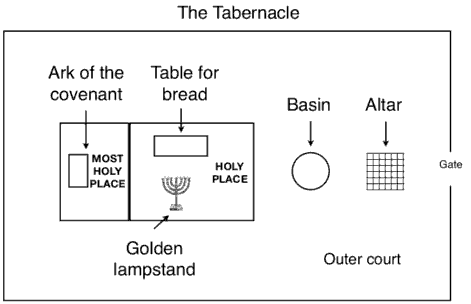
 Tabernacle - plan

God’s Tent

On the wall here is a sketch of the tabernacle together with the surrounding courtyard and equipment (it’s also on the back of your newsletters)

  • This is not to scale and it doesn’t convey anything of the beauty or fine art prescribed by God – but it does give us an overall picture

[Take my Russian dolls and set them out on a table]


I have here my Russian dolls to help us understand something of the layout of God’s tent

  • On other occasions I have used these Russian dolls as a metaphor for the different layers of our human self
  • Today though, I am not using these dolls to describe our personality, much less God’s personality
  • God is mystery and He can’t be reduced to a set of dolls
  • I’m simply using these Babushkas to help us understand the layout of God’s tent (His mobile home)

From verse 10 of chapter 25 God begins His instructions with a plan for making what we call the ‘Ark of the Covenant’ or the ‘Ark of the Testimony’

  • Interestingly God starts with the smallest doll
  • He begins with the core or the heart of His mobile home

At the very core of God’s tent – in the most holy place – we find His covenant with Israel

  • As we heard last week a covenant is more than just a contract
  • A covenant is a sacred agreement for attachment
  • At the very heart of God’s house is not a TV, but a reminder of His commitment to Israel’s well being
  • We might call this commitment – this covenant – loyal love

After giving the dimensions for this ark (or chest), God then says in verse 17 of Exodus 25…

  • “Make an atonement cover of pure gold…” to go over the top of the ark

Some versions of the Bible translate this verse ‘mercy seat’

  • Essentially the atonement cover or the mercy seat represents forgiveness
  • God provides a covering for Israel’s sin and that covering is forgiveness
  • Forgiveness is the second smallest doll in the tabernacle

God is so good – He does not require us to deny our imperfection

  • He provides for our imperfection and shows a willingness to re-enter the relationship with us when we fail

The most holy place is separated from the holy place by a veil or a curtain

In Luke 23, verse 45 we read that when Jesus died on the cross the curtain in the temple – the curtain into the most holy place – was torn in two

  • Jesus’ sacrifice on the cross reveals God’s forgiveness, His atonement for our sin

The next doll (or the holy place) is where we find the table with the bread of the presence and the lamp stand – bread & light

  • Perhaps bread is the strength to serve and light is the wisdom to see by
  • Strength and wisdom is found with God
  • What did Jesus say?
  • I am the light of the world. I am the bread of life

Moving out of the tent itself to the outer courtyard we find a basin for the priests to wash their hands and two altars

  • This diagram only shows one altar but Exodus describes two
  • One for burning incense, a symbol of the people’s prayers rising to heaven and the other for burning sacrifices

The main altar, for burning sacrifices, was basically like an incinerator

  • It wasn’t like a table with a top on it
  • It was open at the top with a grate part way down
  • This is where animals were offered to God

The message seems to be it is not a cheap or easy thing to come near to God

  • There is sacrifice and purity involved

The courtyard is fenced off with a curtain around the perimeter

  • There is only one entrance to the courtyard and that faces to the east – toward the sunrise
  • (What was it Jesus said? No one comes to the Father except by me. Jesus is the gate to God the Father.)
  • Verse 16 of Exodus 27 tells how there is to be a curtain made of fine linen embroidered with blue, purple and scarlet yarn, at the entrance to the courtyard

So the impression given to the people looking from the outside is one of beauty

  • The outer doll is attractive
  • Or to put it another way, God’s presence – His holiness – is beautiful
  • This stands in contrast to our society which generally tends to associate beauty with youth, novelty and permissiveness

In saying that the outer doll is attractive and beautiful and fascinating in its intricate design and detail I don’t mean that God is pimping His mobile home

  • God is not making His tent look flashy
  • If anything He is toning it down so as not to embarrass His neighbours
  • When you think about it the really precious stuff is hidden inside God’s tent where most people don’t get to see it

The metals used inside the tent are gold & silver – whereas the metal used outside is predominantly bronze

  • There may be practical reasons for this but I can’t help thinking of the poetry of it all – God is modest and often comes to us in ordinary ways
  • He doesn’t put the gold on the outside of His tent – He puts it on the inside
  • He doesn’t bring out the best wine first and then save the poorer quality wine for later – No, He saves the best till last
  • The longer we are in relationship with Him, the more we get to know Him and the deeper we go, the better it gets

When we put all that together, from the inside out we have…

  • Loyal (covenant) love at the very core of God’s tent, the smallest doll
  • Then forgiveness or mercy
  • Then light & bread or wisdom to see by and strength to serve
  • Then the outer court, a place of purity & sacrifice
  • And then the largest doll – the curtain at the entrance – humble beauty, the beauty of holiness

As I mentioned before, quite a bit of space is devoted to the Tabernacle in Exodus

  • We may wonder why there is so much detail
  • Well, later in Israel’s history Solomon would build a temple
  • In many ways the temple was modelled off the tabernacle, except the temple wasn’t portable like a tent
  • God moved into the temple but you get the sense He was uneasy with it
  • I think He preferred His mobile home

Some centuries after Solomon the temple in Jerusalem was destroyed and the survivors of Israel carried off to exile in Babylon

  • While in exile they didn’t have a temple
  • But they did have the elaborate description of the tabernacle which they could read about and picture in their mind’s eye
  • What a comfort it would have been to the exiles to be reminded that God is not fixed in one place – that God is able to move with them

Conclusion:

Ultimately though, the instructions for the tabernacle point to Christ

  • Jesus is the incarnation of God – He is Emmanuel – God with us
  • In the person of Jesus God didn’t just set up a tent among His people
  • God’s Word actually became a man and lived life as one of God’s people
  • Holiness rubbed shoulders with humanity

As we read at the beginning of John’s gospel…

  • The Word became flesh and made his dwelling among us. We have seen his glory, the glory of the One and Only, who came from the Father, full of grace and truth

Now God lives among His people by His Spirit

  • Today the Christian Church is the tabernacle of God
  • We, the Lord’s people, are God’s mobile home, made to mediate His presence in the world
  • This is a mystery too profound to explain – the best we can do is remain present to it (present to God’s presence, among us and through us)

Let us pray…

[1] Terence Frethiem, Exodus, page 277.

God’s Plan

Scripture: Exodus 19:1-6

Title: God’s Plan

Structure:

  • Introduction – God’s plan
  • What God has done for Israel – Grace
  • What God expects of Israel – Obedience
  • What Israel will be (if they obey) – Purpose
    • A treasured possession
    • A kingdom of priests
    • A holy nation
  • Conclusion

Introduction:

Today we continue our series in Exodus, focusing on chapter 19, verses 1-6

  • I will be reading from the New International Version this morning
  • So the words will appear on the wall shortly

At this point in the story the people of Israel have travelled to the foot of Mount Sinai – it has been 3 months since they left Egypt

  • The Israelites will camp at Sinai for 11 months while God gives them the Law
  • Today’s Scripture describes the first of Moses’ seven ascents up the mountain to meet with God
  • From Exodus 19, verse 1 we read…


On the first day of the third month after the Israelites left Egypt – on that very day – they came to the Desert of Sinai. After they set out from Rephidim, they entered the Desert of Sinai, and Israel camped there in the desert in front of the mountain.


Then Moses went up to God, and the Lord called to him from the mountain and said, ‘This is what you are to say to the descendants of Jacob and what you are to tell the people of Israel:


“You yourselves have seen what I did to Egypt, and how I carried you on eagles’ wings and brought you to myself. Now if you obey me fully and keep my covenant, then out of all nations you will be my treasured possession.


Although the whole earth is mine, you will be for me a kingdom of priests and a holy nation.” These are the words you are to speak to the Israelites.’


May the Spirit of Jesus illuminate this reading for us

In these verses Yahweh lays out his blue print for Israel

  • If you have a look on the back page of your newsletter you will see the basic outline of God’s plan for His people

Firstly, God recaps what He has done for Israel in delivering them from slavery in Egypt – step one is salvation by grace

Then God makes it clear (in general terms) what He expects of Israel and so step two is obedience

  • Obedience is the appropriate response to grace

And thirdly God explains what Israel will be (if they obey)

  • Step three, therefore, is about purpose
  • God’s purpose is for Israel to be…
  • A treasured possession
  • A kingdom of priests
  • And a holy nation

So that’s the basic outline of God’s plan for Israel

  • Let’s unpack each step of the plan a little now…
  • Firstly, God’s grace in delivering Israel from slavery in Egypt

eagle

What God has done for Israel – Grace

Tell me, when you see this eagle, what is it that comes to mind?

[Wait for people to respond]


Thanks for those thoughts

  • When I see a picture of an eagle in flight I mostly think, freedom
  • But I also think skill and good vision – eagle eyed

One fact I wasn’t aware of before preparing this sermon is that the mother & father eagle are known for their devotion to their young

  • More than most other birds they take great care over their eaglets
  • Another thing I learned is that young eagles need to be taught to fly
  • It doesn’t come instinctively to them
  • In fact, without an adult eagle to mentor them, young eagles won’t learn to fly – they learn by watching their parents and imitating what they do


In verse 4 the Lord says to Moses…

  • “You yourselves have seen what I did to Egypt, and how I carried you on eagles’ wings and brought you to myself.”

In this verse God is recapping what He has done for Israel in rescuing them from slavery in Egypt – this is stage one of God’s plan in retrospect

  • Israel have been carried by God out of harm’s way
  • They did not need to fight for their release – God fought for them
  • All they had to do was hold on and enjoy the ride
  • Israel did not do anything to earn this special treatment by God
  • It was done at God’s initiative and by His grace – freely

God hasn’t just carried the people out of Egypt, He has brought them to Himself

  • This speaks of a personal relationship and of being at home with the Lord
  • It also indicates that God’s presence is revealed in a special way here at Sinai, where the people are now camped

It’s interesting that God associates Himself with an eagle – a powerful & skilful bird that is known for its freedom – this fits because God is free

  • If we are to imply from the metaphor that Israel is like a young eagle learning to fly then we have a very powerful image
  • The Israelites, who had been slaves, were being told by God that they should think of themselves as free, like an eagle
  • But while they were free in principle, they still needed to learn how to fly
  • That is, Israel needed to learn how to use their freedom well, without falling, and God intended to teach them

The giving of the Law at Sinai needs to be understood in the light of the eagle metaphor

  • God didn’t give the Israelites a whole lot of rules to make their lives more difficult – he gave them the Law so they could learn how to fly safely
  • So they could get the most of life and enjoy their new found freedom

Okay – so that’s stage one of God’s plan – it starts with grace

  • The next stage covers Israel’s response to that grace
  • God makes it clear his expectation of the people is obedience

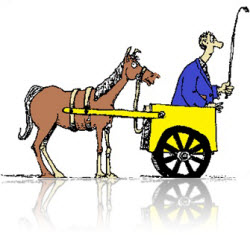
 cart before the horse

What God expects of Israel – Obedience

Who can tell me what’s wrong with this picture?

  • [Wait for people to respond]

Yes, that’s right – the driver has got the cart before the horse

The expression ‘cart before the horse’ is English idiom for getting things in the wrong order – the wrong way around

Obviously things work better when the horse pulls the cart

  • It doesn’t work so well when the cart is in the way of the horse

When it comes to Jewish faith (and Christian faith for that matter), the horse is God’s grace and the cart is our obedience

  • The horse of grace pulls the cart of obedience
  • Grace is the engine – it is the power for us to obey

Judaism and Christianity are concerned with keeping God’s grace in front and allowing the awareness of God’s grace to draw us into obedience

  • So we don’t do things for God in order to get Him to do things for us
  • That would be paganism
  • God does good things for us up front and then as a grateful and willing response we do what God asks

So when the apostle Paul (in the New Testament) said we are not saved by works but by grace through faith – what he meant was, ‘Don’t get the cart before the horse’

  • God’s grace comes first and gives us the willingness to obey

It’s interesting isn’t it that the book of Exodus gives us 19 chapters of God’s grace before it introduces the Law with the 10 commandments

  • Grace precedes law, like a horse precedes a cart

The wonderful thing about the horse of God’s grace is that it leads us in the way we should go and at the right pace

  • It is an intelligent horse – we don’t need to drive it – it will draw us along

Okay then – stage 1 of God’s plan is grace

  • Stage 2 is obedience
  • And stage 3 is purpose

What Israel will be (if they obey) – Purpose

From verse 5 of Exodus 19, God instructs Moses to say to the people…

  • Now if you obey me fully and keep my covenant, then out of all nations you will be…
    • my treasured possession
    • a kingdom of priests
    • a holy nation

Clearly this is a conditional statement

  • If you obey me this is what you will be
  • Some things with God are unconditional – like His deliverance of the people from slavery in Egypt
  • It was all grace – a free gift, or more accurately a free ride

Other things with God are conditional – like whether or not we will fulfil the purpose He has for us

  • Fulfilling God’s purpose for us is not automatic – it depends (to some degree at least) on the choices we make

The horse of God’s grace will take us to the destination God has planned for us – but only if we attach our cart to the horse and stay on the cart

  • If we fall off the wagon (so to speak) then we can’t expect to arrive at the destination

A couple of weeks ago Robyn was offered some free tickets to the WOW festival (WOW stands for World of WearableArt)

  • Some people pulled out at the last minute and we had the option to use their tickets that night
  • Now I wouldn’t ordinarily go to something like this, but it was free, so I made the choice to accept the offer and we had a great time
  • What an amazing display of creativity
  • WOW is certainly the right word for it

The point is, although the tickets were free to us – a gift – our attendance at the event was not automatic

  • Fulfilling the purpose of the tickets was conditional on me changing my plans for the evening, driving into the city and collecting the tickets

It was like this with Israel

  • God was giving them a free ticket for a wonderful purpose – being His priests to the world
  • But whether Israel would actually fulfil God’s purpose for them was conditional on their obedience
  • They had to put aside their plans in order to go with God’s plan

As we’ve already noted verses 5 & 6 give three descriptions of God’s purpose for Israel – they are to be…

  • A treasured possession
  • A kingdom of priests
  • And a holy nation

These aren’t three separate things

  • They are three different but related ways of describing the same thing – Israel’s special relationship to Yahweh for the world
  • Israel don’t exist for themselves – they live for God’s purpose in the world

Each of the three descriptors highlights a unique perspective on God’s purpose for Israel

  • What then does it mean to be a ‘treasured possession’?

Imagine for a moment that your house is on fire

  • No one else is inside – only you
  • As it happens you have just enough time to rescue one item from the flames – your most treasured possession – What would you take?

Maybe the family photographs or your grandfather’s war medals or your mother’s wedding ring?

You probably wouldn’t take the TV or the microwave – those things can be replaced with insurance

  • You would be more inclined to take those things which have a special significance because of their association with people you love – right?
  • Things that can’t be replaced

In verse 5 we read that if Israel obeys Yahweh fully they will be His treasured possession – like the special photo you keep in your wallet or the heirloom wedding ring or the watch your grandfather gave you – something priceless

Now it is important to understand that God chose Israel as His people before they obeyed – their photo is already in His wallet

  • But whether their photo will be a painful reminder to God or a joyful one is conditional – it depends on Israel’s obedience


The second (and central) descriptor of God’s purpose for Israel is they are to be

  • A kingdom of priests

Most kingdoms are about ruling – being the boss in charge of other nations

  • But Israel is to be a kingdom of priests
  • A priest’s job isn’t to exert power and rule over people
  • A priest’s job is to serve people
  • So Israel is to be a servant nation, not a ruling nation [1]
  • God’s purpose for Israel is not total world domination
  • Rather God wants Israel to bless the other nations of the world
  • To this end priests act as mediators – representing other people to God


On the wall here is the picture of a linesman, working on overhead wires

  • Priests are a little like linesmen in that they work to restore the connection between God and people when the lines are down
  • In other words, priests pray (or intercede) for other people – especially those who are not able to pray for themselves

The whole world is God’s temple and Israel are to function as God’s priests in the world

  • They are to be a kingdom of priests both by representing others to God and by representing God to the world
  • Priests are God’s rep team
  • They make Yahweh known to others & they teach God’s ways to people
  • In particular Israel are to represent God by being a holy nation
  • You can’t expect to complete a marathon if you don’t do the training
  • You can’t expect to represent God as a priest if you live a life of drunkenness & debauchery


To be holy basically means to be different in a good way

  • If Israel obeyed the Lord then they would be distinctive from the nations around them
  • People would look at them and think: ‘Wow, they are on to it – we want what they’ve got.’

When Jesus talked about holiness in Matthew 5, he said to His disciples…

14 ‘You are the light of the world. A town built on a hill cannot be hidden. 15 Neither do people light a lamp and put it under a bowl. Instead they put it on its stand, and it gives light to everyone in the house. 16 In the same way, let your light shine before others, that they may see your good deeds and glorify your Father in heaven.

To be a holy nation therefore is to be distinctive – a light in the darkness

  • When all the other nations around them are worshipping many gods, Israel is to worship just one God, Yahweh
  • And when all the other nations around them are stealing and lying and committing adultery and wishing they could get their hands on their neighbour’s stuff, Israel are to look out for their neighbour’s well being

There is a cost to being holy – or different in a good way – and that is people don’t always like you or accept you

  • But Israel are to fear the Lord, not the nations
  • They are to care more for what God thinks than for what other people think


Conclusion:

This morning we’ve heard God’s plan for Israel in three basic steps:

  • Grace, obedience and purpose
  • God has rescued Israel from slavery in Egypt by His grace
  • And in response to that grace God is calling for their obedience
  • If they obey the Lord then Israel will serve a special purpose as God’s priests to the other nations of the world

This blueprint for Israel applies to Christians as well

  • While we were still sinners Christ died for us – the righteous for the unrighteous
  • Jesus is our rescue from slavery to sin & death – He is God’s grace for us up front before we’ve done anything to deserve it
  • In response to that grace we follow Jesus, in obedience to God
  • And if we obey the Lord in this way then we will be…
    • A treasured possession to God
    • A kingdom of priests

  • And a holy people
  •  

    The apostle Peter picks up God’s blue print in his letter to the churches, where he writes…


    But you are a chosen people, a royal priesthood, a holy nation, God’s special possession, that you may declare the praises of him who called you out of darkness into his wonderful light. 10 Once you were not a people, but now you are the people of God; once you had not received mercy, but now you have received mercy.


    11 Dear friends, I urge you, as foreigners and exiles, to abstain from sinful desires, which wage war against your soul. 12 Live such good lives among the pagans that, though they accuse you of doing wrong, they may see your good deeds and glorify God on the day he visits us.  

    Grace, obedience and purpose

    Let’s pray…

    [1] Durham 263, cited in Fretheim, Exodus, page 212.

    Moses Delegates

    Scripture: Exodus 18:13-27

    Title: Moses Delegates

    Structure:

    • Introduction
    • Moses’ blind spot
    • Jethro’s vision
    • Conclusion

    Introduction:

    There are many things you can do with your time – most of which can be done by someone else

    • So you have ask yourself, ‘What are the things only I can do?’
    • They are probably the things you need to give priority to


    There were many things Michelangelo could have done with his time

    • He could have been a blacksmith or a monk;
    • He could have studied the law or milked cows – but he didn’t
    • Instead he gave himself to what only he could do
    • Four years it took him to paint the ceiling of the Sistine chapel
    • Three years to sculpt the statue of David

    Please turn with me to Exodus chapter 18 – page 79 in your pew Bibles

    • Today we continue our series on Moses through Exodus
    • In chapter 18 Moses’ father-in-law, Jethro, comes to visit and finds that his son-in-law is doing many things – most of which could be done by someone else
    • From Exodus 18, verse 13 we read…

    [Read Exodus 18:13-27]

    May the Spirit of Jesus illuminate this reading for us

    In this Scripture we get a rare glimpse of Moses’ blind spot and Jethro’s vision

    Moses’ blind spot:

    Blind Spot

    On the wall here is a diagram showing the blind spots for a driver on the road

    • The red area, either side of the vehicle, reveals those zones the driver can’t see in his rear vision mirror
    • So to be able to change lanes safely the driver needs to look over their shoulder and check their blind spot


    Blind spots aren’t just something drivers have on the road – we all have them

    • A blind spot is essentially something about ourselves we are not aware of
    • Some personality trait we don’t realise we possess
    • Or some behaviour we do unconsciously
    • Other people can see it clearly enough, but we can’t

    It’s interesting isn’t it – that (without a mirror) we can’t see our own faces

    • Have you ever been in a conversation with someone and they’ve got something stuck in their teeth and you’re not sure whether to say anything
    • Or maybe they start wiping their nose and that makes you think, ‘Are they trying to subtly tell me I’ve got a bogey hanging out?’
    • So you wipe your nose too, which makes them wipe their nose again and so on, until it gets really awkward
    • Has that ever happened to you? (No – it’s just me then)

    Blind spots – things other people can see but you can’t

    True story – many years ago when our children were young and I wasn’t getting much sleep, Robyn and I went for a walk on the beach (we were on holiday)

    • I remember pushing the pram along the firm sand for probably the better part of an hour when Robyn pointed out to me that I had some toilet paper hanging out the back of pants (like a tail)
    • I had no idea – I couldn’t see because it was in my blind spot
    • Robyn had no sympathy – she cracked up laughing (if you’ll excuse the pun) and couldn’t look at me without giggling for the rest of the day

    When we are young we tend to have a lot of blind spots – we don’t know ourselves all that well

    • But hopefully as we get older and more experienced we learn to look into our blind spots and become more self-aware

    Carl Jung describes psychological blind spots as our shadow side – He writes…

    “Wholeness for humans depends on the ability to own their own shadow”

    In other words, unless we are prepared to face and accept those parts of ourselves which we are not aware of, and which we perhaps don’t like all that much, we’ll never be whole

    Moses was a remarkable leader – a man of incredible character – but even he had his blind spots, his shadow

    • Fortunately he had the humility not to deny his shadow side but to face it

    What Moses wasn’t aware of, but what Jethro (and everyone else) could plainly see, was that Moses was doing too much himself

    • Because of his relationship with Yahweh Moses had become the ‘go to’ guy for settling disputes
    • If you want peace you must have justice
    • But in order to have justice you must have wisdom
    • Where does wisdom come from? – It comes from God
    • Moses hears from God better than anyone else – so we’ll go to him

    Consequently, what we have in Exodus 18 is a bottleneck

    • Thousands of cases (many trivial, some serious) coming to one person for a resolution
    • It was a recipe for burnout & frustration
    • Burn out for Moses and frustration for the people, who had to stand in the hot sun all day waiting for a hearing with Moses
    • Justice delayed is not justice

    Jethro could see the problem and the solution – but Moses couldn’t

    This is kind of ironic when you think about it

    • Here we have Moses making enquiries of God to help other people fix their problems, all the time quite blind to his own problem
    • We can understand this though…
    • You can see a car in your rear vision mirror in the distance
    • But when it’s up close beside you, then you can’t see it
    • Moses couldn’t see because he was too close – too involved

    The other contributor to Moses’ blind spot was that he was doing good things

    • And when we do good things we are less inclined to question our method
    • Doing the right thing doesn’t guarantee we are doing it in the right way
    • Moses was doing the right thing – in the wrong way
    • He couldn’t see the toll his work was taking on him
    • Sometimes our focus on the task at hand conceals from us the expenditure on our reserves and it’s not until we stop and have a day off that we realise just how exhausted we are

    Quite apart from the drain on Moses’ personal resources, being sucked into the details and doing things other people could do, prevented Moses from seeing the bigger picture

    There are times when leaders need to take a step back and look at the situation from the balcony, rather than the floor

    • Of course, we don’t know what we don’t know
    • If we don’t know we have a problem then we don’t know to stand back and get some perspective – nor do we know to ask for help
    • This is where God’s grace comes in


    In his letter to the Romans the apostle Paul writes…


    …the Spirit helps us in our weakness. We do not know what we ought to pray for, but the Spirit Himself intercedes for us with groans that words cannot express. And He who searches our hearts knows the mind of the Spirit, because the Spirit intercedes for the saints in accordance with God’s will. [1]

    There have been times in my life when all I had was an ache in my heart, which I couldn’t put into words, but which the Holy Spirit felt and understood

    • Then, when I wasn’t expecting it, God did something which answered the ache in my heart and it was better than anything I might have asked for, had I been able to find the language
    • There’s no way I can explain the mystery of this
    • Either you understand it from your own experience or you don’t

    Moses didn’t know what to pray for – but God, who searches the human heart, knew the strain Moses was under

    • God also felt the frustration of the people as they waited for justice
    • And so the Lord, in His wonderful grace, sent Jethro to give Moses the perspective he needed

    Once Jethro had pointed out the issue, in Moses’ blind spot, Moses was able to see clearly what he needed to do

    • Seeing into his blind spot and accepting the truth it contained actually set Moses free from a whole lot of work he didn’t need to do
    • It also set the people free from waiting around all day

    We, in the west, tend to think of freedom as licence to do what whatever we want

    • But this is not freedom as the Bible understands it
    • Biblical freedom comes with spiritual sight – or with knowing the truth
    • As Jesus said, ‘…it is the truth that sets you free’ [2]

    It is looking in your blind spot to assess the reality of the situation, before changing lanes, that sets you free from a crash on the motorway

    • It is checking yourself in the mirror before going out in public that sets you free from the embarrassment of stray bogeys and toilet paper tails
    • It is the humility of listening to the truthful observations of wise Jethro’s which sets us free from self-destructive patterns of behaviour

    Face your shadow side – look for the truth it contains – there is freedom in it

    One of the things that is interesting in this little story from Exodus 18 is that the truth which sets Moses free doesn’t come from within the Israelite community

    • The truth comes from the outside – from Jethro, a Midianite

    In contrast to Moses’ blind spot we have Jethro’s vision

    Jethro’s vision:

    There are two aspects to Jethro’s vision in Exodus 18

    • Jethro has the insight to see the root of the problem
    • And he has the foresight to imagine a different future

    Moses is carrying the weight of the world (or at least the weight of Israel) on his shoulders and so Jethro asks the question…

    • “Why are you doing this all alone?” (verse 14)

    Why indeed?

    • This question is insightful – it cuts to the core of the issue, which is Moses’ isolation – his sense of alienation from his own people
    • Moses is alone in the crowd and it is the pattern of his life

    He grew up in a palace while his fellow Israelites lived in a slum

    • When he tried to reconnect with his people and help them he was rejected and ended up spending 40 years in exile
    • Then, as if he doesn’t feel different enough, God calls him to a special task – something no one else has ever done before
    • Moses reluctantly obeys and for all his pains and troubles the people complain against him and accuse him of meaning them harm, even though he has only ever done them good
    • It is little wonder that Moses doesn’t think to ask for help

    Leadership is a paradox

    • On the one hand, a leader needs to learn the strength to stand alone
    • And unfortunately you can’t learn that without the experience of being alone & misunderstood
    • At the same time though, a leader also needs to learn to trust other people
    • It seems to me Moses knew how to stand alone – he had that in spades – but he was still learning to trust

    Of course, it’s one thing to point out the problem, but unless you can offer a better alternative then it’s usually best to keep your opinions to yourself

    Not only did Jethro uncover the core of the problem – Moses’ loneliness

    • He also gave Moses the vision to imagine a better future
    • He gave Moses a plan and a strategy that was sustainable
    • In a word, that strategy was, delegation. Jethro says…

    Choose some capable men and appoint them as leaders of the people: leaders of thousands, hundreds, fifties and tens. They must be God fearing men who can be trusted and who cannot be bribed. Let them serve as judges for the people on a permanent basis. They can bring all their difficult cases to you, but they themselves can decide all the smaller disputes. That will make it easier for you as they share your burden.


    The first thing we observe about Jethro’s vision here is that delegation is not abdication

    • Moses isn’t to appoint just any body
    • The men he appoints must be capable, God fearing and trustworthy

    To be God fearing means to be more concerned with what God thinks than with what other people think

    • A God fearing person is not a ‘yes’ person
    • A God fearing person is able to say ‘no’ when it matters
    • They are guided by their conscience more than the praise or blame of others

    To be trustworthy in this context means having integrity – not open to bribery

    • The judge must love truth & justice more than money or comfort
    • Being ‘trustworthy’ implies it is a relationship of trust
    • Trust is a sacred thing and should not be abused or misplaced

    The point is, Moses shouldn’t just throw his authority away – he should carefully place it in men who have the competence & character to handle it

    We also note that Moses is not to delegate all his authority

    • Delegation doesn’t really work when the leader in charge expects everyone else to get stuck in without doing anything themselves
    • The delegates need to know the buck stops with Moses and that Moses will be there to take care of the really difficult cases
    • If Moses abdicated all responsibility and sat back saying – ‘It’s all on you boys’ – then he would lose the respect of his men pretty quickly

    Jethro’s plan – his vision of delegation – comes with a number of advantages


    The first and most obvious advantage is that many hands make light work

    At the end of verse 22 Jethro comments to Moses that his plan…

    • …will make it easier for you as they share your burden.
    • The burden is shared in that Moses has less disputes to sort out
    • And it’s also shared in the sense that Moses is less alone
    • Sharing responsibility actually engenders more understanding for the leader

    You often find those who are most critical of leaders have never actually been in leadership themselves

    • They are arm chair critics who have never really felt the burden or the isolation of leadership and so they have no empathy
    • But when you have had to carry some responsibility and felt the loneliness of a difficult decision then you have a bit more understanding for your boss

    By delegating, Moses was drawing the best out of others

    • Jesus said, “You are the salt of the earth”
    • One of the things salt does is bring the best out of food
    • Trusting others to do something meaningful (as Moses did) generally brings the best out of them

    Conclusion:

    There are many things you can do with your time – most of which can be done by someone else

    • So you have ask yourself, ‘What are the things only I can do?’
    • They are probably the things you need to give priority to

    No one could have helped Moses to see his blind spot quite like Jethro did

    • The same good advice from one of Moses’ juniors would have been a lot more difficult for Moses to accept
    • But Jethro was a leader in his own right (a priest of Midian) and so he understood Moses’ position
    • He had done his time and earned the right to speak into Moses’ life
    • Fortunately for Moses (and for Israel) Jethro used his vision to help Moses find a sustainable way forward
    • Imagine if Jethro had held his tongue
    • Moses and Israel would have suffered for it


    No one could hear from God quite like Moses could – he seemed to have a direct line of communication with the Lord

    • Fortunately for Israel (and for us) Moses gave himself to listening to God’s word and communicating this to the people
    • But that didn’t mean he had to settle every dispute
    • There were others capable of handling the smaller more routine matters
    • Imagine if Moses hadn’t taken Jethro’s advice
    • What a waste that would have been

    No one could save the world like Jesus did

    • Fortunately for us Jesus gave Himself on the cross for our salvation
    • Imagine if he had remained in Nazareth working as a carpenter his whole life
    • There would be some nice houses there I guess, but we would be without hope

    Now at this point you might be thinking that’s all well & good but what can I do that no one else can?

    • I’m not Michelangelo, I’m not Moses, I’m not Jethro and I’m certainly not Jesus
    • Well, each of us is unique and none of us are fully aware of how God will use us
    • Quite often our potential is hidden in our blind spot
    • God sees though and He will use us for His good purpose – even if we aren’t aware

    [1] Romans 8:26-27

    [2] John 8:32

    Resilient Faith

    Scripture: Exodus 16:1-21

    Title: Resilient Faith

    Structure:

    • Introduction
    • What is resilience?
    • Developing resilience
      • Presence (not absence)
      • Nourishment (not neglect)
      • Discipline (not excess)
    • Conclusion

    Introduction:

    Resilience - Elephant

    Resilience is the capacity to withstand stress & catastrophe [1]

    • This Volts Wagon is certainly showing some resilience

    Please turn with me to Exodus chapter 16 – page 76 in your pew Bibles

    • Today we continue our series in Exodus
    • The people have been camped at Elim – an oasis in the wilderness
    • Now they set out toward Sinai and on the way their resilience is tested and found wanting. From Exodus 16, verse 1, we read…

    Read Exodus 16:1-21


    May the Spirit of Jesus illuminate this reading for us


    What is resilience?

    A diamond is just a piece of charcoal that handled stress exceptionally well

    • Diamonds are of course one of the most resilient objects known to man
    • They are formed when carbon is put under extreme heat and pressure

    Resilience is not something you’re born with

    • Resilience develops as we grow up – although it doesn’t develop automatically

    Some factors that contribute to resilience are:

    • A good support network – including family & friends
    • A positive (and accurate) view of yourself
    • Good problem-solving and communication skills
    • The ability to ask for help and resources
    • Healthy coping strategies – including the ability to celebrate & enjoy life
    • An outward focus – by which I mean a mind-set which considers the needs and well-being of others
    • And most importantly, in my view, faith in a loving God

    All these things give us the basic materials for resilience – but we don’t really know how resilient we are until we face some kind of crisis

    • Pressure and stress reveal the diamond in our charcoal

    People who are resilient have the ability to pick themselves up and carry on

    • They don’t see themselves as victims – they see themselves as survivors
    • Those with resilience are able to find positive meaning in the difficult circumstances of their lives
    • And they have the strength to manage strong feelings and impulses

    Moses provides a good example of someone with resilience

    • The people of Israel? – Not so much

    In Exodus 16 the people have left the oasis at Elim and followed Moses into the desert of Sin

    • It has been somewhere between 4 and 6 weeks since the Israelites left Egypt (depending on how you interpret verse 1)
    • For not the first time the people complain to Moses & Aaron, saying…
    • “We wish the Lord had killed us in Egypt. There we could at least sit down and eat meat and as much other food as we wanted. But you have brought us out into this desert to starve us all to death”

    Wow – that’s messed up

    • The people who said that didn’t have their heads screwed on right
    • It hasn’t been two months yet and already they seem to have forgotten what God has done for them

    The good old days are never as good as people remember them

    • In actual fact the Israelites were slaves in Egypt – they were badly mistreated – they didn’t always have meat or enough to eat
    • Pharaoh was trying to kill them
    • But God delivered them from their suffering in a miraculous way

    The people weren’t starving yet – they were just worried that they might run out of food – what happens then?

    • They were getting ahead of themselves and thinking the worst

    One of the things you notice when you watch interviews with the All Blacks for this world cup is that they are very careful not to get ahead of themselves

    • The tournament is just getting underway
    • They’re not thinking about the final
    • They’re thinking about what’s happening now
    • They’re thinking about the practice that morning
    • Or the pool game that afternoon
    • One day at a time sweet Jesus, one day at a time

    Not getting ahead of yourself – not thinking the worst – takes mental discipline

    • Sadly it was a discipline the Israelites hadn’t learned at that point
    • They accuse Moses of wanting to starve them which just shows how fearful they were – and how little control they had over their thoughts
    • They weren’t calm on the inside – their minds were racing
    • The food crisis has led to a faith crisis [2]

    Moses shows resilience in the face of this accusation

    • Like the Volts Wagon under the elephant he doesn’t crumple
    • He isn’t defeated by the weight of the people’s criticism
    • Nor does he spit the dummy and walk off
    • Moses waits for God

    So where does Moses’ resilience come from?

    • Well, I think there are a number of pillars to his resilience

    If we look at Moses’ upbringing we note that he had a loving and supportive family network

    • His sister Miriam watched over him as a baby when he was put in a basket and floated down the Nile
    • His biological mother spent lots of face to face time with him as an infant, so he learned basic trust from that consistent attachment
    • His adopted mother was a princess in Egypt and so Moses never wanted for anything growing up
    • His basic assumption as a child was one of abundance not scarcity

    But Moses didn’t live his whole life in an ivory tower

    • After 40 years living in the wilderness as a shepherd he was well acquainted with the realities of survival
    • His adult life experience had taught him resilience in harsh environments

    Aaron was another string to Moses’ bow of resilience – although it was only a matter of time before Aaron became a thorn in Moses’ side

    The main stay of Moses’ resilience is his relationship with Yahweh

    • Moses is not acting or speaking on his own
    • He is following God’s instructions and so he is able to say…
    • ‘When you complain against us you are really complaining against the Lord’, verse 8
    • When we know we are in God’s will for us, when we know we are doing what God wants us to do, nothing can shake us
    •  “If God is for us, who can be against us?” [3]
    • The Lord is Moses’ support network, his resilience, his strength

    To be fair the people of Israel did not enjoy the same advantages that Moses did

    • They didn’t have the raw materials needed for resilience
    • They didn’t have a princess looking after them
    • They had the sting of the slave driver’s whip instead
    • They didn’t know abundance – they only knew hard work & poverty
    • Years of brutal oppression & slavery had all but wiped out their resilience

    Suffering and stress may reveal resilience – like sandpaper reveals the wood grain under paint

    • But when suffering and stress is all you’ve known then pain and fear is all you’ve got
    • If you keep sanding the wood too long it will wear thin and break
    • Suffering by itself doesn’t make you stronger – it makes you less resilient
    • Faith – learning to trust – that is what makes a person stronger

    Developing resilience:

    It seems to me that God wanted to develop a resilient faith among His people

    • The sort of faith that wouldn’t fall to pieces every time they found themselves in a stressful situation

    And to develop this resilience the Lord gave the people three things…

    • His presence, nourishment and discipline
    • These three things are (coincidentally) what a parent needs to give their child for resilience

    Presence – not absence

    C.S. Lewis once wrote…

    “We may ignore, but we can nowhere evade the presence of God. The world is crowded with Him. He walks everywhere incognito. And the incognito is not always easy to penetrate. The real labour is to remember to attend. In fact to come awake. Still more to remain awake.”


    This has been my experience

    • God is not absent or aloof – He is everywhere, but He’s in disguise

    Personally I see God most clearly in my circumstances

    • I tend to be more aware of Him out there (in the world) than I am of Him in here (in church)
    • I love it when God puts me in just the right place, at just the right time, with just the right resources to help just the right person
    • That’s when I’m most aware of God’s presence

    I remember on our honeymoon, Robyn and I were near Russell, in the Bay of Islands

    • We were driving along in our burnt orange Mark 2 Ford Escort, coming over the hill from Tapeka Point, and this lady waved us down
    • So I pulled over to the side of the road and she quickly opened the door and jumped in the back
    • She was scared out of her wits because a dog had been chasing her
    • We gave her a lift down the hill into Russell township – she got out and we never saw her again

    It was a small thing for us to do – no inconvenience really – but I saw God in that situation

    • He put us in the right place, at the right time, with the right resources to help a stranger in need
    • If we had come over the hill one minute earlier we would probably have missed her
    • And if we had come one minute later, who knows – maybe she would have been bitten or worse
    • It was a God moment

    In Exodus 16, verse 10, we read how God makes is presence visible to the people of Israel in the form of a dazzling light inside a cloud

    • The people were scared and insecure – they needed to see God’s presence in a tangible way
    • Nothing is more convincing than presence

    If you want to develop or maintain a resilient faith, then stay alert to the signs of God’s presence, whatever form He may meet you in, whether that’s through:

    • Reading the Bible
    • Or singing worship songs
    • Or helping people
    • Or experiencing dreams and visions
    • Or whatever – just look for His presence

    Nourishment – not neglect

    The second thing God does in Exodus 16, to help the people develop resilient faith, is He feeds them

    • God provides nourishment (He does not neglect His people)

    The nourishment comes in the form of meat and bread – protein and carbs

    • God sends quail in the evening and manna in the morning

    Quail are known to migrate across the Sinai Peninsula at certain times of the year

    • They stop to rest on the ground in the evening and would be easy for the people to catch
    • Although quail are naturally occurring, their provision in this situation, is extraordinary – God must be behind it
    • Because the quail arrive every night for 40 years and they never run out
    • In the ordinary course of events you wouldn’t expect that sort of frequency or quantity

    The manna which appeared in the morning could also be a naturally occurring food source

    • There is an insect in that part of the world which feeds off the tamarisk tree and it secretes a white yellowy substance which is sweet to eat
    • It is rich in carbohydrates & sugar and it’s still gathered by people living in that area today
    • At night, when it’s cold, the substance congeals, but then, when the sun comes out, it melts in the heat of the day
    • It is a food which normally decays quickly and it attracts ants

    Whatever you want to call this stuff it fits the description of manna in Exodus

    The provision of manna, in this situation, is extraordinary – God must be behind it

    • Because the manna is there every morning for 40 years, enough to feed well over 1 million people each day
    • And on Friday’s it lasts for two days without going bad
    • In the normal course of events you wouldn’t expect that kind of frequency or quantity – nor would you expect that kind of shelf life

    The way God consistently provides quail & manna shows the people He can be relied on – they can trust Him

    • Even when the people complain or disobey, God still keeps feeding them

    Feeding children is one of the core responsibilities of parents

    • That routine of providing regular meals is actually one of the things that contributes to a child’s resilience
    • It helps them to feel safe and secure so they learn to trust and not worry about where their next meal is coming from

    God provides the ingredients for a resilient faith by the gift of His presence and by feeding His people regularly

    • He also develops resilience through discipline

    Discipline – not excess

    Discipline is a misunderstood word these days

    • We often associate discipline with punishment – six of the best or time out or being grounded or some other negative consequence

    But discipline isn’t really about punishment – discipline is about learning

    • To discipline someone is to teach them

    So for example, teaching your child how to use a knife and fork so they can eat their dinner independently – that is discipline

    • Or teaching them how to bake a cake or sew on a button – these are also examples of disciplining your children

    God’s gift of manna & quail comes with certain instructions

    • These instructions are designed to help the people get the most out of God’s gifts and to teach the people faith or trust in God

    So when God says, ‘only gather as much as you need and don’t try and hoard it’, this is teaching the people both to practice self-restraint and to trust the Lord to provide some more tomorrow

    • Give us this day our daily bread

    And when the Lord says, ‘gather a double portion on Friday and don’t gather any on Saturday’, this is teaching the people to rest

    • It is showing them their life does not depend on work and endless activity – it depends on God
    • Learning to rest, to celebrate, to enjoy life, to find a healthy distraction from work, this is a significant contributor to resilience also

    Another thing you notice if you watch interviews with the All Blacks, leading up to this world cup, is the way they are keeping the conversation light

    • They’re not intensely focused on rugby all the time and I think this helps to preserve their resilience
    • I saw an interview in which Luke Romano was talking about how he and Sam Whitelock had been feeding the hotel nuts to a squirrel
    • It’s a healthy distraction – something else to think about – it helps them stay relaxed so they are better able to handle the pressure when it comes

    God loves the people of Israel enough to discipline them

    • He doesn’t spoil the Israelites with excess
    • He teaches them resilience by giving them boundaries

    We human beings need certain boundaries (especially when we are young)

    • The discipline or the teaching of what is good for us, and what is harmful, actually gives us a sense of security and strength in adulthood

    Boxing - footpath

    Discipline (teaching right from wrong) is like setting up the boxing when you are pouring concrete

    • If you want the concrete to hold its shape you need to make sure the boxing is in place beforehand
    • Without the boxing the wet concrete runs everywhere
    • But with the firm boundary provided by the boxing the concrete stays in place and then once it is set you can take the boxing away
    • Once the child has learned you don’t have to stay on their back all the time

    Bicycle-Training-Wheels

    Or to use another metaphor, teaching resilient faith is like teaching someone to ride a bike

    • When we start out in the faith God may give us training wheels
    • By training wheels I mean special supports like miracles perhaps, or a warm glow, or enthusiasm for reading the Bible or something else that makes believing in Him a bit easier
    • These training wheels give us the feel of faith and help us to build up some confidence

    But ultimately God wants to teach us to ride without the training wheels

    • Because the picture of an adult riding with kiddy wheels is disturbing


    And so, as we progress in the Christian faith, God may take away the supports

    • We might not experience miracles anymore or we may go through a real dry time in our devotional life or we may struggle with doubt
    • When God removes the training wheels it might feel like He has abandoned us – but actually He hasn’t – He’s still right there beside us
    • It’s just that we are having to learn to ride a two wheeler now
    • It feels a bit wobbly to begin with and we may fall over & skin our knees
    • But if we pick ourselves up again and carry on we eventually get the hang of it – we learn resilient faith

    Conclusion:

    I’m conscious that we are not all the same when it comes to resilience

    • Some people have been given all they need for resilience
    • They have grown up in a functional family and are surrounded by people who love and support them
    • They are able to take time off to enjoy life and have really good communication skills and so on

    Then there are others who have suffered loss repeatedly and actually feel quite fragile most of the time

    • Or those who didn’t have a happy childhood
    • Those whose experience was one of neglect or excess or even abuse
    • And others who are having to work three jobs just to make ends meet, so they don’t have time to rest and enjoy life
    • Resilience in these cases seems like an unattainable goal
    • Let me say to you, Jesus understands – He is all compassion
    • “A bruised reed he will not break and a smouldering wick he will not snuff out.”

    Whatever your situation – Jesus is our security

    • His resurrection from the dead is our hope of eternal resilience.
    • Whether we feel bullet proof or paper thin – strong or weak…
    • We need to keep looking to Christ for His presence, His nourishment and His discipline
    • And we shouldn’t be afraid or surprised when the training wheels come off – it’s really a compliment when God does that – a sign of His love and trust in us

    [1] http://www.pbs.org/thisemotionallife/topic/resilience/what-resilience

    [2] Terence Fretheim, Exodus, page 181.

    [3] Romans 8:31

    Sharing Christ

    Scripture: John 7:37-39

    Title: Sharing Christ

    Structure:

    • Introduction
    • Open wells
    • We are the cup
    • Grace & truth
    • Conclusion

    Introduction:

    Today, because we have welcomed people into church membership, we take a break from our series on Moses to focus on one of our members’ pledges:


    To share with other people the gospel of Jesus Christ our Lord.


    To some people sharing their faith comes naturally, but not to all of us

    • For many of us sharing the gospel of Christ feels anything but natural
    • It feels awkward or difficult or scary
    • And while there is risk involved in sharing our faith we need not be afraid

    Looking more closely at that statement on the wall, the word ‘gospel’ simply means good news

    • We Christians are not being asked to share bad news
    • We have something positive to share, something life-giving

    And the good news we have to share is about a person, ‘Jesus Christ’

    • Sharing the gospel isn’t primarily about passing on ideas or rules or doctrines (although it does include those things)
    • Sharing the gospel is first & foremost about sharing a relationship – introducing others to Jesus, our friend

    Open wells:

    One of the best illustrations of what it means to share Christ with others is found in John chapter 7 – page 128 toward the back of your pew Bibles

    To put you in the picture, Jesus is in Jerusalem for the festival of shelters

    • This is an 8 day festival held at the end of autumn
    • Autumn, in the Middle East, is usually a dry time of year and the people are looking to God to provide rain
    • On each of the first seven days of the festival the priest draws water from the pool of Siloam, then leads a procession to the Temple, where he pours the water onto the altar
    • The people are reminded of God’s provision for Israel in the wilderness after leaving Egypt – particularly the way God made water pour out of a rock in the desert
    • Words from Isaiah may be read as part of the water pouring ceremony
    • “With joy you will draw water from the wells of salvation” [1]
    • Or, “You will be like a well-watered garden, like a spring whose waters never fail.” [2]

    It is against this background that Jesus makes His statement

    • From John 7, verse 37, we read…

    [Read John 7:37-39]


    May the Spirit of Jesus refresh us today

    On the wall here is a picture of the fresh water springs at Petone

    • Most of you would have been to this spring I’m sure
    • Water bubbles up through the ground naturally – and as it passes through the sand and gravel the water is purified
    • Even though people could easily get water by turning a tap on at home they still come to the spring to fill up bottles to drink


    In John 7, Jesus uses the water symbolism of the feast of shelters to talk about the living water He will bestow

    • The land is dry and the people are thinking of rain and of their own physical thirst [3]
    • Jesus turns their attention to the deep need of the soul and to the way he would meet that need – with the gift of Himself, the gift of His Spirit
    • Jesus is like a fresh water spring (or a well) – and the water He offers is God’s Holy Spirit

    With this in mind, sharing the gospel of Christ is best understood as introducing others to Jesus – the one person who can satisfy the thirst of the soul

    • In sharing the gospel, therefore, we are showing thirsty people where they can get a drink
    • More than this though we actually become the means through which Jesus delivers His water


    Jesus says…

    • “Whoever believes in me, streams of life-giving water will pour from his [or her] heart”

    In other words, those who believe in Jesus (those who trust Him and are committed to Him) will become a vessel for God’s Holy Spirit

    • Wow – that’s pretty incredible

    A fresh water spring or a well works by being accessible and open

    • People are drawn to a well and they draw from a well

    One of the keys to sharing our faith is simply being open & honest with people

    • Listening carefully to what people are saying & letting them enquire of us
    • We don’t need to try and make something happen
    • God will create the opportunities naturally – we don’t need to force anything – but we do need to be open and available

    If you look at our organ pipes here you will see they have holes in them

    • Holes in either end and a hole in the front
    • The pipes make a sound precisely because they are open
    • If we were to block up the holes so the air couldn’t pass through then there would be no music
    • Each of us is like one of those organ pipes – we must stay open to strike the right note
    • But as organ pipes we don’t provide the air
    • God is the organist and the wind of His Spirit passes through us

    Christian believers are like organ pipes and water wells – we work best when we are open – open to God and open to others

    Openness to God and to others could mean accepting an invitation to dinner

    • Or, if someone asks you what you did on the weekend you include the fact that you went to church
    • Being open might mean being interruptible enough to listen to someone or help them with something
    • Those who volunteer to help support a refugee family to relocate in our area (if that is needed) are showing an openness to God & to others

    Other times openness means allowing people to draw the water of grace & truth out of us by answering the questions they ask, openly and honestly

    Not that we must always wait to be asked what we believe – sometimes it is appropriate for us to take the initiative

    • If you can see someone is thirsty, then why not put a cup of water directly into their hands

    We are the cup:

    Okay, time for a practical demonstration

    • I need a volunteer to come up the front on the stage with me
    • This would especially suit someone who doesn’t like me that much
    • [Wait for volunteer]

    On the table over here we have a bowl of water and a cup

    • I want you [the volunteer] to fill the cup with water from the bowl and stand ten steps away from me
    • Now I’m going to open my mouth and I want you to try and throw as much water as you can from the cup into my mouth, without moving from the spot

    [Volunteer throws water, I get wet and dry myself]


    [To the congregation] what would be a better way to get the water into me? [Wait for people to respond]

    • That’s right, pass the cup to me and let me drink from it myself
    • [Get the volunteer to do that – then ask them to sit down]

    For the purposes of this illustration I want you to imagine…

    • The bowl is Christ
    • The water is the gospel – the good news of salvation
    • And you are the cup

    As the cup you have no ability to manufacture the water by yourself

    • The most you can do is be filled with the good news about Jesus so that others can drink from you

    Sharing Christ, sharing the gospel, doesn’t really work from a distance

    • It doesn’t work to throw the gospel at someone
    • You have to get close to people to share your faith
    • Introducing others to Jesus is an intimate thing
    • It will inevitably require us to make ourselves vulnerable

    Making yourself vulnerable means demonstrating trust in others

    • In Luke 10, when Jesus sent out 72 of his followers to share the gospel, He said to them, “Go! I am sending you out like lambs among wolves. Do not take a purse or bag or sandals… When you enter a house… stay in that house eating and drinking whatever they give you…”
    • In other words, don’t go in strength, go in weakness
    • In that situation, Jesus wanted his disciples to trust themselves to the mercy and hospitality of strangers
    • Talk about making yourself vulnerable

    If you go up to someone cold, on the street, and say to them…

    • ‘You’re going to hell unless you repent and accept Jesus’
    • Then that’s not making yourself vulnerable
    • That’s like throwing water in their face
    • I guess God could use that as a wake-up call for some people
    • But I expect most people would be turned away from Jesus by that sort of approach – it would just make them feel angry and like you’re trying to manipulate them

    We need to be careful with the way we represent Christ and His gospel

    • Yes, there is a judgment which we must all face one day
    • And yes, there is a hell which we want to avoid
    • And yes again, Jesus is our hope of salvation
    • But trust needs to come first – faith is the foundation
    • And it’s a far stronger foundation than fear and guilt

    We are the cup, we are the container – we don’t manufacture the water, we simply hold it for others to drink

    • But people quite often need to trust the cup before they will drink its contents
    • If the cup is dirty then people will be less inclined to drink from it
    • We need to keep the cup of our soul clean

    So what does it mean then to keep the cup clean?

    • Well, in a word, integrity

    What we do needs to match what we say

    • It’s no good speaking about faith in Jesus and then ignoring those in need
    • As James says, ‘What good is it, my brothers, if a man claims to have faith but has no deeds? Can such faith save him? Suppose a brother or sister is without clothes and daily food. If one of you says to him, “Go, I wish you well; keep warm and well fed,” but does nothing about his physical needs, what good is it? In the same way, faith by itself, if it is not accompanied by action, is dead.’ [4] 

    We need to share Christ with our words and our deeds

    Integrity (or keeping the cup clean) also means keeping our motives pure

    • Our motivation for sharing Christ with others needs to be love
    • Love for God and love for our neighbour
    • If your motivation is fear or guilt or self-interest then people are less likely to trust you
    • They won’t want to drink from your cup
    • Even if you what you have to say happens to be true

    Grace & truth:

    There’s a wonderful movie which came out a few years ago called ‘The Bucket List’, starring Morgan Freeman and Jack Nicholson

    • Carter, the character played by Freeman, is a believer
    • But Edward Cole, played by Nicholson, is not
    • Carter is always trying to put the cup in Edward’s hand, but Edward is reluctant to drink


    You can put the cup of water into someone’s hand but you can’t make them drink – people need to be thirsty before they will drink

    One of the things I like about Freeman’s character in this movie is that he is honest – there is truth in his conversation with Edward – truth with grace

    • Freeman’s character (Carter) does not deny his faith in any way – he accepts Edward without bending to accommodate him too much
    • Carter is honest about who he is and what he believes – and through that honesty trust grows between the two men
    • Then, as the trust grows, Carter begins to challenge Edward
    • Because Edward is actually very thirsty – he just doesn’t know how to satisfy that thirst

    Although Nicholson’s character (Edward) is closed to God at first, Carter helps Edward to find the joy in his life

    • In the end Edward’s heart is opened – opened by truth and grace

    As we have already noted, the living water Jesus talked about in John 7 is the Holy Spirit of God

    • The key characteristics of the Spirit are truth & grace
    • When the Spirit of Jesus is in us, our words and actions will communicate grace and truth

    In John chapter 4 Jesus encounters a Samaritan woman at a well

    • He does the culturally inappropriate thing of asking the woman for a drink of water
    • The woman answers, “You are a Jew and I am a Samaritan – so how can you ask me for a drink?” (Jews won’t use the same cups as Samaritans)
    • The woman is taken aback by the grace Jesus shows here – the grace of acceptance

    And Jesus replies with truth, “If only you knew what God gives and who it is that is asking you for a drink, you would ask him and he would give you life-giving water… ”

    As the conversation progresses Jesus asks the woman to go and get her husband

    • But she says, “I haven’t got a husband”
    • And Jesus agrees, “You are right when you say you haven’t got a husband. [The truth is] you have been married to five men and the man you live with now is not really your husband.”

    By saying this Jesus reveals that He is a prophet

    • And as a prophet Jesus has put His finger on an inconvenient truth – the woman has a chequered past and is currently living in sin
    • But the woman stays in the conversation with Jesus, even if she does change the subject to talk about where God should be worshipped
    • In the end though Jesus reveals that He is more than just a prophet – He is the Messiah
    • The woman believes in Jesus and tells those in her town about him – many of whom believe also, because of her testimony
    • She has become the first missionary to the Samaritans


    Conclusion:

    To share with other people the gospel of Jesus Christ our Lord.

    • This is one of the most important reasons for us being here

    The good news is about a person, ‘Jesus Christ’

    • Sharing the gospel is first & foremost about sharing a relationship – introducing others to Jesus, our friend

    In sharing Christ we are not selling anything – we are giving something away, by keeping ourselves open and accessible to God and the world

    • We are not trying to prove something
    • We are putting the cup of the gospel (a cup of grace & truth) into people’s hands and letting them decide for themselves

    Let’s pray…

    [1] Isaiah 12:3

    [2] Isaiah 58:11

    [3] Leon Morris, NICNT ‘John’, page 373.

    [4] James 2:14-17

    God Heals

    Scripture: Exodus 15:19-27

    Title: God Heals

    Structure:

    • Introduction
    • God heals the waters, naturally
    • God heals the people, conditionally
    • Conclusion

    Introduction:

    Please turn with me to Exodus chapter 15, page 75, near the beginning of your pew Bibles

    • This morning we continue our series on Moses
    • Last week we heard how God & Moses led the Israelites out of Egypt and through the Red Sea
    • This was a journey from triumphalism, through terror, to trust
    • Today Moses & God lead the people from victory, through bitter disappointment to healing & refreshment

    From Exodus 15, verse 19, we read…

    [Read Exodus 15:19-27]


    May the Spirit of Jesus illuminate this reading for us

    In this Scripture God heals through Moses

    • God heals the bitter waters, naturally
    • And God heals the people, conditionally


    God heals the waters, naturally:

    If we were to make a movie of the Exodus (and people have of course) then the end of chapter 14 would be the perfect place to finish

    • The Israelites (who are the underdogs) have just passed through the Red Sea to safety
    • God (the hero) has won the day and the bad guy (Pharaoh) has been defeated
    • Now the Israelites can ride off into the sunset and live happily ever after
    • The audience can leave the theatre with Miriam’s song of victory ringing in their ears and reality can be avoided for another day

    But what if the movie kept going?

    • What if we went past the climax of the story and into ordinary life beyond the happy ending?

    This is what happens in Exodus 15

    • After the victory over the Egyptians at the Red Sea, Moses leads the people off into the desert
    • And after three days of walking into the sunset the people are thirsty

    You can imagine their disappointment when they do eventually find some water, only to discover it was too bitter to drink

    • This is life after the end credits

    Terence Fretheim observes…

    • “It is not enough for the people of God to sing, they must also listen to their God and follow the divine leading” [1]

    The people were understandably happy to be delivered from the Egyptians and it was right that they responded to God with songs of praise

    • But the best way to give thanks to God is by listening to what he says and following His lead

    Jesus told a parable (in Matthew 21) of a man who had two sons

    • He went to the elder one and said…
    • ‘Son, go and work in the vineyard today’
    • And the elder son replied…
    • ‘Na. Don’t want to’, but later he changed his mind and went
    • Then the father went to the other son and said the same thing
    • The younger son said, ‘Yea sure Dad, be happy to’, but he did not go

    The first son says the wrong thing but then he does the right thing

    • The other son says the right thing but he does the wrong thing

    It is not enough for the people of God to sing the right words, they must also listen to God and follow His leading

    I said last week that passing through the Red Sea was a kind of baptism for Israel

    • Baptism is a new beginning
    • It is not the end of all your problems – it is the end of an old way of life and the start of a new way of life

    Shortly after Jesus was baptised the Spirit of God led Him into the wilderness to be tested by Satan

    • It was similar for Israel
    • After their baptism in the Red Sea, God led the people into the wilderness to test them
    • The people needed to learn not just to say the right thing but also to do the right thing
    • Because it is in listening to God and obeying Him that we are healed (spiritually)

    Verse 24 of Exodus 15 tells us the people said the wrong thing – they complained to Moses, asking, ‘what are we going to drink?’

    Moses models the example of the right thing to do in a situation like this

    • Moses prays earnestly
    • This means both calling on God and listening for His response
    • As Moses listened the Lord showed him a piece of wood (a tree) which Moses threw into the water – to make it drinkable

    This is interesting

    • The fact there is a tree here which can be used to heal the bitter waters shows us that God had prepared a solution a long time in advance
    • God is not taken by surprise, even if we are
    • God goes ahead of His people not to remove all obstacles but rather to provide the remedy for the problem

    God could have arranged for the tree to fall into the water before the people came to Marah – that way the water would be ok to drink when they arrived

    • But God didn’t do it like that
    • He waited to be asked before helping
    • It’s not that God can’t do anything unless we pray
    • It’s more that we need to be reminded not to take God for granted
    • If things always go our way, or come too easily for us, we will begin to think we did it ourselves and we won’t learn to rely on God

    It’s also interesting that God resolved the difficulty with something in nature

    • God doesn’t wave a magic wand or snap His fingers to fix the problem
    • He doesn’t do anything miraculous here
    • God simply uses what’s at hand naturally, in creation, to help His people
    • The point seems to be, if you have a problem, don’t just look up, look around – the solution might be right in front of you

    God’s healing of the bitter waters at Marah is perhaps an acted out parable of the healing God intended for Israel

    • Years of oppression and brutality at the hands of the Egyptians was bound to leave its mark
    • God wanted to remove the bitterness caused by this hurt

    Okay then, God heals the bitter waters, naturally

    • And, God heals the people, conditionally

    God heals the people, conditionally:

    The last part of verse 25 tells us that, there (at Marah) the Lord gave them laws to live by

    • We tend to have this idea that God only gave the Law in one place – at Sinai – but God gives the law in a variety of places
    • Which means, “Israel will need to be attentive to the will of God in every life situation, knowing that the body of law given at Sinai may not speak directly to the issue at hand.” [2]

    Jesus seemed to understand this

    • He realised that you can’t legislate for every possibility in life
    • You can’t anticipate rules to cover every situation that might arise
    • But you can be attentive to the will of God
    • Because Jesus was listening to God all the time, He was able to see behind the letter of the law to find its spirit – that is, to understand what God’s will was in that particular circumstance
    • The Pharisees, on the other hand, were not listening to God (they were listening to themselves) and so they often missed the point

    Now it’s all very well for me to say, ‘we need to listen to God’, but hearing Him clearly is often difficult in practice

    • How do we know if we’ve heard God accurately?
    • Well, one clue is that God reveals His will (or gives His law) to heal people

    Yes, healing can come in miraculous ways – like when Jesus restored sight to the blind or when He enabled the lame to walk

    • And healing can come in natural ways too – like when God directed Moses to throw a certain tree into the bitter waters at Marah
    • But God’s healing is also something we participate in through our obedience to the Lord – by the changes we make to our lifestyle
    • The people had to learn God’s laws – His way of living – a new lifestyle, in order to be healed of bad habits – in order for their soul to be restored

    When I was younger – a teenager – I injured my back

    • It wasn’t so bad that I couldn’t walk, but it was pretty painful all the same
    • We were new to the Christian faith at that stage
    • My mum asked one of her friends to pray for me and when she did I fell into a deep sleep
    • When I woke up the woman who had prayed for me was gone and my back was healed
    • I had no more pain and I had freedom of movement – it was wonderful
    • A small miracle – But miracles are for beginners

    Years later, when I became a pastor, I did a sermon series on Job and during that time, while I was sitting down to plan the series, the pain in my lower back returned – the timing was interesting

    • On this occasion God did not heal me miraculously like He did when I was young
    • This time God showed me through physiotherapists how to change my posture and do exercises to heal & strengthen my back
    • It was like God was teaching me to take better care of myself
    • Now, if I revert to those old habits of not holding myself in the right position, the pain returns
    • But as long as I keep good posture and avoid using my back like a crane it’s fine

    In verse 26 God says to Israel…

    • “If you will obey me completely by doing what I consider right and by keeping my commands, I will not punish you with any of the diseases that I brought on the Egyptians. I am the Lord, the one who heals you.”


    God gives His law (He reveals is will) to heal us

    What we notice here, in verse 26, is that this is a conditional statement by God

    • If you obey me I won’t punish you’
    • This does not mean that all sickness is a punishment from God
    • In the context of Exodus 15, God is talking about Himself as a healer,
    • And so we should take this statement positively, as a promise of good things

    But even if we take it positively, the promise is still conditional

    • God is not saying, ‘You will enjoy good health no matter what’
    • God is saying, ‘You will enjoy good health if you obey me’
    • It’s like with the physiotherapist, ‘your back will get better if you do the exercises’

    Now some of us might struggle with the idea that God’s promise of good health & healing (in this context) is conditional on Israel’s obedience

    • It seems to contradict a belief held by many people today that God’s love is unconditional

    To say that “God’s love is unconditional.” (full stop), is misleading

    • It gives some people the impression that they have licence to do whatever they want and get away with it
    • Some use it to claim diplomatic immunity from God’s judgement – like a get out of jail free card

    Well, that kind of thinking presumes too much

    The Bible does talk about God’s steadfast love & faithfulness

    • It talks about Him being slow to anger and rich in love
    • The Lord is gracious and gives freely to all
    • He causes His rain to fall on the just and the unjust alike [3]

    God’s virtue is not interested in reward

    • God loves us because of who He is – not because of what we do
    • God doesn’t stop loving us when we sin – His love for us remains steadfast and true
    • He doesn’t switch His love off and on, like a light
    • His love stays on permanently

    But that doesn’t mean we have a licence to do whatever we want

    • The Bible also talks about God punishing those who do wrong
    • Over the last few weeks we’ve heard how God has punished the Egyptians for oppressing the Israelites

    You see, love is not licence

    • Love seeks the well-being of the other person
    • And it’s not always in the other person’s interests to give them everything they want
    • Sometimes the most loving thing to do is to impose certain restrictions and certain conditions

    A recovering alcoholic needs very firm restrictions & conditions

    • You can’t say to an alcoholic, ‘You’re allowed a drink on special occasions’
    • You have to say, ‘You can never have a drink of alcohol again. And if you blow your wages on booze, I’m not going to come to your rescue
    • I’m not going to buy you groceries because that would just be enabling you to destroy yourself’

    Other times imposing conditions is not appropriate and grace is what is needed

    So for example, babies need a lot of grace – they don’t need a lot of conditions

    • Babies are completely dependent on their parents to take care of them
    • It’s no good saying to a new born baby…
    • ‘Look you’re going to have to start pulling your weight around here. If you don’t take your turn with the household chores there’s no breast milk for you.’

    The goal with babies is to teach them basic trust and we do that by providing a consistent person in their lives – someone who loves them and takes care of them without thought of reward or reimbursement

    Of course, as the child develops, they reach a point where they need some conditions placed on them – otherwise they won’t grow up psychologically

    • And so it’s appropriate to say to your 12 year old…
    • ‘If you want pocket money this week then you need to help with the vacuuming or putting the dishes away or mowing the lawns’

    Sometimes we experience God’s love unconditionally, as pure grace, no strings attached – but not always

    • There are other times when we experience God’s love with conditions

    God’s healing of my back when I was young – that was unconditional, no strings attached, pure grace

    • But God’s healing of my back in mid-life is conditional on the choices I make about how I use my back
    • I don’t think God has stopped loving me because my healing is conditional
    • He’s just loving me in a different way now – by teaching me to take better care of myself

    God’s promise to Abraham, to make him the father of a great nation was unconditional

    • Israel did nothing to earn God’s favour
    • Their selection as God’s special people was pure grace
    • As was their deliverance from slavery in Egypt

    But God’s healing of their soul, by giving the law, was conditional on the choices they made – whether to listen to God and obey Him, or not

    God’s grace – His giving things to us unconditionally, for free – makes it possible for us to live by faith – to trust Him

    • It should also make us think twice about imposing unreasonable conditions on other people

    But as well as grace, we also need God’s restrictions & conditions

    • His conditions help us to grow up – they teach us responsibility
    • And His restrictions show us our limits – they give us firm and healthy boundaries, which make it possible for others to trust us
    • If God didn’t impose certain restrictions & conditions on us we would become spoiled and develop an ugly attitude of entitlement
    • Which would make living with other people pretty difficult

    Whether we experience God’s unconditional grace or His restrictions & conditions, it is still love – He always has our well-being at heart

    Conclusion:

    Verse 27 tells us how the people next came to Elim, where there were twelve springs and seventy palm trees; there they camped by the water.

    Twelve and seventy – these are numbers representing perfection, completeness

    • God and Moses led the people to a place of rest
    • God does not test us beyond what we can endure
    • Yes there are challenges along the way but there are oasis’ too
    • God wants us to enjoy these pleasant places and be refreshed by them for the journey ahead

    God heals the bitter waters, naturally (with what is at hand in creation)

    • God heals the people, conditionally (with His law)
    • And God heals through rest

    Let us pray…

    Our Father in heaven

    • You are our home,
    • We belong to You

    Hallowed be Your name

    • Your integrity is perfect,
    • Your reputation is sacred
    •  

    Your Kingdom come, Your will be done on earth as it is in heaven

    • You alone have the wisdom to heal our world
    • We want You in charge

    Give us this day our daily bread

    • Nourish and strengthen us for what each day holds
    • You know our needs

    Forgive us our sins as we forgive those who sin against us

    • Release us from bitterness, resentment and hate
    • Set us free to love our neighbour

    Lead us not into temptation but deliver us from evil

    • Help us God not just to say the right thing
    • But also to do the right thing. Amen.

    [1] Terence Fretheim, Exodus, page 176

    [2] Terence Fretheim, Exodus, page 179

    [3] Matthew 5:45

    Communion is Union

    COMMUNION IS UNION


    Last month, when we celebrated communion together, I talked about how communion is about remembering Jesus

    • And that remembering is a past, present and future remembering
    • Remembering what Christ did on the cross 2000 years ago
    • Remembering that Christ is present with us now by His Spirit
    • And remembering that Christ will return in glory one day


    More than simply remembering though, communion is union


    Desmond Tutu once said, “We are only lightbulbs and our job is just to remain screwed in”


    In John chapter 14, the night before his crucifixion and death Jesus said…

    • ‘I am in the Father and you are in me, just as I am in you’
    • Then he went on to talk about how he is the vine and we are the branches and the only way to be fruitful is to remain in him
    • Desmond Tutu’s lightbulb metaphor is a modern day take on this


    Jesus was talking about our union with him and with God


    In taking communion (into ourselves) we are reminded of our union with Jesus

    • The bread we eat represents the body of Christ and the grape juice (or the wine) represents his blood
    • When we eat or drink something it becomes a part of us – it sustains us
    • Sort of like electricity sustains the lightbulb so it can give off light
    • Or like the sap from the vine sustains the branches so they may bear fruit


    There is a certain mystery associated with our union with Christ and with communion itself

    • In some sense, which can’t be explained scientifically, Christ is in us and we are in Him


    Communion is union and when we have union with God through Christ it is possible to face all manner of suffering with hope & joy


    Reluctant Moses

    Scripture: Exodus 3:1-14 & 4:1-17

    Title: Reluctant Moses

    Structure:

    • Introduction
    • Back-bone
    • The dialogue
    • Conclusion


    Introduction:

    True perfection is the ability to include imperfection [1]


    The teacher who perseveres with a difficult student

    • The wife who goes on loving her husband even though he doesn’t trim his nose hairs and keeps leaving the toilet seat up
    • The father who welcomes home the prodigal son or daughter
    • The mother who patiently stays up all night nursing her sick child
    • The humble who can laugh at their own mistakes
    • The leader who allows criticism even when it is unfair
    • Anyone really who is able to forgive others and most especially able to forgive themselves


    Please turn with me to Exodus 3, verse 10, page 61 in your pew Bibles

    • Today we continue our series on Moses
    • Last week we heard how God spoke to Moses as a flame in a bush, calling him to confront Pharaoh and lead the Israelites out of slavery
    • This week we hear how a very reluctant Moses tries to evade God’s call
    • Moses is all too aware of his own inadequacy
    • But God, who is true perfection, wants to include Moses in all his glorious imperfection


    Our reading is in two parts this morning – the first part from the middle of chapter 3 and the second part from the first half of chapter 4

    • From verse 10 of chapter 3, God says to Moses…


    [Read Exodus 3:10-14]


    Now we will skip to the beginning of chapter 4 on page 62 of your pew Bibles

    • From verse 1 we read…


    [Read Exodus 4:1-17]


    May the Spirit of Jesus help us to accept the imperfection in ourselves


    Back-bone:

    Most of you would have heard of the three classic parenting styles…

    • Brick wall
    • Jellyfish, and
    • Back-bone


    The brick wall parent doesn’t give an inch

    • It’s my way or the highway
    • There is no flexibility, no grace, no understanding with the brick wall parent – they come off as hard and unloving
    • The demanding (sometimes brutal) discipline of the brick wall style often leaves the child angry, resentful and alienated
    • Brick wall relationships are brittle – they don’t cope well with earthquakes or other crises because they have no give


    Jellyfish parents are the opposite to this

    • They don’t know how to say ‘No’ to their kids – they are too soft and give in all the time
    • Jellyfish relationships tend to lack integrity or substance
    • You can’t really trust a jellyfish – they won’t support you when the chips are down and they may even sting you


    Then we have the back-bone parenting style

    • As the name suggests, backbone parents combine strength & support with flexibility
    • A back-bone relationship is one you can rely on – it has integrity and substance, but it also has grace & understanding
    • Therefore you can trust the other person


    Now when I first heard this brick wall, jellyfish, backbone thing, like most parents, I felt guilty for not always being a backbone parent

    • In reality though there are no perfect parents – we are all a bit of a mixture of the three
    • And that’s okay – the world is not a perfect place and so children need imperfect parents in order to prepare them for an imperfect world
    • True perfection is the ability to include imperfection


    If you turn to the back page of your newsletter you will see a table there

    • This table basically summarises God’s dialogue with Moses
    • On one side of the table we have Moses’ objections to God’s call
    • And on the other side we have God’s response


    Verses Moses’ objections God’s response Verses
    3:11 Who am I? (I am nobody)  I will be with you 3:12
    3:13 Who are you?(What’s your name) “I am who I am” Or,“I will be who I will be” 3:14
    4:1 What if Israel doesn’t believe me? Here are 3 signs to help them believe you 4:2-9
    4:10 I’m not a good speaker  I will help you to speak 4:11-12
    4:13 Send someone else(or – send whoever you want) I will give you Aaron as your spokesman 4:14-17


    When God calls Moses to confront Pharaoh and lead the people of Israel out of Egypt, Moses tries to talk God out of it

    • Five times he resists God’s call on his life


    Moses comes across as a bit insecure

    • He appears full of self-doubt and lacking confidence
    • But in a paradoxical kind of way Moses’ questions and objections are actually a good thing
    • It is helpful and necessary to deal with our doubts in God’s presence before going out to face the enemy


    Not only that but Moses’ questioning of God allows a meaningful dialogue to take place

    • If Moses had simply said ‘yes’ to God without offering any resistance then the conversation would have ended
    • Moses might not have heard God’s name nor been properly equipped to face Israel and Pharaoh – he would have no answer for his doubts


    The other good thing here, about Moses’ resistance, is that it reveals back-bone

    • The fact that Moses is able to stand up to God bodes well for when he will have to stand up to Pharaoh
    • Leaders need a certain amount of stubbornness
    • Pharaoh was a brick wall, against which a jellyfish would make no impression
    • If you want to shift a brick wall you need backbone – strength combined with flexibility


    God responds to Moses’ reluctance with some backbone of his own

    • He doesn’t give Moses what he wants or let him off the hook
    • God could have done the job himself but he doesn’t
    • God is resolute in his plan to work with the imperfect Moses
    • By the same token he doesn’t bulldoze Moses either
    • God gives Moses support with flexibility
    • He dialogues with Moses


    The Dialogue:

    A dialogue is a two way conversation, sort of like tennis – one player hits the ball over the net and the other player responds by hitting it back


    God serves a rip snorter to Moses saying, ‘I am sending you to the king of Egypt so that you can lead my people out of his country

    • And Moses sends God’s serve right back over the net with, ‘I am nobody’
    • Or more literally, ‘Who am I to go the king of Egypt?’


    Interestingly, God takes Moses’ concerns seriously

    • God doesn’t deny what Moses is feeling
    • And he doesn’t disagree with Moses’ assessment of himself
    • God simply says, ‘I will be with you’
    • Which is sort of like saying, ‘Yea, I agree with you Moses. You’re not adequate by yourself. But I’m more than adequate, so don’t worry’
    • God is inviting Moses to trust him


    Moses isn’t entirely sure if he is ready to trust the Lord just yet, so he fires the ball back over the net to God with another question

    • ‘In case someone asks me, what’s your name?’
    • First Moses had asked, ‘Who am I?’
    • Now he asks, ‘Who are you?’


    Names in Biblical times were significant

    • The Lord’s name is his story
    • It sums up who he is and what he wants to make known about himself [2]


    In verse 14 of Exodus 3, God famously replies, “I am who I am” which can also be translated, “I will be who I will be”


    God’s name doesn’t reveal everything about him but it does show us some things

    • Firstly, that we don’t define God – he defines himself
    • There is a certain divine freedom in this


    ‘I am who I am’ is quite open ended

    • It means, if we are going to be in relationship with God, then we must be prepared to cope with mystery
    • with not knowing
    • with loose ends and unresolved questions,
    • For God won’t be tied down or dissected


    ‘I will be who I will be’ indicates that God’s story is being told in human history and so it is unfolding even as history continues to unfold


    In Tolkien’s book, The Lord of the Rings, the character Treebeard speaks of his name in this way…

    • “My name is growing all the time and I’ve lived a very long, long time; so my name is like a story. Real names tell you the story of the things they belong to” [3]


    The people of Israel would come to know the meaning of God’s name through the history of his presence with them and salvation of them

    • We come to know the meaning of God’s name through Christ


    Reluctant Moses tries to get the ball out of his court a third time by saying, in verse 1 of Exodus 4, ‘But suppose the Israelites do not believe me and will not listen to what I say…?

    • At which point God gives Moses power to perform three signs
    • Turning a stick into a snake and back into a stick again
    • Turning a hand leprous and back into a healthy hand again
    • And turning water into blood


    These might seem like pretty random things but I suspect they were freighted with meaning


    The Pharaohs wore a crown on their head and on the front of that crown was a cobra snake, raised and ready to strike as a threat to Egypt’s enemies

    • By giving Moses the power to change his stick into a snake and back again I reckon God was saying, ‘Egypt is no threat to me, so you don’t need to feel threatened by them either’
    • Interestingly God told Moses to pick up the snake by the tail
    • This is the most dangerous way to pick up a snake for it can whip it’s head around and bite you
    • Just as God protected Moses from the snake, so too he would protect Moses (and Israel) from Pharaoh


    With the second sign God tells Moses to put his hand inside his robe and when Moses does it turns leprous

    • Then when Moses repeats the movement his hand is made healthy again
    • This sign is different from the other two in that it was a sign which was done to Moses’ person – his own body


    Lepers were considered unclean and were excluded from society

    • Moses had lived like a leper for a long time, in the sense that he had been excluded from Hebrew & Egyptian society
    • Moses also felt unfit or unworthy for the task God was calling him to
    • But God has the power to declare things clean
    • He has the power to open doors so those standing on the outside looking in may be included
    • God, who is true perfection, is able to include Moses’ imperfection – to declare Moses clean


    The third sign, turning the water of the river Nile into blood, shows us that God has power over life and death and he is putting that power into Moses’ hands

    • Water & blood are both symbols of life and potentially death
    • Egypt relied on the Nile for its livelihood
    • Turning the river into blood would destroy the economy


    These three signs prefigure the 10 plagues that will come on Egypt


    Moses is becoming a bit desperate now – God just doesn’t seem to be getting the hint, so he says…

    • Lord… I have never been a good speaker and I haven’t become one since you began speaking to me. I am a poor speaker, slow and hesitant.


    Perhaps Moses thinks he’s got God here, because a leader needs to be able to communicate effectively


    There was a king who lived during the Second World War who struggled with a speech impediment – can anyone tell me his name? [Wait]

    • Yes, that’s right, King George the sixth, also known as Bertie
    • He was the father of our current Monarch, Queen Elizabeth the second


    A movie came out recently called the King’s Speech, which tells King George’s story

    • After his brother abdicated, Bertie reluctantly assumes the throne
    • He doesn’t want to be king because that requires public speaking – the one thing he can’t do well
    • Every time he opens his mouth in public he is vulnerable – for his greatest weakness is exposed for the whole world to see
    • Bertie engages the help of an unorthodox speech therapist named Lionel Logue who helps him find his voice and lead the country through the war


    Hitler was articulate and charismatic, some might say a gifted speaker – kind of the opposite of King George and yet, who won the war?

    • God does not call perfect individuals to leadership – he chooses what is weak in the eyes of the world to shame the strong
    • God did not miraculously heal Moses’ slowness of speech and he didn’t heal King George’s stammer either
    • But he does help Moses, as he helped King George
    • God works in and through real human impediments to further his purpose
    • True perfection is the ability to include imperfection


    In verse 13 of Exodus 4, Moses says, No Lord, send someone else

    • This translation is something of a paraphrase
    • The original Hebrew is far more vague – it literally reads…
    • Send by whose hand you will send– which could mean…
    • Have it your own way [God] – do what you want – send whoever [4]


    Either way it is clear that Moses is not happy to be chosen for the task


    Verse 14 tells us God became angry with Moses at this


    I don’t think God’s anger here is the anger of impatience

    • God is eternal – he literally has all the time in the world – he is the very definition of patience and long suffering
    • So why is God angry?


    Well, it seems to me that often when God gets angry in the Bible it is because someone has mistreated what God values

    • For example, God values the poor & the oppressed – so if we mistreat them God will be angry with us
    • Likewise if God gives us something sacred or holy and we treat his gift cheaply or in an unholy way, then he is not happy


    God has just given Moses a sacred call – a special job to do – and that job involves helping the poor & oppressed

    • But Moses has turned his back on the poor by rejecting God’s call – he has treated them cheaply as though they were nothing
    • So we can understand why God is angry – Moses has been careless with people God cares about


    And yet God still has the strength and the flexibility to accommodate Moses

    • He says, ‘Okay then, I’ll send Aaron with you as your spokesman’
    • As it turns out Moses ends up doing most of the talking anyway


    Conclusion:

    True perfection is the ability to include imperfection


    When we look at the ministry of Jesus we see quite clearly that he included imperfection

    • Jesus called very ordinary people to be his witnesses and disciples
    • Not only that but he had a reputation for hanging out with imperfect people – lepers, tax collectors, prostitutes and so on


    In Matthew 5 Jesus says to his disciples…

    • Love your enemies and pray for those who persecute you…
    • You must be perfect just as your Father in heaven is perfect
    • And what does it mean to love your enemy?
    • It means to include them – include them in your prayers, include them in sharing good things – even though they are not perfect


    The ones Jesus had the biggest problem with were the Pharisees. Why?

    • Because they had no tolerance for imperfection
    • They wouldn’t admit the imperfection in themselves and consequently they gave everybody else a hard time for being imperfect


    It is one thing to include other people’s imperfection but it is another thing entirely to accept our own imperfection

    • Somehow imperfection is more tolerable in other people
    • In fact someone else’s imperfection can make us feel positively wonderful about ourselves – unless of course their failings remind us of our own, and then we are likely to give them a hard time


    We do such violence to our own soul when we judge and condemn those parts of ourselves that we find unacceptable

    • We can be that brick wall parent to the child in us


    • We can be so hard on ourselves – so unforgiving of our own weaknesses and mistakes
    • We do well to remember that we are sacred to God
    • You are sacred to God – so be careful with yourself
    • The things you detest may be the very things God values the most


    True perfection is the ability to include imperfection


    [1] From Richard Rohr’s daily meditation for Tuesday 16 June 2015

    [2] Motyer, BST Exodus, page 68

    [3] J.R.R. Tolkien, Lord of the Rings, page 454.

    [4] Alec Motyer, BST Exodus, page 81