Scripture: Matthew 14:13-21
Video Link: https://youtu.be/4V8DB8BO2FE
Structure:
- Introduction
- Jesus’ leadership
- Jesus’ faith
- Conclusion
Introduction:
Good morning everyone.
Most nights Robyn and I do some of the New York Times word puzzles. There’s Wordle of course, but we normally start with the lesser known Connections.
With Connections you are given 16 words; that is, four sets of four words which are related in some way. The object is to find the right connections.
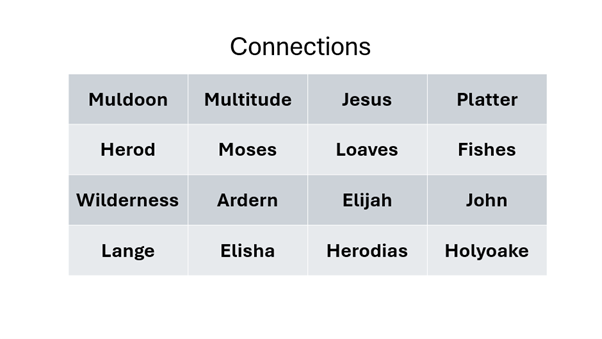
For example, among the 16 words you are given, you might have four names like Holyoake, Muldoon, Lange and Ardern. The connection there is pretty obvious. They are all former Prime Ministers of New Zealand.
What about Multitude, Wilderness, Loaves and Fishes? What connection do you see with those words? Yes, Jesus’ feeding of the 5000. Today our message focuses on Matthew 14, verses 13-21, which describes Jesus’ miracle of feeding a multitude with just a handful of loaves and fishes.
This event is recorded in all four gospels and it finds multiple connections with the Old Testament as well. The feeding of the 5000 is a nexus point of Biblical connections. From Matthew 14, verse 13 we read…
13 When Jesus heard what had happened, he withdrew by boat privately to a solitary place. Hearing of this, the crowds followed him on foot from the towns. 14 When Jesus landed and saw a large crowd, he had compassion on them and healed their sick. 15 As evening approached, the disciples came to him and said, “This is a remote place, and it’s already getting late. Send the crowds away, so they can go to the villages and buy themselves some food.”
16 Jesus replied, “They do not need to go away. You give them something to eat.” 17 “We have here only five loaves of bread and two fish,” they answered. 18 “Bring them here to me,” he said. 19 And he directed the people to sit down on the grass. Taking the five loaves and the two fish and looking up to heaven, he gave thanks and broke the loaves. Then he gave them to the disciples, and the disciples gave them to the people. 20 They all ate and were satisfied, and the disciples picked up twelve basketfuls of broken pieces that were left over. 21 The number of those who ate was about five thousand men, besides women and children.
May the Spirit of Jesus illuminate God’s word for us.
Two main things I want to draw your attention to in this passage:
Jesus’ leadership and Jesus’ faith. We begin with Jesus’ leadership. The light of Jesus’ leadership shines brightly against the darkness of Herod’s reign.
Leadership:
When you see (or hear) the words, Herod, platter, John and Herodias, what do you think of? Surely the beheading of John the Baptist.
John was the forerunner to Jesus, the prophet who came to prepare the way for the Messiah. John was Jesus’ ally, his wing man if you like. More than that, they were cousins.
In Matthew 14, verses 1-12, we read how Herod Antipas had John the Baptist killed. Herod was the puppet ruler of Galilee during the time of Jesus. He was a ruthless and depraved man.
When John the Baptist called Herod out on some of the bad stuff he was doing, Herod had John thrown in prison. Then when the daughter of Herodias danced for Herod, he promised to give her whatever she wanted. Herodias told her daughter to ask for John’s head on a platter.
After John had been beheaded, John’s disciples buried his body and told Jesus what had happened.
Given these facts, Jesus’ response to Herod is interesting. Jesus did not confront Herod; he did not organize a protest outside Herod’s palace or lead a revolt against Herod. Jesus did not seek revenge. Instead, Jesus quietly withdrew to a solitary place. Why?
Well, there was probably more than one reason. Perhaps Jesus did not want to inflame an already volatile situation. What Herod had done was a gross injustice. Anger and outrage are the natural response to injustice.
If Jesus confronted Herod or led a protest against him, it would have resulted in more violence. A calm head and a strategic withdrawal were necessary for the sake of peace. This was not a time for Jesus to be distracted from his core mission.
It appears too that Jesus needed some alone time; a short spiritual retreat to deal with his own feelings arising from John’s murder, but also to commune with God and seek his Father’s will on what his next move should be.
With God, small things can make a big difference. Seeking solitude may seem like a small thing, but (in the context of Matthew 14) it accomplished much good and avoided even greater evil.
I wonder if Jesus had Psalm 37 in mind when he chose to put distance between himself and Herod. In verse 7, David writes…
7 Be still before the Lord and wait patiently for him; do not fret when people succeed in their ways, when they carry out their wicked schemes. 8 Refrain from anger and turn from wrath; do not fret—it leads only to evil. 9 For those who are evil will be destroyed, but those who hope in the Lord will inherit the land.
Jesus had faith that God Almighty would deal with Herod, and the Lord did deal with him. Some years later, in Acts 12, we read how an angel of the Lord struck Herod down. He was eaten by worms and died. God is just.
When the crowds worked out where Jesus was headed, they walked around the lake on foot and met him on the other side, in the wilderness. Seeing the large crowd, Jesus had compassion on them and healed their sick.
Compassion is the key word here. Compassion, in this context, is that deep feeling of empathy which moves a person to acts of kindness. Compassion speaks of an intimate connection, a heart and hand response to others in need. Compassion puts aside any thought of personal convenience or comfort for the sake of another person’s wellbeing.
Seeing all those people lost and confused, by what Herod had done to John, evoked a gut response from Jesus. The Lord was deeply moved in the core of his being. Rather than venting his spleen at Herod, Jesus used his emotional energy to heal and feed people.
By putting the account of Herod’s murder of John the Baptist alongside the account of Jesus’ compassion for the people, we (the reader) are invited to compare and contrast Herod’s leadership with Jesus’ leadership.
Herod was self-indulgent, brutal and destructive. Herod threw wild parties at the expense of the poor. He showed no restraint and it resulted in him taking the life of a righteous man. Herod’s leadership was toxic to the people.
In contrast, Jesus shows compassion for the poor. Jesus heals the sick, feeds the hungry and protects the vulnerable. Jesus demonstrates the kind of good shepherd leadership God wants for his people.
Those who are familiar with the Old Testament will see here a connection between Jesus and God’s word through the prophet Ezekiel…
11 “I, the Sovereign Lord, tell you that I myself will look for my sheep and take care of them 12 in the same way as shepherds take care of their sheep that were scattered and are brought together again. … 14 I will let them graze in safety in the mountain meadows and the valleys and in all the green pastures of the land of Israel. 15 I myself will be the shepherd of my sheep, and I will find them a place to rest. I, the Sovereign Lord, have spoken.
By caring for the people in the wilderness, Jesus was acting as the divine shepherd leader of Israel, who has compassion on his people.
Okay, so we have talked about Jesus’ leadership, in contrast to Herod’s abuse of power. We also notice Jesus’ faith. Jesus models for us complete trust in God the Father.
Jesus’ faith:
The story is told of a soldier who was separated from his unit. The fighting had been intense, and in the smoke and the confusion, he had lost touch with his mates.
Alone in the jungle, he could hear enemy soldiers coming in his direction. Scrambling for cover, he found his way up a ridge to several small caves in the rock. Quickly he crawled inside one of the caves.
Although safe for the moment, he realized that once the enemy soldiers swept up the ridge, they would quickly search all the caves and he would be killed.
As he waited, he prayed, “Lord, if it be your will, please protect me. Whatever your will though, I love you and trust you. Amen.”
After praying, he lay quietly listening to the enemy begin to draw close.
He thought, “Well, I guess the Lord isn’t going to help me out of this one.”
Just then he saw a spider begin to build a web over the front of his cave. As he watched, listening to the enemy searching for him, the spider layered strand after strand of web across the opening of the cave.
“Hah” he thought, “what I need is a brick wall and what the Lord has sent me is a spider web. God does have a sense of humour.”
As the enemy drew closer, he watched from the darkness of his hideout and could see them searching, one cave after another. When they came to his cave, he got ready to face his end. To his amazement, though, they moved on.
Suddenly, he realized that with the spider web over the entrance, his cave looked as if no one had entered it for quite a while.
“Lord, forgive me,” the soldier prayed, “I had forgotten that in you a spider’s web is stronger than a brick wall.”
With God, small things can make a big difference.
Take plankton for example. Plankton are small. Many types of plankton are microscopic in fact, smaller than a human blood cell, and yet they feed whales, the largest of mammals.
More than simply being a food source though, phytoplankton produce somewhere between 50% and 80% of the earth’s oxygen. God supports life on earth using tiny plankton.
Phytoplankton also absorb carbon dioxide helping to regulate the earth’s climate by removing greenhouse gas, from circulation.
With God, small things can make a big difference.
Returning to Matthew 14. Jesus (the shepherd leader) had been ministering to people most of the day. It was getting late, so the disciples suggested to Jesus that he send the crowd away to the nearby villages to buy some food for themselves.
Given there were well over 5000 people present, this was not really a practical solution. It is unlikely the surrounding villages could cater for that number of people.
Jesus has another idea. ‘You give them something to eat’, he tells his disciples.
The disciples raise the obvious objection that they only have five loaves and two fish.
In the gospel of John, we learn that these five loaves and two fish belonged to a boy. The loaves were made from barley. Barley bread was the food of the poor and the fish was probably small and pickled (like sardines).
It appears this boy was not well connected. He did not come from a wealthy family and his lunch was pretty ordinary.
Jesus is not phased though. He says, ‘bring them here to me’. And he directed the people to sit down on the grass. Green grass does not grow all year round in the middle east, like it does in New Zealand. The mention, therefore, that there is grass tells us it is springtime, Passover season.
The Jewish Passover celebrates God’s deliverance of Israel from slavery in Egypt. We (the reader) are meant to see a connection here between God’s deliverance under Moses and the deliverance God brings under Jesus’ leadership.
In verse 19 we read how Jesus took the five loaves and the two fish and looking up to heaven, he gave thanks and broke the loaves. Then he gave them to the disciples, and the disciples gave them to the people.
Here we see Jesus acting in faith that God would provide. As one commentator puts it, Jesus simply gave thanks for the food, confident that he represents the Father’s will.
In Jesus’ hands those five loaves and two fish fill the bellies of well over 5000 people, so that everyone had more than enough to eat.
Some people try to explain this miracle away, in various rational ways, but doing that empties this event of its meaning, robbing us of wonder and hope in the process. Jesus trusted God his Father completely and the Father honoured Jesus’ faith.
With God, small things can make a big difference.
Looking at our game of Connections once again we see there are four words left, names actually: Jesus, Moses, Elijah and Elisha. What do these four men share in common?
They were all prophets of the living God, offering spiritual leadership for the people. More than that, they all trusted God to provide for their needs and consequently participated in a feeding miracle.
When the people of Israel cried out to Moses for food in the Sinai desert, Moses did not try to engineer a solution himself. He turned to God in prayer and the Lord God provided an abundance of manna and quail.
When God told the prophet Elijah to hide in the wilderness east of the Jordan, with no supermarket in sight, Elijah obeyed the Lord in faith, and God had ravens bring bread to feed him.
When a man brought the prophet Elisha 20 loaves of barley bread, Elisha told the man (in faith) to give the bread to the people. The 20 loaves fed 100 men and there was some left over.
So, when we read how Jesus had faith in God to multiply five loaves and two fish to feed over 5000 people in the wilderness of Galilee, we see that in Jesus someone greater than Moses, Elijah and Elisha has come. Jesus is more than a prophet.
With God, small things can make a big difference.
Now in saying this, I do not mean to imply that we can be stingy with God, giving him our scrapes. The boy who offered his five loaves and two fish, gave Jesus everything he had. The boy was generous.
The point is, even when we give our best and our all, it may seem like a drop in the bucket. Our best and our all will usually fall short of the ocean of human need. But that is no reason to give up in despair. We can only do what is in our power to do and trust God with the outcome.
Hearing this miracle story of Jesus feeding the multitudes is lovely and inspiring, but when we watch the news, we become painfully aware of the millions in our world today who are starving. Why doesn’t God feed them?
Well, God has provided enough to feed everyone on the planet. It’s not a production problem; it’s a distribution problem. Human greed and fear often get in the way.
Jesus trusted his disciples to distribute the food to the multitude and the disciples were faithful in carrying out the task Jesus gave them. In the end, there were 12 basketfuls left over, one for each of the disciples.
Conclusion:
This morning we have observed multiple connections, all orbiting around Jesus and the miraculous feeding of the 5000 in the wilderness. There’s just one more connection we need to make. This too finds its fulfilment in Christ.
Centuries before Jesus came, the Lord God gave the prophet Isaiah a glimpse of a future heavenly banquet, with food far richer than barley bread and pickled fish. From Isaiah 25 we read…
6 On this mountain the Lord of hosts will make for all peoples a feast of rich food, a feast of well-aged wine, of rich food full of marrow, of aged wine well refined. 7 And he will swallow up on this mountain the shroud that is cast over all peoples, the veil that is spread over all nations. 8 He will swallow up death forever; and the Lord God will wipe away tears from all faces, and the reproach of his people he will take away from all the earth, for the Lord has spoken.
Jesus is the one who removes the shroud of death. It is through faith in Jesus (his death and resurrection) that we have sure hope of participating in God’s heavenly banquet.
Let us pray…
Gracious God, you know our every need and you care for us. Thank you for Jesus, the good shepherd, who leads us in paths of righteousness and restores our soul. Grant us the grace to follow Jesus all the days of our life and enjoy you forever. Amen.
Questions for discussion or reflection:
- What stands out for you in reading this Scripture and/or in listening to the sermon? Why do you think this stood out to you?
- Why did Jesus withdraw to a solitary place after hearing how Herod had killed John? What good did Jesus’ retreat accomplish? (What evil did it prevent?)
- What is compassion? What (or who) moves you to acts of kindness?
- Compare and contrast Jesus’ shepherd leadership with Herod’s abuse of power. How do you experience Jesus’ care and provision?
- Discuss / reflect on the connections you notice between Jesus’ feeding of the 5000 in Matthew 14 and other feeding miracles in the Bible. How are these miracles similar? How are they different?
- In what ways do we see Jesus’ faith operating in Matthew 14?
- What small thing can you do (in faith) to show God’s love and care for others?
 Tawa Baptist