Jesus’ Commission

Scripture: Matthew 28:16-20

Video Link: https://youtu.be/BsRMobff4y8

Structure:

  • Introduction
  • Make disciples
  • Conclusion

Introduction:

Good morning everyone.

Today we continue our Renew Together mini-series in support of Arotahi.

Arotahi is the new name for the New Zealand Baptist Missionary Society.

Arotahi means to focus in one direction, concentrating on one thing together.

Renew Together is about remembering God’s mission of gospel renewal and our part in that mission. Over the three weeks of this year’s Renew Together campaign we are using the sermon time to focus on Matthew 28, verses 16-20.

Although this passage is called ‘the great commission’, there’s actually more going on here. Last Sunday we heard about Jesus’ great authority and next week we will hear about Jesus’ great presence.

Today though our focus is the commission part of ‘the great commission’. Jesus’ great commission is to make disciples. Let’s remind ourselves of what Jesus says in Matthew 28…

16 Then the eleven disciples went to Galilee, to the mountain where Jesus had told them to go. 17 When they saw him, they worshiped him; but some doubted. 18 Then Jesus came to them and said, “All authority in heaven and on earth has been given to me.  19 Therefore go and make disciples of all nations, baptizing them in the name of the Father and of the Son and of the Holy Spirit, 20 and teaching them to obey everything I have commanded you. And surely I am with you always, to the very end of the age.”

May the Spirit of Jesus illuminate God’s word for us.

If we think of the great commission as a house, then Jesus’ authority is the foundation on which the house is built. ‘Making disciples’ is like the structure of the house. While the Spirit filled people of God, who live in the house, provide the presence. Our focus this morning is on Jesus’ commission to make disciples.

Make disciples

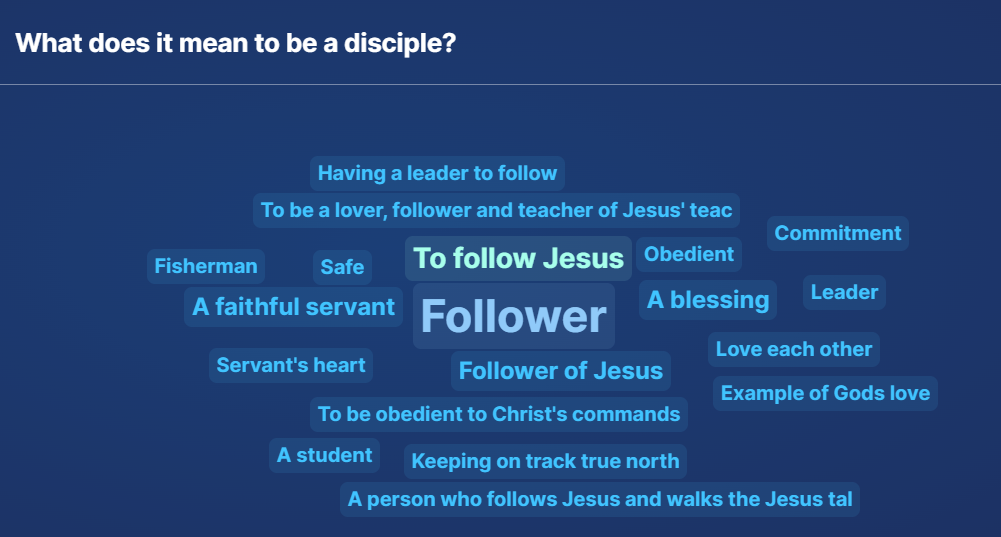
Perhaps the first question to ask then is, what does Jesus mean by a disciple?

Well, the Greek word used in the New Testament for ‘disciple’ is mathetes, from which we get the word mathematics. 

A mathetes (or a disciple) is a learner, a student, an apprentice. Someone, in the context of the gospels, who is learning to be like Jesus by following his example. The heart and soul of Christian discipleship is learning to love and obey God, like Jesus did.

Being a Christian is like being a tradesperson; a builder or a plumber or a boiler maker (if they still have those). In the same way you don’t become a qualified tradie overnight, so too you don’t become proficient at loving and obeying God instantaneously. It’s a process.

Jesus is the master tradesman and we are his apprentices. We learn how to love and obey God by listening to what Jesus tells us and by watching and following Jesus’ example.

Jesus commissions his eleven disciples to go and make more disciples, after training them. For three years the disciples accompanied Jesus wherever he went. They spent many hours in conversation with Jesus. They listened to his preaching. They watched how Jesus cared for people and they experienced his power and love for themselves, firsthand.

Not only that but they cut their teeth on some short term mission trips of their own. They put into practice what they saw Jesus doing by having go at preaching and healing for themselves.

The point here is that before the eleven could make disciples, they had to do their apprenticeship as a disciple. But even after they had done their apprenticeship and got their commission, they were still learning. Christian discipleship is a lifelong process.    

It’s the same with us. Before we can make disciples, we have to be a disciple. And, in this life, we never stop being a disciple. We never stop learning to love and obey God.   

There is a real freedom in being a disciple. If you think of yourself as a learner, and not as an expert, then you don’t have to have all the answers. A disciple is not a guru. A disciple is not perfect or elite. A disciple is curious. Sometimes disciples make mistakes but they learn from those mistakes. A disciple is on a journey to becoming more like Jesus. 

In verses 19 & 20 of Matthew 28, Jesus outlines the two main things involved with ‘making disciples’: baptizing people and teaching people.

Baptism is the sign of Christian conversion. Or to put it another way, baptism is how we enroll to become a disciple of Jesus. To be baptized is to surrender your life to Christ. Baptism says, I am making a commitment to learn to love and obey God, with Jesus as my teacher.

While baptism is important and is something to celebrate, it is not an end in itself. Baptism is a beginning. Jesus did not say, ‘Go and make converts’. No. He said, ‘Go and make disciples’. 

The bigger part of making disciples is teaching them to obey everything Jesus has commanded. 

Now, when we hear the word ‘teach’, we might think of a classroom setting with a teacher at the front and pupils sitting in desks. Chalk and talk. Part of discipleship does involve sitting and listening to people talk about Jesus.

But learning happens in other ways too, especially in the example we set. Discipleship is caught more than taught.

Teaching people to obey Jesus isn’t just about stuffing knowledge into people’s heads. Christian knowledge is primarily relational. So the point is not to know lots of facts about God and Jesus. The point is to help people grow in their experience of God’s love and truth.

The disciple, Simon Peter, learned something of God’s grace by listening to Jesus’ parable of the prodigal son and by watching the way Jesus forgave other people. But Peter’s most profound lesson on grace and forgiveness happened when he denied the Lord and was then later restored by Jesus.

In John 13, Jesus gave his disciples the command to love one another, as I have loved you… By this everyone will know you are my disciples.

Learning to love other Christians only happens when you spend time with them. And spending time with Christians (who may be quite different from you, or perhaps too similar in all the wrong ways) is more difficult than you might think. But we can’t expect to learn how to love one another without some form of church involvement.

As important as church life is, discipleship happens mostly in the ordinary, mundane routines of life.

If you are married, then marriage is the primary context for your discipleship. For example, you learn patience, grace and humility by listening to your partner, by doing the dishes and the vacuuming, by forgiving each other’s mistakes and so on.

Likewise, if you are single, then discipleship happens in the context of your singleness. Without a husband or wife, you might, for example, learn to rely more fully on God in faith and become good at companionship as you share your time and talents with the church and community.  

The workplace is another important context for discipleship. In most work situations you will have to get along with people who hold different beliefs from you. There may be times when you are tempted to do something morally wrong. As someone learning to love and obey God, how do you choose the Jesus’ way?

We learn by doing. We learn to love and obey God through the life situation we find ourselves in. Christian discipleship is a full emersion process.

In the 1970’s James Engel, of Wheaton College in the United States, developed what is known today as the Engel scale. The Engel scale describes the process of Christian conversion and discipleship.   

James Engel came up with 16 steps in this process. Most of those steps are taken before someone makes the conscious decision to become a disciple of Jesus.

Generally speaking, we start out in life having no awareness of God, that’s step one. Then, at some point, we become aware that other people believe in a higher power that we call ‘God’. Step two.

Having some contact with Christians is another important step in the process. You might, for example, grow up in a Christian home or you might know Christians at school or in your work place.

Hopefully, this contact with Christians is positive so you become interested in finding out more about Jesus, because Jesus is the heart of the Christian faith. 

As you learn more about Jesus you are faced with some decisions. Do I believe that Jesus is the Son of God? Do I believe that God raised Jesus from the dead? Do I believe God’s grace is sufficient for me? And, if I do accept these things as true, am I willing to surrender my life to Jesus and become his disciple?

The Alpha Course is helpful when working through these questions of faith.  

Once you have decided to become an apprentice of Jesus, by God’s grace you gain confidence in your decision and you make changes to your lifestyle in obedience to Christ. Those changes might include giving up drugs or alcohol or becoming kinder and more generous, or some other change depending on what God’s Spirit is doing in your life.

Part of your discipleship journey will include practicing spiritual disciplines like a daily quiet time for prayer and Bible study, attending Sunday worship regularly, giving to the poor and to the church, observing a Sabbath, volunteering your time in service to others and so on.

Eventually, you will learn to share your faith authentically, in a way that fits the shape of your soul. And, in the process of sharing your faith and discipling others, you yourself continue to grow in your relationship with Jesus.       

The Engel scale isn’t just about growing in our head knowledge of Jesus. More importantly it has to do with our attitude toward God. Are we cultivating a greater openness to God’s Spirit? Are we learning to love and obey the Lord more and more in faith?

The steps that James Engel developed provide a rough map of the discipleship process for some people. But the thing about maps is they don’t always match the reality on the ground. Discipleship is not necessarily a linear step by step process.

Sometimes we do the steps in a different order. Sometimes it’s three steps forward, one step back. Sometimes we have to repeat certain steps. And your particular discipleship journey may involve other steps that James Engel didn’t think of. That’s okay.

The point is, discipleship is a process and, like any learning process, you have to give yourself to it. We have to submit to our teacher, Jesus.

One of the helpful things about the Engel scale is that it reminds us to be sensitive to where other people are at in their journey toward Christ likeness. The Engel scale prompts us to listen and seek to understand others first.

If someone is in the early stages, just beginning to make contact with Christians, then you want their first contact to be positive. Do your best to ensure their experience with you is warm and real, not weird or scary.

You don’t need to dump a whole lot of Christian doctrine on people in the early stages. A theological framework can come later. Just be honest and kind. Listen with empathy and understanding. Let people experience the love and truth of Jesus through you.  

A couple of weeks ago we had the filters in our home ventilation system changed. The guy who came to our house to do this was from India. Jesus said ‘go to the nations’ but in many ways the nations have come to us here in New Zealand.

When I was paying the bill this guy asked me what I did for work and so I told him I was a minister at the local Baptist church.

He was curious about the different denominations, like Catholic and Protestant, so I said the various church traditions are like different flavours of the Christian faith. What really matters though is Jesus. Jesus is the one we share in common. Jesus is the heart of the Christian faith.

Now, most of the time when you mention the name Jesus, people change the subject. But this guy wanted to keep the conversation going. Fine by me.

He told me how he had been working in a woman’s house recently and she had given him a coin with ten rules on it. I guess it was the ten commandments.

While I admire this woman’s boldness, I’m not sure she was paying attention to where this guy was at or what he needed.

Yes, Christian discipleship does involve learning to obey the commandments, but knowing Jesus needs to come first. Because if we don’t know that Jesus loves us, then we won’t be able to obey.

Sadly, she gave him another rule, telling him not to get vaccinated against Covid. On the rare occasion someone wants to know about your faith, please talk about Jesus. Do not go off on a tangent. Do not take them down a rabbit hole. Keep the main thing the main thing. Jesus is the main thing.

This guy had been vaccinated so where does that leave him? Probably feeling judged, if not condemned. What would Jesus do in that situation?

Well, I believe Jesus would stand in solidarity with the man.

So, as Jesus’ representative in this situation, that’s what I did. I told the man I had been vaccinated too and that I believe God gives us science for our health and wellbeing. In other words, you don’t need to feel condemned for being vaccinated. Vaccination is not a barrier to becoming a Christian. Science is not the enemy of faith.

He looked at me and communicated his understanding with one word, ‘Freedom’. This guy was intelligent. He made the connection that Jesus and the Christian faith are about setting people free to love God, to love their neighbour and to love themselves. (Keep the main thing the main thing.)

Of course, there is much more you could say about Jesus and the gospel but you don’t have to cover everything all at once. Making disciples is a process and you may be just one of the many people God uses in that process. I believe there is still more God wants to do in this man’s life.

For the first eleven disciples, being commissioned by Jesus to go and make disciples of all nations meant actually travelling out from Jerusalem to other countries with the gospel. Does it mean the same for us as well? It might do, but not necessarily.

Obviously, God does still call people to become overseas missionaries. That’s what Arotahi is about. But he is more likely to call you to make disciples in your own neighbourhood; your school, your home, your church or your workplace.

If you are a parent or grandparent, then regularly reading stories about Jesus to your children and grandchildren is the obvious place to start. If you are married to someone who is not yet a disciple of Jesus, then showing your partner in marriage what a follower of Jesus looks like is surely a priority.

If you have the time and skill and desire to work with children or young people, then serving in Kids’ Church or Youth Group is a sensible way to make disciples. Likewise, if you love the Bible and people, then leading a small group Bible study might be one way you carry out Jesus’ great commission.

Or, if you work with someone who is interested in knowing more about Jesus, then embrace the opportunity the Lord has provided. Walk humbly with that person and share the grace and truth God’s Spirit has given you.

Conclusion:

Where are you at in the process of learning to love and obey God?

What are the next steps for you?

May the Lord bless you with wisdom and courage as you go and make disciples. Amen.

Questions for discussion or reflection:

What stands out for you in reading this Scripture and/or in listening to the sermon? Why do you think this stood out to you?

  • What is a disciple? What is the goal of Christian discipleship?
  • Where are you at in the process of learning to love and obey God? What are the next steps, for you, in that process?
  • Think of those who have been instrumental in discipling you? What did they do that helped you to love and obey God?
  • What are some of the ways we might make disciples? How do you, personally, work out Jesus’ commission to make disciples?
  • Discuss / reflect on the Engel scale. To what extent do these steps align with your own experience? How is it different? How might the Engel scale help in the process of making disciples? 
  • If you had one minute to talk about your faith with someone who had some awareness of God but little or no experience of Christian faith, what would you say? 

Discipleship – by Becca

Scripture: Deuteronomy 6:5-9

Good morning everyone!

When Will asked me to speak, I planned to talk about the passages where Jesus invites the children to come to him. As I read and planned, it kept changing and eventually I ended up focusing on verses from Deuteronomy which fits in perfectly for our current sermon series. Will actually covered these verses as part of one of his sermons back in July, so they should be familiar to you all.

Deuteronomy 6:5-9 reads, “Love the Lord your God with all your heart, with all your soul, and with all your strength. Never forget these commands that I am giving you today. Teach them to your children. Repeat them when you are at home and when you are away, when you are resting and when you are working. Tie them on your arms and wear them on your foreheads as a reminder. Write them on the doorposts of your houses and on your gates.”

These verses are really about discipleship. The Greek word used in the Bible for discipleship, mathēteuō has two definitions, to be a disciple of someone, and to make a disciple of someone, and both meanings are included in these verses. 

To be a disciple means being a student, someone who adheres to and follows a particular doctrine.  It’s not about being the best Christian. Being a disciple of Jesus isn’t some status level that we can attain, like Gold status for flying a certain number of times with Air New Zealand. We often hear of the 12 disciples, Jesus’ closest friends and students, but in Acts, anybody who comes to know and believe in Jesus as God’s Son is called a disciple. 

Jesus’ 12 disciples stayed with him, they learnt and studied and lived life together. Disciples study and remember a teacher’s words, but more than that, they learn by imitating the teacher’s entire way of life. 

For Christians, being a disciple is about loving God with all of our being and constantly striving to imitate Jesus. We are told by Moses in Deuteronomy, and by Jesus in the Gospels, to love God with everything we have. With all our energies, and with all our efforts, and with all our understanding. That is a big ask, especially when we are trying to manage everything else going on in our lives – our work, families, children, homes, friendships, volunteering roles and so on. Putting God first, above all of that is hard!

Reflection question – I have a few of these questions throughout, they are things that have challenged me and may be a challenge to you as well. Where are your energies going? What are your priorities? Are you loving God with all of your heart, soul, and strength?

—————

The next part of our passage in Deuteronomy goes on to say, “Never forget these commands.” This is another aspect of being a disciple. Later on in the chapter, Moses warns the Israelites not to forget God when they are rich and don’t have to rely on him anymore. 

“When the Lord your God brings you into the land he swore to your fathers, to Abraham, Isaac and Jacob, to give you a land with large, flourishing cities you did not build, houses filled with all kinds of good things you did not provide, wells you did not dig, and vineyards and olive groves you did not plant – then when you eat and are satisfied, be careful that you do not forget the Lord, who brought you out of Egypt, out of the land of slavery.”

How often do we call out to God when we need him, but kind of ignore him through the good times? Or maybe we find it easy to have faith when life is going well, but feel abandoned or alone when things get tough? It can be challenging to be a follower of Christ in all situations, in all aspects of our lives, particularly in a society which often looks down on Christians. But these verses remind us that being a disciple is a full-time job and requires us to commit to following God all of the time, never forgetting his commands.

—————

In the next verses, Moses gives the Israelites, and us, ideas for how we can ensure we don’t forget or put aside God and his commands. “Repeat them when you are at home and when you are away, when you are resting and when you are working. Tie them on your arms and wear them on your foreheads as a reminder. Write them on the doorposts of your houses and on your gates.” 

Some Orthodox Jews put tefllins, these prayer boxes, on their heads and wrists when they pray, to acknowledge these verses. However, you’ll be pleased to know that most commentaries on these passages agree that the instructions to tie God’s commands on our arms and foreheads are not meant to be literal, but rather an example of what we can do to remember God’s Word.

Before we can remember God’s Word though, we need to make sure we are reading it! My Nana is one of those people who can recall a Bible verse or story for just about any situation. You could be stuck up a tree and she’d tell you the story of Zaccheus, or you could be talking about a friend, and she would recite a verse from Proverbs or Ecclesiastes about the importance of friendships, or you hit a pothole as you’re driving, and she’d tell you about the part in Numbers where the earth opened up and swallowed a whole bunch of people. 

As long as I can remember, she’s had amazing habits for reading her Bible and doing studies – every day she sets aside time to read, pray, and learn about God. I’m not sure what she did when she was younger and had a busy family, but when we’ve stayed with her, it’s pretty common to wake up and come out to the kitchen and see her sitting in her dressing gown, with her Bible and study open, while she drinks her morning cup of tea. I am still working on building those habits myself, but I’m so inspired by people like her, and Will and Daryl and I’m sure many others here, who have so much Scripture committed to heart.

Reflection – We need to think about our own Bible reading, and what our own personal, modern version of these verses could be. Do you set aside a time to spend with God and his Word each day? What’s your version of tying God’s Word to your arms or writing it on your doorpost? Is it wearing a cross necklace, or a bracelet engraved with a special verse? Is it having a Bible verse as the screensaver on your phone or a Bible app on your homescreen? Is it a meaningful poster/photo/verse on your wall at home? What can we do to remind ourselves to follow God all throughout the day?


—————

Jesus’ last words on earth are known as the Great Commission. “Therefore, go and make disciples of all nations, baptising them in the name of the Father and of the Son and of the Holy Spirit, and teaching them to obey everything I have commanded you. And surely I am with you always, to the very end of the age.”

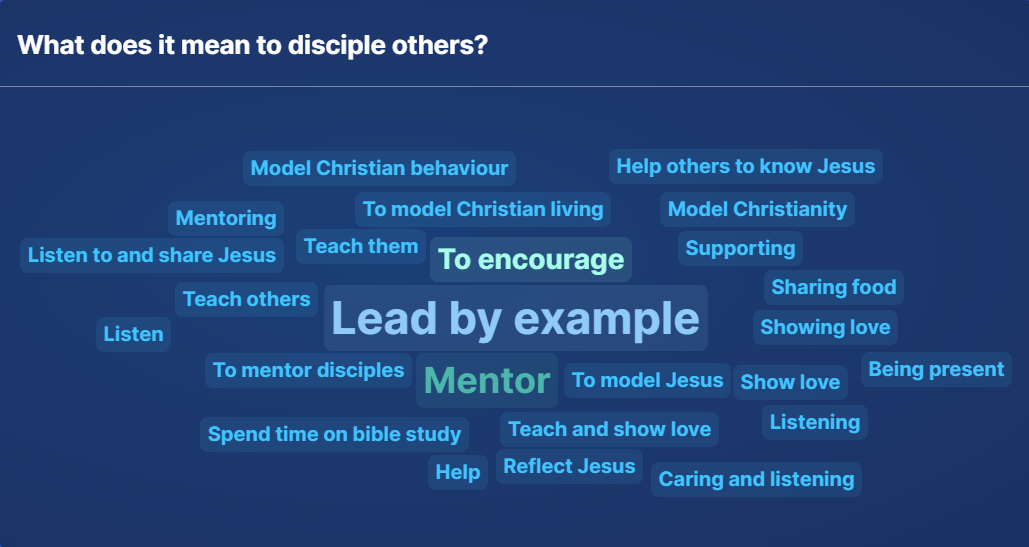
Discipling others largely refers to teaching or mentoring, both in word and by example. 

In our Deuteronomy passage, we come back to the “Teach them to your children” instruction. That is the one sentence in this passage which gives explicit instruction on discipling others. It’s as if making disciples is actually a part of being a disciple. 

The Bible makes it clear that teaching our children about God and his Word is an important part of our role as parents.

  • Ephesians 6:4 says, Fathers, do not exasperate your children; instead, bring them up in the training and instruction of the Lord.  (I love the part about not exasperating your children – every time I read it I see myself as a teenager, rolling my eyes at my Dad’s lame jokes!)
  • Proverbs 22:6 – Train up a child in the way he should go, and when he is old he will not depart from it. 
  • And in 2 Timothy 1:5, where Paul is writing to Timothy, he says: I am reminded of your sincere faith, which first lived in your grandmother Lois and in your mother Eunice and, I am persuaded, now lives in you also. 

This last verse shows us the importance of grandparents and wider whanau in teaching children. 

The Barna group, a well-regarded research group in the US, found that 95% of children’s ministry workers believed that the primary, that is the main source of children’s discipling should be their home (i.e. their parents and families), while only 49% of parents with children at church believed that they were the primary source, with 51% saying that church should be the primary source of discipling for their kids. 

The same study found that only 50% of church parents said their children pray at least once a week at home, and 42% said their children hear the gospel at least once a week. If we are to believe that parents have the primary role of discipling their children, since they have the most time with them and know their child the best, then church needs to be there as a support for the parents, discipling the parents as they disciple their children.

Discipling children isn’t just the role of parents, however. In the book of Mark, Jesus tells off the people who try to keep the children away and welcomes the children to come to him. He didn’t say, “nope those kids aren’t my problem, it’s up to their parents to sort them out”, but rather brought them in to be blessed and be part of the group. I know there are many, many people in our church who are like Jesus in the way they treat children at Tawa Baptist, and I have always felt like my own two girls are welcomed and loved here. 

Going back to our Deuteronomy verses once more, and the sentence, “Teach them to obey my commands.” Many of the same tools suggested for parents and churches to disciple children are also useful for discipling other adults. Discipling other adults may mean teaching unbelievers or very new believers; it might mean mentoring someone in our church or working with other Christians. Jesus did all of those things as part of his discipleship, and we can too. Here are three key things we can all do to disciple others, whether they are our own children or someone else.

First, knowing our Bibles. We’ve already covered this but if you are trying to teach someone about God’s Word, it’s really handy to know what you are talking about. Little kids are especially good at asking the hard questions, like “Who made God?” and “How did God make the world if he doesn’t have hands?” When Tillie was two, we were heading to her first dentist appointment. On the way, we were talking about how God is everywhere. She asked, “will God even be at the dentist’s office?” and, trying to be a good mum and reassure her, I said “of course!” We walked into the dentist office, and she took one look at the female receptionist and in a very loud voice, as Tillie generally uses, asked, “Is that God?!” When I told her no, she persisted, “But how do you know that’s not God?” I have to admit, that was a time I didn’t have a great answer.


Another example of how knowing our Bibles is important can be seen in the story of Apollos, Priscilla and Aquila, in Acts 18:24-26. “At that time a Jew named Apollos came to Ephesus. He was an educated man from Alexandria. He knew the Scriptures very well. Apollos had been taught the way of the Lord. He spoke with great power. He taught the truth about Jesus. But he only knew about John’s baptism. He began to speak boldly in the synagogue. Priscilla and Aquila heard him. So they invited him to their home. There they gave him a better understanding of the way of God.” – Priscilla and Aquila were able to help Apollos because they had good scripture knowledge themselves, and they discipled Apollos, who was then able to go and preach widely to others.

A second tool for discipling others is building relationships. 

One of the special things about our church logo is the different people represented. There’s a family with children, single people, an elderly couple, and so on. Having good relationships is a key tool in discipleship. Children who have meaningful relationships with adults in the church stay around at church, and in their faith, at a far higher rate than those who don’t have those relationships. This is also true for adults as well – would you be more likely to keep coming to a new church if you were seeing strangers who only talk to each other, or people who you were starting to build friendships and relationships with? 

Intergenerational relationships are important as well. Children need to hear about Jesus from people outside their own families. Titus 2 calls for older women and men to teach and train the younger generation, while 1 Timothy 4:12 calls on young people to “be an example for the believers in speech, in conduct, in love, in faith and in purity.” 

Hebrews 10:24-25 talks about all the church members coming together: “And let us consider how we may spur one another on toward love and good deeds, not giving up meeting together, as some are in the habit of doing, but encouraging one another.”

The third and final tool for discipling others is sharing about Jesus. Obvious, right? While explicit formal teaching of God’s Word is important when discipling our children and other people, it’s just as important to include God in our everyday conversations. 

One of the ways we learn is by watching other people and then having a go ourselves. The Parenting for Faith course talks about using “windows” or little moments for children to get glimpses into our relationship with Jesus. It’s about going about our everyday lives and showing our children how we include God as a part of that. For example, letting your children see you study your Bible, or pray in a difficult moment, or thank God for a rainbow and the promise of hope. 

The book Sticky Faith: Everyday Ideas to Build Lasting Faith in Your Kids highlights an important truth: “The greatest gift you can give your children is to let them see you struggle and wrestle with how to live a lifetime of trust in God.” This doesn’t happen once a week or overnight. Showing children your relationship with Jesus, imperfect, messy, and difficult as it may be, is one of the best ways to help them develop their own relationships. And as our own relationships with God deepen, sharing these moments with our children becomes more natural.

For people who have grown up children, the Parenting for Faith course suggests that even though your children aren’t living at home with you, they are still learning from you what older, wiser life looks like with God. Even if they seem uninterested, they will still be watching you and learning from you whenever they see you – even if they don’t say so. The same goes for discipling others, Christian or not, – just living our lives and being open about our relationship with God can make a big difference. 

Reflection questions… Who in our lives are you or could you be discipling? What is your role in discipleship within the church?

————

This morning we’ve talked about being a disciple and discipling others. Let’s finish off by re-reading Deuteronomy 6:5-9 one more time: “Love the Lord your God with all your heart, with all your soul, and with all your strength. Never forget these commands that I am giving you today. Teach them to your children. Repeat them when you are at home and when you are away, when you are resting and when you are working. Tie them on your arms and wear them on your foreheads as a reminder. Write them on the doorposts of your houses and on your gates.”

Reflection questions:

  • Deuteronomy 6:5 says “Love the Lord your God with all your heart, with all your soul, and with all your strength.” Where are your energies going? What are your priorities? Are you loving God with all of your heart, soul, and strength?
  • Verses 7-9 tell us to remember God’s commands. How much time do you spend with God and His Word? What can you do to remind yourself throughout the day?
  • Verse 7 encourages us to teach God’s commands to our children, and Jesus’ last words were telling us to make disciples of all the nations. Who in your life are you or could you be discipling? What is your role in discipleship within the church?

High Fidelity

Scripture: Deuteronomy 5:18 and Matthew 5:27-28 & 31-32

Video Link: https://youtu.be/Pva-KR5maAE

Structure:

  • Introduction
  • What is adultery?
  • Strengthening marriage
  • Conclusion

Introduction:

Kia ora whanau and good morning everyone.

Normally my messages are rated PG but today’s sermon is more like an R16. Content may disturb. 

If I say the word, Hi-Fi, what am I talking about? [Wait]

That’s right, a Hi-Fi is a stereo system, for playing music. Hi-Fi is short for High Fidelity, meaning high quality sound reproduction.

Fidelity is another word for faithfulness. So a High Fidelity sound system is one which faithfully reproduces the original music to a high standard. A Hi-Fi sound is a pure sound, unadulterated.

Today we continue our series in Deuteronomy. We are up to that part (in chapter 5) where Moses reiterates the ten commandments or the ten words of Yahweh. Today our focus is the command, ‘You shall not commit adultery’, in verse 18.

In actual fact, God wants us to do more than just avoid adultery. His real intention here is for marriage to be high fidelity. Because a high fidelity marriage clearly reproduces the faithfulness of God and the faithfulness of God is music to the ears of his creation.

When we look at where adultery is placed among the ten commandments, we see it comes between murder and theft. In some ways, adultery is like murder in that it (usually) kills a marriage and breaks up a family. At the same time, it is also like theft in that it takes something precious that does not belong to you. 

The command prohibiting adultery is about protecting marriage. When you protect marriage, you protect families and when you protect families you strengthen society.  

Our message today puts the instruction of Moses (in Deuteronomy) alongside the teaching of Jesus (in the gospel of Matthew). Broadly speaking, we will look at what adultery is and how we might strengthen marriage.

What is adultery?

First though, what do we mean by adultery? Well, from a contemporary secular perspective, adultery is voluntary sexual intercourse between a married person and someone other than his or her spouse.

Or to put it more plainly, adultery is when a person who is married willingly has sex with someone they are not married to. Usually my sermons come with pictures to illustrate what I mean, but it doesn’t seem appropriate in this case.  

The Bible agrees with the secular definition of adultery, except that Jesus takes it even further.

In Matthew 5, Jesus says…

27 “You have heard that it was said, ‘You shall not commit adultery.’ 28 But I tell you that anyone who looks at a woman lustfully has already committed adultery with her in his heart. 

So by Jesus’ (kingdom of God) definition, you don’t need to have sex in order to commit adultery. You can be guilty of adultery without touching anyone. 

Like much of Jesus’ sermon on the mount, the Lord is setting the bar of holiness very high indeed. There are a couple of things to clarify here.

Firstly, Jesus appears to be addressing married men in these verses, for he says anyone who looks at a woman lustfully has already committed adultery. Is he being sexist? Does this mean that only men can commit adultery and that women are not culpable?

No. Jesus is not being sexist. Women are just as capable of adultery as men and can be just as guilty. We need to understand that Jesus was speaking into a patriarchal culture. In a patriarchal society men are in control and women are generally subservient to their husbands. So there is a power imbalance.

As I read it, Jesus is addressing married men because they are the ones with the power. He is telling men to be responsible and use their power to protect their families by guarding against adultery.

At the same time, I think Jesus is undermining a common male prejudice that women are the problem; that women are somehow to blame for adultery. It’s her fault for dressing like that. Or it’s her fault for flirting with me in that way.

Jesus is not having any of that. Guys, you can’t blame women for your own selfish desire. That’s not fair. A man needs to take responsibility for controlling himself. He needs to keep it in his pants, especially in a society where women are not treated equally.  

Okay, so what does Jesus mean by looking at a woman lustfully? Well, lust is the hunger or the desire to possess someone else for your own self-gratification. Let me explain by way of example. And for this example to work you need to think of yourself as married.

You might be taking the train into the city when you notice someone who looks quite attractive. You think to yourself, they’re handsome or they’re beautiful. You don’t stare at them though. You don’t want to possess them for your own self-gratification. Instead you check the emails on your phone and your mind quickly moves on to its next thought. That is not lust or adultery.

But what if, in that scenario, an impure thought momentarily and involuntarily enters your mind. You quickly caste it out with a silent prayer, then distract yourself by doing the daily Wordle. Is that adultery? No. That is not adultery. That is temptation.

Temptation is that thin line between right and wrong. Temptation is the doorway to evil deeds. In the scenario I just described you did not cross the line of temptation. You backed away from it. Well done you.

Okay, so when does it become adultery? Well, you are on the train. You see the beautiful person. An impure thought enters your mind but this time, instead of distracting yourself with the Wordle, you welcome the thought in. You start undressing that person in your mind or you imagine them in the shower. Okay, now stop imagining. (I did warn you, this message is R16.)

If you entertain that kind of fantasy you have crossed the line of temptation and you have committed adultery with that person in your heart. You have wanted to possess that person for your own self-gratification.

You might say, that’s disgusting, I would never think like that. The truth is you don’t know the depths of your own heart. None of us knows what we might do given the opportunity. Remember how king David fell. He watched Bathsheba from a distance as she bathed naked and then he sent for her so he could sleep with her. So he could possess her for his own self-gratification.

Having said that, I don’t want you leave here today thinking, everyone is undressing me with their eyes. Most people are not thinking about you at all.

The point is, we have to be very careful with our thoughts. Thoughts are like seeds. A good thought grows into good actions. But the seed of a bad thought bears the fruit of all sorts of wrong doing. Where lust is the root, adultery is the fruit. Jesus wants us to nip adultery in the bud and prevent wrong doing before it has a chance to bear fruit. 

Choose prevention, not perversion. Choose self-denial, not self-gratification.

We are talking about what adultery is and what it means to look at someone lustfully, because by Jesus’ definition lust qualifies as adultery.

Now at this point some of you may be thinking, what about pornography? How does that fit with Jesus’ definition of adultery? Well, pornography encourages lust. Pornography provides the means for self-gratification. So, by Jesus’ standards, the use of pornography is a form of adultery.

The ancient Greek word for sexual immorality, in a general sense, is porneia, The English word pornography comes from the Greek word porneia. Pornography literally means ‘sexually immoral images’.  

In mainstream media, the use of pornography is accepted as normal and okay, provided it doesn’t involve children. But for Christians no form of pornography is acceptable, whether you are married or single.

Some people might say, ‘What’s the problem with pornography? No one is getting hurt’. That is simply not true. People are being hurt by pornography.

The use of pornography has the potential to destroy a marriage. God’s intention is for a husband and wife to give themselves to each other fully. If the husband is giving part of himself to dirty magazines and dodgey websites, then his wife is not getting the best of him.     

Deeper than this, pornography hurts the one who uses it. The more someone uses pornography the more likely they are to have impure thoughts about random strangers on the train. Pornography distorts our perception. It causes us to see other people as objects for our own self-gratification. Things to consume rather than human beings made in the image of God.

Whether you are married or single, please (for your own sake) do not go down the path of using pornography. It will put you in a prison that is very difficult to escape from.  

Deuteronomy 5, verse 21, reads: “You shall not covet your neighbour’s wife”.

In Catholic and Lutheran tradition, this verse (about not coveting your neighbour’s wife) stands alone as the ninth commandment. It is not lumped together with coveting your neighbour’s house and donkey. Wives are qualitatively different from houses and cars.

In the Greek version of the Old Testament, the word translated as covet is the same word Jesus uses for lust in Matthew 5. Lust / covet, same word in the original Greek. This is because coveting (like lust) is about the hunger or the desire to possess someone or something for our own self-gratification.

The implication here is that adultery isn’t just about sexual desire. Adultery can be about desiring someone else’s spouse for any reason. For example, a woman may covet her neighbour’s husband because he is good at earning money. In that case the lust isn’t sexual, it’s about greed or insecurity.    

Adultery doesn’t always present itself as so obviously evil. More often the temptation to self-gratification presents itself as something good, at first, but we don’t realise the path we are on until too late.

Returning to our train scenario. Imagine someone sits beside you on the train. You don’t have any inappropriate thoughts. You talk about the weather.  A couple of days later you sit together again and they share a few small details of their life. Turns out they work in a government department.

The weeks go by and you look forward to your daily commute. Your train buddy is easy to talk to. You feel comfortable with them. One day, their hand brushes against yours. It feels electric. You wonder if they felt it too. 

You find yourself thinking of them more and more after that. Innocent enough thoughts. You wonder what they might be having for dinner, whether they are watching the same TV programme as you, what they are planning for the weekend, that sort of thing.

Over the course of weeks and months you learn bits and pieces of their story. How their husband or wife left them to raise a child on their own. You feel a kind of empathy for their situation and before long you imagine yourself coming to their rescue, being their white knight or their Fraulein Maria.

Next you find they are populating your every waking thought. You become jealous when you see anyone else talking with them. You start going to the gym more often and eating a little less to get in shape, just in case.

At the same time, you pull away from your own spouse. You stay later at work, you talk less when you come home, you are more irritable with your family and you choose to withhold sex from your husband or wife.

Occasionally, you have a twinge of guilt but it soon passes. How can this be wrong when I feel so good? Besides, you are not sleeping with your train buddy (at least not yet). But still, your loyalty is divided. You are having an affair of the heart. You are trapped in a fantasy, an illusion which gratifies your ego or at least dulls the pain you feel. This too is a form of adultery.

Okay, so we’ve talked about the physical act of adultery, which is normally preceded by mental and emotional adultery, an adultery of the heart. But there is another kind of adultery too. In Matthew 5, verses 31-32, Jesus says…

31 “It has been said, ‘Anyone who divorces his wife must give her a certificate of divorce.’ 32 But I tell you that anyone who divorces his wife, except for sexual immorality, makes her the victim of adultery, and anyone who marries a divorced woman commits adultery.

This is high fidelity stuff. Again, Jesus’ words here need to be understood in their proper context. A man in ancient Jewish culture could divorce his wife simply by writing her a letter of dismissal. Jewish women had no legal right to divorce their husband. It was a patriarchal society. Power imbalance.   

The conservatives of Jesus’ day said the only justifiable cause for divorcing your wife was if she was guilty of sexual immorality of some kind (porneia). The liberals, on the other hand, said a man could divorce his wife for anything. Maybe if she burnt the dinner or if he decided he liked the lady on the train more.

Not all husbands were so callous. Some loved their wives and remained loyal to them. But, by and large, men at that time felt entitled to send their wife away at a moment’s notice.

This was incredibly unfair to women, especially when we remember they had no social welfare benefit to fall back on and career options were limited.

Jesus took a hard line approach on the issue of divorce because he could see men were abusing the law at the expense of women and children. Some husbands were using a loop hole to get rid of their old wife so they could marry a new one. Serial monogamy. That is effectively the same as adultery, just with a thin veil of respectability.

Jesus is saying, it’s not okay guys for you opt out of your marriage commitment for your own convenience. Men, you need to stay loyal to your wife.

Now I imagine there will be some here who have been through the pain of divorce and remarriage. These words of Jesus are not meant to condemn you. Jesus’ intent is to protect those who are most vulnerable.

Your attitude to marriage and the reasons for your divorce may be entirely different from the problem Jesus was addressing in the first century. If you have left a marriage because you were abused or abandoned or betrayed, that’s a different matter. 

Whatever the circumstances of your divorce, God is gracious. I believe the Lord is willing to forgive anyone who is genuinely repentant.

The other thing I want to make plain is that, by Jesus’ standards, almost everyone listening to this is guilty of committing adultery, if not in deed then in their heart. And so no one here has the moral high ground. We are all in need of God’s mercy and forgiveness.

Returning to the main point. As Christians we are called to high fidelity in marriage. For us, marriage needs to be about commitment, not convenience. Divorce, in order to trade up to someone you like better, is not allowed for believers.

Strengthening marriage:

Okay, so now that we have explored what adultery is, let’s turn to something more positive. How do we strengthen marriage? How do we improve fidelity in marriage? I have three D’s for you: Discipleship, delight and disclosure.

Many people these days look to marriage as a means for self-fulfilment. They approach marriage with the mind-set of what can I get out of this? How can this benefit me? How can this make me happy? Me, me, me.

That sort of expectation puts way too much pressure on a marriage. As soon as one partner is unhappy, they look for a way out.

There are benefits and happiness in being married but marriage can also be difficult at times. A husband and wife need to be prepared to weather some unhappiness and stick with each other through the tough times.  

When Jesus talked about marriage it was often in the context of discipleship.    A disciple is a student or an apprentice. A disciple of Christ is someone who is learning to be like Christ. Marriage is one way to learn to be more like Jesus. It’s not the only way but if you are married it is probably the main way.

When we think of marriage not as something that fulfils me but rather as an opportunity to love and serve our partner, even when that involves sacrifice, then our expectations will be far more realistic. Over time, we will strengthen our marriage relationship, we will build our character and become more like Christ.

For example, there might be times in your marriage when you go months (perhaps longer) without having sex, due to illness or busy-ness or whatever.

If that happens you don’t think, where can I go to get some satisfaction? (Maybe I’ll take the train to work today.) No. As a disciple you think, how can I learn to be more like Christ through this experience? Jesus was celibate. I too will practice self-control and find other ways to be intimate with my spouse.

Another example of how discipleship works: In any marriage there will be little things that irk you about your partner. Small frustrations. Maybe they always leave the toilet seat up or they put the milk bottle back in the fridge when the bottle is empty or they don’t replace the toilet roll or they throw the tooth paste out before it has been fully used, or they restack the dishwasher after you’ve already done it, or something else that might annoy you.

Those moments of frustration are part of your discipleship. They are an opportunity to develop patience and show grace, as Jesus does for us.      

Our second D stands for delight. Husbands and wives can strengthen fidelity in marriage by delighting in each other. This means having fun together in a whole variety of ways, including enjoying each other’s bodies.

As we read in Proverbs 5: 18 May your fountain be blessed, may you rejoice in the wife of your youth. 19 A loving doe, a graceful deer— may her breasts satisfy you always, may you ever be intoxicated with her love.

Although that verse is addressed to a man, it applies to women as well. Wives, may you rejoice in the husband of your youth, may his fountain satisfy you always.

The point is, when a husband and wife are looking for ways to make each other happy, they will have no need to look elsewhere.

Disclosure is another way to strengthen fidelity in marriage. Disclosure is about being open and honest with your spouse. Not keeping secrets. Now, as a pastor, I can’t tell Robyn everything about my work. There are some things people tell me in confidence and that stays with me.

Disclosure in marriage means answering any question your partner asks in relation to you and your relationship together. It means letting your spouse have access to your phone, your computer and your diary. It also means paying attention and listening well to what your husband or wife is saying to you.     

Disclosure, being honest, is not always easy to do. It is a learned skill. It takes patience and time. Saying the first 90% of what you need to say is relatively painless. It’s the last 10% of your truth that tends to hurt. But at the intersection of truth and love, trust is formed and intimacy is allowed to breathe.

Viewing marriage as a pathway of discipleship, delighting in your spouse and learning the art of graceful disclosure, all these things strengthen fidelity in marriage.  

Conclusion:

There’s one more thing I want to share with you, a single verse from Deuteronomy 24, which reads: If a man has recently married, he must not be sent to war or have any other duty laid on him. For one year he is to be free to stay at home and bring happiness to the wife he has married.

Moses was wise. This is about laying a good foundation in your marriage. And its great advice for anyone who is married, whether it’s been one year or 50 years. Don’t just avoid adultery, foster high fidelity in your marriage. Bring happiness to your wife or husband.

Let us pray…

Loving God, you are faithful through all the seasons of life. By your standards most of us are guilty of adultery, if not in deed then in our hearts. Forgive us we pray. Whether we are married or single, may you satisfy our hunger for love. May our relationships be characterised by commitment, not convenience. By self-giving, not self-gratification. Through Jesus we pray. Amen.

Next week we look at the commandment about not stealing. I expect the message will be rated PG. So you should feel more comfortable, unless you are a burglar. May God bless you (and be careful on the train this week). 

Questions for discussion or reflection:

What stands out for you in reading this Scripture and/or in listening to the sermon? Why do you think this stood out to you?

  • What is adultery? How does a secular understanding of adultery differ from Jesus’ teaching on adultery? What is adultery of the heart? Where do you draw the line?  
  • Why did Jesus specifically address married men in Matthew 5:28?
  • How might we deal with impure thoughts? How might someone recover from pornography?
  • Why did Jesus take a hard line approach against divorce in Matthew 5:32? Why did Jesus insist on such a high standard of fidelity in marriage? 
  • What difference does it make thinking of marriage as a pathway of discipleship, rather than a pathway to self-fulfilment?
  • What practical things can people do to strengthen fidelity in marriage?

Baptism

Scriptures: Various

Title: Baptism

Key Idea: Baptism is like a bridge, it connects people

Structure:

  • Introduction
  • Belief
  • Repentance
  • Identity
  • Discipleship
  • Grace
  • Entry
  • Conclusion

Introduction:

–         Hamilton is a city of two halves in a way – it is dissected by the Waikato River and consequently there are a number of bridges spanning the river, providing points of connection for people on either side

–         There is a flat looking bridge known as the Whitiora Bridge

–         I remember walking across that as a 7 year old when it was first opened

–         But probably my favourite bridge is the one with the humps – the Fairfield bridge

–         It’s older than the Whitiora Bridge and more interesting to look at

–         As a school boy I remember hearing stories of how someone rode the humps of the bridge on a motorbike – probably just a folk legend

On one occasion I found a 5 speed push bike in the water near the river bank underneath the Fairfield Bridge

–         I handed it in to the police and after a few months, because no one claimed it, they said I could have it. I rode that bike for years


This morning our message focuses on baptism

–         Baptism is a word that means to submerge or immerse

–         It is also a ritual of Christian initiation

To help us understand the meaning of baptism and what it stands for I’ve come up with the following acronym: BRIDGE:

–         Belief, Repentance, Identity, Discipleship, Grace and Entry

–         In some ways baptism is like a bridge – it connects people

–         First let us consider the belief that goes with baptism


Belief:

Belief in Jesus is central to Christian baptism

–         In particular belief in Jesus’ resurrection from the dead

–         And belief that Jesus is Lord

In the book of Acts the apostles preached that Jesus is the Messiah and to prove their point they spoke of how God raised Jesus from the dead

–         For example, in Acts 18, after Paul had preached about Jesus, we read that: Crispus, who was the leader of the synagogue, believed in the Lord, together with his family; many other people in Corinth heard the message, believed, and were baptised.

–         In this situation, as in others like it, belief & baptism go together


Sometimes we understand what something is by reference to its opposite

–         The opposite of belief is cynicism

–         Many of the Jewish religious leaders of Paul’s day were cynical about Jesus – they didn’t believe Jesus was Lord & Messiah

–         In other words, they didn’t want to submit to his authority

–         But Crispus stands against the flow by submitting to Jesus in baptism

Christians are not cynical or hard hearted (or at least they are not supposed to be)

–         Christians believe that Jesus is the Messiah and that he still lives today

–         If we believe that Jesus is the Messiah of God who has conquered death then it logically follows that Jesus is Lord – that he has legitimate authority over life & death and over us

–         To be baptised is to submit oneself to the Lordship or authority of Christ

–         It is to say, “From this time forward my first allegiance is to Jesus. He is my King, I give Christ my loyalty and the keys to my heart.”

For most of us these days submitting to any sort of authority can be difficult

–         Our society places a high value on personal freedom

–         Not only that but we tend to be suspicious of those in authority

–         What we need to understand is that Jesus is no ordinary king

–         In submitting our will, our desires, our wishes & dreams to Jesus we are placing our very lives in the hands of someone who is wise and gentle and compassionate and good – someone who loves us personally and has our best interests at heart

–         We each have a choice: either we take charge of our own lives or we let Jesus be in charge

–         Jesus is a far kinder authority than we are, even to ourselves


Now I’m aware that not all of you come from a Baptist background – some of you may come from an Anglican or Catholic or Lutheran background where the tradition is for infants to be baptised

–         So, if belief in Jesus’ resurrection and Lordship is central to Christian baptism, how does infant baptism fit with that?

–         (Because babies aren’t able to make that choice for themselves)

–         Well, in the case of infants, it is the parents and the community of faith who believe on the child’s behalf until such time as the child is old enough to confirm their belief in Jesus for themselves

–         While we don’t practice infant baptism in this church we do accept people into membership who have been baptised as babies and later accepted Jesus as Lord & Saviour

–         We believe in a God who is generous & spacious – we don’t believe God would exclude people on a technicality like how much water was involved or when the baptism took place


Belief in Jesus goes hand in hand with baptism in the New Testament, as does repentance


Repentance:

Repentance is a change of mind which leads to a change in behaviour

–         If we truly believe that Jesus is Lord then we will be willing to make changes to our lifestyle as Jesus requires us to

–         A belief in Jesus that does not result in some kind of positive change, over time, probably isn’t genuine


Complacency is the enemy of repentance

–         Often it is only when we are deeply troubled that we change

The year was 1970 something – I was about 8 or 9 years old I suppose and my grandfather took me and three of my cousins to the winter show in Hamilton

–         The winter show was sort of a make shift carnival with various rides and side shows

–         You know there was a Ferris wheel and dodgems and a shooting gallery and put the ball in the clowns mouth and candy floss and so on

There was this one ride called the ‘Sizzler’

–         The Sizzler goes round and round in circles really fast

–         Any way my three cousins and I all sat in a bench seat on the Sizzler and the ride started

–         As the speed was building I noticed the safety bar had come undone

–         We tried to fix it but it wouldn’t latch properly so I yelled out for the operator to stop the ride but the operator ignored us – we were just kids

–         My grandfather could see we were in distress and he asked the operator to stop it but the operator said he couldn’t because the ride was on a timer

–         We did our best to hold on but eventually the G forces became too much and we were thrown out onto the tar seal

–         We lost a bit of skin off our hands and knees and face but we were lucky really not to have been thrown into the metal fence

–         Funny thing was, as soon as we came off the operator shut the ride down

–         Hmm, so much for it being on a timer

Repentance is about change – a change of mind that leads to a change in behaviour

–         When we are deeply troubled we want change and we want it now

–         My cousins and I wanted change on the Sizzler but the operator wouldn’t repent – It was only after he saw us come off that he became troubled enough to change


In Acts 2, when Peter preached to the crowd in Jerusalem on the day of Pentecost he spoke about Jesus’ death & resurrection saying…

–         “People of Israel, know for sure that this Jesus, whom you crucified, is the one that God has made Lord and Messiah.”

–         When the people heard this, they were deeply troubled and said, “What shall we do?”

–         Peter said to them, “Each one of you must turn away from their sins & be baptised in the name of Jesus Christ, so that your sins will be forgiven…”

The crowd in Acts 2 were willing to repent (to change and turn away from their sins) because they felt deeply troubled at what they had done to Jesus, God’s Messiah

–         Someone once said, ‘Jesus comes to disturb those who are comfortable and to comfort those who are disturbed.’


It’s not just Peter who put repentance & baptism together – so did John the Baptist and the apostle Paul

In his letter to the Romans Paul writes…

–         What shall we say then? Should we continue to live in sin so that God’s grace will increase? Certainly not! We have died to sin – how then can we go on living in it? For surely you know that when we were baptised into union with Christ Jesus, we were baptised into union with his death. By our baptism then we were buried with him and shared his death in order that, just as Christ was raised from death by the glorious power of the Father, so also we might live a new life. 

Baptism with repentance gives us a fresh start, a clean slate from which to move forward

The Great Flood of Noah’s day offers an image of baptism as a fresh start

–         In a sense the whole earth was baptised in the flood and God made a fresh start with Noah and his family

–         Likewise, after 40 years wandering in the wilderness, the people of Israel went through a kind of baptism, when they passed through the River Jordan, before making a fresh start by entering the Promised Land


There is a danger with any sort of ritual that it can become convention, just going through the motions

–         Baptism doesn’t mean business as usual

–         Baptism usually involves being disturbed enough to repent (to change our mind & behaviour) and make a fresh start


Identity:

Receiving a new identity – becoming a new creation in Christ is part & parcel of the fresh start implied by baptism

Some of you here follow the Super Rugby competition which has recently finished

–         When I say the colours red & black, what team do you think of?

–         What about yellow & black, which team wears those colours?

–         A sports team is known by the colour of their uniform

If someone has been playing for the Crusaders and then repents and changes to the Hurricanes they don’t keep wearing their old red & black colours – they start wearing their new yellow & black colours

In his letter to the Galatians Paul writes…

–         You are all children of God through faith in Christ Jesus, for all of you who were baptised into Christ have clothed yourselves with Christ. There is neither Jew nor Greek, slave nor free, male nor female, for you are all one in Christ Jesus.


When we are baptised into Christ we are clothed in his colours – his identity

–         That means we are no longer defined by our past mistakes or by superficial things like our gender or our ethnicity or our occupation

–         We are defined by Christ and given a new identity as children of God

–         We become a new creation in Christ – we belong to God’s family


Last week I spoke about naming as an act of creation by God

–         God gave Abram the new name of Abraham

–         And he gave Jacob the new name of Israel

–         Many centuries later Jesus changed Simon’s name to Peter, meaning rock

–         When the Lord changes a person’s name he is giving them a new identity

–         It is no accident that when infants are baptised they also receive their Christian names – signalling the child’s identity in Christ


It is not easy or popular these days (in NZ) to identify yourself as a Christian

–         The politics of identity has become complex and fraught

–         Standing in solidarity with Jesus can be uncomfortable


Belief, repentance, identity and discipleship


Discipleship:

Baptism is a commitment to become a disciple of Jesus

–         A disciple is essentially a student or an apprentice – someone who learns from and follows the example of their master

–         And in the case of Christian baptism the master is Jesus

At the end of Matthew’s gospel, after his death & resurrection but before his ascension to heaven, Jesus says to his disciples…

–         “All authority in heaven and on earth has been given to me. Therefore go and make disciples of all nations, baptising them in the name of the Father and of the Son and of the Holy Spirit, and teaching them to obey everything I have commanded you…”

Baptism marks the beginning of Christian discipleship – of learning the ways of Christ

–         And it’s important to understand that baptism is a beginning

–         Baptism is not a badge that says you’ve made it – it’s not a sign that you’ve got your black belt in loving God and your neighbour

–         Or to use a Star Wars reference, baptism doesn’t make you a Jedi master, rather it makes you a Padawan – a learner or apprentice

–         So you don’t have to have it all together to get baptised – but you do need to be serious in your commitment to learn from Jesus


We learn how to be like Christ with the help of the Holy Spirit…

–         By reading the Scriptures; especially the gospels

–         By being in community with other believers

–         And by having a go at doing what Jesus taught

When it comes to reading the Bible we tend to get more out of it when we listen to sermons or read Bible study notes or discuss the meaning of the Scriptures with other Christians in a study group

Of course we need more than reading and sermons and Bible study

–         In the Christian life understanding comes with practice

–         For example, we learn to pray by reading what Jesus taught about prayer, and by listening to other Christians praying and by praying ourselves

–         We learn patience by not having all our prayers answered quickly but by being made to wait sometimes

–         We learn forgiveness by being part of an imperfect community of faith where we are forgiven for our mistakes & have to forgive others for theirs

When we are new to the Christian faith it is important to have a few older more mature believers we can go to for guidance or encouragement

–         And when we’ve been walking with Jesus for a while it is important to be available to those who may want a bit of support in their faith

–         Whether we’ve been on the journey for a short while or a long while we all have something to offer toward each other’s faith development


Baptism is like a bridge – it connects people

–         B is for Belief, R is for Repentance, I is for Identity, D is for Discipleship and G is for Grace


Grace:

The classic definition of God’s grace is ‘unmerited favour’

–         This means grace is something favourable or pleasant & good that God gives without us having to earn it

–         Grace goes beyond the contract – beyond the letter of the law

Imagine for example that you have an employment contract that allows you up to 5 days a year sick leave and that sick leave doesn’t accumulate beyond 5 days

–         If you get sick and need to take time off then the first 5 days of sick leave is not grace, it’s something you are entitled to under the terms of your contract – your employer is obligated to pay you that much, no one is doing you any favours

–         But if you have to take two weeks off to recuperate and your boss decides she will pay you for a second week as well, without taking your annual leave, then that is unmerited favour

–         Your boss is not obligated to pay you – she is showing you grace


Baptism is a ceremony that celebrates God’s grace – sort of like a wedding is the ceremony that celebrates marriage


God’s grace has many dimensions to it – very briefly 2 significant aspects of grace in baptism include: forgiveness and the gift of the Holy Spirit

In preparing the way for Jesus, John the Baptist said,

–         I baptise you with water for repentance. But after me will come one who is more powerful than I, whose sandals I am not fit to carry. He will baptise you with the Holy Spirit and with fire…” [1]

Then, about 3 years later, in Acts 2 at Pentecost, Peter says to the crowd…

–         “Repent and be baptised, everyone one of you, in the name of Jesus Christ for the forgiveness of your sins. And you will receive the gift of the Holy Spirit.”

–         The grace of forgiveness and the gift of the Holy Spirit – God’s unmerited favour

Now it needs to be said that the Holy Spirit is free to move as He wishes

–         There are some in the book of Acts who receive the Spirit before being baptised in water and others who receive the Spirit after

–         In any case it is the Holy Spirit who makes our baptism effective


Baptism is like a bridge – it connects people

–         Belief, Repentance, Identity, Discipleship, Grace & Entry


Entry:

The bridge of baptism represents entry into the church universal

In Anglican churches the baptismal font is at the front door to symbolise that baptism is entry into the church

Baptism isn’t something people do in isolation – it is a ceremony that joins the one being baptised to the community of believers throughout the world and indeed throughout history

–         Baptism is something Christians share in common

–         So in being baptised we aren’t just identifying with Jesus, we are also identifying with his body, the church

–         Baptism then is about belonging to a community of Christian faith – becoming part of God’s family

In his letter to the Ephesians Paul touches on the mystery of our oneness in Christ when he writes…

–         As a prisoner for the Lord, then, I urge you to live a life worthy of the calling you have received. Be completely humble and gentle; be patient, bearing with one another in love. Make every effort to keep the unity of the Spirit through the bond of peace. There is one body and one Spirit, just as you were called to one hope when you were called; one Lord, one faith, one baptism; one God and Father of all, who is over all and through all and in all.  [2]

Christian believers are connected in a profound way by Jesus, so we need to tread gently in each other’s lives – what one believer does is felt by another


Conclusion:

Baptism is like a bridge, but we don’t build the bridge on our own

–         Jesus, the master carpenter, does the building by His Spirit

–         We need to decide if we will cross the bridge


Questions for discussion or reflection:

1.)    What stands out for you in reading these Scriptures and/or in listening to the sermon?

2.)    What is your experience of baptism? (E.g. Have you been baptised? If so, when and how? What led you to your baptism? Or, what keeps you from being baptised?)

3.)    What core beliefs do we affirm in baptism?

–         What does it mean to submit to Jesus’ authority?

4.)    What does true repentance look like?

–         What is the catalyst for true repentance?

5.)    In what sense do we gain a new identity at baptism?

6.)    What does it mean to be a disciple of Christ?

–         How might we work out our discipleship today?

7.)    What is grace?

–         How is God’s grace present in baptism?

8.)    Take some time this week to reflect on Ephesians 4:1-6 and our oneness with other Christian believers throughout the world and throughout history.


[1] Matthew 3:11

[2] Ephesians 4:1-6

Seeing Jesus

Scripture:

Mark 8:27-35

Key Idea:

There is a time to hold on and a time to let go

Title:

Seeing Jesus

Structure:

  • Introduction
  • Peter’s confession – Mark 8:27-30
  • Jesus’ prediction – Mark 8:31-33
  • Salvation’s paradox – Mark 8:34-35
  • Conclusion

Introduction:

Today we continue our sermon series looking at some of Jesus’ conversations with his disciple, Simon Peter

Please turn with me to Mark chapter 8, verse 27

–        You can find Mark 8 on page 56 toward the back of your pew Bibles

–        Chapter 8 is a hinge passage in Mark’s gospel

–        In comes in the centre as a turning point in Jesus’ ministry

–        It is also a hinge point for Peter and the disciples as they become aware of who Jesus is, what he came to do and what it all means for them

–        From Mark chapter 8, verse 27, we read…

[Read Mark 8:27-35]

May the Spirit of Christ help us to understand the time for holding on and the time for letting go

Peter’s confession – Mark 8:27-30

William Barclay retells the story of a 4th Century monk by the name of Telemachus [1]

–        Telemachus had determined to leave the world to live all alone in prayer & fasting and through these disciplines to save his soul

–        In his lonely life he sought nothing but contact with God

–        But somehow he felt there was something wrong

One day, as he rose from his knees, it suddenly dawned on him that the life he was living was somewhat selfish

–        He realised that if he was to serve God he must serve people and therefore the desert was no place for a Christian to live

–        The cities may have been full of sin but they were also full of people who needed to know God’s love

So Telemachus left his life of solitude in the desert and set out to the greatest city in the world – the city of Rome

–        He begged his way across land and seas to reach his destination

By this time Rome was officially Christian

–        Telemachus arrived at a time when the Roman General, Stilicho, had gained a mighty victory over the Goths

–        As part of the celebrations there would be gladiatorial games where those captured in battle were forced to fight each other to the death to entertain the Roman populace

The crowd of 80,000 roared with blood lust as the gladiators fought

–        Meanwhile Telemachus found his way into the arena

–        He was appalled at what he saw

–        Men for whom Christ had died were killing each other to amuse a supposedly Christian audience

Still in his monk’s robes, Telemachus, leapt over the barrier and dropped into the fighting pit – standing between two gladiators

–        For a moment they stopped

–        But the crowd shouted, ‘Let the games go on’

–        The gladiators pushed Telemachus aside & again he stood between them

–        The crowd began to hurl stones at him urging the soldiers to kill the old monk, so the captain of the games gave an order, a sword flashed and in moments Telemachus was dead

The arena fell silent – shocked that a holy man had been killed in such a way

–        Suddenly everyone’s eyes were opened and they saw Christ in the man who gave his life to stop the violence

The games ended abruptly that day and never began again

There is a time for holding on and a time for letting go

–        Telemachus let go of his life of solitude but he held on to his vision of Christ

–        Then he let go of his life so that others could get hold of God’s love

This morning’s reading from Mark’s gospel begins with Jesus leading his disciples from Bethsaida to the villages near the city of Caesarea Philippi

–        At the time of Jesus, Caesarea Philippi was a centre of worship for those who believed Caesar was a god

–        Before that the city had been a centre of worship for Pan, the Greek god of nature

–        And before that Caesarea Philippi had been a site where the god Baal was worshiped [2]

Now you would think this was a most unlikely location for Jesus to reveal his true identity and purpose – like hearing God speak to you at a Metallica concert, or in a shopping mall or at an arena during a gladiators’ contest – totally unexpected

–        Caesarea Philippi may have been a city full of sin but it was also a city full of people who needed to know the love of God

–        So in a way it was the most appropriate place for the disciples to learn who Jesus really is

Whales communicate by a technique called echo-location

–        They can’t see all that well under water so they make high pitched sounds measuring how long it takes for the sound to bounce back to them

–        Obviously the longer it takes for the sound to come back the further away the object

It seems to me Jesus uses a bit of echo-location with the disciples on this occasion

–        Jesus doesn’t come straight out with it by saying…

–        “Guess what guys – I’m the Messiah”

–        No – he gently questions the disciples to sound out how far they are from understanding who he really is

–        In an area which is renowned for its worship of false gods Jesus says to his followers, “Who do people say that I am”

–        And they reply, “Some say you are John the Baptist, others say that you are Elijah, while others say that you are one of the prophets.”

This tells us most people didn’t yet perceive who Jesus actually was

–        Yes, they had a vague idea that Jesus was a messenger from God (and this created quite a bit of expectation) but their vision of Jesus was still pretty blurry

So Jesus asks his disciples another echo-location question…

–        “What about you? Who do you say I am?

–        This is more specific – more personal

–        Peter replies, “You are the Messiah”

The word ‘Messiah’ is a Hebrew word which literally means ‘anointed one’

–        The Greek equivalent is ‘Christ’ – also meaning ‘anointed one’

–        In Old Testament times when God wanted to identify someone to be king he would have one of his prophets anoint the chosen one by pouring olive oil on his head

The words ‘Messiah’ and ‘Christ’ are not surnames for Jesus – they are titles

–        You know – like ‘Sir Daryl’ or ‘Baron Brian’ or ‘Dame Letitia’

–        Except the title of ‘Messiah’ carries a far greater status and honour than any other title

–        To call Jesus ‘Messiah’ was like calling him King – a rival to Caesar

–        This title was politically explosive – a treasonable offence

Verse 30 tells us that Jesus ordered his disciples not to tell anyone about him

–        For various reasons the Jews thought the Messiah would be a military leader (like king David) who would completely destroy Israel’s enemies

–        If word got out that Jesus was the Messiah all hell would break lose

–        People would rally alongside Jesus in expectation of a violent overthrow of Rome and much life would be lost for nothing

So Jesus orders his disciples to remain silent about his true identity

–        Jesus didn’t come for genocide – he came for salvation

–        He didn’t come to take life – he came to give life

Jesus’ prediction – Mark 8:30-33

There is a time for holding on and a time for letting go

–        Peter had correctly confessed that Jesus is the Messiah – and the disciples needed to hold on to that

–        But the common misconception that the Messiah would spill his enemies’ blood they needed to let go of

–        The only blood that would be spilled was Jesus’ blood. From verse 31 we read…


Then Jesus began to teach his disciples: the Son of Man must suffer much and be rejected by the elders, the chief priests and the teachers of the Law. He will be put to death but three days later will rise to life. Jesus made this very clear to them (Which means he didn’t talk in parables)


So Peter took Jesus aside and began to rebuke him but Jesus turned round, looked at his disciples, and rebuked Peter, saying…

–        “Get behind me Satan. Your thoughts don’t come from God but from man”

This is one of the most difficult parts of the gospel to listen to

–        It sounds like such a harsh thing for Jesus to say when Peter is so well intentioned

So what’s actually happening here?

–        Well, the first thing we notice is that Jesus only rebukes Peter after Peter has tried to rebuke him

–        The measure we use for others is the measure God will use for us

–        If we forgive others He will forgive us

–        If we are generous with others He will be generous with us

–        If we rebuke God or try to correct Him, He will rebuke us

The Good News Bible (the one in our pews) translates verse 33 as ‘Get away from me Satan’

–        A more accurate translation has Jesus saying, ‘Get behind me Satan’

–        These are words of grace and truth

–        Jesus is not telling Peter to get lost (as the Good News translation suggests)

–        Jesus is telling Peter to get in behind

  • Stop trying to lead me
  • Stop trying to manage me
  • Stop trying to set the agenda for me

–        ‘Get behind me as my disciple – I need your support not your opposition’

Having said that, we can’t avoid the fact that Jesus compares Peter to Satan

–        Although it sounds harsh it is a fair comparison

–        Just as Satan had tried to divert Jesus from going to the cross by offering a short cut, so too Peter tries to divert Jesus

–        The difference between Peter and the Devil is that Peter wasn’t really aware of what he was doing, whereas Satan was quite intentional

It’s interesting that Jesus follows the phrase ‘Get behind me Satan’ with ‘Your thoughts don’t come from God but from man’

–        The implication is the human race has had its thinking distorted by Satan

–        So Peter was not on his own in wanting Jesus to avoid the cross

–        He was only saying what everyone else was thinking

–        Jesus may have been talking to Peter but he was looking at the other disciples as he spoke

–        They (and we) have all had our thinking distorted by the devil

Recently a movie came out called Gravity – starring Sandra Bullock & George Clooney

–        Set in space Gravity tells the story of one woman, Dr Ryan Stone, who learns that in order to truly live she needs to learn to let go

I’d like to play you a clip from the film now – I think it helps to illustrate what Jesus was saying and how Peter struggled with it…

Play the clip from ‘Gravity’

Chapter 4, start at 29:45 and finish at 32:40 if using VLC Media Player


In the scene we just saw Matt Kowalski (played by George Clooney) was the leader of the mission and Dr Ryan Stone (played by Sandra Bullock) was the scientist

–        Dr Stone didn’t want to let go of her mission leader Matt Kowalski

–        In her desperation she started trying to give him orders

–        Her thought was to try & save Kowalski by grabbing hold of the tether between them

–        But Kowalski tells her, ‘…you have to let me go or we will both die’

–        Dr Stone can’t do it – she can’t let go

–        In the end mission commander Kowalski has to unclip the tether himself

This situation reminds me a bit of Jesus and Peter

–        Peter is holding on when he needs to let go

–        Jesus is the mission leader and Peter is hanging by a thread

–        Peter wants to save Jesus (or perhaps he just wants to save his idea of the Messiah) and in his desperation he starts trying to give Jesus orders

–        Jesus knows if he doesn’t go to the cross he can’t save Peter or anyone

–        So it’s like Jesus says to Peter, You have to let me go or we will both die

Salvation’s paradox – Mark 8:34-35

There is a time for holding on and a time for letting go

–        In verse 34 Jesus calls the crowd and his disciples to him saying…

–        If anyone wants to come after me he must forget self, carry his cross and follow me.

Jesus is referring to his own death in this verse – he would literally be crucified as would some of his disciples

–        Most of us are unlikely to ever be crucified but nevertheless there is still a cost to following Jesus

So what does it mean then for us forget self and carry our cross?

Well, forgetting self does not mean neglecting our own physical or mental health

–        It does not mean working 16 hours a day 7 days a week burning ourselves out for the gospel – that’s just poor stewardship

–        As a general rule we do better if we keep life in balance and take care of ourselves so we are able to serve God as a living sacrifice

By the same token carrying your cross does not mean stoically putting up with any sort of suffering or hardship – like when people say of an illness or a difficult relative, ‘It’s just my cross to bear’

–        No – carrying our cross has to do specifically with suffering through our association with Jesus

–        Crucifixion was not only a painful death – it was also a humiliating death

–        Part of the punishment involved carrying the cross bar through the streets as a way publicly shaming the person and destroying their reputation

–        So ‘forget self and carry your cross’, in the context of Mark 8, means forget your reputation for the sake of Christ

–        Be prepared to identify with Jesus even though it makes you look bad in the eyes of others

Jesus’ step dad Joseph (the carpenter) forgot himself

–        Joseph had a good reputation – a reputation as a just man

–        But when God asked him to marry the pregnant Mary he had to forget his reputation

–        He couldn’t afford to worry about what others thought or said about him

–        He had to suck it up and endure being misunderstood

What if we bring this idea of forgetting your reputation into a contemporary NZ context?

–        Well, generally speaking Christians don’t get good press in this country

–        We are sometimes portrayed as a bit backward, a bit homo-phobic, a bit irrelevant, a bit narrow minded and a bit cultish – like the Moonies, something to be avoided

–        Whenever someone asks if they can name me as a referee on their job application I think they are quite brave really

–        I’m not sure it always helps your cause to say you go to church

Having said this we shouldn’t be too quick to develop a persecution complex

–        Christians are not usually targeted for persecution in NZ – we have it a lot easier than Christians in some other countries

–        And, in my experience, once people get to know you properly any reservations they may have had about Christians tend to dissolve – so it is generally worth the risk being up front about our allegiance to Jesus

–        Better for your employer to find out you are Christian before they give you the job than to find out 3 months down the track and then feel like you have been hiding things from them

Anyway, the point is, forgetting self and carrying your cross means forgetting your reputation and being willing to suffer humiliation for the sake of Christ

–        In reality this can hurt because so much in life seems to depend on our reputation

–        Like getting a foot in the door, getting work, getting a promotion, getting friends, getting accepted and getting ahead in life

–        Jesus is saying we need to be prepared to put these things aside if we are going to follow him – because he didn’t come make us look good

I was reading an article in Time magazine recently – this article in fact…

 [Display slide 1]

Time - google-calico-cover-0913

“Can Google solve death?”

–        Internet giant Google have started a subsidiary company called ‘Calico’ which is doing some long range research into finding ways to enable people to live longer

–        Not just finding a cure for diseases like cancer and dementia but trying to find a way to reverse the aging process

–        Sounds like science fiction but I suppose if you have lots of money and time you begin to think seriously about this sort of stuff

–        Now I have no intention of criticising their efforts

–        Who knows – maybe they will stumble upon some remedy which helps to extend the average life expectancy of human beings – good luck to them

As I reflected on the article though it occurred to me that Jesus has already solved death

 [Stop displaying slide 1]

 In verse 35 Jesus says…

–        For whoever wants to save his own life will lose it; but whoever loses his life for me and the gospel will save it.

There is a profound paradox in these words which evades full comprehension

The movie clip we saw earlier sheds some light on the first part of what Jesus says…

–        Whoever wants to save his own life will lose it

–        If Matt Kowalski had tried to save his own life he would have lost it and taken Dr Stone with him

–        He knew it was time for him to let go – even if Dr Stone didn’t

But the story I told earlier about the monk Telemachus provides a better illustration of the paradox, for Telemachus’ story finds its meaning more directly in relation to Jesus’ story

–        Jesus literally lost his life by dying on a cross to make us right with God

–        But in losing his life Jesus saved it – for God raised him from the dead

–        Now all who put their faith in Jesus will share in his resurrection, even though they die

–        Telemachus’ death reminded the crowd that Jesus died for them and for those gladiators who were being killed for their entertainment

–        His death also reminded the people of Jesus’ resurrection – a resurrection that Telemachus shares in, just as he shared in Christ’s sufferings

Conclusion:

At the heart of this idea of losing our life to save it is the lesson all human beings need to learn – the lesson of when to hold on and when to let go

For those of us who are parents – our kids need us to hold on to them when they are young but as they get older we need to learn to let them go

–        Not all at once but gradually

–        If we hold on too tightly for too long it damages the relationship

It’s a similar principle with school and work

–        When we are studying for an exam or working toward an important deadline at work – that’s the time to hold on

–        But once the exam is finished and the deadline has passed – that’s the time to let go

–        Do the work, do the hard yards, but don’t worry about the outcome

There is a time for holding on and a time for letting go

–        Forgiveness requires us to hold on to God’s grace while letting go of our feelings of hurt and guilt

–        Grief is similar to forgiveness – it’s the letting go which is painful

When you are maligned, misunderstood and mistreated because of Christ that is a time to hold on to the hope of heaven – those who share in Christ’s suffering will also share in his glory

–        But when you want something so badly that you would give anything to get it – that’s a time to let go and simply pray, ‘Not my will Father, but your will be done.’

There is a time for holding on and a time for letting go

–        What time is it for you?

Let us pray…


[1] William Barclay, ‘The Gospel of Mark’, pages 208-209.

[2] Ben Witherington, ‘The Gospel of Mark’, page 240.