Connections

Scripture: Matthew 14:13-21

Video Link: https://youtu.be/4V8DB8BO2FE

Structure:

  • Introduction
  • Jesus’ leadership
  • Jesus’ faith
  • Conclusion

Introduction:

Good morning everyone.

Most nights Robyn and I do some of the New York Times word puzzles. There’s Wordle of course, but we normally start with the lesser known Connections.

With Connections you are given 16 words; that is, four sets of four words which are related in some way. The object is to find the right connections.   
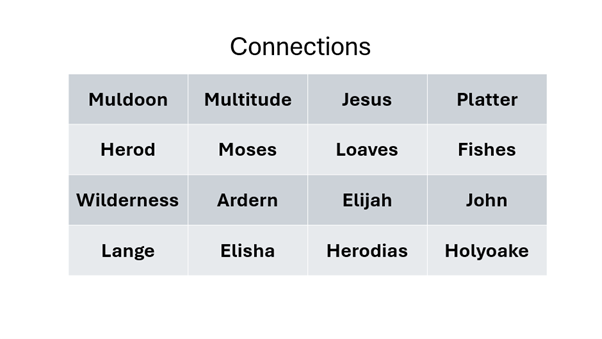
For example, among the 16 words you are given, you might have four names like Holyoake, Muldoon, Lange and Ardern. The connection there is pretty obvious. They are all former Prime Ministers of New Zealand.    

What about Multitude, Wilderness, Loaves and Fishes? What connection do you see with those words? Yes, Jesus’ feeding of the 5000. Today our message focuses on Matthew 14, verses 13-21, which describes Jesus’ miracle of feeding a multitude with just a handful of loaves and fishes.

This event is recorded in all four gospels and it finds multiple connections with the Old Testament as well. The feeding of the 5000 is a nexus point of Biblical connections. From Matthew 14, verse 13 we read…

13 When Jesus heard what had happened, he withdrew by boat privately to a solitary place. Hearing of this, the crowds followed him on foot from the towns. 14 When Jesus landed and saw a large crowd, he had compassion on them and healed their sick. 15 As evening approached, the disciples came to him and said, “This is a remote place, and it’s already getting late. Send the crowds away, so they can go to the villages and buy themselves some food.”

16 Jesus replied, “They do not need to go away. You give them something to eat.” 17 “We have here only five loaves of bread and two fish,” they answered. 18 “Bring them here to me,” he said. 19 And he directed the people to sit down on the grass. Taking the five loaves and the two fish and looking up to heaven, he gave thanks and broke the loaves. Then he gave them to the disciples, and the disciples gave them to the people. 20 They all ate and were satisfied, and the disciples picked up twelve basketfuls of broken pieces that were left over. 21 The number of those who ate was about five thousand men, besides women and children.

May the Spirit of Jesus illuminate God’s word for us.

Two main things I want to draw your attention to in this passage:

Jesus’ leadership and Jesus’ faith. We begin with Jesus’ leadership. The light of Jesus’ leadership shines brightly against the darkness of Herod’s reign.  

Leadership:

When you see (or hear) the words, Herod, platter, John and Herodias, what do you think of? Surely the beheading of John the Baptist.

John was the forerunner to Jesus, the prophet who came to prepare the way for the Messiah. John was Jesus’ ally, his wing man if you like. More than that, they were cousins.

In Matthew 14, verses 1-12, we read how Herod Antipas had John the Baptist killed. Herod was the puppet ruler of Galilee during the time of Jesus. He was a ruthless and depraved man.

When John the Baptist called Herod out on some of the bad stuff he was doing, Herod had John thrown in prison. Then when the daughter of Herodias danced for Herod, he promised to give her whatever she wanted. Herodias told her daughter to ask for John’s head on a platter.

After John had been beheaded, John’s disciples buried his body and told Jesus what had happened.

Given these facts, Jesus’ response to Herod is interesting. Jesus did not confront Herod; he did not organize a protest outside Herod’s palace or lead a revolt against Herod. Jesus did not seek revenge. Instead, Jesus quietly withdrew to a solitary place. Why?

Well, there was probably more than one reason. Perhaps Jesus did not want to inflame an already volatile situation. What Herod had done was a gross injustice. Anger and outrage are the natural response to injustice.

If Jesus confronted Herod or led a protest against him, it would have resulted in more violence. A calm head and a strategic withdrawal were necessary for the sake of peace. This was not a time for Jesus to be distracted from his core mission.

It appears too that Jesus needed some alone time; a short spiritual retreat to deal with his own feelings arising from John’s murder, but also to commune with God and seek his Father’s will on what his next move should be.   

With God, small things can make a big difference. Seeking solitude may seem like a small thing, but (in the context of Matthew 14) it accomplished much good and avoided even greater evil.

I wonder if Jesus had Psalm 37 in mind when he chose to put distance between himself and Herod. In verse 7, David writes…

Be still before the Lord and wait patiently for him; do not fret when people succeed in their ways, when they carry out their wicked schemes. Refrain from anger and turn from wrath; do not fret—it leads only to evil. For those who are evil will be destroyed, but those who hope in the Lord will inherit the land.

Jesus had faith that God Almighty would deal with Herod, and the Lord did deal with him. Some years later, in Acts 12, we read how an angel of the Lord struck Herod down. He was eaten by worms and died. God is just.

When the crowds worked out where Jesus was headed, they walked around the lake on foot and met him on the other side, in the wilderness. Seeing the large crowd, Jesus had compassion on them and healed their sick.

Compassion is the key word here. Compassion, in this context, is that deep feeling of empathy which moves a person to acts of kindness. Compassion speaks of an intimate connection, a heart and hand response to others in need. Compassion puts aside any thought of personal convenience or comfort for the sake of another person’s wellbeing.

Seeing all those people lost and confused, by what Herod had done to John, evoked a gut response from Jesus. The Lord was deeply moved in the core of his being. Rather than venting his spleen at Herod, Jesus used his emotional energy to heal and feed people.

By putting the account of Herod’s murder of John the Baptist alongside the account of Jesus’ compassion for the people, we (the reader) are invited to compare and contrast Herod’s leadership with Jesus’ leadership.

Herod was self-indulgent, brutal and destructive. Herod threw wild parties at the expense of the poor. He showed no restraint and it resulted in him taking the life of a righteous man. Herod’s leadership was toxic to the people.

In contrast, Jesus shows compassion for the poor. Jesus heals the sick, feeds the hungry and protects the vulnerable. Jesus demonstrates the kind of good shepherd leadership God wants for his people.

Those who are familiar with the Old Testament will see here a connection between Jesus and God’s word through the prophet Ezekiel…  

11 “I, the Sovereign Lord, tell you that I myself will look for my sheep and take care of them 12 in the same way as shepherds take care of their sheep that were scattered and are brought together again. … 14 I will let them graze in safety in the mountain meadows and the valleys and in all the green pastures of the land of Israel. 15 I myself will be the shepherd of my sheep, and I will find them a place to rest. I, the Sovereign Lord, have spoken.

By caring for the people in the wilderness, Jesus was acting as the divine shepherd leader of Israel, who has compassion on his people.

Okay, so we have talked about Jesus’ leadership, in contrast to Herod’s abuse of power. We also notice Jesus’ faith. Jesus models for us complete trust in God the Father.

Jesus’ faith:

The story is told of a soldier who was separated from his unit. The fighting had been intense, and in the smoke and the confusion, he had lost touch with his mates.

Alone in the jungle, he could hear enemy soldiers coming in his direction. Scrambling for cover, he found his way up a ridge to several small caves in the rock. Quickly he crawled inside one of the caves.

Although safe for the moment, he realized that once the enemy soldiers swept up the ridge, they would quickly search all the caves and he would be killed.

As he waited, he prayed, “Lord, if it be your will, please protect me. Whatever your will though, I love you and trust you. Amen.”

After praying, he lay quietly listening to the enemy begin to draw close.

He thought, “Well, I guess the Lord isn’t going to help me out of this one.”

Just then he saw a spider begin to build a web over the front of his cave. As he watched, listening to the enemy searching for him, the spider layered strand after strand of web across the opening of the cave.

“Hah” he thought, “what I need is a brick wall and what the Lord has sent me is a spider web. God does have a sense of humour.”

As the enemy drew closer, he watched from the darkness of his hideout and could see them searching, one cave after another. When they came to his cave, he got ready to face his end. To his amazement, though, they moved on.

Suddenly, he realized that with the spider web over the entrance, his cave looked as if no one had entered it for quite a while.

“Lord, forgive me,” the soldier prayed, “I had forgotten that in you a spider’s web is stronger than a brick wall.”

With God, small things can make a big difference. 

Take plankton for example. Plankton are small. Many types of plankton are microscopic in fact, smaller than a human blood cell, and yet they feed whales, the largest of mammals.

More than simply being a food source though, phytoplankton produce somewhere between 50% and 80% of the earth’s oxygen. God supports life on earth using tiny plankton.

Phytoplankton also absorb carbon dioxide helping to regulate the earth’s climate by removing greenhouse gas, from circulation.

With God, small things can make a big difference.  

Returning to Matthew 14. Jesus (the shepherd leader) had been ministering to people most of the day. It was getting late, so the disciples suggested to Jesus that he send the crowd away to the nearby villages to buy some food for themselves.

Given there were well over 5000 people present, this was not really a practical solution. It is unlikely the surrounding villages could cater for that number of people.

Jesus has another idea. ‘You give them something to eat’, he tells his disciples.

The disciples raise the obvious objection that they only have five loaves and two fish.  

In the gospel of John, we learn that these five loaves and two fish belonged to a boy. The loaves were made from barley. Barley bread was the food of the poor and the fish was probably small and pickled (like sardines).

It appears this boy was not well connected. He did not come from a wealthy family and his lunch was pretty ordinary.

Jesus is not phased though. He says, ‘bring them here to me’. And he directed the people to sit down on the grass. Green grass does not grow all year round in the middle east, like it does in New Zealand. The mention, therefore, that there is grass tells us it is springtime, Passover season.  

The Jewish Passover celebrates God’s deliverance of Israel from slavery in Egypt. We (the reader) are meant to see a connection here between God’s deliverance under Moses and the deliverance God brings under Jesus’ leadership.

In verse 19 we read how Jesus took the five loaves and the two fish and looking up to heaven, he gave thanks and broke the loaves. Then he gave them to the disciples, and the disciples gave them to the people. 

Here we see Jesus acting in faith that God would provide. As one commentator puts it, Jesus simply gave thanks for the food, confident that he represents the Father’s will.

In Jesus’ hands those five loaves and two fish fill the bellies of well over 5000 people, so that everyone had more than enough to eat.

Some people try to explain this miracle away, in various rational ways, but doing that empties this event of its meaning, robbing us of wonder and hope in the process. Jesus trusted God his Father completely and the Father honoured Jesus’ faith.

With God, small things can make a big difference.

Looking at our game of Connections once again we see there are four words left, names actually: Jesus, Moses, Elijah and Elisha. What do these four men share in common?

They were all prophets of the living God, offering spiritual leadership for the people. More than that, they all trusted God to provide for their needs and consequently participated in a feeding miracle. 

When the people of Israel cried out to Moses for food in the Sinai desert, Moses did not try to engineer a solution himself. He turned to God in prayer and the Lord God provided an abundance of manna and quail.

When God told the prophet Elijah to hide in the wilderness east of the Jordan, with no supermarket in sight, Elijah obeyed the Lord in faith, and God had ravens bring bread to feed him.

When a man brought the prophet Elisha 20 loaves of barley bread, Elisha told the man (in faith) to give the bread to the people. The 20 loaves fed 100 men and there was some left over.  

So, when we read how Jesus had faith in God to multiply five loaves and two fish to feed over 5000 people in the wilderness of Galilee, we see that in Jesus someone greater than Moses, Elijah and Elisha has come. Jesus is more than a prophet.

With God, small things can make a big difference.

Now in saying this, I do not mean to imply that we can be stingy with God, giving him our scrapes. The boy who offered his five loaves and two fish, gave Jesus everything he had. The boy was generous.

The point is, even when we give our best and our all, it may seem like a drop in the bucket. Our best and our all will usually fall short of the ocean of human need. But that is no reason to give up in despair. We can only do what is in our power to do and trust God with the outcome.   

Hearing this miracle story of Jesus feeding the multitudes is lovely and inspiring, but when we watch the news, we become painfully aware of the millions in our world today who are starving. Why doesn’t God feed them?

Well, God has provided enough to feed everyone on the planet. It’s not a production problem; it’s a distribution problem. Human greed and fear often get in the way.

Jesus trusted his disciples to distribute the food to the multitude and the disciples were faithful in carrying out the task Jesus gave them. In the end, there were 12 basketfuls left over, one for each of the disciples.  

Conclusion:

This morning we have observed multiple connections, all orbiting around Jesus and the miraculous feeding of the 5000 in the wilderness. There’s just one more connection we need to make. This too finds its fulfilment in Christ.

Centuries before Jesus came, the Lord God gave the prophet Isaiah a glimpse of a future heavenly banquet, with food far richer than barley bread and pickled fish. From Isaiah 25 we read…

On this mountain the Lord of hosts will make for all peoples a feast of rich food, a feast of well-aged wine, of rich food full of marrow, of aged wine well refined. And he will swallow up on this mountain the shroud that is cast over all peoples, the veil that is spread over all nations. He will swallow up death forever; and the Lord God will wipe away tears from all faces, and the reproach of his people he will take away from all the earth, for the Lord has spoken.

Jesus is the one who removes the shroud of death. It is through faith in Jesus (his death and resurrection) that we have sure hope of participating in God’s heavenly banquet.

Let us pray…

Gracious God, you know our every need and you care for us. Thank you for Jesus, the good shepherd, who leads us in paths of righteousness and restores our soul. Grant us the grace to follow Jesus all the days of our life and enjoy you forever. Amen.   

Questions for discussion or reflection:

  1. What stands out for you in reading this Scripture and/or in listening to the sermon? Why do you think this stood out to you?
  2. Why did Jesus withdraw to a solitary place after hearing how Herod had killed John? What good did Jesus’ retreat accomplish? (What evil did it prevent?)
  3. What is compassion? What (or who) moves you to acts of kindness?
  4. Compare and contrast Jesus’ shepherd leadership with Herod’s abuse of power. How do you experience Jesus’ care and provision?
  5. Discuss / reflect on the connections you notice between Jesus’ feeding of the 5000 in Matthew 14 and other feeding miracles in the Bible. How are these miracles similar? How are they different?
  6. In what ways do we see Jesus’ faith operating in Matthew 14?
  7. What small thing can you do (in faith) to show God’s love and care for others?     

Ravens

Scripture: 1 Kings 17:1-6

Video Link: https://youtu.be/hVTLHhUvvFQ

Structure:

  • Introduction
  • Anti-heroes
  • Elijah
  • Ravens
  • Conclusion

Introduction:

Good morning everyone.

Can anyone tell me what a group of ravens is called? [Wait] That’s right, a group of ravens is often called an unkindness.

But you sometimes also hear terms like a treachery of ravens or a conspiracy of ravens. Unkindness, treachery, conspiracy, these are not very friendly words. Clearly, there is something a bit sinister or spooky about ravens in the human imagination. 

Today we continue our series on birds of the Bible. Last week we considered the ostrich. Today our message focuses on the raven

One of the classic Bible stories involving ravens comes from the Old Testament book of First Kings. In this account ravens are not associated with unkindness or treachery. To the contrary, they serve as instruments of God’s faithfulness and provision. From verse 1 of First Kings 17 we read… 

Now Elijah the Tishbite, from Tishbein Gilead, said to Ahab, “As the Lord, the God of Israel, lives, whom I serve, there will be neither dew nor rain in the next few years except at my word.” Then the word of the Lord came to Elijah: “Leave here, turn eastward and hide in the Kerith Ravine, east of the Jordan. You will drink from the brook, and I have directed the ravens to supply you with food there.” So he did what the Lord had told him. He went to the Kerith Ravine, east of the Jordan, and stayed there. The ravens brought him bread and meat in the morning and bread and meat in the evening, and he drank from the brook.

May the Spirit of Jesus illuminate God’s word for us.

Anti-heroes:

You may have heard of the term ‘anti-hero’. An anti-hero is a central character in a story who lacks conventional heroic attributes. Anti-heroes are like flawed heroes. Anti-heroes blur the line between protagonist and antagonist. They may even seem like the bad guy at first, but in the end they are revealed to be the one who saves the day.

Examples of anti-heroes in the movies include Shrek, Snake Plisskin, Deadpool, Professor Snape and Robin Hood. They are unlikely heroes. In the context of First Kings 17, the raven is also something of an anti-hero. No one would think that God would use a raven to care for Elijah and yet he does.

The Law of Moses declared ravens to be ceremonially unclean and therefore not fit for human consumption. Ravens are birds of prey. Like vultures they feed off dead carcasses, among other things. You don’t eat ravens because ravens eat road kill.

Now in saying that ravens are ceremonially unclean, we don’t mean they are evil or bad. Ravens are one of God’s creatures and God’s creation is good. But as a non-kosher food, ravens came to be looked upon as something that God’s people should avoid.

A couple of weeks ago we heard about Noah sending a dove out of the ark to see if the flood waters had receded. Well, the dove wasn’t the first bird Noah sent. In verse 7 of Genesis 8, we read that God sent out a raven but (unlike the dove) the raven did not come back. It kept flying around.

The inference seems to be that the raven did not return to the ark because it found a smorgasbord of dead flesh to feast on.

The raven stands in stark contrast to the dove. The dove is gentle and winsome, a symbol of new life and peace. While the raven is wild and associated with death, rapaciously feeding off the left overs of judgement.

The ravens’ connection with death and judgement is seen again in Proverbs 30, verse 17, which reads…

The eye that mocks a father, that scorns an aged mother, will be pecked out by the ravens of the valley, will be eaten by the vultures.

The fifth command, to honour your father and mother, comes with a blessing attached; that you will live long in the land the Lord your God is giving you. The flip side to this blessing is that if people cursed (or mistreated) their parents they should be put to death.

Proverbs 30:17 is talking about the outcome for those who do not take care of their mum & dad. To have one’s eyes pecked out by ravens implies being killed and not receiving a proper burial, so one’s body is left out in the open for birds to eat. This is a poetic way of saying, if you don’t respect your parents, then no one will respect you.

Given these sorts of horrific images, it is little wonder that ravens are considered a bad omen, associated with death and judgement.

As scavengers that feed off the misfortune of others, ravens don’t fit the classical profile of a hero. They are more like the anti-hero in the Elijah story.

Elijah:

The prophet Elijah is also something of an anti-hero. Elijah is a complete unknown. He pops up in the history of the kings of Israel out of some place no one has heard of. He doesn’t come from a famous family. There is nothing especially impressive about him. And, from what we can tell, he appears to be prone to bouts of depression.

Despite his lack of pedigree and his loneliness, God’s Spirit was with Elijah making him brave.

Elijah lived at the same time as king Ahab. King Ahab reigned over Israel for 22 years and did more evil in the eyes of the Lord than any of the kings before him. Ahab was not an anti-hero; he was 100% villain.

Together with his infamous wife Jezebel, Ahab built a temple in Samaria for the worship of Baal, something forbidden by God.

Baal was the pagan god of fertility and weather. People in ancient times sacrificed to Baal (and did a whole lot of other terrible things besides) in the vain hope that he would make it rain so their crops would grow and they would not starve. But Baal does not control the weather.  

Yahweh, the Lord, the living God, does not want people to worship Baal or anything else because that is meaningless, empty, a waste of time, a lie. Even worse, it leads people to degrade themselves and hurt others.

These days, people in the western world don’t normally bow down to statues of wood and stone but we do have a tendency to worship things like money, sex, reputation, personal freedom, career and so on.

These things are not bad in themselves. In fact, they may be used for good. But if we make any of them the most important thing in our life, then they have a destructive effect on our own soul and in our relationships.

Given that many Israelites were vainly putting their trust in false gods to make it rain, the Lord (in his love for Israel) was moved to do something about it. In order to demonstrate that Baal was powerless and that Yahweh was Israel’s true provider, the Lord sent Elijah to tell king Ahab that it was not going to rain for a few years, nor would there be any dew.

In other words, Baal does not control the weather, the Lord God almighty is in charge, therefore trust him.

Notice the way Elijah says: “As the Lord, the God of Israel, lives, whom I serve…”  There are two rebukes implicit in this phrase. Firstly, Elijah is telling king Ahab that Yahweh, is the living God; not Baal.

And secondly, Elijah is saying he serves Yahweh, not king Ahab or anyone else. There is no flattery, no charm, no spin.

Elijah was risking his life by confronting Ahab in this way. This was a heroic thing to do. And yet Elijah is an anti-hero because he is doing something we don’t expect of a hero.

We would expect the hero to defeat the villain, and save the nation from disaster. But Elijah does not do this, at least not straight away. Elijah becomes God’s instrument for bringing about a famine across the land. Elijah’s ministry precipitates disaster. This is tough love, a way of bringing the nation to its senses. Elijah is both protagonist and antagonist.

For Elijah’s protection, the Lord instructed his prophet to hide in the Kerith Ravine, east of the Jordan.

We don’t know exactly where the Kerith Ravine is today but a ravine with a stream running through it is an interesting choice. Ravines in the Middle east are prone to flash flooding. You wouldn’t ordinarily camp out in a ravine because if it rains suddenly, you could be swept away and drown.

Of course, if it doesn’t rain then you are at no risk of drowning. By obeying God and hiding in a ravine, Elijah was putting his money where his mouth was. He was showing through his actions that he trusted God’s word to him that it would not rain.

The Lord goes on to say to Elijah, “You will drink from the brook, and I have directed the ravens to supply you with food there.”

Anyone who is familiar with the Law of Moses would be somewhat surprised by this. As we’ve already noted, ravens are ceremonially unclean birds. They are associated with judgement and death. Why would God use ravens to feed his prophet?

Well, Elijah is not eating the ravens themselves, so he is not breaking the law. Given that Elijah is in hiding, it makes sense to use ravens to courier the food. Elijah can’t leave the ravine without risk of being spotted. Ravens flying around in the wilderness are not going to give away Elijah’s hiding place.  (The ravens were sort of like God’s Uber Eats.)  

Ravens

Yahweh’s use of ravens to feed his prophet is a criticism of Israel. Unlike Israel, the ravens obey God’s command. They are faithful servants of Yahweh. If the so called ‘unclean’ ravens are serving Yahweh, how much more should God’s holy people serve the Lord?

When we consider the way God made the raven, we can see it is a fitting choice to feed Elijah. The raven mirrors Elijah, as a sign, embodying God’s message to Israel. It’s like God is saying, the raven (the anti-hero bird) has something to teach you about how you should relate with me.

Ravens are highly intelligent birds, with relatively large brains for their body size. Ravens are smart enough to craft tools and plan for the future, as well as play games like hide and seek.

Unlike king Ahab, who lacks the understanding to realise he is wrong, ravens are intelligent enough to understand what God wants and do it. If a bird is smart enough to understand what God wants, then we human beings have no excuse.

Ravens are excellent hunters. They often hunt in groups enabling them to trap and kill prey twice their size. Just as ravens are excellent hunters, able to provide Elijah with bread and meat (suitable for human consumption), so too God is an excellent provider and can be trusted to feed his people.

In the gospel of Luke chapter 12, Jesus says this to his disciples…

22 “Therefore I tell you, do not worry about your life, what you will eat; or about your body, what you will wear. 23 For life is more than food, and the body more than clothes. 24 Consider the ravens: They do not sow or reap, they have no storeroom or barn; yet God feeds them. And how much more valuable you are than birds! 

Jesus’ teaching here is not an excuse for folding your hands and doing nothing. The ravens still have to gather their food, just as we human beings still need to work to earn money to buy food.

The point is, God knows what we need and is well able to provide it, so we don’t need to worry. Worry is the cousin of Baal worship. By the same token, we do well to take a leaf out of the ravens’ book and be resourceful in using whatever is at hand.   

Ravens can remember faces. Whether you are kind to a raven or cheat a raven, it will remember your face and treat you accordingly. The Israelites of Elijah’s day had forgotten their covenant with the Lord. They had forgotten the Lord’s face, as it were. They needed to be more like the raven and remember God’s goodness to them.

At the end of the service most weeks, I pray a blessing over you which includes the phrase, may the Lord make his face shine upon you. In other words, may God smile on you. May he show you favour and grace. May he be pleased with you and may you feel his pleasure.

There is a lot that happens to us in this world to make us forget the Lord. Remember God’s face. Remember your commitment to him and remember the ways the Lord has made his face shine upon you. Thank him for his goodness. 

Ravens are good communicators, with the ability to point to things with their beaks and hold up items of interest as a way of making conversation. Ravens can even mimic human voices better than a parrot.

The Scripture doesn’t say this but I can’t help imagining the ravens communicating with Elijah, pointing at things and perhaps even mimicking what he said. Certainly they communicated something of God’s faithfulness in returning to feed Elijah each morning and evening.

We human beings are made for relationship, especially relationship with God. Communication is how we establish and maintain our relationships. Prayer is the word we use to describe our communication with God.

The people of Elijah’s day were not talking to the living God. They were talking to dead pieces of wood and stone. In essence they were talking to themselves. Keep talking to God. And when you don’t know what to say, mimic the words of Jesus. Pray the Lord’s prayer.

One other thing about ravens, they are faithful. Ravens mate for life. The Lord is faithful too. God wants an exclusive relationship with us. The Lord wants us to trust him. Yahweh desires our obedience of faith. As we read in Psalm 147…

The Lord gives animals their food and feeds the young ravens when they call. 10 His pleasure is not in strong horses, nor his delight in brave soldiers; 11 but he takes pleasure in those who honour him, in those who trust in his constant love.

The ravens trust God and honour him. We can too.  

Conclusion:

Okay, so if the ravens and Elijah are like anti-heroes, then what about Jesus? Well, Jesus doesn’t exactly fit the category of anti-hero. Yes, Jesus is the hero of God’s story but he breaks the mold. He redefines what it means to be a hero.

Jesus is not flawed like your classic anti-hero. Jesus is perfect. That being said, Jesus is misunderstood and rejected by many, precisely because he does what we don’t expect the hero to do. Jesus loves his enemies and forgives those who are killing him, even as he bleeds out on a cross.  

Here’s the thing about Jesus. Jesus shows us the face of God. It’s a face of forgiveness. The face of grace. The face of acceptance. A face that smiles on you.

Let us pray…

God of grace, help us to trust you and remember your face, as we go into this week. Through Christ we pray. Amen.

Questions for discussion or reflection:

What stands out for you in reading this Scripture and/or in listening to the sermon? Why do you think this stood out to you?

  • What is an anti-hero? Can you think of examples of anti-heroes from books or films?
  • In what ways is the raven like an anti-hero? In what ways is Elijah like an anti-hero?
  • Why is the worship of Baal bad? What sorts of things do people today typically worship? What (or who) do you worship? Is there anything in your life that threatens to take God’s place?
  • Why did God choose ravens to feed Elijah? What can ravens teach us about how we are to relate with God?
  • What practical things can you do to remember God’s face?
  • What spiritual qualities do you share with the raven?  What raven like qualities would you like to develop?

Energy Part 2 – The Soul’s Energy

Scripture: 1st Kings 19:10-18

Title: Energy – Part 2 (Energy for the soul)

Structure:

  • Introduction
  • Treat the cause and the symptoms
  • Recovering the soul’s energy
  • Conclusion

Introduction:

Today we continue our series on well-being and care of the soul, using the acronym: HEALING.

–         Each letter represents a word which, when properly applied, is life giving to the human soul…

–         Hope Energy Appreciation Lament Inter-dependence Nurture & Giving

–         Last Sunday we heard about the body’s energy

–         Today our message focuses on the soul’s energy

When we talk about energy, as it relates to people, we mean the strength, vitality or power required for activity.

–         Energy is one of the resources we need to function and get things done.

–         Depression is a state of very low energy or exhaustion.

To help us explore this subject of the soul’s energy we will continue looking at an episode in the life of Elijah – from 1st Kings, chapter 19

–         Elijah was one of the great prophets of Israel

–         In 1st Kings 19 Elijah is on the run for his life after defeating the prophets of Baal. He is at a very low ebb – physically & emotionally exhausted

–         Last Sunday we heard how an angel restored Elijah’s physical strength with food and sleep. This morning we pick up the story from verse 10…

Then the word of the Lord came to him, saying, “What are you doing here, Elijah?” He answered, “I have been very zealous for the Lord, the God of hosts; for the Israelites have forsaken your covenant, thrown down your altars, and killed your prophets with the sword. I am the only one left, and now they are trying to kill me too.”

He said, “Go out and stand on the mountain before the Lord, for the Lord is about to pass by.” Now there was a great wind, so strong that it was splitting mountains and breaking rocks in pieces before the Lord, but the Lord was not in the wind; and after the wind an earthquake, but the Lord was not in the earthquake; and after the earthquake a fire, but the Lord was not in the fire; and after the fire a sound of sheer silence. When Elijah heard it, he wrapped his face in his mantle and went out and stood at the entrance of the cave.

Then there came a voice to him that said, “What are you doing here, Elijah?” He answered, “I have been very zealous for the Lord, the God of hosts; for the Israelites have forsaken your covenant, thrown down your altars, and killed your prophets with the sword. I am the only one left, and now they are trying to kill me too.”

Then the Lord said to him, “Go, return on your way to the wilderness of Damascus; when you arrive, you shall anoint Hazael as king over Aram. Also you shall anoint Jehu son of Nimshi as king over Israel; and you shall anoint Elisha son of Shaphat of Abel-meholah as prophet in your place.

Jehu will put to death any who escape the sword of Hazael, and Elisha will put to death any who escape the sword of Jehu. Yet I reserve seven thousand in Israel, all whose knees have not bowed down to Baal, and all whose mouths have not kissed him.”

May the Spirit of Jesus illuminate God’s word for us

Last week I talked about the body’s energy and the importance of maintaining healthy rhythms and balance with our sleeping and eating

–         This morning our focus is the soul’s energy

–         By the soul’s energy I mean things that feed our mind, emotions & spirit

–         This is not to say that the body & soul are separate or unrelated

–         To the contrary there is a close relationship between our body & soul so that what happens to our soul can affect our body and vice versa

–         Nevertheless, the soul needs different things from the body – we cannot live by bread alone


Treat the cause and the symptoms:

If we think of our whole person like a tree, then the roots are sort of like the soul, while the branches are like the body

–         Meaning or purpose is like the soil which feeds the roots of our soul and enables our whole life (body & soul) to stand

–         Just as you can’t see the roots of a tree because they are underground, so too you can’t see your soul in a physical sense, but you can see the effects of the soul – you can see the fruit in other words

–         The fruit represents the health (or sickness) of the body & soul

–         The fruit of the tree is only a symptom, not the cause

–         For example the fruit might be pain or it might be joy

–         It might be cynicism or it might be faith

–         So often when the fruit in our life is unpalatable, or not enjoyable, we treat the symptom with a pain killer, while ignoring the root or the underlying cause


To illustrate the importance of treating the cause, as well as the symptoms, let me give you some scenarios. Here’s the first one…

–         You are at sea in your boat and it starts to leak. Land is 5 days away and your radio is broken so you can’t call for help. What do you do? Do you..

–         A.) Ignore the leak and carry on?

–         B.) Empty the water out by hand?

–         C.) Patch the leak?

–         D.) Both B & C – patch the leak and empty the water out?

–         Yes, I reckon D is the best answer – deal with the cause (which is the hole) and the symptom (which is water in the boat)


Here’s another scenario…

–         You break your leg falling out of a tree – what do you do? Do you…

–         A.) Take a painkiller?

–         B.) Go to hospital to get treatment for your leg?

–         C.) Both A & B

–         D.) Harden up and climb back into the tree?

–         Yes, I reckon C is the best answer – deal with the cause (which is the broken leg) and the symptom (which is the pain)


One more scenario…

–         Your body breaks out in hives because you’ve been eating too many apples – what do you do? Do you…

–         A.) Eat more apples to condition your body against hives?

–         B.) Keep eating apples and take an antihistamine?

–         C.) Stop eating apples and take an antihistamine?

–         D.) Blame God for the suffering he has caused by making apples?

–         I reckon C is the best answer. If you keep eating apples while taking an antihistamine you might deal with the symptoms but you’ll never address the cause of the problem


Recovering the soul’s energy:

As we heard last week Elijah was in a state of abject despair – he was so down he had asked God to take away his life but God refused to euthanize Elijah

–         Instead the Lord began to restore Elijah by providing him with food and rest

–         But Elijah knows the problem runs a lot deeper than being physically tired & hungry

–         Once he has recovered his physical strength Elijah is able to address the needs of his soul (the root cause of his despair) and he does this by going on a spiritual retreat – by walking off into the wilderness to meet with God at Mount Horeb


Put yourself in Elijah’s shoes for a moment – 40 days on your own, walking through the wilderness – what is that doing to Elijah’s soul?


Well, for starters, we know that physical exercise and spending time in nature is actually good for the human soul in that it renews our perspective

–         When we are walking in the mountains or by the ocean or looking at the stars at night we are reminded that it’s not all about me

–         We are part of a something much larger than us and our problems

Of course, Elijah probably walked through nature a lot – so he wouldn’t have been as disconnected from God’s creation as a modern city dweller might be

–         So simply walking through the wilderness wasn’t going to be enough to sort out Elijah’s soul – he needed something more than that


The psychologist Carl Jung had a theory that we each have a number of sides to our personality – including an extroverted side and an introverted side

–         However, we usually have a preference for either one or the other – sort of like we have two hands with a preference for using either our right or our left

Introversion and extroversion is about where we get our mental or emotional energy from – it’s about what recharges us and what drains us

–         Introverts usually recharge their batteries by spending time alone or with just one or two other people

–         Going to a party where there are lots of people and lots of small talk is exhausting to an introvert

–         Extroverts are the other way inclined – they love lots of activities and lots of people around – being on their own is usually exhausting for them

–         Introverts prefer to process their thoughts internally before speaking

–         Whereas extroverts prefer to think out loud – they speak in draft

One of the things we need to do to take care of our soul is understand whether we have a preference for extroversion or introversion and make sure we manage our life in such a way that our soul gets the balance it needs

–         So, if you discover that you are an extrovert then having a job where you get to interact with other people a fair bit will be good for you

–         Whereas a job where you are alone a lot probably isn’t such a good match

–         Or if you discover that you are an introvert then after a busy week at work you will need to plan your weekend with some quiet time in it

–         Or if you are at a party and you need a break from people you might go and do the dishes – because that’s less tiring than talking

This introversion / extroversion stuff is something I’ve found to be true and helpful in my own experience


I asked the question before, what would it have done to Elijah’s soul to be on his own for 40 days in the wilderness?

–         Well, it probably depends on whether he was an extrovert or an introvert

–         I don’t know if Jung’s theory applied in the ancient world but if it did then I suspect Elijah was an introvert and the time alone (after the conflict with the priests of Baal) would have been what his soul needed

–         Too much time on the front line facing your enemies is exhausting for anyone, whether you’re introverted or extroverted – Elijah needed some respite from the battle, which his spiritual retreat would have provided

–         Time alone would have also given Elijah opportunity to process his thoughts, internally, so he knew what he wanted to say to God

–         However, too much time alone isn’t good for your soul either, even if you are an introvert – everyone needs social connection and community


When he finally reaches Horeb Elijah finds a cave to shelter in for the night and God gets him talking (presumably Elijah hadn’t talked to anyone for 40 days)

–         God asks Elijah, ‘What are you doing here?’ and when Elijah speaks, the Lord listens patiently

–         To some degree listening releases people from the burdens & pain they carry and in this way helps to restore energy to the soul

–         Listening well is a fine art – it requires both grace & truth

–         On the one hand Elijah needed God to listen in a way that made him feel safe – without judgement or criticism

–         At the same time he also needed God to gently challenge what is false

You see, each of us is telling ourselves a story – we are playing a script over and over in our mind to help make sense of our lives

–         It’s like breathing – we usually do it without thinking about it

–         The story we tell ourselves is like the soil in which we are planted – it feeds our soul with meaning & purpose

–         We need to be careful that the story we are telling ourselves is true

–         If we tell ourselves things that are not true then the roots of our soul are feeding on what is false and the tree of our life becomes sick

For example, when a child is mistreated by the adults in their life they will often tell themselves that it is their fault – that they somehow deserved this

–         No one else would say it was their fault, but that’s the story they tell themselves to help make sense of what has happened to them

–         Adults are supposed to care for me but they haven’t in this situation

–         Adults are always right therefore I must be wrong

When the child grows up they usually carry that story into adulthood

–         They think they are responsible for all the bad things that happen to them

–         They develop a sense that they are not worth much and they don’t take care of themselves very well

–         Not everyone who is mistreated responds in this way but many do


So what story is Elijah telling himself? In verse 10 Elijah says to the Lord…

“I have been very zealous for the Lord, the God of hosts; for the Israelites have forsaken your covenant, thrown down your altars, and killed your prophets with the sword. I am the only one left, and now they are trying to kill me too.”

On the face of it, it would appear that what Elijah is telling himself is true

–         It is true the authorities are trying to kill Elijah

–         And it’s true that Elijah has been very zealous for the Lord

–         He has dedicated his whole life to serving the God of hosts

–         He has put all his eggs in one basket

–         He doesn’t have a plan B or a retirement fund

However, when we dig beneath the surface we see that much of the story Elijah is telling himself is not true

–         The sub text to Elijah’s story goes like this…

–         ‘I am alone in this task – it all depends on me and I have failed

–         My mission was to turn the hearts of the people back to God

–         To make people aware of their sin and lead them to repentance

–         But no one has heeded my call, therefore my life’s work has been for nothing – my life is meaningless

–         Because it all depends on me and because I have failed, Israel has no future and I have no future – so there’s no point in carrying on’

–         This is the story that Elijah’s soul has been feeding on for months, maybe years – no wonder the fruit of his life is pain & despair

–         No wonder he wants it to end

What Elijah needs is a new story – one that is true and good for his soul

–         So that’s what God gives him

Elijah’s story excludes God – Elijah’s story imagines that evil has won and that God is powerless to do anything about it

–         Consequently God reminds Elijah of his power & presence. From vs 11…

Now there was a great wind, so strong that it was splitting mountains and breaking rocks in pieces before the Lord, but the Lord was not in the wind; and after the wind an earthquake, but the Lord was not in the earthquake; and after the earthquake a fire, but the Lord was not in the fire; and after the fire a sound of sheer silence.

The wind, the earthquake and the fire are all powerful forms of energy

–         In the past God had made his presence manifest to his servants through earthquake, wind & fire – but not this time

–         God does not come to Elijah in force as we might expect

–         No – the Lord comes to Elijah in sheer silence

–         God’s presence, in verse 12, can also be translated as a gentle whisper or a still small voice – I guess God’s presence can’t be easily defined

Perhaps the point is: Elijah had expected God to behave in a certain way but when the Lord didn’t behave as Elijah expected Elijah lost hope

–         However, just because God doesn’t turn up in the way we expect doesn’t mean he is absent or powerless

–         No one expected the Son of God to turn up as a baby born in a manger and yet that is how God chose to reveal his presence to humankind

–         In vulnerability and innocence


Now you would think after that incredible display of God’s power & presence the problem’s with Elijah’s soul and story would all be sorted

–         But that was not the case – Elijah is not changed by the presence of God

–         When the Lord asks Elijah a second time, ‘What are you doing here?’

–         Elijah answers exactly as he did before – he is still telling himself the same story: that he is alone and that it all depends on him and he has failed so there’s no future for him, no point in carrying on

Sometimes God’s presence is not enough – sometimes we need human presence as well

–         In Genesis 2 when Adam was alone in the Garden of Eden, the Lord God said, “It is not good for man to be alone. I will make a helper suitable for him.”  


To help Elijah realise he is not alone and it doesn’t all depend on him the Lord instructs Elijah to anoint two kings (Hazael & Jehu) and an apprentice prophet (Elisha) to carry on his work

–         Jehu will deal with the bad guys that escape the sword of Hazael and Elisha will mop up the ones who escape the sword of Jehu

–         In other words, Elijah it’s not over yet, your enemies won’t win in the end

–         Nor does it all depend on you – my purpose will be achieved through a team effort.

–         Therefore you have not failed in your mission – you are vindicated

–         Your life has not been a waste. Your work is meaningful

–         What’s more, you are not a victim – you are a survivor

Finally the Lord says to Elijah, there are 7,000 others who have remained faithful to me. In other words, Elijah you are not alone as you suppose

–         God has the last word

–         Elijah now has a new story to tell himself, one that is true


Conclusion:

You know, when I think about the way God restored Elijah’s energy I’m aware that the Lord used a number of different strategies

–         He didn’t just give Elijah a pill and send him on his way

First the Lord gave Elijah food and rest – to restore his physical energy

–         Then the Lord restored Elijah’s soul by giving him time apart from his enemies – too much conflict is bad for the soul

–         Next the Lord listened to Elijah – in order to hear the story Elijah was telling himself, sort of like counselling I suppose

–         Then the Lord gave Elijah a new story, one that was true and life giving to his soul

–         God did this by revealing his power & presence to Elijah

–         And by showing him a future in which all of Elijah’s enemies were removed and he was not alone

–         The work continued with Elisha and a faithful remnant of 7000 souls


What story are you telling yourself?

–         Is it one in which you are a victim and God is powerless to do anything?

–         Is it one in which you end up alone because you think no one likes you?

–         Is it one in which the bad stuff that happens is always your fault – that you don’t deserve to be treated with respect?

–         Is it one in which you will only be accepted if you pretend to be someone you are not?

–         Is it one in which there is no redemption, no forgiveness, no future if you fail or make a mistake?

–         It is one in which everything depends on you?

–         They are just some of the false story lines (lies) we tell ourselves

–         We have to tell ourselves the truth – our soul depends on it


Two things you can do to weigh your story to see if you are telling yourself the truth or not

–         The first thing is: read the Bible on your own and in conversation with other Christians and as you read ask God to reveal the truth he wants you to know and to dismantle the lies you have come to believe

–         The second thing is: Find a good counsellor – someone who will listen to you with grace & truth – someone you feel safe with, who will gently challenge what is false in your story and affirm what is true

Jesus said, it’s the truth that sets us free


Questions for discussion or reflection:

1.)    What stands out for you in reading this Scripture and/or in listening to the sermon?

2.)    Where does the soul’s energy come from? (What feeds your soul?)

3.)    What do you think 40 days alone, walking through the wilderness, would do to Elijah’s soul?

4.)    Would you say you were an extrovert or an introvert?

–         What energises you?

–         What drains you?

–         Is your life organised in a way that gives your soul the balance it needs?

–         If not, what might need to change for that to happen?

5.)    What does it mean to listen well (with grace & truth)?

–         How might we be a safe listener?

–         When listening to others how might we gently challenge what is false?

–         How might we affirm what is true?

6.)    What is the underlying cause of Elijah’s despair?

–         (That is: What is wrong with the story he is telling himself?)

–         How does God give Elijah a new story?

7.)    What story are you telling yourself?

–         How might you verify what is true in your story and identify what is false?

8.)    Take some time this week to reflect on the meaning of verses 11-12, in its various translations. (E.g. sheer silence, still small voice, gentle whisper…)

–         What is God saying to you in these verses?


Elijah & Elisha

Scriptures: 1st Kings 19:19-21 & 2nd Kings 2


Title: Elijah & Elisha


Structure:

  • Introduction
  • The call of Elisha
  • The empowerment of Elisha
  • Conclusion


Introduction:

On the wall here we have a picture of a Maori Adze (or axe)

–         The head of the axe is made out greenstone (pounamu) and the handle is made out of wood

–         The handle has carving on it which symbolises the history or whakapapa of those leaders who have carried the adze in previous generations

–         With each new generation of leadership the greenstone head is removed and a new handle is carved for the new leader

–         So the pounamu head stays the same from generation to generation, while the handle changes

–         This means there is continuity with the past but also freshness or newness with each succeeding generation


Today we continue our series on intergenerational relationships in the Bible

–         That is, relationships between people of different ages or generations

–         This morning’s focus is the relationship between Elijah & Elisha

–         This is a relationship in which the mantle of prophetic leadership is passed from one generation to the next, so the work of God continues

–         Elisha is like the new handle for the old pounamu axe head

–         Elisha carries the word of God as Elijah did before him and as others would after him


Today’s message is in two parts:

–         Firstly, the call of Elisha and then the empowerment of Elisha


Elisha’s call:

The call of Elisha is found in 1st Kings 19, just after Elijah’s encounter with the Lord God on Mt Horeb

–         After defeating the prophets of Baal, Elijah runs for his life into the wilderness because Jezebel wants to kill him

–         Elijah feels scared and alone – he has lost his perspective, his sense of continuity (some would say he is burnt out)

–         But God meets him, not in the fire or the wind or the earthquake but in sheer silence

–         After this Yahweh tells Elijah to go and anoint Elisha son of Shaphat to succeed him as prophet

–         By giving Elijah an apprentice the Lord is making Elijah’s work less lonely and he is giving Elijah a sense of hope & continuity

–         The Lord’s work will not die with Elijah

–         From verse 19 of 1st Kings chapter 19, we read…


19 So Elijah went from there and found Elisha son of Shaphat. He was plowing with twelve yoke of oxen, and he himself was driving the twelfth pair. Elijah went up to him and threw his cloak around him. 20 Elisha then left his oxen and ran after Elijah. “Let me kiss my father and mother goodbye,” he said, “and then I will come with you.”

“Go back,” Elijah replied. “What have I done to you?”

21 So Elisha left him and went back. He took his yoke of oxen and slaughtered them. He burned the plowing equipment to cook the meat and gave it to the people, and they ate. Then he set out to follow Elijah and became his servant.


On the wall here is a picture of some Korowai

–         A Korowai is a special type of Maori cloak (or mantle) woven out of flax with tassels and sometimes feathers on it

–         It can take anywhere between 4-12 months to make a Korowai by hand

–         They are a special garment to be worn on special occasions like graduations or weddings and other important ceremonies

–         Korowai are often handed down as an heirloom from one generation to the next

–         They provide a continuity or connection with the past, present and future

–         A Korowai is reflective of honour, leadership, identity, warmth, protection, skill & beauty


One of the intriguing things about Elisha’s call is that Elijah doesn’t actually say anything to Elisha

–         Elijah simply takes his cloak (or his mantle) and throws it over Elisha

–         Elijah’s cloak wasn’t a Korowai as such, (it may have been quite ordinary for all we know) but it was nevertheless special because Elijah wore it

–         By throwing his mantle over Elisha, Elijah was effectively bestowing honour, leadership, identity, warmth, protection and skill on Elisha

–         It was an invitation for Elisha to become his successor and Elisha understood this intuitively


Another thing we note is that Elijah found Elisha at work in the fields plowing

–         To give some context the land had been in drought for over 3 years and after Elijah prayed the rains came

–         This meant that farmers, like Elisha, were finally able to get out and plow the ground and sow their crops

–         Which means Elisha was being called to leave his work at a time when things were picking up again

–         It wasn’t so much that one door closed and another opened for Elisha

–         It was more like two doors opened at the same time and Elisha had to choose which one he was going to walk through

–         Was he going to be a farmer or a prophet?


Elisha chose to follow Elijah – but first he asked permission to kiss his parents good bye


Elijah granted permission saying: “What have I done to you?”

–         It is unclear what Elijah meant by this exactly

–         It could mean, ‘you are free to choose what you do’

–         But at the same time, Elijah may have his own experience in mind so he means something like, ‘In calling you to be a prophet, I’ve called you to a difficult life. You will be lonely, misunderstood and you will lack the usual securities and comforts that other people enjoy’

–         Jesus said a similar thing to those who followed him – people will hate you because of me


Elisha is young and willing – he’s a good keen man which is just what the older more jaded Elijah needs

–         After some difficult experiences Elijah (who is recovering from burn out) is at risk of falling into cynicism and contempt

–         Elisha is a breath of fresh air for Elijah

–         I imagine Elisha’s youthful enthusiasm and sense of hopefulness inspired Elijah to be the best version of himself that he could be, for Elisha’s sake


To mark his commitment in following Elijah and God’s call, Elisha sacrifices his two bulls as a fellowship offering – there’s no turning back now

–         Sometimes choosing continuity with God’s story means discontinuity with our old way of life

–         Elisha feeds the people with the meat from his oxen

–         This is symbolic of his ministry – as a prophet Elisha will sustain people with the meat of God’s word (man cannot live by bread alone)


When I started here at Tawa, you (the congregation) gave me a mantle of sorts – a cloak in the form of a Hurricanes rugby jersey

–         I come from the Waikato / Bay of Plenty area where the Chiefs are based

–         Had I been a Chiefs supporter I suppose I would have had to burn my chiefs jersey, sort of like Elisha burned his oxen and farming equipment

–         Luckily for me I was never a Chiefs supporter


After Elisha has said his goodbyes and fed the people he goes with Elijah and becomes his attendant or servant

–         Similar language is used of Joshua who became Moses’ servant centuries earlier

–         We, the reader, are meant to see the continuity woven into the Korowai of God’s salvation story

–         Elisha is to Elijah what Joshua was to Moses – someone chosen by God to carry on the Lord’s work after Elijah is gone


Elisha’s empowerment:

Some of the external doors of the church auditorium have been difficult to open and close, partly due to their age and partly due to all the rain we’ve had lately

–         During the week Ewan & Neville fixed the fire exit here at the front

–         One of the things they did to free the door up was replace the hinges – the old hinges were a bit rusted and seized

–         They didn’t throw the door out – they kept the door but replaced the hinges so there is continuity with the past, present and future


The purpose of a hinge is to allow movement and change – to create openings and endings

–         In some ways a prophet is a bit like a hinge in that they allow movement and change

–         They are anchored to the past (the door frame) and to the present (the door itself)

–         Through the words they speak God’s prophets make society aware of hinge moments in human history

–         They let people know when new doors of hope have been opened

–         They also warn people when old doors of sin & injustice are about to close in judgment


Of course, it is God who opens and closes the doors of history – the prophet (like the hinge) simply helps to facilitate that movement

–         If a prophet performs the function of a hinge in history then we could say, Elisha is like the new set of hinges on the old door


We are not told much about how Elijah mentors Elisha, as we were with Moses & Joshua

–         Presumably Elisha learned like any apprentice, by watching and doing

–         In any case the emphasis of the text isn’t on the technical aspects of mentoring – it is rather on the spiritual empowerment of Elisha


The next time we hear about Elijah & Elisha together is 2nd Kings chapter 2

–         After a bit of a tiki-tour through Gilgal, Bethel and Jericho, Elijah & Elisha head out into the wilderness toward the Jordan

–         They both know that Elijah is soon to be taken by God

–         When they reach the river Elijah strikes the water with his cloak, the water divides and the two of them walk across on dry ground

–         Sort of like Moses separating the Red Sea with his staff

–         Once again we find a continuity – the past, present and future are woven together into the wider cloak of the Biblical narrative

–         We pick up the story from verse 9 or 2nd Kings chapter 2…


When they had crossed, Elijah said to Elisha, “Tell me, what can I do for you before I am taken from you?”

“Let me inherit a double portion of your spirit,” Elisha replied.

10 “You have asked a difficult thing,” Elijah said, “yet if you see me when I am taken from you, it will be yours—otherwise, it will not.”


In ancient Jewish culture the first born son inherited a double portion of the Father’s estate

–         So in asking for a double portion of Elijah’s spirit, Elisha is asking to be Elijah’s legitimate heir – that is, the prophet’s successor

–         Elisha wants to carry on the prophetic work Elijah started but he needs the power of Elijah’s spirit to do that

–         And by “Elijah’s spirit” we don’t mean his human spirit we mean the Spirit of God that rests on Elijah


Elijah says to Elisha, “You have asked a difficult thing”

–         In other words, it’s not up to me whether you will be my successor or not

–         I can’t control what the Spirit of God does any more than I can control where the wind blows

–         The hinge doesn’t get to tell the carpenter what door it will hang on


From verse 11…

11 As they were walking along and talking together, suddenly a chariot of fire and horses of fire appeared and separated the two of them, and Elijah went up to heaven in a whirlwind. 12 Elisha saw this and cried out, “My father! My father! The chariots and horsemen of Israel!” And Elisha saw him no more. Then he took hold of his garment and tore it in two.


By calling Elijah his “father”, Elisha is showing deep respect and affection for his predecessor

–          “The chariots and horsemen of Israel” is another title of respect for Elijah

–          Elisha is basically saying that Elijah is the Lord’s weapon against evil

–          God’s word through Elijah was far more powerful than any army of chariots and horsemen


The point, not to be missed here, is that Elisha saw his master go, which means he would inherit Elijah’s spirit – the Spirit of God

–         Elisha would now become the Lord’s weapon against evil


Yet again we see continuity with the past, present & future

–         Elijah’s ascension foreshadows Jesus’ ascension to heaven – it is all part of the weaving of the larger Biblical narrative of salvation

–         Just as Elijah ascended to God’s presence in heaven before Elisha inherited his spirit – so too Jesus ascended to heaven before pouring out his Spirit on his disciples at Pentecost

–          So if Jesus is like Elijah then we are sort of like Elisha, empowered by Jesus’ Spirit to carry on the Lord’s work


Elisha then picked up Elijah’s cloak that had fallen from him and went back and stood on the bank of the Jordan. 14 He took the cloak that had fallen from Elijah and struck the water with it. “Where now is the Lord, the God of Elijah?” he asked. When he struck the water, it divided to the right and to the left, and he crossed over.


Again we notice the Lord’s masterful weaving

–         Just as Joshua (the successor to Moses) separated the river Jordan so the people could cross over into the Promised Land, so too Elisha (the successor to Elijah) divides the waters of the Jordan on his re-entry


The interesting thing here is that it didn’t work the first time for Elisha

–         He has to strike the water twice and ask where God is before the river parts for him

–         Perhaps this is a reminder that the power is not in Elijah’s mantle – the cloak is not magic – the power is with the Lord God Almighty


In any case…

15 The company of the prophets from Jericho, who were watching, said, “The spirit of Elijah is resting on Elisha.” And they went to meet him and bowed to the ground before him.


Conclusion:

The other night around our dinner table one of the kids asked what is salience?

–         I had a vague idea but wanted to make sure I had my facts straight so went to get a dictionary off the book shelf to look it up

–         Robyn laughed at me (as she usually does) and said, “Just google it”

–         Of course I ignored her and went off to find an actual dictionary while she looked up a virtual dictionary on her phone

–         Robyn has kept up with the new generation – I’m more old school

–         Not that it really matters – different approaches, same answer


Salience is the quality of being particularly noticeable or important

–         A salient point is one which is prominent – or sticks out like a tall poppy


The story of Elijah & Elisha is enigmatic – it is cloaked in mystery

–         Yes, theirs is an intergenerational relationship but so what?

–         What is the salient point of their story?

–         What’s the application for us?


Well, the thing that stands out most prominently to me is that God is weaving the cloak (the Korowai) of our salvation

–         One of our values as a church is passing on our faith (the Christian faith) to the next generation

–         We don’t want the church to end with us – we want to leave things in good shape for our kids and see them continue walking with Jesus

–         We want there to be a continuity between the past, present and future

–         That’s one of the reasons we encourage an intergenerational culture in the life of the church – that’s why we are having this sermon series


The salient point with Elijah & Elisha’s story is that God is the weaver, not Elijah & Elisha

–         Yes, Elijah was obedient to God when the Lord told him to appoint Elisha as his successor

–         And yes, Elisha was willing to submit to God’s purpose, even though he had other options

–         But really it was the Spirit of God who empowered both Elijah & Elisha and created the continuity


What I’m trying to say is that, even though the tide of cultural change is against us at present, we don’t need to be anxious about the future of the church

–         Yes, we have our part to play but what really counts with passing on our faith to the next generation is the power of God’s Spirit

–         Like Elijah, we don’t get to tell the Spirit what to do

–         God is the master weaver and he will draw it all together in the end

–         We are part of his larger Korowai – his cloak of salvation

–         The Lord will provide the continuity by his Spirit


Reflection Questions:


1.)    What stands out for you in reading these Scriptures and/or in listening to the sermon?


2.)    Why did God tell Elijah to anoint Elisha to succeed him as prophet?

–         How might Elisha help Elijah?


3.)    What was the significance or meaning of Elijah throwing his cloak (mantle) over Elisha?


4.)    Have you (like Elisha) had the experience of two doors opening at the same time and needing to make a decision about which one you will walk through?

–         Can you share your story? (E.g. What happened? How did God guide you? What and why did you decide as you did? Etc.)


5.)    How is Elisha similar to Joshua?


6.)    In what sense is a prophet like a hinge?


7.)    What does Elisha mean when he asks for a double portion of Elijah’s spirit?

–         Why is this a difficult thing to ask for?


8.)    In what ways does Elijah foreshadow Jesus?


9.)    What is the salient point in the story of Elijah & Elisha?

–         And what’s the application for us?


https://soundcloud.com/tawabaptist/27-aug-2017-elijah-elisha

Pray

Scripture: 1st Kings 17:8-24

Title: Pray

Structure:

  • Introduction
  • Prayer is listening in faith
  • Prayer is asking in hope
  • Prayer is confessing in truth
  • Conclusion

Introduction:

Today is the first of three Sundays when we focus on the work of Tranzsend and our NZ Baptist missionaries serving overseas


The framework for the three weeks of the campaign is…

  • Week 1 – Pray (Inoi)
  • Week 2 – Shine (Tiaho), and
  • Week 3 – Thank (Mihi)


The Scripture story Tranzsend suggest for, this, the first week of the appeal is…

  • 1st Kings chapters 17 & 18 – which focuses on the story of Elijah and the drought in Israel


Elijah was one of the great prophets of the Old Testament

  • He lived at the time when Ahab was king of Israel
  • Ahab was the worst king in the entire history of the nation
  • Ahab married Jezebel and together they committed all sorts of evil
  • In particular Ahab encouraged the Hebrew people to turn away from the one true living God, by building a temple for Baal worship


In the ancient world Baal was thought by some to be the god of fertility and rain

  • So pagans who wanted a good harvest or rain to water their crops would offer sacrifices to Baal in order to appease him and find favour with him
  • Baal worshippers did all sorts of cruel things including child sacrifice


God was not happy with this and wanted to show the people that Baal worship was a lie, so the Lord sent Elijah to tell king Ahab there would be no rain for a few years

  • By stopping the rain God intended to show the people Baal was false
  • Of course, without any rain, the crops failed and there was a terrible famine throughout the region


Please turn with me to 1st Kings 17, verse 8 – page 357 toward the front of your pew Bibles

  • At this point in the story the drought & famine have been in progress for some time and people are really feeling the pinch
  • From 1st Kings, chapter 17, verse 8 we read…


Then the Lord said to Elijah, “Now go to the town of Zarephath, near Sidon, and stay there. I have commanded a widow who lives there to feed you.” 10 So Elijah went to Zarephath, and as he came to the town gate, he saw a widow gathering firewood. “Please bring me a drink of water,” he said to her. 11 And as she was going to get it, he called out, “And please bring me some bread, too.”


12 She answered, “By the living Lord your God I swear that I don’t have any bread. All I have is a handful of flour in a bowl and a bit of olive oil in a jar. I came here to gather some firewood to take back home and prepare what little I have for my son and me. That will be our last meal, and then we will starve to death.”


13 “Don’t worry,” Elijah said to her. “Go on and prepare your meal. But first make a small loaf from what you have and bring it to me, and then prepare the rest for you and your son. 14 For this is what the Lord, the God of Israel, says: ‘The bowl will not run out of flour or the jar run out of oil before the day that I, the Lord, send rain.’”


15 The widow went and did as Elijah had told her, and all of them had enough food for many days. 16 As the Lord had promised through Elijah, the bowl did not run out of flour nor did the jar run out of oil.


17 Some time later the widow’s son got sick; he got worse and worse, and finally he died. 18 She said to Elijah, “Man of God, why did you do this to me? Did you come here to remind God of my sins and so cause my son’s death?”


19 “Give the boy to me,” Elijah said. He took the boy from her arms, carried him upstairs to the room where he was staying, and laid him on the bed. 20 Then he prayed aloud, “O Lord my God, why have you done such a terrible thing to this widow? She has been kind enough to take care of me, and now you kill her son!” 21 Then Elijah stretched himself out on the boy three times and prayed, “O Lord my God, restore this child to life!” 22 The Lord answered Elijah’s prayer; the child started breathing again and revived.


23 Elijah took the boy back downstairs to his mother and said to her, “Look, your son is alive!”

24 She answered, “Now I know that you are a man of God and that the Lord really speaks through you!”


May the Spirit of Jesus illuminate God’s word for us


In this passage we see how prayer is listening in faith

  • Asking in hope, and
  • Confessing in truth


Prayer is listening in faith:

First let’s consider prayer as listening in faith

  • Listening is about paying attention
  • Being aware of what’s going on around you
  • Taking heed of what God is saying and doing, so that we can respond in obedience to God – so we can work in harmony with Him


The story is told of a man who had lost his job and was unemployed [1]

  • Not being able to find work he was facing a personal famine of sorts


One cold winter’s night as he was driving home he noticed an old lady stranded on the side of the road – he could see she had a flat tyre and needed help

  • So he pulled over in his Holden Belmont, parked behind her Mercedes Benz and got out

Even with the smile on his face the woman felt anxious and vulnerable

  • It was a quiet road and no one had been past in the last hour
  • The man looked a bit rough – he was missing a tooth and he hadn’t shaved in a few days


He could see the woman was cold and frightened, so he tried to make her feel more comfortable…

  • “I’m here to help you. You look freezing. Why don’t you wait in the car where it’s warm? By the way, my name is Sam.”
  • The woman decided to trust Sam – she sat in her car and popped the boot open, so he could get the spare tyre out


Sam soon had the tyre changed

  • Feeling relieved the lady offered to pay him
  • But Sam just smiled and said, “You don’t owe me a thing. This is what it means to be human – to help people”


Humbled by Sam’s kindness she thanked him, got back in her car & drove away

  • A few miles down the road the lady saw a small café
  • Feeling hungry she went in for a coffee and a bite to eat


The waitress had a sweet smile even after being on her feet all day and being 8 months pregnant

  • She went out of her way for the old lady, moving the heater closer for her to sit beside


As the old lady drank her coffee she remembered Sam’s kindness to her

  • She wanted to help someone too
  • Not wanting to embarrass the waitress the old lady wrote a note on a paper serviette, “Someone once helped me out the way I’m helping you.”
  • When the waitress returned to the table the old lady had left her a $100


Later that night when the waitress got home from work and climbed into bed, she thought about the money and what the lady had written

  • How could she have known how much she and her husband needed it?
  • With the baby due next month it was going to be hard
  • She knew how worried her husband was since he had lost his job
  • As he lay sleeping beside her she kissed him softly and whispered…
  • “It’s going to be okay. I love you Sam.”


Prayer is listening in faith


Our reading from 1st Kings earlier began with Elijah listening to God in faith

  • God told Elijah to go to the town of Zarephath, near Sidon, and stay with a widow there
  • I’m not sure exactly how Elijah heard God but I’m pretty sure it would have taken a fair bit of faith for him do what God said


Zarephath was not part of Israel

  • This means Elijah had to leave his home country
  • In a very real way this was cross-cultural mission – representing God in a culture which was not his own


The other thing about Zarephath is that it was near where Jezebel came from

  • Jezebel, the queen married to Ahab, was Elijah’s nemesis
  • God was sending Elijah into enemy territory – but Elijah listened in faith and obeyed God


Our Tranzsend missionaries serve God overseas in a cross-cultural context

  • And like Elijah they are often called to live with and amongst people like the widow of Zarephath
  • People who are poor and vulnerable and barely scrapping to get by


Just as Elijah listened in faith to God, so too the widow of Zarephath listened in faith to Elijah

  • When Elijah asked for bread and water she said…
  • “All I have is a handful of flour and a drop of olive oil… That will be our last meal and then we will starve to death”
  • But Elijah said to her…
  • “Don’t worry… The bowl will not run out of flour or the jar run out of oil before the day that the Lord sends rain.”


Despite the fact she and her son faced starvation, the widow listened in faith and prepared some bread for Elijah

  • That’s some faith – sharing your last meal with a complete stranger
  • But this act of faith saved the woman
  • She discovered the flour and oil did not run out and there was always enough for the three of them


Tranzsend call their campaign Self Denial

  • The implication being that we deny ourselves something in order to identify with the poor and support the work of overseas mission
  • We appreciate that everyone is in a different position financially
  • Some people are able to give more than others – that’s okay
  • From a human perspective the amount you give does matter
  • But from God’s perspective the faith and love with which it is given matters more


People should decide how much to give after listening to God in faith

  • So I encourage you to try and hear God on this
  • Is there something you could give up (like a daily cup of coffee or some other treat) in order to put the money toward the Self Denial appeal
  • Or do you have a stash of loose coins sitting in your car that you could clear out to give to Tranzsend at the end of the month
  • Or is God saying, “Be more generous than that. Give a day’s pay”


I’m not here to tell you how much to give – that’s between you and God

  • What I can say is that when we give as God directs, like the widow of Zarephath, we find that our needs are met


Prayer is listening in faith, and prayer is asking in hope


Prayer is asking in hope:

Things seemed to be going along okay for the widow and her son until sometime later the boy fell ill

  • He got worse and worse until finally he died


I can only imagine how hard it would be to lose a child

  • But for this poor widow it was worse
  • She had already lost her husband
  • And her only son was her whole life – her present and her future


At this point the widow says to Elijah…

  • “Man of God, why did you do this to me? Did you come here to remind God of my sins and so cause my son’s death?”
  • Ouch – these are the words of a mother in pain
  • The woman blames everyone – she blames Elijah, God and herself
  • She thinks God is punishing her for her sins


The widow’s words reveal a lot about what she believes

  • She had been brought up to think like a pagan
  • A pagan lives in fear of the gods
  • A pagan thinks, ‘If something bad happens to me it’s my fault and I’m being punished’
  • That was part of the lie and the evil of Baal worship


Sometimes we can believe the lie that God doesn’t like us

  • We may suffer some misfortune and wonder…
  • ‘What have I done wrong this time? Is God punishing me?’
  • We may have this concept of God as a harsh judge and cold executioner
  • And while the Lord is judge of all the earth, He is not harsh or detached
  • God is more like a loving Father and a caring coach – he likes us
  • God is not our critic – He doesn’t want us to fail
  • God is our strength and our support – He wants us to prevail
  • Whatever might happen to us – God still loves us
  • So when things go wrong we have hope – we can ask God for a solution


The widow wasn’t feeling God’s love though – she was feeling judgment

  • Elijah knows that her perception of God is out of balance and he goes about giving her a new (more accurate) concept of God


Because Elijah has hope – he takes the boy in his arms, carries him upstairs and asks God for a solution. Crying out with heartfelt emotion he says…

  • “O Lord my God, have you brought tragedy also upon this widow I am staying with, by causing her son to die? Let this boy’s life return to him.”


The Good News version, which you have in your pews, has Elijah saying to the Lord, “…why have you done such a terrible thing to this widow?”

  • I think that translation may have taken a few liberties with the original text – it almost sounds like Elijah is accusing God
  • Rather Elijah asks God respectfully “…have you brought tragedy on this widow?…”, as if to say…
  • ‘I don’t believe it is your will for this widow to suffer like this’


Elijah can’t tell God what to do – but he can ask God in hope – and when he does the Lord restores the boy’s life


Prayer is listening in faith, asking in hope and confessing in truth


Prayer is confessing in truth:

The famous Baptist preacher Charles Spurgeon once said…


“True prayer is measured by weight, not by length. A single groan before God may have more fullness of prayer in it than a fine oration of great length.”


On seeing her son restored to life the widow confesses in truth, saying…

  • “Now I know you are a man of God and the Lord really speaks through you”


What we notice here is that the widow’s confession of truth is hard won

  • It’s not just loosely patched on the outside – she owns it on the inside
  • The crucible of loss & despair gives weight & substance to her confession


In John 17, Jesus talks about how his disciples have been sanctified by the truth

  • To be sanctified is to be made holy, purified, cleansed
  • In a way this woman has been sanctified by the truth
  • Not only has Elijah been proved a bona fide prophet of God
  • The widow has also come to know, through personal experience, that Yahweh is Lord of life and death – Baal is just an imposter
  • And knowing that truth sets her free from the fear of Baal


What God did for the widow of Zarephath is kind of a story in miniature (a living parable) of what he was doing for Israel through the drought

  • Israel had to go through the crucible of the famine to realise the truth that Yahweh is the Lord of life & death and Baal is just a fraud
  • It’s the truth that sets people free
  • It’s the truth that sanctifies us
  • But getting the truth through a hard heart takes tough love
  • And Ahab, it seems, had the hardest of hearts


In his book The Ragamuffin Gospel Brennan Manning (a recovering alcoholic) tells the true story of a group therapy session he participated in once [2]

  • It was April 1975 and there were 25 chemically dependent men in this rehab facility for drug addicts and alcoholics


The leader of the group was a skilled therapist by the name of Sean Murphy-O’Connor

  • Sean told one of the patients, Max, to sit in the hot seat in the centre of the group
  • Max was a nominal Christian, married with 5 children and the owner of a successful company
  • He was wealthy, affable and gifted with remarkable poise – it was hard to rattle him


Sean, the group leader, started bluntly…

  • “How long have you been drinking like a pig, Max?”
  • Max winced, “That’s a bit unfair”
  • “We’ll see”, replied Sean. “How much do you drink each day?”
  • “Two drinks before lunch, two after work, two before dinner and two before bed”
  • “So that’s a total of 8 drinks a day, Max?” Sean inquired
  • “Yes, not a drop more and not a drop less”


“You’re lying”, Sean replied

  • Max didn’t like Sean’s tone and insisted that his word was his bond but Sean wasn’t buying it
  • “Get me a phone” said Sean
  • A phone was brought in and Sean consulted a memo pad for a number
  • The phone was on speaker so everyone in the room could hear


Sean dialled Max’s local and spoke to Hank Shea the bartender

  • After introducing himself Sean asked Hank if he knew Max
  • “Yea, I know Max well”, Hank replied, “He has his standard six martinis every afternoon”
  • Max leapt to his feet and unleashed a stream of profanities that would make a stevedore blush
  • Then, after regaining his composure, he sat down again


One of the addicts in the group, a guy named Fred, spoke up…

  • “Have you ever been unkind to one of your kids, Max?”
  • “Glad you brought that up Fred. I have a fantastic rapport with my four boys. Last year I took them on a fishing expedition to the Rockies, a great time. Two of my sons graduated from Harvard you know…”
  • “I didn’t ask you that Max. At least once in his life every father has been unkind to one of his kids… Now give us a specific example.”


There was a long pause while Max tried hard to think

  • “Well, I was a little thoughtless with my 9 year old daughter last Christmas Eve”
  • “What happened?”
  • “I don’t remember exactly. I just get this heavy feeling whenever I think about it”
  • “Where did it happen? What were the circumstances?”
  • “Now wait one minute!” I told you I don’t remember.”


Sean dialled Max’s home number to speak with his wife

  • “Sean Murphy-O’Connor here ma’am. We’re in a group therapy session and your husband just told us he was unkind to your daughter last Christmas Eve. Can you give me the details please?”


A soft voice filled the room.

  • “Yes, I can tell you the whole thing. Our daughter Debbie wanted a pair of shoes for her Christmas present.
  • On the afternoon of December 24th my husband drove her downtown, gave her $60 and told her to buy the best pair of shoes in the store.
  • That is exactly what she did
  • When she climbed back in the car, she kissed her father on the cheek and said he was the best daddy in the whole world
  • Max was preening himself like a peacock and decided to celebrate on the way home
  • He stopped at the Cork n’ Bottle and told her he would be right out
  • It was a clear, extremely cold day, so Max left the motor running and locked both doors of the car from the outside so no one could get in
  • It was a little after three in the afternoon…”


Max’s wife began to cry.

  • “My husband met some old Army buddies in the tavern… He lost track of time and didn’t make it out of the Cork n’ Bottle until midnight
  • He was drunk
  • The motor had stopped running and the car windows were frozen shut
  • Debbie was badly frostbitten on both ears and on her fingers.
  • When we got her to the hospital, the doctors had to amputate her thumb and forefinger.”


On hearing his wife speak the reality of what he had done Max collapsed on the floor and sobbed hysterically – undone by the truth about himself


Max was a liar: his lie consisted in appearing to be something he was not – a social drinker

  • Truth for him meant acknowledging that he was an alcoholic and his drinking was hurting those closest to him


Like Max, king Ahab and much of Israel were lying to themselves – appearing to be something they were not – righteous

  • Truth for them meant acknowledging that their religion was false and that their worship of Baal was hurting those closest to them
  • God had to turn the rain off to get the message through
  • Israel had to go through a crucible of loss and despair to realise the truth – to be able to pray in truth


It’s the truth which sets us free – the truth that sanctifies us

  • I’m not sure what your truth is
  • Maybe you’re not an alcoholic, maybe you are a workaholic
  • Or maybe you’re addicted to something else
  • We all have a tendency to lie to ourselves in some way
  • The point is: prayer requires us to be honest with God
  • But before we can be honest with Him we need to be honest with ourselves
  • Prayer isn’t just reciting a few words from a book
  • Prayer is confessing in truth
  • Being real and owning what we say before God, personally

Conclusion:

They call it the Tranzsend Prayer and Self Denial campaign, because prayer is essential to mission – without prayer there is no mission

  • Prayer means listening in faith
  • Asking in hope, and
  • Confessing in truth

[1] This story is adapted from the story, By the way, my name is Joe, in “Stories for a Man’s Heart, compiled by Al and Alice Gray, pages 17-18.

[2] Refer pages 123-130 of Brennan Manning’s book, ‘The Ragamuffin Gospel’.