A New Heart

Scripture: Mark 13:14-27

Video Link: https://youtu.be/mOK3ojB1xyU

Structure:

  • Introduction
  • A new heart
  • A new security
  • A new King
  • Conclusion

Introduction:

Good morning everyone.

New Zealand law stipulates that church buildings with an occupancy of 100 people or more must have a fire evacuation scheme approved by Fire and Emergency New Zealand. This auditorium has an occupancy rating of 200. Therefore, we have an approved scheme.

Part of the scheme requires us to provide fire warden training on a six-monthly basis, which we do. The door stewards, sound and projector operators, pastors, deacons, kids’ church leaders and service leaders all have specific areas of responsibility to help the congregation safely exit the building in case of a fire.

If you hear the fire alarm ringing, then you need to leave immediately by the nearest safe exit and report to the assembly point on the corner of Lincoln Ave and the Main Rd. Don’t go back to get your purse or your phone, just get out before the smoke and fire overwhelms you. Following the emergency evacuation scheme will save your life.

Today we continue our series in the gospel of Mark. Last Sunday we heard how Jesus predicted the destruction of the Jerusalem temple. In today’s reading Jesus outlines the emergency evacuation scheme for the people of Jerusalem. Jesus tells his disciples what warning sign to look out for and what they should do when they hear the alarm bells ringing. From Mark 13, verse 14 we read…

14 “When you see ‘the abomination that causes desolation’standing where itdoes not belong—let the reader understand—then let those who are in Judea flee to the mountains. 15 Let no one on the housetop go down or enter the house to take anything out. 16 Let no one in the field go back to get their cloak. 17 How dreadful it will be in those days for pregnant women and nursing mothers! 18 Pray that this will not take place in winter, 19 because those will be days of distress unequalled from the beginning, when God created the world, until now—and never to be equalled again. 20 “If the Lord had not cut short those days, no one would survive. But for the sake of the elect, whom he has chosen, he has shortened them. 21 At that time if anyone says to you, ‘Look, here is the Messiah!’ or, ‘Look, there he is!’ do not believe it. 22 For false messiahs and false prophets will appear and perform signs and wonders to deceive, if possible, even the elect. 23 So be on your guard; I have told you everything ahead of time. 24 “But in those days, following that distress, “‘the sun will be darkened, and the moon will not give its light; 25 the stars will fall from the sky, and the heavenly bodies will be shaken.’  26 “Then they will see the Son of Man coming in clouds with great power and glory. 27 And he will send his angels and gather his elect from the four winds, from the ends of the earth to the ends of the heavens.

May the Spirit of Jesus illuminate God’s word for us.

If today’s reading sounds a bit scary, that’s because it is. We need to keep in mind that Jesus was speaking about the fall of Jerusalem which took place in AD 70. So, from our perspective, the events described by Jesus have already happened. They are in the past. But, from the disciples’ perspective, these events were still to happen, 40 years in the future.     

That said, history has a habit of repeating itself. Some say the judgement that fell on the temple in the first century is a foretaste of the judgement that will one day fall on the whole world.

Where then is the good news? Well bigger picture, God is making all things new. He is giving the world a new heart, a new security and a new King. Let’s begin by considering God’s gift of a new heart.

A new heart:

The heart of a car is the engine. Without an engine, the car cannot fulfil its purpose of taking you from one place to another.

The heart of a chocolate cake is cocoa. Without cocoa powder in the mix, it’s not a chocolate cake.  

The heart of an apple is its core, where the seeds are found. Without the seeds, we wouldn’t be able to grow more apple trees and the fruit would be lost forever. 

The heart of a marriage is commitment. Without commitment to one another’s wellbeing the marriage won’t last.

The heart of worship is love for God. Without love, all our singing and giving and talking is just white noise.

The heart of ancient Israel was the temple building. The temple was the engine of Jewish values and identity. The temple was the cocoa powder in Israel’s chocolate cake. The temple was the center of Israel’s worship. The temple carried the seeds of Israel’s faith and covenant commitment with Yahweh.

Sadly, as we heard last week, the Jerusalem temple had become corrupt and so the nation of Israel was rotten at its core.

God’s remedy was to give Israel a new heart. As the Lord says through the prophet in Ezekiel 36…

I will give you a new heart and put a new spirit in you; I will remove from you your heart of stone and give you a heart of flesh. And I will put my Spirit in you and move you to follow my decrees and be careful to keep my laws.     

From our individualistic 21st Century cultural context, we tend to read these words as applying to us personally, individually. And that’s okay. The Scripture is spacious enough to accommodate that sort of interpretation.

But if we think more collectively, if we think in terms of we rather than me, we understand that the Lord is probably talking about giving his people, the nation of Israel, a new heart. That is, replacing their temple of stone with a temple of living flesh.

I believe Ezekiel is talking about Jesus here. Jesus is the new heart of flesh who replaces the old stone temple building. Jesus is the engine driving, not just Israel’s values and identity, but the values and identity of all humanity.     

Jesus is the cocoa powder in the world’s chocolate cake. Jesus is the center of our worship. Jesus carries the seeds of humanity’s faith and covenant commitment with God Almighty.

The question is: where is our heart? Who or what is driving the engine of our values and identity. Where does our loyalty and commitment lie?

A new security:

God is making all things new. He is giving the world a new heart, and a new security. Jesus is the new heart and Jesus offers a new kind of security. But there’s a catch; the security Jesus offers doesn’t feel that safe at first. Jesus’ security feels like a risk.

Human development experts tell us that small children have a need for enclosure. By creating boundaries and building enclosures, children start to feel a sense of control over their environment which leads to a sense of security and comfort.  

This need for enclosure often finds expression in children’s play. A child might, for example, build forts out of cardboard boxes or huts out of furniture and blankets. Or they might wrap up their dolls or toys. Playing hide and seek also helps a child to meet their need for enclosure. 

The need for enclosure often remains with us into adulthood. We have an unfortunate but understandable tendency to insulate ourselves against fear and disappointment. We might surround ourselves with small empty comforts, taking refuge behind a wall of cardboard box confidence.    

Enclosure and the sense of security it brings was a deeply felt need for many Jews during the first century. In verse 2 of Mark 13, Jesus predicted the complete destruction of the temple building in Jerusalem. And in verse 4, Jesus’ disciples ask him when this will happen and what will be the sign?

It’s not until verse 14 that Jesus answers their question. After telling his disciples to keep calm and carry on, Jesus says, “When you see the abomination that causes desolation standing where it does not belong – let the reader understand – then let those in Judea flee to the mountains.”      

Verse 14 summarises Jesus’ emergency evacuation plan for Jerusalem.

The abomination that causes desolation is their fire alarm. It is a clear signal that they are in mortal danger and need to get as far away from Jerusalem as quickly as possible.

So, what was this abomination that causes desolation?

Well, an abomination is something that is highly offensive, loathsome or detestable. And desolation is emptiness, isolation, ruin and misery.    

The experts can’t agree on what historical event Jesus was referring to here. Some say Jesus is talking about the Roman legions surrounding the city during the siege of Jerusalem. The idolatry displayed on the Roman standards would be an abomination to the Jews, while the army itself caused desolation.

Others say Jesus was referring to the time shortly before the siege of Jerusalem when the zealots took over the temple building and murders were committed in the temple itself. Which was highly offensive and detestable. 

Whatever the case, the Jews of the first century understood what Jesus meant. God had left the temple building desolate, empty and unprotected, so the Romans could destroy the city. Jesus’ advice was to run for the hills, get away from Jerusalem.

In many ways Jesus’ advice was counter intuitive. The enclosure of the city walls made the people feel safe. Jews flocked to Jerusalem seeking security but also out of a misplaced sense of nationalism. They didn’t realise they would be safer in the wide-open spaces away from the city walls.

Staying in Jerusalem was like remaining in a burning building. History tells how 1.1 million people died in the siege of Jerusalem in the first century. Most were taken by starvation. Thousands were put to the sword or crucified. It was a disaster made more tragic by the fact it did not need to happen. If people had listened to Jesus, there would have been no siege in the first place.

Sadly, for many, Jesus’ voice was largely ignored. In verses 21-22 Jesus warns against false Messiahs and false prophets offering false hope. These false Messiahs were telling people to resist the Roman Empire and God would come to their rescue. Which I suppose is what the people wanted to hear.

Josephus, a first Century Jewish historian, tells how during the siege of Jerusalem several rival groups, with leaders claiming to be sent by God, struggled with one another for control within the city. [1]

Jesus warns against getting involved with these rival factions. Indeed, have nothing to do with the war, for God will not defend the city. This is like the time of Jeremiah when the Babylonians destroyed Jerusalem, only worse.     

All of this goes to prove that true security is found through faith in Jesus.

It is by trusting and obeying Jesus’ word that we are saved, even when that word seems counter intuitive. We need the Holy Spirit to help us discern the voice of Jesus and give us courage to obey.

The question is, where do we find our security? Do we find it in the good opinion of others? Or behind a healthy economy and favourable trade agreements? Do we find it by aligning ourselves with a strong military force? Well, those realities are not unimportant. They can be helpful.

But real security, real peace and wellbeing, is the product of a just society.

We pray for leaders to govern with wisdom and fairness that we may live in respectful relationship with those around us.  

A new King:       

God is making all things new. He is giving the world a new heart, a new security and a new King. Jesus is the new heart. Jesus offers a new security. And Jesus is a King like no other.

For a long time, people thought the sun revolved around the earth. It wasn’t until 1543, when Copernicus published his theory, ‘On the Revolutions of the Heavenly Spheres’, that people’s thinking started to change. Prior to Copernicus everyone thought the earth was the centre of the universe.

Often when we read the Bible, we think it revolves around us. And while the Bible certainly is relevant to us, it’s not primarily about us. The Bible is first and foremost about Jesus.

Jesus is the King at the heart of the universe, both the physical universe and the spiritual universe. Jesus is the centre. Everything in heaven and earth revolves around him. As we read in Colossians 1, verse 17: ‘He is before all things and in him all things hold together’.         

In verses 24-26 of Mark 13, Jesus says…

24 “But in those days, following that distress, “‘the sun will be darkened, and the moon will not give its light; 25 the stars will fall from the sky, and the heavenly bodies will be shaken.’ 26 “Then they will see the Son of Man coming in clouds with great power and glory.

Some people assume that Jesus is talking about the end of the world in these verses. We human beings naturally think it’s all about us. But, as verse 26 makes clear, these words are primarily about Jesus, the Son of Man. 

It is unlikely that Jesus is talking about the end of the world here. If he was, what would be the point of his earlier advice to flee to the mountains? [2] Furthermore, we know he wasn’t talking literally because the physical sun, moon and stars are still above us today.

In verses 24-25 Jesus is quoting from the prophet Isaiah.[3] In the context of Isaiah, the sun being darkened and the stars falling from the sky is a metaphor to describe the end of the Babylonian empire. (The Babylonians being the great world power back in the day.) It’s a poetic way of describing political chaos.

Jesus is borrowing Isaiah’s metaphor, which his disciples were familiar with, and using it to describe the end of the temple system. As we have heard, the temple was the heart of the Jewish nation and religion. Everything revolved around the temple. To lose the temple was like losing the sun, moon and stars.

Jesus’ point seems to be that just as God passed judgement on the evil city of Babylon, so too he will pass judgement on the Jerusalem temple, which had become corrupt. This is a shocking reversal. [4]

Incidentally, in AD 69 four Roman emperors came and went in quick and violent succession: Nero, Otho, Vitellius and Vespasian. These men were like falling stars. So, the metaphor might also refer to chaos in the Roman empire as well as chaos in the nation of Israel.    

Verse 26, which talks about the Son of Man coming in clouds with great power and glory, is a reference to Daniel 7, where the Son of Man comes to God in great triumph and after great suffering.

The term Son of Man, in the book of Daniel, is a metaphor for the faithful people of Israel (the saints of the Most High).[5] Jesus uses the term Son of Man to refer to himself. Jesus is the true embodiment of God’s faithful people.

Jesus is saying those in the heavenly realm will see him come in glory.

People on earth, during the first century, wouldn’t see this because we human beings can’t see what’s happening in heaven.

Jesus is making the audacious claim that he will be enthroned as Son of Man, that is, King in heaven. This means the people of God will no longer be defined exclusively as ethnic Israel. With Jesus’ enthronement in heaven, the people of God are now defined as those who are in Christ, regardless of their ethnicity.

Okay, so Jesus is the new King of the universe. But he is not like any other earthly king we might know. Jesus is a Shepherd King. Jesus has compassion for his people. He weeps over the coming destruction of Jerusalem and he gives his life to redeem God’s creation.

Being the good shepherd King that he is, Jesus gathers all those who belong to him from wherever they are scattered. Verse 27 reads…

And he will send his angels and gather his elect from the four winds, from the ends of the earth to the ends of the heavens.

There is more than one way to interpret this verse. Some say, verse 27 is talking about the rapture, when Jesus will return for those who believe in him. Others think verse 27 is talking about the spread of the gospel.

The word translated as angels literally means messengers. An angel is a messenger. The angels in view here don’t necessarily have wings.

They may also be human messengers (apostles or missionaries) preaching the gospel of Jesus Christ to the four corners of the earth.

This interpretation fits the historical context. With the fall of Jerusalem, the Jewish Christians were scattered to the four winds and spread the seeds of the gospel wherever they went.

Whether verse 27 is talking about the rapture or the spread of the gospel or both, it’s primarily about Jesus. Jesus is the shepherd King who will not leave anyone behind, who believes in him.

The question is: who (or what) is the centre of our universe? Who (or what) do our lives revolve around?  Is Jesus our King? Do we obey his commands?

Conclusion:

Let us pray…

Lord Jesus, you are God’s heart for this world. In you we find security. You are the King of heaven and earth. Help us to trust and obey you, always. Amen.

Questions for discussion or reflection:

  1. What stands out for you in reading this Scripture and/or in listening to the sermon? Why do you think this stood out to you?
  2. What function or purpose did the Jerusalem temple serve in ancient Israel? How does Jesus fulfil the function and purpose of the Jerusalem temple?
  3. Where is your heart? Who or what is driving the engine of your values and identity. Where does your loyalty and commitment lie?
  4. Why do human beings feel a need for enclosure? What makes you feel secure and in control of your environment?
  5. What security does Jesus offer? How do we find the security Jesus offers?
  6. Discuss / reflect on the meaning of Mark 13:24-26. How would Christians in the first century have understood these words of Jesus? What do these verses show us about Jesus?
  7. In what ways is Jesus different from any other king? Who (or what) is the centre of your universe? Who (or what) does your life revolve around? Does anything need to change?  

[1] Refer Larry Hurtado’s commentary on Mark, page 217.

[2] Refer Tom Wright’s commentary, ‘Mark for Everyone’, page 183.

[3] Refer Isaiah 13:10 & 34:4 in relation to Mark 13:24-25.

[4] RT France, NICNT Matthew, page 922.

[5] Daniel 7:13 & 18
Keep Calm

Scripture: Mark 13:1-13

Video Link: https://youtu.be/kURCOQhAKTc

Structure:

  • Introduction
  • Calm your enthusiasm
  • Calm your speculation
  • Calm your fear
  • Conclusion

Introduction:

Good morning everyone.

Keep calm and carry on has become a well-known phrase around the world. Some might say it is overused. Keep calm and carry on was originally coined by the British Ministry of Information in 1939, just before the Second World War.

The Ministry of Information put this phrase on posters to help the public. They printed nearly two and half million copies. However, very few posters were ever displayed. Hence the slogan didn’t really catch on during World War Two.

It wasn’t until the beginning of the 21st Century that keep calm and carry on became popular. A bookshop owner was sorting through a box of second-hand books when he found one of the original posters. When he displayed the poster in his shop, it created so much interest he reproduced it and started selling copies. Now it’s everywhere. 

Keep calm and carry on reflects the spirit of British stoicism. It speaks to the self-discipline and fortitude of the war generation. It’s about not being carried away by anxiety but staying calm under pressure for the sake of those around you.

Today we continue our series in Mark’s gospel, focusing on chapter 13, verses 1-13. In this reading Jesus talks about the future. The disciples can expect the years ahead to be difficult. When the mud hits the fan, Jesus’ advice is to keep calm and carry on. From Mark 13, verse 1, we read… 

As Jesus was leaving the temple, one of his disciples said to him, “Look, Teacher! What massive stones! What magnificent buildings!” “Do you see all these great buildings?” replied Jesus. “Not one stone here will be left on another; every one will be thrown down.” As Jesus was sitting on the Mount of Olives opposite the temple, Peter, James, John and Andrew asked him privately, “Tell us, when will these things happen? And what will be the sign that they are all about to be fulfilled?” Jesus said to them: “Watch out that no one deceives you. Many will come in my name, claiming, ‘I am he,’ and will deceive many. When you hear of wars and rumours of wars, do not be alarmed. Such things must happen, but the end is still to come. Nation will rise against nation, and kingdom against kingdom. There will be earthquakes in various places, and famines. These are the beginning of birth pains. “You must be on your guard. You will be handed over to the local councils and flogged in the synagogues. On account of me you will stand before governors and kings as witnesses to them. 10 And the gospel must first be preached to all nations. 11 Whenever you are arrested and brought to trial, do not worry beforehand about what to say. Just say whatever is given you at the time, for it is not you speaking, but the Holy Spirit. 12 “Brother will betray brother to death, and a father his child. Children will rebel against their parents and have them put to death. 13 Everyone will hate you because of me, but the one who stands firm to the end will be saved.

May the Spirit of Jesus illuminate God’s word for us.

Keeping calm is the key to carrying on. If you don’t keep calm, you won’t be able to carry on for long.

In the verses we just read, Jesus counsels his disciples to keep calm. More specifically, they need to calm their enthusiasm for the temple. They need to calm their speculation about end times, and they need to calm their fear of rejection. Let’s begin with the disciples’ misplaced enthusiasm.  

Calm your enthusiasm:

Have you ever seen a shiny red apple which looked fresh and crisp in the fruit bowl, only to bite into it and get a mouth full of floury mush?

Have you ever read glowing reviews about a restaurant, only to find the meal servings were tiny and the prices enormous?

Have you ever bought an electrical appliance that seemed like good value in the shop, only to have it break down a few days outside of its warranty?    

Sometimes it pays to curb your enthusiasm.

In verse 1 of Mark 13, as Jesus is leaving Jerusalem for the Mount of Olives, one of his disciples expresses his enthusiasm for the temple. He remarks how the stones are enormous and the building looks magnificent. His enthusiasm is understandable. Some of the stones were the size of a bus and the architecture was ornate.  

The temple of Jesus’ day had been rebuilt by Herod the Great. The same Herod who had murdered innocent babies around the time Jesus was born.

Herod’s purpose in building the temple was to make a name for himself and wrangle political power. Herod was not interested in honouring God.

The temple was meant to be a place of prayer and purity. Instead, it had become a place of politics and corruption. It was supposed to be a place of healing and reconciliation, but it had become a place of greed and conniving. The temple should have been a place to worship God in spirit and in truth, but it was really a man-made idol.       

Jesus pours cold water on the disciples’ enthusiasm for the temple, predicting a time when the temple will be destroyed, not one stone left on top of another. Why does Jesus do this? Because the temple is under God’s judgement.

Enthusiasm for the temple building is misplaced, it is a waste of energy.

Getting all excited about the temple is like being eager to buy a ticket for the Titanic’s maiden voyage. 

The Jerusalem temple was, in fact, destroyed by the Romans just a few decades later, in AD 70. We will hear more about that next week.

When speaking to the Pharisees in Matthew 12, Jesus says: “I tell you, one greater than the temple is here”. Jesus was talking about himself.

Given the choice between looking at a picture of an ice cream or actually eating the ice cream, most people would choose to eat the ice cream.

Following this metaphor, the temple building was just a pretty picture, an image, it wasn’t the real thing. Jesus is the ice cream. Jesus is the real thing. Through Jesus we taste and experience the goodness of God. 

Jesus is greater than the Jerusalem temple, for Jesus embodies the living presence of God on earth. Jesus is the atoning sacrifice who makes us right with God. In Jesus we find healing for body, mind and soul. Through Jesus our prayers and our worship are made acceptable to God.

Sadly, the disciples couldn’t tell the difference between the picture and the ice cream itself. The disciples couldn’t yet see that being in Christ was better, by far, than being in the temple courts. For when we are in Christ, we are as close to God as we can possibly be.

So, given Jesus’ criticism of the Jerusalem temple, does that mean we should not have church buildings? Well, no. Our situation is different from the Jewish temple of the first century.

The church buildings are useful in so far as they support relationship and connection. The buildings provide a place for the community to come together for worship and fellowship, and they are a symbol of the Christian presence in this place. We want our buildings to be functional and safe. That’s why we did the earthquake strengthening and the north wing renovations.

At the same time, we hold our buildings lightly. We recognize that while the buildings are useful, they are not the most important thing. The church depends on Jesus, not on this auditorium. The church would continue to exist if the buildings were taken away.

Jesus is our temple. Wherever two or three are gathered in Jesus’ name, the Lord is present. Therefore, the church is the people, all those who are in Christ.      

I don’t think anyone could accuse Tawa Baptist of making too much of their buildings. Someone told me once (before we did our renovations) how they liked that our buildings looked a bit tired and weather worn. They could identify with this. They had been knocked around by life and felt at home here.

That’s the gospel. Weakness and vulnerability speak to people in a way that strength and beauty can’t.    

Jesus is more concerned with the quality of our relationships with God and each other, than he is with our architecture. Are we a people of faith and prayer? Are we a community of grace and truth? Do others experience something of God’s presence among us? Does this church feel like coming home?

Calm your speculation:

After calming the disciples’ enthusiasm for the temple, Jesus goes on to calm their speculation about end times.

For thousands of years people have speculated about how the world will end. Some thought it would all be over 12 years ago because the Mayan calendar ran out on the 21 December 2012. And yet here we are. There was also quite a bit of anxiety 25 years ago with the Y2K bug. Remember that?

Not to mention all the conspiracy theories that float around whenever there is a war. The leaders of those countries we consider to be our enemies at the minute, tend to be labelled the anti-Christ. Give it another 30 or 40 years and our enemies will be our allies again.

People are slow to learn. Consequently, history keeps repeating itself.

Humanity remains fascinated with the so-called apocalypse. A case in point: The Left Behind book series sold over 65 million copies and was made into a number of movies as well. Sadly, some people base their belief about end times on those books. The Left Behind series might be entertaining in the way that Tom Clancy or Stephen King is entertaining, but it’s not the gospel. It’s fiction.

To be clear, the experts are not agreed that Mark 13 is about the end of the world. But that is how many people today read it. In the context Jesus is talking about the destruction of Jerusalem which, to the Jews of the first century, would have seemed like the end of the world.

When four of Jesus’ disciples ask him when the temple will be destroyed and what sign they should look out for that the end is nigh, Jesus seeks to calm their speculation.

Jesus tells his disciples to watch out for false Messiah’s and not to be alarmed when they hear of wars and rumours of wars. Such things must happen,but they do not signal the end.  

Jesus goes on to say: Nation will rise against nation, and kingdom against kingdom. There will be earthquakes in various places, and famines. These are the beginning of birth pains.

Wars, earthquakes and famines happen in every age of human history and do not necessarily carry any weight as signs that the end is imminent.

Jesus wants his disciples to guard against apocalyptic fanatics who think the end of the world is at hand. These fanatics point to false prophets, false Messiah’s and various earthly upheavals to prove their point. [1] Don’t be sucked in by their conspiracy theories.  

Jesus’ metaphor of birth pains sounds a note of hope. Wars, earthquakes and famines are normally associated with death and destruction. But Jesus sees beyond the death and destruction of these events to the new creation God is bringing about. Jesus’ story does not end with the cross. Jesus’ story (and ours) continues with the resurrection.

Rather than speculating about how the world might end, the disciples are to give their time and energy to preaching the gospel to all nations. You can’t control the future, but you can tell people about Jesus in the present. 

Calm your fear:

Perhaps the hardest part of keeping calm and carrying on is managing our fear. Fear is often more difficult to control than enthusiasm and speculation.

But it’s not just fear in general that Jesus wants to calm. More specifically we need help to calm our fear of rejection.  

We can experience rejection in a variety of ways. For example…

Being made redundant from a job you really enjoyed and were good at.

Not getting a job you interviewed for. Being dumped by someone you really liked. Or perhaps having your husband or wife cheat on you. Being picked last for a sports team in PE. Being overlooked or abandoned by a parent. Not getting invited to a party.

These are just some of the ways we might feel rejected.  

Sometimes rejection is relatively minor. Other times it is more significant. Whether it is major or minor though, rejection erodes your spirit and your self-confidence. Suffer enough rejection and you will end up with a hole in your heart, where faith and hope used to be. That’s a difficult hole to fill.

Often when someone rejects us, they have made a judgement about us that is not fair. Prejudice goes hand in hand with rejection. No one wants to be prejudged or condemned. We are naturally afraid of rejection and try to avoid it.

To those who have been judged and rejected unfairly, let me say this. God sees you, even when you are invisible to others. The Lord is our judge and he is just. God will make things right in the end. He can heal your wounds and fill the hole in your heart. That’s not speculation. That is God’s character.

In verses 9-13, Jesus warns his disciples of the prejudice and rejection they will face because of their relationship with him. Their rejection will be quite a bit worse than being picked last in PE. Their rejection will be akin to the suffering Jesus faced. Jesus’ experience sets the pattern for his followers.

The disciples will be flogged and rejected by their fellow Jews in the local synagogues. They will stand trial and be rejected before the Roman authorities as well. And, worst of all, they will be betrayed and rejected by members of their own family.  Everyone will hate the disciples because of Jesus.   

In verse 11 Jesus says, Whenever you are arrested and brought to trial, do not worry beforehand about what to say. Just say whatever is given you at the time, for it is not you speaking, but the Holy Spirit.”

This is not an excuse for preachers to avoid doing the hard yards with their sermon prep. The idea here is that, when you are blindsided and the pressure comes on you from the authorities, keep calm and carry on. Don’t panic. The Holy Spirit has got you.

We read how the Holy Spirit empowered the apostles under trial in the book of Acts. For example, in Acts 4 we read how Peter responded when standing before the Jewish Sanhedrin…

Then Peter, filled with the Holy Spirit, said to them: “Rulers and elders of the people! If we are being called to account today for an act of kindness shown to a man who was lame and are being asked how he was healed, 10 then know this, you and all the people of Israel: It is by the name of Jesus Christ of Nazareth, whom you crucified but whom God raised from the dead, that this man stands before you healed. 11 Jesus is “‘the stone you builders rejected, which has become the cornerstone.’ 12 Salvation is found in no one else, for there is no other name under heaven given to humankind by which we must be saved.” 13 When they saw the courage of Peter and John and realized that they were unschooled, ordinary men, they were astonished and they took note that these men had been with Jesus… 

The Sanhedrin tried to silence the apostles 19 But Peter and John replied, “Which is right in God’s eyes: to listen to you, or to him? You be the judges! 

20 As for us, we cannot help speaking about what we have seen and heard.”

Peter and John were rejected by the Jewish authorities, but the Holy Spirit gave them the courage and the words they needed to keep calm and carry on.

On that occasion the apostles were set free with a warning, but it didn’t always end so well. Eventually Peter was killed for his witness for Jesus and John was sent into exile.

Humanly speaking, not many (if any) could stand the rejection that believers suffered in the first century, except by the strengthening of the Holy Spirit.

When we are rejected because of Jesus, the Holy Spirit is like a hug from God. The Spirit reassures us of Jesus’ presence and God’s acceptance. When we know that God is for us, what does it matter who is against us.  

Conclusion:

One commentator notes that Jesus’ followers live at a place where the purposes of God and the pain of the world cross paths.

“Many Christians today face persecution every bit as severe as that which the early church suffered; and those Christians who don’t face persecution [Christians like us in NZ] often face the opposite temptation, to stagnate, to become cynical, to suppose nothing much is happening, that the Kingdom of God is just a pious dream”. [2]

We are unlikely to suffer in the same way the early church did, but the temptation to not carry on is no less real. We need to find our balance.

We don’t want to be so uptight that we burn out or put others off. 

Nor do we want to be so relaxed that we become bored or fall asleep.

As Jesus said, those who stand firm to the end will be saved.    

Let us pray…

All knowing God, save us from wasting our energies on misplaced enthusiasm and speculation about the future. Fill us with your Spirit that we would know your acceptance and not be afraid. Help us to keep calm and carry on, in your will, to the end. Through Jesus we pray. Amen.  

Questions for discussion or reflection:

  1. What stands out for you in reading this Scripture and/or in listening to the sermon? Why do you think this stood out to you?
  2. What is the purpose of a temple? Why does Jesus curb the disciples’ enthusiasm for the temple? What is the church?
  3. Why does Jesus discourage speculation about end times? What does Jesus encourage his followers to do instead?
  4. In what ways did the disciples of Jesus experience rejection? In what ways have you experienced rejection? How did you feel when you were rejected?
  5. How does Jesus say the Holy Spirit will help the disciples? Can you think of a time when the Holy Spirit gave you the right words in a tight spot? What happened? 
  6. What does it mean to stand firm to the end? How do we do this? How might we find a healthy balance with keeping calm and carrying on? 

[1] See Ben Witherington’s commentary on Mark, page 337. 

[2] Refer Tom Wright’s commentary on Mark, page 180.

Back to the Future

Scripture: Matthew 24:1-36

Video Link: https://youtu.be/Zjd842v-qhk

Introduction:

Good morning everyone.

Several years ago Robyn and I attended an end of year Christmas function which included a Christmas themed quiz. Most of the questions were from pop culture but there were some related to the original Christmas story.

One question in particular stuck in my memory. The quiz master asked, what were the names of the three wise men? I sighed inwardly. Yet another example of how the Scriptures have been hijacked by manmade traditions.

We have no way of knowing whether there were, in fact, three wise men, let alone what their names may have been. The Scriptures don’t say. We know there were three gifts and from that an assumption was made. For all we know there might have been five wise men bearing three gifts.

Sometimes we read things into the Bible that are not there. It’s misleading. Certain traditions of interpretation build up over the years, like barnacles on the bottom of a boat that need to be scrapped off.  

Today we continue our sermon series for Lent, looking at some of the things Jesus did and said in the week leading up to his crucifixion and death. Last Sunday we heard about Jesus’ clearing of the temple. Our reading this morning focuses on Matthew 24, in which Jesus talks about the future.

This is one of the most difficult passages of Scripture in the New Testament. There is a great deal of misunderstanding and false assumption surrounding Matthew 24 due, in part, to a poor tradition of interpretation.

So, I’m asking you put aside everything you thought you knew about this text and listen to what the Scripture is actually saying in its original context. It may surprise you.

Our reading this morning covers the first 36 verses of Matthew 24, which is quite a lot to take in all at once. To make it easier, I’ll break the passage into smaller bite size bits.

Two Questions (1-3)

Let’s start at the beginning. From verse 1 we read…

Jesus left the temple and was walking away when his disciples came up to him to call his attention to its buildings. But he said in reply, “Do you see all these things?” Truly I tell you, not one stone here will be left on another; it will all be demolished.”

As Jesus was sitting on the Mount of Olives, the disciples came to him and asked him privately. “Tell us, when will these things happen, and what will be the sign of your coming and of the end of the age?”

May the Spirit of Jesus illuminate God’s word for us.

The Greek word for coming, used in verse 3, is Parousia. In ancient Greek, Parousia is a special word reserved for the coming of a king. It’s not the same as asking when your husband or wife will be coming home for dinner.

Matthew only uses the word Parousia to refer to Jesus’ second coming to earth. For the sake of clarity, he uses a different Greek word for coming (erchomenos) when he’s not talking about Jesus’ return. [1] Unfortunately, the differentiation is lost in translation, which only adds to the confusion for English readers.

Jesus’ prediction of the destruction of the temple building caused his disciples to ask him two questions: When will these things happen (that is: when will the temple be destroyed) and what will be the sign of your coming and the end of the age?

The disciples want to know what sign they should be looking out for that indicates Jesus’ Parousia (his coming as King in glory) is near. In their minds, the destruction of the temple and the Parousia of Jesus were connected in some way. But Jesus makes it clear they are two separate events.

The experts are divided, as usual, but basically Jesus answers the question about the temple first and the question about his Parousia second.

Sadly, people down the centuries have tended to confuse Jesus’ two answers. They have read what Jesus said about the destruction of the temple as if he were talking about his second coming in glory. When we do that, we get ourselves into all sorts of bother.

So let’s listen to what Jesus has to say from verse 4…

Routine history (4-14)

Jesus answered: “Be careful that no one deceives you. For many will come in my name, claiming, ‘I am the Messiah,’ and will deceive many. You will hear of wars and rumours of wars, but see to it that you are not alarmed. Such things must happen, but the end is still to come. Nation will rise against nation, and kingdom against kingdom. There will be famines and earthquakes in various places. All these are the beginning of birth pains. “Then you will be handed over to be persecuted and put to death, and you will be hated by all nations because of me. 10 At that time many will turn away from the faith and will betray and hate each other, 11 and many false prophets will appear and deceive many people. 12 Because of the increase of wickedness, the love of most will grow cold, 13 but the one who stands firm to the end will be saved.

It’s been a pretty rough few years for New Zealand. Our country has been through a global pandemic, an ongoing housing crisis, earthquakes, volcanic eruptions, a mass shooting, severe flooding and growing economic inequity.

Every night on the news we are bombarded by images of war and disaster around the wider world. Most recently it is the war in Ukraine. Before that it was Afghanistan and before that the focus was on Syria.

Some dooms day prophets might say these things are surely a sign that Jesus is coming soon, but they are not. The wars, famines, natural disasters and persecutions Jesus describes in verses 4-13 have been happening for the past 2000 years and so they cannot be a sign that the end is near. They are routine history. We should not be alarmed.

We might paraphrase Jesus’ advice as ‘Keep calm and carry on in the faith’. Don’t go down the rabbit hole of the latest conspiracy theory.

The end of the temple (15-22)

Having talked about things that are not signs of the end, Jesus addresses the question of when the temple will be destroyed, from verse 15… 

15 “So when you see standing in the holy place ‘the abomination that causes desolation,’ spoken of through the prophet Daniel—let the reader understand — 16 then let those who are in Judea flee to the mountains. 17 Let no one on the housetop go down to take anything out of the house. 18 Let no one in the field go back to get their cloak. 19 How dreadful it will be in those days for pregnant women and nursing mothers! 20 Pray that your flight will not take place in winter or on the Sabbath. 21 For then there will be great distress, unequalled from the beginning of the world until now—and never to be equalled again. 22 “If those days had not been cut short, no one would survive, but for the sake of the elect those days will be shortened. 

For many years I misread these verses, thinking they were talking about Jesus’ second coming and the end of the world. If we read it that way, we will be terrified. However, when we understand that Jesus is not talking about his Parousia here, he’s actually talking about the destruction of the temple, we can park our fear.    

Jesus spoke this prophecy around AD 30. After Jesus’ death and resurrection, Jewish nationalism festered and in AD 66 the Jews revolted against the Roman empire. Long story short, the Roman General Titus, laid siege to Jerusalem for five months and the city (along with the temple) were both destroyed in AD 70, forty years after Jesus predicted it.

The sign Jesus gave, that people should flee Jerusalem, is a rather cryptic phrase from the prophet Daniel, ‘the abomination that causes desolation’.

We can’t be sure what this abomination was exactly but the gospel writer Luke understood it to be the Roman army. When you see the Roman army on the move, get out as soon as you can.  

Some Jewish believers did heed Jesus’ warning and fled to Pella. Tragically, many more Jews ignored Jesus and gathered inside the walls of Jerusalem thinking they would be safe. But that only made things worse.      

The Jewish historian, Josephus, lived through the siege and described the horror experienced by the people. Over 1,100,000 people died, most from starvation. Some mothers ate their children to stay alive, that’s how bad it was. The suffering was catastrophic.

We see God’s mercy, entwined with his judgement, in at least two ways. Firstly, God gave people 40 years’ warning to avoid disaster. And secondly, God cut the siege short. 

False hope (23-28)

The distress caused by the siege of Jerusalem would inevitably create a hope in people’s hearts that the Messiah would appear to save the day. Jesus does not want to give anyone false hope and so he says, from verse 23…

23 At that time if anyone says to you, ‘Look, here is the Messiah!’ or, ‘There he is!’ do not believe it. 24 For false messiahs and false prophets will appear and perform great signs and wonders to deceive, if possible, even the elect. 25 See, I have told you ahead of time. 26 “So if anyone tells you, ‘There he is, out in the wilderness,’ do not go out; or, ‘Here he is, in the inner rooms,’ do not believe it. 27 For as lightning that comes from the east is visible even in the west, so will be the coming of the Son of Man. 28 Wherever there is a carcass, there the vultures will gather.

Up until verse 26 Jesus had been talking about the destruction of the temple. But in verses 27-28 he briefly touches on his Parousia, comparing his second coming to lightning.

We know that Jesus is talking about his second coming, in verse 27, because Matthew uses the Greek word Parousia to describe the coming of the Son of Man. (‘Son of Man’ is Jesus’ favourite way of referring to himself.)

Jesus’ Parousia will be like lightning. Lightning is powerful, it illuminates the darkness. Lightning is unmistakable, it can be seen everywhere by everyone. And lightning is unpredictable, no one knows when it might strike. 

The point here is that Jesus’ second coming in glory will not be ambiguous. Jesus’ Parousia will be clear to everyone. There will be no doubt.

The meaning of verse 28 is not clear.  We are probably best to think of false Messiahs like a rotting carcass and those who gather around them as vultures.

Once again, the point of application for us is: Don’t follow the crowd. Don’t be sucked in by conspiracy theories. Learn to think for yourself.

Jesus’ enthronement (29-31)

From verse 29, Jesus returns to the subject of the temple, describing (in poetic terms) what will happen in the wake of the temple’s destruction…

29 “Immediately after the distress of those days “‘the sun will be darkened, and the moon will not give its light; the stars will fall from the sky, and the heavenly bodies will be shaken.’

Most people make the false assumption that Jesus is talking about his second coming in this verse. They also make the mistake of reading the words literally.

We know that Jesus is definitely not talking about his Parousia, in verse 29, because he says, ‘Immediately after the distress of those days’. Jesus did not return to earth immediately after the destruction of the temple, so verse 29 cannot be talking about his Parousia.

We know Jesus is using poetic language, in verse 29, because the physical stars did not fall from the sky. We can still see literal stars and planets in the night sky today. 

Scripture interprets Scripture. Jesus is quoting from the prophet Isaiah.[2] In the context of Isaiah, the sun being darkened and the stars falling from the sky is a metaphor to describe the end of the Babylonian empire. (The Babylonians being the great world power back in the day.) It’s a poetic way of describing political chaos.

Jesus is borrowing Isaiah’s metaphor, which his disciples were familiar with, and using it to describe the end of the temple system. The temple was the heart of the Jewish nation and religion. Everything revolved around the temple. To lose the temple was like losing the sun, moon and stars.

Jesus’ point seems to be that just as God passed judgement on Babylon, so too he will pass judgement on the Jerusalem temple. This is a shocking reversal. [3]

Incidentally, about the same time the temple was destroyed, four Roman emperors came and went (one after the other) in the space of a year. So, the metaphor of stars falling, might also refer to chaos in the Roman empire as well as chaos in the nation of Israel.    

Of course, when a power structure with as much gravity as the Jerusalem temple is destroyed, something else needs to take its place. In verse 30, Jesus explains that he (the Son of Man) will replace the Jerusalem temple.     

30 “Then will appear the sign of the Son of Man in heaven. And then all the tribes of the land will mourn when they see the Son of Man coming on the clouds of heaven, with power and great glory. 31 And he will send his angels with a loud trumpet call, and they will gather his elect from the four winds, from one end of the heavens to the other.

Jesus is still on the subject of the temple in these verses. He’s talking about himself as the replacement for the temple system. Jesus becomes the new centre of worship, the new heart of Israel, the new means of drawing near to God.

We know Jesus is not talking about his second coming to earth, in verse 30, because the word used to describe the coming of the Son of Man is erchomenos, not Parousia. [4]   

We also know Jesus is not talking about his second coming to earth here because, in verse 30, the Son of Man comes on the clouds of heaven (not the clouds of earth). Jesus is saying those in the heavenly realm will see him come in glory, soon after the temple is destroyed. People on earth wouldn’t see this because we human beings can’t see what’s happening in heaven. You with me.

The other thing that is lost in translation for most of us is that Jesus is referencing the prophet Daniel, in verse 30. Scripture interprets Scripture. The term Son of Man, in the book of Daniel, is a metaphor for the faithful people of Israel (the saints of the Most High).[5] Jesus uses the term Son of Man to refer to himself. Jesus is the true leader (or ruler) of God’s faithful people.

Jesus is making the audacious claim that, once the temple is destroyed, he will be enthroned as Son of Man in heaven. This means the people of God will no longer be defined exclusively as ethnic Israel. With Jesus’ enthronement in heaven, the people of God are now defined as those who are in Christ, regardless of their ethnicity. This claim got Jesus killed.

For a long time, I thought angels gathering God’s chosen people from the four winds (in verse 31) was talking about the rapture, when Jesus returns. This might be how the rapture happens, we don’t know. What we do know is that verse 31 is not talking about the rapture. It’s most probably talking about the spread of the gospel throughout heaven and earth.

The word translated as angels literally means messengers. An angel is a messenger. The angels in view here don’t all have wings. They may also be human messengers (apostles, missionaries) delivering the message of the gospel of Jesus Christ to the four corners of the earth.

This interpretation fits the historical context. With the fall of Jerusalem, the Jewish Christians were scattered to the four winds and communicated the gospel wherever they went.

If you are still not convinced that these verses are about the destruction of the temple and not about Jesus’ second coming, then verse 34 should clear it up. Jesus says: 34 Truly I tell you, this generation will certainly not pass away until all these things have happened.

‘This generation’ means the people of Jesus’ day. Jesus did not return to earth during the first century. We are still waiting for Jesus’ Parousia 2000 years later. Therefore, all these things, must refer to the destruction of the temple and Jesus’ enthronement in heaven.

Jesus doesn’t start to answer the disciples’ second question about the sign of his Parousia and the end of the age until verse 36, where he says…

Jesus’ return (36 forward)

36 “But about that day or hour no one knows, not even the angels in heaven, nor the Son,but only the Father.

In other words, with Jesus’ second coming there will be no warning sign. It will come like a thief in the night, at a time we are not expecting. Jesus cannot give us a sign because he doesn’t know the timing.

For the rest of chapter 24 and all of Matthew 25, Jesus talks about his Parousia and the end of history, mostly using parables. In summary, because the time of Jesus’ return to earth is unknowable, we must always be ready, making the most of the opportunity to do good while we can.    

Conclusion

We have covered a lot this morning, some of which may be challenging. Having our preconceived ideas and false assumptions exposed can be unsettling. I make no apology. Blind faith won’t sustain you. Truth gives faith eyes to see.

If you are struggling with some aspect of today’s message, you can revisit the sermon notes on the church website. And if you still don’t get it, then let it go and think about something else for a while. Perhaps it’s not meant for you at this time.

As I said at the beginning, Matthew 24 is a difficult chapter to interpret. Attempting to understand Jesus’ teaching about the future is like trying to climb K2. You shouldn’t do it alone or without the right preparation and equipment. It requires humility.

For those of you who prefer a simple message, here’s three quick takeaways…

Firstly, avoid conspiracy theories. Learn to think for yourself. When terrible things happen in the world, don’t panic. Keep calm and carry on in the faith. It will be worth it in the end.

Secondly, Matthew 24, verses 4-35, is mostly about the destruction of the temple in AD 70. It’s not about Jesus’ second coming, so don’t try to read the end of the world into it. That will only make you more afraid.

And thirdly, the timing of Jesus’ second coming is unknown. There is no warning sign, so be ready. Make the most of the time by doing good. Jesus could return at any moment.

May the Lord bless you with clarity and peace. Amen.   

Questions for discussion or reflection:

What stands out for you in reading this Scripture and/or in listening to the sermon? Why do you think this stood out to you?

  • Why is it important to question our assumptions (or traditions of interpretation) when reading the Bible?  How might we test / challenge our assumptions, without throwing the baby out with the bath water?
  • Why does Matthew use the Greek word ‘Parousia’ to describe Jesus’ second coming to earth?
  • What should we do when we hear of wars and rumours of wars, earthquakes and famines? How might we discern conspiracy theory from truth? 
  • Scripture interprets Scripture. In what way(s) does Isaiah 13:10 & 34:4 help us to understand Matthew 24:29? In what way(s) does Daniel 7:13 & 18 help us to understand Matthew 24:30? 
  • In what way(s) is Jesus’ second coming like lightning? Why is Jesus unable to give a sign of his second coming?
  • What should we do as we wait for Jesus’ second coming? How can we be ready for Jesus’ return?

Outtakes

In verse 14, Jesus says…

14 And this gospel of the kingdom will be preached in the whole world as a testimony to all nations, and then the end will come.

The traditional way to interpret this verse is that Jesus cannot return to earth until every nation and culture has heard the gospel. And so there was a push at the beginning of the 20th Century to evangelise the whole world in order to speed the return of Christ.

While the vision to reach all nations with the gospel is good, using this verse as the basis for global evangelism is a bit shaky. For evangelism to be authentic, it needs to be born out of our own experience of God’s love and a desire to share His love with others. Otherwise it comes across as a bit self-serving, a bit fake.

Jesus is most likely talking about the end of the temple in verse 14, rather than the end of history. What’s more, the whole world, in verse 14, probably means the whole known world at that time; the Mediterranean world. Jesus’ disciples would not have known about the Americas or Australia. 

By the time the temple was destroyed in AD 70 the known world of the Mediterranean had been largely evangelised.


[1] Refer RT France, NICNT Matthew, page 924.

[2] Refer Isaiah 13:10 & 34:4 in relation to Matthew 24:29

[3] RT France, NICNT Matthew, page 922.

[4] Ibid, page 924.

[5] Daniel 7:13 & 18

Long View

Scripture: 1st Thessalonians 5:1-11

Video Link: https://youtu.be/N0JwN1MmGmc

Structure:

  • Introduction
  • Take a long view
  • Be prepared
  • Conclusion

Introduction:

Good morning everyone.

As many of you know there is a residential care facility (a home) for older people at the southern end of Tawa called Longview. Originally it was a facility for people who were blind.  

When you sit in one of the north facing lounges, the name makes sense. Situated as it is, on a hill, you can see right down the valley. You do in fact get a long view, as the name suggests.

Thinking metaphorically, the term long view describes an approach to a problem or situation that emphasises long range factors.

People who save for their retirement take a long view of their life.

People who plant native trees strategically, take a long view of the environment.

A government that invests wisely in education is taking a long view of the country’s future.

We can take a long view of the Covid pandemic by reminding ourselves that these sorts of things come around every 100 years or so and normally run their course after 3 or 4 years.

Today we continue our series in Paul’s letter to the Thessalonians, focusing on chapter 5, verses 1-11. Last week we heard how Paul reassured the Thessalonian believers who were concerned about those who died before Jesus’ second coming. Paul said they would not be disadvantaged in any way.

This week’s passage continues the theme of Jesus’ second coming with the same tone of reassurance. In these verses Paul encourages the Thessalonians to take a long view and to be prepared. From chapter 5, verse 1 we read…      

Now, brothers and sisters, about times and dates we do not need to write to you, for you know very well that the day of the Lord will come like a thief in the night. While people are saying, “Peace and safety,” destruction will come on them suddenly, as labour pains on a pregnant woman, and they will not escape.

But you, brothers and sisters, are not in darkness so that this day should surprise you like a thief. You are all children of the light and children of the day. We do not belong to the night or to the darkness. So then, let us not be like others, who are asleep, but let us be awake and sober. 

For those who sleep, sleep at night, and those who get drunk, get drunk at night. But since we belong to the day, let us be sober, putting on faith and love as a breastplate, and the hope of salvation as a helmet. For God did not appoint us to suffer wrath but to receive salvation through our Lord Jesus Christ. 10 He died for us so that, whether we are awake or asleep, we may live together with him. 11 Therefore encourage one another and build each other up, just as in fact you are doing.

May the Spirit of Jesus illuminate God’s word for us.

Paul is using a lot of metaphors in these verses. If we boil it all down though, his message seems to be that when it comes to waiting for Jesus to return, we need to take a long view and we need to be prepared.

Or said another way, taking a long view helps us to be prepared for Christ’s return.   

Take a long view:

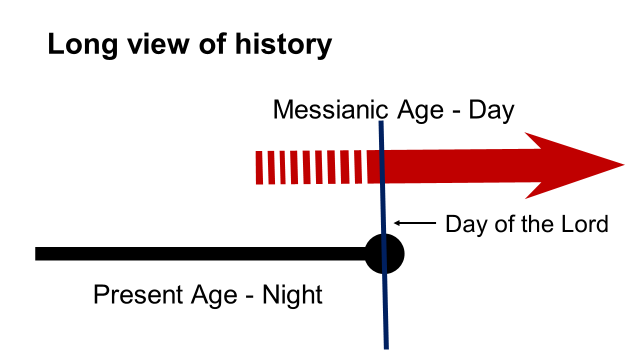
The Bible thinks of history in two ages or two epochs. The first epoch of history is the present age, which is characterised by evil. And the second epoch we might call the Messianic age, which is characterised by the reign of King Jesus.

Paul uses the metaphor of night and day (darkness and light) to describe these two ages. The present age is like night time and the Messianic age is like the new day.   

There is an overlap between the present age of darkness and the Messianic age of light. The Messianic age started with Jesus’ coming 2000 years ago and will continue eternally. The present age is still going but will eventually come to an end with the return of Jesus.

We live in the overlap between Jesus’ first coming and his second coming. During this time of overlap, the Kingdom of God is sometimes described as ‘now but not yet’. Or, ‘now, but not fully realised’.

We might catch glimpses of heaven on earth but generally speaking this world (the time in which we live) is a bit of a mixed bag really. The best is yet to come for those who are in Christ.

The point at which Jesus returns and the present age ends is sometimes called the Day of the Lord.

In verses 2-3 Paul writes…

for you know very well that the day of the Lord will come like a thief in the night. While people are saying, “Peace and safety,” destruction will come on them suddenly, as labour pains on a pregnant woman, and they will not escape.

‘The day of the Lord’ is a phrase borrowed from the Old Testament. It describes a period of time (not necessarily 24 hours) in which God intervenes in human history to save and to judge.

So the day of the Lord is both a day of salvation and a day of judgment. A day of deliverance for some but also a day of destruction for others. Like when God saved the people of Israel from slavery in Egypt. That was a time of deliverance for Israel, but a time of death and destruction for Egypt.

Or going back further to the time of the great flood. That was a time when God intervened to judge the people of the earth for their evil deeds. But it was also the beginning of a new day, a new start for creation, with Noah and his family. 

Paul’s words, in these opening verses from Thessalonians 5, echo the words of Christ. Jesus talked about his return coming like a thief in the night. No one knows the day or the hour. 

There are two images in these verses; that of a thief and that of a pregnant woman. Burglars don’t make an appointment to rob people’s houses. So the image of a thief tells us that Jesus’ second coming will happen at a time when people least expect it. It will take people by surprise.

The image of a pregnant woman adds a different nuance. Labour pains, for a pregnant woman, are expected. They are certain and unavoidable. When a woman is heavily pregnant there is no turning back. The baby has to come out one way or another.

Put the two images together and the thought is: the day of the Lord (when Jesus returns) will certainly happen (no one can escape it) but it will happen at a time when no one expects.

Now, this idea that the day of the Lord means salvation for some people and destruction for others can be a little unsettling. It raises the question, what will happen to me and the people I love? Because you don’t want to be on the wrong side of the Lord when he returns.

Both John the Baptist and Jesus preached a message of repentance. They said, the day of the Lord is certainly coming and so you need to get your life in order. You need to make sure that your hearts and minds and way of living are acceptable to God, so that you are not destroyed along with evil.   

But Paul’s purpose is not to frighten the Thessalonians. His purpose is to encourage them. They were persecuted. They were getting a hard time from their pagan neighbours. Paul is not telling the believers to repent. They have already done that. He is reminding them to take a long view of history.    

The fact that the day of the Lord is certainly coming is a comfort to the beleaguered church. It means they will be delivered from the pagans who are treating them unfairly.

It’s like that famous line preached by Martin Luther King: The arc of the moral universe is long, but it bends towards justice. That’s good news if you are oppressed. But it’s bad news for the oppressors.

From verse 4 Paul reassures the Thessalonian believers that they are on the right side of the Lord…

But you, brothers and sisters, are not in darkness so that this day should surprise you like a thief. You are all children of the light and children of the day. We do not belong to the night or to the darkness.

For those who are in Christ, the day of the Lord is not like a thief. Rather Jesus’ return is like the dawn of a new day.

Paul says: you are all children of the light and children of the day. ‘Light’ is an image for God. Paul is saying you are all children of God. To be a child of God is to belong to God’s family and to get our identity from Him. To bear his image.  

The word ‘day’ in these verses refers to the new day, the new epoch, the Messianic age, when the kingdom of God is realised in its fullness. To be ‘children of the day’, therefore, means that anyone who is in Christ belongs to the Messianic age and will not be destroyed.  

Paul is comforting the Thessalonians by showing them a long view of history. Taking a long view helps us to be prepared.   

Be prepared:

The Thessalonians are children of the day in more than name only. Being children of the day carries with it a responsibility to conduct ourselves in a way that is appropriate to daytime behaviour. From verse 6 we read… 

 So then, let us not be like others, who are asleep, but let us be awake and sober. For those who sleep, sleep at night, and those who get drunk, get drunk at night. But since we belong to the day, let us be sober,

Once again Paul is using metaphors or word images to get his idea across. It’s not that the Thessalonians were alcoholics. They did not need to be reprimanded about their drinking habits.

When a person is drunk they are not in control of themselves. By saying, don’t be like those who get drunk and fall asleep, but be sober and awake, Paul is saying exercise self-control.

We can’t control what other people do, nor can we control when the Lord will return. The best we can do is control ourselves so we are prepared for Jesus’ coming.

Getting drunk is also about excess. So the idea here is to avoid excess of any kind (not just excess alcohol). As we wait in the overlap, the now but not yet, we want to live a balanced life.

On one level, living a balanced life is about making sure our rhythms of work, play and sleep are in order. Making sure we pay attention to the needs of our body and soul. Looking after ourselves. Building fun and enjoyment into our lives and not always being a slave to duty. Making sure we get the mix of solitude and social interaction right for our personality and stage of life. 

On another level, living a balanced life is about managing our thoughts and feelings and not becoming too fixated on just one thing. Children of the light avoid getting stuck in a rut with the same old patterns of thought.

When Paul says, don’t be asleep but be awake, he is talking figuratively. He doesn’t mean we should not get a good night’s sleep. He means, be prepared for Christ’s coming. (Incidentally, good rhythms of literal sleep actually support us to be awake and prepared.)

I like Gordon Fee’s turn of phrase in relation to these verses. He says (and I paraphrase), being prepared is not about living up-tightly but living uprightly. [1]   

Did you get that? Being prepared is not about living up-tightly but living uprightly. If we are always on edge, thinking: ‘I must be good, I must be good. Jesus could comeback at any moment. I don’t want to be left behind’, then we will end up having a nervous breakdown.

There is enough anxiety in the world without adding to it. Paul doesn’t want the Thessalonians to be fearful or uptight. He is well aware of the present difficulties they are facing and, with that in mind, he is urging them to be prepared; to live righteously and without fear of what the future holds.

Getting prepared for the day of the Lord is not something we can leave to the last minute. John Stott offers some helpful illustrations for guiding our understanding of what it means to be prepared

It’s too late to prepare for an exam at the moment the exam paper is set in front of you. You have to put in hours of study before that.  Likewise, it is too late to prepare for a marathon when the starting pistol goes off. It takes months of training and discipline to get ready for a marathon.

And, living in Wellington, we might add: it is too late to prepare for an emergency when the earthquake strikes. You need to have your emergency water supply and canned foods in place before that happens.

In verse 8 Paul brings out another metaphor for how believers are to prepare for Jesus’ return, saying…

But since we belong to the day, let us be sober, putting on faith and love as a breastplate, and the hope of salvation as a helmet.

The first thing we notice here is the triad of faith, love and hope. Paul had talked about these three at the beginning of his letter. Faith, love and hope are at the core of what it means to be a follower of Christ. 

Paul uses this image of Christians equipping themselves for spiritual battle in a couple of other letters as well. Most likely he is drawing on Isaiah 59 where the Lord God (Yahweh) dresses himself in military armour as he sets out to achieve justice in the world.

A breastplate protects your heart and a helmet protects your head. They are defensive, not offensive. Paul is not encouraging the Thessalonians to attack their enemies. He is encouraging them to be prepared for when they come under attack.

Living in the overlap is a dangerous place to be, spiritually speaking. We might not suffer persecution like the Thessalonians, but the world in which we live is not altogether friendly to the followers of Christ either.

What then does it mean to put on the armour of faith, love and hope. Well, armour doesn’t put itself on. It’s not like Iron Man’s suite of armour which automatically wraps itself around Robert Downey Junior. To get dressed in military equipment we must be intentional. It won’t happen by itself.

One tried and true method by which Christians have equipped themselves with faith, love and hope is something called a rule of life. A rule of life is a schedule or rhythm of practices that one carries out each day and each week.

This rule of life is designed to train our bodies and our minds to be more like Christ. You might tailor your rule of life to suit your spiritual needs or the shape of your soul, much like a personal trainer at the gym might tailor a work-out programme to meet your fitness goals.  

A rule of life could include things like starting each day with prayer and Bible reading.

Taking one day off in seven to rest and worship.

Drinking alcohol in moderation or not drinking at all.

Opening your home in hospitality to others on a regular basis.

Ending each day by writing in your thankfulness journal.

Not having any screen time 2 hours before going to sleep at night. 

Getting 40 minutes of physical exercise each day.

Taking half an hour to be completely still and silent, three or four times a week.

Meeting weekly with other believers to pray and share and study the Bible.

Some form of service to the community.

Devoting a certain percentage of your income in worship to God.

Trying not to work more than 50 hours a week in your paid job.

And, if you are married, setting aside regular time to listen to your spouse

And, if you have children in your life, reading to them.   

The thing about a rule of life is that you follow the rule even when you don’t feel like it, so that you develop moral and spiritual fitness. In this way we are prepared for being at odds with the world and we are ready for Jesus’ return. 

Whatever your rule of life is, it needs to include times and places when you can take your armour off and relax a bit. We each need to find sanctuary, or safety, with other believers, when we can let down our guard and allow others in.  

Do you have an intentional rule of life? If you don’t, then make it your goal this week to develop a plan for one. 

Now, please don’t feel burdened by this. That was never Paul’s intention. To the contrary, Paul was wanting to lighten the Thessalonians’ burden (and ours) by encouraging us to take a long view and by reminding us that our salvation does not depend entirely on us.

From verse 9 Paul says…

For God did not appoint us to suffer wrath but to receive salvation through our Lord Jesus Christ. 10 He died for us so that, whether we are awake or asleep, we may live together with him.

We might hear the word wrath and immediately alarm bells go off so that we don’t hear what follows. But if we pay attention to what Paul is saying, the main thought is that our salvation does not depend on our performance or the shifting sands of our feelings. It depends on God.

Our salvation is by God’s initiative and through Jesus’ sacrifice. Therefore, we don’t have to live up-tightly, we are free to live uprightly.

With the phrase, God did not appoint us to suffer wrath, we need to be careful not to take Paul’s words in a direction he never intended. It is not that we human beings have no choice in the matter. It’s not that God chooses for some people to suffer wrath and others to be saved.

God wants all people to be saved but, at the same time, he respects the choices people make, even if that choice is to reject him.

Like I’ve said in other sermons, God’s wrath is not an emotional or uncontrolled flare up of anger. God’s wrath is measured and fair. God’s wrath is his settled and righteous opposition to evil.

God’s love means that he cannot tolerate evil indefinitely. The long view is that, ultimately, God intends to destroy evil. That is good news. God is the one who bends the arc of the moral universe toward justice.

The words in verse 10, about being awake or asleep, are metaphors for being alive or dead when Christ returns. They refer back to the concerns Paul dealt with at the end of chapter 4. For believers, it makes little difference whether we are alive or dead at Jesus’ second coming, for we will all be reunited with him.

Conclusion:

Paul finishes this section of his letter by saying…

11 Therefore encourage one another and build each other up, just as in fact you are doing. 

This tells us that Paul’s purpose in sharing this stuff about the Day of the Lord is not to scare people but to give believers courage to carry on.

Life was tough for the Thessalonians because they identified with Jesus. It was important that they looked out for one another and had each other’s backs.

Life is tough for us at times too. Not in the same way exactly, but it can still be a grind as we wait for our salvation to be realised in its fullness. The opposition we face today is perhaps more subtle, less overt.

In any case, it is important that we look out for each other too. To do this we need keep in touch with one another regularly and not neglect meeting together. But I hardly need to tell you to build each other up with kind words and expressions of trust, for you are already doing that.

Let us pray…

Almighty God, you see the beginning from the end. Thank you for including us in your plan of salvation. Thank you for the forgiveness that is ours through faith in Christ. Grant us the grace to take the long view that we would be prepared when Jesus returns. Help us to live uprightly, not up-tightly. Through Jesus we pray. Amen.

Questions for discussion or reflection:

  1. What stands out for you in reading this Scripture and/or in listening to the sermon? Why do you think this stood out to you?
  • What does it mean to take a long view? When is it helpful to take a long view?
  • What is the day of the Lord?  How does the day of the Lord make you feel? (E.g. comforted or full of dread, or indifferent, or something else.) Why is that do you think?
  • Discuss / reflect on the two epochs / ages of history. How might this long view of history shape our thinking and behaviour in the present?
  • What practical things can we do to be prepared for Jesus’ return? Do you have an intentional rule of life? If so, what is your rule of life? If not, how might you go about developing a rule of life? 
  • Why did Paul write about the Day of the Lord (Jesus’ second coming) in his letter to the Thessalonians?
  • How might we encourage one another and build each other up, as Paul instructs in verse 11?  

[1] Gordon Fee’s NICNT The First and Second Letters to the Thessalonians, page 200.