His plan, your story

Sermon by Neville Gardner

Please bear with me as I give a brief outline of the story of The Penguin Who Wanted to Fly, which I read out earlier in the service. This is for people who will read the online text or listen to a recording of the sermon, which don’t include the story.

The story was of a penguin who thought that, because penguins are birds, they belong in the sky. Against the advice of all the other penguins, he tried hard to fly, running faster and jumping from higher, but always crashing. Even from the highest iceberg he could find, he just crashed into the sea – only to find that he could fly, in the upside-down sky beneath the waves.

At the risk of spoiling the fun of a good story, I’d like to raise four things that struck me:

The penguin was determined to carry out his own plan for his life

The penguin tried to succeed using his own strength and determination

The penguin did not listen to advice

The penguin wanted to share his story (I like to think the penguin who told the story to the man on the beach was the same as the one featured in it, but I can’t be sure).

Each of these topics merits its own sermon. But, because this is the first sermon of the year, I thought I’d just do a gentle overview. Stir up your thinking, perhaps.

  • The penguin put all his time and effort into carrying out his own plan.

This was beyond a simple New Year resolution – trying to fly was everything to the penguin. Self-help books by the shelf-full tell us that if we try hard enough, practice enough and sacrifice enough, we can do anything, be anybody. Inspirational, even if not true.

Working towards your own dreams and challenging yourself with New Year resolutions can have their place. But now is as good a time as any to remember that God has plans for you too. He has a general plan, the same for everyone, and he has a specific plan, different for each person.

The Bible is full of what God wants for, and from, us. One summary is contained in Micah 6:8

“. . the Lord has told us what is good. What he requires of us is this: to do what is just, to show constant love, and to live in humble fellowship with our God.”

Matthew 22 records that Jesus said “Love the Lord your God with all your heart, with all your soul, and with all your mind. This is the greatest and the most important commandment. The second most important commandment is like it: ‘Love your neighbour as you love yourself.”

God’s general plan is for everyone to have a relationship with Him, to love Him and to love other people.

As well as this general plan, God has a specific plan for each individual believer. Ephesians 2:10 tells us “God has made us what we are, and in our union with Christ Jesus he has created us for a life of good deeds, which he has already prepared for us to do.” 1 Corinthians:12 gives us a picture of a body made up of many parts, each with a vital role to play – everyone who follows Jesus is like a part of his body (meaning the church), each with a special role to play. For you, this role is called your ministry.

God has given every believer a personal ‘gift’ to use to serve him. That means we are wired to care more about some things than others, with a particular style of relating to other people. Every believer has at least one such gift – a passion, a heart for serving God in a particular way.

1 Peter 4:10-11 tells us

“Each one of us, as a good manager of God’s particular gift, must use for the good of others the special gift he has received from God. Whoever preaches must preach God’s messages; whoever serves must serve with the strength that God gives him, so that in all things praise may be given to God through Jesus Christ.”

Our gifts are to be used for God and others, not ourselves.

If you are one of the many Christians who are not sure what God’s plan is for them, ask him. James 1:5 says “But if any of you lacks wisdom, he should pray to God, who will give it to him; because God gives generously and graciously to all.” But be prepared to wait for an answer.

We are used to reading in the Bible of times when God sent an angel or a dream to people, telling them exactly what he wanted them to do. And they did it. Remember Mary, Joseph and the shepherds in the Christmas story? If only it was always that simple.

From my own experience, and from talking with others, I don’t think God always suddenly reveals a lifetime plan to someone and expects them to accept it and get on with it. His plans may well be revealed to you gradually during your journey with him. God gives you the tools and guidance for carrying out his plan, but expects you to use your own skills and initiative too. Of course, there are times during your journey when God says “I want you to do a certain thing, and I want you to do it now.” We need to be open to those opportunities.

A couple of years ago I was due to give a sermon here, and I was sitting in church waiting for the service to start. All of a sudden, a single new sentence popped into my head, and I knew I had to include it in the sermon. I found a pen and scribbled it into my notes. After the service, someone thanked me for saying something that they had really needed to hear – you’ve guessed, it was that last minute sentence. If I learned nothing else from that experience, I know to keep a pen handy!

As an example of God only gradually revealing his plan, I’m afraid I’m going to use my experiences again. Not because it’s a particularly good example, but because it’s the one I know.

For the first 30 years of my life, I knew nothing of God. I was like the penguin, doing my own thing, succeeding or failing by my own abilities, or lack of. After leaving school and working for 10 years, I came up with a plan to be an archaeologist. I went to university, worked hard, got some good qualifications and prepared to fulfil my dream. Then God stepped in, and being an archaeologist didn’t figure in his plan for me.

To start with, he formed a relationship with me. My eyes were opened, just like those of the penguin when he found he was meant to fly in the sea, not the sky.

And the change to my life was almost as dramatic – less than a year after accepting Jesus, I was married and had moved from the UK right around the world to New Zealand. Here, my relationship with God developed.

At some stage, God gave me a gift of teaching, for want of a better word, something I had not been interested in before. I started a job that helped me develop teaching and writing skills, and looking back, this was part of my preparation for ministry.

It was only after developing a relationship with God, realising my God-given gifts and gaining the necessary skills and personal style of doing things, that God started the next stage in his plan – He put me to work teaching about Him. Firstly with children, then adults and all ages. At various stages along the way, such as when Will first asked me to give a sermon, I would ask “Really God, you want me to do that now? Am I ready?” I could sense God shaking his head and saying “I am God you know, I don’t make mistakes.”

I think I now have a broad awareness of God’s plan for me, much of it gained by hindsight.

God’s plan for me involved forming a relationship with him, receiving a special gift, developing the skills I needed, and only then obviously serving him as he intended. This was just my experience – things might happen, or have already happened, quite differently for you.

  • Back to the penguin in the story. He tried to carry out his own plan, using his own strength and determination.

There is only one person who can carry out the ministry role God has planned for you – you. But you will need his help, your own strength will not be enough.

In Philippians 4: 13 Paul said “I have the strength to face all conditions by the power that Christ gives me.”

Proverbs 3 says “Trust in the Lord with all your heart. Never rely on what you think you know. Remember the Lord in everything you do, and he will show you the right way.”

  • The penguin did not listen to advice.

We have no excuse for doing this, because we each have the Holy Spirit to teach and guide us, to help us overcome our weaknesses. The Holy Spirit also helps us know God better, and helps him know us. When we don’t know what to pray for, the Holy Spirit will intercede for us.

Romans 8:26-27 tells us: “In the same way the Spirit also comes to help us, weak as we are. For we do not know how we ought to pray; the Spirit himself pleads with God for us in groans that words cannot express. And God, who sees into our hearts, knows what the thought of the Spirit is; because the Spirit pleads with God on behalf of his people and in accordance with his will.”

  • The penguin wanted to share his story

This is a positive aspect of the tale. The Bible teaches that followers of Jesus will want to tell others about Him and what he’s done in their lives. Sharing with others is a vital part of the Christian life – it’s another aspect of God’s general plan for everyone. Just before Jesus was taken up to Heaven, it is recorded in Acts 1:8 that he told his disciples “But when the Holy Spirit comes upon you, you will be filled with power, and you will be witnesses for me in Jerusalem, in all Judaea and Samaria, and to the ends of the earth.”

The story of The Penguin Who Wanted to Fly was just that, a story. But I have used it to remind us of a few aspects of our journey with God. Your story will be different from mine, it will be different from everyone else’s, but it will be your story, one God has created with you. God’s plan for you is a story that’s still being written.

Are you ready to turn the next page?

God’s Plan

Scripture: Exodus 19:1-6

Title: God’s Plan

Structure:

  • Introduction – God’s plan
  • What God has done for Israel – Grace
  • What God expects of Israel – Obedience
  • What Israel will be (if they obey) – Purpose
    • A treasured possession
    • A kingdom of priests
    • A holy nation
  • Conclusion

Introduction:

Today we continue our series in Exodus, focusing on chapter 19, verses 1-6

  • I will be reading from the New International Version this morning
  • So the words will appear on the wall shortly

At this point in the story the people of Israel have travelled to the foot of Mount Sinai – it has been 3 months since they left Egypt

  • The Israelites will camp at Sinai for 11 months while God gives them the Law
  • Today’s Scripture describes the first of Moses’ seven ascents up the mountain to meet with God
  • From Exodus 19, verse 1 we read…


On the first day of the third month after the Israelites left Egypt – on that very day – they came to the Desert of Sinai. After they set out from Rephidim, they entered the Desert of Sinai, and Israel camped there in the desert in front of the mountain.


Then Moses went up to God, and the Lord called to him from the mountain and said, ‘This is what you are to say to the descendants of Jacob and what you are to tell the people of Israel:


“You yourselves have seen what I did to Egypt, and how I carried you on eagles’ wings and brought you to myself. Now if you obey me fully and keep my covenant, then out of all nations you will be my treasured possession.


Although the whole earth is mine, you will be for me a kingdom of priests and a holy nation.” These are the words you are to speak to the Israelites.’


May the Spirit of Jesus illuminate this reading for us

In these verses Yahweh lays out his blue print for Israel

  • If you have a look on the back page of your newsletter you will see the basic outline of God’s plan for His people

Firstly, God recaps what He has done for Israel in delivering them from slavery in Egypt – step one is salvation by grace

Then God makes it clear (in general terms) what He expects of Israel and so step two is obedience

  • Obedience is the appropriate response to grace

And thirdly God explains what Israel will be (if they obey)

  • Step three, therefore, is about purpose
  • God’s purpose is for Israel to be…
  • A treasured possession
  • A kingdom of priests
  • And a holy nation

So that’s the basic outline of God’s plan for Israel

  • Let’s unpack each step of the plan a little now…
  • Firstly, God’s grace in delivering Israel from slavery in Egypt

eagle

What God has done for Israel – Grace

Tell me, when you see this eagle, what is it that comes to mind?

[Wait for people to respond]


Thanks for those thoughts

  • When I see a picture of an eagle in flight I mostly think, freedom
  • But I also think skill and good vision – eagle eyed

One fact I wasn’t aware of before preparing this sermon is that the mother & father eagle are known for their devotion to their young

  • More than most other birds they take great care over their eaglets
  • Another thing I learned is that young eagles need to be taught to fly
  • It doesn’t come instinctively to them
  • In fact, without an adult eagle to mentor them, young eagles won’t learn to fly – they learn by watching their parents and imitating what they do


In verse 4 the Lord says to Moses…

  • “You yourselves have seen what I did to Egypt, and how I carried you on eagles’ wings and brought you to myself.”

In this verse God is recapping what He has done for Israel in rescuing them from slavery in Egypt – this is stage one of God’s plan in retrospect

  • Israel have been carried by God out of harm’s way
  • They did not need to fight for their release – God fought for them
  • All they had to do was hold on and enjoy the ride
  • Israel did not do anything to earn this special treatment by God
  • It was done at God’s initiative and by His grace – freely

God hasn’t just carried the people out of Egypt, He has brought them to Himself

  • This speaks of a personal relationship and of being at home with the Lord
  • It also indicates that God’s presence is revealed in a special way here at Sinai, where the people are now camped

It’s interesting that God associates Himself with an eagle – a powerful & skilful bird that is known for its freedom – this fits because God is free

  • If we are to imply from the metaphor that Israel is like a young eagle learning to fly then we have a very powerful image
  • The Israelites, who had been slaves, were being told by God that they should think of themselves as free, like an eagle
  • But while they were free in principle, they still needed to learn how to fly
  • That is, Israel needed to learn how to use their freedom well, without falling, and God intended to teach them

The giving of the Law at Sinai needs to be understood in the light of the eagle metaphor

  • God didn’t give the Israelites a whole lot of rules to make their lives more difficult – he gave them the Law so they could learn how to fly safely
  • So they could get the most of life and enjoy their new found freedom

Okay – so that’s stage one of God’s plan – it starts with grace

  • The next stage covers Israel’s response to that grace
  • God makes it clear his expectation of the people is obedience

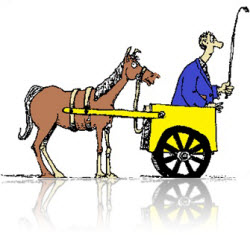
 cart before the horse

What God expects of Israel – Obedience

Who can tell me what’s wrong with this picture?

  • [Wait for people to respond]

Yes, that’s right – the driver has got the cart before the horse

The expression ‘cart before the horse’ is English idiom for getting things in the wrong order – the wrong way around

Obviously things work better when the horse pulls the cart

  • It doesn’t work so well when the cart is in the way of the horse

When it comes to Jewish faith (and Christian faith for that matter), the horse is God’s grace and the cart is our obedience

  • The horse of grace pulls the cart of obedience
  • Grace is the engine – it is the power for us to obey

Judaism and Christianity are concerned with keeping God’s grace in front and allowing the awareness of God’s grace to draw us into obedience

  • So we don’t do things for God in order to get Him to do things for us
  • That would be paganism
  • God does good things for us up front and then as a grateful and willing response we do what God asks

So when the apostle Paul (in the New Testament) said we are not saved by works but by grace through faith – what he meant was, ‘Don’t get the cart before the horse’

  • God’s grace comes first and gives us the willingness to obey

It’s interesting isn’t it that the book of Exodus gives us 19 chapters of God’s grace before it introduces the Law with the 10 commandments

  • Grace precedes law, like a horse precedes a cart

The wonderful thing about the horse of God’s grace is that it leads us in the way we should go and at the right pace

  • It is an intelligent horse – we don’t need to drive it – it will draw us along

Okay then – stage 1 of God’s plan is grace

  • Stage 2 is obedience
  • And stage 3 is purpose

What Israel will be (if they obey) – Purpose

From verse 5 of Exodus 19, God instructs Moses to say to the people…

  • Now if you obey me fully and keep my covenant, then out of all nations you will be…
    • my treasured possession
    • a kingdom of priests
    • a holy nation

Clearly this is a conditional statement

  • If you obey me this is what you will be
  • Some things with God are unconditional – like His deliverance of the people from slavery in Egypt
  • It was all grace – a free gift, or more accurately a free ride

Other things with God are conditional – like whether or not we will fulfil the purpose He has for us

  • Fulfilling God’s purpose for us is not automatic – it depends (to some degree at least) on the choices we make

The horse of God’s grace will take us to the destination God has planned for us – but only if we attach our cart to the horse and stay on the cart

  • If we fall off the wagon (so to speak) then we can’t expect to arrive at the destination

A couple of weeks ago Robyn was offered some free tickets to the WOW festival (WOW stands for World of WearableArt)

  • Some people pulled out at the last minute and we had the option to use their tickets that night
  • Now I wouldn’t ordinarily go to something like this, but it was free, so I made the choice to accept the offer and we had a great time
  • What an amazing display of creativity
  • WOW is certainly the right word for it

The point is, although the tickets were free to us – a gift – our attendance at the event was not automatic

  • Fulfilling the purpose of the tickets was conditional on me changing my plans for the evening, driving into the city and collecting the tickets

It was like this with Israel

  • God was giving them a free ticket for a wonderful purpose – being His priests to the world
  • But whether Israel would actually fulfil God’s purpose for them was conditional on their obedience
  • They had to put aside their plans in order to go with God’s plan

As we’ve already noted verses 5 & 6 give three descriptions of God’s purpose for Israel – they are to be…

  • A treasured possession
  • A kingdom of priests
  • And a holy nation

These aren’t three separate things

  • They are three different but related ways of describing the same thing – Israel’s special relationship to Yahweh for the world
  • Israel don’t exist for themselves – they live for God’s purpose in the world

Each of the three descriptors highlights a unique perspective on God’s purpose for Israel

  • What then does it mean to be a ‘treasured possession’?

Imagine for a moment that your house is on fire

  • No one else is inside – only you
  • As it happens you have just enough time to rescue one item from the flames – your most treasured possession – What would you take?

Maybe the family photographs or your grandfather’s war medals or your mother’s wedding ring?

You probably wouldn’t take the TV or the microwave – those things can be replaced with insurance

  • You would be more inclined to take those things which have a special significance because of their association with people you love – right?
  • Things that can’t be replaced

In verse 5 we read that if Israel obeys Yahweh fully they will be His treasured possession – like the special photo you keep in your wallet or the heirloom wedding ring or the watch your grandfather gave you – something priceless

Now it is important to understand that God chose Israel as His people before they obeyed – their photo is already in His wallet

  • But whether their photo will be a painful reminder to God or a joyful one is conditional – it depends on Israel’s obedience


The second (and central) descriptor of God’s purpose for Israel is they are to be

  • A kingdom of priests

Most kingdoms are about ruling – being the boss in charge of other nations

  • But Israel is to be a kingdom of priests
  • A priest’s job isn’t to exert power and rule over people
  • A priest’s job is to serve people
  • So Israel is to be a servant nation, not a ruling nation [1]
  • God’s purpose for Israel is not total world domination
  • Rather God wants Israel to bless the other nations of the world
  • To this end priests act as mediators – representing other people to God


On the wall here is the picture of a linesman, working on overhead wires

  • Priests are a little like linesmen in that they work to restore the connection between God and people when the lines are down
  • In other words, priests pray (or intercede) for other people – especially those who are not able to pray for themselves

The whole world is God’s temple and Israel are to function as God’s priests in the world

  • They are to be a kingdom of priests both by representing others to God and by representing God to the world
  • Priests are God’s rep team
  • They make Yahweh known to others & they teach God’s ways to people
  • In particular Israel are to represent God by being a holy nation
  • You can’t expect to complete a marathon if you don’t do the training
  • You can’t expect to represent God as a priest if you live a life of drunkenness & debauchery


To be holy basically means to be different in a good way

  • If Israel obeyed the Lord then they would be distinctive from the nations around them
  • People would look at them and think: ‘Wow, they are on to it – we want what they’ve got.’

When Jesus talked about holiness in Matthew 5, he said to His disciples…

14 ‘You are the light of the world. A town built on a hill cannot be hidden. 15 Neither do people light a lamp and put it under a bowl. Instead they put it on its stand, and it gives light to everyone in the house. 16 In the same way, let your light shine before others, that they may see your good deeds and glorify your Father in heaven.

To be a holy nation therefore is to be distinctive – a light in the darkness

  • When all the other nations around them are worshipping many gods, Israel is to worship just one God, Yahweh
  • And when all the other nations around them are stealing and lying and committing adultery and wishing they could get their hands on their neighbour’s stuff, Israel are to look out for their neighbour’s well being

There is a cost to being holy – or different in a good way – and that is people don’t always like you or accept you

  • But Israel are to fear the Lord, not the nations
  • They are to care more for what God thinks than for what other people think


Conclusion:

This morning we’ve heard God’s plan for Israel in three basic steps:

  • Grace, obedience and purpose
  • God has rescued Israel from slavery in Egypt by His grace
  • And in response to that grace God is calling for their obedience
  • If they obey the Lord then Israel will serve a special purpose as God’s priests to the other nations of the world

This blueprint for Israel applies to Christians as well

  • While we were still sinners Christ died for us – the righteous for the unrighteous
  • Jesus is our rescue from slavery to sin & death – He is God’s grace for us up front before we’ve done anything to deserve it
  • In response to that grace we follow Jesus, in obedience to God
  • And if we obey the Lord in this way then we will be…
    • A treasured possession to God
    • A kingdom of priests

  • And a holy people
  •  

    The apostle Peter picks up God’s blue print in his letter to the churches, where he writes…


    But you are a chosen people, a royal priesthood, a holy nation, God’s special possession, that you may declare the praises of him who called you out of darkness into his wonderful light. 10 Once you were not a people, but now you are the people of God; once you had not received mercy, but now you have received mercy.


    11 Dear friends, I urge you, as foreigners and exiles, to abstain from sinful desires, which wage war against your soul. 12 Live such good lives among the pagans that, though they accuse you of doing wrong, they may see your good deeds and glorify God on the day he visits us.  

    Grace, obedience and purpose

    Let’s pray…

    [1] Durham 263, cited in Fretheim, Exodus, page 212.