The Cedar Tree

Scriptures: Leviticus 14, 1 Kings 6, Psalm 92, Ezekiel 17

Video Link: https://youtu.be/PAZlUkTL934

Structure:

  • Introduction
  • Health (purification)
  • Holiness (presence)
  • Hope (purpose)
  • Conclusion

Good morning everyone.

There are five countries in the world who have a tree on their flag, one of which is Lebanon. Would anyone like to guess what tree we find on the Lebanese flag? [Wait] That’s right, the cedar tree. 

Today we continue our testimony of trees series by focusing on the cedar tree. The Cedar of Lebanon (scientific name: Cedrus libani) is mentioned many times in the Old Testament. The cedar is a majestic tree, reaching a height of 20-30 metres. It grows in the mountains of Lebanon where the temperature is cooler and it gets plenty of water. 

Our message this morning draws on a variety of Scripture references. Essentially though the cedar is associated with health, holiness and hope.

Or, if you prefer the three points of a sermon to start with a P, then purification, presence and purpose. Let us begin then with purification and health. From Leviticus 14, we read…

Health – Leviticus 14

The Lord said to Moses, “These are the regulations for any diseased person at the time of their ceremonial cleansing, when they are brought to the priest: The priest is to go outside the camp and examine them. If they have been healed of their defiling skin disease, the priest shall order that two live clean birds and some cedar wood, scarlet yarn and hyssop be brought for the person to be cleansed. Then the priest shall order that one of the birds be killed over fresh water in a clay pot.He is then to take the live bird and dip it, together with the cedar wood, the scarlet yarn and the hyssop, into the blood of the bird that was killed over the fresh water. Seven times he shall sprinkle the one to be cleansed of the defiling disease, and then pronounce them clean. After that, he is to release the live bird in the open fields.

May the Spirit of Jesus illuminate God’s word for us.

How many of you say grace before eating a meal? To my mind, a meal isn’t ready to eat until we have said a prayer to thank God and bless the food.

The spiritual ritual of saying grace is as important as the physical ritual of cooking the food properly.

We are not just bags of skin, bone and flesh. We are spiritual beings, inhabiting a physical body. There is a relationship between the physical and the spiritual. Saying grace before eating, acknowledges the reality of God’s provision for our lives.

In ancient Israel, people with skin diseases were excluded from community life. Although they may have done no moral wrong, they were considered ceremonially unclean and therefore not allowed to participate in religious events.

If a person recovered from their skin disease, then the priest (who was also the public health officer) checked the disease was gone and performed the purification ritual described in Leviticus 14 to declare the person fit to return to community life.

This ritual involved the use of cedar wood. It’s not that the cedar tree was used to heal skin diseases. Rather, once a person had been healed of a skin disease, cedar was used in the purification rite declaring them clean.

This ritual probably seems strange or unnecessary to us but, to someone with an ancient mindset, who believed in spiritual reality as much as material reality, the healing wasn’t complete until the priest had carried out the ritual.

We might think of this ritual like saying grace before eating a meal. The ritual acknowledges the reality of God in our lives. It is God who heals and purifies us, just as it is God who feeds and sustains us.

One of the distinctive features of the cedar tree is its natural resistance to insects and rot. The cedar tree contains certain oils which make it smell nice and repel insects, while also preserving the wood. It may be for this reason that the cedar tree was used by Jewish priests in purification rituals. Cedar wood symbolises restored strength and good health.

One of the interesting things about the ritual in Leviticus 14, is that two birds are used. One bird is offered to God as a sacrifice, while the other bird is set free, signifying that the person who was healed is now free to rejoin the worshipping community. 

As Christians, we don’t need to perform the rituals prescribed in Leviticus every time we recover from shingles or boils or scabies or whatever. But we do need to give thanks to God for restoring our health and purifying us. What rituals do you observe that acknowledge the reality of God in your life?

Alongside health and purification, the cedar tree is also associated with holiness. In particular, the beauty of God’s holy presence represented by the temple.

Holiness – 1 Kings 5 & 6

In First Kings chapters 5 and 6, we read how Solomon used cedar in the building of the Jerusalem temple. The external structure of the temple was mostly made from stone, but a lot of cedar wood was used inside the temple.

Cedar trees grew abundantly in the mountains of ancient Tyre. The region of Tyre lay north of Israel in the land we know today as Lebanon. Solomon made a deal with Hiram, the king of Tyre, to obtain the cedar.

Solomon conscripted 30,000 labourers to cut down the cedar trees. The trees were then brought to Jerusalem where they were used in the construction of the temple. Let me read you a selection of verses from First Kings chapter 6, which describe how the cedar tree was used…

14 So Solomon built the temple and completed it. 15 He lined its interior walls with cedar boards, panelling them from the floor of the temple to the ceiling and covered the floor of the temple with planks of juniper. 16 He partitioned off twenty cubits at the rear of the temple with cedar boards from floor to ceiling to form within the temple an inner sanctuary, the Most Holy Place. 20 The inner sanctuary was twenty cubits long, twenty wide and twenty high. He overlaid the inside with pure gold, and he also overlaid the altar of cedar.

These verses tell us cedar was used extensively in the temple, including in the most holy place and for the construction of the altar.

Most likely cedar was used for both practical and aesthetic reasons. As already mentioned, cedar is a strong, durable wood that smells nice, repels insects and is resistant to rot, making it an excellent building material.

Aesthetically, cedar wood has a beautiful grain, without knots. It is pleasant to look at. Cedar is beautiful inside and out.

A temple is a holy place, a place of God’s presence, where prayers and worship are offered. Ideally, a place of reconciliation that brings people closer to God and closer to one another. Because of its use in the temple, cedar is associated with the beauty of holiness.  

We don’t often think of holiness as a beautiful thing. Holiness in our society seems more weird than attractive. Not so in ancient Hebrew society.

In Psalms 29 and 96, we are told to worship the Lord in the beauty of holiness.

The kind of beauty in view here is that of splendour or majesty. God’s holiness is like the beauty of a mountain range or the beauty of a cedar forest. God’s holiness is evergreen, its beauty does not fade.

To worship the Lord in the beauty of holiness is to worship God with clean hands, a clean heart and a clean conscience, without pretense or hypocrisy.

Worship the Lord like no one is looking.

Solomon cut down thousands of cedar trees, both for the temple and for his own palace. His carbon footprint was enormous.

Does this mean we (today) need to use cedar in the construction of our church buildings? Well, no. For Christians, God’s holy presence does not rest in a building. God’s presence is found in Jesus and among his people. We are the new temple, a temple not made by hands. The church is like a forest of living souls, made pure and holy by Christ.

The cedar tree is associated with health and purification, together with the beauty of God’s holy presence. The cedar tree is also pregnant with hope and purpose.

Hope – Psalm 92 & Ezekiel 17

Because of their strength and beauty and usefulness, the cedar forests of Lebanon have been depleted down through the centuries. Consequently, the Lebanese authorities have established special reserves to protect and regenerate cedar trees.

Despite humanity’s greed, some cedars have survived for more than 2000 years. One of the keys to the cedar’s longevity is its root system. The roots of the cedar tree grow deep to find water and give the tree stability. Once the tree is established, it will generally last a long time if left undisturbed.   

In Psalm 92 we read…

12 The righteous will flourish like a palm tree, they will grow like a cedar of Lebanon; 13 planted in the house of the Lord, they will flourish in the courts of our God. 14 They will still bear fruit in old age, they will stay fresh and green, 15 proclaiming, “The Lord is upright; he is my Rock, and there is no wickedness in him.”

Psalm 92 is a worship song for the Sabbath day. Being a song for the Sabbath, Psalm 92 looks forward (in hope) to that day of eternal rest, when there will be no more evil or suffering or death, when every day will be a perfect day, an everlasting Sabbath fulfilling God’s purpose for creation.

Cedars don’t grow as quickly as some plants, but they do grow tall and last a long time. The poetry of Psalm 92 is saying the righteous have hope for a good and lasting future. Their purpose is to serve and worship God.      

Righteousness in the Bible simply means right relationship. The righteous relate with God and their neighbours in a right way, in a way that is gracious and true, fair and kind.

You don’t have to be perfect to be righteous. Righteous people sometimes mess up. But if a righteous person does make a mistake, they do everything in their power to put it right.

Faith is the foundation of righteousness. Or to use the metaphor of the cedar, faith is the root system of the tree. Faith in God finds the water of life and lends stability to the tree.

Notice the underlying tone of humility in these verses. Just as the cedar grows best at altitude (in the mountains of Lebanon), so too the righteous grow best in the courts of our God. That is, in close relationship with the Lord and his people. The righteous owe their vitality and fruitfulness to the Lord, not their own righteousness. It is by God’s grace that the cedar tree enjoys long life.

The point is, the righteous are like cedars, they have hope of an evergreen future. The worship and service of the righteous is purposeful and lasting.

We are talking about the cedar tree and its connection with hope and purpose in the Bible.

In Ezekiel 17 we read… 

22 “‘This is what the Sovereign Lord says: I myself will take a shoot from the very top of a cedar and plant it; I will break off a tender sprig from its topmost shoots and plant it on a high and lofty mountain. 23 On the mountain heights of Israel I will plant it; it will produce branches and bear fruit and become a splendid cedar. Birds of every kind will nest in it; they will find shelter in the shade of its branches. 24 All the trees of the forest will know that I the Lord bring down the tall tree and make the low tree grow tall. I dry up the green tree and make the dry tree flourish.

You all know the story of Cinderella. The girl who was loved by her father but hated by her stepmother and stepsisters. When her father died, Cinderella experienced a reversal of fortunes. She became a servant to her stepmother and stepsisters and was mistreated by them.

When the prince of the realm decided to hold a ball, Cinderella was made to stay home, until her fairy godmother intervened. Cinderella goes to the ball and dances with the prince but has to leave in a hurry at midnight. In her rush she leaves behind a glass slipper.

In his search for the mysterious woman who left so quickly, the prince goes through the land trying to find the one who fits the glass slipper. Eventually, after a few twists and turns, the prince is reunited with Cinderella and they are married.

Once again Cinderella experiences a dramatic reversal of fortunes, this time from being a lowly servant girl to becoming a princess.         

The Bible is full of Cinderella stories. In fact, the fairy tale of Cinderella is inspired by the true stories of the Bible. The stories of Jacob and Joseph are packed with reversals. As is the story of Ruth and Naomi. To say nothing of the history of Israel; from slavery in Egypt to exodus in the wilderness to a fresh start in the promised land of Canaan to exile in Babylon and return from exile. 

Why does the Bible contain so many stories of reversal? Two reasons mainly. Firstly, because these stories literally happened in history. And secondly, because stories of reversal inspire hope and humility.

If you are down on your luck, bullied by your enemies, poor in spirit and unable to see a way forward, you can remember how God reversed his people’s fortunes to give them a good future.

God did it for Joseph and Ruth and Naomi and Hannah and Israel and many others. Perhaps he will do it for you too. These true stories of reversal inspire hope and give purpose to our struggles.

At the same time, if life is going well and you feel like you are on top, healthy, wealthy and wise, remember how God reversed the fortunes of people like Nebuchadnezzar, Pharaoh and Saul, to humble them. Then any pride you might feel at your accomplishments will be diminished. Stories of reversal let the air out of an over inflated ego. No one wants to be the ugly stepsister.   

God has the power to reverse our fortunes. In verse 24 of Ezekiel 17, the Lord says: All the trees of the forest will know that I, the Lord, bring down the tall tree and make the low tree grow tall. I dry up the green tree and make the dry tree flourish.

That is a picture of reversal, inspiring both hope and humility at the same time.

In verses 22-23 of Ezekiel 17, the Lord says that he will take a shoot from the top of a cedar tree and plant it on the mountain heights of Israel, where it will become a splendid cedar tree.

To the ancient mind the image of a majestic tree (like a cedar) stands as a metaphor for a mighty king and his kingdom.

For Christians, the shoot that God takes from the top of a cedar tree to replant, is a picture of Jesus, the Messiah. Jesus is the King who embodies the tree of God’s kingdom on earth.

God’s kingdom, established through Jesus, is strong and enduring like the cedar tree. God’s kingdom is healthy and holy, with a purifying presence resistant to rot. God’s kingdom bears good fruit and provides shelter for every kind of bird. The birds here probably represent the different peoples of the world. God’s kingdom is for all nations.

We are reminded of Jesus’ parable of the mustard seed. The kingdom of heaven starts small like a mustard seed but grows to be a large garden plant providing shelter for the birds of the air. Transformation from small to large; sounds like a story of reversal, inspiring hope, giving purpose.

Conclusion:

Most of you will see where this sermon is headed. Jesus, the prince of heaven, born into humble circumstances. Raised in obscurity, the son of a carpenter. Homeless and relying on the kindness of strangers for the three years of his public ministry.

Condemned for a crime he did not commit. Sentenced to a humiliating, agonizing death on a cross. Dead and buried, then raised to eternal life on the third day. The life, death and resurrection of Jesus is God’s ultimate reversal story and the foundation of our hope.

Let us pray…

Lord Jesus Christ, you are the priest who purifies us and sets us free. You are our holiness, the root of all righteousness. Your resurrection is the ground of our hope. We thank you for your faithfulness to God and to us. Amen.

Questions for discussion or reflection:

  1. What stands out for you in reading this Scripture and/or in listening to the sermon? Why do you think this stood out to you?
  2. What are some of the distinctive characteristics of the cedar tree? What is the cedar tree associated with in the Bible?
  3. Why did God provide rituals of purification for people who had recovered from a skin disease? What rituals do you observe that acknowledge the reality of God in your life?  
  4. Why was cedar wood used in the construction of the Jerusalem temple? What does it mean to worship God in the beauty of holiness? How do we do this?
  5. Why does the Bible contain so many stories of reversal? What purpose do these stories serve? Do you have a personal story of reversal? If so, what happened?
  6. How does the parable of the cedar shoot (in Ezekeil 17:22-24) point to Jesus?
With

Scripture: Genesis 39

Video Link: https://youtu.be/S4Rksw5XlBQ

Structure:

  • Introduction
  • God’s presence
  • Joseph’s faithfulness
  • God’s kindness
  • Conclusion

Introduction:

Good morning everyone.

Sometimes when you are reading a book or watching a movie you come across a story within the story. The smaller story helps to make sense of the bigger story.

The Bible is really one big story, the true story in fact, of God and his people. Today we continue our sermon series in the life of Joseph, focusing on Genesis 39. The account of Joseph is one of those smaller stories which helps to make sense of God’s bigger story.

You may remember from two weeks ago how Joseph had been sold into slavery by his brothers. From verse 1 of Genesis 39 we pick up the story…

Now Joseph had been taken down to Egypt. Potiphar, an Egyptian who was one of Pharaoh’s officials, the captain of the guard, bought him from the Ishmaelites who had taken him there. The Lord was with Joseph and he prospered, and he lived in the house of his Egyptian master.

When his master saw that the Lord was with him and that the Lord gave him success in everything he did, Joseph found favour in his eyes and became his attendant. Potiphar put him in charge of his household, and he entrusted to his care everything he owned. From the time he put Joseph in charge of his household and of all that he owned, the Lord blessed the household of the Egyptian because of Joseph. The blessing of the Lord was on everything Potiphar had, both in the house and in the field. So he left in Joseph’s care everything he had; with Joseph in charge, he did not concern himself with anything except the food he ate.

Now Joseph was well-built and handsome, and after a while his master’s wife took notice of Joseph and said, “Come to bed with me!” But he refused. “With me in charge,” he told her, “my master does not concern himself with anything in the house; everything he owns he has entrusted to my care. No one is greater in this house than I am. My master has withheld nothing from me except you, because you are his wife. How then could I do such a wicked thing and sin against God?”

And though she spoke to Joseph day after day, he refused to go to bed with her or even be with her. One day he went into the house to attend to his duties, and none of the household servants was inside. She caught him by his cloak and said, “Come to bed with me!”

But he left his cloak in her hand and ran out of the house. When she saw that he had left his cloak in her hand and had run out of the house, she called her household servants. “Look,” she said to them, “this Hebrew has been brought to us to make sport of us! He came in here to sleep with me, but I screamed. When he heard me scream for help, he left his cloak beside me and ran out of the house.” She kept his cloak beside her until Joseph’s master came home. Then she told him this story:

“That Hebrew slave you brought us came to me to make sport of me. But as soon as I screamed for help, he left his cloak beside me and ran out of the house.” When his master heard the story his wife told him, saying, “This is how your slave treated me,” he burned with anger.

Joseph’s master took him and put him in prison, the place where the king’s prisoners were confined. But while Joseph was there in the prison, the Lord was with him; he showed him kindness and granted him favour in the eyes of the jailer. So the jailer put Joseph in charge of all those held in the prison, and he was made responsible for all that was done there. The jailer paid no attention to anything under Joseph’s care, because the Lord was with Joseph and gave him success in whatever he did.

May the Spirit of Jesus illuminate God’s word for us.

There are three parts to Genesis 39. Verses 1-6 emphasize God’s presence with Joseph. Verses 7-19 reveal Joseph’s faithfulness to God. And verses 20-23 tell us about God’s kindness to Joseph.

These three things; presence, faithfulness and kindness, all find connections with the bigger story of God and his people. First let’s consider God’s presence with Joseph.  

God’s presence – vv. 1-6:

Nicky Gumble tells the story of a young boy playing on a piano. The boy didn’t know what he was doing really. He simply banged away at the keys in front of him.

A maestro happened to hear the child and although the boy was making a ghastly sound, he didn’t interrupt. He simply listened. After a while, the maestro noticed that the boy seemed to be following his own rough sort of pattern.

The maestro then sat down beside the boy and began filling in notes alongside the pattern the boy was making. And in moments the noise was transformed into song. The maestro’s presence made all the difference.

Joseph’s brothers had sold him into slavery to get rid of him and then lied to their father to cover up what they had done. Consequently, Joseph was taken to Egypt. The Lord did not stop this from happening. But the Lord was with Joseph in Egypt.

What does it mean to be with someone?

To be with someone means to be by their side, to identify with them and to stand in solidarity with them. To be with someone means to keep pace with them, not running ahead and not lagging behind. To be with someone means to listen to them.

To be with someone means to join in whatever it is they are doing. To help them and to support them by filling in the missing notes.

God was with Joseph in Egypt. That means the Lord came alongside Joseph and joined in with the work that Joseph was doing. In a sense, it’s like God chose to become a slave with Joseph.

The signs of God’s presence may differ, depending on the situation, but in Joseph’s case the light of God’s presence was evident in the success of Joseph’s work. Everything Joseph put his hand to prospered.

This resulted in Joseph being trusted and given greater freedom to manage Potiphar’s household. Those who are faithful with little will be trusted with much.

Joseph was blessed to be a blessing. Joseph’s success was to Potiphar’s profit. God doesn’t just bless us for our own sakes. God blesses us for the sake of the world.

Jesus talked about putting our lamp on a stand and not hiding it under a bushel. Let your light shine before others.

If the light Jesus is referring to here is the light of God’s presence, then Jesus wants us to put our light on a stand so that others may benefit. Jesus wants us to let people see that God is with us.

Joseph’s faithfulness – vv. 7-19:

Now in associating God’s presence with Joseph’s success (as Genesis 39 does) we must underline the fact that true success (in Christian thought) is defined by faithfulness, not health, wealth or popularity. As we remain in Christ and faithful to God our lives will bear good fruit.

The problem with success is that it often comes with the ball and chain of temptation. And without faithfulness to set us free, it is just a matter of time before temptation puts our success in the ditch of failure.

Temptation can come in many forms but for Joseph it came in the form of Potiphar’s wife. It doesn’t pay to be too attractive.

Apparently, Joseph’s chiseled features, bronzed skin and good teeth were too much and after a while Potiphar’s wife told Joseph to sleep with her. The phrase, ‘Come to bed with me’, in the original Hebrew, is only two words. A very blunt command. Maybe something like, ‘sex now’.

Joseph tells her, clearly, ‘no’. Joseph resists temptation with truth. And the truth is, sleeping with Potiphar’s wife would be a wicked betrayal of his master’s trust and a sin against God. Joseph could not live with himself if he committed adultery. These are the facts.

We might think that would be the end of the matter but unfortunately that is not how temptation works. Potiphar’s wife keeps on trying to seduce Joseph day after day.

Temptation is a siege. With temptation we are surrounded on every side. Temptation wears us down slowly, over time, before making its final assault, often when we are at our weakest.

Joseph is under no illusion. He has the self-awareness to know he is vulnerable. He is a young man in his twenties and, at that age, the male libido is strong. To add to his vulnerability, Joseph is alone. He doesn’t have a wife and is a long way from home.

Who wouldn’t hunger for a little comfort in his situation? But Joseph doesn’t take the short cut offered by temptation. Joseph seeks refuge in the Lord who is with him.

What about us? What can we do to resist temptation? Not just sexual temptation but any kind of temptation? Whether it is the temptation to gossip or lie or feel sorry for ourselves or whatever. Three things…

Firstly, be completely honest with yourself. Have the self-awareness to understand your points of vulnerability and put safeguards in place.

For example, if alcohol is a weakness for you, then don’t go to the pub. Put distance between yourself and temptation. Sometimes an accountability group is necessary for keeping you honest. Like AA or Celebrate Recovery.

A second thing you can do to resist temptation is think about the outcome if you were to give in. How is this action going to affect the people I care about? How will this affect my own personal wellbeing? Could I live with myself if I did this?

Thirdly, find a life-giving alternative to temptation. For example, spend time with people who respect you and care about you. Take a holiday somewhere nice. Or, if reading is your thing, then enjoy a good book.

Whatever is decent, whatever is noble, whatever is true, think about that. Whatever fills your spiritual tank and keeps you grounded, do that. Remember to pray.

As a slave Joseph is trapped. He can’t resign and get another job. He can’t even take a holiday. Nevertheless, Joseph successfully resisted the siege of temptation by standing firm in his resolve and keeping out of her way.

Now it needs to be acknowledged that Genesis 39 isn’t just about resisting temptation. It’s also about sexual harassment. Potiphar’s wife was sexually harassing Joseph. Joseph wanted her to stop but she wouldn’t.  

Joseph was a slave and slaves are often exploited for sex. Potiphar’s wife thought she was entitled to Joseph’s body. But she wasn’t. Your body is sacred. It is holy. Your body belongs to you and to Christ. No one else has a right to it.

Avoiding Potiphar’s wife works for a while but eventually she gets Joseph alone and grabs his cloak. At this point her prolonged sexual harassment of Joseph threatens to become sexual assault. It is unusual for a woman to do this. More often it is men who assault women.

If we think about this from Joseph’s point of view, we realise he has three options. He could give in to her and let her have her way. He could hit her in self-defense. Or he could run. Freeze, fight or flight.

Joseph flees. He runs for his life, leaving his cloak in her hand. It is the only righteous option available to him. By running Joseph shows respect for everyone concerned. Unfortunately, it makes him look guilty.

Potiphar’s wife uses Joseph’s cloak to frame him. She blames Joseph for her own crime. This shows us that she did not love Joseph. The inclination of love is to give and protect. First, she seeks to consume Joseph and when she can’t do that, she tries to destroy him.  

We know that Joseph is innocent because the text makes it clear he did no wrong and because sexual abuse is about power. You can’t abuse someone when you have no power over them. Joseph is a slave. At no point did Joseph have any power over Potiphar’s wife. Potiphar’s wife holds the power over Joseph.

Sadly, not everyone who is sexually harassed is able to run or defend themselves. If you are a survivor of abuse, then you need to know, it’s not your fault. You are not to blame. What was done to you was wrong but that does not make you wrong.   

If you ever find yourself in the position of being harassed, then you don’t have to put up with that. You are not a slave. You have options. You can ask someone you trust for help and formulate an escape plan.

But in asking for help, please understand that (depending on the situation) other people or agencies like the police or Women’s Refuge may need to be involved. If you want to escape an abusive situation then you will need help and that means some people finding out.

Of course, in a room this size, there may be some who are guilty of abusing their power. If that’s you, what can you do?

Well, you can stop and be honest with yourself. Don’t make it worse. Don’t double down. Admit your wrongdoing and repent. That means stepping aside from positions of power and seeking help. Seeking God’s mercy for your soul.

Split Enz have a song from the 1980’s. The chorus reads: History never repeats, tell myself before I go to sleep. Don’t say the words you might regret. I lost before, you know I can’t forget.

We like to tell ourselves that history never repeats but deep down we know that is not always true. The time, the place, the people may all be different, but sometimes we get hurt again in the same way we’ve been hurt before. And we can’t forget.

History repeats itself for Joseph. Just as Joseph’s brothers took his cloak from him, so too, Potiphar’s wife strips Joseph of his cloak. And just as Joseph’s screams from the pit were ignored by his brothers, so too Joseph’s voice is silenced by the accusations of his master’s wife.

Verse 19 tells us how Potiphar burned with anger on hearing his wife’s version of events. It is unclear, though, exactly who Potiphar was angry with. Was he angry with Joseph or was he angry with his wife?  

Potiphar is no fool. Potiphar knows his wife’s character and he knows Joseph’s character too. In all likelihood, Potiphar suspects Joseph to be innocent but in order to save face and keep peace with his wife he has to punish Joseph in some way.

God’s kindness – verses 20-23:

Potiphar could have had Joseph killed on the spot. But he doesn’t. Instead, he puts Joseph in the king’s prison.

Although it probably doesn’t seem like it, being put in the king’s prison was a kindness really. Not only was this the most lenient punishment Potiphar could hand Joseph, it also meant Joseph was free from further harassment by Potiphar’s wife.

Sometimes the thing we fear most is the very thing God uses to set us free from our fear.

Verse 21 says the Lord (Yahweh) was with Joseph (in prison); he showed him kindness and granted him favour in the eyes of the prison warden.  

The word translated as kindness is actually hesed, in the original Hebrew.

Kindness doesn’t do justice to the full meaning of hesed. Loyal love or steadfast love is a better translation.

Katherine Sakenfeld, who did her PhD on this subject, outlines the three main criteria of hesed[1]

Firstly, the action is essential to the survival or the basic wellbeing of the recipient. So it’s not something you do to entertain a whim or a fancy.  

Secondly, the needed action is one that only the person doing the hesed is in a position to provide. Given the circumstances no one else can do it.

And thirdly, hesed takes place in the context of an existing relationship.

Examples of hesed might include donating a kidney to save a loved one’s life. Or adopting the child of a friend who has died. Or paying off a significant debt for a family member so they are not in poverty.

In Genesis 39, the Lord God did hesed for Joseph in a number of ways. The Lord saved Joseph from being killed. The Lord was with Joseph in prison, so that he was not harmed. And the Lord gave Joseph favour with the prison warden, so that Joseph was trusted to run the place.  

It’s interesting that God did not prevent Potiphar’s wife from maligning Joseph. But the Lord did not abandon Joseph either. God joined Joseph in prison and worked it for good, as we will see in the coming weeks.   

It’s good to remember that. When we are going through a hard time, God is with us in that experience.

Conclusion:

I said at the beginning of this message that the account of Joseph is one of those smaller stories in the Bible which helps to make sense of God’s bigger story. You have probably figured it out already but, if not, let me explain…

What happened to Joseph foreshadows what would happen to the people of Israel. Just as Joseph was a slave in Egypt, so too the people of Israel became slaves in Egypt.

And just as Joseph was raised to a position of honour, before being thrown into jail, so too Israel was exalted for a time among the nations, before being thrown into exile in Babylon.

But whether they were exalted or humiliated, God stuck with his people through thick and thin. The Lord showed hesed (loyal love) to Israel.

Sadly, the people of Israel were not always as faithful or righteous as Joseph. The nation of Israel was more like Judah, who we heard about last week.

Nevertheless, Joseph points to Christ who resists temptation and remains faithful to God. Jesus fulfils God’s purpose for Israel in an even greater way than Joseph.    

Let us finish with one other connection, from Psalm 139…

Where can I go from your Spirit, O Lord? Where can I flee from your presence? If I go up to the heavens, you are there; if I make my bed in the depths, you are there. If I rise on the wings of the dawn, if I settle on the far side of the sea, 10 even there your hand will guide me, your right hand will hold me fast.

May we be aware of God’s presence with us this week and always. Amen.

Questions for discussion or reflection:

What stands out for you in reading this Scripture and/or in listening to the sermon? Why do you think this stood out to you?

  • What does it mean to be with someone? In what ways are you aware of God’s presence with you? How might you let people see that God is with you?
  • Why does Joseph refuse to sleep with Potiphar’s wife? Why do you resist temptation?
  • What temptations are you particularly vulnerable to? What strategies do you have for resisting temptation?
  • What can you do to escape a situation of harassment or abuse? How can you help someone who tells you they are being harassed or abused?
  • What is hesed? How does God do hesed for Joseph? How has God done hesed for you? Who can you do hesed for?
  • In what ways does the smaller story of Joseph illuminate the bigger story of God and his people?

[1] Katherine Doob-Sakenfeld, Ruth, page 24

God Goes Camping

Scripture: Exodus 25-31

Title: God Goes Camping

Key Idea: The tabernacle is a sacred tent through which God mediates His holy presence within Israel


Structure:

  • Introduction
  • God dwells among His people
  • God’s tent
  • Conclusion

Introduction:

On the wall here we have a picture. Can anyone tell me what this is? [Wait]

  • Yes, that’s right. A hub
  • A hub is at the centre of things – it holds everything together and gives shape and coherence to the whole, while also allowing movement
  • It isn’t just wheels which have hubs.
  • People, families & communities have hubs too

For many busy people these days the hub of their life is their smart phone – it is the central connecting point holding all the strands & loose ends together

  • For some, the hub may be their family – so being near to parents or children or grandchildren is important to them
  • For others their hub may be found at work or in the pub or their local sports club or RSA – anywhere they might connect with others
  • For those who are Christians though, Jesus and His church are the hub

This morning we continue our series on Moses by focusing on Exodus chapters 25 to 31

  • This is where God gives Moses some quite detailed instructions for the making of a tabernacle
  • The tabernacle, in the context of Exodus, is essentially a sacred tent through which God mediates His holy presence within Israel

Terence Frethiem notes that…

  • In their journey through the wilderness God gives Israel two basic institutions, the Law and the Tabernacle.
  • Both are portable
  • Both are designed to bring order to disorder
  • And both give shape to life when the centre has trouble holding
  • The Law provides an ethical shape and the Tabernacle provides a liturgical shape [1] 

Or said another way the Law and the Tabernacle were the hub of Israel’s life

  • The Law and the Tabernacle were the centre, holding the nation together and allowing movement
  • They were designed to keep Israel distinctive from the nations around them – to prevent Israel from conforming to the pattern of this world and enabling them to follow God’s pattern

God dwells among His people:

One of the distinctive things about God and His pattern is that He comes to dwell among His people

  • Yahweh is not aloof or removed like the gods of other nations – He is present with His people, living with them

Art is good for the soul

  • It helps us to reflect on our experience and find meaning in our pain
  • Art has the potential to put us in touch with beauty and goodness
  • It can inspire us, challenge us and help us to feel more connected

Normally if you want to view paintings or sculptures you would go to an art gallery – a special purpose built facility containing art works

  • Galleries are usually found in cities and so if you are a child and your parents won’t take you, or if you live out the back of nowhere, you might not ever get to see fine art


Some years ago a NZ couple came up with the idea of a portable art gallery called the Real Art Road Show

  • The Real Art Road Show is basically a truck which travels the country displaying art work to school kids
  • Rather than going to a gallery, the gallery comes to you

The truck opens up and school pupils walk through it

  • We had this Art Truck set up in our church car park a few years ago and kids from Tawa School came through

Why am I telling you this?

  • Well, as I said before, the tabernacle is a sacred tent through which God mediates His holy presence within Israel
  • It is basically a mobile home for Yahweh – the Lord God
  • Sort of like the concept of the Real Art Road Show truck
  • Rather than God’s presence being contained in an immovable temple or a fixed place like a mountain – God will be on the move with His people
  • Unlike the pagan religions around them, Israel’s God does not expect His people to come to Him
  • Rather, Yahweh comes to dwell among His people
  • Just as they are living in tents in the wilderness, so too the Lord will dwell in a tent with them

Seven (plus) chapters is a lot of space to devote to this subject – which indicates the tabernacle was pretty significant to God and Israel

  • Because the purpose of the tabernacle is to mediate God’s presence to the people, the Lord refers to it as ‘the tent of my presence’ or ‘the tent of meeting’. At the end of chapter 29 the Lord says to Moses…
  • “…at the entrance of the tent of my presence… I will meet my people and speak to you. There I will meet the people of Israel and the dazzling light of my presence will make the place holy…
  • …I will live among the people of Israel and I will be their God. They will know that I am the Lord their God who brought them out of Egypt so that I could live among them…”

In saying that He will live among the people of Israel, God is not forcing Himself into the community

  • Israel has a choice about whether they will receive God or not
  • God could have made the tent Himself and plonked it down in the middle of the camp, but He doesn’t
  • God is respectful of human freewill
  • He entrusts the making of His mobile home to the Israelites
  • If they don’t want God living among them then they simply don’t make the tent. By making the tent Israel are accepting Yahweh’s presence

We see God’s vulnerability, in giving the people the option to reject Him, at the beginning of Exodus 25 where the Lord says to Moses…

  • “Tell the Israelites to bring me an offering. You are to receive the offering for me from each man whose heart prompts him to give.”
  • God wants His people to give willingly and freely – because they love Him and value His presence with them

Now while God comes to dwell among His people, God still maintains certain boundaries

  • Boundaries are important in relationships
  • Without appropriate boundaries the wheel of community falls apart
  • God’s tent is a holy place – it is made sacred and special by His presence
  • The people need to respect God’s holiness by keeping a certain distance

Holiness in the Old Testament is a dangerous thing – like fire

  • It provides warmth and light but if you get too close it will harm you
  • It’s not like people could casually drop by for a cuppa & a chat with God
  • In more than one place in these chapters God makes it clear, ‘You can’t touch this’

Only certain people (like the priests, Aaron and his sons) were allowed to approach the tabernacle and then only in a respectful and prescribed way

  • God devotes a whole chapter to instructions for the consecration of priests
  • Just as it took God seven days to consecrate the cosmos so too it takes seven days to ordain a priest
  • God’s holiness is a serious matter

It’s interesting to me that people outside the church often have a better sense of God’s holiness than we Christians do

  • We can be a bit casual in our approach to the Lord, while those who are less familiar with God may be more cautious

I remember when Robyn and I invited my grandfather to our wedding

  • He asked where the ceremony would be held and we said in a church
  • He then replied, ‘The church would fall down if I walked into it’
  • He was joking but there is usually a kernel of truth in people’s humour
  • His point was, ‘A church building is where God is worshipped and so it is a holy place. I’m not holy. How can I approach God?’

If you think about it, God’s holiness actually lends a certain dignity & honour to humanity who are made in His image

  • In verse 2 of Exodus 28 the Lord says, “Make sacred garments for your brother Aaron, to give him dignity and honour”
  • The rest of the chapter goes on to detail what the priest’s vestments will look like

The priest represented the people before God – he was sort of like the nation in one person

  • So by dressing the priest in a special way God was basically communicating to the people that His holy presence clothed all of Israel with dignity & honour
  • They were to be different from the nations around them and did not need to be ashamed of who they were

Okay then, God comes to dwell among His people Israel

  • His dwelling with them is not to be forced but freely accepted
  • Nor is His dwelling with them to be a casual thing, for God’s presence is holy, giving dignity & honour
  • What about the tabernacle itself – what can we learn about God’s tent?

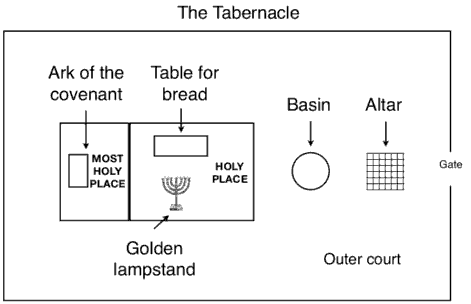
 Tabernacle - plan

God’s Tent

On the wall here is a sketch of the tabernacle together with the surrounding courtyard and equipment (it’s also on the back of your newsletters)

  • This is not to scale and it doesn’t convey anything of the beauty or fine art prescribed by God – but it does give us an overall picture

[Take my Russian dolls and set them out on a table]


I have here my Russian dolls to help us understand something of the layout of God’s tent

  • On other occasions I have used these Russian dolls as a metaphor for the different layers of our human self
  • Today though, I am not using these dolls to describe our personality, much less God’s personality
  • God is mystery and He can’t be reduced to a set of dolls
  • I’m simply using these Babushkas to help us understand the layout of God’s tent (His mobile home)

From verse 10 of chapter 25 God begins His instructions with a plan for making what we call the ‘Ark of the Covenant’ or the ‘Ark of the Testimony’

  • Interestingly God starts with the smallest doll
  • He begins with the core or the heart of His mobile home

At the very core of God’s tent – in the most holy place – we find His covenant with Israel

  • As we heard last week a covenant is more than just a contract
  • A covenant is a sacred agreement for attachment
  • At the very heart of God’s house is not a TV, but a reminder of His commitment to Israel’s well being
  • We might call this commitment – this covenant – loyal love

After giving the dimensions for this ark (or chest), God then says in verse 17 of Exodus 25…

  • “Make an atonement cover of pure gold…” to go over the top of the ark

Some versions of the Bible translate this verse ‘mercy seat’

  • Essentially the atonement cover or the mercy seat represents forgiveness
  • God provides a covering for Israel’s sin and that covering is forgiveness
  • Forgiveness is the second smallest doll in the tabernacle

God is so good – He does not require us to deny our imperfection

  • He provides for our imperfection and shows a willingness to re-enter the relationship with us when we fail

The most holy place is separated from the holy place by a veil or a curtain

In Luke 23, verse 45 we read that when Jesus died on the cross the curtain in the temple – the curtain into the most holy place – was torn in two

  • Jesus’ sacrifice on the cross reveals God’s forgiveness, His atonement for our sin

The next doll (or the holy place) is where we find the table with the bread of the presence and the lamp stand – bread & light

  • Perhaps bread is the strength to serve and light is the wisdom to see by
  • Strength and wisdom is found with God
  • What did Jesus say?
  • I am the light of the world. I am the bread of life

Moving out of the tent itself to the outer courtyard we find a basin for the priests to wash their hands and two altars

  • This diagram only shows one altar but Exodus describes two
  • One for burning incense, a symbol of the people’s prayers rising to heaven and the other for burning sacrifices

The main altar, for burning sacrifices, was basically like an incinerator

  • It wasn’t like a table with a top on it
  • It was open at the top with a grate part way down
  • This is where animals were offered to God

The message seems to be it is not a cheap or easy thing to come near to God

  • There is sacrifice and purity involved

The courtyard is fenced off with a curtain around the perimeter

  • There is only one entrance to the courtyard and that faces to the east – toward the sunrise
  • (What was it Jesus said? No one comes to the Father except by me. Jesus is the gate to God the Father.)
  • Verse 16 of Exodus 27 tells how there is to be a curtain made of fine linen embroidered with blue, purple and scarlet yarn, at the entrance to the courtyard

So the impression given to the people looking from the outside is one of beauty

  • The outer doll is attractive
  • Or to put it another way, God’s presence – His holiness – is beautiful
  • This stands in contrast to our society which generally tends to associate beauty with youth, novelty and permissiveness

In saying that the outer doll is attractive and beautiful and fascinating in its intricate design and detail I don’t mean that God is pimping His mobile home

  • God is not making His tent look flashy
  • If anything He is toning it down so as not to embarrass His neighbours
  • When you think about it the really precious stuff is hidden inside God’s tent where most people don’t get to see it

The metals used inside the tent are gold & silver – whereas the metal used outside is predominantly bronze

  • There may be practical reasons for this but I can’t help thinking of the poetry of it all – God is modest and often comes to us in ordinary ways
  • He doesn’t put the gold on the outside of His tent – He puts it on the inside
  • He doesn’t bring out the best wine first and then save the poorer quality wine for later – No, He saves the best till last
  • The longer we are in relationship with Him, the more we get to know Him and the deeper we go, the better it gets

When we put all that together, from the inside out we have…

  • Loyal (covenant) love at the very core of God’s tent, the smallest doll
  • Then forgiveness or mercy
  • Then light & bread or wisdom to see by and strength to serve
  • Then the outer court, a place of purity & sacrifice
  • And then the largest doll – the curtain at the entrance – humble beauty, the beauty of holiness

As I mentioned before, quite a bit of space is devoted to the Tabernacle in Exodus

  • We may wonder why there is so much detail
  • Well, later in Israel’s history Solomon would build a temple
  • In many ways the temple was modelled off the tabernacle, except the temple wasn’t portable like a tent
  • God moved into the temple but you get the sense He was uneasy with it
  • I think He preferred His mobile home

Some centuries after Solomon the temple in Jerusalem was destroyed and the survivors of Israel carried off to exile in Babylon

  • While in exile they didn’t have a temple
  • But they did have the elaborate description of the tabernacle which they could read about and picture in their mind’s eye
  • What a comfort it would have been to the exiles to be reminded that God is not fixed in one place – that God is able to move with them

Conclusion:

Ultimately though, the instructions for the tabernacle point to Christ

  • Jesus is the incarnation of God – He is Emmanuel – God with us
  • In the person of Jesus God didn’t just set up a tent among His people
  • God’s Word actually became a man and lived life as one of God’s people
  • Holiness rubbed shoulders with humanity

As we read at the beginning of John’s gospel…

  • The Word became flesh and made his dwelling among us. We have seen his glory, the glory of the One and Only, who came from the Father, full of grace and truth

Now God lives among His people by His Spirit

  • Today the Christian Church is the tabernacle of God
  • We, the Lord’s people, are God’s mobile home, made to mediate His presence in the world
  • This is a mystery too profound to explain – the best we can do is remain present to it (present to God’s presence, among us and through us)

Let us pray…

[1] Terence Frethiem, Exodus, page 277.

Resilient Faith

Scripture: Exodus 16:1-21

Title: Resilient Faith

Structure:

  • Introduction
  • What is resilience?
  • Developing resilience
    • Presence (not absence)
    • Nourishment (not neglect)
    • Discipline (not excess)
  • Conclusion

Introduction:

Resilience - Elephant

Resilience is the capacity to withstand stress & catastrophe [1]

  • This Volts Wagon is certainly showing some resilience

Please turn with me to Exodus chapter 16 – page 76 in your pew Bibles

  • Today we continue our series in Exodus
  • The people have been camped at Elim – an oasis in the wilderness
  • Now they set out toward Sinai and on the way their resilience is tested and found wanting. From Exodus 16, verse 1, we read…

Read Exodus 16:1-21


May the Spirit of Jesus illuminate this reading for us


What is resilience?

A diamond is just a piece of charcoal that handled stress exceptionally well

  • Diamonds are of course one of the most resilient objects known to man
  • They are formed when carbon is put under extreme heat and pressure

Resilience is not something you’re born with

  • Resilience develops as we grow up – although it doesn’t develop automatically

Some factors that contribute to resilience are:

  • A good support network – including family & friends
  • A positive (and accurate) view of yourself
  • Good problem-solving and communication skills
  • The ability to ask for help and resources
  • Healthy coping strategies – including the ability to celebrate & enjoy life
  • An outward focus – by which I mean a mind-set which considers the needs and well-being of others
  • And most importantly, in my view, faith in a loving God

All these things give us the basic materials for resilience – but we don’t really know how resilient we are until we face some kind of crisis

  • Pressure and stress reveal the diamond in our charcoal

People who are resilient have the ability to pick themselves up and carry on

  • They don’t see themselves as victims – they see themselves as survivors
  • Those with resilience are able to find positive meaning in the difficult circumstances of their lives
  • And they have the strength to manage strong feelings and impulses

Moses provides a good example of someone with resilience

  • The people of Israel? – Not so much

In Exodus 16 the people have left the oasis at Elim and followed Moses into the desert of Sin

  • It has been somewhere between 4 and 6 weeks since the Israelites left Egypt (depending on how you interpret verse 1)
  • For not the first time the people complain to Moses & Aaron, saying…
  • “We wish the Lord had killed us in Egypt. There we could at least sit down and eat meat and as much other food as we wanted. But you have brought us out into this desert to starve us all to death”

Wow – that’s messed up

  • The people who said that didn’t have their heads screwed on right
  • It hasn’t been two months yet and already they seem to have forgotten what God has done for them

The good old days are never as good as people remember them

  • In actual fact the Israelites were slaves in Egypt – they were badly mistreated – they didn’t always have meat or enough to eat
  • Pharaoh was trying to kill them
  • But God delivered them from their suffering in a miraculous way

The people weren’t starving yet – they were just worried that they might run out of food – what happens then?

  • They were getting ahead of themselves and thinking the worst

One of the things you notice when you watch interviews with the All Blacks for this world cup is that they are very careful not to get ahead of themselves

  • The tournament is just getting underway
  • They’re not thinking about the final
  • They’re thinking about what’s happening now
  • They’re thinking about the practice that morning
  • Or the pool game that afternoon
  • One day at a time sweet Jesus, one day at a time

Not getting ahead of yourself – not thinking the worst – takes mental discipline

  • Sadly it was a discipline the Israelites hadn’t learned at that point
  • They accuse Moses of wanting to starve them which just shows how fearful they were – and how little control they had over their thoughts
  • They weren’t calm on the inside – their minds were racing
  • The food crisis has led to a faith crisis [2]

Moses shows resilience in the face of this accusation

  • Like the Volts Wagon under the elephant he doesn’t crumple
  • He isn’t defeated by the weight of the people’s criticism
  • Nor does he spit the dummy and walk off
  • Moses waits for God

So where does Moses’ resilience come from?

  • Well, I think there are a number of pillars to his resilience

If we look at Moses’ upbringing we note that he had a loving and supportive family network

  • His sister Miriam watched over him as a baby when he was put in a basket and floated down the Nile
  • His biological mother spent lots of face to face time with him as an infant, so he learned basic trust from that consistent attachment
  • His adopted mother was a princess in Egypt and so Moses never wanted for anything growing up
  • His basic assumption as a child was one of abundance not scarcity

But Moses didn’t live his whole life in an ivory tower

  • After 40 years living in the wilderness as a shepherd he was well acquainted with the realities of survival
  • His adult life experience had taught him resilience in harsh environments

Aaron was another string to Moses’ bow of resilience – although it was only a matter of time before Aaron became a thorn in Moses’ side

The main stay of Moses’ resilience is his relationship with Yahweh

  • Moses is not acting or speaking on his own
  • He is following God’s instructions and so he is able to say…
  • ‘When you complain against us you are really complaining against the Lord’, verse 8
  • When we know we are in God’s will for us, when we know we are doing what God wants us to do, nothing can shake us
  •  “If God is for us, who can be against us?” [3]
  • The Lord is Moses’ support network, his resilience, his strength

To be fair the people of Israel did not enjoy the same advantages that Moses did

  • They didn’t have the raw materials needed for resilience
  • They didn’t have a princess looking after them
  • They had the sting of the slave driver’s whip instead
  • They didn’t know abundance – they only knew hard work & poverty
  • Years of brutal oppression & slavery had all but wiped out their resilience

Suffering and stress may reveal resilience – like sandpaper reveals the wood grain under paint

  • But when suffering and stress is all you’ve known then pain and fear is all you’ve got
  • If you keep sanding the wood too long it will wear thin and break
  • Suffering by itself doesn’t make you stronger – it makes you less resilient
  • Faith – learning to trust – that is what makes a person stronger

Developing resilience:

It seems to me that God wanted to develop a resilient faith among His people

  • The sort of faith that wouldn’t fall to pieces every time they found themselves in a stressful situation

And to develop this resilience the Lord gave the people three things…

  • His presence, nourishment and discipline
  • These three things are (coincidentally) what a parent needs to give their child for resilience

Presence – not absence

C.S. Lewis once wrote…

“We may ignore, but we can nowhere evade the presence of God. The world is crowded with Him. He walks everywhere incognito. And the incognito is not always easy to penetrate. The real labour is to remember to attend. In fact to come awake. Still more to remain awake.”


This has been my experience

  • God is not absent or aloof – He is everywhere, but He’s in disguise

Personally I see God most clearly in my circumstances

  • I tend to be more aware of Him out there (in the world) than I am of Him in here (in church)
  • I love it when God puts me in just the right place, at just the right time, with just the right resources to help just the right person
  • That’s when I’m most aware of God’s presence

I remember on our honeymoon, Robyn and I were near Russell, in the Bay of Islands

  • We were driving along in our burnt orange Mark 2 Ford Escort, coming over the hill from Tapeka Point, and this lady waved us down
  • So I pulled over to the side of the road and she quickly opened the door and jumped in the back
  • She was scared out of her wits because a dog had been chasing her
  • We gave her a lift down the hill into Russell township – she got out and we never saw her again

It was a small thing for us to do – no inconvenience really – but I saw God in that situation

  • He put us in the right place, at the right time, with the right resources to help a stranger in need
  • If we had come over the hill one minute earlier we would probably have missed her
  • And if we had come one minute later, who knows – maybe she would have been bitten or worse
  • It was a God moment

In Exodus 16, verse 10, we read how God makes is presence visible to the people of Israel in the form of a dazzling light inside a cloud

  • The people were scared and insecure – they needed to see God’s presence in a tangible way
  • Nothing is more convincing than presence

If you want to develop or maintain a resilient faith, then stay alert to the signs of God’s presence, whatever form He may meet you in, whether that’s through:

  • Reading the Bible
  • Or singing worship songs
  • Or helping people
  • Or experiencing dreams and visions
  • Or whatever – just look for His presence

Nourishment – not neglect

The second thing God does in Exodus 16, to help the people develop resilient faith, is He feeds them

  • God provides nourishment (He does not neglect His people)

The nourishment comes in the form of meat and bread – protein and carbs

  • God sends quail in the evening and manna in the morning

Quail are known to migrate across the Sinai Peninsula at certain times of the year

  • They stop to rest on the ground in the evening and would be easy for the people to catch
  • Although quail are naturally occurring, their provision in this situation, is extraordinary – God must be behind it
  • Because the quail arrive every night for 40 years and they never run out
  • In the ordinary course of events you wouldn’t expect that sort of frequency or quantity

The manna which appeared in the morning could also be a naturally occurring food source

  • There is an insect in that part of the world which feeds off the tamarisk tree and it secretes a white yellowy substance which is sweet to eat
  • It is rich in carbohydrates & sugar and it’s still gathered by people living in that area today
  • At night, when it’s cold, the substance congeals, but then, when the sun comes out, it melts in the heat of the day
  • It is a food which normally decays quickly and it attracts ants

Whatever you want to call this stuff it fits the description of manna in Exodus

The provision of manna, in this situation, is extraordinary – God must be behind it

  • Because the manna is there every morning for 40 years, enough to feed well over 1 million people each day
  • And on Friday’s it lasts for two days without going bad
  • In the normal course of events you wouldn’t expect that kind of frequency or quantity – nor would you expect that kind of shelf life

The way God consistently provides quail & manna shows the people He can be relied on – they can trust Him

  • Even when the people complain or disobey, God still keeps feeding them

Feeding children is one of the core responsibilities of parents

  • That routine of providing regular meals is actually one of the things that contributes to a child’s resilience
  • It helps them to feel safe and secure so they learn to trust and not worry about where their next meal is coming from

God provides the ingredients for a resilient faith by the gift of His presence and by feeding His people regularly

  • He also develops resilience through discipline

Discipline – not excess

Discipline is a misunderstood word these days

  • We often associate discipline with punishment – six of the best or time out or being grounded or some other negative consequence

But discipline isn’t really about punishment – discipline is about learning

  • To discipline someone is to teach them

So for example, teaching your child how to use a knife and fork so they can eat their dinner independently – that is discipline

  • Or teaching them how to bake a cake or sew on a button – these are also examples of disciplining your children

God’s gift of manna & quail comes with certain instructions

  • These instructions are designed to help the people get the most out of God’s gifts and to teach the people faith or trust in God

So when God says, ‘only gather as much as you need and don’t try and hoard it’, this is teaching the people both to practice self-restraint and to trust the Lord to provide some more tomorrow

  • Give us this day our daily bread

And when the Lord says, ‘gather a double portion on Friday and don’t gather any on Saturday’, this is teaching the people to rest

  • It is showing them their life does not depend on work and endless activity – it depends on God
  • Learning to rest, to celebrate, to enjoy life, to find a healthy distraction from work, this is a significant contributor to resilience also

Another thing you notice if you watch interviews with the All Blacks, leading up to this world cup, is the way they are keeping the conversation light

  • They’re not intensely focused on rugby all the time and I think this helps to preserve their resilience
  • I saw an interview in which Luke Romano was talking about how he and Sam Whitelock had been feeding the hotel nuts to a squirrel
  • It’s a healthy distraction – something else to think about – it helps them stay relaxed so they are better able to handle the pressure when it comes

God loves the people of Israel enough to discipline them

  • He doesn’t spoil the Israelites with excess
  • He teaches them resilience by giving them boundaries

We human beings need certain boundaries (especially when we are young)

  • The discipline or the teaching of what is good for us, and what is harmful, actually gives us a sense of security and strength in adulthood

Boxing - footpath

Discipline (teaching right from wrong) is like setting up the boxing when you are pouring concrete

  • If you want the concrete to hold its shape you need to make sure the boxing is in place beforehand
  • Without the boxing the wet concrete runs everywhere
  • But with the firm boundary provided by the boxing the concrete stays in place and then once it is set you can take the boxing away
  • Once the child has learned you don’t have to stay on their back all the time

Bicycle-Training-Wheels

Or to use another metaphor, teaching resilient faith is like teaching someone to ride a bike

  • When we start out in the faith God may give us training wheels
  • By training wheels I mean special supports like miracles perhaps, or a warm glow, or enthusiasm for reading the Bible or something else that makes believing in Him a bit easier
  • These training wheels give us the feel of faith and help us to build up some confidence

But ultimately God wants to teach us to ride without the training wheels

  • Because the picture of an adult riding with kiddy wheels is disturbing


And so, as we progress in the Christian faith, God may take away the supports

  • We might not experience miracles anymore or we may go through a real dry time in our devotional life or we may struggle with doubt
  • When God removes the training wheels it might feel like He has abandoned us – but actually He hasn’t – He’s still right there beside us
  • It’s just that we are having to learn to ride a two wheeler now
  • It feels a bit wobbly to begin with and we may fall over & skin our knees
  • But if we pick ourselves up again and carry on we eventually get the hang of it – we learn resilient faith

Conclusion:

I’m conscious that we are not all the same when it comes to resilience

  • Some people have been given all they need for resilience
  • They have grown up in a functional family and are surrounded by people who love and support them
  • They are able to take time off to enjoy life and have really good communication skills and so on

Then there are others who have suffered loss repeatedly and actually feel quite fragile most of the time

  • Or those who didn’t have a happy childhood
  • Those whose experience was one of neglect or excess or even abuse
  • And others who are having to work three jobs just to make ends meet, so they don’t have time to rest and enjoy life
  • Resilience in these cases seems like an unattainable goal
  • Let me say to you, Jesus understands – He is all compassion
  • “A bruised reed he will not break and a smouldering wick he will not snuff out.”

Whatever your situation – Jesus is our security

  • His resurrection from the dead is our hope of eternal resilience.
  • Whether we feel bullet proof or paper thin – strong or weak…
  • We need to keep looking to Christ for His presence, His nourishment and His discipline
  • And we shouldn’t be afraid or surprised when the training wheels come off – it’s really a compliment when God does that – a sign of His love and trust in us

[1] http://www.pbs.org/thisemotionallife/topic/resilience/what-resilience

[2] Terence Fretheim, Exodus, page 181.

[3] Romans 8:31