Scriptures: Leviticus 14, 1 Kings 6, Psalm 92, Ezekiel 17
Video Link: https://youtu.be/PAZlUkTL934
Structure:
- Introduction
- Health (purification)
- Holiness (presence)
- Hope (purpose)
- Conclusion
Good morning everyone.
There are five countries in the world who have a tree on their flag, one of which is Lebanon. Would anyone like to guess what tree we find on the Lebanese flag? [Wait] That’s right, the cedar tree.
Today we continue our testimony of trees series by focusing on the cedar tree. The Cedar of Lebanon (scientific name: Cedrus libani) is mentioned many times in the Old Testament. The cedar is a majestic tree, reaching a height of 20-30 metres. It grows in the mountains of Lebanon where the temperature is cooler and it gets plenty of water.
Our message this morning draws on a variety of Scripture references. Essentially though the cedar is associated with health, holiness and hope.
Or, if you prefer the three points of a sermon to start with a P, then purification, presence and purpose. Let us begin then with purification and health. From Leviticus 14, we read…
Health – Leviticus 14
The Lord said to Moses, 2 “These are the regulations for any diseased person at the time of their ceremonial cleansing, when they are brought to the priest: 3 The priest is to go outside the camp and examine them. If they have been healed of their defiling skin disease, 4 the priest shall order that two live clean birds and some cedar wood, scarlet yarn and hyssop be brought for the person to be cleansed. 5 Then the priest shall order that one of the birds be killed over fresh water in a clay pot. 6 He is then to take the live bird and dip it, together with the cedar wood, the scarlet yarn and the hyssop, into the blood of the bird that was killed over the fresh water. 7 Seven times he shall sprinkle the one to be cleansed of the defiling disease, and then pronounce them clean. After that, he is to release the live bird in the open fields.
May the Spirit of Jesus illuminate God’s word for us.
How many of you say grace before eating a meal? To my mind, a meal isn’t ready to eat until we have said a prayer to thank God and bless the food.
The spiritual ritual of saying grace is as important as the physical ritual of cooking the food properly.
We are not just bags of skin, bone and flesh. We are spiritual beings, inhabiting a physical body. There is a relationship between the physical and the spiritual. Saying grace before eating, acknowledges the reality of God’s provision for our lives.
In ancient Israel, people with skin diseases were excluded from community life. Although they may have done no moral wrong, they were considered ceremonially unclean and therefore not allowed to participate in religious events.
If a person recovered from their skin disease, then the priest (who was also the public health officer) checked the disease was gone and performed the purification ritual described in Leviticus 14 to declare the person fit to return to community life.
This ritual involved the use of cedar wood. It’s not that the cedar tree was used to heal skin diseases. Rather, once a person had been healed of a skin disease, cedar was used in the purification rite declaring them clean.
This ritual probably seems strange or unnecessary to us but, to someone with an ancient mindset, who believed in spiritual reality as much as material reality, the healing wasn’t complete until the priest had carried out the ritual.
We might think of this ritual like saying grace before eating a meal. The ritual acknowledges the reality of God in our lives. It is God who heals and purifies us, just as it is God who feeds and sustains us.
One of the distinctive features of the cedar tree is its natural resistance to insects and rot. The cedar tree contains certain oils which make it smell nice and repel insects, while also preserving the wood. It may be for this reason that the cedar tree was used by Jewish priests in purification rituals. Cedar wood symbolises restored strength and good health.
One of the interesting things about the ritual in Leviticus 14, is that two birds are used. One bird is offered to God as a sacrifice, while the other bird is set free, signifying that the person who was healed is now free to rejoin the worshipping community.
As Christians, we don’t need to perform the rituals prescribed in Leviticus every time we recover from shingles or boils or scabies or whatever. But we do need to give thanks to God for restoring our health and purifying us. What rituals do you observe that acknowledge the reality of God in your life?
Alongside health and purification, the cedar tree is also associated with holiness. In particular, the beauty of God’s holy presence represented by the temple.
Holiness – 1 Kings 5 & 6
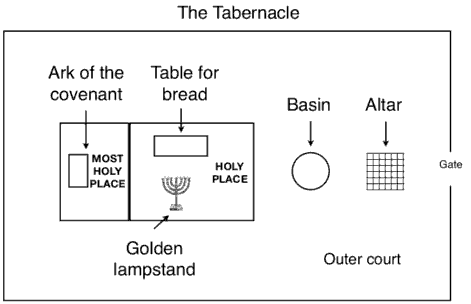
In First Kings chapters 5 and 6, we read how Solomon used cedar in the building of the Jerusalem temple. The external structure of the temple was mostly made from stone, but a lot of cedar wood was used inside the temple.
Cedar trees grew abundantly in the mountains of ancient Tyre. The region of Tyre lay north of Israel in the land we know today as Lebanon. Solomon made a deal with Hiram, the king of Tyre, to obtain the cedar.
Solomon conscripted 30,000 labourers to cut down the cedar trees. The trees were then brought to Jerusalem where they were used in the construction of the temple. Let me read you a selection of verses from First Kings chapter 6, which describe how the cedar tree was used…
14 So Solomon built the temple and completed it. 15 He lined its interior walls with cedar boards, panelling them from the floor of the temple to the ceiling and covered the floor of the temple with planks of juniper. 16 He partitioned off twenty cubits at the rear of the temple with cedar boards from floor to ceiling to form within the temple an inner sanctuary, the Most Holy Place. 20 The inner sanctuary was twenty cubits long, twenty wide and twenty high. He overlaid the inside with pure gold, and he also overlaid the altar of cedar.
These verses tell us cedar was used extensively in the temple, including in the most holy place and for the construction of the altar.
Most likely cedar was used for both practical and aesthetic reasons. As already mentioned, cedar is a strong, durable wood that smells nice, repels insects and is resistant to rot, making it an excellent building material.
Aesthetically, cedar wood has a beautiful grain, without knots. It is pleasant to look at. Cedar is beautiful inside and out.
A temple is a holy place, a place of God’s presence, where prayers and worship are offered. Ideally, a place of reconciliation that brings people closer to God and closer to one another. Because of its use in the temple, cedar is associated with the beauty of holiness.
We don’t often think of holiness as a beautiful thing. Holiness in our society seems more weird than attractive. Not so in ancient Hebrew society.
In Psalms 29 and 96, we are told to worship the Lord in the beauty of holiness.
The kind of beauty in view here is that of splendour or majesty. God’s holiness is like the beauty of a mountain range or the beauty of a cedar forest. God’s holiness is evergreen, its beauty does not fade.
To worship the Lord in the beauty of holiness is to worship God with clean hands, a clean heart and a clean conscience, without pretense or hypocrisy.
Worship the Lord like no one is looking.
Solomon cut down thousands of cedar trees, both for the temple and for his own palace. His carbon footprint was enormous.
Does this mean we (today) need to use cedar in the construction of our church buildings? Well, no. For Christians, God’s holy presence does not rest in a building. God’s presence is found in Jesus and among his people. We are the new temple, a temple not made by hands. The church is like a forest of living souls, made pure and holy by Christ.
The cedar tree is associated with health and purification, together with the beauty of God’s holy presence. The cedar tree is also pregnant with hope and purpose.
Hope – Psalm 92 & Ezekiel 17
Because of their strength and beauty and usefulness, the cedar forests of Lebanon have been depleted down through the centuries. Consequently, the Lebanese authorities have established special reserves to protect and regenerate cedar trees.
Despite humanity’s greed, some cedars have survived for more than 2000 years. One of the keys to the cedar’s longevity is its root system. The roots of the cedar tree grow deep to find water and give the tree stability. Once the tree is established, it will generally last a long time if left undisturbed.
In Psalm 92 we read…
12 The righteous will flourish like a palm tree, they will grow like a cedar of Lebanon; 13 planted in the house of the Lord, they will flourish in the courts of our God. 14 They will still bear fruit in old age, they will stay fresh and green, 15 proclaiming, “The Lord is upright; he is my Rock, and there is no wickedness in him.”
Psalm 92 is a worship song for the Sabbath day. Being a song for the Sabbath, Psalm 92 looks forward (in hope) to that day of eternal rest, when there will be no more evil or suffering or death, when every day will be a perfect day, an everlasting Sabbath fulfilling God’s purpose for creation.
Cedars don’t grow as quickly as some plants, but they do grow tall and last a long time. The poetry of Psalm 92 is saying the righteous have hope for a good and lasting future. Their purpose is to serve and worship God.
Righteousness in the Bible simply means right relationship. The righteous relate with God and their neighbours in a right way, in a way that is gracious and true, fair and kind.
You don’t have to be perfect to be righteous. Righteous people sometimes mess up. But if a righteous person does make a mistake, they do everything in their power to put it right.
Faith is the foundation of righteousness. Or to use the metaphor of the cedar, faith is the root system of the tree. Faith in God finds the water of life and lends stability to the tree.
Notice the underlying tone of humility in these verses. Just as the cedar grows best at altitude (in the mountains of Lebanon), so too the righteous grow best in the courts of our God. That is, in close relationship with the Lord and his people. The righteous owe their vitality and fruitfulness to the Lord, not their own righteousness. It is by God’s grace that the cedar tree enjoys long life.
The point is, the righteous are like cedars, they have hope of an evergreen future. The worship and service of the righteous is purposeful and lasting.
We are talking about the cedar tree and its connection with hope and purpose in the Bible.
In Ezekiel 17 we read…
22 “‘This is what the Sovereign Lord says: I myself will take a shoot from the very top of a cedar and plant it; I will break off a tender sprig from its topmost shoots and plant it on a high and lofty mountain. 23 On the mountain heights of Israel I will plant it; it will produce branches and bear fruit and become a splendid cedar. Birds of every kind will nest in it; they will find shelter in the shade of its branches. 24 All the trees of the forest will know that I the Lord bring down the tall tree and make the low tree grow tall. I dry up the green tree and make the dry tree flourish.
You all know the story of Cinderella. The girl who was loved by her father but hated by her stepmother and stepsisters. When her father died, Cinderella experienced a reversal of fortunes. She became a servant to her stepmother and stepsisters and was mistreated by them.
When the prince of the realm decided to hold a ball, Cinderella was made to stay home, until her fairy godmother intervened. Cinderella goes to the ball and dances with the prince but has to leave in a hurry at midnight. In her rush she leaves behind a glass slipper.
In his search for the mysterious woman who left so quickly, the prince goes through the land trying to find the one who fits the glass slipper. Eventually, after a few twists and turns, the prince is reunited with Cinderella and they are married.
Once again Cinderella experiences a dramatic reversal of fortunes, this time from being a lowly servant girl to becoming a princess.
The Bible is full of Cinderella stories. In fact, the fairy tale of Cinderella is inspired by the true stories of the Bible. The stories of Jacob and Joseph are packed with reversals. As is the story of Ruth and Naomi. To say nothing of the history of Israel; from slavery in Egypt to exodus in the wilderness to a fresh start in the promised land of Canaan to exile in Babylon and return from exile.
Why does the Bible contain so many stories of reversal? Two reasons mainly. Firstly, because these stories literally happened in history. And secondly, because stories of reversal inspire hope and humility.
If you are down on your luck, bullied by your enemies, poor in spirit and unable to see a way forward, you can remember how God reversed his people’s fortunes to give them a good future.
God did it for Joseph and Ruth and Naomi and Hannah and Israel and many others. Perhaps he will do it for you too. These true stories of reversal inspire hope and give purpose to our struggles.
At the same time, if life is going well and you feel like you are on top, healthy, wealthy and wise, remember how God reversed the fortunes of people like Nebuchadnezzar, Pharaoh and Saul, to humble them. Then any pride you might feel at your accomplishments will be diminished. Stories of reversal let the air out of an over inflated ego. No one wants to be the ugly stepsister.
God has the power to reverse our fortunes. In verse 24 of Ezekiel 17, the Lord says: All the trees of the forest will know that I, the Lord, bring down the tall tree and make the low tree grow tall. I dry up the green tree and make the dry tree flourish.
That is a picture of reversal, inspiring both hope and humility at the same time.
In verses 22-23 of Ezekiel 17, the Lord says that he will take a shoot from the top of a cedar tree and plant it on the mountain heights of Israel, where it will become a splendid cedar tree.
To the ancient mind the image of a majestic tree (like a cedar) stands as a metaphor for a mighty king and his kingdom.
For Christians, the shoot that God takes from the top of a cedar tree to replant, is a picture of Jesus, the Messiah. Jesus is the King who embodies the tree of God’s kingdom on earth.
God’s kingdom, established through Jesus, is strong and enduring like the cedar tree. God’s kingdom is healthy and holy, with a purifying presence resistant to rot. God’s kingdom bears good fruit and provides shelter for every kind of bird. The birds here probably represent the different peoples of the world. God’s kingdom is for all nations.
We are reminded of Jesus’ parable of the mustard seed. The kingdom of heaven starts small like a mustard seed but grows to be a large garden plant providing shelter for the birds of the air. Transformation from small to large; sounds like a story of reversal, inspiring hope, giving purpose.
Conclusion:
Most of you will see where this sermon is headed. Jesus, the prince of heaven, born into humble circumstances. Raised in obscurity, the son of a carpenter. Homeless and relying on the kindness of strangers for the three years of his public ministry.
Condemned for a crime he did not commit. Sentenced to a humiliating, agonizing death on a cross. Dead and buried, then raised to eternal life on the third day. The life, death and resurrection of Jesus is God’s ultimate reversal story and the foundation of our hope.
Let us pray…
Lord Jesus Christ, you are the priest who purifies us and sets us free. You are our holiness, the root of all righteousness. Your resurrection is the ground of our hope. We thank you for your faithfulness to God and to us. Amen.
Questions for discussion or reflection:
- What stands out for you in reading this Scripture and/or in listening to the sermon? Why do you think this stood out to you?
- What are some of the distinctive characteristics of the cedar tree? What is the cedar tree associated with in the Bible?
- Why did God provide rituals of purification for people who had recovered from a skin disease? What rituals do you observe that acknowledge the reality of God in your life?
- Why was cedar wood used in the construction of the Jerusalem temple? What does it mean to worship God in the beauty of holiness? How do we do this?
- Why does the Bible contain so many stories of reversal? What purpose do these stories serve? Do you have a personal story of reversal? If so, what happened?
- How does the parable of the cedar shoot (in Ezekeil 17:22-24) point to Jesus?
 Tawa Baptist