Connections

Scripture: Matthew 14:13-21

Video Link: https://youtu.be/4V8DB8BO2FE

Structure:

  • Introduction
  • Jesus’ leadership
  • Jesus’ faith
  • Conclusion

Introduction:

Good morning everyone.

Most nights Robyn and I do some of the New York Times word puzzles. There’s Wordle of course, but we normally start with the lesser known Connections.

With Connections you are given 16 words; that is, four sets of four words which are related in some way. The object is to find the right connections.   
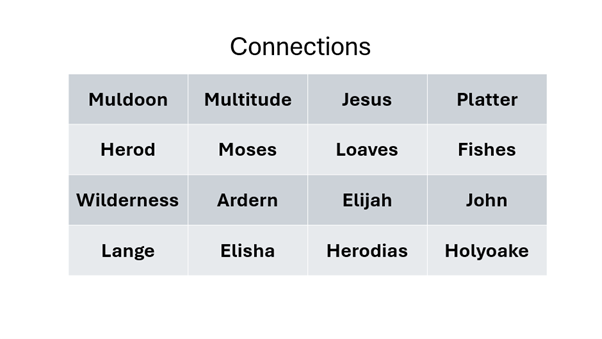
For example, among the 16 words you are given, you might have four names like Holyoake, Muldoon, Lange and Ardern. The connection there is pretty obvious. They are all former Prime Ministers of New Zealand.    

What about Multitude, Wilderness, Loaves and Fishes? What connection do you see with those words? Yes, Jesus’ feeding of the 5000. Today our message focuses on Matthew 14, verses 13-21, which describes Jesus’ miracle of feeding a multitude with just a handful of loaves and fishes.

This event is recorded in all four gospels and it finds multiple connections with the Old Testament as well. The feeding of the 5000 is a nexus point of Biblical connections. From Matthew 14, verse 13 we read…

13 When Jesus heard what had happened, he withdrew by boat privately to a solitary place. Hearing of this, the crowds followed him on foot from the towns. 14 When Jesus landed and saw a large crowd, he had compassion on them and healed their sick. 15 As evening approached, the disciples came to him and said, “This is a remote place, and it’s already getting late. Send the crowds away, so they can go to the villages and buy themselves some food.”

16 Jesus replied, “They do not need to go away. You give them something to eat.” 17 “We have here only five loaves of bread and two fish,” they answered. 18 “Bring them here to me,” he said. 19 And he directed the people to sit down on the grass. Taking the five loaves and the two fish and looking up to heaven, he gave thanks and broke the loaves. Then he gave them to the disciples, and the disciples gave them to the people. 20 They all ate and were satisfied, and the disciples picked up twelve basketfuls of broken pieces that were left over. 21 The number of those who ate was about five thousand men, besides women and children.

May the Spirit of Jesus illuminate God’s word for us.

Two main things I want to draw your attention to in this passage:

Jesus’ leadership and Jesus’ faith. We begin with Jesus’ leadership. The light of Jesus’ leadership shines brightly against the darkness of Herod’s reign.  

Leadership:

When you see (or hear) the words, Herod, platter, John and Herodias, what do you think of? Surely the beheading of John the Baptist.

John was the forerunner to Jesus, the prophet who came to prepare the way for the Messiah. John was Jesus’ ally, his wing man if you like. More than that, they were cousins.

In Matthew 14, verses 1-12, we read how Herod Antipas had John the Baptist killed. Herod was the puppet ruler of Galilee during the time of Jesus. He was a ruthless and depraved man.

When John the Baptist called Herod out on some of the bad stuff he was doing, Herod had John thrown in prison. Then when the daughter of Herodias danced for Herod, he promised to give her whatever she wanted. Herodias told her daughter to ask for John’s head on a platter.

After John had been beheaded, John’s disciples buried his body and told Jesus what had happened.

Given these facts, Jesus’ response to Herod is interesting. Jesus did not confront Herod; he did not organize a protest outside Herod’s palace or lead a revolt against Herod. Jesus did not seek revenge. Instead, Jesus quietly withdrew to a solitary place. Why?

Well, there was probably more than one reason. Perhaps Jesus did not want to inflame an already volatile situation. What Herod had done was a gross injustice. Anger and outrage are the natural response to injustice.

If Jesus confronted Herod or led a protest against him, it would have resulted in more violence. A calm head and a strategic withdrawal were necessary for the sake of peace. This was not a time for Jesus to be distracted from his core mission.

It appears too that Jesus needed some alone time; a short spiritual retreat to deal with his own feelings arising from John’s murder, but also to commune with God and seek his Father’s will on what his next move should be.   

With God, small things can make a big difference. Seeking solitude may seem like a small thing, but (in the context of Matthew 14) it accomplished much good and avoided even greater evil.

I wonder if Jesus had Psalm 37 in mind when he chose to put distance between himself and Herod. In verse 7, David writes…

Be still before the Lord and wait patiently for him; do not fret when people succeed in their ways, when they carry out their wicked schemes. Refrain from anger and turn from wrath; do not fret—it leads only to evil. For those who are evil will be destroyed, but those who hope in the Lord will inherit the land.

Jesus had faith that God Almighty would deal with Herod, and the Lord did deal with him. Some years later, in Acts 12, we read how an angel of the Lord struck Herod down. He was eaten by worms and died. God is just.

When the crowds worked out where Jesus was headed, they walked around the lake on foot and met him on the other side, in the wilderness. Seeing the large crowd, Jesus had compassion on them and healed their sick.

Compassion is the key word here. Compassion, in this context, is that deep feeling of empathy which moves a person to acts of kindness. Compassion speaks of an intimate connection, a heart and hand response to others in need. Compassion puts aside any thought of personal convenience or comfort for the sake of another person’s wellbeing.

Seeing all those people lost and confused, by what Herod had done to John, evoked a gut response from Jesus. The Lord was deeply moved in the core of his being. Rather than venting his spleen at Herod, Jesus used his emotional energy to heal and feed people.

By putting the account of Herod’s murder of John the Baptist alongside the account of Jesus’ compassion for the people, we (the reader) are invited to compare and contrast Herod’s leadership with Jesus’ leadership.

Herod was self-indulgent, brutal and destructive. Herod threw wild parties at the expense of the poor. He showed no restraint and it resulted in him taking the life of a righteous man. Herod’s leadership was toxic to the people.

In contrast, Jesus shows compassion for the poor. Jesus heals the sick, feeds the hungry and protects the vulnerable. Jesus demonstrates the kind of good shepherd leadership God wants for his people.

Those who are familiar with the Old Testament will see here a connection between Jesus and God’s word through the prophet Ezekiel…  

11 “I, the Sovereign Lord, tell you that I myself will look for my sheep and take care of them 12 in the same way as shepherds take care of their sheep that were scattered and are brought together again. … 14 I will let them graze in safety in the mountain meadows and the valleys and in all the green pastures of the land of Israel. 15 I myself will be the shepherd of my sheep, and I will find them a place to rest. I, the Sovereign Lord, have spoken.

By caring for the people in the wilderness, Jesus was acting as the divine shepherd leader of Israel, who has compassion on his people.

Okay, so we have talked about Jesus’ leadership, in contrast to Herod’s abuse of power. We also notice Jesus’ faith. Jesus models for us complete trust in God the Father.

Jesus’ faith:

The story is told of a soldier who was separated from his unit. The fighting had been intense, and in the smoke and the confusion, he had lost touch with his mates.

Alone in the jungle, he could hear enemy soldiers coming in his direction. Scrambling for cover, he found his way up a ridge to several small caves in the rock. Quickly he crawled inside one of the caves.

Although safe for the moment, he realized that once the enemy soldiers swept up the ridge, they would quickly search all the caves and he would be killed.

As he waited, he prayed, “Lord, if it be your will, please protect me. Whatever your will though, I love you and trust you. Amen.”

After praying, he lay quietly listening to the enemy begin to draw close.

He thought, “Well, I guess the Lord isn’t going to help me out of this one.”

Just then he saw a spider begin to build a web over the front of his cave. As he watched, listening to the enemy searching for him, the spider layered strand after strand of web across the opening of the cave.

“Hah” he thought, “what I need is a brick wall and what the Lord has sent me is a spider web. God does have a sense of humour.”

As the enemy drew closer, he watched from the darkness of his hideout and could see them searching, one cave after another. When they came to his cave, he got ready to face his end. To his amazement, though, they moved on.

Suddenly, he realized that with the spider web over the entrance, his cave looked as if no one had entered it for quite a while.

“Lord, forgive me,” the soldier prayed, “I had forgotten that in you a spider’s web is stronger than a brick wall.”

With God, small things can make a big difference. 

Take plankton for example. Plankton are small. Many types of plankton are microscopic in fact, smaller than a human blood cell, and yet they feed whales, the largest of mammals.

More than simply being a food source though, phytoplankton produce somewhere between 50% and 80% of the earth’s oxygen. God supports life on earth using tiny plankton.

Phytoplankton also absorb carbon dioxide helping to regulate the earth’s climate by removing greenhouse gas, from circulation.

With God, small things can make a big difference.  

Returning to Matthew 14. Jesus (the shepherd leader) had been ministering to people most of the day. It was getting late, so the disciples suggested to Jesus that he send the crowd away to the nearby villages to buy some food for themselves.

Given there were well over 5000 people present, this was not really a practical solution. It is unlikely the surrounding villages could cater for that number of people.

Jesus has another idea. ‘You give them something to eat’, he tells his disciples.

The disciples raise the obvious objection that they only have five loaves and two fish.  

In the gospel of John, we learn that these five loaves and two fish belonged to a boy. The loaves were made from barley. Barley bread was the food of the poor and the fish was probably small and pickled (like sardines).

It appears this boy was not well connected. He did not come from a wealthy family and his lunch was pretty ordinary.

Jesus is not phased though. He says, ‘bring them here to me’. And he directed the people to sit down on the grass. Green grass does not grow all year round in the middle east, like it does in New Zealand. The mention, therefore, that there is grass tells us it is springtime, Passover season.  

The Jewish Passover celebrates God’s deliverance of Israel from slavery in Egypt. We (the reader) are meant to see a connection here between God’s deliverance under Moses and the deliverance God brings under Jesus’ leadership.

In verse 19 we read how Jesus took the five loaves and the two fish and looking up to heaven, he gave thanks and broke the loaves. Then he gave them to the disciples, and the disciples gave them to the people. 

Here we see Jesus acting in faith that God would provide. As one commentator puts it, Jesus simply gave thanks for the food, confident that he represents the Father’s will.

In Jesus’ hands those five loaves and two fish fill the bellies of well over 5000 people, so that everyone had more than enough to eat.

Some people try to explain this miracle away, in various rational ways, but doing that empties this event of its meaning, robbing us of wonder and hope in the process. Jesus trusted God his Father completely and the Father honoured Jesus’ faith.

With God, small things can make a big difference.

Looking at our game of Connections once again we see there are four words left, names actually: Jesus, Moses, Elijah and Elisha. What do these four men share in common?

They were all prophets of the living God, offering spiritual leadership for the people. More than that, they all trusted God to provide for their needs and consequently participated in a feeding miracle. 

When the people of Israel cried out to Moses for food in the Sinai desert, Moses did not try to engineer a solution himself. He turned to God in prayer and the Lord God provided an abundance of manna and quail.

When God told the prophet Elijah to hide in the wilderness east of the Jordan, with no supermarket in sight, Elijah obeyed the Lord in faith, and God had ravens bring bread to feed him.

When a man brought the prophet Elisha 20 loaves of barley bread, Elisha told the man (in faith) to give the bread to the people. The 20 loaves fed 100 men and there was some left over.  

So, when we read how Jesus had faith in God to multiply five loaves and two fish to feed over 5000 people in the wilderness of Galilee, we see that in Jesus someone greater than Moses, Elijah and Elisha has come. Jesus is more than a prophet.

With God, small things can make a big difference.

Now in saying this, I do not mean to imply that we can be stingy with God, giving him our scrapes. The boy who offered his five loaves and two fish, gave Jesus everything he had. The boy was generous.

The point is, even when we give our best and our all, it may seem like a drop in the bucket. Our best and our all will usually fall short of the ocean of human need. But that is no reason to give up in despair. We can only do what is in our power to do and trust God with the outcome.   

Hearing this miracle story of Jesus feeding the multitudes is lovely and inspiring, but when we watch the news, we become painfully aware of the millions in our world today who are starving. Why doesn’t God feed them?

Well, God has provided enough to feed everyone on the planet. It’s not a production problem; it’s a distribution problem. Human greed and fear often get in the way.

Jesus trusted his disciples to distribute the food to the multitude and the disciples were faithful in carrying out the task Jesus gave them. In the end, there were 12 basketfuls left over, one for each of the disciples.  

Conclusion:

This morning we have observed multiple connections, all orbiting around Jesus and the miraculous feeding of the 5000 in the wilderness. There’s just one more connection we need to make. This too finds its fulfilment in Christ.

Centuries before Jesus came, the Lord God gave the prophet Isaiah a glimpse of a future heavenly banquet, with food far richer than barley bread and pickled fish. From Isaiah 25 we read…

On this mountain the Lord of hosts will make for all peoples a feast of rich food, a feast of well-aged wine, of rich food full of marrow, of aged wine well refined. And he will swallow up on this mountain the shroud that is cast over all peoples, the veil that is spread over all nations. He will swallow up death forever; and the Lord God will wipe away tears from all faces, and the reproach of his people he will take away from all the earth, for the Lord has spoken.

Jesus is the one who removes the shroud of death. It is through faith in Jesus (his death and resurrection) that we have sure hope of participating in God’s heavenly banquet.

Let us pray…

Gracious God, you know our every need and you care for us. Thank you for Jesus, the good shepherd, who leads us in paths of righteousness and restores our soul. Grant us the grace to follow Jesus all the days of our life and enjoy you forever. Amen.   

Questions for discussion or reflection:

  1. What stands out for you in reading this Scripture and/or in listening to the sermon? Why do you think this stood out to you?
  2. Why did Jesus withdraw to a solitary place after hearing how Herod had killed John? What good did Jesus’ retreat accomplish? (What evil did it prevent?)
  3. What is compassion? What (or who) moves you to acts of kindness?
  4. Compare and contrast Jesus’ shepherd leadership with Herod’s abuse of power. How do you experience Jesus’ care and provision?
  5. Discuss / reflect on the connections you notice between Jesus’ feeding of the 5000 in Matthew 14 and other feeding miracles in the Bible. How are these miracles similar? How are they different?
  6. In what ways do we see Jesus’ faith operating in Matthew 14?
  7. What small thing can you do (in faith) to show God’s love and care for others?     

John’s Expectations

Scripture: Luke 7:18-30

Video Link: https://youtu.be/1aD988jAIZY

Structure:

  • Introduction
  • Luke 7:18-20
  • Luke 7:21-23
  • Luke 7:24-30
  • Conclusion

Introduction:

Good morning everyone.

Expectations. They are like balloons; buoyant, fun, uplifting, but also vulnerable. They can be stolen by the wind (and drift across America) or burst on the sharp edges of reality. Even if you manage to keep hold of the balloon of your expectations though, it will inevitably become deflated.   

Expectations are also like bread baking in the oven. It has a pleasant aroma which fills the house, triggering memory and hunger, drawing people together, in anticipation of a good feed. But, like bread, expectations have a tendency to go stale.

Today we conclude our series on John the Baptist by considering John’s expectations. From Luke chapter 7, verse 18, we read…

18 John’s disciples told him about all these things. Calling two of them, 19 he sent them to the Lord to ask, “Are you the one who is to come, or should we expect someone else?”

20 When the men came to Jesus, they said, “John the Baptist sent us to you to ask, ‘Are you the one who is to come, or should we expect someone else?’”

21 At that very time Jesus cured many who had diseases, sicknesses and evil spirits, and gave sight to many who were blind. 22 So he replied to the messengers, “Go back and report to John what you have seen and heard: The blind receive sight, the lame walk, those who have leprosyare cleansed, the deaf hear, the dead are raised, and the good news is proclaimed to the poor. 23 Blessed is anyone who does not stumble on account of me.”

24 After John’s messengers left, Jesus began to speak to the crowd about John: “What did you go out into the wilderness to see? A reed swayed by the wind? 25 If not, what did you go out to see? A man dressed in fine clothes? No, those who wear expensive clothes and indulge in luxury are in palaces. 26 But what did you go out to see? A prophet? Yes, I tell you, and more than a prophet.  27 This is the one about whom it is written: “‘I will send my messenger ahead of you, who will prepare your way before you.’ 28 I tell you, among those born of women there is no one greater than John; yet the one who is least in the kingdom of God is greater than he.”

29 (All the people, even the tax collectors, when they heard Jesus’ words, acknowledged that God’s way was right, because they had been baptized by John. 30 But the Pharisees and the experts in the law rejected God’s purpose for themselves, because they had not been baptized by John.)

May the Spirit of Jesus illuminate God’s word for us.

Luke 7:18-20

Did you feel the earthquake last Wednesday night? It was about 6.2 or 6.3 in magnitude, located 81 km’s north of Wellington in the Tasman Sea. In Wellington we live with this ambient expectation of an earthquake most of the time. Mindful of the damage caused on the east coast by the recent cyclone, we are thankful the earthquake on the west coast didn’t do any harm.

Expectations are a bit like fault lines. Just as we get an earthquake when two tectonic plates bump up against each other, so too we get a disturbance deep in our soul when our expectations bump up against reality. The stronger the expectation the bigger the magnitude of shock if that expectation is not met.

By the time we get to Luke 7, John the Baptist is in prison. This was hardly unexpected. John was smart enough to realise that if you criticise powerful people (as he had criticised Herod) they are going to make life difficult for you.

For John, the fault line created by unmet expectations did not come from Herod, it came from Jesus. Jesus’ ministry had not unfolded in the way John the Baptist had expected.

When there is a gap between our expectations and the reality we experience, that creates uncertainty. John did not doubt that Jesus was from God but when he heard what Jesus was doing it may have caused him to doubt himself; did I get it right in thinking Jesus is the Messiah? 

You see, John had preached that the Messiah would bring God’s fiery judgement, to destroy the wicked, but Jesus seemed to be doing the opposite. Jesus was actually healing people and bringing God’s mercy. Jesus even helped a Roman centurion, the last person you would expect to benefit from the Messiah’s work.

What’s more, Jesus’ approach was completely different from John’s approach. Yes, they had the same objective; to bring people back to God. But they went about achieving that objective in a totally different way. John abstained from drinking alcohol. He lived in the wilderness and fasted, while Jesus went to parties in town and was accused of being a glutton and a drunkard.

Jesus was not behaving in the way John expected the Messiah to behave. So, John sent two of his own disciples to ask Jesus if he was the one who is to come or should we expect someone else?

Before we consider how Jesus responds to John, let’s pause for a moment to think about what John is doing here.

Sending two disciples was significant. It takes at least two witnesses to agree for the truth to be established. Sending two witnesses was almost like putting Jesus under oath. The question and the answer is important to John.

And it is little wonder. John has given his whole life to one purpose: telling people to repent and be baptised because the Messiah is coming to judge the living and the dead. 

John doesn’t have a wife or any family or even a home to return to. John has put all his eggs in one basket. He has no safety net. He has no back up plan. John needs to know that his life has not been in vain. He needs to know that the message he has poured his heart and soul into is true. That he backed the right horse (or the right Messiah in this case).

We human beings can suffer a great deal if we know why, if we understand the meaning in our sacrifice. Jesus is John’s why. John is not relying on himself. He is looking to Jesus for meaning in his suffering.

At some point in your journey of faith, God will disappoint your expectations. There will come a day (if it hasn’t come already) when it feels like Jesus has pulled the rug out from under your feet. It is never fair. The expectation created by the lovely aroma of freshly baking bread can turn stale overnight.

It happened for Job, when he lost everything. It happened for Jonah when he preached to Nineveh. It happened for Joseph when he was sold into slavery. It happened for Mary & Martha, when Lazarus died. It happened for the disciples when Jesus went to the cross. It happened for the early church who were persecuted for their faith. It’s probably happening right now for believers in the Hawke’s Bay and Syria and Turkey and the Ukraine.  

Disappointment with God can happen when a marriage fails, or when a loved one becomes ill and dies. It can happen when your dreams and goals are turned to ash. It can happen in an instant or over a prolonged period. It can happen once or it can happen multiple times.

Though he slay me, yet I will hope in him. (Job 13:15).

John does not quit God when Jesus upsets John’s expectations. No. John takes his question to Jesus. He enters into a conversation with the Lord. And that is the key.

When God does not meet your expectations, don’t give him the silent treatment. Give him a piece of your mind, in a respectful way. Be honest with him. Tell him what you are thinking and feeling. Ask him what you need to know.

You might not get the answer you want but (if you are listening) God will probably give you some perspective. The important thing is to stay in the conversation with him. Do not close yourself off from God. That would be like holding your breath, it would be madness.     

Okay, so John takes his question to Jesus. He basically asks if Jesus is the Messiah. How then does Jesus respond?

Luke 7:21-23

Expectations can be a bit like movies. When you go to watch a movie you escape reality for a couple of hours. The storyline of the movie normally involves the hero overcoming great odds to achieve their goal and live happily ever after.

Movies tend to create unrealistic expectations because they edit out the boring bits of life and usually have a neat and tidy ending. Then you go back to real life, which is mostly hard work and frustration with no neat and tidy endings, and you can’t wait to escape back to the movies again. 

Jesus doesn’t make a movie. He doesn’t create any false expectations for John or anyone else. Jesus simply states the facts, saying…

The blind receive sight, the lame walk, those who have leprosyare cleansed, the deaf hear, the dead are raised, and the good news is proclaimed to the poor.

These words of Jesus are, in fact, a collage of quotes from the prophet Isaiah. But they are not just random quotes. They are words that Isaiah wrote in relation of the Messiah. John would have known this. It’s like Jesus is saying: ‘I am doing exactly what Isaiah said the Christ would do. You do the math’.

Jesus doesn’t say directly to John, ‘Yes, I am the Messiah. You just have to blindly trust me’. No. Nor does Jesus send John to the movies. Jesus offers John hard evidence from real life and from the Scriptures.

None of this results in a happy ending for John. None of this gets John out of prison. Jesus does not save John from Herod’s executioner. As far as we know, Jesus doesn’t even visit John or send him a care package. John still suffers great injustice at the hand of Herod’s household. This is not a movie. This is real life.

But John can take comfort in the fact that he was right to identify Jesus as God’s Messiah. John does not need to doubt himself, much less Jesus. John’s sacrifice was not in vain. His life had the highest meaning and purpose. Jesus gave John the ‘why’ he needed to deal with his uncertainty and pain.

Some of you may be wondering, if John’s expectations were not quite right about the Messiah, does that mean we can disregard what John said about the coming judgement and the need for repentance?

Well, no. Just because God’s judgement did not come as quickly as John expected doesn’t mean that it’s not coming. There is still going to be a day of judgement at the end of time. And repentance still goes hand in hand with forgiveness.

One of the functions of judgement is to separate the wheat from the chaff, the good from the bad. What we notice when we look at the ministry of Jesus is that he sifted pretty much everyone he met. Jesus did not come to condemn or destroy people. Nevertheless, his very presence divided people.

There is no sitting on the fence with Jesus. You are either for him or against him but, once you encounter Christ, you cannot ignore him. Each of us must decide how we will respond to Jesus. We either accept him as Saviour and Lord or we don’t. Those who receive Jesus, receive God’s mercy. Those who don’t receive Jesus, can expect God’s justice.  

Luke 7:24-30

I have compared expectations to balloons, to fault lines, to the aroma of freshly baked bread and to the movies. We might also think of expectations like the pendulum of a clock. Expectations swing both ways; they can be high or low, positive or negative.

Expectations can also have a hypnotic affect. Stare at them too long and they will put you in a trance, leading you down the path of fantasy and illusion.

Once John’s disciples have left, Jesus begins to speak to the crowd about John. In doing this Jesus is getting the people to consider their own expectations. Jesus does not want the people to fall into a trance or be misled. From verse 24 Jesus says…

“What did you go out into the wilderness to see? A reed swayed by the wind? 25 If not, what did you go out to see? A man dressed in fine clothes? No, those who wear expensive clothes and indulge in luxury are in palaces. 26 But what did you go out to see? A prophet? Yes, I tell you, and more than a prophet.’      

To contrast John with ‘a reed swayed by the wind’ is a poetic way of saying that John was not a voice echoing public opinion. Likewise, to contrast John with a palace official ‘dressed in fine clothes’ is a way of saying that John was not a spokesman for the rich and powerful.

Rather, John was a prophet. He was a spokesman for God and as God’s spokesman he did not compromise his message. He was not interested in scratching the itching ears of his audience by telling people what they wanted to hear. John gave God’s message straight up; no spin, no hidden agenda.  

It seems to me that Jesus is trying to bridge a gap in people’s understanding. He is helping people to make the logical connection. Given that John the Baptist is a prophet from God, it logically follows that to accept John’s message is to agree with God. But to reject John’s message is to call God a liar.

Luke spells out the connection Jesus is wanting people to make in verses 29-30, where he says…

29 (All the people, even the tax collectors, when they heard Jesus’ words, acknowledged that God’s way was right, because they had been baptized by John. 30 But the Pharisees and the experts in the law rejected God’s purpose for themselves, because they had not been baptized by John.)

Once again this goes against the grain of our expectations. We would ordinarily expect the religious leaders to model the right example and accept God’s purpose by repenting and being baptised. But they don’t.

In a bizarre reversal of expectations, the non-religious people (including the really bad people like tax collectors) are able to recognise John as God’s prophet and they flock to him in their thousands.

Jesus and John may have had very different approaches to ministry but they both had the same goal: to reach out to people and bring them closer to God. John used the stick of God’s judgement, while Jesus used the carrot of God’s mercy. Different approaches, same result. People turned to God.  

This is in contrast to the religious leaders who were more aloof and did not help people come to God. Jesus and John did not dance to the religious leaders’ tune and so (like spoilt brats) the religious leaders refused to play with them.

Now, it’s tempting for you (in the congregation) to sit there thinking to yourself, ‘Well, lucky I’m not a religious leader, like our pastor Will. Man is he going to be in trouble when Jesus comes back’. (Maybe, but I hope not.)

Here’s the thing. Being a religious leader is not the problem. Being self-righteous is the problem. Anyone can be self-righteous. You don’t need to be a religious leader for that. So the thing to avoid is self-righteousness.

To be self-righteous is to live as if you don’t need God. A self-righteous person expects to be able to do what is right without God’s help. And if they do make a mistake they think they can make things right without God.

The unfortunate thing about self-righteousness is that it hides in our shadow, where we can’t see it. So when we are being self-righteous we are blind to it. We don’t realise it. It’s like we are in a trance, being misled by the illusion of our own expectations. Pretty much all of us have a bit of religious leader in us.

John’s question of Jesus shows that he was not self-righteous. It takes real humility to acknowledge what you don’t know and to ask for help.

In verse 28 Jesus has this to say about John…

28 I tell you, among those born of women there is no one greater than John; yet the one who is least in the kingdom of God is greater than he.”

I’m not sure I fully understand Jesus’ words here. Most of the experts I read on this passage say it has to do with two different epochs of history. John belongs to the old age and Jesus to the new. So maybe it’s like we stand on the shoulders of those who have gone before us. We stand on John’s shoulders.

Leon Morris puts it this way: the least in the kingdom is greater [than John], not because of any personal qualities he may have, but because he belongs to the time of fulfilment. [1]

The message seems to be: we are lucky to live at a time in history when Jesus has fulfilled the law on our behalf. This means, for example, that we no longer need to keep sacrificing animals or performing other rituals to make ourselves right with God. We can be right with God by accepting Jesus.  

Through Jesus’ death and resurrection, we enjoy privileges that people before the time of Christ did not. Of course, with privilege comes responsibility. 

Conclusion:

What are your expectations of Jesus?

Do you expect judgement or mercy when Christ returns?

Do you expect to carry on as you are or do you need to make some changes?  

Do you expect to escape pain and uncertainty in this life? Or do you expect to receive the strength to face whatever the day may bring?

Do you expect Jesus to behave in a certain way or are you prepared to let God be God?

Let us pray…

Heavenly Father, the events of recent times have left us not knowing what to expect. Give us strength and wisdom to follow Jesus through the uncertainty and the pain. May we not become so entranced by our own expectations that we exclude you. Have mercy on us and on this world that you love, we pray, in Jesus’ name. Amen.   

 Questions for discussion or reflection:

What stands out for you in reading this Scripture and/or in listening to the sermon? Why do you think this stood out to you?

  • Can you remember a time in your life when your expectations did not meet with the reality of your experience? What happened? How did you feel? What did you learn?
  • Why did John ask if Jesus was the Messiah (the one to come)?
  • How does Jesus respond to John’s question? Why do you think Jesus responds in this way?
  • What should we do when we experience disappointment with God? How can we help others who may be going through similar disappointments?
  • Discuss / reflect on the meaning of Jesus’ words in Luke 7:28. What is Jesus saying here? What might this mean for us?
  • What are your expectations of Jesus? How might you know if your expectations are fair or accurate? Do your expectations need to change? If so, how? 

[1] Refer Leon Morris’ commentary on Luke, page 143.

John’s Humility

Scripture: John 3:22-30

Video Link: https://youtu.be/yDbL-iH2iQg

Structure:

  • Introduction
  • John’s humility
  • How is humility formed?
  • Conclusion

Introduction:

Good morning everyone.

Imagine a can of peaches. Most people would agree the contents are more important than the label. The quality of the peaches inside the can matters more than the picture on the outside because you don’t eat the label, you eat the peaches. The label is still useful though, provided it is accurate.

(I’ve always found this brand to be good by the way.)

Today we continue our series on John the Baptist. Last week we heard about John’s magnum opus, his great work, of preparing people for the coming of the Messiah, Jesus.

This morning we take a look inside the can of John’s character. John has the label of a wild man, living in the desert, preaching hell fire and repentance. But, underneath the tough exterior, there is a winsomeness to John which is quite lovely. From the gospel of John chapter 3, verses 22-30 we read…

22 After this, Jesus and his disciples went out into the Judean countryside, where he spent some time with them, and baptized. 23 Now John also was baptizing at Aenon near Salim, because there was plenty of water, and people were coming and being baptized. 24 (This was before John was put in prison.) 25 An argument developed between some of John’s disciples and a certain Jew over the matter of ceremonial washing. 26 They came to John and said to him, “Rabbi, that man who was with you on the other side of the Jordan—the one you testified about—look, he is baptizing, and everyone is going to him.”

27 To this John replied, “A person can receive only what is given them from heaven. 28 You yourselves can testify that I said, ‘I am not the Messiah but am sent ahead of him.’ 29 The bride belongs to the bridegroom. The friend who attends the bridegroom waits and listens for him, and is full of joy when he hears the bridegroom’s voice. That joy is mine, and it is now complete. 30 He must become greater; I must become less.”

May the Spirit of Jesus illuminate God’s word for us.

This reading from John’s gospel gives us a glimpse inside John the Baptist’s character. What we find in the can, is not peaches, but the fruit of humility.

John’s humility:

Mother Teresa had this to say about humility…

Humility is the mother of all virtues… It is in being humble that our love becomes real, devoted and ardent. If you are humble nothing will touch you, neither praise nor disgrace, because you know what you are. If you are blamed, you will not be discouraged. If they call you a saint, you will not put yourself on a pedestal.

Mother Teresa is not just speaking for herself here. She is reflecting Christian wisdom gleaned over centuries. Humility is about being completely honest with yourself. It’s about knowing who and what you truly are. Having an accurate estimation of yourself in relation to God and others. Humility, therefore, is about being real, authentic. 

Being humble is not about being self-effacing. Often, in kiwi culture, we cut ourselves down before anyone else has a chance. But humility, in the Bible, is not the same as self-sabotage.

A humble person is quietly self-affirming. They have a healthy self-awareness, without being self-absorbed. In other words, a humble person knows their own imperfections and limitations but still accepts themselves.

John the Baptist was humble. He knew who he was and what he was in relation to Jesus and others. 

After Jesus’ conversation with Nicodemus in the night, Jesus and his disciples went out into the Judean countryside where they spent some time baptising people. Jesus’ disciples happened to be baptising in the same area that John was baptising, because that’s where the water was.

You may remember John’s baptism was a baptism of repentance for the forgiveness of sins. It was a sign of surrender to God and making a fresh start in preparation for the coming of the Messiah.

By having his disciples baptise people, Jesus was showing his support for John’s ministry. Jesus was not competing against John. They were on the same team, like a batting partnership in cricket. 

As sometimes happens with intense religious people, who insist on being right, an argument developed between the disciples of John the Baptist and a certain Jew over ceremonial washing. We don’t know who this Jew was or precisely why he took issue with John’s baptism.

Given the details are not mentioned, it doesn’t matter, which serves as a lesson to us. Some things are not worth dwelling on or arguing about. A humble person knows when to let it go and walk away.

John is not drawn into a pointless argument. He is walking humbly with God. John is secure in the knowledge that he is doing what God wants him to do. He doesn’t have anything to prove.   

John’s disciples are not so secure. They are concerned that Jesus’ disciples are baptising more people. John’s disciples were loyal to John and felt jealous on his behalf, because Jesus was becoming more popular.

But John’s ego is not bruised by Jesus’ success. John is not proud. He is humble. John knows what he is in relation to Jesus. John replies with an accurate estimation of himself…

“A person can receive only what is given them from heaven. 28 You yourselves can testify that I said, ‘I am not the Messiah but am sent ahead of him.’…”                     

In some ways, we are like tea pots. The tea pot does not make the tea. The tea pot is simply a vessel for holding and pouring the tea. Nor does the tea pot have any ownership rights over the tea. The very purpose of the tea pot is to share the tea.

In this analogy, God is the one who makes the tea. The tea pot (that’s each of us) can only receive what is given from heaven. As the apostle Paul said,

‘But we have this treasure in jars of clay, to show that the surpassing power belongs to God and not to us’.

John was successful in the sense that people came to him in their thousands to listen to him preach and to be baptised. But that success wasn’t because of John. That success was given by God.  John was under no illusion. He knew that people came to him because he was serving the heavenly tea of God’s word. And he served the tea hot, not lukewarm.

In verse 29, John offers this metaphor to describe his relationship with Jesus.

29 The bride belongs to the bridegroom. The friend who attends the bridegroom waits and listens for him, and is full of joy when he hears the bridegroom’s voice. That joy is mine, and it is now complete.

The bride in John’s analogy is the nation of Israel and the bridegroom is Jesus, the Messiah. The friend is John the Baptist. John is like Jesus’ best man at the wedding between the Messiah and Israel.

Notice here how humility opens the door for joy. The best man is not envious or covetous. He does not want to keep the bride for himself. The best man is happy to see his friend get married. 

As I’ve said before, joy is the positive energy that comes from hope. John has been waiting and listening for Jesus to come and be united with Israel. Now that is finally happening, John’s hope is realised and his joy is complete.  

John is genuinely pleased that the people are flocking to Jesus, for that means John has done his job.

And so we come to some of the most winsome words in the whole Bible. John says of Jesus, in verse 30: He must become greater; I must become less.

The best man has a key role to play in assisting the groom, both before the wedding and on the big day itself. But once the ceremony has taken place and the speeches are done, the best man slips away. After all, it was never about the best man.

He must become greater; I must become less, reveals more than just humility; it also reveals John’s self-giving love for Jesus. “It is in being humble that our love becomes real, devoted and ardent.”

John willingly gave his time and strength to prepare the way for Christ. And he was glad to give up his popularity for the sake of Jesus. Eventually he would give up his freedom and his life also. 

He must become greater; I must become less.

When I reflect on what that means for us, I am mindful of the people Tawa Baptist has donated to other churches and to the work of mission over the years. We have given away some of our best and brightest for the greater good of God’s kingdom. We have become less so that Jesus would become more.

Thinking on a personal level, He must become greater; I must become less, is the process of a lifetime really. It describes the journey of faith. Very few people give their whole life to Jesus all at once. Most of us give ourselves to Jesus incrementally (bit by bit). 

We do well to remember, with thankfulness, those who have acted as a John the Baptist in our lives; introducing us to Jesus and then becoming less so he can become more.

We do even better to consider who we might be a John the Baptist for.

If you are a Sunday school teacher or a youth group leader or a parent, then you can be like John the Baptist for those in your care. You know you won’t have these young ones forever. They will grow up and move on. But while they are with you, you can point them to Jesus.  

Likewise, when you point friends, neighbours, work colleagues or school mates to Jesus, through winsome words and deeds, then you are being a John the Baptist for them. May God bless you with joy as you become less and Jesus becomes more.    

How is humility formed?  

Some of you may wonder, how is humility formed? How can I become humble, like John? Well, the Spirit of God can develop humility in all manner of ways. I don’t think there is a formula to it necessarily.

But that’s not particularly helpful to you, so let me suggest three things that I’ve observed (anecdotally). Among other things, humility is formed with acceptance, with the wilderness and with a personal experience of grace.   

Humility is about being completely honest with yourself; telling yourself the truth. Being honest with yourself goes hand in hand with accepting yourself. To not accept yourself is to live in denial of who you really are.

If the can contains peaches, then it is best to accept that fact. Nothing good comes from pretending the can contains something else, like boysenberries.   

John the Baptist was honest with himself. He knew he was second fiddle to Jesus and he accepted that fact. At no point did John entertain a Messiah complex. He never let his early success get the better of him. He never lied to himself or misled anyone. 

Accepting yourself is not as easy as it sounds, especially if there are parts of yourself that you don’t like that much.  It helps to have one or two significant people in your life who know you and accept you for who you are.

I imagine John found acceptance from his parents Zechariah and Elizabeth. They knew who their son was and why he was born. So John likely grew up with a strong sense of his own identity and purpose.

Who is it that sees you and gets you? Who is it that speaks the truth to you, in a gracious way, in order to keep you honest? It might be a family member. It might be your partner in marriage. It might be a friend or a teacher or your spiritual director. Value that relationship, take care of it.

Humility is like walking. It requires us to keep our feet on the ground and to stand upright. Walking humbly is not something we can do alone. No. We walk humbly with God. Ultimately, it is God’s love for us, his presence with us, that enables us to accept ourselves and keep our feet on the ground.   

The wilderness is also helpful in forming humility. John the Baptist lived in the wilderness for much of his life. The wilderness has its own way of lending perspective. When you are in the desert or in the mountains or out on the open sea, you learn that you are not in charge. The wilderness is in charge.

It is humbling to walk the length of the valley leading up to Franz Joseph glacier, with sheer cliffs either side of you, and realise how small you are in comparison to the powerful ice that has carved a valley out of rock over millions of years.

Young men are seldom honest with themselves. Young men often think they are bullet proof. When we were still at school, my friends and I used to go kayaking on the Wairoa River in the Kaimai rangers, near Tauranga. One day one of the members of our canoe club was swept under a ledge and drowned. The force of the water (a grade 5 rapid) held him there.

He was an experienced paddler who had run that particular rapid many times before and he respected the river, yet it claimed his life. It was a sad day. A humbling way to learn we were not in charge. The wilderness was in charge. 

A third thing that helps to form humility is a personal experience of grace. When someone bestows on us an honour we know we don’t deserve. Or when they treat us with a generosity we have not earned, that is grace. If you let that grace touch you deeply enough, it has a humbling affect.

John the Baptist was humbled by a personal experience of grace when Jesus came to be baptised by him. John feels unworthy of the honour and tries to deter Jesus saying: “I need to be baptised by you, and do you come to me?”

Now this is remarkable. John was a holy man. He lived a pure life and had a far better moral compass than most. Yet, despite his righteousness, John did not rely on his own goodness. John knew that he was from earth while Jesus was from heaven.

But Jesus says to John: “Let it be so now; it is proper for us to do this to fulfil all righteousness.” Then John consented. What else could he do? To deny Jesus would be out of line, it would be arrogant. John is humbled by Jesus’ grace.    

We can be humbled by grace in all sorts of ways. To receive forgiveness, when you know you were wrong and are genuinely sorry, is to be humbled by grace.

To realise the privilege of receiving a good education, when others who went before us were denied the opportunity, is to be humbled by grace.

To recognise you have a choice over which career path to follow, when most of the world does whatever job they can to survive, is to be humbled by grace.

I feel humbled by grace watching the news at times. Seeing pictures of the death & devastation caused by the earthquake in Turkey & Syria, is sobering. Then there is the suffering of the people in Ukraine. Thousands of lives lost and homes destroyed, in winter.

I know New Zealand has suffered its own trauma in recent times, but I still reckon most of us who live here have won the lottery, even without buying a ticket. We have much to be thankful for. I am humbled by God’s goodness and grace for us in this land.

Opportunities to grow in humility are all around, if we don’t let a sense of entitlement get in the way.

Conclusion:

When we look inside the can of John’s character we find humility. We also find love. As the apostle Paul says in 1st Corinthians 13…

Love is patient, love is kind. It does not envy, it does not boast, it is not proud. It does not dishonor others, it is not self-seeking, it is not easily angered, it keeps no record of wrongs. Love does not delight in evil but rejoices with the truth.

John was patient, waiting and listening for Jesus. John did not get angry when Jesus became more popular. John was not proud or boastful. Nor was John envious of Jesus. John had the humility to be honest with himself and to rejoice in Jesus’ success.

Being honest with ourselves requires each of us to ask: What is in the can of my character? And do the contents of that can match the label?

Let us pray…

Father God, we thank you for those people who have acted like a John the Baptist in our lives, introducing us to Jesus, then becoming less so he can become more. Help us to be a John the Baptist for others. Give us the grace to be honest with ourselves and true to you. May we always be motivated by love. Through Jesus we pray. Amen.

Questions for discussion or reflection:

What stands out for you in reading this Scripture and/or in listening to the sermon? Why do you think this stood out to you?

  • What is humility? Why is it important to be honest with ourselves? What is in the can of your character? And do the contents of that can match the label?
  • Discuss / reflect on John’s metaphor in verse 29. E.g. What does the analogy mean? What is the relationship between humility and joy? How does humility make love real, devoted and ardent?
  • What might it look like for us to become less, so that Jesus becomes more? 
  • Who has acted as a John the Baptist in your life? Give thanks for them. Who can you be a John the Baptist for? Pray about this.
  • How is humility formed? How can we become/remain humble? 
  • Who accepts you? Who is it that sees you and gets you? Who is it that speaks the truth to you, in a gracious way, in order to keep you honest? What can you do to take care of that relationship?
  • Take some time this week to consider God’s grace in your life. Let the reality of that grace touch you deeply. Let grace humble you.  

John’s Opus

Scripture: Luke 3:1-20

Video Link: https://youtu.be/eeSiWyptiKc

Structure:

  • Introduction
  • John’s timing (darkness & light)
  • John’s baptism (repentance & forgiveness)
  • John’s message (judgement & hope)
  • Conclusion

Introduction:

Good morning everyone.

Can anyone hear tell us what the phrase Magnum Opus means? [Wait]

That’s right, magnum opus is a Latin term which literally means great work. A person’s magnum opus is their greatest work.

The painting of the Mona Lisa is arguably Leonardo da Vinci’s magnum opus. Moby Dick is considered Herman Melville’s magnum opus. Winston Churchill’s leadership during World War Two was his magnum opus.  

And, in the book ‘Charlotte’s Web’, Charlotte (the spider) refers to her egg sac as her magnum opus, the ‘finest thing she has ever made’.

I wonder what your magnum opus is?

Today we continue our series on John the Baptist. Last Sunday we heard about John’s purpose in being born; to prepare for the coming of the Messiah. This morning, we jump forward three decades to that time when John fulfils his purpose. Luke chapter 3 describes John’s magnum opus, his great work. From Luke 3, verses 1-18, we read…

In the fifteenth year of the reign of Tiberius Caesar—when Pontius Pilate was governor of Judea, Herod tetrarch of Galilee, his brother Philip tetrarch of Iturea and Traconitis, and Lysanias tetrarch of Abilene— during the high-priesthood of Annas and Caiaphas, the word of God came to John son of Zechariah in the wilderness. He went into all the country around the Jordan, preaching a baptism of repentance for the forgiveness of sins. As it is written in the book of the words of Isaiah the prophet:

“A voice of one calling in the wilderness, ‘Prepare the way for the Lord, make straight paths for him. Every valley shall be filled in, every mountain and hill made low. The crooked roads shall become straight, the rough ways smooth. And all people will see God’s salvation.’”

John said to the crowds coming out to be baptized by him, “You brood of vipers! Who warned you to flee from the coming wrath? Produce fruit in keeping with repentance. And do not begin to say to yourselves, ‘We have Abraham as our father.’ For I tell you that out of these stones God can raise up children for Abraham. The axe is already at the root of the trees, and every tree that does not produce good fruit will be cut down and thrown into the fire.”

10 “What should we do then?” the crowd asked.

11 John answered, “Anyone who has two shirts should share with the one who has none, and anyone who has food should do the same.”

12 Even tax collectors came to be baptized. “Teacher,” they asked, “what should we do?”

13 “Don’t collect any more than you are required to,” he told them.

14 Then some soldiers asked him, “And what should we do?”

He replied, “Don’t extort money and don’t accuse people falsely—be content with your pay.”

15 The people were waiting expectantly and were all wondering in their hearts if John might possibly be the Messiah. 16 John answered them all, “I baptize you with water. But one who is more powerful than I will come, the straps of whose sandals I am not worthy to untie. He will baptize you with the Holy Spirit and fire. 17 His winnowing fork is in his hand to clear his threshing floor and to gather the wheat into his barn, but he will burn up the chaff with unquenchable fire.” 18 And with many other words John exhorted the people and proclaimed the good news to them.

May the Spirit of Jesus illuminate God’s word for us.

Today’s message highlights three aspects of John’s opus: John’s timing, John’s baptism and John’s message. Let’s begin with the timing of John’s work. 

John’s timing

In cricket, it is a thing of beauty to watch a batsman gracefully drive the ball through the covers with little effort. That’s the power of timing.

Likewise, cooking is all about timing. If you leave your chicken in the pan too long it becomes dry and chewy. Not long enough and you end up with food poisoning. Get the timing right though and the chicken is succulent, delicious.

And when it comes to music, it’s not enough to hit the right notes, one must also be in time with the conductor and the other musicians.  

In the opening verses of Luke 3, the gospel writer goes to some trouble to underline the timing of John’s public ministry. Luke lists all the relevant political and religious leaders at the time the word of the Lord came to John. 

From what we know of these leaders, historically, they were men of darkness. They abused their power and committed acts of gross injustice.

Among other things, the Emperor Tiberius ordered the deportment of all Jews from Rome. The last years of his reign were a time of pure terror. [1]

Pilate, the governor of Judea, ran an administration characterised by bribery, racial insult and frequent executions without trial. Pilate was the one who handed Jesus over to be crucified. [2]

Then there was Herod Antipas, sort of a puppet of Rome, ruling in Galilee. Herod was thoroughly immoral. When John the Baptist told Herod to tidy up his act, Herod threw John in prison.

Even the Jewish high priests, Annas and Caiaphas were rotten. They conspired to have Jesus murdered.

Probably these rulers thought of themselves as stars. But really they were more like the darkness of the night sky. In contrast, John the Baptist is like the moon against the backdrop of this dark time in history. John reflects the divine light of God’s word and he has a strong influence on the people, bringing about a tide of social change.

According to Luke, John is the one Isaiah spoke about when he said: A voice of one calling in the wilderness, prepare the way for the Lord…

Isaiah originally spoke that word, centuries earlier, as a kind of night light to comfort the people of Israel who were sitting in the darkness of exile.

The interesting thing with Isaiah’s prophecy is that, all people will see God’s salvation. So the redemption on offer here isn’t just for Israel, it’s for all people. God’s salvation is universally offered.

John the Baptist came on the scene at just the right time in history, when anticipation of God’s redemption was high and Jesus was about to emerge publicly. John was the bearer of God’s word, identifying Jesus as the true light of the world, God’s Messiah.

John’s baptism

Okay, so John’s timing was God’s timing. What about John’s baptism? 

Well, John was a prophet and prophets usually communicate God’s message in two main ways; through words and through signs.

Sometimes the signs are super natural, like when Moses parted the Red Sea or when Elisha healed Naaman of leprosy. Other times the signs are everyday things, which may appear odd but are invested with a special meaning, like when Jeremiah wept over Jerusalem or when Hosea married a prostitute.

Baptism, immersing people in water, was John’s sign from God to the people.

It was not a miraculous sign, it was something anyone could do, and yet it was both distinctively odd (at that time) and invested with meaning.

Baptism wasn’t really something Jews did. Gentiles, who wanted to convert to Judaism, underwent a ceremonial bath as a kind of ritual cleansing but Jews did not do this because being descended from Abraham was their ticket, or so they thought.

John’s baptism was a baptism of repentance for the forgiveness of sins. In the Bible, forgiveness is not automatic. Forgiveness goes together with repentance. We can’t separate them. Repentance is a change of mind that leads to a change in behaviour.

If you are driving in your car and you take a wrong turn, then repentance is realising your mistake, turning your car around and driving in the right direction. Spiritually speaking, there are two roads you can take in this world. One leads to life and the other leads to destruction. Repentance puts you on the road to life.

Another example of repentance. If you are baking a cake and inadvertently put a cup of salt in the mix, instead of a cup of sugar, then repentance is throwing the cake mix out and starting again using the right ingredients this time. Otherwise you (and everyone else eating the cake) will get a nasty surprise.

Spiritually speaking, we might think of our deeds, in this life, as the ingredients we use to make a cake. We want to make sure our deeds are good because, at the end of the day, we get out what we put in. We eat the deeds we bake.

What are you putting into the mix of your life? The measure you use for others is the measure God will use for you. If you forgive others, God will forgive you. But if you nurse resentment, God will leave you in the prison cell of bitterness. That is what Jesus taught. 

John told his fellow Jews, it’s not enough to claim Abraham as your ancestor, you cannot rely on your parents’ faith; that is no guarantee of salvation. Nor will sacrificing animals save you. You need to repent and believe in God’s Messiah, then you will be forgiven. Being baptised is a public sign of one’s repentance. It shows you are committed to righteous living.  

Baptism involves being immersed in water and so the most obvious symbolism here is cleansing from sin. Not that the water of baptism takes away sin. No. Jesus is the one who takes away our sin. The water is a metaphor or a sign pointing to what Jesus does.

One of the odd things about John’s baptism is that John himself administered it. This was in contrast to the Jewish washing rituals of the day in which the person bathed themselves. So those who went to John for baptism were putting themselves in the hands of God’s representative. This signified their surrender to God’s purpose.[3]

But wait, it gets even weirder. John’s baptism took place in the wilderness, near the Jordan. We would expect a sacred ritual like this to happen in or near the Jerusalem temple. But no, it happens in the wilderness, an untamed and potentially dangerous place, outside the sphere of institutional religion.

The wilderness reminds us of Israel’s exodus from slavery in Egypt and the Jordan is the river Israel crossed when entering the Promised Land.

By coming out into the wilderness to be baptised by John and then returning home, the people were symbolically leaving behind those attitudes and habits that enslaved them and re-entering their everyday life with a new freedom, characterised by righteousness. The journey to the wilderness and back signified a fresh start.

John’s baptism informs Christian baptism. Christian baptism borrows from John’s baptism the imagery of repentance from sin, surrender to God and making a fresh start by following Jesus. For John and for us, baptism is an outward sign of an inward reality.

That being said, John’s baptism is not exactly the same as Jesus’ baptism. John himself made it clear he was not the Christ saying…

I baptize you with water. But one who is more powerful than I will come, the straps of whose sandals I am not worthy to untie. He will baptize you with the Holy Spirit and fire.

John’s baptism is like a sign post, pointing to Jesus’ baptism. The Holy Spirit is the one who enables us to repent and grow toward Christlikeness. The Holy Spirit is the primary sign that we belong to Jesus.

John’s pathway to salvation; of repentance, believing in Jesus and being baptised, is still the pattern of Christian conversion for many people today.  

Okay, so in thinking about John’s magnum opus (his greatest work) we’ve considered John’s timing and John’s baptism. What about John’s message?

John’s message

Well, like the prophets before him, John proclaimed a message of judgement and hope. Judgement and hope may seem polar opposites but, in Christian thought, they are one, like a single guitar string held against the fret board of history.

In verse 9, of Luke 3, John says to the crowds…

The axe is already at the root of the trees, and every tree that does not produce good fruit will be cut down and thrown into the fire.”

And, in verse 17, John employs another image of judgement, saying…

17 His winnowing fork is in his hand to clear his threshing floor and to gather the wheat into his barn, but he will burn up the chaff with unquenchable fire.”

This is a poetic way of saying: The Messiah is coming soon to destroy the wicked and save the righteous. But, as scary as it sounds, the coming judgement is actually good news. Because, if you are oppressed by evil men, then removing the evil will make life better for everyone.

Even if you are wicked though, there is still hope for you, provided you stop behaving badly and start practising social justice.   

I’m reading Bono’s autobiography at the moment. As well as being a rock star, Bono has also worked as a social justice activist. Among other things he has lobbied some pretty powerful people to forgive third world debt and provide medicine to fight the AIDS epidemic in developing countries.

In the pursuit of social justice, Bono has had to build relationships with people who hold a different point of view. Bono writes…

The search for common ground starts with a search for higher ground. Even with your opponents. Especially with your opponents. …you don’t have to agree on everything if the one thing you agree on is important enough. [4]  

Now I’m not suggesting that Bono is a modern day John the Baptist. For one thing, Bono doesn’t live on locusts and wild honey. But I do like his idea that ‘the search for common ground starts with a search for higher ground’.

It seems to me that John had little in common with those he was communicating with. Nevertheless, John was uncompromising in his search for higher ground.  

When the people asked what does repentance look like, what should we do? John pointed them to the higher ground of social justice saying: “Anyone who has two shirts should share with the one who has none, and anyone who has food should do the same.”

And when tax collectors and soldiers came, John did not require them to quit their jobs and join a monastery. He basically told them to remain in the world and be fair with people and not abuse their power. We can see the wisdom in this. When tax collectors and soldiers act justly and show restraint, the whole community is better off.

The repentance John had in mind wasn’t just personal, it was also social. Forgiveness without repentance doesn’t help anyone. But when you tie repentance to social justice (as John did) that redeems the soul of the individual and it makes the world a better place, at the same time.    

Weeding out corruption at an interpersonal level was something almost everyone (except the ruling elite) could agree on. By preaching the higher ground of social justice, John helped many to find common ground with Jesus and with each other.

But you are never going to get everyone to agree. John wasn’t able to find common ground with Herod. Sometimes social justice divides people.  

John’s message is still as challenging and relevant for us today as it was 2,000 years ago. Social justice begins with each of us personally. How do we practice right relationships in our homes, our schools, our places of work and our community?     

Conclusion:

This morning we have considered John’s magnum opus, his greatest work. John came onto the scene at just the right time in history, reflecting the light of God’s word in a world darkened by evil leadership.

As part of his work John baptised people. John’s baptism was a tangible sign of repentance for the forgiveness of sins. John’s baptism anticipated Jesus’ baptism with the Holy Spirit.  

John’s preaching (his spoken word) was a message of judgement and hope. The Messiah is coming soon, so get yourself ready by practising social justice. Then you will find some common ground with Jesus and with each other.   

The question remains: Are we ready for Jesus’ return?  

Let us pray now as we prepare our hearts for communion…

Father God, you are the author of salvation. You bend the arc of history toward justice. Forgive us for the times we have failed to act justly or show mercy.
Lord Jesus, we thank you for suffering on our behalf. Thank you for your grace. May you be honoured in the breaking of this bread and the sharing of this cup. Empower us by your Holy Spirit to live out social justice for your glory. Amen.

Questions for discussion or reflection:

What stands out for you in reading this Scripture and/or in listening to the sermon? Why do you think this stood out to you?

  • What is your magnum opus?
  • What is significant about the timing of John’s public ministry? What is significant about the times in which we live?
  • Discuss / reflect on the symbolism of John’s baptism. How is John’s baptism similar to Jesus’ baptism? How is it different?
  • Can you think of a time when God changed your mind and behaviour? What happened? What deeds are you putting into the mix of your life? 
  • Why does John tie repentance to social justice?
  • Are we ready for Jesus’ return? How do we practice social justice in our homes, our schools, our work places and our communities?   

[1] Refer Joel Green’s NICNT on Luke, page 168.

[2] Ibid.

[3] Refer Joel Green’s NICNT on Luke, page 164.

[4] Refer Bono’s book, ‘Surrender’, pages 392-393.

John’s Birth

Scripture: Luke 1:5-25 & 39-45 & 57-80

Video Link: https://youtu.be/ezvbkI-Yymk

Structure:

  • Introduction
  • John’s parents
  • John’s purpose
  • John’s power
  • Conclusion

Introduction:

Good morning everyone.

Did you know there are over 500 active undersea cables connecting the continents of the world? 98% of all international internet traffic flows through these undersea cables. Inside the protective casing there are many strands of fibre optic cable all carrying data from one country to the next. Pretty amazing.

Before the new seal was laid on the church carpark we had a trench built and laid a pipe under the carpark so we could run cabling to provide a more reliable internet connection between the church office and auditorium. Similar principle to the undersea cables, just not as far. 

The Bible, as you know, is a book of two halves. The older and bigger half, what we call the Old (or First) Testament, was written before the time of Christ. The second half, what we call the New Testament, was written shortly after Jesus walked the earth.  

Sometimes people think of the Old and New Testaments as separate, which is understandable given there is a 400-year gap between them. But actually they are connected. Both Testaments are concerned with God’s plan of salvation and both testaments point to Jesus, the Messiah of God.

Today we begin a new sermon series on the life of John the Baptist. John the Baptist was like an undersea cable, carrying valuable information, connecting the Old and New Testaments. John’s life and work demonstrate a clear continuity in God’s plan of salvation.

This morning we focus on John’s birth in Luke chapter 1. Listen for the connections with the Old Testament. From verse 5 we read…

In the time of Herod king of Judea there was a priest named Zechariah, who belonged to the priestly division of Abijah; his wife Elizabeth was also a descendant of Aaron. Both of them were righteous in the sight of God, observing all the Lord’s commands and decrees blamelessly. But they were childless because Elizabeth was not able to conceive, and they were both very old. Once when Zechariah’s division was on duty and he was serving as priest before God, he was chosen by lot, according to the custom of the priesthood, to go into the temple of the Lord and burn incense. 10 And when the time for the burning of incense came, all the assembled worshipers were praying outside. 11 Then an angel of the Lord appeared to him, standing at the right side of the altar of incense. 12 When Zechariah saw him, he was startled and was gripped with fear. 13 But the angel said to him: “Do not be afraid, Zechariah; your prayer has been heard. Your wife Elizabeth will bear you a son, and you are to call him John. 14 He will be a joy and delight to you, and many will rejoice because of his birth, 15 for he will be great in the sight of the Lord. He is never to take wine or other fermented drink, and he will be filled with the Holy Spirit even before he is born. 16 He will bring back many of the people of Israel to the Lord their God. 17 And he will go on before the Lord, in the spirit and power of Elijah, to turn the hearts of the fathers to their children and the disobedient to the wisdom of the righteous—to make ready a people prepared for the Lord.”

May the Spirit of Jesus illuminate God’s word for us.

In thinking about the birth of John the Baptist, this morning, we consider three things: John’s parents, John’s purpose and John’s power. Let’s begin with John’s parents, Zechariah and Elizabeth.

John’s parents:

When we get what we want, we call that satisfaction. But when we get something less than what we want, we call that disappointment. Disappointment is the difference (or the shortfall) between what we get and what we had hoped we would get.

The more disappointment we experience in life the more inclined we are to clip the wings of our hope; to hope less. That may be a necessary survival technique but it makes for a pretty sad life, because joy and hope are intimately related. Joy is the energy of hope. So the less you hope for the less joy you have. Risk and reward. 

The Rolling Stones have a line in one of their songs: “You can’t always get what you want but if you try sometimes you just might find you get what you need.” I’m not sure what the Stones meant by that but it sounds to me like a strategy for balancing hope and managing disappointment.

Another famous singer, Bono, has a different take on disappointment. He compares disappointment to manure. Manure smells bad and is messy. No one really likes to handle it. But despite the unpleasantness, manure acts as a fertiliser. It enriches soil to grow beautiful flowers and delicious veges.

I like that image. If we think of disappointment as manure; as something that is unpleasant now but which produces better quality of life in the future, we redeem our suffering and we preserve hope.

Zechariah and Elizabeth understood disappointment better than most. They were faithful people who did everything in their power to obey God’s law.

Verse 6 tells us: Both of them were righteous in the sight of God and yet, despite wanting children, they were childless. It doesn’t seem fair. But notice the echo with Abraham & Sarah, who were also faithful and not able to conceive. What is God about to do?  

Zechariah was quite remarkable really. Despite the disappointment of not becoming a father, he stuck to his calling as a priest. He did not ditch his faith or walk out on God because he didn’t get what he wanted. This reveals a certain purity of heart from Zechariah.

To some degree a husband’s relationship with his wife mirrors his relationship with God. In the cultural context of the time, Zechariah could have written Elizabeth a letter of divorce and sent her away for not giving him children.

But he doesn’t. Zechariah remains loyal to Elizabeth. He shows Elizabeth hesed. Zechariah loves Elizabeth with a faithfulness not dimmed by the years. It was like the manure of disappointment had enriched the soil of their marriage.

Of course, it takes more than manure to grow a good crop. Unrelenting disappointment is not helpful to the human soul. Disappointment does not have the last word though. The fruit of God’s purpose is ultimately satisfying.

There were so many Jewish priests 2000 years ago in Palestine that they were on a roster. Your average priest was only required to serve in the Jerusalem temple two weeks a year. And the chance to enter the holy place and burn incense was a once in a lifetime privilege. Some priests were never so lucky.

The smoke of the incense symbolised the prayers of the faithful rising to God. It was while burning the incense that the angel of the Lord appeared to Zechariah saying…

“Do not be afraid, Zechariah; your prayer has been heard. Your wife Elizabeth will bear you a son, and you are to call him John…”  

Now, at first glance, we might assume that Zechariah had been praying for a son. But when we think it through we realise this is unlikely. Remember, Zechariah & Elizabeth are now very old and past that stage in their life. Zechariah has long since given up on that dream. It’s simply too painful to risk more manure.

Besides, if Zechariah had been praying for a son, then we would expect a less doubtful response from him. Given the context, of the temple and the people praying outside, it is more likely that Zechariah was calling on God to redeem Israel.

After all, this is primarily God’s story. The Lord is planning to redeem humanity and indeed all creation. At the same time, God is going to redeem Zechariah and Elizabeth’s suffering by giving them a son (John) who will play a significant role in the divine plan of salvation.

You see, Zechariah and Elizabeth are representative of the faithful remnant of God’s people. They are the best of Israel in miniature, the smaller story within the larger story.

Just as Zechariah and Elizabeth have lived with disappointment and grief for many years, so too the nation of Israel has suffered for centuries. But that is all about to change. God is about to bring new life.

Zechariah questions the angel Gabriel, asking for proof and Gabriel makes Zechariah mute, unable to speak, until John is born. I don’t think this is a punishment as such. After all, Zechariah is a righteous man. Zechariah’s muteness is more of a call to listen. It’s a symbolic way of saying: ‘Just be quiet for a while and watch God work’.  

Sometimes in prayer we feel like we have to tie everything down, like we have to mansplain everything to God, as if he doesn’t know our concerns already. There is a place for words in prayer but there is also a time to be silent and watch God work.

Okay, so John’s parents were representative of the true Israel, those who remain faithful to God in the face of chronic disappointment.

John’s purpose:

What about John’s purpose? What was God wanting John to do?

Before you can paint an old surface you must first sand off the flaky bits, so the paint sticks. If we think of Israel as the old surface, then we might think of John the Baptist as the one who did the sanding to prepare the surface for Jesus to paint.

Or to use another analogy; before you sow seed it pays to plough up the hard ground. That way the seed has a better chance of taking root and growing. If Israel is the hard ground, then John is the ploughman, softening the ground for Jesus to plant the seed of God’s redemption.

Before a big tournament, the coach drills their team with a combination of fitness and skills training. That way the team are prepared when game day comes. John was like a spiritual fitness coach, getting the people ready for the coming of the Messiah and the coming of God’s kingdom.

The angel Gabriel talked about John’s purpose in God’s plan saying:

16 He will bring back many of the people of Israel to the Lord their God. 17 And he will go on before the Lord, in the spirit and power of Elijah, to turn the hearts of the fathers to their children and the disobedient to the wisdom of the righteous—to make ready a people prepared for the Lord.”

Notice the connections with the Old Testament. John will be a prophet, like Elijah, calling the people to return to God.

That phrase about turning the hearts of the fathers to their children, comes from the prophet Malachi. It’s a variation on one of the last verses in the Old Testament. Does this mean that John’s purpose was to fix broken family relationships? Well, maybe. But it’s probably more than that.

In Hebrew thought, ‘the fathers’ often refers to the Jewish patriarchs (Abraham, Isaac and Jacob); the founding fathers if you like. From their vantage point in the next world, the fathers looked at their descendants and were not pleased. However, John’s work would bring about such a positive change that the fathers would look with favour on Israel. [1]  

John was to be a catalyst for change. It was John’s job to get the people ready for the coming of the Messiah, Jesus.

We can also glean something of John’s purpose from the name he was given before birth. John means ‘Jehovah’s gift’ or said another way, ‘God is gracious’. John is the spokesman for God’s grace. But, as we will see in the coming weeks, it’s not a soft mushy grace. It is a strong gritty grace, salted with inconvenient truth. It is grace with sharp edges. It is the grace of a surgeon’s scalpel.

After John was born, Zechariah had this to say about John’s purpose…

76 And you, my child, will be called a prophet of the Most High; for you will go on before the Lord to prepare the way for him, 77 to give his people the knowledge of salvation through the forgiveness of their sins, 78 because of the tender mercy of our God…

John’s purpose is to serve as a human data cable, carrying the knowledge of salvation from heaven to earth. Notice though that the salvation in view here is not military or political. It is not won by violence or force.

It is salvation in the form of the forgiveness of our sins. In other words, God intends to save us from ourselves. Because the real enemy is not the Romans or anyone else, it’s not the political left or right; the real danger lies within.   

John’s parents were faithful to God and to each other. John’s purpose was to prepare the people for Jesus’ coming (for redemption). But how was John going to achieve this? Where did his power come from?

John’s power:

Well, the greatest source of John’s power was the Holy Spirit.

In verse 15, of Luke 1, the angel says to Zechariah that John will be filled with the Holy Spirit, even before birth.

Later, in verse 41, we read how Elizabeth (who was six months pregnant with John) was filled with the Holy Spirit when Mary (who was pregnant with Jesus) came to visit.

Elizabeth, who is decades older than Mary, puts herself in a lower social position, giving honour and respect to her younger relative, saying:

“Blessed are you among women, and blessed is the child you will bear! 43 But why am I so favoured, that the mother of my Lord should come to me?”

It’s a winsome moment. Elizabeth is genuinely happy for Mary. There is no envy, just pure joy. For love rejoices with the truth. 

You know, those undersea data cables I mentioned at the beginning of this message; they are only as good as the information passing through them. Without data being sent and received the cables are lifeless, powerless, dead. The information transferring inside is like the spirit of the cable. It is the spirit that fulfils the purpose.

It’s similar with the human spirit. Your thoughts and feelings and personality are a manifestation of the human spirit. Without thoughts and feelings and personality your body is an empty shell, with nothing to share and no way of communicating. It is the human spirit that enables us to relate with others and fulfil our purpose.

Given that we human beings are made in the image of God, we could think of the Holy Spirit (capital H, capital S) as a manifestation of God’s thoughts and feelings and personality. God relates to the human spirit through his Holy Spirit. Spirit communicates with spirit.

God’s Spirit cannot be reduced or confined by any neat formula or definition we try to wrap around him. But if you need some handles for God’s Spirit, then love and truth are a good place to start.

To be filled with the Holy Spirit is to be filled with God’s love and truth. When you are filled with the Holy Spirit (as John was), your thoughts are informed by truth and not led astray by ignorance. Likewise, feelings of fear give way to the impulse of love. And your personality, that unique finger print of your soul, is set free to be its true self, as God intended.

Sin is when the deep sea cable of the human spirit is severed, so we lose comms with God. Jesus came to repair the cable and restore the connection. The problem is, we don’t always realise the cable is severed because it is buried deep. It was John’s job to make people aware of the disconnect and point to Jesus as the one who had come to fix our relationship with God.

Conclusion:

This morning we have considered the special circumstances surrounding John’s birth. John’s parents were true Israelites; the manure of disappointment had enriched their faithfulness to God and to each other. John’s purpose was to prepare the people’s hearts, minds & spirits for Jesus’ coming. And John’s power to do this came from the Holy Spirit.

Next week we will give some thought to the substance of John’s message.

Let us pray…

Father God, we thank you for Jesus, who repairs the cable of our human spirit so we can commune with your Holy Spirit. As the busy-ness of the new year gains momentum, help us to remain connected to you. Drive out ungodly fear with your love and truth we pray, in Jesus’ name. Amen.

Questions for discussion or reflection:

What stands out for you in reading this Scripture and/or in listening to the sermon? Why do you think this stood out to you?

  • What connections can you see between John’s birth narrative (in Luke 1) and the Old Testament?
  • What noble characteristics do we observe in Zechariah and Elizabeth? Who do Elizabeth and Zechariah represent?
  • Can you think of a time in your life when the manure of disappointment enriched the soil of your life and relationships? What happened. How did God redeem the disappointment?
  • Why did the angel cause Zechariah to become temporarily mute? When might we include sacred silence in our prayer life? How might we create space for sacred silence?  
  • What was John’s purpose? Reflect on / discuss the meaning of the phrase, to turn the hearts of the fathers to their children and the disobedient to the wisdom of the righteous.
  • Where did John’s power come from? Where does your power come from?
  • How strong is your connection with God at present? Does anything need to change to improve the connection? If so, what needs to change? 

[1] Refer Leon Morris’ commentary on Luke, page 70.

A New Spirit

Scripture: Luke 3:1-18


Title: A New Spirit

Structure:

  • Introduction
  • What is spirit?
  • The spirit of John’s message
  • The Spirit of Jesus’ baptism
  • Conclusion

Introduction:

During the month of March we take a break from our sermon series on the life of Abraham to focus on the Tranzsend Prayer & Self Denial campaign

–         The overarching theme of this year’s Self Denial campaign is Made New – Jesus came to make all things new and that newness begins with the initiative of God’s Spirit

–         With this in mind the headline for today’s message is A New Spirit


Please turn with me to Luke chapter 3 – page 79 toward the back of your pew Bibles

–         I’ve chosen the reading from Luke 3 because it fits in a number of ways

–         Firstly, Luke 3 features John the Baptist and John is the picture of self-denial (the opposite of self-indulgence) – living in the desert on locusts and wild honey, making his own clothes out of camels’ hair

–         Not only that but John’s preaching signals a new move of God’s Spirit, as John is the herald or forerunner of Jesus, the Messiah

–         John baptised with water but the Messiah baptises with the Holy Spirit & fire. From Luke chapter 3, verses 1-18 we read…


It was the fifteenth year of the rule of Emperor Tiberius; Pontius Pilate was governor of Judea, Herod was ruler of Galilee, and his brother Philip was ruler of the territory of Iturea and Trachonitis; Lysanias was ruler of Abilene, and Annas and Caiaphas were High Priests. At that time the word of God came to John son of Zechariah in the desert. So John went throughout the whole territory of the Jordan River, preaching, “Turn away from your sins and be baptized, and God will forgive your sins.” As it is written in the book of the prophet Isaiah:

“Someone is shouting in the desert:
‘Get the road ready for the Lord;
make a straight path for him to travel!
Every valley must be filled up,
every hill and mountain leveled off.
The winding roads must be made straight,
and the rough paths made smooth.
The whole human race will see God’s salvation!’”

Crowds of people came out to John to be baptized by him. “You snakes!” he said to them. “Who told you that you could escape from the punishment God is about to send? Do those things that will show that you have turned from your sins. And don’t start saying among yourselves that Abraham is your ancestor. I tell you that God can take these rocks and make descendants for Abraham! The axe is ready to cut down the trees at the roots; every tree that does not bear good fruit will be cut down and thrown in the fire.”

10 The people asked him, “What are we to do, then?”

11 He answered, “Whoever has two shirts must give one to the man who has none, and whoever has food must share it.”

12 Some tax collectors came to be baptized, and they asked him, “Teacher, what are we to do?”

13 “Don’t collect more than is legal,” he told them.

14 Some soldiers also asked him, “What about us? What are we to do?”

He said to them, “Don’t take money from anyone by force or accuse anyone falsely. Be content with your pay.”

15 People’s hopes began to rise, and they began to wonder whether John perhaps might be the Messiah. 16 So John said to all of them, “I baptize you with water, but someone is coming who is much greater than I am. I am not good enough even to untie his sandals. He will baptize you with the Holy Spirit and fire. 17 He has his winnowing shovel with him, to thresh out all the grain and gather the wheat into his barn; but he will burn the chaff in a fire that never goes out.”

18 In many different ways John preached the Good News to the people and urged them to change their ways.

May the Spirit of Jesus illuminate this reading for us

What is spirit?

We are talking this morning about a new spirit – but what is spirit?

–         Well, the word spirit can mean different things in different contexts


Usually spirit refers to some kind of non-physical quality or attribute – so spirit is not something we can touch or measure in a scientific sense

–         Spirit can also refer to that which is the deep essence or the most important part of a thing – as in ‘the spirit of the law is love’, or the spirit of the game of cricket is fairness

–         Other times the term spirit can be used to describe temperament or character – as in ‘he had a generous spirit’ or ‘the Spirit of Jesus is a Spirit of grace & truth’


Spirit is commonly used in relation to a person’s underlying motivation or emotional tank, their mental strength or energy

–         When understood in this sense, the ‘poor in spirit’ are those whose emotional tank is empty so they don’t have the energy reserves to face the difficulties of life

–         The really wonderful thing, Jesus tells us, is that the poor in spirit are blessed (they’re lucky) for theirs is the Kingdom of heaven

–         Perhaps what Jesus means here is: it’s when you are at the end of your rope, when you’ve got nothing left to give and your emotional tank is empty that you are able to receive what God wants to give you


When the word Spirit is spelt with a capital ‘S’, in the Bible, it generally means the God’s Holy Spirit

–         The Holy Spirit is the power or breath of life which animates the body, giving us vitality & special ability, making us come alive & sustaining us


The human spirit (with a lower case ‘s’) is different from God’s Holy Spirit

–         The human spirit is our capacity to respond to or relate with God

–         So a spiritual person is someone who is aware of their capacity to relate with God and in fact exercises that capacity


By way of analogy, the human spirit is like the sail of a yacht catching the wind of God’s Spirit

–         So a spiritual person is someone who knows how to trim their sail to catch the wind of God’s Spirit


Or to use another analogy, if the human spirit is our capacity to relate with God then our spirit is like a wifi connection with God

–         Or like a radio or TV aerial, designed to pick up the signal of God’s Spirit

–         A spiritual person then is someone who is tuned in to God – they are aware of what God wants and they respond accordingly


The spirit of John’s message

Luke 3 begins with reference to the various political and religious authorities at the time John began his ministry

–         The 15th year of the Emperor Tiberius places John’s ministry in historical context – beginning around 28 or 29 AD

–         Old Testament prophets were often introduced in the same way, so Luke is showing us that John the baptiser stands in the same tradition as men like Isaiah & Jeremiah & Elijah


God’s word doesn’t come to John in a vacuum – it comes at a time when the Romans are in charge

–         The spirit of the age (as in the character of the age) is hierarchical, it is a top down dictatorship and brutally violent at times

–         This spirit breeds inequality and abuse of power – there is an underclass and oppressors

–         John’s role is to prepare the way for the Messiah and that means challenging the spirit of his day by calling people to change their behaviour


The spirit (or essence) of John’s message is summarised in verse 3, where John is quoted as saying…

–         Turn away from your sins and be baptised and God will forgive your sins

–         John is trying to get people to trim their sails to catch the wind of God’s Spirit

–         He is encouraging them to realign the aerial of their human spirit and tune in to what God is doing


In some ways John’s message is not new – he is warning people that God’s judgment is coming and so they should repent to avoid being destroyed

–         Verse 9: The axe is ready to cut down the trees at the roots; every tree that does not bear good fruit will be cut down and thrown in the fire

–         Turn or burn basically

–         The prophets of the Old Testament had a similar message – they also called people to change their behaviour – to act justly & mercifully


Having said that, John’s approach is not exactly the same as his forebears

–         John is saying God will forgive the people’s sins if they repent and are baptised – the baptism part was new

–         Up until that time the Jewish people made atonement for their sins through animal sacrifice but John doesn’t require animal sacrifice for forgiveness – which implies the sacrificial system was on the way out


Now when I say baptism was new, I mean it was new for the Jews

–         Jews didn’t baptise themselves – they felt they were already clean and didn’t need a spiritual bath as it were

–         They reserved baptism for Gentiles who were converting to Judaism because they considered Gentiles unclean, spiritually speaking

–         So in calling Jews to be baptised John was basically saying to his own people, you guys are not clean – you are no better in God’s eyes than a Gentile – this was really insulting stuff if you were a Jew


The spirit (or character) of John’s message is that it’s our behaviour that counts, not genetics – It’s how we treat our neighbour that matters, not who our great grand-daddy was.

–         Verse 8: Do those things that will show you have turned from your sins. And don’t start saying among yourselves that Abraham is your ancestor.

–         I tell you that God can take these stones and make descendants for Abraham.

–         The image of God bringing forth descendants for Abraham out of stones is an image of God giving new life & breath (new Spirit) to that which is lifeless and without spirit

–         If God can give life to a stone on the ground then he can certainly give new life to a people with hearts of stone


The predominant spirit of our age (21st Century western society) is (among other things) one of permissiveness and individualism

–         Many things are socially accepted now that weren’t previously permitted

–         Hand in hand with this spirit of permissiveness & individualism goes a spirit of entitlement and consumerism

–         The spirit of our age is not all bad though – there is a growing sense of environmental responsibility which, to some degree, mitigates against our sense of entitlement and consumerism

–         But we also seem to be a less robust, less resilient and more sensitive, more fragile, generally speaking, so John’s ‘turn or burn’ message probably sounds quite harsh and overly severe to most people today


John calls the people a brood of snakes (snakes being a symbol of evil)

–         And he paints a picture of God that seems very punitive

–         God is going to burn you (he’s going to vaporise you) if you don’t change your ways – like he did the people of Sodom & Gomorrah

–         John’s words are very strong because he has such a clear vision of God’s goodness and when we see God’s goodness as clearly as John did we tend to have a low tolerance for anything that falls short of the justice, mercy & humility that God requires of humanity


By the same token having a clear vision of God’s goodness also widens our awareness of the scope of God’s redemption

–         What I mean here is that the spirit of John’s preaching is not narrow – it’s remarkably broad in the cultural context of his day

–         Even those who were most despised by the community (tax collectors and soldiers) could be forgiven if they acted justly


Because John is preaching in a hierarchical, top down society, where power is often abused, his message is aimed at those in a position of relative power

–         If he can get the powerful to change their ways then the powerless will benefit

–         When people come to him asking, ‘What should we do?’ (Or what does repentance look like in practical terms) John answers…

–         Whoever has two shirts must give one to the man who has none and whoever has food must share it.

–         John is encouraging practical acts of mercy when it’s in our power do so


In speaking to tax collectors and soldiers John essentially tells them to act justly

–         Don’t take more tax than is legal

–         Don’t extort money from people or accuse anyone falsely

–         Be content with your pay


Tax collectors and soldiers were generally hated by the Jewish people because they colluded with the enemy and often used their position to feather their own nest, at the expense of others

–         The interesting thing here is that John doesn’t require tax collectors and soldiers to leave their jobs – what good would that do?

–         Someone else would only replace them and do just as bad or worse

–         But if those tax collectors & soldiers change their behaviour and stay in their jobs then the system changes too

–         The spirit of John’s preaching was broad in its reach of redemption and immensely practical


Sometimes we might think that our so called ‘secular’ employment is somehow less spiritual or less Christian

–         But actually spirituality is not determined by who our employer is

–         You might sell real estate or used cars

–         You might work in education or insurance

–         You might make lattes or drive a truck

–         You might work in the city or you might stay home looking after the kids

–         You might be paid for what you do, you might not

–         You might write reports or read them or both

–         You might work in the private sector or for government, it doesn’t matter

–         God is no less present in those jobs than he is in the work of the church


You see spirituality isn’t about what we do for a living

–         Spirituality is about our capacity to respond to & relate with God   

–         You can be aware of God and relate with him in your work Monday to Saturday, just as much as you can in church on a Sunday

–         So if you are a retailer then being spiritual means being aware that God is just and engaging in fair trade practices

–         Or, if there is someone in your work place who you find particularly difficult, then being spiritual means remembering that God loves that person and Jesus died for them – which might lead you to pray for them

–         Or if you find your job frustrating or menial then being spiritual means doing that job as for the Lord (giving your best) and being mindful of Jesus who took the role of a servant and washed his disciples’ feet


One of the reasons we gather for worship each Sunday is to stay in tune with the Lord so we can sense what he is doing Monday to Saturday – so we can trim the sails of our spirit to catch the wind of His Spirit


The Spirit of Jesus’ baptism

Okay, so we’ve talked about what it means to be spiritual

–         And we’ve talked about the spirit of John’s preaching

–         But the whole reason John was calling people to repent was Jesus

–         Jesus, God’s Messiah, was coming and he would baptise with the Holy Spirit and fire


In the Old Testament the prophet Ezekiel said…


I will give you a new heart and put a new spirit in you; I will remove from you your heart of stone and give you a heart of flesh. And I will put my Spirit in you and move you to follow my decrees and be careful to keep my laws.


If you have a stringed instrument (a guitar or a violin or a piano) and the strings break, you don’t throw the whole instrument away – you replace the broken strings

–         It’s similar with the human soul

–         If the human soul is the whole instrument then our spirit is sort of like all the strings together – our spirit carries the music

–         If the strings of our spirit break or our spirit becomes so damaged it can no longer hold its tune then God has the power to replace our spirit

–         He has the power to transform a heart of stone (a dead heart – a heart without a spirit) into a heart of flesh (a living heart, with spirit)


Central to John’s message was this idea that the Messiah was coming soon and he would give those who were willing a new spirit

–         By the power of God’s Holy Spirit Jesus gives people the capacity, the energy, the motivation, the discernment to respond to & relate with God


It’s sort of like the sails of our human spirit have been torn so they no longer catch the wind of God’s Spirit

–         God’s remedy is to give us new sails and put his wind in those sails, so we can move in the right direction

–         Or, it’s like the aerial of the human spirit has been broken so people can’t pick up God’s signal anymore

–         God’s solution is to replace the aerial of our spirit so we can tune in to what God is saying and doing


Jesus came to make all things new and that newness begins with the Holy Spirit

–         John baptised with water whereas Jesus baptises with the Holy Spirit and fire

–         To be baptised with the Holy Spirit means to be immersed in the life and energy of God

–         But what does John mean by Jesus baptising with fire’? – because that sounds really uncomfortable to me


Well, let me offer three possible meanings

–         Fire is one of the images in the Bible associated with the Holy Spirit

–         For example, at Pentecost when the disciples received the Holy Spirit, what looked like tongues of fire came down & touched each person there

–         In this case fire is just another way of saying Holy Spirit – so it’s like John is saying the same thing twice for emphasis


Of course a ‘baptism of fire’ can also mean a difficult or painful ordeal – as in a particularly vicious battle in war time

–         Daniel’s friends: Shadrach, Meshach & Abednego were literally baptised in fire when king Nebuchadnezzar threw them into the fiery furnace

–         On that occasion God delivered them

–         Certainly Jesus predicted that those who followed him would suffer and face many trials and ordeals – so becoming a disciple of Jesus involves its own baptism of fire, much like becoming a soldier involves battle


A third interpretive possibility is that the fire applies to those who reject Jesus

–         Fire destroys things – so those who reject Jesus are destroyed

–         While those who accept Jesus are immersed in God’s life giving Spirit


All three meanings are possible at the same time – so you don’t have to pick one

–         But it seems the third meaning is the one foremost in John’s mind

–         In verse 17, straight after talking about Jesus baptising with the Holy Spirit and fire, John says of the Messiah…

–         He has his winnowing shovel with him, to thresh out all the grain and gather the wheat into his barn; but he will burn the chaff in a fire that never goes out

–         John is essentially talking about the future judgment here


It’s tempting to read these verses in a lazy or superficial way so the grain (which is saved) equates to good people and the chaff (which is destroyed) equates to bad people

–         But that kind of black & white, simplistic interpretation just won’t do

–         It’s not consistent with the gospel – Jesus came to transform bad people

–         Nor is it consistent with our experience in this life

–         The reality is, none of us are 100% grain or 100% chaff – our lives are a mixture of both


Grain has substance, while chaff is light and without substance

–         It makes more sense to say the grain represents those things of eternal value – things that last, like our acts of justice & mercy, our deeds of faith motivated by love and the truth we speak

–         While the chaff represents that which is temporary – things like money, our reputation and the lies we tell ourselves, the sorts of things you can’t take with you when you die

–         God’s judgement is the process of separating the grain from the chaff, separating the eternal from the temporal


John’s message is this: God’s Messiah is coming for judgment so make sure your house is in order before he arrives

–         Invest your trust, your hope, your whole lives in God’s Messiah (in Jesus) because by doing that you are investing in eternal life


One thing we notice is there was a real urgency with John’s message

–         It seems that in John’s mind judgement would happen with the arrival of the Messiah – but things didn’t happen exactly as John expected

–         God, in his grace, has withheld the day of judgement to give humanity more time to turn to him – but there will still be a day of reckoning

–         When Jesus returns in glory we will have to give account for how we have used our freedom – so John’s message of pending judgement and the need to repent is still relevant for us today


Conclusion:

The main thing to take away in all of this is that Jesus makes all things new

–         And it begins with the work of the Holy Spirit

–         Jesus has the power to give us a new spirit – one that is tuned in to what God is doing, one that is able to catch the wind of God’s Spirit


Questions for Discussion or reflection

1.)    What stands out for you in reading this Scripture and/or in listening to the sermon?

2.)    What is spirit?

–         How is the Holy Spirit different from the human spirit?

–         Can you think of some other analogies to describe the relationship between God’s Holy Spirit and our human spirit

3.)    What does it mean to be spiritual?

–         How might you be spiritual in your job &/or everyday life?

4.)    What is the spirit of our age? (I.e. what characterises our time & culture?)

–         How does this spirit express itself?

5.)    What was the spirit (or essence) of John’s message?

6.)    What could it mean to be baptised with the Holy Spirit and fire?

7.)    Discuss (or reflect on) John’s image of God’s judgement as winnowing

–         What does grain represent?

–         What does chaff represent?

8.)    Are you ready for Jesus’ return?


https://soundcloud.com/tawabaptist/4-march-2018-a-new-spirit