Connections

Scripture: Matthew 14:13-21

Video Link: https://youtu.be/4V8DB8BO2FE

Structure:

  • Introduction
  • Jesus’ leadership
  • Jesus’ faith
  • Conclusion

Introduction:

Good morning everyone.

Most nights Robyn and I do some of the New York Times word puzzles. There’s Wordle of course, but we normally start with the lesser known Connections.

With Connections you are given 16 words; that is, four sets of four words which are related in some way. The object is to find the right connections.   
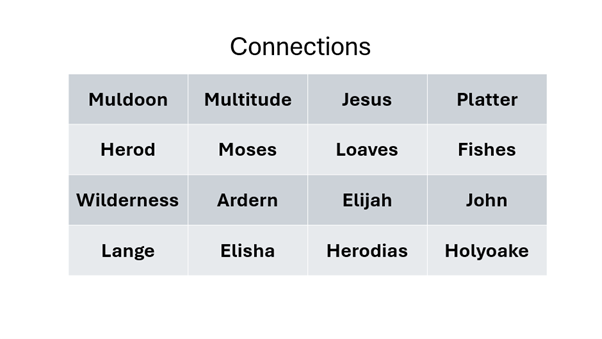
For example, among the 16 words you are given, you might have four names like Holyoake, Muldoon, Lange and Ardern. The connection there is pretty obvious. They are all former Prime Ministers of New Zealand.    

What about Multitude, Wilderness, Loaves and Fishes? What connection do you see with those words? Yes, Jesus’ feeding of the 5000. Today our message focuses on Matthew 14, verses 13-21, which describes Jesus’ miracle of feeding a multitude with just a handful of loaves and fishes.

This event is recorded in all four gospels and it finds multiple connections with the Old Testament as well. The feeding of the 5000 is a nexus point of Biblical connections. From Matthew 14, verse 13 we read…

13 When Jesus heard what had happened, he withdrew by boat privately to a solitary place. Hearing of this, the crowds followed him on foot from the towns. 14 When Jesus landed and saw a large crowd, he had compassion on them and healed their sick. 15 As evening approached, the disciples came to him and said, “This is a remote place, and it’s already getting late. Send the crowds away, so they can go to the villages and buy themselves some food.”

16 Jesus replied, “They do not need to go away. You give them something to eat.” 17 “We have here only five loaves of bread and two fish,” they answered. 18 “Bring them here to me,” he said. 19 And he directed the people to sit down on the grass. Taking the five loaves and the two fish and looking up to heaven, he gave thanks and broke the loaves. Then he gave them to the disciples, and the disciples gave them to the people. 20 They all ate and were satisfied, and the disciples picked up twelve basketfuls of broken pieces that were left over. 21 The number of those who ate was about five thousand men, besides women and children.

May the Spirit of Jesus illuminate God’s word for us.

Two main things I want to draw your attention to in this passage:

Jesus’ leadership and Jesus’ faith. We begin with Jesus’ leadership. The light of Jesus’ leadership shines brightly against the darkness of Herod’s reign.  

Leadership:

When you see (or hear) the words, Herod, platter, John and Herodias, what do you think of? Surely the beheading of John the Baptist.

John was the forerunner to Jesus, the prophet who came to prepare the way for the Messiah. John was Jesus’ ally, his wing man if you like. More than that, they were cousins.

In Matthew 14, verses 1-12, we read how Herod Antipas had John the Baptist killed. Herod was the puppet ruler of Galilee during the time of Jesus. He was a ruthless and depraved man.

When John the Baptist called Herod out on some of the bad stuff he was doing, Herod had John thrown in prison. Then when the daughter of Herodias danced for Herod, he promised to give her whatever she wanted. Herodias told her daughter to ask for John’s head on a platter.

After John had been beheaded, John’s disciples buried his body and told Jesus what had happened.

Given these facts, Jesus’ response to Herod is interesting. Jesus did not confront Herod; he did not organize a protest outside Herod’s palace or lead a revolt against Herod. Jesus did not seek revenge. Instead, Jesus quietly withdrew to a solitary place. Why?

Well, there was probably more than one reason. Perhaps Jesus did not want to inflame an already volatile situation. What Herod had done was a gross injustice. Anger and outrage are the natural response to injustice.

If Jesus confronted Herod or led a protest against him, it would have resulted in more violence. A calm head and a strategic withdrawal were necessary for the sake of peace. This was not a time for Jesus to be distracted from his core mission.

It appears too that Jesus needed some alone time; a short spiritual retreat to deal with his own feelings arising from John’s murder, but also to commune with God and seek his Father’s will on what his next move should be.   

With God, small things can make a big difference. Seeking solitude may seem like a small thing, but (in the context of Matthew 14) it accomplished much good and avoided even greater evil.

I wonder if Jesus had Psalm 37 in mind when he chose to put distance between himself and Herod. In verse 7, David writes…

Be still before the Lord and wait patiently for him; do not fret when people succeed in their ways, when they carry out their wicked schemes. Refrain from anger and turn from wrath; do not fret—it leads only to evil. For those who are evil will be destroyed, but those who hope in the Lord will inherit the land.

Jesus had faith that God Almighty would deal with Herod, and the Lord did deal with him. Some years later, in Acts 12, we read how an angel of the Lord struck Herod down. He was eaten by worms and died. God is just.

When the crowds worked out where Jesus was headed, they walked around the lake on foot and met him on the other side, in the wilderness. Seeing the large crowd, Jesus had compassion on them and healed their sick.

Compassion is the key word here. Compassion, in this context, is that deep feeling of empathy which moves a person to acts of kindness. Compassion speaks of an intimate connection, a heart and hand response to others in need. Compassion puts aside any thought of personal convenience or comfort for the sake of another person’s wellbeing.

Seeing all those people lost and confused, by what Herod had done to John, evoked a gut response from Jesus. The Lord was deeply moved in the core of his being. Rather than venting his spleen at Herod, Jesus used his emotional energy to heal and feed people.

By putting the account of Herod’s murder of John the Baptist alongside the account of Jesus’ compassion for the people, we (the reader) are invited to compare and contrast Herod’s leadership with Jesus’ leadership.

Herod was self-indulgent, brutal and destructive. Herod threw wild parties at the expense of the poor. He showed no restraint and it resulted in him taking the life of a righteous man. Herod’s leadership was toxic to the people.

In contrast, Jesus shows compassion for the poor. Jesus heals the sick, feeds the hungry and protects the vulnerable. Jesus demonstrates the kind of good shepherd leadership God wants for his people.

Those who are familiar with the Old Testament will see here a connection between Jesus and God’s word through the prophet Ezekiel…  

11 “I, the Sovereign Lord, tell you that I myself will look for my sheep and take care of them 12 in the same way as shepherds take care of their sheep that were scattered and are brought together again. … 14 I will let them graze in safety in the mountain meadows and the valleys and in all the green pastures of the land of Israel. 15 I myself will be the shepherd of my sheep, and I will find them a place to rest. I, the Sovereign Lord, have spoken.

By caring for the people in the wilderness, Jesus was acting as the divine shepherd leader of Israel, who has compassion on his people.

Okay, so we have talked about Jesus’ leadership, in contrast to Herod’s abuse of power. We also notice Jesus’ faith. Jesus models for us complete trust in God the Father.

Jesus’ faith:

The story is told of a soldier who was separated from his unit. The fighting had been intense, and in the smoke and the confusion, he had lost touch with his mates.

Alone in the jungle, he could hear enemy soldiers coming in his direction. Scrambling for cover, he found his way up a ridge to several small caves in the rock. Quickly he crawled inside one of the caves.

Although safe for the moment, he realized that once the enemy soldiers swept up the ridge, they would quickly search all the caves and he would be killed.

As he waited, he prayed, “Lord, if it be your will, please protect me. Whatever your will though, I love you and trust you. Amen.”

After praying, he lay quietly listening to the enemy begin to draw close.

He thought, “Well, I guess the Lord isn’t going to help me out of this one.”

Just then he saw a spider begin to build a web over the front of his cave. As he watched, listening to the enemy searching for him, the spider layered strand after strand of web across the opening of the cave.

“Hah” he thought, “what I need is a brick wall and what the Lord has sent me is a spider web. God does have a sense of humour.”

As the enemy drew closer, he watched from the darkness of his hideout and could see them searching, one cave after another. When they came to his cave, he got ready to face his end. To his amazement, though, they moved on.

Suddenly, he realized that with the spider web over the entrance, his cave looked as if no one had entered it for quite a while.

“Lord, forgive me,” the soldier prayed, “I had forgotten that in you a spider’s web is stronger than a brick wall.”

With God, small things can make a big difference. 

Take plankton for example. Plankton are small. Many types of plankton are microscopic in fact, smaller than a human blood cell, and yet they feed whales, the largest of mammals.

More than simply being a food source though, phytoplankton produce somewhere between 50% and 80% of the earth’s oxygen. God supports life on earth using tiny plankton.

Phytoplankton also absorb carbon dioxide helping to regulate the earth’s climate by removing greenhouse gas, from circulation.

With God, small things can make a big difference.  

Returning to Matthew 14. Jesus (the shepherd leader) had been ministering to people most of the day. It was getting late, so the disciples suggested to Jesus that he send the crowd away to the nearby villages to buy some food for themselves.

Given there were well over 5000 people present, this was not really a practical solution. It is unlikely the surrounding villages could cater for that number of people.

Jesus has another idea. ‘You give them something to eat’, he tells his disciples.

The disciples raise the obvious objection that they only have five loaves and two fish.  

In the gospel of John, we learn that these five loaves and two fish belonged to a boy. The loaves were made from barley. Barley bread was the food of the poor and the fish was probably small and pickled (like sardines).

It appears this boy was not well connected. He did not come from a wealthy family and his lunch was pretty ordinary.

Jesus is not phased though. He says, ‘bring them here to me’. And he directed the people to sit down on the grass. Green grass does not grow all year round in the middle east, like it does in New Zealand. The mention, therefore, that there is grass tells us it is springtime, Passover season.  

The Jewish Passover celebrates God’s deliverance of Israel from slavery in Egypt. We (the reader) are meant to see a connection here between God’s deliverance under Moses and the deliverance God brings under Jesus’ leadership.

In verse 19 we read how Jesus took the five loaves and the two fish and looking up to heaven, he gave thanks and broke the loaves. Then he gave them to the disciples, and the disciples gave them to the people. 

Here we see Jesus acting in faith that God would provide. As one commentator puts it, Jesus simply gave thanks for the food, confident that he represents the Father’s will.

In Jesus’ hands those five loaves and two fish fill the bellies of well over 5000 people, so that everyone had more than enough to eat.

Some people try to explain this miracle away, in various rational ways, but doing that empties this event of its meaning, robbing us of wonder and hope in the process. Jesus trusted God his Father completely and the Father honoured Jesus’ faith.

With God, small things can make a big difference.

Looking at our game of Connections once again we see there are four words left, names actually: Jesus, Moses, Elijah and Elisha. What do these four men share in common?

They were all prophets of the living God, offering spiritual leadership for the people. More than that, they all trusted God to provide for their needs and consequently participated in a feeding miracle. 

When the people of Israel cried out to Moses for food in the Sinai desert, Moses did not try to engineer a solution himself. He turned to God in prayer and the Lord God provided an abundance of manna and quail.

When God told the prophet Elijah to hide in the wilderness east of the Jordan, with no supermarket in sight, Elijah obeyed the Lord in faith, and God had ravens bring bread to feed him.

When a man brought the prophet Elisha 20 loaves of barley bread, Elisha told the man (in faith) to give the bread to the people. The 20 loaves fed 100 men and there was some left over.  

So, when we read how Jesus had faith in God to multiply five loaves and two fish to feed over 5000 people in the wilderness of Galilee, we see that in Jesus someone greater than Moses, Elijah and Elisha has come. Jesus is more than a prophet.

With God, small things can make a big difference.

Now in saying this, I do not mean to imply that we can be stingy with God, giving him our scrapes. The boy who offered his five loaves and two fish, gave Jesus everything he had. The boy was generous.

The point is, even when we give our best and our all, it may seem like a drop in the bucket. Our best and our all will usually fall short of the ocean of human need. But that is no reason to give up in despair. We can only do what is in our power to do and trust God with the outcome.   

Hearing this miracle story of Jesus feeding the multitudes is lovely and inspiring, but when we watch the news, we become painfully aware of the millions in our world today who are starving. Why doesn’t God feed them?

Well, God has provided enough to feed everyone on the planet. It’s not a production problem; it’s a distribution problem. Human greed and fear often get in the way.

Jesus trusted his disciples to distribute the food to the multitude and the disciples were faithful in carrying out the task Jesus gave them. In the end, there were 12 basketfuls left over, one for each of the disciples.  

Conclusion:

This morning we have observed multiple connections, all orbiting around Jesus and the miraculous feeding of the 5000 in the wilderness. There’s just one more connection we need to make. This too finds its fulfilment in Christ.

Centuries before Jesus came, the Lord God gave the prophet Isaiah a glimpse of a future heavenly banquet, with food far richer than barley bread and pickled fish. From Isaiah 25 we read…

On this mountain the Lord of hosts will make for all peoples a feast of rich food, a feast of well-aged wine, of rich food full of marrow, of aged wine well refined. And he will swallow up on this mountain the shroud that is cast over all peoples, the veil that is spread over all nations. He will swallow up death forever; and the Lord God will wipe away tears from all faces, and the reproach of his people he will take away from all the earth, for the Lord has spoken.

Jesus is the one who removes the shroud of death. It is through faith in Jesus (his death and resurrection) that we have sure hope of participating in God’s heavenly banquet.

Let us pray…

Gracious God, you know our every need and you care for us. Thank you for Jesus, the good shepherd, who leads us in paths of righteousness and restores our soul. Grant us the grace to follow Jesus all the days of our life and enjoy you forever. Amen.   

Questions for discussion or reflection:

  1. What stands out for you in reading this Scripture and/or in listening to the sermon? Why do you think this stood out to you?
  2. Why did Jesus withdraw to a solitary place after hearing how Herod had killed John? What good did Jesus’ retreat accomplish? (What evil did it prevent?)
  3. What is compassion? What (or who) moves you to acts of kindness?
  4. Compare and contrast Jesus’ shepherd leadership with Herod’s abuse of power. How do you experience Jesus’ care and provision?
  5. Discuss / reflect on the connections you notice between Jesus’ feeding of the 5000 in Matthew 14 and other feeding miracles in the Bible. How are these miracles similar? How are they different?
  6. In what ways do we see Jesus’ faith operating in Matthew 14?
  7. What small thing can you do (in faith) to show God’s love and care for others?     

The Almond Tree

Scriptures: Numbers 17 and Jeremiah 1:4-12

Video Link: https://youtu.be/s7j84uA3qy0

Structure:

  • Introduction
  • Numbers 17 – Priest
  • Jeremiah 1 – Prophet
  • Conclusion

Introduction:

Good morning everyone.

One of the greatest joys in life is learning something new. One new thing I learned this past week is that walnuts, cashews, pistachios and almonds are not nuts. Technically they are drupes

A drupe is a kind of fruit with the fleshy part on the outside and the seed inside. The seed, on the inside, is often encased in a hard shell. Other examples of drupes include peaches, plums and cherries. The flesh is on the outside and the seed is on the inside.

It’s a bit confusing because with peaches, plums and cherries we eat the flesh on the outside and throw away the seed in the middle. But with walnuts, cashews, pistachio and almonds we don’t eat the flesh on the outside. We discard the flesh and the shell and eat the seed in the middle.

When you buy walnuts, cashews and almonds in the shop they usually come with the outer fleshy part removed. Sometimes they come in their shell, but more often all we see is the edible seed.

Today we continue our Testimony of Trees series by considering the almond tree, the fruit of which is not a nut but a drupe. There are different kinds of almonds, some bitter, some sweet.

My favourite kind is a variety known as Scorched Almonds. Scorched Almonds are native to New Zealand. Unlike regular almonds, you do eat the chocolatey flesh on the outside as well as the almond seed on the inside. No part of the scorched almond fruit is wasted.

Our message this morning focuses on two readings from the Bible which feature the almond tree. Numbers 17 and Jeremiah 1.

Numbers 17 – Priest:

We begin with Numbers 17, where we pick up the story of Aaron and Moses and the people of Israel in the wilderness. From Numbers chapter 17, verse 1 we read…

The Lord said to Moses, “Speak to the Israelites and get twelve staffs from them, one from the leader of each of their ancestral tribes. Write the name of each man on his staff. On the staff of Levi write Aaron’s name, for there must be one staff for the head of each ancestral tribe. Place them in the tent of meeting in front of the ark of the covenant law, where I meet with you. The staff belonging to the man I choose will sprout, and I will rid myself of this constant grumbling against you by the Israelites.” So Moses spoke to the Israelites, and their leaders gave him twelve staffs, one for the leader of each of their ancestral tribes, and Aaron’s staff was among them. Moses placed the staffs before the Lord in the tent of the covenant law. The next day Moses entered the tent and saw that Aaron’s staff, which represented the tribe of Levi, had not only sprouted but had budded, blossomed and produced almonds. Then Moses brought out all the staffs from the Lord’s presence to all the Israelites. They looked at them, and each of the leaders took his own staff. 10 The Lord said to Moses, “Put back Aaron’s staff in front of the ark of the covenant law, to be kept as a sign to the rebellious. This will put an end to their grumbling against me, so that they will not die.” 11 Moses did just as the Lord commanded him. 12 The Israelites said to Moses, “We will die! We are lost, we are all lost! 13 Anyone who even comes near the tabernacle of the Lord will die. Are we all going to die?”

May the Spirit of Jesus illuminate God’s word for us.

Almond trees grow best in a Mediterranean type climate. They prefer warm dry weather. Too much rain and the crop will fail. A few years ago, they tried growing almond trees in the Hawke’s Bay. At that time the Hawke’s Bay had a drought and they found the almond trees did well in the dry weather, better than any other tree.

The name ‘almond’ derives from the ancient Greek word, ‘amygdala’.

For us today, the amygdala refers to that part of the human brain (shaped like an almond) which is associated with memory and emotion, in particular fear. The amygdala triggers the body’s fight or flight response when you feel like you are in danger.   

For example, if you have a bad experience around water when you are young, your amygdala stores that memory so that whenever you find yourself in a similar situation, you automatically feel frightened and want to get out as quickly as possible, whether it is dangerous or not.   

People in Biblical times would not have understood the structure of the brain in the same way we do today. For them an amygdala was an almond, so we shouldn’t make too much of it, but it’s a curious connection, particularly given the fear reaction of the Israelites in Numbers 17.

In the context of Numbers 17, the people of Israel are in the desert after their exodus from slavery in Egypt and they are not happy. In fact, many of the people are angry with Moses and Aaron.

Some people (led by a bloke called Korah) resented Moses and Aaron, accusing them of setting themselves above everyone else. Korah thought any Israelite should be able to serve as a priest.

It was the priests’ job to act as an intermediary between the people and God. Among other things, the priests helped the people deal with their sin so they could be right with God.

But ancient Israel was not a democracy. Ancient Israel was supposed to be a theocracy, which means the priesthood is decided by God, not popular vote.

When Korah and his followers tried to act as priests by burning incense (in Numbers 16) some were swallowed by the ground, some were consumed by fire and others were killed by a plague. Thousands died. It was carnage.

To settle the matter once and for all, the Lord tells Moses to gather up the staffs of the leaders of the 12 tribes of Israel, write each man’s name on his staff and leave them in the tent of meeting (aka: the tabernacle).

The tent of meeting was a holy place, like a mini portable temple for God’s presence. God would choose the high priest he wanted by causing that man’s staff to sprout.

Sure enough, the next morning when Moses went to collect the 12 staffs, he saw that Aaron’s staff had not only sprouted but had budded, blossomed and produced almonds.

Normally, it takes about three years before the almond tree is ready to bear fruit and once it is mature enough it takes between 7 and 8 months from when the tree first flowers (in early spring) to when the fruit is ripe (in autumn).

God had made Aaron’s staff (a dead piece of wood) flower and produce almonds in one night. This miracle served as a sign to the people that God had chosen Aaron and his sons to serve as priests for Israel.

We don’t need to try and find a scientific explanation for Aaron’s staff budding. That would miss the point. Better to be filled with a sense of awe and wonder.

The miracle performed by Yahweh shows that God enlivens every stage of life, from flower to fruit, from youth to maturity. Indeed, it is the Lord who makes life fruitful and fulfils its purpose.

More than that, the Lord has power over sin and death. It is God who appoints an intermediary to deal with our sin and it is God who causes dead things to spring to life.

From our vantage point in history, we who believe in Jesus, can see that Aaron’s budding staff points to the resurrection.   

You might be wondering, why did Aaron’s staff grow almonds? Why not plums or cherries or apples? Well, if Aaron’s staff was made from almond wood, then that might explain it.

Nevertheless, there is a curious connection between God and the almond tree. When God gave instructions on how the tabernacle should be built, he stipulated in Exodus 25, that the gold cups of the lampstand be shaped like almond flowers, with buds and blossoms. The almond tree, then, is associated with divine light, holy light.  

I said before, there are different varieties of almonds, some bitter and some sweet.

Bitter almonds contain a compound that when ingested breaks down into cyanide. Cyanide is poisonous of course.

Sweet almonds (which you get in the supermarket) are safe to eat, but bitter almonds are dangerous and should be avoided. Around 50 bitter almonds could kill an adult, even less would kill a child. 

Were the almonds on Aaron’s staff bitter or sweet? We don’t know. But there is something mysterious and potentially dangerous about these almonds. Just as there is something mysterious and potentially dangerous about God.

The young nation of Israel is terrified by the miracle of Aaron’s staff growing almonds overnight. It is a clear sign of God’s holiness, power and sovereignty. The memory of God’s holiness sears itself on the collective amygdala of the nation.

Instinctively, on an unconscious level, we all know that God is holy. Deep down we all know that God is good, but he is not safe.

People living in a Western society today (people like us) tend to struggle with what God did in Numbers 16 and 17. It offends our sensibilities. The society we live in believes in personal freedom.

Freedom is not a bad thing in itself, it’s a good thing. I’m thankful for the freedoms we enjoy in New Zealand (democracy is better than fascism).

But if we put personal freedom on a pedestal and make an idol out of it, then we reject God’s sovereignty and forfeit true freedom.

Any society that sacrifices holiness on the altar of individualism is on a dangerous path. May God deliver us from ourselves.

Jeremiah 1 – Prophet:

Our second reading, featuring the almond tree, comes from the book of Jeremiah chapter 1. In Numbers 17, the Lord makes it clear to everyone that he has chosen Aaron as high priest. In Jeremiah 1, the Lord chooses Jeremiah to be his spokesman, his prophet to Israel and the nations.

From Jeremiah chapter 1, verses 4-12, we read…   

The word of the Lord came to me, saying, “Before I formed you in the womb I knewyou, before you were born I set you apart; I appointed you as a prophet to the nations.” “Alas, Sovereign Lord,” I said, “I do not know how to speak; I am too young.” But the Lord said to me, “Do not say, ‘I am too young.’ You must go to everyone I send you to and say whatever I command you. Do not be afraid of them, for I am with you and will rescue you,” declares the Lord. Then the Lord reached out his hand and touched my mouth and said to me, “I have put my words in your mouth. 10 See, today I appoint you over nations and kingdoms to uproot and tear down, to destroy and overthrow, to build and to plant.” 11 The word of the Lord came to me: “What do you see, Jeremiah?”

“I see the branch of an almond tree,” I replied. 12 The Lord said to me, “You have seen correctly, for I am watchingto see that my word is fulfilled.”

May the Spirit of Jesus illuminate God’s word for us. 

The famous Renaissance artist, Michelangelo, painted an image of the prophet Jeremiah on the ceiling of the Sistine chapel in Vatican City. In Michelangelo’s fresco, Jeremiah is depicted as deep in thought and anguish as he laments over the destruction of Jerusalem. His face is darkened with grief, his countenance heavy with unwanted responsibility.

Jeremiah is known as the weeping prophet. He was reluctant to accept God’s call on his life. He didn’t want the job and who could blame him. He had the unenviable task of telling the nation that Jerusalem would be destroyed because of the people’s sin. Very few people listened to him. Jeremiah was misunderstood and mistreated, even though he was the real deal.  

God’s call is not always attractive or comfortable. Sometimes we are compelled by God, whether we like it or not. We may protest (like Jeremiah) or rebel (like Jonah) but eventually we realise God’s purpose is inevitable and irresistible, like the current of a river or the ocean’s tide, or the pull of gravity.

Some art historians think Michelangelo’s painting of Jeremiah is a self-portrait. It seems Michelangelo identified closely with Jeremiah. Michelangelo was burdened by unwanted responsibility. He did not want to paint the Sistine chapel. He wanted to sculpt, but the Pope gave him little choice.      

Jeremiah was the son of Hilkiah, one of the priests of Israel. That means Jeremiah was related to Aaron, for only Aaron’s descendants could serve as priests.

Jeremiah’s message was two parts judgement and one part hope. In verse 10 the Lord says to Jeremiah: See, today I appoint you over nations and kingdoms to uproot and tear down, to destroy and overthrow, to build and to plant.”

For Jeremiah there will be twice as much uprooting as there will be planting. Uprooting and planting is something one does with trees. This metaphor suggests God’s sovereign activity in restoring order to his creation by his word.

The almond tree features in verses 11 and 12 of chapter 1, where we read:

11 The word of the Lord came to me: “What do you see, Jeremiah?”
“I see the branch of an almond tree,” I replied.

12 The Lord said to me, “You have seen correctly, for I am watching to see that my word is fulfilled.”

Sometimes in English you come across words which sound the same and are spelt the same but have different meanings. We call these words homonyms.

Take for example the word bark; depending on the context bark can refer to the skin of a tree (as in tree bark) or it can refer to the noise a dog makes.

Crane is another homonym. A crane can be bird or a piece of machinery used for lifting heavy objects. One might also crane their neck to see over an obstacle. Spelt the same but with a different meaning.

Homonyms are fodder for puns and jokes. And so we get sayings with a double meaning like, “You’re barking up the wrong tree”.  

We can’t see it in the English translation but in the original Hebrew there is a play on words with almond and watching. They are not homonyms exactly, but they are very close. In Hebrew, the word for almond and the word for watching come from the same root and are spelled the same except for one letter. [1]

This gives the word almond a double meaning. Essentially, the almond tree is also the watching tree.

It makes perfect sense. One thing that is true of almond trees the world over is they are the first tree to bud and flower in spring. They are like the daffodils of the tree kingdom.

Just as one might watch for the flowers of the almond tree to see when winter is ending and spring is starting, so too God is watching over his word to see that it is fulfilled.

On the one hand this is a word of encouragement to Jeremiah, a reassurance that God will make his word (through Jeremiah) come true. God isn’t going to let Jeremiah down or give him a message that is not fulfilled.

At the same time, God is telling the people of the day that Jeremiah is the one to watch. By paying attention to Jeremiah, the people will know when the long winter of Judah’s idolatry and apostacy are coming to an end and the spiritual renewal of spring is close at hand.

Basically, God’s word through Jeremiah is like flowers blossoming on an almond tree. God’s word will bear fruit in season but not right away. In fact, Jeremiah prophesied for about 40 years before the words God gave him about Jerusalem were fulfilled.

Conclusion:

You may be relieved to know the almond tree passages in Numbers 17 and Jeremiah 1 are not primarily about us. In the Bible, the almond tree is a sign of what God is doing in Israel. They also point to Christ.

The almond tree is associated with God’s selection of Aaron to be the high priest of Israel. Jesus is the high priest chosen by God to be our intermediary. Faith in Jesus makes us right with God. Don’t be like Korah who rejected God’s sovereignty. Choose life.

The almond tree is associated with the lamp stand in the Tabernacle, God’s holy place. Jesus is the light of the world; the holy one who reveals God’s glory. The light of Jesus casts out darkness and fear. The light of God’s love for us in Christ illuminates the way of humility and respect. Walk in the light.   

The almond tree is associated with the fulfilment of God’s word through the prophet Jeremiah. Jesus is the word of God in human form; Jesus (the Christ) fulfils the law and the prophets. If you want to understand God’s word, then trust and obey Jesus.

The almond tree is associated with spring and new life. Jesus is the first sign of the resurrection to come. Those who embrace Christ, even though they suffer for it, will be raised to eternal life. Build your hope on the firm foundation of Jesus’ resurrection.   

The almond tree is a sign pointing to the beauty, the mystery and the holiness of God’s presence among us. With this in view our response needs to be that of wonder, awe and praise. May the word of the Lord blossom in your life. Amen.

Questions for discussion or reflection:

  1. What stands out for you in reading this Scripture and/or in listening to the sermon? Why do you think this stood out to you?
  2. What are some of the characteristics of the almond tree and its fruit?
  3. What is the almond tree associated with in Numbers 17?
  4. What did the budding of Aaron’s staff signify? Why did the people of Israel react with fear? What do we mean when we say God is holy? How does God’s holiness affect you? 
  5. What is the almond tree associated with Jeremiah 1?
  6. In what ways is does the almond tree point to Jesus?
  7. Discuss / reflect on the meaning of Jeremiah 1:11-12. 

[1] Refer Derek Kidner’s commentary on Jeremiah, page 27.

Choose Life

Scripture: Deuteronomy 30:15-20

Video Link: https://youtu.be/U7W0WavoDT4

Structure:

  • Introduction
  • What is life?
  • Choose life
  • Conclusion

Introduction:

Good morning everyone.

In the 1970’s there was a game show on TV called “It’s in the Bag”. Can anyone remember the name of the host? [Wait] That’s right, Selwyn Toogood, not to be confused with Jon Toogood, the lead singer of Shihad.

It’s in the Bag contestants got to choose between the money or the bag. They knew how much money they would get but they didn’t know what was in the bag. The bag might contain a TV or a pencil, a trip to Fiji or a paper clip, so it was a bit of a risk. The audience loved it when a contestant chose the bag.

Today we conclude our series in Deuteronomy by focusing on chapter 30, verses 15-20. We haven’t covered everything in Deuteronomy but given we started this series in May and Christmas is now upon us, it seems like a good time to finish.

In today’s reading, Moses asks the people of Israel to make a choice. Not the money or the bag, but rather life or death. Unlike the contestants in the game show, the Israelites knew exactly what they would get with either choice. From verse 15 of Deuteronomy 30 we read… 

15 See, I set before you today life and prosperity, death and destruction. 16 For I command you today to love the Lord your God, to walk in obedience to him, and to keep his commands, decrees and laws; then you will live and increase, and the Lord your God will bless you in the land you are entering to possess.

17 But if your heart turns away and you are not obedient, and if you are drawn away to bow down to other gods and worship them, 18 I declare to you this day that you will certainly be destroyed. You will not live long in the land you are crossing the Jordan to enter and possess. 19 This day I call the heavens and the earth as witnesses against you that I have set before you life and death, blessings and curses. Now choose life, so that you and your children may live 20 and that you may love the Lord your God, listen to his voice, and hold fast to him. For the Lord is your life, and he will give you many years in the land he swore to give to your fathers, Abraham, Isaac and Jacob.

May the Spirit of Jesus illuminate God’s word for us.

What is life?

In this reading Moses encourages the people to choose life. But what does Moses mean by life? Many people think of life in physical or material terms. So if you still have a pulse, if you are still breathing, then you have life. And while physical vitality is one aspect of life, there is more to it than that.

In verse 20 of Deuteronomy 30, Moses says: For the Lord God is your life. This tells us that life is more than just breathing and having a pulse. Life is essentially about our connection with God. In other words, the essence of life is right relationship with God, who is the one true source and giver of life.

We might think of it like this. The life of a light bulb is its connection to a power source. If we are the light bulb, then God is our power source. Our breath and our pulse, our hope and our joy, depend on God.

Or, if you think of a lake, then the life of a lake is its connection to the river which feeds the lake. If we are the lake, then God is one who provides rivers of grace and tributaries of truth to fill up our soul.

Or take a car as another example. The life of a car is its connection to the road. Without a road to drive on, the car is stuck and can’t fulfil its purpose.

If we are the car, then God enables us to fulfil our purpose. He provides the right road for us to take, as well as places to recharge or refuel along the way. For ancient Israel, the Law of Moses (summed up in the ten commandments) was the right road. For us today, Jesus is the way, the truth and the life.    

The life of a tree is its connection to the soil. The tree gets the water and nutrients it needs from the soil. If we are the tree, then God is the ground of our being, providing stability and all that our soul needs to grow and be fruitful.

The life of planet earth is its connection to the sun. The sun provides a centre of gravity around which the earth can orbit with regularity. The sun also provides just the right amount of light and warmth to sustain physical life on earth. If we are the earth, then Jesus is the sun whom our life revolves around and on whom our life depends. 

The life of a marriage is the couple’s connection to one another. The better the quality of the connection (the better the intimacy) between husband and wife, the healthier their marriage will be. The community of God’s people is the bride of Christ.    

The life of a baby is their connection with parents. A baby is completely dependent on their parents for survival. If we are the baby, then God is our Father and Mother, feeding, protecting and loving us. The Lord meets all our needs; physical, emotional and spiritual.   

This idea that life is connection with God is found right at the beginning of the Bible. In Genesis 2, the Lord God says to Adam & Eve: You are free to eat from any tree in the garden; but you must not eat from the tree of the knowledge of good and evil, for when you eat it you will surely die.

Adam and Eve did eat the forbidden fruit but they did not die physically until many years later. Their heart kept beating for a long time. This shows us that life and death is not just a matter of breathing.

The death Adam & Eve experienced, after eating the fruit, was separation from God. They were cast out of the garden and survival became much harder. After losing their close connection to God, relationships suffered and before long the children of Adam & Eve were killing each other.

In John 15, Jesus tells the parable of the vine saying: I am the vine, you are the branches. Whoever remains in me will bear much fruit; for you can do nothing without me. This parable tells us quite plainly that life is connection with Jesus. We need Jesus like a branch needs the trunk of a tree.

You get the point. Life isn’t just about breathing or having a pulse. Life is connection with God. And this is good news because it means that life is not necessarily over when we stop breathing and our heart fails. If we are connected to God, through Jesus, then we will be raised to eternal life.

Eternal life is not primarily measured in units of time. Eternal life is more like a quality connection with God, intimacy with God, a relationship which sustains joy and vitality and abundant life forever.

Choosing Life:

Okay, given that life is connection with God, how do we choose life?

Sometimes we understand what something is by its opposite. In verses 17-18 of Deuteronomy 30, Moses paints a picture of what it looks like to choose death and destruction. He gives this warning…

17 But if your heart turns away and you are not obedient, and if you are drawn away to bow down to other gods and worship them, 18 I declare to you this day that you will certainly be destroyed. You will not live long in the land you are crossing the Jordan to enter and possess.

If idolatry and disobedience leads to death and destruction, then choosing life equates to keeping the Law of Moses. That is, following the ten commandments, the greatest of which is the command to love the Lord your God and stay loyal to him. 

When you are driving a car, you make choices all the time. How fast to drive, when to slow down and give way, when to pass, which lane you will drive in and so on. The road rules are there to help people make good choices so we can drive safely and reach our destination without incident.

If you think of your soul as a car, then the heart of your soul is like the driver of the car. The heart is where choices are made; how fast you will drive yourself, whether you will keep to your lane or take a wrong turn and come off the road.

God’s law is like the road rules. It is there to help us make good choices and keep our soul on the right path so we (and our neighbours) all reach our destination safely.

When we become a Christian we talk about giving our heart to Jesus. What we mean is asking Jesus to sit in the driver’s seat of our soul, letting Jesus have the wheel. Inviting his Spirit to guide our decisions so that we choose life.

Sadly, the Israelites disobeyed the rules God put in place to protect them. Their hearts turned away. They made choices to run after other gods and got off track. Eventually, after many centuries of Israel’s unfaithfulness, God allowed the Babylonians to destroy Jerusalem and carry the survivors into exile.  

Looking at it more positively, Moses offers three things that go hand in hand with choosing life and a connection with God. From verses 19 & 20 we read…

…Now choose life, so that you and your children may live 20 and that you may love the Lord your God, listen to his voice, and hold fast to him. For the Lord is your life…

Love, listen and hold fast to God; this is how we choose life. Not that these are three separate things. More like three different ways of saying the same thing.

Love the Lord your God with all your heart, with all your soul and with all your strength. This is first and greatest commandment. Much of Deuteronomy is an exposition on this theme.

Listening to the Lord’s voice means paying attention to His word by obeying his Law and heeding his prophets. If you love God, you will listen to his voice and do what he says.

Love and obedience are two sides of the same coin, where God is concerned. In verse 16, Moses highlights the close relationship between love and obedience when he says: Love the Lord your God, walk in his ways and keep his commands, decrees and laws.

In his letter to the Romans, the apostle Paul talks about the obedience of faith. We are saved (we choose life) by putting our faith in Christ. And the fruit of faith, in Paul’s thinking, is obedience to the teachings of Jesus.       

Hold fast is about loyal commitment to Yahweh, in good times and bad. It’s about cleaving to God like a husband and wife cleave to each other.

As William Shakespeare famously wrote: Love is not love which alters when it alteration finds or bends with the remover to remove. O no! It is an ever-fixed mark that looks on tempests and is never shaken… Love alters not with his brief hours and weeks, but bears it out even to the edge of doom.

In other words, love holds fast, it does not change when the going gets tough. Love is loyal or it is not really love at all (like in Nicholas Sparks’ movie, The Notebook).  

One of my favourite parts of the Christmas story is when Joseph finds out that his fiancé Mary is pregnant with someone else’s baby. The law of Moses allowed Joseph to publicly humiliate Mary and even have her stoned.

But Joseph loved Mary and his love was true; it did not alter when it alteration finds. In other words, Joseph’s love for Mary did not change when he discovered Mary did not appear to love him. Joseph went beyond the letter of the law to find its spirit. In Matthew 1, verse 19 we read…

Because Joseph was a righteous man and did not want to expose Mary to public disgrace, he had in mind to divorce her quietly. 

By choosing this path of action, Joseph chose life for Mary. Little did Joseph realise that Mary was pregnant by the Holy Spirit. Once the angel told Joseph this in a dream, Joseph had the faith to believe and take Mary as his wife. Love believes all things.

Love, listen and hold fast to the Lord your God; this is how we choose life for ourselves and for others. Joseph loved God and Mary. He listened to God’s message through the angel and he obeyed, holding fast to Mary. 

Joseph’s loyal love for Mary stands as a pattern for us and illustrates what Jesus meant when he said: Whoever finds his life will lose it and whoever loses his life for my sake will find it.  

Sometimes choosing life requires us to make a difficult choice. Obedience to God is not always pleasant or easy. This is where faith is tested. For Jesus, choosing life (paradoxically) meant submitting to death on a cross. But God honoured Jesus’ loving obedience by raising his Son from the dead.

Conclusion:

What difficult choices are you facing this Christmas? What does choosing life look like for you?

Let us pray…

Father God, we thank you for Jesus, through whom we can choose life with you. Give us the grace to love, listen and hold fast to Jesus, in good times and bad. Help us to go the distance in your will and for your glory. Amen.   

Questions for discussion or reflection:

What stands out for you in reading this Scripture and/or in listening to the sermon? Why do you think this stood out to you?

  • Imagine yourself on the TV show “It’s in the Bag”. What would you choose, the money or the bag? At what point do you take the money?
  •  What is life?
  • In Deuteronomy 30:20 Moses says: “The Lord is your life”. What implications does this have for when our physical bodies die?
  • What three (related) things go hand in hand with choosing life? How might we apply these three things in our daily lives?
  • What difficult choices are you facing this Christmas? What does choosing life look like for you?

The Prophet

Scripture: Deuteronomy 18:9-22

Video Link: https://youtu.be/auVnpWoDedM

Structure:

  • Introduction
  • Choose a future with hope
  • Listen to God’s prophet
  • Conclusion

Introduction:

Good morning everyone.

What would you give to know the future?

If you knew exactly when an earthquake or fire was going to destroy your property, you would get insurance cover for that period, but you wouldn’t bother getting cover for the rest of the time.

Likewise, if you knew someone was going to be involved in a car accident tomorrow, you would hide their keys and keep them home for a day. 

What would you give to know the future?

Today we continue our series in Deuteronomy, focusing on chapter 18. In this passage Moses deals with the question of how God’s people are to manage themselves in the face of an unknown future. From Deuteronomy 18, verses 9-22 we read… 

When you enter the land the Lord your God is giving you, do not learn to imitate the detestable ways of the nations there. 10 Let no one be found among you who sacrifices their son or daughter in the fire, who practices divination or sorcery, interprets omens, engages in witchcraft, 11 or casts spells, or who is a medium or spiritist or who consults the dead. 12 Anyone who does these things is detestable to the Lord; because of these same detestable practices the Lord your God will drive out those nations before you. 13 You must remain completely loyal to the Lord your God.  14 The nations you will dispossess listen to those who practice sorcery or divination. But as for you, the Lord your God has not permitted you to do so. 15 The Lord your God will raise up for you a prophet like me from among you, from your fellow Israelites. You must listen to him. 16 For this is what you asked of the Lord your God at Horeb on the day of the assembly when you said, “Let us not hear the voice of the Lord our God nor see this great fire anymore, or we will die.” 17 The Lord said to me: “What they say is good. 18 I will raise up for them a prophet like you from among their fellow Israelites, and I will put my words in his mouth. He will tell them everything I command him. 19 I myself will call to account anyone who does not listen to my words that the prophet speaks in my name. 20 But a prophet who presumes to speak in my name anything I have not commanded, or a prophet who speaks in the name of other gods, is to be put to death.” 21 You may say to yourselves, “How can we know when a message has not been spoken by the Lord?” 22 If what a prophet proclaims in the name of the Lord does not take place or come true, that is a message the Lord has not spoken. That prophet has spoken presumptuously, so do not be alarmed.

May the Spirit of Jesus illuminate God’s word for us.

There are two halves to today’s message: The first half is about choosing a future with hope. And the second half is about listening to God’s prophet. Let’s start by choosing a future with hope. 

Choose a future with hope:

Another question for you to consider: Is the future fixed?

There are some who believe the future is fixed and there’s nothing we can do to change it. These people think the future is up to fate.

Believing the future is set in stone comes with a number of problems. For one thing, it undermines hope and creates a sense of apathy or despair in the person who thinks this way.

If you really believe the future is pre-determined and there’s nothing you can do about it, then you will be inclined to care less. A fixed future is devoid of any ethical considerations. If I can’t change the future, then my actions in the present don’t matter. I may as well do whatever makes me feel good. You become reckless and lose your sense of responsibility. A rebel without a cause.

At the other extreme, there are those who don’t believe the future is fixed at all. They think we create our own future. These people have a strong belief in themselves and their own abilities. They tend to be quite driven or intense.

If you really believe the future depends entirely on you, then that’s a lot of pressure. That comes with heaps of worry and not much peace. Human beings need some freedom but total freedom is a terrifying thing. If you go sky diving you don’t want to be free of your parachute, that would be disastrous.  

The person who believes the future is totally on them tends to take on too much responsibility. They don’t leave room for God to do something unexpected.

Just as there is no hope in thinking it is all up to fate, there is no real hope in thinking it is all up to you either. Because when you fail yourself, and everyone does fail eventually, you have no safety net.  

We are asking the question: is the future fixed? Somewhere in the middle of the spectrum are those who answer both ‘yes’ and ‘no’. Some things are fixed but not everything. We can have some influence over the future, but there are other things we have no control over and simply have to accept.

Hope is the capacity to imagine a better future, a good future, the best is yet to come. If you believe the choices you make matter in shaping the future, but that it doesn’t depend entirely on you, that ultimately God will work it all for good, then you have hope.

There are of course those who might say, I don’t know whether the future is fixed or not. That might be because they are too lazy to wrestle with the hard questions. Or it might be because the future has ambushed them and they are not sure of anything at the moment.    

Deuteronomy believes that ultimately God is in control of the meta-narrative of human history, but the choices human beings make still influence the course the future takes. God uses our choices in shaping the future. To obey God, in faith, is to choose abundant life. To receive Christ, in faith, is to choose a heavenly future, beyond this life.  

In verses 10-11 of Deuteronomy 18, Moses lists several things the Israelites are not to do. No divination, no magic, no witchcraft, no child sacrifice, no consulting the dead and so on. This list illustrates the sorts of things people sometimes do in order to try and know the future or even control the future.

There are still people today, in New Zealand, who do this kind of stuff. People who try to predict the future by reading tarot cards or tea leaves or the stars. Or, maybe they try to control the future by casting spells or sacrificing the wellbeing of their children in order to pursue a love affair or some other fantasy.

These people either believe the future is fixed and cannot change or they believe they create their own future. Either way, their hope is not in God. The Lord hates all this witchy poo stuff because it is based on a lie and it destroys people’s capacity for hope. It’s takes away people’s freedom. It is not good for the human soul.

There may be some here who have dabbled in this sort of thing, or maybe you’ve got in over your head. Perhaps you were at a fair ground one day and out of curiosity you got your palm read by Madam Zelda. Or maybe you were grieving for a loved one and went to a medium to try and contact them. Or perhaps you and your friends had too much to drink one night and tried a séance. Or maybe you’ve done worse.   

Does this mean you are excluded from God’s people forever? Is there no hope for you? Well, not necessarily.

Your future is not yet set in concrete. You have some influence over your future. You can choose not to do that sort of thing anymore. You can choose life and trust your future to Jesus. God, who loves you very much, has the power to deliver you from your past.  

The message of Deuteronomy is summed up in verse 13, which reads…

You must remain completely loyal to the Lord your God.

We must not divide our loyalty between God and anything else. We can’t say, in God we trust, and then rely on horoscopes or gazing into a crystal ball. 

Verse 13 is another way of saying, Love the Lord your God with all your heart, with all your soul and with all your strength. This is how we choose life and a future with hope for ourselves.

Okay, that’s first part of our message, choose a future with hope. The second part is about listening to God’s prophet. God, in his grace, provides an alternative to airy fairy magic. God is willing to reveal the future through his chosen spokesperson.  

Listen to God’s prophet:

In verse 15 of Deuteronomy 18, Moses says: The Lord your God will raise up for you a prophet like me from among you, from your fellow Israelites. You must listen to him.                                                          

Israel did not need to go to a medium or a spiritist to find out the future. God sent his own messenger. In fact, God raised up a series of prophets throughout the Old Testament who spoke His messages to the people as they needed it. Men and women like Samuel, Deborah, Nathan, Isaiah, Huldah, Micah, Jeremiah, Amos, Ezekiel, Daniel and so on. These prophets had a special role in keeping the nation accountable to the Law and their covenant with Yahweh.

In a healthy democracy the government’s powers are not concentrated in one person or one institution. Rather, power is separated, so the people who make the law are not the same as the people who enforce the law or decide disputes.

Traditionally, a democracy has three official institutions:

There is the legislature, which is the people who make the laws (for example, our Members of Parliament).

Then there is the judiciary, which are the people who adjudicate disputes (the courts and the judges).

And thirdly, there is the executive, which are the people who enforce the law (that would be the police).

There is another (unofficial) institution known as the fourth estate. We call it the news media; that is, journalists or the press. It is the job of the news media to report the facts concerning parliamentary, police and court proceedings, in a balanced and unbiased way, keeping the governing authorities accountable

In some ways our modern democracy, with its four estates, has its roots in the structure of government Moses prescribed for Israel. Yahweh (and Moses) recommended a separation of power in government.

Yahweh gave the Law through Moses. Judges were appointed in a democratic way to adjudicate disputes between people. And the Levites and priests had a role in enforcing the law.

The king (as we heard last week) was an optional extra. It wasn’t his job to make the law. His main job was to be a good example in keeping the law. He might also support the judges and the priests in making sure justice was done.

But it was the role of the prophets to be the fourth estate. The prophets were like credible investigative journalists who reported the facts in order to keep the king, the judges and the priests accountable to God’s law. Staying loyal to Yahweh was the key to life and a future with hope.

Now, in using this analogy, I do not mean to imply that journalists today are the contemporary prophets of our world. God can choose whoever he wants to be his spokesperson.

We might also think of God’s prophet as a doctor, diagnosing illness in the nation. If you have diabetes, you don’t want the doctor fudging your results and saying you will be fine. You need to understand clearly what the problem is and how best to manage your health going forward, so you have a future with hope.

Likewise, if God’s people are losing their saltiness and conforming to the pattern of this world, then they need God’s prophet to diagnose their spiritual illness and prescribe the right treatment to restore them.

Asking the prophet for advice was sort of like phoning a friend. If something was amiss and the king or the priests or the judges were unsure what to do next, they could inquire of God through his chosen prophet.

Of course, the prophet also passed on messages from God when no one had asked for his input. Like when the prophet Nathan confronted David after the king had murdered Uriah and committed adultery with Bathsheba. 

God’s prophet was a friend to Israel, but he (or she) was not in the king’s pocket. The prophet was a step removed, operating outside official government channels, able to give an unpopular minority report.

In verse 18 of Deuteronomy 18, the Lord says concerning his prophet, I will put my words in his mouth. This naturally raises questions for us: how did God do that? How did the Lord communicate with the prophets?

Reading through the Old Testament we notice the Lord spoke to the prophets in a variety of ways. It appears that God spoke to Moses and Samuel in a clear, audible voice. Other prophets, like Daniel & Ezekiel, received dreams or visions. Some may have interacted with angels. Elijah heard God not in earthquake, wind or fire but in a still small voice, like a whisper.

I’m not a prophet. I can’t tell you what the future holds specifically. I don’t know when the war in Ukraine will end. Nevertheless, there are times when I sense the word of the Lord has come to me. Not in an audible voice as such. More like a thought planted in my mind.

I know the thought is not my own because it is a better quality thought than the usual rubbish that flows through my brain and it is not a thought I’ve had before. It hasn’t come from any book I’ve read or any TV show I’ve watched.

It is new to me and it feels whole. It fits for the circumstances I’m in. Like the missing piece of a jigsaw puzzle, it creates connections and makes sense of other things. God’s word brings order to my thinking.

When the word of the Lord comes, I have to take myself off somewhere quiet and write, because writing helps me to listen to the virgin thought. 

There are times when I’m preaching in church and a stillness comes over the congregation. A kind of holy hush. (I’m sure it happens for other preachers too.) The traffic noise dies down, the rustling of lolly wrappers ceases and people stop coughing or whispering among themselves. I love those moments. In that stillness it seems to me the word of God is at work among us, in our hearts.

I believe the word of the Lord can come to any Christian believer, just not always in the same way. God made us with the capacity to receive his word, to sense his presence touching our spirit.

We cannot control when or how the word of the Lord comes but when it does come we need to pause and listen. Receive it into ourselves.

I wonder how the word of the Lord comes to you.

As God’s spokesperson, the Lord’s chosen prophet held quite a bit of influence in Israel. So there would inevitably be a few pretenders for the role, despite the severe punishment for taking the Lord’s name in vain. How then could you tell who was a bona fide, God authorised prophet and who was a fake? Well, there were three main tests…

Firstly, a true prophet of God speaks in the name of Yahweh and not in the name of some other god. Secondly, the message they preach comes true. And thirdly, they don’t say anything that contradicts the Law of Moses.

The first test, speaking in the name of Yahweh, is the test of clarity. Reading tea leaves or interpreting the entrails of a bird are pretty ambiguous and unclear signs. In contrast to this, the Lord’s prophets are clear about who they represent and what their message is.

Although the poetry and signs of the prophets of old may seem strange to us, their metaphors were not difficult for the people of that time to decipher, even if the prophet’s message was difficult to accept.

John the Baptist, the last of the Old Testament prophets, was very clear in his message of repentance, calling the religious leaders of his day a brood of vipers. Despite this clarity, many religious leaders hardened their hearts and chose not to believe John’s testimony concerning Jesus.

The second test, proclaiming a message that comes true, indicates the prophet’s words are verifiable. God’s messages are ‘evidenced based’, in other words. The truth of God’s word is worked out in human history.

We know Jeremiah was legit because his message came true in history. While other self-proclaimed prophets at the time were saying, “Don’t be afraid of Babylon, God will save Jerusalem”, Jeremiah was giving the very unpopular message of, “Don’t resist Babylon, you can’t win”. God upheld Jeremiah’s words because Jeremiah’s words were actually God’s words.     

Centuries later, Jesus (like Jeremiah) wept over Jerusalem when he could see history about to repeat itself. In Luke 19, Jesus predicted the Romans laying siege to the holy city and destroying it. This happened, as Jesus said, in AD 70.

There is a small catch with the verifiable test though. Sometimes true prophets are killed before their predictions can be verified.

The third test of a true prophet, that their message does not contradict the Law of Moses, is the test of consistency. God’s word is consistent. God does not contradict himself.

Jesus criticised the religious leaders for making their man made rules more important than God’s Law. The Pharisees had become so bogged down in the details they couldn’t see the wood for the trees. They were more loyal to their own tradition than they were to God himself and so, like the true prophet he is, Jesus called them out on their blindness.

As you have probably deduced by now, Jesus is the ultimate prophet to succeed Moses. Jesus fulfils the Law and the prophets. Through faith in Jesus, we can know the truth from God and we can choose a future with hope.

Does that mean then, that we have no further need for prophets? Well, no. In his letters to various churches the apostle Paul writes about the gift of prophecy. For Paul it was one of the more important spiritual gifts.

Of course, if someone claims to bring a word of prophecy, we (the church) still need to test that word and discern together if it is legitimate. The threefold test is similar. A true prophet speaks clearly in the name of Jesus. Their message is verifiable and it is consistent with the teachings of Jesus.

The Spirit of Jesus is a Spirit of grace & truth, so we would expect the prophets of Jesus to embody the same Spirit of grace & truth.

Conclusion:

At the beginning of this message I asked the question: What would you give to know the future?

A better question to ask is: What would you give to know Jesus?

I say that’s a better question because Jesus is the future, the eternal future. Jesus is the goal of humanity. He is our hope. If you want to know the future, get to know Jesus. Most of us know Jesus to some degree but none of us knows him completely or fully yet. May we grow deeper in our knowledge of and trust in Christ.

Let us pray… 

Father God, we thank you for not leaving us in the dark. We thank you for revealing your will to us through Jesus. We thank you too for offering us a future with hope. May you empower us by your Spirit to be completely loyal to Christ, for your glory and our own salvation. Amen.         

Questions for discussion or reflection:

What stands out for you in reading this Scripture and/or in listening to the sermon? Why do you think this stood out to you?

  • What would you give to know the future? What is it you would want to know and why?
  • Where would you place yourself on the spectrum between a fixed future and a fluid future? What are the implications of thinking the future is fixed? What are the implications of thinking we create our own future?
  • How do we choose life and foster a future with hope?
  • Why does Moses outlaw discerning the future through magic, reading omens, consulting the dead, etc.?
  • Has the word of the Lord ever come to you? What happened? What did the Lord say? How did you respond?
  • How might we test / know whether a prophecy is true or not?   

Prevention

Scripture: Deuteronomy 5:20; 7:25; Exodus 20:17; Matthew 6:19-24

Video Link: https://youtu.be/CtbHmRzQrW0

Structure:

  • Introduction
  • Do not covet – it’s about prevention
  • Taking care of yourself
  • Conclusion

Introduction:

Good morning everyone.

Have you ever stood on the edge of a cliff and been tempted to take a peak over the side? It’s a pretty risky thing to do. You could slip and fall. You could be caught by a gust of wind and lose your balance. Or the ground on which you are standing may give way and take you with it. The smart thing to do is stay well away from the edge, then you eliminate the risk of falling.  

Today we continue our series in Deuteronomy. We are up to that part (in chapter 5) where Moses reiterates the ten commandments of Yahweh. This morning our focus is the last command, in verse 21, which can be summarised as you shall not covet.

The word covet means to desire strongly, yearn for or set your heart on something that belongs to someone else. Coveting, therefore, is about one’s inner life. It is not so much an action, but rather the thought and feeling (or the

motivation) that precedes the action.

Do not covet – it’s about prevention:

The command to not covet is like a fence at the top of the cliff which prevents you going anywhere near the edge. If you can keep the command to not covet, then you won’t come close to breaking any of the other commandments. Do not covet is that stitch in time that saves nine. It is that ounce of prevention that is better than a pound of cure.

The command to not covet requires us to take care of our heart; to pay attention to the workings of our inner life, our thoughts and feelings and desires. But before we get into taking care of our inner life, let’s look more closely at the actual wording that goes with the command to not covet.

In Deuteronomy 5, we read…   

21 “You shall not covet your neighbour’s wife.

You shall not set your desire on your neighbour’s house or land, his male or female servant, his ox or donkey, or anything that belongs to your neighbour.”

As you know by now, the ten commandments were given twice in the Bible. Firstly, in Exodus 20, at Mount Sinai near the beginning of Israel’s time in the wilderness and then a second time, in Deuteronomy 5, nearly 40 years later when the people of Israel were preparing to enter the Promised Land.

Both versions are written from a patriarchal perspective and so they probably make us cringe a little bit today. But the wording reflects the reality of that time. Three to four thousand years ago men tended to be the ones in charge and women were generally subservient to men.

I don’t think God (or Moses) was meaning to exclude women with this commandment. Nor is this an endorsement of patriarchal culture.

To the contrary, the law was given to protect women and other vulnerable people, from abuse by those in power (and men held most of the power). If a man decided he wanted someone else’s wife or house or servant, it was usually the women and children who suffered the most.

So women are not excluded from this commandment. Translating this for our own contemporary context we would say that no one should covet.

We need to avoid a literalistic interpretation. The examples given in this commandment are not exhaustive, they are by way of illustration. Not many people own an ox or a donkey these days but if you are a farmer then you probably own a tractor (which is equivalent to an ox) and most of us own a car (which is equivalent to a donkey).    

When we put the Exodus version alongside the Deuteronomy version we notice, they are not exactly the same. In the Exodus version, wives are lumped together with houses and donkeys. But in Deuteronomy 5, wives come first and are treated separately from houses and livestock.

It appears like something happened those 40 years in the wilderness that changed the way men think.  

In Christian tradition, the Catholics and Lutherans have followed Deuteronomy and treated the injunction to not covet as two separate commandments. That is: you shall not covet your neighbour’s wife is the ninth commandment and you shall not set your desire on your neighbour’s stuff is the tenth commandment.  

The Protestant tradition has followed Exodus and lumped everything together, which lends itself to being misunderstood.

I prefer the Deuteronomy version and am treating wives separately from chattels. We dealt with the command to not covet your neighbour’s spouse a few weeks ago, when we talked about adultery and doing the Wordle on the train, so there is no need to cover that again today.

This morning’s message focuses more on the second part of Deuteronomy 5, verse 21, about not coveting your neighbour’s house and contents. If you don’t set your heart on your neighbour’s stuff you will avoid falling off the cliff edge of murder, adultery, theft and lying.

Although there is a direct connection between coveting and the other commandments, coveting is unique in that it is a secret sin. No one can witness you coveting, like they might see you stealing or hear you lying. Which means you can’t face legal proceedings or go to jail for coveting.

Yet this does not make coveting any less dangerous. If anything, the internal, hidden nature of coveting makes it more dangerous. With coveting the poison is inside you. It’s not like dirt on your hands which you can wash off. Coveting is more like sugar in your petrol tank; it wrecks your engine.

Coveting is insidious in that it undermines the foundation of our relationships, not just our relationship with our neighbour but also our relationship with God. Coveting can lead to idolatry, the worship of things God has made.

In Deuteronomy 7 we read:  25 The images of their gods you are to burn in the fire. Do not covet the silver and gold on them, and do not take it for yourselves, or you will be ensnared by it…  

In the context of Deuteronomy 7, Moses is instructing the Israelites to destroy Canaanite religion because it is like acid to the human soul and therefore detestable to God.

Jesus was well aware of the danger of coveting. He saw the connection between coveting and idolatry. In Matthew 6, Jesus warned against the dangers of setting your heart on earthly wealth. From verse 19 we read…

19 “Do not store up riches for yourselves here on earth, where moths and rust destroy, and robbers break in and steal. 20 Instead, store up riches for yourselves in heaven, where moths and rust cannot destroy, and robbers cannot break in and steal. 21 For your heart will always be where your riches are.

22 “The eyes are like a lamp for the body. If your eyes are sound, your whole body will be full of light; 23 but if your eyes are no good, your body will be in darkness. So if the light in you is darkness, how terribly dark it will be!

 24 “You cannot be a slave of two masters; you will hate one and love the other; you will be loyal to one and despise the other. You cannot serve both God and money.

Jesus is warning against the dangers of greed and material wealth here. Although he doesn’t explicitly use the word ‘covet’ in these verses, it is implied by the little parable about the eyes being a lamp for the body. We tend to covet things with our eyes. We see it, we want it.

Jesus is speaking metaphorically. A person’s eyes, in this context, refer to that person’s perception of others. So the phrase, ‘if your eyes are sound’, means if your perception or your way of looking at others is generous, warm and open hearted, then your body will be full of light. You will have a right perspective and generally be happier, in other words.

But if your eyes are no good, that is: if you look at others with meanness of spirit or if you look at others with greedy or coveting eyes, thinking how can I take advantage of this person for my own ends, then you will be filled with darkness. You will lose perspective and become cynical, cold and suspicious of others.

Greed, coveting, love of money, all goes hand in hand with idolatry, with the worship of things God has made, things that are beneath us. And when we worship the things God has made (rather than God himself) we tend to devalue our neighbour who is made in God’s image.

Okay, so we have talked about what coveting is and how dangerous it is as a gateway to all sorts of evil. The purpose with the command to not covet is to prevent us from breaking any of the other commandments. How then can we avoid coveting?

Taking care of ourselves:

Well, four things you can do to take care of yourself and guard against coveting: Renew, Reflect, Remember and Relax. Renew your mind. Reflect on your true desires. Remember who you serve. Relax and enjoy what you have.

In Romans 12, Paul says: Do not conform to the pattern of this world, but be transformed by the renewing of your mind. Then you will be able to test and approve what God’s will is—his good, pleasing and perfect will.

Renewing your mind is about thinking well. It’s about replacing the lies we tell ourselves with the truth.

For example, if the pattern of this world is, I must make lots of money and be rich in order to be secure, then renewing your mind means changing the script and replacing the lie with the truth, namely: Security comes through right relationships with others. Therefore, taking care of my relationships needs to be the priority.       

Or, if the pattern of this world is, I must be successful in the eyes of others in order to be accepted, then renewing your mind means changing the script and replacing the lie with the truth, namely: God accepts me in Christ. I need to be faithful. What other people think of me is none of my business. 

The trouble with the pattern of this world is that we don’t usually recognise it at first, because it is all we know. We often believe the lie to be true. What lies do you believe in? What truth do you need to replace these lies with?

Reflecting on your true desires is the second thing you can do to guard against coveting.  

Augustine wrote in his Confessions: “You have made us for yourself, O Lord, and our hearts are restless until they rest in you.”

Or, as Bono puts it, ‘I still haven’t found what I’m looking for’.

Sometimes we think we know what we want but when we get it, we are still dissatisfied, still hungry for more. Which tells us we didn’t really understand our true desire in the first place. Our desires are like an onion or a Russian doll, they have layers. 

For example, we might think we want a fourth and fifth glass of wine when what we really want is someone to love us. While the wine does numb the pain temporarily, no amount of alcohol can take away loneliness.

Rather than reacting to every desire that raises it head (like a game of whack a mole) we do better to press pause and reflect on what our true desire is, the deeper underlying desire.

Most of our desires are perfectly legitimate in themselves. The desire for intimacy, the desire for identity and belonging. The desire for our lives to have lasting significance. Nothing wrong with these. The problem is the way we might try to satisfy those desires.  

Take the desire for affection. Nothing wrong with wanting affection. But if we try to satisfy our desire for affection by pursuing someone else’s spouse, then people get hurt. Likewise, there is nothing wrong with wanting to be accepted. But if we try to satisfy our desire for acceptance by harming someone else’s reputation, then our belonging is based on a lie.

The point is, sometimes bad behaviour is driven by legitimate desires. Before we react to every little craving, we need to reflect on what it is we really want and find a better strategy for meeting those desires.    

For example: If you want to belong, build trust. If you want intimacy, find the right person to be vulnerable with. If you want your life to have meaning, love God and love your neighbour. If you want to be wise, listen more than you talk. If you want to be great, become the servant of all. If you want to be righteous, look to Jesus to justify you.        

Augustine believed the deepest desire of all, the hunger that drives every other hunger, is our desire to be reunited with God. Our heart (our inner life) is restless until it finds its rest in God. Jesus came to give us that rest. He came to reunite us with God.

For most of us that reunion with God is a slow train coming. Becoming a Christian doesn’t automatically mean the end of all wanting. God is faithful and gives us what we need to be sure. But he doesn’t always give us what we want. We have to wait for Jesus’ return before we can fully realise true rest from desire.

In the meantime, we do well to ask ourselves: what are the deeper desires driving my behaviour? What is it I really want? And, do I need better strategies for managing those desires?

The third thing you can do to avoid coveting is to remember who you serve

In Deuteronomy 5, as part of the Sabbath commandment, we read…        

15 Remember that you were slaves in Egypt and that the Lord your God brought you out of there with a mighty hand and an outstretched arm. 

This verse (along with much of Deuteronomy) is an instruction to the people of Israel to remember who they serve. The Israelites no longer serve a tyrant like Pharaoh. Nor do they serve themselves. They serve the Lord God Almighty, who is both powerful and kind.

Yahweh set Israel free from Egypt in order to be his holy people. Likewise, Jesus has set us free from sin and death so that we can be God’s holy people too. We are not set free to do whatever we want. We are set free to serve God’s purpose.

Remembering who you serve is closely related to remembering who you are. In the gospels of Matthew & Luke we read how Satan tempted Jesus in the wilderness.

The evil one did not tempt Jesus with obvious sins like murder or adultery. Satan appealed to Jesus’ desires by trying to entice Jesus to covet. ‘If you are the Son of God, satisfy your hunger by turning these stones into bread. Make a name for yourself by jumping off the temple. Get power for yourself by worshipping me.’

But Jesus wasn’t buying any of it. Jesus remembered who he was and who he served. Interestingly, the Scriptures Jesus used to resist Satan come from Deuteronomy chapters 6-8.

Where Israel failed in the wilderness, Jesus made good on their behalf. Where we fail in our times of testing, Jesus makes good on our behalf. And so we belong to Christ, we serve Jesus.

We remember who we are and who we serve by maintaining simple rhythms like daily Bible reading, giving thanks to God before every meal, spending quality time with other believers, and not letting ourselves become too busy but making space to be still.        

So the question is, what rhythms (or spiritual disciplines) do you maintain to remind yourself that you serve Jesus?

We are talking about how we take care of ourselves in order to avoid coveting. Renew your mind. Reflect on your true desires. Remember who you serve, and fourthly, relax, enjoy what you have.

God didn’t give us the ten commandments to make our lives more stressful or difficult. When applied properly, God’s Law supports human flourishing and indeed the flourishing of all creation.  

Distress is one of the hidden costs of coveting. Wanting what we can’t have creates a pressure in us. It puts us on edge. It robs us of our peace and joy. We are generally happier when we relax and enjoy what we already have, rather than chasing after something we can’t have.

In Mark 2, Jesus says: The Sabbath was made for man, not man for the Sabbath. We are not machines. God did not make us to stay ‘on’ all the time. The Lord provides one day off in seven for us to relax and enjoy what we have.

When we practice Sabbath, when we take time off to relax, we find that many of those desires which are unhelpful, evaporate, like the morning mist after sunrise. God’s law supports the flourishing of his creation.  

I wonder then, how do you relax? Do you practice Sabbath, taking one day off in seven. What is it you do for enjoyment?

Conclusion:

In Psalm 37 we read…

Delight yourself in the Lord and he will give you the desires of your heart.

Much of what we set our heart on in this life doesn’t last. Houses, cars, career, status, reputation. These sorts of things are here today, gone tomorrow. But the Lord is forever.

Delighting yourself in the Lord is about taking pleasure in God himself. It’s about loving the giver more than his gifts. It’s about being mindful of God’s grace in the present and not longing for the past or worrying about the future.

Delighting in the Lord is the fence at the top of the cliff, preventing us from coveting. Delighting in the Lord renews our mind and puts us in touch with our true desires, most of all the desire to be close to God. Delighting in the Lord reminds us of who we serve and who we are. What’s more, delighting in the Lord enables us to relax and enjoy what we have.

Let us pray…

Father God, your ways are life to us. Forgive us for the times we pursue things we shouldn’t. Help us to think well and find our contentment in you. Through Jesus we pray. Amen.  

Questions for discussion or reflection:

What stands out for you in reading these Scriptures and/or in listening to the sermon? Why do you think this stood out to you?

  • In what sense is the command to not covet like a fence at the top of the cliff?
  • How does coveting affect our relationship with God? How does coveting affect our relationship with our neighbour? How does coveting affect us personally (internally)?
  • What does it mean to ‘renew your mind’? How do we go about renewing our mind? What lies do you believe in? What truth do you need to replace these lies?
  • How might we identify our true desires? What underlying desires are driving your behaviour at present? What strategies do you have for managing those desires?  Do you need some better strategies? 
  • Why did Jesus set us free? What rhythms (or spiritual disciplines) do you maintain to remind yourself that you serve Jesus? Are these rhythms an effective reminder? If not, what needs to change?
  • How do you relax? What do you enjoy? Make a list of the good things in your life. How might you best enjoy / celebrate these good things?

In Exodus 20 we read…

17 “You shall not covet your neighbour’s house. You shall not covet your neighbour’s wife, or his male or female servant, his ox or donkey, or anything that belongs to your neighbour.”

Security

Scriptures: Deuteronomy 5:19; 19:14; 23:15-16, 19-20, 24-25; 24:6-7, 10-15, 19-22; 25:13-16 and 1st King 21

Video Link: https://youtu.be/voWPWYrYbm0

Structure:

  • Introduction
  • Generosity, not greed
  • Security, not anxiety
  • Trust, not threat
  • Conclusion

Introduction:

Good morning everyone.

When I was growing up in the 1970’s people didn’t lock their house during the day. You trusted your neighbours and complete strangers for that matter. If you popped down to the dairy to pick up a bottle of milk, you could leave the keys in your car, with the engine running, and not give it a second thought. You felt safe, like no one was going to pinch your stuff.

It’s not like that now. Almost every week we hear reports of ram raids and smash and grab crimes. Just two weeks ago I noticed a $200 charge on our credit card for something we had not purchased. Theft through the internet. We quickly cancelled the card to stop any further loss.

Many of you have got rid of your landline phones, partly because we use cell-phones now but also because many of the calls we get on our landline are scam artists, trying to weedle their way in our bank account.

It used to make me angry, especially when I thought of someone more vulnerable being taken advantage of. But then I thought, how desperate must someone be if they are having to resort to committing fraud for a living.

Even the post is suspect now. You take a risk sending anything of value in the mail. A number of times we’ve had things going ‘missing’ in the post.   

All these nasty little experiences breed cynicism and anxiety, undermining our sense of security and our ability to trust.

Today we continue our series in Deuteronomy. We are up to that part (in chapter 5) where Moses reiterates the ten commandments or the ten words of Yahweh. This morning our focus is the command, ‘You shall not steal’, in verse 19.

You shall not steal is perhaps one of the broadest commandments. It covers a wide range of activity. On the face of it, you shall not steal affirms the right to own personal property and provides protection for one’s material assets.

When we look at Deuteronomy as whole we get the sense that, you shall not steal is about fostering trust between people. It’s about promoting security in the neighbourhood. The kingdom of God is to be a place of generosity.

Generosity not greed, security not anxiety and trust not threat, this is the kaupapa or the purpose with the command not to steal.

Moses gives heaps of examples of how, you shall not steal, applies in daily life. Let’s start with land. The right use of land has to do with generosity. All too often human greed gets in the way.  

Generosity, not greed:

In Deuteronomy 19 we read: 14 Do not move your neighbour’s boundary stone set up by your predecessors in the inheritance you receive in the land the Lord your God is giving you to possess.

To move a boundary stone is to take land that does not belong to you. These days moving your neighbour’s boundary stone would equate to building a fence in the wrong place, so as to disadvantage your neighbour. In ancient Israel moving a boundary stone reduced your neighbour’s capacity for growing food.

Worse than this though, it was an offence against God. You see, land for the ancient Israelites, was not privately owned by individuals. Land is owned by God.

The Lord allocated portions of the Promised Land of Canaan to the various tribes of Israel. Each tribe and clan and family were to act like kaitiaki or guardians, caretakers of the land entrusted to their care. The section of land you were responsible for was to stay in your family and be passed down from generation to generation.

You could use your allocation of land to graze your sheep or grow your grain but you could never sell the land. If a family fell on hard times they could lease their land, for a specified period of time, to someone else from their tribe (ideally a close relative) but they could never permanently sell it.

As a safe guard, once every 50 years, the allocations of land were to be returned to the original family holdings.

In first Kings chapter 19, we read how king Ahab (arguably the most evil king Israel ever had) wanted to buy Naboth’s vineyard so he could grow vegetables. Ahab basically told Naboth to name his price.

Naboth, who was a regular citizen and also a God fearing man, said ‘no’ to king Ahab. ‘God forbid’ that I ever sell my land to anyone. In Naboth’s mind, Ahab was essentially trying to bribe him to move a boundary stone.

Ahab started sulking around the palace and so his wife, Jezebel, arranged to have Naboth killed so that Ahab could seize Naboth’s field. God responded by sending the prophet Elijah to pronounce judgement on Ahab and Jezebel.

We might wonder how this story applies to us in our world today, because we buy and sell land all the time.

Well, the situation of ancient Israel is not exactly the same as contemporary New Zealand. I don’t think we should interpret the law of Moses to be saying we can’t buy and sell land ever. Selling your house to buy a new one is simply a practical necessity in the world in which we live today.

We need to look deeper than the letter of the law in order to find its spirit. The purpose (or kaupapa) of the law is generosity not greed. The land is one of God’s generous gifts to us. It is part of God’s hospitality to humanity. If we misuse the land for our own selfish gain, then we are essentially treating God’s generosity with contempt. We are stealing from God.

In practical terms, not moving your neighbour’s boundary stone, means people should not be pushed off their land. Big business interests need to give way to people’s welfare. In particular, the real estate of indigenous people needs to be respected and restored where it has been stolen.   

We do well to think of ourselves as caretakers of the land and of our neighbours. With this in view, the idea of protecting fertile land, so it cannot be turned into housing or carparks but rather used to grow crops, is a sensible one. 

The command to not steal also applies to paying a fair price for things. If land is being sold under a mortgagee sale, that is no excuse to drive the price lower in order to get it for a steal (as the saying goes). As believers we need to pay what it is worth. That is what it means to be generous and not greedy.

So, generally speaking, as long as no one is being taken advantage of, it’s okay to buy and sell land in New Zealand today. In any property transaction though, we need to be thinking of how that transaction will affect others.

For Christians, the Promised Land of Canaan is a symbol or a metaphor for the Kingdom of God. Through faith in Jesus we get a share in God’s kingdom. As believers in Christ we are meant to be more attached to Jesus than we are to land. God is our eternal home, our place to belong.

So, not moving a boundary stone (in a spiritual sense) means not abandoning our faith in Jesus. It means not selling out for some temporary short term gain. It means staying loyal to God, like Naboth did.      

Security, not anxiety:

Closely related to this principle of generosity is the idea of security. In Deuteronomy 23 we read…

24 If you enter your neighbour’s vineyard, you may eat all the grapes you want, but do not put any in your basket. 25 If you enter your neighbour’s grain field, you may pick kernels with your hands, but you must not put a sickle to their standing grain.

These verses help us to see where the line is drawn between reasonable use and theft. The spirit of the law here is to encourage land owners to be generous, not stingy. At the same time, the law provides a measure of food security for the poor. Generosity and security are held together in these verses.  

In a by-gone era people who were starving in Europe got sent to jail (or to Australia) for stealing a loaf of bread or a handful of potatoes. This kind of hard line punishment against the poor, who are already in a vulnerable position, is not condoned by the Bible. 

That said, I don’t think you can help yourself to grapes and apples when you are walking through the fresh produce section of the supermarket.

It is Moses’ intention to promote security, not anxiety. In Deuteronomy 24 we find another example of food security…

19 When you are harvesting in your field and you overlook a sheaf, do not go back to get it. Leave it for the foreigner, the fatherless and the widow, so that the Lord your God may bless you in all the work of your hands. 

The Lord Almighty (Yahweh) was generous to his people up front, without them having to do anything to earn his favour. The farmers were to pay Yahweh’s generosity forward by leaving plenty of produce in the field for the poor to collect. Boaz famously did this for Ruth.     

I guess we do something similar when we leave garage sale items outside for the wider community to help themselves to.

When the principles of generosity and security are practiced, the poor do not need to be anxious. Of course, being poor or in need is not the only cause of stealing. Some people will steal anything, without any good reason.

Here, at church, we’ve had brass door latches taken, small shrubs stolen out of the garden and copper pinched off the roof. I’m not sure why people would steal from a church? What I do know is that the cost of those thefts was far greater than the value of the items stolen.

Quite apart from the physical damage burglars do to a building, on forcing entry, there is also the damage a burglary does to one’s soul. I’m talking about the erosion of trust, the heightened anxiety you might experience going into an empty building at night and that feeling of being violated in some way.

Thieves don’t just take your stuff; they can potentially rob you of your peace of mind. Who wants to live in a society where you are always looking over your shoulder, always second guessing your neighbour’s motivation?   

By the same token, when someone takes care of your stuff, it has a restorative effect on your soul. It helps you regain some capacity to trust. It makes you feel more positively connected, more at home in the neighbourhood.

In Deuteronomy 22, we read…

If you see your fellow Israelite’s ox or sheep straying, do not ignore it but be sure to take it back to its owner… 

It is not enough simply to avoid stealing. We need to actively protect our neighbour’s stuff. This is about being your brother (or sister’s) keeper. It’s about providing security and reducing anxiety in the neighbourhood.

Probably the worst kind of theft is kidnapping. Taking another human being against their will in order to exploit them in some way. This is also known as people trafficking or slavery.

Literally hundreds of thousands of people are trafficked throughout the world each year. Some are forced into the sex trade and others are made to do manual labour for next to nothing. People trafficking is revolting to God.  

In the case of stolen goods, the law of Moses stipulates that what was stolen be replaced at least two fold. But for the one who steals other people, the prescribed punishment is death. That is how serious it is.   

I don’t expect anyone here is a slave trader as such but we have probably all purchased an item of clothing made by an exploited worker at some point. Perhaps the least any of us can do is buy fair trade goods whenever we can.

The problem is we are disconnected from the supply chain. So it is often impossible to know if we are making ethical purchases.

The slave trade is the opposite of God’s law. Kidnapping for exploitation is greed in an extreme form. It threatens the life of those who are enslaved and it creates anxiety in those who wish to do the right thing.

No one is beyond God’s redemption though. Although Joseph’s brothers sold him into slavery, Joseph was (in the end) able to forgive his brothers saying: What you intended for harm, God intended for good.    

Trust, not threat:  

Okay, so the purpose of God’s command to not steal is to encourage generosity not greed, to promote security not anxiety and to foster trust not threat within the neighbourhood.

Poverty was a real threat for some in ancient Israel. God’s concern and practical care for the poor is seen again and again in Deuteronomy.

For example, in chapter 24, verses 14-15, we read: 14 Do not take advantage of a hired worker who is poor and needy… 15 Pay them their wages each day before sunset, because they are poor and are counting on it.

Sometimes the rich and middle class don’t have too many clues about how the poor live day to day. We may be completely unaware of the realities our neighbours face. God’s law requires us to put ourselves in other people’s shoes and consider things from their perspective.

We need to be thinking, how can I promote security in my neighbourhood? How can I alleviate my neighbour’s anxiety? How can I promote trust? Paying a fair rate in a timely way helps with all three.   

Sometimes, when it is difficult to make ends meet, people may be forced to borrow money. The law of Moses prohibited charging interest on loans to fellow Israelites, although they could charge interest to foreigners.

This might seem like a double standard to us but in all likelihood the foreigners Moses had in mind here were probably not poor. They might be merchants who bought and sold goods for profit. 

So the distinction is between commercial loans and compassionate loans. It is okay to charge a reasonable rate of interest on commercial loans because the borrower is not hard up and they are using your money to make a profit.

But it’s not okay to charge interest on compassionate loans to the poor because that would be profiting from someone else’s misfortune. That would be like stealing from the poor.

A compassionate loan lets people keep their dignity because they are going to pay it back, it’s not charity. At the same time, an interest free loan is generous not greedy. It promotes security and reduces anxiety in the neighbourhood.

Whether the lending is commercial or compassionate, these verses warn against loan sharking and charging unfair rates of interest.

But there is also an encouragement, for those who can afford it, to offer small interest free loans to help family members or fellow believers who are in need. Of course, common sense dictates that you should never lend more than you can afford to lose.       

In verse 6, of Deuteronomy 24, Moses talks about security for debt and how lenders are to relate with those who have borrowed from them. That is, in a trusting way, not in a threatening way. Moses says…

Do not take a pair of millstones—not even the upper one—as security for a debt, because that would be taking a person’s livelihood as security.

And, in verses 12-13 we read:12 If the neighbour is poor, do not go to sleep with their pledge in your possession. 13 Return their cloak by sunset so that your neighbour may sleep in it… 

To take someone’s millstone as security for a debt was like taking their fry pan or their bread mixer. It was a threatening thing to do, because without a millstone the poor borrower couldn’t make bread.

Taking a poor man’s cloak as pledge was also a threatening thing to do. Without their cloak they might be too cold to sleep at night.

Moses wants to prevent the haves from intimidating the have nots. He wants people to use their power (their money) to help the poor. This requires lenders to trust God and not threaten people by taking things that are vital for their survival.

Yes, there will be times when you lend to someone and they won’t repay you. Nevertheless, God will act as guarantor for the financially vulnerable. If you loan money in good faith to help someone in need and they fail to repay you, the Lord will see that and credit it to you as a righteous act.

Trust, not threat is the purpose or the kaupapa at work in the law here.  

Another form of theft (which undermines trust) is the use of dishonest weights. Scales that disadvantage the buyer. In Deuteronomy 25, Moses says: 15 You must have accurate and honest weights and measures… 16 For the Lord your God detests anyone who deals dishonestly.

In today’s terms that means more than just having accurate scales. It means not winding the odometer back when selling a second hand car. It means not misleading people about the discount they are getting by inflating the retail price. It means not skimping on the meat in a steak and cheese pie. It means not pumping chickens with water to make them heavier. It means being honest with nutritional information on labels.   

Honest weights support trust. Dishonest weights threaten trust. 

Conclusion:

This morning we have heard how the command not to steal applies in a variety of areas of life. The purpose with this command is to promote generosity and discourage greed. The intention is to create a sense of security in the neighbourhood and reduce anxiety. You shall not steal is also about fostering trust between people and preventing threat.

When we look at the life and ministry of Jesus, we notice the Lord was not really that attached to material possessions. His main concern was for eternal life with God the Father. Following this train of thought, our greatest love needs to Jesus, for it is in and through Christ that we have eternal life with God. 

When we are more attached to Jesus than things like money, cars, clothes, houses and furniture, then material possessions will hold less sway over us. It’s not that material things are bad. They are useful and we still need them in this world. But at the end of the day we will lose all that stuff anyway. You can’t take it with you. But nothing invested in God’s kingdom is ever lost.

Let us pray…

Gracious God, thank you for your generosity to us. May we be generous like you. Forgive us for the times we have threatened the poor, through our own ignorance and self-interest. Forgive those who have stolen our stuff, robbed our peace of mind and undermined our trust. Holy Spirit, strengthen our attachment to Jesus we pray. Amen.

Questions for discussion or reflection:

What stands out for you in reading these Scriptures and/or in listening to the sermon? Why do you think this stood out to you?

  • What was the world like when you were growing up as a child? How is it different today?
  • Have you been through the experience of being robbed? What happened? How did you feel / respond? Conversely, have you ever stolen from others? Why did you do this? How did stealing affect you?
  • How might the command not to move your neighbour’s boundary stone apply to us today?
  • In what ways did the law of Moses provide security for the poor? What can we do to strengthen security and reduce anxiety in our neighbourhoods today?
  • Why is the slave trade (kidnapping) so offensive to God?  When is it okay to charge interest on loans and when is it not okay?
  • What practical things can we do to strengthen our attachment to Jesus?

L.O.V.E.

Scripture: Deuteronomy 6:1-9

Video Link: https://youtu.be/ncW1DISd1kQ

Audio Link: https://soundcloud.com/tawabaptist/sermon-3-jul-2022-love

Structure:

  • Introduction
  • Love for God is Loyal
  • Love for God is Obedient
  • Love for God is Voluntary
  • Love for God is Educational
  • Conclusion

Introduction:

Good morning everyone.

Last Tuesday a parcel arrived for Robyn in the post. It was relatively large, about 600mm square. The parcel contained a flat pack table, that Robyn wanted me to assemble for her classroom.

While I quite enjoyed woodwork at school, flat packs are not my favourite. Flat packs tend to be a bit of a lottery. Sometimes they go together okay and other times, there are pieces missing or the instructions don’t exactly line up with the pieces you are given.

When it comes to assembling flat packs, you give yourself the best chance of success by reading the instructions all the way through first. The other thing I find helpful, is having a picture of what the finished product is supposed to look like. That way, if the instructions are a bit vague, you can at least see what you are aiming for.

As it turned out, this particular flat pack was decent quality. It had good instructions and a picture of the finished product on the box. I managed to assemble it without any trouble, while watching the sports news and the weather. The things we do for love.

Today we continue our series in Deuteronomy. Among other things, Deuteronomy contains detailed instructions on how to assemble the flat pack of Israel’s life in the ancient world.

In this morning’s passage, which focuses on the opening verses of Deuteronomy 6, Moses shows the Israelites a picture of what the finished product is supposed to look like. The Israelites need to keep this bigger picture in mind because it makes sense of the details. From Deuteronomy 6, verses 1-9 we read…  

These are the commands, decrees and laws the Lord your God directed me to teach you to observe in the land that you are crossing the Jordan to possess, so that you, your children and their children after them may fear the Lord your God as long as you live by keeping all his decrees and commands that I give you, and so that you may enjoy long life. Hear, Israel, and be careful to obey so that it may go well with you and that you may increase greatly in a land flowing with milk and honey, just as the Lord, the God of your ancestors, promised you. Hear, O Israel: The Lord our God, the Lord is one. Love the Lord your God with all your heart and with all your soul and with all your strength. These commandments that I give you today are to be on your hearts. Impress them on your children. Talk about them when you sit at home and when you walk along the road, when you lie down and when you get up. Tie them as symbols on your hands and bind them on your foreheads. Write them on the doorframes of your houses and on your gates.

May the Spirit of Jesus illuminate God’s word for us.

These words, about loving God with all your heart, all your soul and all your strength probably sound familiar because we hear them on the lips of Jesus, who identified loving God as the greatest commandment.

But what does it mean to love God? True love for God involves at least four things. Love for God is Loyal, Obedient, Voluntary and Educational. L.O.V.E. spells love.  First let us consider loyalty.

Love for God is Loyal:

Sylvester Stallone once said: “I learned the real meaning of love. Love is absolute loyalty. People fade, looks fade but loyalty never fades.”

We might not expect that sort of wisdom from the man who played Rocky and Rambo, but I think there is more to Sly than meets the eye. He is right on the money with that quote. Loyalty is at the heart of true love. I guess a life time of working in Hollywood and the fickleness of fame showed him what matters.

In Arthur Millar’s play, ‘The death of a Salesman’, the main character Willy says, “You can’t eat the orange and throw the peel away. A man is not a piece of fruit.”

What Willy means is that you can’t treat a person like he is a piece of fruit. You can’t take the best out of him and then chuck him away when he is used up. That’s not loyalty. Loyalty is about remaining faithful, sticking with someone through thick and thin. Accepting the person, peel and all.

The Bible is full of stories of loyal love. There is Ruth’s loyal love for Naomi, Jonathon’s loyal love for David, Barnabas’ loyal love for Mark, Moses’ loyal love for Israel, the Father’s loyal love for the prodigal, Jesus’ loyal love for Simon Peter and so on.   

One of the key messages of Deuteronomy is, remain loyal to Yahweh the Lord. Do not turn aside to the right or the left. Do not worship any other gods. Stay on track with God Almighty. Don’t treat the Lord like an orange.

In verses 4-5 we read: Hear, O Israel: The Lord our God, the Lord is one. Love the Lord your God with all your heart and with all your soul and with all your strength.   

These verses are known as the Shema which means ‘hear’. For centuries Jews have recited these words as part of a daily ritual of prayer.

Verse 4 is sometimes translated ‘the Lord is one’ and other times, ‘the Lord alone’. This is not an either / or choice. The original Hebrew embraces a both / and meaning.

To say, the Lord is one, points to the wholeness, the oneness, the unity and integrity of God Almighty. God is wholehearted in his commitment to the promises he makes. God’s loyalty is undivided. This means, if we are going to be in a relationship with God, we must give Him our undivided loyalty too.    

To say, the Lord alone, points to the reality that there is no other god. It connects with the first of the Ten Commandments, ‘You shall have no other gods before me’.

The Lord God Almighty is not in competition with anyone or anything else. There is only one God, therefore, to worship anything else is a lie, a falsehood, a meaningless fantasy. Again, this belief calls for our undivided loyalty to the one true God. 

When we hear the word love we may be inclined to think of a nice, warm fuzzy feeling. An emotion, like falling in love. Sometimes good feelings accompany love but not always.

Loyalty is the backbone of love. Loyalty enables love to stand under the weight of gravity. Loyalty provides strength with movement. Without loyalty, love is like a jelly fish; beautiful to look at but with no skeleton, no integrity, just a nasty sting in the tail.

We might also compare loyalty to the roots of a tree. The deeper the roots of loyalty go the more resilient the tree of our relationship with God. But if the roots of loyalty don’t run deep, then when dry times come, the tree of our relationship withers and dies.  

So that’s the first thing: to love God is to be loyal to him. Closely connected to loyalty is the idea of obedience

Love for God is Obedient:

If you grew up in the 80’s you are probably familiar with the movie the Princess Bride. It is a story of loyal love. The story begins with a boy sick in bed with a cold. His grandfather comes over to his house to look after him and reads him a story from a book.

In the book we are introduced to the heroes, Westley and Buttercup. Buttercup is a farm girl and Westley is a farm hand. Whenever Buttercup wants something Westley answers with the words, ‘As you wish’. He obeys her, doing just what she asks, simply because he loves her.

At the end of the movie, after the boy’s grandad has finished reading the story, the boy asks him to come back and read again tomorrow and the grandad answers, ‘As you wish’, because he loves the boy. 

Deuteronomy is peppered with commands, decrees and laws and with the encouragement to obey the Lord, so things will go well for you in the land.

In verse 5, we are told the essence or the DNA of all the commands and laws and decrees of Deuteronomy…  

Love the Lord your God with all your heart and with all your soul and with all your strength.

This is the picture on the box, showing us what the finished product of a life of obedience to God looks like. This is what we are aiming for. This greatest commandment makes sense of all the detailed instructions. The main reason we obey God is because we love him.   

The heart, in Hebrew thought, refers to a person’s inner life. Not just our feelings but our mind and our will, or our decision making faculties, as well.

The meaning of the word soul can have a different nuance depending on the context, but in this verse the soul refers to our whole self, including our physical body and our life force or vitality.

The word translated as strength, in verse 5, is more than just your physical energy or your ability to bench press heavy weights. Your strength here includes your wealth, your money, your time, your tools, your social influence, your house, your skills and talents, as well as your livestock (if you a farmer) or your car (if you live in the modern world).

Your strength basically equates to the resources at your disposal.  

The point is, love for God involves using everything we are and everything we have in obedience to God’s purpose.

So, for example, loving God with all your heart, soul and strength means paying a fair price for things, even if that might cost a little more, because we know that God wants us to do justly and not rip other people off.

Of, if you are in the place of the seller, loving God with all your heart, soul and strength means charging a fair price, rather than letting the market decide.

I know Christian landlords who are charging their tenants significantly less than the market rate because they are motivated by love for God, not love of money. 

Love for God is Voluntary:

This obedience of love is not an empty, heartless, fulfilling of duty. Nor is it a callous, mercenary, self-interested obedience, so that God will bless me. The obedience God wants is voluntary, motivated by love. In verse 6 we read…

These commandments that I give you today are to be on your hearts.

In other words, the obedience of love isn’t just for show. Our obedience needs to come from the heart, from the core of our self, from the inside out. Not because we have to, but because we want to. True love for God is voluntary.

As much as I don’t like assembling flat pack furniture, I will volunteer to do it for Robyn because I love her. I don’t hold Robyn in my debt for assembling her table. I take pleasure in being able to help her. In fact, I would feel jealous if she asked anyone else.

If you are a parent of small children, then you may not like changing nappies but you volunteer to clean up your child’s mess because you love them. You don’t keep an account of all the money you spend on nappies and wipes in order to invoice them when they are older. You don’t even think of it as a debt.

Or, if you are a parent of teenagers, then you may not like picking your kids up from wherever they happen to be in the middle of the night, but you volunteer because you love them. You don’t expect your kids to pay you like an Uber driver. You may not even expect them to thank you. You are just pleased to have them home safe. Love is its own reward.    

Or, if you have a friend in hospital, then even if you don’t like hospitals you may still volunteer to visit because you love them. You don’t expect your friend to entertain you when you arrive. Nor do you tell them all your troubles. You are there for them, to listen and be present so they know they are not alone.

When we volunteer to help others, out of a heart motivated by love, we are imitating God our Father. God’s love for us is voluntary. God is not obligated to us in any way. God takes care of us, even though there is often nothing in it for him. And he does not count the cost.  

Now when we say that ‘love for God is voluntary’, we are implying that true love is an act of freedom. Love is not involuntary, like a sneeze or the hiccups or an obsession of some kind. Love is a conscious choice. In fact, we cannot love God unless we are free. God sets us free so we can love.  

The Israelites had to be set free from their slavery in Egypt and from their fear, before they could truly volunteer to love God with their all. What things are binding you? What things are holding you back from loving God more fully? What hurts from the past do you still carry?

Okay, to recap what we’ve covered so far: Loving God with all your heart, soul and strength is the greatest commandment, the one that makes sense of all the other laws and decrees. Love for God is loyal, love for God is obedient and love for God is voluntary.

As nice and neat as this sounds, it’s a pretty tall order. Loving God with all your heart, soul and strength, all the time is not easy. Do not despair though. The ‘E’ in our L.O.V.E. acronym stands for educational.

And by ‘educational’ I mean love for God is a learning process. We aren’t expected to know everything all at once. Nor are we expected to never make a mistake. But we are expected to learn from our mistakes.       

Love for God is Educational:

Those of you who watch the TV show, The Simpsons, will know how every episode starts with Bart writing lines on the board at school. I’m not sure if teachers still make students do this but I remember having to write lines on the odd occasion.

Zig Ziglar is quoted as saying: “Repetition is the mother of learning, the father of action, which makes it the architect of accomplishment.”

There is truth in this I think. The more we repeat something over and over again, the more it sticks in our memory. That’s true, not just of writing lines, but of anything we attempt to learn.

Remember when you first started to learn to drive. Everything was a bit stressful and unfamiliar. You were trying to remember to look in the rear vision mirror, while changing gear and keeping an eye on your speed limit. After a couple of months though it becomes second nature.

Returning to Deuteronomy 6, from verse 7 Moses says…

Impress these commandments on your children. Talk about them when you sit at home and when you walk along the road, when you lie down and when you get up. Tie them as symbols on your hands and bind them on your foreheads. Write them on the doorframes of your houses and on your gates.

This is education by saturation, learning by repetition.

We probably never learn more than when we have to teach someone else.

Deuteronomy always has its eye on the next generation. Moses doesn’t want the people to forget. He wants them to remember and pass on God’s law of love to their children and grandchildren and so on.

Verse 7, instructs adults to talk to children about God’s commands in the everyday circumstances of life. You see a rainbow you talk about the hope we have because of God’s promises. You watch a movie with a redemption arc in the story line, you find a way to connect it back to Jesus. The kids get grumpy and have a fight, you talk about forgiveness, once they have calmed down enough to listen.

When you sit down for a meal you say a prayer to thank God. When you put your kids to bed at night you read a Bible story or two. When you start the day you recite the Lord’s prayer together. These are just some of the ways we might apply verse 7.

Thinking of verses 8 & 9, we might not tie Bible verses to our hands and heads but some of you may have a fish symbol on your car or perhaps a cross stitch Bible verse hanging on your wall. When I was younger, and had time for hobbies, I used to make small wooden crosses and give them to people as gifts. Maybe you have decorated a cake with the words ‘Jesus loves you’.

Use your imagination, be creative. What can you do to remind yourself and the people in your household of God’s law of love?      

Conclusion:

The night before his crucifixion and death Jesus said to his disciples:

Whoever accepts my commandments and obeys them is the one who loves me.

This means we love Jesus by obeying his commands.

In a few moments we will share communion together. Communion is a time to remember God’s love for us in Christ. Jesus opens the door to friendship with God. It is Jesus who makes it possible for us to love God.

Where we have failed to be loyal to God, Jesus has been loyal for us.

Where we have failed to obey God, Jesus has obeyed for us.

Jesus volunteered for the cross, because of his love for God.

By following Jesus in faith, and with the help of the Holy Spirit, we receive an education in loving God.

Grace and peace to you on the journey. 

Questions for discussion or reflection:

What stands out for you in reading this Scripture and/or in listening to the sermon? Why do you think this stood out to you?

  • Have you ever assembled a flat pack before? How did it go? Are you the kind of person who reads the instructions first or do you prefer to wing it?
  • What is loyalty? Why is loyalty important to love?
  • Why do we obey God? What is the difference between obedience motivated by love and obedience driven by duty? Who do you obey?
  • Discuss / reflect on the meaning of Deuteronomy 6:5 ‘Love the Lord your God with all your heart, with all your soul and with all your strength.’
  • Who do you volunteer for? What things are binding you or holding you back from loving God? What hurts do you carry from the past?
  • What can you do to remind yourself and the people in your household of God’s law of love?    

Outtakes

This idea that love for God is educational isn’t just an Old Testament Moses thing. It’s a New Testament Jesus thing too. Jesus taught his disciples the meaning of love and in turn commanded them to make disciples also.

Incidentally, the word ‘disciple’ simply means student or apprentice. To be a disciple of Christ just means we are learning to be like Jesus.

We shouldn’t compartmentalise discipleship exclusively into some form of church programme. Christian discipleship doesn’t only happen when you are listening to a sermon or attending a Bible study group or doing your personal devotions. Learning to love God encompasses all of life. 

Discipleship, learning to be like Jesus, happens in singleness and marriage, when you are at work or play, whether you are well or sick.

God’s No

Scripture: Deuteronomy 3:21-29

Video Link: https://youtu.be/Ytjj0JHzE1A

Audio Link: https://soundcloud.com/tawabaptist/sermon-26-jun-2022-gods-no

Structure:

  • Introduction
  • Moses prays
  • God answers
  • Conclusion

Introduction:

Good morning everyone.

In 1969 the Rolling Stones released a song: You can’t always get what you want. I don’t know what Mick Jagger and Keith Richards meant by the lyrics but, given it was the end of the 60’s, one might guess the song reflected a certain felt disappointment that the social change promised by the prophets of that decade had not been delivered.

In these days, of hyper-individualism, the song has become a kind of personal lament, when things don’t go our way.   

This morning we continue our series in the book of Deuteronomy by focusing on the closing verses of chapter 3, in which Moses does not get what he wants. From verse 21 of Deuteronomy 3 we read…

21 At that time I commanded Joshua: “You have seen with your own eyes all that the Lord your God has done to these two kings. The Lord will do the same to all the kingdoms over there where you are going. 22 Do not be afraid of them; the Lord your God himself will fight for you.”

23 At that time I pleaded with the Lord: 24 “Sovereign Lord, you have begun to show to your servant your greatness and your strong hand. For what god is there in heaven or on earth who can do the deeds and mighty works you do? 25 Let me go over and see the good land beyond the Jordan—that fine hill country and Lebanon.”

26 But because of you the Lord was angry with me and would not listen to me. “That is enough,” the Lord said. “Do not speak to me anymore about this matter. 27 Go up to the top of Pisgah and look west and north and south and east. Look at the land with your own eyes, since you are not going to cross this Jordan. 28 But commission Joshua, and encourage and strengthen him, for he will lead this people across and will cause them to inherit the land that you will see.” 29 So we stayed in the valley near Beth Peor.

May the Spirit of Jesus illuminate God’s word for us.

In this reading, Moses prayers and God answers Moses’ prayer, although not exactly in the way Moses might have wanted.

But before we get into Moses’ prayer let me recap where the Israelites have got to. You may remember from last week how the Lord instructed Israel to approach the Promised Land from the East being careful not to pick a fight with Edom, Moab or Ammon, and Israel obeyed.

Well, after that, there were two small kingdoms (Heshbon and Bashan), on the east side of the Jordan, which Israel had to pass through to get to the Jordan river. Israel tried to pass through these lands peacefully but king Sihon and king Og would not allow it, so Israel were forced to go to war against them and the Lord gave the new generation of Israelites victory.

Now the path was cleared for the people of Israel to cross the Jordan and take possession of the land of Canaan. Moses wanted to cross over with the Israelites too and so he prayed to ask God’s permission.

Moses prays:

Have you ever played the spinning broom game? This is when you hold a broom close to your body, looking up at the end of the handle, while spinning around a few times. After you have spun you then have to step over the broom.

To the casual observer it seems quite easy but for the person doing the spinning it is a lot harder than it looks. Trying to keep your balance after having spun several times is really difficult. You have to pause and be still for a wee bit to get your bearings and reorient yourself.

Life can be a bit like the spinning broom game at times. We can find ourselves going around and around in circles focusing on the same things and it throws us off balance. Prayer is one thing we can do to reorient ourselves.

With prayer we make time and space to be still and to shift our focus off the broom handle of life’s chores and onto the God of eternity. One of the main purposes of prayer is to connect with God, to realign ourselves with his will. We find our true north when we focus on God in worship. 

When Moses approaches God in prayer, he doesn’t start by telling God what he wants. Moses begins by focusing on God and what the Lord has done. In verse 24 Moses says…

24 “Sovereign Lord, you have begun to show to your servant your greatness and your strong hand. For what god is there in heaven or on earth who can do the deeds and mighty works you do?

Verse 24 is an example of adoration of God. By focusing on God in adoration, Moses stops spinning and reorients himself.  Moses isn’t trying to butter God up in order get what he wants. Moses is getting his head straight; he is realigning his perspective by speaking the truth about God.

When we listen to the Lord’s Prayer we notice the first half of it is all about God. Our Father who is in heaven, hallowed be your name. Your kingdom come, your will be done on earth as it is in heaven.   

Jesus taught us to pray in this way because it reorients us toward God, it shows us the true north of heaven.  There is no me, my or I in the first half of Moses’ prayer or Jesus’ prayer.

So, next time you are in a spin. Next time life is going too fast and you feel like you are losing your balance, so you don’t know which way is up, take some time to stop and be still and focus on God. Tell him and yourself some things you know to be true about the Lord. Simply adore him and let your perspective return.

Only after Moses has focused on God in adoration does he then attempt to step over the broom handle and ask for what he wants, saying in verse 25…

25 Let me go over and see the good land beyond the Jordan—that fine hill country and Lebanon.”

This is quite remarkable really. Moses is the better part of 120 years old by this stage and he isn’t yet tired of this life. Moses has had a taste of what God can do and he wants more. After 40 years of frustration, doing the hard yards and wandering in the wilderness, Moses wants to see the fruits of his labours. And who could blame him.

Moses describes the land beyond the Jordan as fine. Elsewhere it is spoken of as fertile, a land flowing with milk and honey. I’ve never been to Palestine but I’ve seen images and not many people would describe it as fine these days.

It’s not rolling green pastures or thick native bush like we have in New Zealand. More the opposite really. Not sure why people make such a fuss and spill so much blood over it?

Well, most probably it was a fine and fertile land during the time of Moses, all those centuries ago. But now, due to the impact of man and erosion, the land is less appealing.

Perhaps though it wasn’t just the physical characteristics of the land that excited Moses. More likely it was the hope that the land embodied.     

As Moses himself indicates, he was keen to see more of the works of God. He saw how the new generation of Israelites obeyed God and he wants to see more of that obedience of faith. Not only that but Moses is keen to see more victories by the Lord’s hand, as when God defeated king Sihon and king Og.

God answers:

Unfortunately, you can’t always get what you want. The Lord responded to Moses saying…  

“That is enough. Do not speak to me anymore about this matter…”

Apparently, this was not the first time Moses had asked God if he could enter the land.

God’s answers to our prayers are like a traffic light. We usually get one of three responses from God. Green for yes, amber for wait and red for no. On this occasion Moses is not able to change God’s mind. It is a firm no.     

In verse 26, Moses says…  

26 But because of you the Lord was angry with me and would not listen to me.

Moses is referring here to an incident that happened years earlier in the wilderness. At one point (in Numbers 20) when the people were complaining about not having any water to drink, Moses asked the Lord what to do.

The Lord told Moses and Aaron to speak to a particular rock in the sight of the Israelites and it will pour out its water. But Moses was in a spin. He had lost his balance. Moses was angry with the people and said to them, ‘Listen you rebels, must we bring water out of this rock for you?’ And then he struck the rock twice with his staff.

Water did come out of the rock and the people drank but God was not happy. So the Lord said to Moses and Aaron, “Because you did not trust in me enough to honour me as holy in the sight of the Israelites, you will not bring this community into the land I give them.”

According to this verse, Moses did two things to offend God here. Firstly, Moses did not trust God enough. He hit the rock twice, when God had told him to speak to the rock. And secondly Moses did not honour the Lord as holy in the sight of the Israelites.

To say that God is holy means that he is set apart, he is different from anyone or anything else. God is one of a kind. There is nothing else in all creation as good or pure or powerful or loving as God Almighty.

When Moses said, ‘must we bring water out of this rock for you?’ he by-passed the Lord. God and God alone is the only one who can bring water out of a rock. This was an opportunity for the people to see the holiness of God in action. Moses didn’t give God the credit or the honour. Moses treated something holy (a life giving miracle of God) as if it were common or profane.

This was out of character for Moses. This was not what we normally observe with the great man. His sister Miriam had just died, so Moses was grieving. More than that though, the people were being really difficult. They were always pushing back on something, so obstinate, so obtuse. Moses’ frustration was understandable.

When we consider Moses’ long and faithful service to the Lord and all the challenges he faced, we might think God was being a bit harsh in refusing Moses entry to the land. Surely God could wink at Moses’ indiscretion this once and make an allowance. But to go down that path in our mind is to misunderstand the holiness of God.

God was not being unfair to Moses by saying ‘no’. The Lord punished others in the wilderness for their mistakes. It wouldn’t then be right or fair for the Lord to give Moses a free pass. Even though Moses is the leader, he was still subject to the Law as much as the people were.

Faithful service to God does not make God obligated to us in any way. Faithful service to God is what we should be doing anyway. It’s like Jesus said to his disciples in Luke 17…

“Suppose one of you has a servant ploughing or looking after the sheep. Will he say to the servant when he comes in from the field, ‘Come along now and sit down to eat’? Won’t he rather say, ‘Prepare my supper, get yourself ready and wait on me while I eat and drink; after that you may eat and drink’? Will he thank the servant because he did what he was told to do? 10 So you also, when you have done everything you were told to do, should say, ‘We are unworthy servants; we have only done our duty.’”

Sometimes we human beings forget our place. Sometimes, when we are busy spinning around that pole, we become disoriented and think that God is there to give us what we want. And while the Lord is gracious and he does help us in so many ways, we need to remember that God is the boss and we are the workers. God is free to say ‘no’ if he thinks that is best and we need to respect his ‘no’.  

Three times in the Garden of Gethsemane Jesus said to God the Father, ‘Take this cup from me’, but God said ‘no’ and Jesus accepted God’s will for him.

Three times the apostle Paul prayed for God to remove his thorn in the flesh but God said, ‘No, my grace is sufficient for you, for my power is made perfect in weakness’.

Sometimes we need to persevere in prayer. Jesus taught that. But after having persevered, if the answer is still ‘no’, then we need to let it go and give our energy to those things God is saying ‘yes’ to.

What prayer do you keep repeating in the hope that God might change his mind? What personal request, in your life, has God answered with a ‘no’? I know for some people this will be a painful thought.

The temptation when God says ‘no’ is to throw our toys out of the cot and go ahead and do what we want anyway. We need to resist that temptation. We need to be still and reorient ourselves through worship and prayer. We need to let God be God and say with Jesus, ‘Not my will Lord, but your will be done.’

Returning Deuteronomy 3; in verses 27 & 28 we see the grace in God’s no. In verse 27 we read what God said to Moses…

27 Go up to the top of Pisgah and look west and north and south and east. Look at the land with your own eyes, since you are not going to cross this Jordan.

God doesn’t let Moses cross the Jordan but he does allow Moses to see the land from a distance.

Moses standing on top of Mount Pisgah looking on the Promised Land, reminds me of the Mount of Transfiguration, when Moses and Elijah (representing the Law and the Prophets) stood with Jesus in all his glory.

Moses may not have entered the land of Canaan physically but God gave Moses something far greater. The Lord allowed Moses to stand in glory with Jesus. 

Jesus fulfilled the purpose of Moses life, just as he fulfils the purpose of our lives.  

If God says ‘no’ to your request, just wait. He might have something better in store for you later.  

From verse 28 the Lord continues his instruction to Moses, saying…

28 But commission Joshua, and encourage and strengthen him, for he will lead this people across and will cause them to inherit the land that you will see.”

Joshua was Moses’ assistant. Moses was Joshua’s mentor. Even though Moses was not allowed to cross the Jordan to take the land, the Lord was saying the new generation of Israelites would. Moses could rest in the knowledge that his life’s work had not been in vain.

The name ‘Joshua’ means The Lord saves. The Greek form of the name Joshua translates to Jesus – so Joshua points to Jesus, the ultimate successor to Moses. It is Jesus who leads us to the Promised Land of God’s kingdom.

To his credit Moses does what God tells him to do. In verses 21 and 22 Moses encourages and strengthens Joshua, saying…

21 “You have seen with your own eyes all that the Lord your God has done to these two kings. The Lord will do the same to all the kingdoms over there where you are going. 22 Do not be afraid of them; the Lord your God himself will fight for you.”

On the face of it Moses appears to be telling Joshua to be brave and courageous in battle, because the Lord (Yahweh) will fight for them and give them victory over the Canaanites. But there is more going on here than a simple pep talk.

In verse 29, we read that the Israelites were staying in the valley near Beth Peor, at this stage.

Geographically, Beth Peor was the last stopping point on the east side of the Jordan. But Beth Peor also had theological significance. According to Numbers 25, Beth Peor was the place where the old generation of Israelites yoked themselves to Baal. So Beth Peor was where Israel had betrayed God. It was a place where pagans practiced their religion. 

Beth Peor then, represented Israel’s failure. It was a spiritually dangerous place. A place of religious temptation.  

Joshua needs all the assurance he can get, not just for military success but (more importantly) to remain faithful to God Almighty and resist the religious alternatives offered by the Canaanites. [1]

To paraphrase Walter Brueggemann: The community of faith is not defined by its past (which is strewn with bad choices) nor by its current context (which breeds despair). Rather, the community of faith is defined by its deep elemental connection to God who can be trusted in every risky circumstance. [2]

In other words, Joshua does not need to be afraid of the so called gods of his enemies. Nor does he need to rely on his own skill or courage. Joshua and Israel need to trust the Lord God Almighty. He will do right by them.  

What is your Beth Peor? What is your moment of failure, your spiritually dangerous place, where you are most vulnerable to temptation, most susceptible to spinning out of control and losing your balance?

Do not be afraid. All our Beth Peors were nailed to the cross with Jesus. There is now no condemnation for those who are in Christ.

Conclusion:

Let us pray…

Sovereign Lord, you have shown your greatness, your love, your grace, your truth, your power, your holiness in the person of Jesus Christ. There is no other god in heaven or on earth who can do the deeds and mighty works you do. Help us to remember you are the master and we are your servants. Keep us faithful to your call, especially when your answer to our prayers is ‘no’. Through Jesus we pray. Amen.

Questions for discussion or reflection:

What stands out for you in reading this Scripture and/or in listening to the sermon? Why do you think this stood out to you?

  • Have you ever played the spinning broom game? What happened? What did it feel like? How do we reorient ourselves when we have lost our balance or perspective?
  • Why do Moses and Jesus teach us to begin prayer with worship and adoration for who God is and what he has done?
  • Why do you think Moses wants to cross the Jordan to see the Promised Land? Why does God say ‘no’ to Moses’ request?
  • Have you ever prayed for something and had God say ‘no’? What happened? How did you feel? How did you respond? In hindsight, are you able to see God’s grace in his ‘no’?
  • Discuss / reflect on Jesus’ parable in Luke 17:7-10.
  • What is your Beth Peor? Ask Jesus’ forgiveness (if you haven’t already) and imagine your mistakes being nailed to the cross. Jesus does for us what we cannot do for ourselves. Declare the truth that there is now no condemnation for those who are in Christ. Start each day this week by giving your mind to thanks and praise for what God has done in Christ.    

[1] Refer Walter Brueggemann’s commentary on Deuteronomy, page 46.

[2] Ibid, page 50.

God of Nations

Scripture: Deuteronomy 2:1-22

Video Link: https://youtu.be/JfIeZYvwFjE

Structure:

  • Introduction
  • God’s greatness
  • Israel’s obedience of faith
  • Conclusion

Introduction:

Kia ora koutou and good morning everyone.

How many countries do you think there are in the world today? Take a guess.

Well, the precise number is disputed but according to the United Nations there are 195 countries in the world. But, according to FIFA, 211 countries are eligible for the world cup. So, if you guessed anywhere between 195 and 211, then well done. You’ve done enough for a mellow puff.  

Today we continue our series in Deuteronomy focusing on chapter 2, verses 1-22. In this passage Moses sheds some light on God’s governance of those nations who will be Israel’s close neighbours. 

Last week we heard how the Israelites failed to enter the Land of Canaan and were sent back to wander in the wilderness for the better part of 40 years. Now it is the turn of the next generation of Israelites. Will they do better than their parents?

From the end of Deuteronomy chapter 1 we pick up the story. This is Moses speaking to the Israelites, on the edge of the land, as their sojourn in the wilderness comes to an end…

46 And so you stayed in Kadesh many days—all the time you spent there.

Then we turned back and set out toward the wilderness along the route to the Red Sea, as the Lord had directed me. For a long time we made our way around the hill country of Seir. Then the Lord said to me, “You have made your way around this hill country long enough; now turn north. Give the people these orders: ‘You are about to pass through the territory of your relatives the descendants of Esau, who live in Seir. They will be afraid of you, but be very careful. Do not provoke them to war, for I will not give you any of their land, not even enough to put your foot on. I have given Esau the hill country of Seir as his own. You are to pay them in silver for the food you eat and the water you drink.’” The Lord your God has blessed you in all the work of your hands. He has watched over your journey through this vast wilderness. These forty years the Lord your God has been with you, and you have not lacked anything.So we went on past our relatives the descendants of Esau, who live in Seir. We turned from the Arabah road, which comes up from Elath and Ezion Geber, and travelled along the desert road of Moab. Then the Lord said to me, “Do not harass the Moabites or provoke them to war, for I will not give you any part of their land. I have given Ar to the descendants of Lot as a possession.” 10 (The Emites used to live there—a people strong and numerous, and as tall as the Anakites. 11 Like the Anakites, they too were considered Rephaites, but the Moabites called them Emites. 12 Horites used to live in Seir, but the descendants of Esau drove them out. They destroyed the Horites from before them and settled in their place, just as Israel did in the land the Lord gave them as their possession.) 13 And the Lord said, “Now get up and cross the Zered Valley.” So we crossed the valley. 14 Thirty-eight years passed from the time we left Kadesh Barnea until we crossed the Zered Valley. By then, that entire generation of fighting men had perished from the camp, as the Lord had sworn to them.  15 The Lord’s hand was against them until he had completely eliminated them from the camp. 16 Now when the last of these fighting men among the people had died, 17 the Lord said to me, 18 “Today you are to pass by the region of Moab at Ar. 19 When you come to the Ammonites, do not harass them or provoke them to war, for I will not give you possession of any land belonging to the Ammonites. I have given it as a possession to the descendants of Lot.”

May the Spirit of Jesus illuminate God’s word for us.

It might not seem like it at first, but this passage is full of good news. Mainly the good news of God’s greatness, but also the good news of Israel’s obedience of faith. First let’s consider God’s greatness.

God’s greatness:

In the 1870’s Thomas Bracken wrote the words of a poem titled, God defend New Zealand. This poem would later be set to music and become the national anthem of our country.

The opening line (in English) begins with the words, ‘God of nations…’. These three words pay homage to God’s greatness. The Lord God is in fact sovereign over all the nations of the earth. That means God is in charge. God draws the boundary lines. He places peoples of different cultures where he decides.

Thomas Bracken got this idea, that the Lord Almighty is the God of nations from Moses.

In Deuteronomy 2, Moses traces the journey of the next generation of Israelites as they approached Canaan. On this occasion, the Lord instructed Israel to enter the land from the East. This meant travelling up through the nations of Edom, Moab and Ammon.   

The Lord instructs the people to be very careful when passing through Edom and not to pick a fight. Treat the Edomites with respect because they are your brothers & sisters and because the land they occupy was given to them by God.

As it turned out the Edomites were so afraid of the Israelites they wouldn’t allow them through their heartland and so Israel had to go around the outskirts.

Likewise, when Israel came to the nations of Moab and Ammon, the Lord gave the Israelites the same instructions; to respect the Moabites and Ammonites because he (the Lord) had given the Moabites and Ammonites the land they occupied as their possession. 

The point, which is repeated here, is that the Lord Almighty is the God of nations. He isn’t just the national God of Israel. Yahweh is greater than that. He rules over all the countries of the world, allocating land as he deems right.

As we read in the New Testament book of Acts…

26 From one man God made all the nations, that they should inhabit the whole earth; and he marked out their appointed times in history and the boundaries of their lands. 27 God did this so that they would seek him and perhaps reach out for him and find him, though he is not far from any one of us. 28 ‘For in him we live and move and have our being.’

These verses tell us that God allocates land to various people groups at different times in history so that people will seek a relationship with him. So that humanity would come to understand that God is the ground of our being.

Israel were not to try and take land given by God to others. They were to respect the boundaries the Lord had put in place and be content with the land God had provided.

Returning to Deuteronomy 2, we also see the greatness of God’s grace.

The land of Edom was occupied by the descendants of Esau. Esau was the twin brother of Jacob and the Israelites were the descendants of Jacob, so Edom & Israel were closely related.

Even though Jacob was the one to inherit God’s promise to Abraham, the Lord did not forget Esau, who sold his birth right for a bowl of stew. The Lord blessed Esau’s descendants and made room for them too.

In a similar vein, the Moabites and the Ammonites were the descendants of Abraham’s nephew Lot. The Israelites were descended directly from Abraham, so that made Moab & Ammon part of Israel’s family tree.  

Lot’s sons, Moab & Ben-Ammi were conceived through incest. But, in spite of this less than ideal start, God (in his amazing grace) blessed Lot’s descendants and made room for them as well.

You might be wondering, so what does this have to with me? Well, the point of application is that God is greater than our mistakes. He is greater than our sin and selfishness. 

Do you have regrets over poor decisions you made in your youth, like Esau? That’s no problem to God. He has the ability to redeem your regret and turn it into something good.

Do you have skeletons in your family closet, like Lot’s family did? That’s no problem to God. He has the ability to turn what you would rather hide into something good.

In verses 20-22 Moses specifically says that God drove the Zamzummites out of the land of Ammon, just as he drove the Horites out of the land of Edom. Moses is underscoring the greatness of God’s power and authority here. The Lord Almighty moves nations around the world like pieces on a chess board. We might not always understand what’s going on but God knows what he’s doing.  

You may remember from last week how the previous generation of Israelites failed to enter the land of promise because they were afraid of the people living there. These people were known by various names. Rephaites (which means ghosts), Emites (which means terror), Anakites (which means giants) and Zamzummites (which refers to a threatening sound). [1]  

With names like that, no wonder the Israelites were scared. For those of you who are familiar with Harry Potter, these people had a Voldemort like reputation. Or if Stranger Things is more your style, then these people were like the mind-splayer, filling the Israelites with fear and dread. Or if you are into Star Wars, then the Rephaites, Emites and Anakites were like Darth Vader and the Imperial Guards.

Moses mentions their demise as a reassurance, to the next generation of Israelites, not to be afraid. Given that God drove the ghosts and the terrorists and the giants out to make room for the Edomites, the Moabites and the Ammonites, then how much more will God do for Israel.  

Again you may ask, that’s all good and well for Israel but what has this got to do with me? Well, the point of application is that our God (the God of nations) is greater than your worst fears. So if God is for you, then you do not need to be afraid.

There’s one other aspect of God’s greatness I want to draw your attention to in these verses from Deuteronomy 2. I’m not sure what to call it? Is it God’s winsomeness? Is it his disinterested virtue? Is it his goodness and generosity? Is it steadfast love? Theologians might call it ‘prevenient grace’. 

Whatever adjective we give it, this quality of God’s greatness is so subtle, so understated in the text, we could easily miss it.

The Moabites did not worship Yahweh, the Lord Almighty. They worshipped a deity called Chemosh. Likewise, the Ammonites did not worship Yahweh either. They worshipped a deity called Milkom. [2]   

And yet, even though the Moabites and the Ammonites were not loyal to Yahweh, the Lord Almighty (the God of nations) still fought on their behalf to give them their portion of land.

What has this got to do with you? Well, God’s action in helping a people who did not know him points to what Jesus did for us. In Romans 5 Paul writes…

You see, at just the right time, when we were still powerless, Christ died for the ungodly. Very rarely will anyone die for a righteous person, though for a good person someone might possibly dare to die. But God demonstrates his own love for us in this: While we were still sinners, Christ died for us. Since we have now been justified by his blood, how much more shall we be saved from God’s wrath through him! 10 For if, while we were God’s enemies, we were reconciled to him through the death of his Son, how much more, having been reconciled, shall we be saved through his life! 

We don’t know the half of what God has done for us. Before we were even born God was at work to provide for us, to care for us and to save us. I don’t know what the word for that is but it speaks of God’s greatness. The greatness of his love.

There is so much good news in today’s reading from Deuteronomy 2. While the main focus of the good news is the greatness of God, we must also acknowledge the good news of Israel’s faith.

Israel’s obedience of faith:

According to the United Nations, the median age of the New Zealand population is currently between 38 and 39 years old and increasing. By the year 2050 the median age is expected to be around 44 years old. Back in 1970 the median age was relatively low at around 25.6 years.

To put that in context the global median age has increased from 21.5 years in 1970 to just over 30 years old today. About a quarter of the world’s population is under the age of 14.

In verse 14 of Deuteronomy 2 we read…

14 Thirty-eight years passed from the time we left Kadesh Barnea until we crossed the Zered Valley. By then, that entire generation of fighting men had perished from the camp, as the Lord had sworn to them. 

That means, by the time the Israelites passed through the nation of Moab, there would be no one older than 60 years of age (with the exception of Moses, Caleb and Joshua). Most of the people would be under the age of 50.

Very few would have any memory of their exodus from Egypt, much less the experience of being oppressed as slaves. Almost the entire population would know nothing except life in the desert. Pretty much everyone would have buried their parents in the wilderness.

We don’t know what the median age of the Israelites would have been at that time in history but one would guess it was maybe around 20 years old, give or take. Pretty young in any case. 

The generation, or time in history, you are raised in tends to have an influence in shaping the way you are. Generally speaking, people who were born around the same time are more likely to share similar experiences in life and to exhibit similar behaviours and attitudes.

Sociologists have identified four generational archetypes which appear to repeat themselves over the course of a century. There is the hero generation (born between 1901 and 1924). Also known as the GI generation or builders, these people lived through the great depression of the 1930’s and fought in the Second World War.

Then came the artist generation (born between 1925 and 1942), also known as the silent generation because they lived in the shadow of the hero generation.

After that came the prophet generation (born between 1943 and 1960). We know them as baby boomers. Some of the prophet generation became hippees.

The next generation (mainly children of the boomers) are the nomad generation (born between 1961 and 1981). These people are sometimes called Gen X, or the latch key generation because they grew up relying on themselves.

In theory, the Millennials (born between 1982 and 2002) start the cycle again as the new hero generation.

The exact years for these generations is disputed. Different experts dice up the generations differently, so don’t get hung up on the details and don’t put too much weight on it. I share it with you today to illustrate the point that each generation is different from the one before. 

The new generation of Israelites (that Moses is addressing in Deuteronomy 2) were different from their parents. The next generation had not been scarred in the same way by the experience of slavery in Egypt. They were not as afraid as their parents. They had been raised in the wilderness as nomads.

During their time in the wilderness they learned to trust God because, despite the difficult circumstances in which they were raised, they knew from personal experience that God had always been faithful in providing manna and quail and water. God had always looked after them.

Now they were about to transition to a more settled existence, with land of their own, they needed to be heroes in taking hold of God’s promise.

Verse 8 of Deuteronomy 2, appears quite unremarkable at first glance. Verse 8 reads: So we went on past our relatives the descendants of Esau, who live in Seir. We turned from the Arabah road, which comes up from Elath and Ezion Geber, and travelled along the desert road of Moab.

On the face of it this verse seems to simply describe Israel travelling by map.

But what verse 8 implies is truly remarkable. This next generation of Israelites obeyed God. They were different to their parents. The Lord (Yahweh) told them to be careful and not attack the Edomites and the Israelites trusted the Lord, doing exactly what he asked of them.

This is what is known as the obedience of faith. Not doing what we think is best but trusting God and doing what he asks, even if it doesn’t make sense to us at the time.   

I imagine it must have been tempting for Israel to see an opportunity here and go for a land grab. Israel had the upper hand. They knew the Edomites were afraid of them. Israel could have taken advantage of Edom’s fear and attacked. But they didn’t. Israel showed restraint.

Often we associate faith with doing something brave or extraordinary, and it can be that. More often though faith takes the form of exercising self-control and not doing anything stupid or selfish. Moving through the land of Edom, Moab and Ammon, without taking advantage of the locals, was a test of faith that Israel passed.

By obeying Yahweh in this way, Israel were demonstrating their faith in the Lord. They were effectively saying, ‘We believe that Yahweh is in charge. The Lord Almighty is God of nations and he will provide land for us’. 

This is next generation faith. This is good news. This is Israel doing justly, showing mercy and walking humbly with God.  

Conclusion:

Deuteronomy 2 touches on some sensitive issues for us. In particular, the issue of land and who has the right to possess it. Disputes and wars to do with land in the Middle East have been simmering and boiling over for centuries.

Every night we see glimpses of the war in Ukraine on our TV’s and laptops. And we, in the West, are shocked and appalled that Russia thinks it is entitled to invade the Ukraine. Presumably there are some in Russia who think they are taking back what was theirs in the first place.   

Here in New Zealand, we have our own history of land grabbing. Greedy, ruthless men in the 19th Century, who cared more about money than anything else, dispossessed Maori of much of the land they occupied. But even before the European came, Maori were taking land from each other. Iwi against Iwi.  

While the Bible wants to affirm that the Lord Almighty is God of nations and he alone has the right to determine who has possession of the land and where the boundary lines fall, the historical reality is that human beings (in their fear and greed and hubris) continue to transgress God’s boundaries.

I have no interest in passing judgment on who is right and who is wrong in disputes over land. I don’t have the knowledge or the wisdom, much less the authority, to decide those sorts of matters.

I’m just a pastor of a small church, in a land that seems to be forgetting God. My job is to remind people of God and to help people understand the Bible so we know how to relate with God and with our neighbours. I don’t have all the answers. In fact, a lot of the time I’m just trying to figure out what the right question is. But this I know to be true. God is just and merciful.

That means, there will be a reckoning for those who transgress the boundaries that God puts in place. It also means that those who have been treated unjustly will be restored.

In the meantime, we need to remember that Jesus is King. He is Sovereign over all the earth. And one day every knee shall bow and every tongue confess that Jesus Christ is Lord. Amen.

Questions for discussion or reflection:

What stands out for you in reading this Scripture and/or in listening to the sermon? Why do you think this stood out to you?

  • What good news do you see in Deuteronomy 2:1-22?
  • What are we saying about God when we sing, “God of nations…”? Why does God allocate land and set geographical boundaries for various people groups? (Refer to Acts 17:24-28)
  • Do you have regrets over decisions you made in the past (like Esau)? How has God redeemed your regrets? (If you are still waiting for God’s redemption, what would you like Him to do?)
  • God provided land for the Moabites and the Ammonites, even though they did not worship Him. Consider God’s loyalty to you throughout your life. Looking back, in what ways has God been at work in your life to care for you and draw you to himself, even before you believed in him?  
  • How was the next generation of Israelites different from their parents? Which generational archetype do you identify with the most and why? (E.g. hero, artist, prophet or nomad.)
  • What is meant by the phrase ‘obedience of faith’? Can you think of a time in your life when you trusted and obeyed God? What happened?

[1] Refer Daniel I. Block, NIVAC Deuteronomy, page 84.

[2] C.f Daniel I. Block, NIVAC Deuteronomy, page 84.

Yesterday

Scripture: Deuteronomy 1:19-45

Video Link: https://youtu.be/JaiElrXVwTc

Structure:

  • Introduction
  • Israel’s fear in the face of God’s faithfulness
  • Israel’s arrogance in the face of God’s anger
  • Conclusion

Introduction:

Good morning everyone.

The atheist philosopher, George Santanya, once said: ‘Those who cannot remember the past are condemned to repeat it.’

Whatever George Santanya may have believed about God, this quote certainly strikes a chord with Moses. In Deuteronomy, Moses gives a series of sermons to the people of Israel as they stand on the edge of the Promised Land, after 40 years of wandering in the wilderness.

In the opening chapters of Deuteronomy, Moses is at pains to remind the Israelites of their past, in particular the mistakes of their past.

Today’s message draws its inspiration from Deuteronomy chapter 1, verses 19-45, in which Moses recounts the events of 38 years earlier, when the people of Israel failed to enter the Promised Land.

Moses is now speaking to the adult children of those who faltered. And he doesn’t mince words or sugar coat it. Moses wants the next generation to learn from the past, so they don’t make the same mistakes their parents did.

Broadly speaking Moses highlights at least two mistakes to avoid from the past. There is Israel’s fear in the face of God’s faithfulness and there is Israel’s arrogance in the face of God’s anger. First let’s consider Israel’s fear. 

Israel’s fear in the face of God’s faithfulness:

In verses 19-33 of Deuteronomy 1, which we read earlier in today’s service, Moses recalls the events that led up to Israel’s first failed attempt to the enter the land.

In summary, the nation left Mount Sinai and arrived at Kadesh Barnea, which is an oasis to the south of the land of Canaan. Moses said: Take the land the Lord your God is giving you, don’t hesitate and don’t be afraid.

But the people wanted to send spies in first, which seemed prudent at the time, so Moses agreed. Each of the 12 spies gave a favourable report of the land but only two (Joshua and Caleb) were keen to proceed. The other 10 spies focused more on the obstacles and threats, saying there were giants in the land and the walls of the cities reached to the sky.

Unfortunately, democracy was the winner and Joshua and Caleb’s minority report was ignored. From verse 26 of Deuteronomy 1, Moses remembers…

26 “But you rebelled against the command of the Lord your God, and you would not enter the land. 27 You grumbled to one another: ‘The Lord hates us. He brought us out of Egypt just to hand us over to these Amorites, so that they could kill us. 28 Why should we go there? We are afraid.

Fear is a powerful thing. There are two kinds of fear. Rational fear, which is well founded in truth and useful to protect us. Like, seeing a hot element on the stove and not touching it for fear of being burned.

And then there is irrational fear, which is based on a lie. Irrational fear, if it gets hold of us, distorts our perspective and blinds us. Irrational fear paralyses people. The Israelites’ fear was irrational. It was based on a false belief.   

David Riddell, a Christian counsellor, has a helpful tool for correcting false beliefs and renewing your mind. He calls it Trace – Face – Replace.

The idea with trace face replace is to trace your self-talk and feelings to the underlying beliefs which are driving those feelings. Then face your beliefs squarely, to see whether or not they are really true. And, if the belief you hold is false, then replace it with a belief that is true.

For example, if you find that you have a habit of bailing out when the going gets tough, you might trace that behaviour to a belief that life should be easy. When you face that belief you find that it is false. Actually, life is not easy. So, with time and practice, you replace the belief with one that is true. Something like, life has it challenges but God is with us and for us through thick and thin. We need to speak the truth to ourselves.

Now I’m not suggesting that all anxiety can be cured in this way. There is a certain level of systemic (or ambient) anxiety in our world today, due to a range of factors which are outside of our control. Nevertheless, I think David Riddell’s method is helpful.   

The Israelites were afraid of entering the Promised Land. And when we trace that feeling of fear to its source, we see it was based on a belief that God hates them.

Moses, who is a wise and compassionate pastor, tries to get the people to face their wrongly held belief in order to replace that false belief with a belief that is true. In verse 29, Moses says… 

29 “But I told you, ‘Don’t be afraid of those people. 30 The Lord your God will lead you, and he will fight for you, just as you saw him do in Egypt 31 and in the desert. You saw how he brought you safely all the way to this place, just as a father would carry his son.’     

Sometimes we think that faith is not based on anything. It’s just a leap in the dark. But Biblical faith looks back at the facts of what God has done in the past. Faith is grounded in the reality of our experience with God.  (Not just our personal experience but our collective experience also.) 

Moses fights fear with facts. The people believe that God hates them and so Moses basically says, ‘Where’s the evidence for that belief?’ The facts are that God delivered you from slavery in Egypt and brought you safely through the desert to this oasis. All the evidence indicates that God loves you.

Why would God provide all that care and protection only to lead you into an ambush? It doesn’t make sense. Your false belief needs to be replaced with a true belief.

In verse 30, Moses says the Lord your God will lead you and fight for you. Here God is portrayed as a powerful warrior, the General of a heavenly army. This belief, that God will fight for Israel, is not random. It is based on the fact that God actually did this for Israel when they left Egypt. 

Then, in verse 31, God is portrayed as a loving Father, where Moses says: You saw how he brought you safely all the way to this place, just as a father would carry his son. Again, that statement is based on the facts of what God has done in the past.

So the true belief, the belief Moses wants the people to hold to going forward, is that God is powerful, like a mighty warrior, but also gentle and protective like a loving Father.

There is so much fear and anxiety in our world today. Some of it is reasonable but not all of it. If we were to trace our fears to the underlying beliefs we hold, we would probably find that many of our beliefs are simply false and need to be replaced with a belief that is accurate and true.

What is it you really believe about God?

I’m not sure we really know what we believe when we are singing songs in church on Sunday. I think we find out what we truly believe when the faecal matter hits the fan, Monday through to Friday.

Do you believe God hates you? The truth is, God loves you like a good father. That doesn’t mean you won’t have to struggle. That doesn’t mean you won’t ever meet with resistance. But it does mean you are not alone in your struggle.

Do you believe God is powerless? The truth is, God is mighty to save, like a powerful warrior. That doesn’t mean life will always be easy. It doesn’t mean everything will be handed to you on a silver platter. But it does mean God can work every circumstance for good.

Returning to Deuteronomy. Sadly, the people of Israel still would not trust the Lord, even though Moses had reminded them of the facts of God’s leadership and care for them. 

If verses 19-33 of Deuteronomy 1 speak of Israel’s fear in the face of God’s faithfulness, then verses 34-45 speak of Israel’s arrogance in the face of God’s anger. We pick up Moses’ retelling of Israel’s past from verse 34…

34 “The Lord heard your complaints and became angry, and so he solemnly declared, 35 ‘Not one of you from this evil generation will enter the fertile land that I promised to give your ancestors. 36 Only Caleb son of Jephunneh will enter it. He has remained faithful to me, and I will give him and his descendants the land that he has explored.’ 

37 Because of you the Lord also became angry with me and said, ‘Not even you, Moses, will enter the land. 38 But strengthen the determination of your helper, Joshua son of Nun. He will lead Israel to occupy the land.’

39 “Then the Lord said to all of us, ‘Your children, who are still too young to know right from wrong, will enter the land—the children you said would be seized by your enemies. I will give the land to them, and they will occupy it. 40 But as for you people, turn around and go back into the desert on the road to the Gulf of Aqaba.’

41 “You replied, ‘Moses, we have sinned against the Lord. But now we will attack, just as the Lord our God commanded us.’ Then each one of you got ready to fight, thinking it would be easy to invade the hill country.

42 “But the Lord said to me, ‘Warn them not to attack, for I will not be with them, and their enemies will defeat them.’ 

43 I told you what the Lord had said, but you paid no attention. You rebelled against him, and in your arrogance you marched into the hill country. 44 Then the Amorites who lived in those hills came out against you like a swarm of bees. They chased you as far as Hormah and defeated you there in the hill country of Edom. 45 So you cried out to the Lord for help, but he would not listen to you or pay any attention to you.

May the Spirit of Jesus illuminate God’s word for us.

When we think of anger we tend to picture someone losing control. A sudden outburst of pent up emotion. Perhaps yelling or punching the wall. Anger has many faces though. More often, in our culture, anger slips out in the form of sarcasm, or it goes inward as with resentment.

Anger is usually the result of injustice. If you cut yourself, you bleed. If you suffer injustice, you feel angry. The greater the injustice the greater the anger (whether that injustice is real or merely imagined).

The problem with us human beings is that we have a proclivity to feel we have been badly slighted or unfairly treated when in fact we haven’t. Or we might be inclined to magnify the injustice we feel because there is power in taking the role of the victim. So human anger is not always righteous or justified.

In verse 34, Moses says that God became angry after listening to Israel’s complaints. Because we human beings are so self-centred we often make the mistake of thinking that divine anger is the same as human anger. But it’s not.

Yes, injustice makes God angry too; the Lord was angry with Israel because their complaints against him were untrue and unjust. But God has a far better handle on his anger than we do. God keeps the injustice in perspective. He doesn’t exaggerate it. And his expression of anger is always fair and measured, salted with mercy and creativity. God does not explode in a fit of rage.

We see the fairness of God’s anger in the solemn declaration he makes in verses 35-38. The Lord vows that this generation of Israelites, who believed he hated them, will not enter the Promised Land. So often God’s wrath takes the form of giving people what they say they want. God’s wrath is not him hitting people with a big stick. More often, God’s wrath takes the form of God stepping back and letting people experience the consequences of their own choices.

But God’s anger is also discerning. God’s anger minimises any collateral damage. The innocent ones do not receive the same treatment as the guilty. Caleb and Joshua, the two spies who trusted God and encouraged the people to take the land, they both get in. They have to wait the better part of 40 years, but still they are treated with fairness.

As well as being fair and righteous, God’s anger is also creative. Verses 39-40 surely reveal the beauty and wisdom of God’s anger. Israel were afraid of what their enemies might do to their children so God basically says, ‘I will prove your fear to be false. Your children will occupy the land. They will succeed where you have failed.’

Imagine this. Someone you know well, someone you had treated with kindness, repaid your kindness by spreading malicious rumours about you. The things they said were untrue, unkind and unfair.

How would you feel? I expect you would feel angry and rightly so. But what are you going to do with that anger? Are you going to play a game of tit for tat and say nasty things about them behind their back?

Or are you going to tell them to their face that they are out of line and then, to prove them wrong, put money in a Trust fund for their kids to buy a house one day? (In this little story you’ve got the means to do that.)

Probably most of us want to speak our mind to those who wrong us but I don’t think any of us would bless their children so generously. And yet that is effectively what God did with his anger. He turned it into something creative and beneficial, saying your kids will inherit the land. God is not like us. His anger is just and merciful.

God’s declaration, that the children will inherit the Promised Land, reminds me of Jesus who says in the gospels: Let the little children come to me and do not hinder them, for to such belongs the Kingdom of Heaven.   

Simple, childlike trust opens the door.

So what does Israel do in the face of the Lord’s anger? Well, they say to Moses (in verse 41)…

‘…we have sinned against the Lord. But now we will attack, just as the Lord our God commanded us.’

On the face of it, this looks like repentance and we would expect repentance to do the trick. But it is too late. This is not the eleventh hour. This is the thirteenth hour.[1] God has already made his solemn declaration and he won’t take it back. That particular generation of Israel have missed their window of opportunity for entering the land.

Another quote from George Santanya: ‘Fanaticism consists in redoubling your effort when you have forgotten your aim.’ 

Or to put it another way, if what you are doing isn’t working, then more of the same isn’t going to help. 

By this definition the Israelites of Moses’ generation were fanatics. They redoubled their efforts while forgetting their aim. Israel’s aim, their purpose, was to trust and obey the Lord God. Sadly, they had forgotten this and compensated by redoubling their efforts, by trying even harder. But there’s no point in shutting the stable door after the horse has bolted.

Even though Moses warned them that God was not with them to give them victory, the people rebelled against the Lord and in their arrogance marched into battle only to suffer heavy defeat.

Maybe their earlier repentance was honest enough in that moment but it is undone by the next moment’s truth.

It seems that Israel’s need for redemption was so great they were willing to risk their lives for it. But salvation belongs to God. We cannot manufacture our own redemption.

Interestingly, Hormah (the place of Israel’s defeat) comes from a word meaning destruction or annihilation. The message is: failure to trust God’s word results in death.

Today’s reading finishes with Moses recalling how the survivors of that defeat cried out to the Lord for help, but he would not listen or pay attention.

We may prefer to think of God’s compassion and grace but what we have here is a picture of God’s unswerving justice. The people have simply reaped what they sowed. More than once they refused to listen to God and so God refuses to listen to them.

After the defeat at Homar, the people went to the oasis at Kadesh before returning to the wilderness for 38 more years. Sometimes you have to go back before you can go forward.

Conclusion:

You know, we need to be careful not to look down on Israel here. If we are honest with ourselves, we are not that different and we may even be worse.

Like Israel, we too are sometimes so focused on the giants in the land that we lose sight of God’s faithfulness. And in losing sight of God’s faithfulness we are overwhelmed by fear.

Like Israel, we too may be so desperate for redemption that we try to manufacture our own salvation. We may wear ourselves out trying to be good enough and then end up feeling defeated by the reality of how far we fall short.

Ultimately though we need to remember, today’s story is not primarily about us. This story is about Jesus. Jesus did for Israel what they could not do for themselves. Just as Jesus did for us what we cannot do for ourselves.

Jesus lived the perfect life of trust and obedience to God the Father on our behalf. And, in the process, Jesus conquered the giants of sin and death. Not only that but Jesus embodies the Promised Land of God’s kingdom.

We get to participate in God’s kingdom, not through our own strength or courage, but through simple childlike trust in Christ.  

The musician, Taylor Kingman, wrote a song called Wannabe. It’s not really the sort of song we might sing in church but the last verse makes an honest prayer, I think, even if Taylor Kingman did not intend that. Can you make this your prayer…      

I wanna be true

The blossoms of love are blighted with fear in the roots

And that moment was honest, untouched by the next moment’s truth

And I’m sorry for all I’ve taken and I’m sorry for all I’ve let loose

I wanna be true, I wanna be forgiven for giving up on everything I knew

I wanna be true. 

Amen. 

Questions for discussion or reflection:

What stands out for you in reading this Scripture and/or in listening to the sermon? Why do you think this stood out to you?

  • Why does Moses remind the nation of Israel of its past mistakes?
  • How might we discern the difference between rational fear and irrational fear? How might we overcome irrational fear?
  • What do you really believe about God, Monday through to Friday? To help you explore this question, you may like to try the following exercise:

Are you aware of a mantra of self-talk or a feeling that is troubling you? Trace that self-talk or feeling to its underlying belief. Face that belief squarely. Is that belief true? If it is false, what belief can you replace it with?   

  • Why did God become angry with Israel? How did God deal with his anger? How do you typically deal with your anger? How is God’s anger different from human anger?
  • What connections do you see between this story of Israel and Jesus? What does Jesus do for Israel that Israel could not do for itself? What does Jesus do for us that we cannot do for ourselves?
  • Take some time this week to intentionally recall God’s faithfulness to you personally. It might be little things God does in each day or bigger things he has done over the years. Think of specific examples and thank him.   

[1] Credit to Walter Brueggemann for this line.