Scripture: Matthew 5:13-16
Title: We’re making a difference
Structure:
- Introduction
- Salt & Light
- Conclusion
Introduction:
Last Friday night I found myself standing on the corner of Courtney Place and Allen Street
– Like most people I normally walk along a busy city street in my own little bubble – not making eye contact, not engaging with anyone at all
– It’s funny how we do that in cities – we’re there but we’re not really involved, we’re just passing through
Anyway, last Friday I did something different and stood still on the footpath
– After a few minutes of just standing there, a man came up to me and started talking – complete stranger, never seen him before in my life
– We had a conversation for quite a while, and he probably would have talked all night, before the person I was waiting for came along and I had to excuse myself
On reflection afterwards, it occurred to me the way we often pass through this world without really getting involved in it
– This stranger who spoke to me was actually present in a way that most people aren’t – he was involved
Today we continue our series for Self Denial
– The overall theme for this year’s campaign is Where God Leads
– Last week we heard from Jonah who spoke to us about how God led him to preach a message of repentance to his enemies
– This morning we are thinking about making a difference
– Earlier in the service we saw a video which showed some of the things our Baptist missionaries overseas are doing to make a difference in Asia
– Now let’s turn to the Scriptures to consider how we can make a difference. From Matthew 5, verses 13-16 we read the words of Jesus…
“You are the salt of the earth. But if the salt loses its saltiness, how can it be made salty again? It is no longer good for anything, except to be thrown out and trampled underfoot.
“You are the light of the world. A town built on a hill cannot be hidden. Neither do people light a lamp and put it under a bowl. Instead they put it on its stand, and it gives light to everyone in the house. In the same way, let your light shine before others, that they may see your good deeds and glorify your Father in heaven.
May the Spirit of Jesus illuminate this Scripture for us
Salt & Light:
We make a difference, in the world, by being distinctive & involved
The one thing that salt & light have in common is that they are distinctive
- – Salt is different from the food it is sprinkled on just as light is distinct from darkness
- – The power of salt & light is not in its quantity but in its quality – it’s distinctiveness
- – You don’t need a lot of salt or a lot of light to make a difference
Obviously for the salt to have any effect it needs to be in contact with the meat of the world
- – Likewise, for light to be effective it needs to be revealed and not hidden
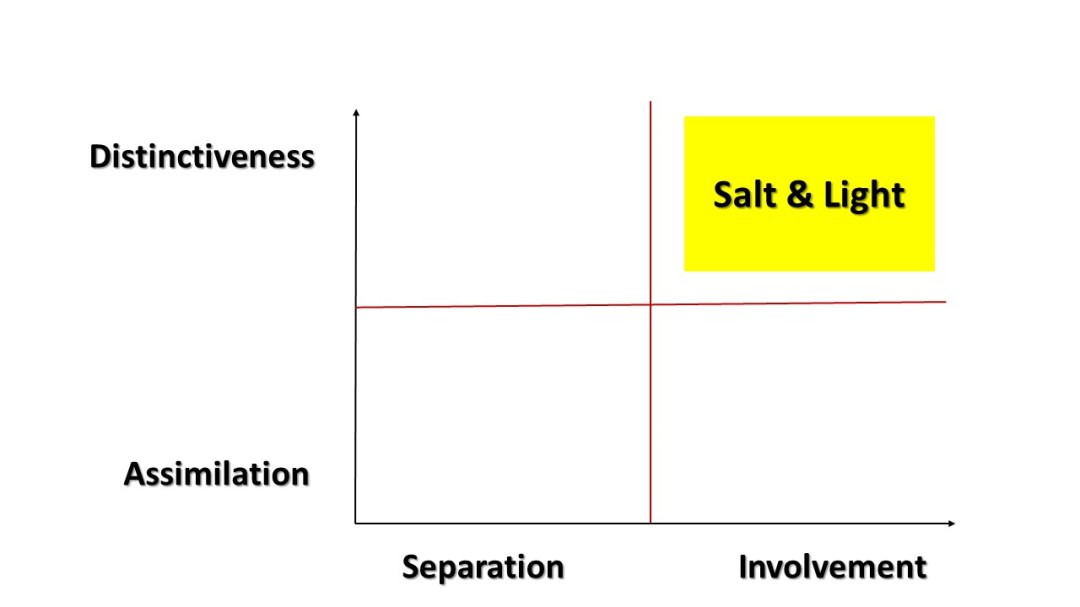
If you imagine a graph with distinctiveness on the y axis and involvement in the world on the x axis then we are aiming for the yellow quadrant
- – The followers of Jesus are not to assimilate to the world’s values nor live separately from the world
- – We make a difference by being distinctive, in a good way, and involved, not just passing through in our own little bubble
But the kind of distinctiveness that is in view here is not an aesthetic or cosmetic difference – rather it is a difference of being or character
- – In the ancient world salt was associated with purity because it came from the purest of all things – the sun and the sea
- – Because of its association with purity salt was rubbed on sacrifices
- – Salt had a holy or sacramental use
One of the primary functions of salt is to preserve things, to arrest decay
- – Before freezers people used to put salt on meat to make it last longer
- – In saying, ‘You are the salt of the earth’ Jesus is calling his disciples to remain pure and be a moral disinfectant in a world where standards of morality are low
Another function of salt is to bring out the flavour in food – salt lends flavour to things
- – As Christians, therefore, we should bring out the best in people, through our example, through our conversation and through our very presence
So, Jesus wants us to be like salt, pure but not bland
Being the salt of the earth comes with a warning: we shouldn’t lose our saltiness
- – In other words, we shouldn’t lose our purity,
- – We shouldn’t let our standards slip
- – We mustn’t assimilate to the values of our society nor conform to the patterns of this world
- – The world needs us to resist and subvert evil with the grace God gives us
To retain our saltiness (our flavour) we must maintain our distinctiveness
- – So how do we do that – how do we maintain our distinctive Christ flavour?
- – Well, as I’ve already alluded to, we don’t do it by dressing differently or living separately – we do it by staying close to Jesus
- – It is the Spirit of Jesus who makes us salty
- – It is the Spirit of Jesus who gives us light to share with others
In verse 16 Jesus says, “…let your light shine before men [and women], that they may see your good deeds and praise your Father in heaven.”
- – (The term ‘men’ is gender inclusive – as in humankind)
- – This verse tells us our light reveals our good deeds – perhaps a bit like sunshine causes flower petals to open
The image of light is rich in interpretive possibility – light represents a number of things at once
- – For example, light could be wisdom – so this verse can mean, let your wisdom shine before men that they may see your good deeds and praise your Father in heaven
- – When we do our good deeds in a way that is smart, that doesn’t create dependencies or cause other problems downstream, then people look at those good deeds and praise God
- – One of the wisest things a missionary can do is learn the language and culture of the people they are sent to and then, having become familiar with the culture, translate the Scriptures into the people’s own language
As well as representing wisdom, light characterises the first day of creation, so light could equate to creativity – as in, let your creativity shine…
- – Therefore, when you do your good deeds, whether that’s making a meal for someone or preparing a Sunday school lesson, or coaching a kids’ sports team, or buying a gift or whatever, don’t be boring – be creative
- – Do that good work in a way that is fresh and unique and expresses who God made you to be
Light is also associated with joy – so it’s like Jesus is saying, let your joy shine…
- – Therefore, when you do your good deeds, don’t do them grudgingly or out of a sense of loveless duty – do them with good humour, have fun
- – Guys, when you’re making breakfast in bed for your wife she doesn’t want you to approach the task with a heavy heart
- – “Oh, not mothers’ day again. How do you want your eggs?”
- – Most mothers of small children want to sleep in but when you do make her breakfast she’ll want you to want to do it and she’ll also want you to clean up the mess afterwards
- – What I’m saying is that when you do your good deeds don’t make the other person feel bad about it
- – Our good deeds are just a vehicle for what we are trying to communicate, God’s love
- – If you make the breakfast with joy then your wife will feel loved
- – But if you make it like a martyr she will probably feel stink
Wisdom, creativity and joy are just some of the things light represents
- – Light has other positive connotations as well but you get the point:
- – Light illuminates our good deeds, it sets our good deeds apart in a special way, it gives them a winsome quality
Elsewhere in the gospels Jesus describes himself as the light of the world – which points to Jesus as the source of our inner light
- – More than just reflecting the light of Christ we actually hold the light of Christ’s wisdom, creativity and joy within us
- – Or to say it another way, we are the lightbulb and the Spirit of Jesus is the electricity or power enabling us to shine
- – Let your light shine then means let people see the Spirit of Jesus in you
- – Let them see love, joy, peace, patience, gentleness, self-control and all the other fruits of the Spirit in your good deeds
Now some of you may be thinking to yourself…
- – “I’m not wise. I feel like I’m bumbling my way through life
- – Nor am I joyful, in fact I feel pretty miserable most of the time.
- – And I’m not that creative or patient or peaceful
- – So what does that say about me?
- – Does that mean I’m not a person of light?”
- – Well no. Being light doesn’t mean having a perfect life
- – You don’t have to have it altogether to be light
- – Just before these verses about being salt & light, Jesus said this,
- – Blessed are the poor in spirit… Blessed are those who mourn…
- – Blessed are those who hunger for righteousness… and so on
- – Jesus is not describing here people who have their life together
- – He’s describing people who are broken, wounded, hurting and hungry
- – People who don’t feel wise or happy or creative but who, through their weakness, display the wisdom and creativity of God in redeeming humankind
Jesus uses the image of a lamp giving light, not the image of a star
- – A lamp has a warm and inviting glow, you can get close to a lamp
- – Stars give off light but you can’t get close to a star
- – The poor in spirit and the meek are not stars – they are humble & down to earth – like an old style lamp with an open flame, giving comfort & joy
- – Or to put it more plainly, being the light of the world isn’t always about what we do when we feel at our best
- – Light is more often about what God is doing when we are at our worst
- – In that case, “Let your light shine”, means be open, be honest – let people get close enough to see God’s goodness & grace at work in your life
So, what might it look like (practically) to be salt & light in the world? Well, it depends on the situation to some degree…
If everyone in the room is raising their voice and pushing their own agenda, then being salt & light (being different in a good way) might mean listening
- – Listening reveals patience and gentleness
Or, if you are in a meeting at work and everyone in the room is saying ‘yes’ to a decision that will increase profits at the expense of peoples’ welfare, then being salt & light might mean saying ‘no’ – and offering a better alternative – one that shines with the light of Christ’s wisdom and compassion
Or, if you are in a conversation and people are maligning someone else behind their back, then being distinctive might sound like disagreeing with them and shining a light on that person’s better qualities
- – It might cause some short term tension to disagree but longer term it will build trust
Or, when everyone is filling their lives with busy-ness and activity and the stress that accompanies that, being salt & light might mean slowing down and taking time out for prayer, corporate worship or spiritual retreat
- – Enjoying Sabbath rest is a positive way of subverting the impatience and greed of our consumerist society
- – The world needs us to be different in a good way – it needs us to subvert evil with grace & truth
Now, you need to know I’m being a bit easy on you – my examples of being salt & light don’t set the bar very high
- – If Jesus was standing here preaching to you now, I imagine he would be saying some very difficult things
- – For example, being salt & light (being distinctive & involved in the world) means not retaliating when someone punches you in the face but turning the other check
- – Being salt & light means loving your enemies and lending to people who can’t afford to repay you
- – It means you will respond to abuse and prejudice with joy
- – It means you won’t do things to promote yourself or make yourself look good – you’ll do things in a way that makes God look good
- – Being salt & light means you will do what you say even when it is no longer convenient to you
- – It also means you won’t worry about the future – you’ll live in the present
- – I’m not making this up, by the way, I’m getting it all from Matthew 5, 6 & 7 – the sermon on the mount
So that we don’t feel too overwhelmed though we need to remember that being salt & light is not something we do on our own
- – When Jesus said to his disciples, “You are the salt of the earth” and “You are the light of the world” the “You” is plural, not singular
- – And when Jesus says in verse 14, “A city on a hill cannot be hidden”, this indicates a community of lights – not just a single house
- – Sometimes we might be the only one in the room saying the unpopular salty thing but we do that in the knowledge we are not acting alone
- – We are acting as Christ’s representative and as a member of his body, the community of the church
A couple of real life examples of what it means to be salt & light
- – The first is from New Zealand history and the second is from the Bible
Those who were at the Salvation Army for the Easter Sunday service a few weeks ago may remember the story of Piripi Taumata-a-Kura
- – Jay Ruka retells Piripi’s story in his book, Huia Come Home
- – Piripi came from the Ngati Porou tribe on the East Cape
- – He was captured in the 1820’s by a Nga Puhi raiding party and taken away as a slave
- – While he was in Waimate, Piripi met the missionary Henry Williams who taught him to read & write and introduced him to the gospel of Jesus
- – Long story short, Piripi was returned to his tribe on the East Cape about 10 years later, where he shared the gospel with his own people before any Pakeha arrived in the area
One situation in particular demonstrates the salt & light influence Piripi had on his world. …
When asked to fight with his people against another tribe, Piripi was reluctant at first
- – Eventually though he was persuaded, but only after he convinced his fellow warriors to adopt a code of conduct which reflected Christian ideas of compassion towards enemies
- – There was to be no cannibalism and no destroying the enemy’s crops
- – In agreement to these conditions he entered the battle
- – Legend says he defied the bullets whizzing around him and emerged unscathed
- – His bravery and trust in God captured the imagination of his people [1]
Obviously the ideal is a world without war, but we don’t live in an ideal world
- – If Piripi had refused to fight the outcome for his enemies would have been worse
- – So when peace wasn’t an option Piripi found a way to be salt & light, to remain involved and make a positive difference
Our second story of what it means to be salt & light comes from the book of Exodus, chapter 1
- – The people of Israel were living in Egypt and they were thriving
- – This made Pharaoh paranoid and he began to oppress the Israelites with slave drivers to crush their spirits
- – But the more the Egyptians oppressed the Israelites the more they increased in number
- – So the king of Egypt called the Hebrew midwives, Shiphrah and Puah to his palace for a chat
- – “When you help the Hebrew women in childbirth and observe them on the delivery stool, kill the baby if it is a boy, but let it live if it is a girl.”
This put the midwives in a difficult position
- – If they did what Pharaoh wanted they would be in trouble with God
- – And if they did what God wanted they would be in trouble with Pharaoh
- – Some people may have abdicated their responsibility by resigning their position but not Shiphrah and Puah – they were made of sterner stuff
- – If they weren’t involved some other midwives with little or no conscience might take their place and then they would have blood on their hands
- – Better to stay involved and have some influence for good
Ultimately the midwives were more afraid of God than Pharaoh, so they let the boys live. But they were clever about it
- – They didn’t make placards and stand in protest outside Pharaoh’s palace
- – That might work in a democracy but not in a dictatorship
- – They were as wise as serpents and as innocent as doves
- – They subverted Pharaoh’s authority quietly and discreetly
On learning that his plan wasn’t working the king of Egypt summoned Shiphrah & Puah back for another meeting and asked them…
- – “Why have you done this? Why have you let the boys live?”
- – Pharaoh wasn’t the sharpest knife in the draw so Shiphrah & Puah said to him, “Hebrew women are not like Egyptian women; they are vigorous and give birth before we arrive.”
This wasn’t true of course – it was a lie – and while it is not ideal to speak falsely, we don’t live in an ideal world
- – If the midwives had been completely honest they would have put the king in a position where he felt obliged to kill them to save face
- – God didn’t seem to mind the midwives deceit though – they were simply being salt & light – staying involved in the world and making a positive difference as they were able
- – God protected Shiphrah & Puah and gave them children of their own
- – The midwives’ subversive tactics worked and Pharaoh had to find another way to carry out his plan of genocide
When I think about the situations that Piripi and Shiphrah & Puah found themselves in, I imagine the pressures would have been huge
- – But they didn’t cave
- – They didn’t run away or assimilate
- – They found a way to stay involved and make a positive difference
Conclusion:
Mission isn’t just something that happens overseas
- – Opportunities for Christian mission are all around us, right here in NZ
- – Jesus said, ‘You are the salt of the earth… You are the light of the world’
- – Jesus means for us to have a positive influence where we are
- – We are to be pure but not bland
- – We are to be different but not separate
- – We are to be open and not pass through life in our own little bubble
Having said that we do well to remember our saltiness and our light comes from our union with Christ
- – This means we can’t be in the world all the time
- – To stay salty and keep the lamp burning we need to guard against busy-ness and make time, apart from the world, to take care of our relationship with Jesus – reading our Bible, praying, gathering for worship and so on
- – If you want good fruit you need to take care of the root.
Questions for discussion or reflection:
1.) What stands out for you in reading this Scripture and/or in listening to the sermon? Why do you think this stood out to you?
2.) What do salt & light share in common?
3.) What does it mean to be the salt of the earth?
4.) What does it mean to be the light of the world?
5.) Where would you place yourself on the graph below? Why?
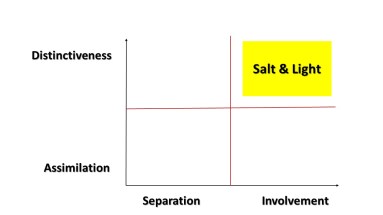
6.) How might we move from assimilation to distinctiveness?
– How might we move from separation to involvement?
7.) Piripi and Shiphrah & Puah provide good examples of people who acted as salt & light in their respective worlds. Can you think of any other examples from your own experience or from history or the Scriptures, where people have been salt & light? (I.e. made a positive difference through their involvement in a less than ideal situation.)
[1] Jay Ruka, Huia Come Home, page 48.
 Tawa Baptist