Free to Worship

Scripture: Exodus 35-40


Title: Free to Worship


Structure:

  • Introduction
  • Preparation for God’s coming (hope)
  • Worship from the inside out (freedom)
  • Conclusion


Introduction:

Today we conclude our series on Moses in Exodus by looking at the final six chapters – 35 through to 40

  • In this section the people make the tabernacle in accordance with the detailed instructions Yahweh gave them in chapters 25 to 31


The tabernacle, you may recall, is like God’s mobile home – it is a sacred tent for God’s presence

  • The God of Israel is not aloof or detached and He is not fixed in one place
  • Yahweh wants to be present among His people – on the move with them


We don’t have time this morning to read all six chapters – I really just want to draw your attention to some of the main points in view, in particular…

  • Israel’s preparation for God’s coming
  • And their worship from the inside out


Preparation for God’s coming:

As we heard earlier, today is the first Sunday in Advent, which means we are less than a month away from Christmas


Tell me, what are some of the things that you have been doing (or at least need to do) to prepare for Christmas?

  • Write and send Christmas cards
  • Shop for Christmas presents
  • Put up the Christmas tree
  • Decide where you will spend Christmas
  • Buy special food
  • Attend end of year parties


Okay, show of hands, who really enjoys this time of year?

  • And who can’t wait for it all to be over?
  • There is much to do in preparing for Christmas – it is a busy time


Recently, in the last 3 months, we’ve had two new babies born in our congregation – Matthias & Pascal

  • There is quite a bit to do in preparing for the arrival of a new born baby, especially if it’s your first (as it was for Oti & Ann Na)
  • You need to set up the nursery, buy baby clothes, make arrangements for time off work, get a baby seat and maybe get a bigger car


At the beginning of this month Prince Charles paid a visit to Tawa College

  • I imagine there was a fair bit of preparation involved with that visit
  • Communicating to the pupils and the parents what was happening
  • Having some students ready to greet and perform for the prince
  • Liaising with police about security
  • Having some contingency plan if things didn’t quite go as expected
  • I don’t know – I guess there was lots to think of


There is certainly a lot to think of in preparing for a wedding

  • Organising the ceremony itself and then the reception afterwards
  • Inviting guests, buying a dress, hiring a suit, arranging flowers, working through some kind of marriage preparation course with the minister
  • Writing a speech, planning the honey moon – all sorts of details you wouldn’t imagine until you go through the process


Next week’s ‘19 Sleeps to Christmas’ guest service involves lots of preparation too (nearly as much as a wedding)

  • I don’t want to give too much away but there has been quite a bit of planning and work going on in the background for several weeks now
  • At this afternoon’s practice we’ll put it altogether to see how it works


That word Advent (on the front of your newsletters) simply means ‘coming’

  • During Advent we look back to Jesus’ first coming to earth 2000 years ago and we look forward to Christ’s second coming in glory
  • Christmas Advent is meant to be a time of preparation for the arrival of both a special event and a special person


When you read through Exodus chapters 35 to 40 you get a feel for the amount of preparation that went into Yahweh’s coming


There’s lots of detail about joining and fastening and making and then assembling the tabernacle. For example:

  • He made curtains of goats’ hair
  • He joined five curtains by themselves
  • He made the table of acacia wood… and overlaid it with pure gold
  • He cast for it four rings of gold and fastened the rings to the four corners
  • He also made the lampstand of pure gold… and so on


The image presented is not a static one

  • We don’t get a still photo of the completed project
  • We get a series of moving pictures, describing the process of the people’s preparation for the coming of God to dwell in their midst.
  • The community is in Advent mode.’ [1]


Much of the detail in chapters 35 to 40 is repetition of chapters 25 to 31

  • The main difference being that in chapters 25-31 God describes things in order of sacredness – starting with the ark in the most holy place and working His way to the outer courtyard and surrounding curtains
  • Whereas in chapters 35 to 40 we get a works report – so the order follows the practical logic of construction


Why the repetition? (albeit in a different order)

  • Because preparing for the Lord’s coming (His Advent) is important
  • It is not instant coffee or a microwave meal
  • It is not a Bunnings flat pack or ready-made curtains
  • Everything is unique, a one off, custom made and hand crafted


In the Old Testament the tabernacle isn’t just a symbol of God’s presence – it is an actual vehicle for divine presence

  • When God fills the tabernacle in Exodus 40, Moses is unable to enter

In the New Testament Jesus is the actual vehicle of God’s presence – more than just a symbol

  • As the Israelites prepared for Yahweh’s coming so we need to make room for the Christ child – we need to be ready to receive our risen Lord


Being prepared for Christ’s coming gets some attention in the gospels too

  • Jesus told a number of parables about being ready for his return
  • The parable of the 10 virgins – only 5 of whom kept their lamps trimmed
  • The thief in the night
  • The parable of the servants and the talents, and so on
  • This looking forward to Christ’s return is not meant to be an anxious thing – it is supposed to inspire hope – Hope is an attractive energy


Looking at the book of Exodus as a whole, we notice a contrast between the beginning and the end of the book

  • At the start of Exodus the people are despairing – Pharaoh is crushing their spirit under cruel slavery – they have nothing to look forward to
  • But by the end of the book Pharaoh is nowhere in sight and the people are busy preparing for the Lord’s coming – energised by hope


  • Despite the Pharaoh’s of this world and despite Israel’s own failure, God promises to be with His people and that promise fills the people with a sense of joyful anticipation
  • Like the joy and excitement we might feel as we anticipate getting married or as we look forward to the birth of a child or being reunited with loved ones at Christmas


As well as describing Israel’s preparation for God’s coming, Exodus 35 to 40 also shows us the quality and fabric of their worship – from the inside out


Worship from the inside out:

Aesop has a story about the sun and the wind – it’s a classic, worth repeating


The North Wind boasted of great strength.

  • The Sun argued that there was greater power in gentleness.
  • “We shall have a contest,” said the Sun.


Far below, a man travelled a winding road.

  • He was wearing a warm winter coat.
  • “As a test of strength,” said the Sun, “Let us see which of us can take the coat off of that man.”


“It will be quite simple for me to force him to remove his coat,” bragged the Wind.

  • The Wind blew so hard, branches broke off trees. The world was filled with dust and leaves.
  • But the harder the wind blew, the tighter the man clung to his coat.


Then, the Sun came out from behind a cloud, warming the air and the frosty ground.

  • The man on the road unbuttoned his coat.
  • The sun grew slowly brighter and warmer.
  • Soon the man felt so hot, he took off his coat and sat down in a shady spot.


“How did you do that?” said the Wind.

  • “Gently, from the inside out”, said the Sun


Pharaoh was like the wind to Israel – forcing them against their will with threats and whips and external pressures

  • But the way of Yahweh was more like the Sun – warming Israel, wooing them gently, so they were moved of their own volition, freely, naturally, from the inside out


From Exodus 35, verse 4 Moses said to all the congregation of the Israelites:

This is the thing that the Lord has commanded:

Take from among you an offering to the Lord; let whoever is of a generous heart bring the Lord’s offering: gold, silver, bronze… [and so on]


And they came, everyone whose heart was stirred and everyone whose spirit was willing and brought the Lord’s offering to be used for the tent of meeting…

So they came, both men and women; all who were of a willing heart brought brooches and earrings and signet rings and pendants, all sorts of gold…

[and so on]


Willing heart – willing spirit


In this context the ‘heart’ stands for the inner constitution or disposition of a person – their unseen inner reality

  • While the human ‘spirit’ refers to personal energy, gusto or inner drive [2]

The point is, no one was forcing the people to provide valuables for making the tabernacle – they did it freely and willingly, from the inside out

  • God, in His grace, had moved them with the warmth of His loyal love and commitment
  • The people were so generous that they had to be asked to stop giving


The best things in life are simple – Chocolate is a point in case

  • Chocolate only has three ingredients – and two of those ingredients come from the same plant
  • You can add other things to the chocolate like fruit or nuts or some other kind of flavouring but essentially the chocolate itself only has 3 parts
  • Would anyone like to guess what those three ingredients are? [Wait]


Yes, that’s right

  • Cocoa beans (or cocoa mass), cocoa butter and sugar


The cocoa beans give the chocolate that dark look and bitter taste

  • The sugar is needed to balance out the bitterness
  • And the cocoa butter gives it a smooth silky texture


Worship is a bit like chocolate – in that it has three basic ingredients

  • Giving (as in some form of sacrifice or offering)
  • Willingness (as in a willing spirit or a generous heart)
  • And obedience (doing what God asks)

Giving is integral to worship – like cocoa beans are integral to chocolate

  • We can give all sorts of things to God – we might offer songs of praise, money, talents or our time
  • The offering we take up each Sunday isn’t just to cover the church’s expenses – It is primarily an act of worship
  • Likewise, if you volunteer your time on the music team or the property committee or the deacons board or helping with Club Intermed or Youth group or Sunday school or doing the lawns or whatever else you may do
  • Then, so long as you are doing it for the Lord, it is worship


We’ve already heard how the people offered their valuables to God – their gold, silver, fine linen and so forth

  • The other thing they gave was themselves – their time and talents in service to make the tabernacle


Those who were at Doris Lindstrom’s funeral yesterday would have heard a reading from Exodus 35, verse 30…


30 Then Moses said to the Israelites: See, the Lord has called by name Bezalel son of Uri son of Hur, of the tribe of Judah; 31 he has filled him with divine spirit, with skill, intelligence, and knowledge in every kind of craft, 32 to devise artistic designs, to work in gold, silver, and bronze, 33 in cutting stones for setting, and in carving wood, in every kind of craft. 34 And he has inspired him to teach…


The Scriptures go on to say how others joined Bezalel, under his guidance and tuition to build the Lord’s tent and equipment

  • They offered their time and skill


What this means is that work is sacred when it is done as an act of worship for the Lord

  • Your work during the week can be as much an act of worship as singing songs of praise in church on a Sunday morning

As the apostle Paul writes in his letter to the Ephesians

  • Render service with enthusiasm, as to the Lord and not to men or women, knowing that whatever good we do, we will receive the same again from the Lord… [3]

If giving is to worship what cocoa beans are to chocolate, then willingness is like the sugar, making the giving sweet

  • Worship isn’t meant to be an empty ritual
  • Worship is not blindly going through the motions
  • Worship needs to be from the inside out – from a willing heart and with a spirit (or an energy) which really wants to express love and appreciation
  • Without willingness the giving becomes bitter drudgery & loveless duty
  • Without willingness the letting go of sacrifice doesn’t free our heart – it clenches our heart into a fist of resentment


Okay then – if giving is the cocoa beans and willingness is the sugar, then obedience must be the cocoa butter


More than the other two ingredients it is the cocoa butter which determines the quality of the chocolate

  • The cocoa butter is the most expensive of the three ingredients and so cheap chocolate tends to skimp on cocoa butter or substitute it with something else
  • Just as there is no substitute for cocoa butter in quality chocolate, so too there is no substitute for obedience in quality worship
  • Obedience is indispensable to worship


Exodus 35-40 never tires of stating how the divine instructions were carried out in precise detail; there are 18 references to Moses doing as God commanded [4]

  • Obedience – doing what God wants – is more important than giving to charity or anything else we might think of as ‘good works’
  • What is it the Lord says, ‘Obedience is better than sacrifice’


Without cocoa butter it isn’t really chocolate

  • Without obedience it isn’t really worship


The cross was Jesus’ ultimate test of obedience to God

  • We read about it in the accounts of Jesus’ anguished prayer in the Garden of Gethsemane
  • Not my will Father, but Your will be done


Giving God what He wants, willingly, that is true worship


Conclusion:

The book of Exodus finishes one year after the people left Egypt with the presence of God filling the tabernacle

  • Exodus means ‘exit’ or ‘leaving’ – so it’s really about movement
  • It’s about God taking Israel out of Egypt and into the wilderness
  • Out of the known and into the unknown
  • Out of forced labour under Pharaoh to willing worship of Yahweh
  • Out of slavery and into freedom
  • Out of despair and into hope


And it hasn’t been an easy journey for Israel or Yahweh or Moses

  • It’s been a rollercoaster of redemption, failure, forgiveness and faith
  • But through the Lord’s (& Moses’) loyal love, Israel are a new creation


Jesus came for our Exodus – for our redemption – to make us a new creation, free to worship the Lord – free to willingly give God what He wants


Let’s stand and sing about the Lord’s love and faithfulness as we prepare for communion…


[1] Terence Fretheim, Exodus, page 314

[2] Alec Motyer, BST Exodus, page 320.

[3] Ephesians 6:7-8

[4] Terence Fretheim, Exodus, page 313.
God Goes Camping

Scripture: Exodus 25-31

Title: God Goes Camping

Key Idea: The tabernacle is a sacred tent through which God mediates His holy presence within Israel


Structure:

  • Introduction
  • God dwells among His people
  • God’s tent
  • Conclusion

Introduction:

On the wall here we have a picture. Can anyone tell me what this is? [Wait]

  • Yes, that’s right. A hub
  • A hub is at the centre of things – it holds everything together and gives shape and coherence to the whole, while also allowing movement
  • It isn’t just wheels which have hubs.
  • People, families & communities have hubs too

For many busy people these days the hub of their life is their smart phone – it is the central connecting point holding all the strands & loose ends together

  • For some, the hub may be their family – so being near to parents or children or grandchildren is important to them
  • For others their hub may be found at work or in the pub or their local sports club or RSA – anywhere they might connect with others
  • For those who are Christians though, Jesus and His church are the hub

This morning we continue our series on Moses by focusing on Exodus chapters 25 to 31

  • This is where God gives Moses some quite detailed instructions for the making of a tabernacle
  • The tabernacle, in the context of Exodus, is essentially a sacred tent through which God mediates His holy presence within Israel

Terence Frethiem notes that…

  • In their journey through the wilderness God gives Israel two basic institutions, the Law and the Tabernacle.
  • Both are portable
  • Both are designed to bring order to disorder
  • And both give shape to life when the centre has trouble holding
  • The Law provides an ethical shape and the Tabernacle provides a liturgical shape [1] 

Or said another way the Law and the Tabernacle were the hub of Israel’s life

  • The Law and the Tabernacle were the centre, holding the nation together and allowing movement
  • They were designed to keep Israel distinctive from the nations around them – to prevent Israel from conforming to the pattern of this world and enabling them to follow God’s pattern

God dwells among His people:

One of the distinctive things about God and His pattern is that He comes to dwell among His people

  • Yahweh is not aloof or removed like the gods of other nations – He is present with His people, living with them

Art is good for the soul

  • It helps us to reflect on our experience and find meaning in our pain
  • Art has the potential to put us in touch with beauty and goodness
  • It can inspire us, challenge us and help us to feel more connected

Normally if you want to view paintings or sculptures you would go to an art gallery – a special purpose built facility containing art works

  • Galleries are usually found in cities and so if you are a child and your parents won’t take you, or if you live out the back of nowhere, you might not ever get to see fine art


Some years ago a NZ couple came up with the idea of a portable art gallery called the Real Art Road Show

  • The Real Art Road Show is basically a truck which travels the country displaying art work to school kids
  • Rather than going to a gallery, the gallery comes to you

The truck opens up and school pupils walk through it

  • We had this Art Truck set up in our church car park a few years ago and kids from Tawa School came through

Why am I telling you this?

  • Well, as I said before, the tabernacle is a sacred tent through which God mediates His holy presence within Israel
  • It is basically a mobile home for Yahweh – the Lord God
  • Sort of like the concept of the Real Art Road Show truck
  • Rather than God’s presence being contained in an immovable temple or a fixed place like a mountain – God will be on the move with His people
  • Unlike the pagan religions around them, Israel’s God does not expect His people to come to Him
  • Rather, Yahweh comes to dwell among His people
  • Just as they are living in tents in the wilderness, so too the Lord will dwell in a tent with them

Seven (plus) chapters is a lot of space to devote to this subject – which indicates the tabernacle was pretty significant to God and Israel

  • Because the purpose of the tabernacle is to mediate God’s presence to the people, the Lord refers to it as ‘the tent of my presence’ or ‘the tent of meeting’. At the end of chapter 29 the Lord says to Moses…
  • “…at the entrance of the tent of my presence… I will meet my people and speak to you. There I will meet the people of Israel and the dazzling light of my presence will make the place holy…
  • …I will live among the people of Israel and I will be their God. They will know that I am the Lord their God who brought them out of Egypt so that I could live among them…”

In saying that He will live among the people of Israel, God is not forcing Himself into the community

  • Israel has a choice about whether they will receive God or not
  • God could have made the tent Himself and plonked it down in the middle of the camp, but He doesn’t
  • God is respectful of human freewill
  • He entrusts the making of His mobile home to the Israelites
  • If they don’t want God living among them then they simply don’t make the tent. By making the tent Israel are accepting Yahweh’s presence

We see God’s vulnerability, in giving the people the option to reject Him, at the beginning of Exodus 25 where the Lord says to Moses…

  • “Tell the Israelites to bring me an offering. You are to receive the offering for me from each man whose heart prompts him to give.”
  • God wants His people to give willingly and freely – because they love Him and value His presence with them

Now while God comes to dwell among His people, God still maintains certain boundaries

  • Boundaries are important in relationships
  • Without appropriate boundaries the wheel of community falls apart
  • God’s tent is a holy place – it is made sacred and special by His presence
  • The people need to respect God’s holiness by keeping a certain distance

Holiness in the Old Testament is a dangerous thing – like fire

  • It provides warmth and light but if you get too close it will harm you
  • It’s not like people could casually drop by for a cuppa & a chat with God
  • In more than one place in these chapters God makes it clear, ‘You can’t touch this’

Only certain people (like the priests, Aaron and his sons) were allowed to approach the tabernacle and then only in a respectful and prescribed way

  • God devotes a whole chapter to instructions for the consecration of priests
  • Just as it took God seven days to consecrate the cosmos so too it takes seven days to ordain a priest
  • God’s holiness is a serious matter

It’s interesting to me that people outside the church often have a better sense of God’s holiness than we Christians do

  • We can be a bit casual in our approach to the Lord, while those who are less familiar with God may be more cautious

I remember when Robyn and I invited my grandfather to our wedding

  • He asked where the ceremony would be held and we said in a church
  • He then replied, ‘The church would fall down if I walked into it’
  • He was joking but there is usually a kernel of truth in people’s humour
  • His point was, ‘A church building is where God is worshipped and so it is a holy place. I’m not holy. How can I approach God?’

If you think about it, God’s holiness actually lends a certain dignity & honour to humanity who are made in His image

  • In verse 2 of Exodus 28 the Lord says, “Make sacred garments for your brother Aaron, to give him dignity and honour”
  • The rest of the chapter goes on to detail what the priest’s vestments will look like

The priest represented the people before God – he was sort of like the nation in one person

  • So by dressing the priest in a special way God was basically communicating to the people that His holy presence clothed all of Israel with dignity & honour
  • They were to be different from the nations around them and did not need to be ashamed of who they were

Okay then, God comes to dwell among His people Israel

  • His dwelling with them is not to be forced but freely accepted
  • Nor is His dwelling with them to be a casual thing, for God’s presence is holy, giving dignity & honour
  • What about the tabernacle itself – what can we learn about God’s tent?

 Tabernacle - plan

God’s Tent

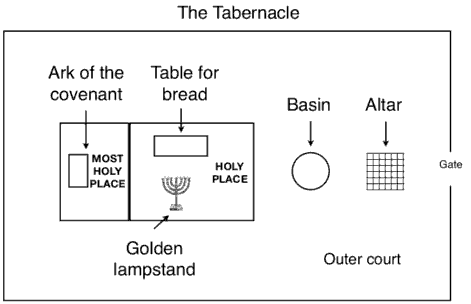
On the wall here is a sketch of the tabernacle together with the surrounding courtyard and equipment (it’s also on the back of your newsletters)

  • This is not to scale and it doesn’t convey anything of the beauty or fine art prescribed by God – but it does give us an overall picture

[Take my Russian dolls and set them out on a table]


I have here my Russian dolls to help us understand something of the layout of God’s tent

  • On other occasions I have used these Russian dolls as a metaphor for the different layers of our human self
  • Today though, I am not using these dolls to describe our personality, much less God’s personality
  • God is mystery and He can’t be reduced to a set of dolls
  • I’m simply using these Babushkas to help us understand the layout of God’s tent (His mobile home)

From verse 10 of chapter 25 God begins His instructions with a plan for making what we call the ‘Ark of the Covenant’ or the ‘Ark of the Testimony’

  • Interestingly God starts with the smallest doll
  • He begins with the core or the heart of His mobile home

At the very core of God’s tent – in the most holy place – we find His covenant with Israel

  • As we heard last week a covenant is more than just a contract
  • A covenant is a sacred agreement for attachment
  • At the very heart of God’s house is not a TV, but a reminder of His commitment to Israel’s well being
  • We might call this commitment – this covenant – loyal love

After giving the dimensions for this ark (or chest), God then says in verse 17 of Exodus 25…

  • “Make an atonement cover of pure gold…” to go over the top of the ark

Some versions of the Bible translate this verse ‘mercy seat’

  • Essentially the atonement cover or the mercy seat represents forgiveness
  • God provides a covering for Israel’s sin and that covering is forgiveness
  • Forgiveness is the second smallest doll in the tabernacle

God is so good – He does not require us to deny our imperfection

  • He provides for our imperfection and shows a willingness to re-enter the relationship with us when we fail

The most holy place is separated from the holy place by a veil or a curtain

In Luke 23, verse 45 we read that when Jesus died on the cross the curtain in the temple – the curtain into the most holy place – was torn in two

  • Jesus’ sacrifice on the cross reveals God’s forgiveness, His atonement for our sin

The next doll (or the holy place) is where we find the table with the bread of the presence and the lamp stand – bread & light

  • Perhaps bread is the strength to serve and light is the wisdom to see by
  • Strength and wisdom is found with God
  • What did Jesus say?
  • I am the light of the world. I am the bread of life

Moving out of the tent itself to the outer courtyard we find a basin for the priests to wash their hands and two altars

  • This diagram only shows one altar but Exodus describes two
  • One for burning incense, a symbol of the people’s prayers rising to heaven and the other for burning sacrifices

The main altar, for burning sacrifices, was basically like an incinerator

  • It wasn’t like a table with a top on it
  • It was open at the top with a grate part way down
  • This is where animals were offered to God

The message seems to be it is not a cheap or easy thing to come near to God

  • There is sacrifice and purity involved

The courtyard is fenced off with a curtain around the perimeter

  • There is only one entrance to the courtyard and that faces to the east – toward the sunrise
  • (What was it Jesus said? No one comes to the Father except by me. Jesus is the gate to God the Father.)
  • Verse 16 of Exodus 27 tells how there is to be a curtain made of fine linen embroidered with blue, purple and scarlet yarn, at the entrance to the courtyard

So the impression given to the people looking from the outside is one of beauty

  • The outer doll is attractive
  • Or to put it another way, God’s presence – His holiness – is beautiful
  • This stands in contrast to our society which generally tends to associate beauty with youth, novelty and permissiveness

In saying that the outer doll is attractive and beautiful and fascinating in its intricate design and detail I don’t mean that God is pimping His mobile home

  • God is not making His tent look flashy
  • If anything He is toning it down so as not to embarrass His neighbours
  • When you think about it the really precious stuff is hidden inside God’s tent where most people don’t get to see it

The metals used inside the tent are gold & silver – whereas the metal used outside is predominantly bronze

  • There may be practical reasons for this but I can’t help thinking of the poetry of it all – God is modest and often comes to us in ordinary ways
  • He doesn’t put the gold on the outside of His tent – He puts it on the inside
  • He doesn’t bring out the best wine first and then save the poorer quality wine for later – No, He saves the best till last
  • The longer we are in relationship with Him, the more we get to know Him and the deeper we go, the better it gets

When we put all that together, from the inside out we have…

  • Loyal (covenant) love at the very core of God’s tent, the smallest doll
  • Then forgiveness or mercy
  • Then light & bread or wisdom to see by and strength to serve
  • Then the outer court, a place of purity & sacrifice
  • And then the largest doll – the curtain at the entrance – humble beauty, the beauty of holiness

As I mentioned before, quite a bit of space is devoted to the Tabernacle in Exodus

  • We may wonder why there is so much detail
  • Well, later in Israel’s history Solomon would build a temple
  • In many ways the temple was modelled off the tabernacle, except the temple wasn’t portable like a tent
  • God moved into the temple but you get the sense He was uneasy with it
  • I think He preferred His mobile home

Some centuries after Solomon the temple in Jerusalem was destroyed and the survivors of Israel carried off to exile in Babylon

  • While in exile they didn’t have a temple
  • But they did have the elaborate description of the tabernacle which they could read about and picture in their mind’s eye
  • What a comfort it would have been to the exiles to be reminded that God is not fixed in one place – that God is able to move with them

Conclusion:

Ultimately though, the instructions for the tabernacle point to Christ

  • Jesus is the incarnation of God – He is Emmanuel – God with us
  • In the person of Jesus God didn’t just set up a tent among His people
  • God’s Word actually became a man and lived life as one of God’s people
  • Holiness rubbed shoulders with humanity

As we read at the beginning of John’s gospel…

  • The Word became flesh and made his dwelling among us. We have seen his glory, the glory of the One and Only, who came from the Father, full of grace and truth

Now God lives among His people by His Spirit

  • Today the Christian Church is the tabernacle of God
  • We, the Lord’s people, are God’s mobile home, made to mediate His presence in the world
  • This is a mystery too profound to explain – the best we can do is remain present to it (present to God’s presence, among us and through us)

Let us pray…

[1] Terence Frethiem, Exodus, page 277.