The Holy Spirit – by Peter Barnett

Have you ever felt the Wellington wind on your face? …Of course you have!  We all have!

You can’t see it, but you know it’s there. You see its effects — trees bending, waves crashing, umbrellas turning inside out, even the way it nearly knocks us over outside here on the Main Road. That’s often how people think of the Holy Spirit — unseen, powerful, a kind of force in the background. But is that all The Holy Spirit is?

Many, maaaany years ago, (back in the 1970s), I had a workmate. I often shared meals with his family, and we became good friends. But over time, Jehovah’s Witnesses began visiting his home. His wife became deeply involved, and before long, my workmate was drawn in too.

Because I was a Christian, our conversations often turned into debates. And one of the topics that kept coming up was the Holy Spirit.

Jehovah’s Witnesses see the Holy Spirit as nothing more than an impersonal force, like electricity, or gravity. They reject the Trinity altogether, saying it’s unbiblical or even pagan. For them, God or Jehovah is supreme, Jesus is acknowledged as a creation of God, and the Spirit is simply His power at work. 


That made me wonder: how many people today — even in our churches — have a clear picture of who the Holy Spirit really is? So, who is the Holy Spirit?

The truth is, there are many different ideas. Judaism insists on the Shema: “The Lord is one.” Islam recognises the Spirit, but not as we do. Let me just take a few minutes to dive into these ideas a little more.


Judaism and the Spirit

In Judaism, the Shema is absolutely central:

Deut. 6:4 says: “Hear, O Israel: The Lord our God, the Lord is one” 

Devout Jews recite this morning and evening — it’s almost their declaration of identity.

So you can imagine, any talk of God being “three-in-one” feels to them like a betrayal of God’s oneness. To Jewish ears, the Trinity sounds like polytheism — as if we were worshipping three gods instead of one.

Now, in the Hebrew Scriptures, the Spirit — Ruach Elohim — certainly appears. In Genesis 1:2, the Spirit of God hovers over the waters of creation. Throughout Judges and Kings, the Spirit comes upon people like Samson or David to empower them. But Jewish teaching doesn’t treat the Spirit as a separate divine Person. Instead, He’s usually understood as God’s power or presence at work in the world.

So when Christians say, “The Holy Spirit is God Himself, personal and active,” that’s a radical difference.

Can you see why the idea of the Trinity is such a stumbling block for them?

Islam and the Spirit

Islam also acknowledges the Spirit — but very differently. The Qur’an speaks of Ruh al-Qudus (the Holy Spirit) and Ruh Allah (the Spirit of God). But in Islamic teaching, the Spirit is not God, nor a person within God.

Some Muslims believe this “Spirit” is actually another name for the angel Gabriel. Others see the Spirit as God’s life-giving breath, as when Adam was created.

And just as in Judaism, Islam strongly rejects the Trinity. The Qur’an says: “Say not ‘Three’ — desist. Allah is but one God.”

So while Judaism and Islam both acknowledge the Spirit in some form, their understanding is very different from the biblical picture. Can you see how different this is? The Spirit is not a distant force, or remote entity, but He is the very presence of God living in us. We proclaim the Spirit as fully God — personal, active, and living in us today. 

These alternate views of the Spirit aren’t just ancient or foreign. Even among Christians today, confusion about the Spirit is common.

The 2022 American LifeWay “State of Theology” survey reports that 55 percent of evangelicals in America believe the Holy Spirit is just a force. I’m not aware of a similar survey for New Zealand — but it raises the question: What might the numbers look like here among our Christian communities, or in fact, here in our church?

This isn’t just a modern misunderstanding. In the 4th century, leaders like Saint Basil of Caesarea wrote entire books defending the Spirit as fully God, co-equal with the Father and the Son.


So let me ask: what about us? Do we see Him as a power… or as a person?

The Scriptures are clear. The Holy Spirit is the third Person of the Trinity — fully God, not a “some-thing,” but a “some-one.”

Jesus Himself promised the Spirit. In Acts 1:4–5 He told His disciples,

“Wait for the gift my Father promised… you will be baptised with the Holy Spirit.”

And at Pentecost that promise came… A rushing wind… Tongues of fire. Suddenly the disciples were empowered. From that moment, the Spirit’s work was unleashed in a new and powerful way.

The Bible describes Him as breath, wind, fire — but He is more than a symbol… He speaks. He can be grieved. He teaches, comforts, convicts, and guides. He has a mind and a will. In Greek, He is called the Paraclete — the one who comes alongside us, like an advocate or helper. 


Isn’t that good news? Jesus has not left us friendless. His Spirit lives in us.

How does He guide us?

So, how does He guide us?

Think of Paul in Acts 16. He and his companions planned to preach in Asia, but the Holy Spirit stopped them. Then Paul had a vision of a man from Macedonia, pleading, “Come and help us.” The Spirit was leading them step by step.

Have you ever had your own plans interrupted, only to find God had something better in mind? The Spirit guides us too. Sometimes it’s through Scripture, when a passage suddenly comes alive. Sometimes it’s that “still small voice” prompting us. Sometimes it’s through another person’s encouragement, or even a dream or vision. In all these circumstances it’s essential they align with God’s word. 

He brings peace in the middle of storms. He stirs us to acts of kindness. He gives spiritual gifts — wisdom, healing, prophecy — and produces His fruit in us: Love, joy, peace, patience, kindness, goodness, faithfulness, gentleness, and self-control.

I’ll never forget a service with Father John Rea, a Catholic priest who travels New Zealand holding healing meetings. Christians from many denominations around Tawa met in the Linden Community Centre. There were Catholic, Anglican, Baptist — it didn’t matter.

What mattered was the Spirit’s love binding us as one. It was so strong I just wanted to hug everyone. That’s the Holy Spirit — breaking down barriers, creating unity, pouring out God’s love.

How should we respond?

So, how should we respond?

The Holy Spirit is a gift. Not something we earn or merit, not something we buy. If we trust Jesus, the Holy Spirit lives within us.

But here’s the question: are we listening to the Spirit? 

Jesus said in John 10:27

“My sheep hear my voice; I know them, and they follow me.”

So do we hear His voice? Do we follow His lead?

Friends, we are privileged to live in this era of the Spirit’s work. He comforts us, empowers us, draws us closer to Jesus. He whispers in our hearts, nudges us into obedience, and transforms us from the inside out. So let’s be attentive. Let’s be sensitive. Let’s be willing to follow wherever He leads.

The Holy Spirit speaks. The only question is: are we listening?

We Believe

By: Neville Gardner, 15 June 2025

In Türkiye, not far from Istanbul, is a small town called Iznik. There is no Christian church, but this year Christians around the world are celebrating a significant event that took place here 1700 years ago. In those days, the town was part of the Roman Empire, and had the Roman name Nicaea.

In 325AD, a statement of faith called the Nicene Creed was formulated here, and it is still a standard document for a majority of Christian churches. To find out how it came about, we’ll need to dig into bit of a history.

In the early years of the 4th century AD, Christians in the Roman Empire were a minority group. Under the emperor Diocletian, Christians were persecuted. Church buildings were destroyed, sacred writings were burnt and worship meetings were banned. Christians who refused to sacrifice to the cult of the emperor could be killed. As you can imagine, Christianity was slow to grow in these circumstances.

Then along came Constantine, first as emperor of the western empire, then in 324 of the combined east and west. Critically, Constantine turned from paganism and became a Christian. He was keen to encourage Christian interests, as a political move to help unify his fractured empire. So the Treaty of Milan decreed that all Roman citizens could worship who they liked, without interference from the empire. Christianity didn’t become the official religion then, but it was free from persecution.

Against this background, Christians were still coming to grips with what it meant to be a Christian. The writings of the apostles had been collected and copied, but their contents were mainly spread orally, which made study and interpretation hard. It also made it relatively easy for people to spread ‘false teaching’ that was not scriptural.

One result was that the nature of the relationship between God, Jesus and the Holy Spirit became contentious. In particular, a Christian sect called Arians claimed that Jesus was a created being, not a divine part of a Trinity with God and the Holy Spirit.

Emperor Constantine’s plans for a unified empire needed a united Christian church. So he gathered together over 300 bishops from across the Empire at his summer palace in Nicaea, where he set them to sorting out their differences. Over three months, the bishops tried to prayerfully determine the will of God. One result was the writing of what is now called the Nicene Creed, a statement of faith that is still used by many denominations around the world.

There were several changes to the Nicene Creed in following councils; the text we’ll look at now is a version in common use today. As I read it out, please don’t say it out loud yourselves – I’d like you to concentrate on what the words mean to you.

We believe in one God,

the Father, the Almighty

maker of heaven and earth,

of all that is, seen and unseen.

We believe in one Lord, Jesus Christ,

the only Son of God,

eternally begotten of the Father,

God from God, Light from Light,

true God from true God,

begotten, not made,

of one Being with the Father.

Through him all things were made.

For us men and for our salvation

he came down from heaven:

by the power of the Holy Spirit

he became incarnate from the Virgin Mary, and was made man.

For our sake he was crucified under Pontius Pilate;

he suffered death and was buried.

On the third day he rose again

in accordance with the Scriptures;

he ascended into heaven

and is seated at the right hand of the Father.

He will come again in glory to judge the living and the dead,

and his kingdom will have no end.

We believe in the Holy Spirit, the Lord, the giver of Life,

who proceeds from the Father and the Son.

With the Father and the Son he is worshipped and glorified.

He has spoken through the Prophets.

We believe in one holy catholic and apostolic Church.

We acknowledge one baptism for the forgiveness of sins.

We look for the resurrection of the dead,

and the life of the world to come.

Having come up with this statement, the council condemned anyone who did not agree with what it said; those bishops at the Council who disagreed were banished as heretics. Constantine got what he wanted, but sadly the unified church went on to persecute heretics to a level that matched what Christians had recently suffered under Diocletian.

The Nicene Creed unified the orthodox church with a basic doctrine of belief, and continues to do so. But since then there has been much disunity over non-doctrinal issues, such as governance, traditional rituals and practices, the style and timing of baptism, the date of Easter and so on. There was an early split between the Western Orthodox Church (which largely became what we term Roman Catholic) and the Eastern Orthodox Church. But they both used the Nicene Creed.

In 16th century Europe, there was a huge upheaval called the Protestant Reformation, which saw many people break away from the Roman Catholic Church, not always peacefully. New Protestant groups continued to appear, and there are now hundreds of denominations. They differ in many ways, but they nearly all maintain belief in the doctrine articulated in the Nicene Creed. For example, the Anglican, Methodist and Presbyterian churches, the Salvation Army and many Baptist churches, all recognise the Nicene Creed.

The Creed I read out just now has four ‘We believe’ statements – three focussing on the Trinity, with a single line on the church. It’s that line I’d like to talk a bit more about.

“We believe in one holy catholic and apostolic Church.”

A couple of quick word explanations here.

The term ‘catholic’ is written with a small c – it just means universal church, and does not refer to the Roman Catholic Church.

Apostolic means based on the words and actions of the Apostles, as recorded in the New Testament.

The use of the phrase “We believe” rather than “I believe” was, of course, deliberate. “I believe” was, and is, used in personal statements of faith, especially those declared at baptism. “We believe” is a communal statement made by a group with shared beliefs – originally by the bishops at Nicaea, later by gathered church congregations everywhere.

Remembering that ‘catholic’ means universal, “We believe in one holy catholic and apostolic Church” says that we believe in one church throughout the world, based on the biblical words of the Apostles. It doesn’t say we believe in a particular denomination, but in God’s worldwide church.

Just before his arrest, we hear in John 17 that Jesus prayed for his disciples. “I pray not only for them, but also for those who believe in me because of their message. I pray that they may all be one. Father! May they be in us, just as you are in me and I am in you.”

Jesus’ prayer reminds us that the church is called to be one, and its unity is to reflect the oneness of Jesus with God the Father. We believe in a universal church, because it is God’s church. When we say the Creed, we can feel part of this worldwide community. This means we all have some responsibility to be part of its ministry.

As Christians, as Baptists, we are part of God’s universal church. Many Baptist churches around the world use the Nicene Creed, as it is fully biblical and it reminds us of our links to the universal church. As a congregationally governed church, affiliated with the Baptist Union of New Zealand, Tawa Baptist has a written constitution which includes a different statement of faith. It’s based on the Nicene Creed, but is shorter and uses plainer language.

I’m going to read out the Tawa Baptist Statement of Faith, and I’d like you to read it out with me. If you don’t want to, that’s fine.

We believe . . 

  • In one God in three persons: God the Father, God the Son and God the Holy Spirit.
  • In the true humanity and deity of the Lord Jesus Christ, God the Son.
  • In the atonement made by the Lord Jesus Christ on the cross for the sin of the world.
  • In the resurrection of the Lord Jesus Christ from the dead.
  • That salvation and membership in the Church universal is by faith in the Lord Jesus Christ.
  • That the Bible is inspired by God and authoritative in matters of Christian faith and practice.

By saying “We believe”, we include ourselves in the global church, as well as in this church of Tawa Baptist. Today, this church has been blessed because Kyle and Izandi have formerly become part of that “We”. We can pray that being part of our church life together will help them grow in their personal faith – indeed for all of us, saying “We believe” helps us to more confidently say “I believe.”

I’d now like to take you back to the modern village of Iznik, Roman Nicaea. One of the bishops present in 325AD wrote that “The most eminent servants of God from all the churches that filled Europe, Africa, and Asia gathered together. One place of worship, as if expanded by God, accommodated the people.”

Over the centuries, the site of this church was forgotten, lost.

Then, in 2014, aerial photographs of the Iznik shoreline got archaeologists very excited. There, close to shore, in shallow water, was the outline of a stone basilica, an early form of church. The building of the church was dated to about 100 years later than the Council of Nicaea, and it disappeared beneath the waters of the lake in an earthquake over 600 years later.

Further excavations revealed the remains of an earlier church under the stone one. It’s not certain, but the date is right for this to be the church the Council of Nicaea met in.

The lake of Iznik has been shrinking due to years of drought, so the ruins of the basilica have gradually got closer to the surface and nearer the shore. You can now stand on the ruins without getting your feet wet. I can’t help wondering if, just as He expanded the church to fit all the bishops in 325, God has revealed that church in time for Nicaea 2025 celebrations.

A few weeks ago, my sister-in-law visited Iznik as part of a Nicaea 2025 tour led by Father Luke Miller, Church of England archdeacon of London. She sent me a photo of the church ruins, where they held a communion service. Later this year, the new Pope Leo is due to meet Patriarch Bartholomew, spiritual leader of the Eastern Orthodox Church, at this very spot. Their joint celebration of the Council at Nicaea is a landmark event in itself.

The church council in 325 aimed for Christian unity, but sometimes it seems that, apart from basic matters of doctrine, unity is still far off. Celebrations of Nicaea 2025 are particularly significant for The World Council of Churches, which for many years has encouraged unity between denominations representing over half a billion Christians worldwide. It may be on a smaller scale, but here in Tawa several churches work together in common witness and service, sharing the unity hoped for in the Nicene Creed.

I’d like to finish by reading some words Father Luke used during his tour to Nicaea.

“Constantine wanted unity. Guided by the Holy Spirit, something extraordinary happened in Nicaea. In all the divisions and stresses of the church, the creed of the fathers of Nicaea remains a bright thread in the frayed fabric of the unity of the church. God is at work still, not to fulfil the desire of a powerful emperor, but to bring us all to the glory of union with Him.”

Questions

What are the main sections of the Nicene Creed, and how do they relate to each other?

What aspects of the Creed resonate with you the most?

How could the Nicene Creed, or the Tawa Baptist statement of faith, help you to understand and deepen your own faith?

You may come across versions of the Nicene Creed that say, “We believe” or “I believe”. What difference does this wording make?

How does your understanding of the Trinity affect how you live and relate to others?

How could you use the Nicene Creed or the Tawa Baptist statement of faith to help you engage in prayer and worship?

Doves

Scripture: Luke 3:21-22

Video Link: https://youtu.be/jlZNgPtC1rk

Structure:

  • Introduction
  • Doves in the Old Testament
  • Doves in the New Testament
  • Conclusion

Introduction:

Good morning everyone.

Scientists estimate there are somewhere between ten and eleven thousand different species of birds in the world today. In total there are thought be at least 50 billion wild birds on the planet, perhaps more. Which means that birds outnumber human beings by six to one. That could be a worry if birds ever got organized. 

The Bible mentions around 25 different species of birds, including various types of owls, the eagle, sparrows, ravens, roosters, the ostrich, the hawk and so on. In fact, birds are referred to over 300 times in the Bible, which seems like quite a lot.

Today we begin a new sermon series called, ‘Birds of the Bible’. I don’t think we will try to cover all 25 species of birds, much less every verse that talks about a bird. But it might be interesting to consider what some of the bird references reveal about the character of God. After all, birds were God’s idea. We start our series this morning with the Dove.

Doves in the Old Testament:

One of the first references to a dove in the Bible is found in Genesis 8, which tells the story of Noah and the great flood. While Noah and his family and all the animals and birds were still floating in the ark, Noah sent out a dove to see if the water had receded. The dove came back because it couldn’t find a place to rest.

Verse 9 of Genesis 8, adds a rather beautiful detail saying, “Noah reached out his hand and took the dove and brought it back into the ark”.

Not many birds would land on a man’s hand like that. That speaks to me of a certain closeness and trust between Noah and the dove.

Noah waited seven days before sending the dove out again. This time it returned with an olive branch in its beak, indicating the waters were receding. After another week, Noah sent the dove out once more but this time it did not return so Noah knew it was safe to leave the ark.

The image of a dove over the waters reminds us of the Holy Spirit hovering over the primordial waters, when God created the cosmos. It speaks of a new creation. It also speaks of peace after the storm. A fresh start.

Doves were used by the ancient Israelites as a sacrifice. In particular, they were the sacrifice of the poor. If someone needed to make atonement for something, but could not afford to offer a lamb or a goat, then they could offer two doves instead.

We read for example, in Luke 2, how Mary & Joseph presented the baby Jesus to the Lord at the temple in Jerusalem and offered two doves in keeping with the Law.

So, as well as signifying peace and new beginnings, doves point to God’s consideration for the poor. God does not want people to be excluded from worship by a lack of finances.

Doves often mate for life. They are loyal, not promiscuous and so doves are associated with love and devotion. Also beauty. They are a pretty bird.

Perhaps the most intimate book in the Bible is a love poem called the Song of Songs. The Song of Songs refers to doves as a metaphor for beauty…

How beautiful you are, my darling. Your eyes are doves. (1:15)

My lover is knocking: Open to me, my darling, my dove, my flawless one. (5:2)

My dove, my perfect one, is unique. (6:9)

Some think the Song of Songs is an allegory of God’s love for his people or of Christ’s love for the church, a love that is reciprocated. Whichever way you might read it, there is a palpable tenderness and intimacy in the language.

As beautiful as they are, the cooing of doves sounds sad, like crying or moaning.

In the 1980’s the musician, Prince, wrote a song titled, When Doves Cry. It was a song of lament. ‘How can you just leave me standing, alone in a world that’s so cold… Why do we scream at each other? This is what it sounds like when doves cry.’

The crying doves in the song are a metaphor for two lovers mourning the loss of their relationship.

In Isaiah 38 we read how king Hezekiah became ill and was at the point of death. When he cried out to the Lord in tears, God healed him and added another 15 years to his life. Afterwards, Hezekiah wrote a song remembering his ordeal. In verse 14 of Isaiah 38 we read…

I cried like a swift or thrush, I moaned like a mourning dove. My eyes grew weak as I looked to the heavens. I am troubled; O Lord, come to my aid.

Moaning like a dove, in sadness and regret, was also used to describe those who survived the fall of Jerusalem. In Ezekiel 7 we read…

All who survive and escape will be in the mountains, moaning like doves…, each because of his sins.

So doves, in the Bible, are associated with mourning and grief. This fits with the idea that doves represent a new beginning. “Every new beginning starts with some other beginning’s end.” I imagine Noah and his family felt some grief after the flood, thinking of all that had been lost, much like the Jewish survivors after the fall of Jerusalem. 

Many of you will be familiar with the story of Jonah. Jonah was a prophet who ran away from God. He was swallowed by a huge fish and then spewed up on a beach. Jonah ran away because God wanted him to preach a message of repentance to his enemies the Assyrians.

Eventually, after three days in a fish, Jonah did what God asked him. He told the people of Nineveh that God was going to destroy their city. No sugar coating it. The people of Nineveh believed Jonah’s message and repented in dust and ashes, so God had mercy and spared the city.

Jonah was not happy with this. He wanted God to smote his enemies but the Lord had mercy saying: Nineveh has more than a hundred and twenty thousand people who cannot tell their right hand from their left, and many cattle as well. Should I not be concerned about that great city?

You might be thinking, ‘Yea, I know the story but what has that got to do with doves?’ Well, as it happens, Jonah’s name in Hebrew means ‘Dove’. So when we think of doves we think of the story of Jonah and the God of mercy who gives second chances.

The Lord gave Jonah a second chance and he gave Nineveh a second chance too. Just as he gives each of us a second and third and fourth chance. The Lord is slow to anger and rich in love.

Doves in the New Testament:

Today is Trinity Sunday, a week after Pentecost. One of the traditional readings for Trinity Sunday is the account of Jesus’ baptism. From Luke 3 we read…

21 When all the people were being baptized, Jesus was baptized too. And as he was praying, heaven was opened 22 and the Holy Spirit descended on him in bodily form like a dove. And a voice came from heaven: “You are my Son, whom I love; with you I am well pleased.”

Many people see the Trinity (Father, Son & Spirit) depicted in this narrative, with the voice from heaven being that of God the Father.

We might also see in this passage a picture of heaven coming to earth, a kind of glimpse of the future, when God’s kingdom is realized in its fullness. As the Lord taught us to pray: Your kingdom come, your will be done, on earth as it is in heaven.

The other thing that is happening in Christ’s baptism is that Jesus is representing the human race. You see, Jesus is without sin and so he does not need to be baptized for himself. Jesus is being baptized for us. He is identifying with human beings and representing humanity to God.

This means the baptism of Jesus is not only a picture of the communion of the Father, Son & Spirit; it is also a picture of the communion (or holy intimacy) that we (who belong to Christ) will enjoy with God, when Jesus returns and heaven comes to earth.

In other words, the Trinity are not having their own private huddle in Luke 3. At Jesus’ baptism, Father, Son and Holy Spirit are having an intimate moment with humanity, in Christ. In and through Jesus, humanity gets to participate in the Trinity.

When the Holy Spirit descended on Jesus, he was also descending on all those who are in Christ. Likewise, when we are baptized into the name of the Father, Son and Holy Spirit, we become God’s sons and daughters, his family. The Father loves you and is pleased with you.

It is a curious thing that Luke only allows two verses to describe Jesus’ baptism. Given the importance of the event we might have expected a whole chapter at least. But we get just a brief glimpse. Sometimes less is more.

The Holy Spirit could have descended on Jesus in any form. A bear, a lion, a stag, a waterfall, tongues of fire or some kind of mysterious symbol. Yet the Spirit chose the form of a dove on this occasion. Why? Because the dove is like a master key unlocking the meaning of what Jesus came to do.  

For those who are familiar with the Old Testament, the mention of the Holy Spirit descending on Jesus like a dove, immediately evokes all the images we might associate with doves from the rest of the Bible.

To begin with, Jesus is like Noah. Or more accurately, Noah points to Christ. Noah and Jesus were both carpenters. Noah and Jesus were both righteous. Noah and Jesus were both instrumental in the salvation of the world.

To be ‘in Christ’ is like being in the ark of salvation that Jesus built. In and through Jesus, God is bringing about a new creation, a fresh start for everything God made, not just human beings.

Although Noah points to Christ, Jesus is greater than Noah. Jesus brings peace between God and humankind. Jesus calms the storm of judgement. Something Noah could not do.

Remember the way the dove landed on Noah’s hand. That speaks of the closeness and trust which characterizes our relationship with God through Jesus. It is the Holy Spirit who enables us to trust Jesus and be close to him.

As we have heard, the meaning of the dove has even greater riches to share. Just as the dove was the chosen sacrifice of the poor, so too Jesus is our atoning sacrifice restoring our relationship with God. Jesus is good news to rich and poor alike, because Jesus takes away the sin of the world.

The picture of the dove descending on Jesus, together with heavenly words of love and affection, reminds us too of the Song of Songs, the greatest love song ever written. Jesus is the word of God. He is God’s love song to the world.

How beautiful you are, my darling. Your eyes are doves. My dove, my perfect one, is unique. When Jesus looks at you, he sees your beauty, he sees the best in you. You might focus on your own flaws and imperfections. Jesus sees that too but not with the look of disdain or contempt. Jesus understands you are a work in progress and he sees you as you will be one day, flawless, perfect, unique.  

Then there is the image of doves crying, moaning and mourning. Jesus is the man of sorrows, acquainted with bitterest grief. Jesus wept at the tomb of his friend Lazarus and he wept over Jerusalem. Jesus weeps for the world today too. He understands your pain, your loss, your loneliness.

The Spirit himself intercedes for us with groans that words cannot express.  

Jonah, whose name means dove, points to Jesus. Both Jonah and Jesus slept in a boat during a storm. Jonah was three days in the belly of a fish, while Jesus was three days in the tomb. And both were prophets sent with a message of repentance to a world in need of God’s mercy.

Jonah is not like Jesus in every way though. Jesus was quicker to obey God.

Not that Jesus’ obedience came easy. Jesus struggled in prayer in the garden of Gethsemane, sweating great drops of blood as he reconciled himself to God’s will in going to the cross. Not my will, Father, but your will be done.

There is one other connection with the dove that we haven’t mentioned yet. Sometime after his baptism, in Matthew 10, Jesus says to his disciples…

I am sending you out like sheep among wolves. Therefore, be as wise as serpents and as innocent as doves.

A dove is innocent in the sense that it is harmless. A dove is not a violent bird. It is not a bird which preys on other animals in order to survive. Therefore, in the context of Matthew 10, the followers of Jesus are to be like doves and do no harm, just as Jesus did no harm.

But in the context of Luke 3, where Jesus is representing the human race and the Holy Spirit descends on Jesus like a dove, the message is twofold…

Firstly, God means us no harm. God intends good for us. The Lord, the holy one, comes gently and without violence, like a dove.

Secondly, Jesus is innocent, not guilty of sin. Which means that all those who are in Christ, are also innocent.   

Conclusion:

Love, beauty, peace, a new creation, a fresh start, sacrifice, the calm after the storm, the pain of mourning, a second chance, mercy and innocence. These are what the Bible associates with doves and these are fulfilled in Christ.

May the Spirit of Jesus fill you and guide you. Amen.

Questions for discussion or reflection:

What stands out for you in reading this Scripture and/or in listening to the sermon? Why do you think this stood out to you?

  • Do you like birds? If so, what is it you like about them? If not, what don’t you like? What is your favourite bird and why? What is your least favourite bird and why?
  • Before hearing this sermon, what did you associate with doves?
  • Discuss / reflect on each of the various images associated with doves in the Old Testament. For example, peace after the storm, sacrifice, love, beauty, Jonah, new creation, etc. Which of these images / ideas speaks most strongly to you? 
  • Thinking of Jesus’ baptism in Luke 3:21-22, what light does the dove imagery shed on Jesus’ purpose/mission?
  • Why did Jesus get baptised? What is the significance of Jesus’ baptism for those who are in Christ?

There is a Redeemer

Scriptures: John 1:29, Deuteronomy 7:8, Luke 4:14-21, Genesis 50:19-21, Philippians 2:5-11, 1st Corinthians 13:8-12, Romans 8:22-24, Ephesians 1:14

Structure:

  • Introduction
  • Jesus, our redeemer
  • Name above all names
  • Father, Son & Spirit
  • When I stand in glory
  • Conclusion

Introduction:

Good morning everyone.

In the late 80’s I wrote an article for a Christian magazine. It was for a competition. I can’t remember exactly what the magazine was called now and I don’t remember the article either, but apparently not many people entered. They published the article and sent me two complimentary CD’s of Keith Green’s music.

Today we continue our ‘Anthems’ series. In this series we are looking at the lyrics of one hymn or Christian worship song each week to see how that song informs our thinking about God and how it connects with Scripture and the heritage of our faith.

This morning, because it is Trinity Sunday and because we are having communion, we are looking at the song There is a Redeemer. For many years I thought this song was written by Keith Green, because I had listened to it on his CD collection and it was his voice singing the song. Only recently did I learn it was actually written in 1977 by Melody Green, Keith’s wife. Keith made the song famous and he added another verse.

Near the beginning of this Anthems series (in November last year) we heard about Keith Green’s conversion to Christianity, when we looked at the song Create in me a clean heart. Melody Green’s story is similar. Like Keith, Melody was born into a Jewish family. Her grandparents fled persecution in Russia and settled in America. Melody’s dad was a Navy Seal, who served in World War 2. On his return he worked in a factory. Her mother worked in an accounting firm and her grandfather was Jewish Rabbi.

During her teenage years Melody went searching for God and tried various Eastern religions and philosophies. Eventually, Melody met Keith and they both went to a Bible study where they became Christians.

Melody and Keith were not ones to do things by halves. They took the words of Jesus seriously and opened their home in radical hospitality to people in need, giving away most of the money they earned. They also wrote an evangelical magazine called Last Days. 

Sadly, in July 1982, just a few months before his 29th birthday, Keith died in a plane crash along with two of their children. Melody was nursing a baby at the time and was pregnant with their fourth child. She became a young widow and solo mum.

Although it was incredibly painful and difficult, Melody came through this tragedy with greater gratitude to God and more love for others. She says, “Today I have more faith in God’s goodness and ability to provide than ever before. Even when terrible things happen He can turn those things towards our good…  but only if we have the patience to wait while we are hurting.”

Melody carried on the work she and Keith had started, serving and loving and preaching and writing in the name of Jesus. She lives in California these days.

Although Melody wrote the song There is a Redeemer five years before Keith died, it speaks to that situation and others like it. There is a Redeemer is about the ability of our triune God (Father, Son & Spirit) to redeem terrible things and use them for good.

Jesus, our redeemer:

The song starts with the words…

There is a redeemer, Jesus, God’s own Son
Precious Lamb of God, Messiah, Holy One.

Right from the start the focus is very much on Jesus. The opening verse gives us five titles for Jesus.

Jesus’ name itself means ‘the Lord saves’.

Jesus is God’s own Son. This means he is divine. We heard about Jesus’ divinity a couple of weeks ago.

Messiah literally means ‘anointed one’. Jesus is the prophet, priest and King, chosen by God to save His people.

Holy One means Jesus is set apart for God’s special purpose. It also points to Jesus’ goodness, his purity and integrity.

And Lamb of God picks up the ancient Jewish idea of sacrifice to remove sins. In the gospel of John chapter 1, John the Baptist sees Jesus and says, “Look, the Lamb of God, who takes away the sin of the world.”     

In the Bible, lambs were associated with innocence, gentleness and deliverance. 

When Abraham was about to sacrifice his son Isaac on the altar, God provided a lamb as a substitute, thus delivering Isaac and his descendants from certain death.

When the people of Israel were about to leave their slavery in Egypt, God instituted the Passover festival – where each family was to sacrifice a lamb and paint the blood over the door frame, so the angel of death would pass-over that house.

And, on a daily basis, lambs were sacrificed in the Jewish temple as a way of atoning for sin

Lamb sacrifices were reminders of God’s deliverance, his redemption from sin and death.

Which brings us to the leading title for Jesus in this song. Jesus is our redeemer. So what is redemption?

Redemption is essentially a two stage process (or transaction). The first stage involves release and the second stage involves restoration.  So redemption is about setting free and making right. It’s about putting things back in their proper place, where they belong.

Imagine you are at a picnic by a lake. It’s a lovely day. You are sitting on your rug, eating your sandwiches and feeding the ducks, when you hear the sound of a large splash. You look round to see your car has rolled into the water. Someone left the hand break off.

Fortunately, no one was in the car and no people or animals were harmed in the making of this story. But you still have a dilemma. Your car is stuck in the mud and half under water. It doesn’t belong there and you can’t get it out. So you ring your insurance company and they redeem things for you. They send a tow truck which comes and winches your car out of the lake. Once the tow truck driver has released your car, she then takes it to the garage where a mechanic restores the engine to get it working again.

A few days later your car is running fine and back with you, on dry land, where it belongs. That’s redemption: first release, then restoration. While it didn’t cost you much, it did cost the insurance company quite a bit. Redemption is usually an expensive exercise, at least for the redeemer.        

The idea of redemption is illustrated clearly in the law of Moses. For example, if an Israelite came upon hard times and was forced to sell their land, the land could be redeemed by a close relative (a kinsman redeemer). This means a price was paid for the land to be released and restored to the rightful owner.

Or, if an Israelite was forced to sell himself into slavery, a close relative (like a brother or a cousin) could pay for that person’s release, so they could be restored to the status of a free man.

Every 50 years the Law of Moses provided for a Jubilee, which was basically a year of redemption, when all land was returned to the families it belonged to and all slaves were set free and debts forgiven. In this way people were released and restored. It was a handy strategy for preventing a gap between rich and poor. (Although we can’t be sure that ancient Israel actually practiced it.)

In any case, Jesus is our redeemer. With Jesus there is Jubilee. This is what Jesus was saying when he stood up in the synagogue and read from the prophet Isaiah saying: “The Spirit of the Lord is on me, because he has anointed me to preach good news to the poor. He has sent me to proclaim freedom for the captives and recovery of sight for the blind, to release the oppressed, to proclaim the year of the Lord’s favour.”

The year of the Lord’s favour refers to the Jubilee year. The year of redemption. The year of release and restoration. Jesus is our redeemer. He makes Jubilee happen. 

The quintessential redemption story is the story of Ruth, Naomi and Boaz. But I’m always referring to Ruth so I’ll choose another story instead. Like when God redeemed the people of Israel from slavery in Egypt.

In Deuteronomy 7:8 we read: But it was because the Lord loved you and kept the oath he swore to your forefathers that he brought you out with a mighty hand and redeemed you from the land of slavery, from the power of Pharaoh king of Egypt.  

The Israelites were under the power of a foreign dominion; they were oppressed in Egypt. God released his people from that land of slavery and (eventually) restored them to the Promised Land, the land of Canaan, flowing with milk and honey, where they belonged. That’s redemption on a national scale.

Jesus is our redeemer. He sets people free from the slavery of sin and death, restoring us to God’s kingdom, where we belong. Jesus’ redemption is international in its scope. He does it for all people and nations who put their faith in him.

One of my favourite redemption stories is the story of Joseph. Joseph was his father, Jacob’s, favourite and it made Joseph’s brothers envious. They sold him into slavery and faked his death. But God redeemed the situation. He used it for good. Through a series of fortunate and unfortunate events Joseph rose through the ranks from being a lowly slave to becoming the Prime Minister of Egypt. God used Joseph to interpret Pharaoh’s dream and deliver the nation from starvation when the seven years of famine came.

In the end God restored Joseph’s family to him also. In Genesis 50 we read how Joseph’s brothers were afraid because of the way they had treated Joseph but Joseph redeemed them saying: “Don’t be afraid. Am I in the place of God? You intended to harm me but God intended it for good to accomplish what is now being done, the saving of many lives. So then, don’t be afraid. I will provide for you and your children.”

Joseph became a redeemer for all of Egypt and for his brothers. Joseph points to Jesus, our redeemer. In Jesus we find the release of forgiveness for our sins and restoration to right relationship with God the Father.

Name above all names:

The next verse of the song reads…

Jesus my redeemer, name above all names,
Precious Lamb of God, Messiah, oh, for sinners slain.

A person’s name is their reputation, their integrity and their honour. That phrase name above all names is saying that Jesus has the greatest name. His reputation, his personal integrity, his honour, is higher than any other. We are reminded of Philippians 2 where the apostle Paul writes…

In your relationships with one another, have the same mind-set as Christ Jesus: Who, being in very nature God, did not consider equality with God something to be used to his own advantage; rather, he made himself nothing by taking the very nature of a servant, being made in human likeness. And being found in appearance as a man, he humbled himself by becoming obedient to death—even death on a cross! Therefore God exalted him to the highest place and gave him the name that is above every name, 10 that at the name of Jesus every knee should bow, in heaven and on earth and under the earth, 11 and every tongue acknowledge that Jesus Christ is Lord, to the glory of God the Father.

May the Spirit of Jesus illuminate God’s word for us.

This passage of Scripture tells us that Jesus is divine; he shares the very nature of God. It also speaks of Jesus’ sacrifice for sinners. Jesus is the precious sacrificial lamb of God.

One of the things about the sacrificial lamb in Jewish worship is that it had to be spotless, without blemish, perfect. God is infinitely worthy and so he deserves the very best we can offer. To say that Jesus is precious is to say that he is one of a kind. He is the only one good enough to serve as a sacrificial lamb in our place. No one else will do.

The song reminds us that Jesus was slain (or killed) for sinners. The word, sinners, does not refer to a particular class or category of people. Sinners refers to all human beings. We are all sinners and we are all sinned against. To be a sinner is to be alienated from God. That is, to be under the power of a foreign dominion. Sin is not where we belong.

As sinners we are like the car that rolled into the lake. We are in need of redemption. We have a choice. We can either stay in the lake or we can call on God for help. When we call on God he sends his Son, Jesus, to redeem us. Our redemption doesn’t cost us as much as it costs Jesus. He releases us from the lake and, as we cooperate with his Spirit, restores the engine of our heart so we are able to function in a right relationship with God again.       

Father, Son & Spirit:

The chorus of Melody’s song reads…          

Thank you, oh my Father for giving us Your Son
And leaving Your Spirit ’til the work on earth is done.

There is a clear reference of the work of the Trinity in this chorus. Jesus doesn’t do the work of redemption all on his own. Rather the redemption of creation is a team effort with each of the three members of the Trinity (Father, Son & Spirit) working together.

Broadly speaking, from a human perspective, redemption is the initiative of God the Father. God the Father comes up with the plan (I imagine in consultation with the Son & the Spirit) and then sends his Son Jesus and the Holy Spirit into the world to implement the plan. The plan is that Jesus will deliver humanity from sin and death by sacrificing himself on the cross. Jesus works in harmony with the Spirit and is obedient to God the Father in going to the cross. Then later, after Jesus’ resurrection, the Holy Spirit was given to complete (or bring to fruition) Jesus’ work of redemption in the lives of human beings. As I said last week, we are sanctified (or made holy) as we cooperate with the Holy Spirit.  

The point is, when it comes to our redemption, it is a team effort on God’s part.

Imagine your liver is failing. The whites of your eyes are turning yellow, you look jaundiced and you feel rotten. So you go to the doctor. This doctor is a liver specialist and a surgeon. The doctor examines you and sees that you need a liver transplant. He goes looking for a donor for you – someone who is healthy and well. As it happens the only donor who is a match for you is the surgeon’s own son. The surgeon’s son is precious for many reasons; especially as he is the only one who can save you.

Although the donor (the surgeon’s son) is a stranger to you, he loves his father and, after hearing about your situation, is willing to donate part of their liver. You only need a part of the liver. It will regenerate on its own once it is transplanted.

The whole situation humbles you. The doctor must really care about you; given he is willing to risk his only son’s life to save yours. But what can you do. You don’t have medical insurance and if you don’t accept the organ donation you will die. You gratefully accept the doctor’s surgery and trust the son’s sacrifice to redeem your life and health.

The surgery goes well and your body accepts the new liver. You begin to feel better and you realise you owe everything to this father and son. You ask what you can do to say ‘thank you’ and they reply, ‘Take care of your new liver.’ So that’s what you do. You lay off the alcohol and you go easy on sugar. You look after your body, inside and out, and you find ways to pay it forward.

In some ways, not in every way, but in some ways God the Father is a little bit like the surgeon and Jesus is a little bit like the son, who donated his liver, and the liver you received is a little bit like the Holy Spirit.

It’s not a perfect analogy, so don’t press it too far. I’m not suggesting the Holy Spirit is chopped liver. The Holy Spirit is a person in his own right. But he is like a vital organ to our life with God.

The point is, your redemption, my redemption, is a team effort on God’s part and it is costly. God’s only motivation was love. We owe God (Father, Son and Holy Spirit) our very lives. How are we taking care of the new liver he has given us?

When I stand in glory:

The last verse of Melody’s song, which I think was added by Keith Green, reads…

When I stand in glory I will see His face
And there I’ll serve my King forever in that holy place.

‘Glory’, in this context, refers to the return of Jesus when God’s kingdom, the kingdom of heaven, is fully realised. So the line, when I stand in glory, looks forward to that time when we see Jesus face to face in all his heavenly glory. In 1st Corinthians 13 the apostle Paul writes about what it will be like when we stand in glory. From verse 8 we read…

But where there are prophecies, they will cease; where there are tongues, they will be stilled; where there is knowledge, it will pass away. For we know in part and we prophesy in part, 10 but when completeness comes, what is in part disappears. 11 When I was a child, I talked like a child, I thought like a child, I reasoned like a child. When I became a man, I put the ways of childhood behind me. 12 For now we see only a reflection as in a mirror; then we shall see face to face. Now I know in part; then I shall know fully, even as I am fully known.

For many years (most of my life in fact) I had seen the Remarkables (a mountain range in Queenstown) on TV or in post cards and thought they look nice. It would be cool to go there one day. But when I actually did go to Queenstown and saw the Remarkables face to face I was blown away. I couldn’t stop looking at them. They really are remarkable.  

None of us have actually seen Jesus face to face, not yet anyway. We’ve seen his reflection in the Scriptures and perhaps in the church, that is, in the love we have known and shared with other believers. And while these reflections are beautiful in their own way, I expect they don’t really compare with the beauty of a face to face encounter with Christ in his glory. I imagine we will find it difficult to stop looking at Jesus.         

Our redemption is not complete. Full redemption is yet to be accomplished. In Romans 8 Paul puts into words our longing for full redemption where he writes, 22 We know that the whole creation has been groaning as in the pains of childbirth right up to the present time. 23 Not only so, but we ourselves, who have the first-fruits of the Spirit, groan inwardly as we wait eagerly for our adoption as sons, the redemption of our bodies. 24 For in this hope we were saved.

And in a similar vein Paul looks forward to the completion of our redemption in Ephesians. From chapter 1, verse 13 we read…

When you believed, you were marked in Christ with a seal, the promised Holy Spirit, 14 who is a deposit guaranteeing our inheritance until the redemption of those who are God’s possession—to the praise of his glory.

When purchasing a house, the buyer normally puts down a deposit first, as a guarantee that they will go through with the agreement. The deposit seals the deal as it were. Then, when it is time to move in, the balance is paid and the keys are released to the new owner.

The Holy Spirit is the deposit on our soul guaranteeing our inheritance in God’s kingdom. We haven’t moved into God’s kingdom fully, not yet. We still live in this far from perfect world. But we won’t be slumming it forever. When Jesus returns we will be released from the power of this world and restored to God’s dominion.      

Conclusion:

Jesus is our redeemer. Jesus releases us from the power of sin and death and he restores us to God’s image and God’s kingdom. But he doesn’t do this on his own. No. Our redemption is a team effort between God the Father, God the Son and God the Holy Spirit.

While our redemption is guaranteed (from God’s end at least) it is not yet complete. In the meantime, we look forward in hope to that day when we can see Jesus face to face. 

I imagine when our redemption is fully realised we will be better able to worship God than we can now. 

Let’s stand and sing There is a redeemer as we prepare for communion…

There is a redeemer, Jesus God’s own Son

Precious Lamb of God, Messiah, Holy One.

Jesus my redeemer, name above all names
Precious Lamb of God, Messiah, oh, for sinners slain.

Thank you, oh my Father for giving us Your Son
And leaving Your Spirit ’til the work on earth is done.

When I stand in glory I will see His face
And there I’ll serve my King forever in that holy place.

Thank you, oh my father, for giving us Your Son
And leaving Your Spirit ’til the work on earth is done.

Questions for discussion or reflection:

Listen to the song ‘There is a Redeemer’.  What are you in touch with as you listen to this song? (What connections, memories or feelings does the song evoke for you?) 

What are the two parts / stages of redemption? Can you think of a time in your own life when you have experienced redemption in some way?

What examples of redemption do we find in the Old Testament? How do these redemption stories point to Jesus, our redeemer?

Discuss / reflect on the meaning of the phrase: ‘Jesus, precious Lamb of God’.

How do the Father, Son & Holy Spirit work together for our redemption?

Thinking of the liver transplant analogy above; how are you taking care of the new liver (new life) God has given you?

In what sense is our redemption incomplete? When will our redemption be fully realized? Take some time this week to reflect on what full redemption will be like. 

Included

Scripture: Ephesians 2:11-22

Title: Included

Structure:

  • Introduction
  • A new access
  • A new humanity
  • A new temple
  • Conclusion

Introduction:

As well as being Trinity Sunday, today is also Disability Awareness Sunday

–         My first job after leaving university was with a community organisation who worked with people with disabilities, in Tauranga

–         I was 23 at the time and had very little disability awareness – so they made me a disability awareness educator

–         Nothing like being thrown in the deep end

My job was to help people with disabilities to be included in the community by educating the community

–         For many years people with disabilities were excluded from mainstream society – they were locked away in institutions and this proved to be quite harmful, both to the people locked away and to mainstream society

–         One of the challenges people with disabilities faced, when they were released from institutions, was the prejudice of others

–         I soon learned that disability isn’t so much a deficit with an individual person, it’s actually more a deficit with our society

–         It is our society which disables people

–         If the only means of access into a building is stairs, then it’s not the person in the wheelchair who is disabled, it’s the building

–         If someone pokes fun at a person because they can’t hear then the problem is not with the person who is deaf

Unless you’ve been excluded (or spent meaningful time with people who are excluded) then you don’t really see the barriers that exist in our society

–         The world we live in says, in a thousand ways, that our value is based on our ability – but the Bible says that isn’t true

–         The truth is our value comes from God who made us and loves us

This morning we continue our series in Ephesians

  • – Our focus today is Ephesians 2, verses 11-22
  • – We could summarise this passage by saying: ‘We were excluded, but in Christ we have now been included, reconciled and brought home’
  • – In today’s reading Paul traces the movement from division to unity
  • – From alienation to reconciliation
  • – From hostility to peace
  • – From despair to hope
  • – And from being excluded to being included
  • – From Ephesians 2, verse 11, in the NIV we read…

Therefore, remember that formerly you who are Gentiles by birth and called “uncircumcised” by those who call themselves “the circumcision” (which is done in the body by human hands)— remember that at that time you were separate from Christ, excluded from citizenship in Israel and foreigners to the covenants of the promise, without hope and without God in the world. But now in Christ Jesus you who once were far away have been brought near by the blood of Christ. For he himself is our peace, who has made the two groups one and has destroyed the barrier, the dividing wall of hostility, by setting aside in his flesh the law with its commands and regulations. His purpose was to create in himself one new humanity out of the two, thus making peace, and in one body to reconcile both of them to God through the cross, by which he put to death their hostility. He came and preached peace to you who were far away and peace to those who were near. For through him we both have access to the Father by one Spirit. Consequently, you are no longer foreigners and strangers, but fellow citizens with God’s people and also members of his household, built on the foundation of the apostles and prophets, with Christ Jesus himself as the chief cornerstone. In him the whole building is joined together and rises to become a holy temple in the Lord. And in him you too are being built together to become a dwelling in which God lives by his Spirit.

May the Spirit of Jesus illuminate this Scripture for us

In our message last week we heard about three aspects of our personal salvation

  • – This week’s reading is about the salvation of the group
  • – In and through Christ we have a new access to God, a new humanity under God and we become part of God’s new temple
  • – First let’s consider the new access we have in Christ


A new access:

When I was a boy we used to visit my great aunt Avis in Auckland

–         She has passed on now but in her day she was a very capable woman

–         Avis’ fulltime job was as PA for Mr Gladding, the general manager of South Auckland Motors

–         In addition to her day job Avis attended St Philip’s Congregational Church in Papatoetoe where she taught Sunday school for many years and also served as the church secretary for a while

During the 1950’s my aunt studied by correspondence to earn her lay preacher’s license

–         It was quite a significant qualification involving Greek, theology, Biblical exegesis and so on

–         The minister, a man named Ted Tabor, was supportive of my aunt and included her by providing opportunities for her to preach in church

–         Having no family of her own the church became her family – she was warmly included

Then in the early 1960’s Avis applied to become a minister within the Congregational denomination

–         Despite her qualifications, her professional skills, her church ministry experience & the support of her minister, the denominational hierarchy turned her down

–         No reason was given but it appears my aunt didn’t make the cut because she was a single woman

–         Now I don’t want to be unfair to the people that made that decision

–         Attitudes in NZ society were different then – maybe they thought they were doing what was best for her and the church at the time

–         But my aunt didn’t see it that way

–         Although Avis had access to the Bible in its original language and although she had proven herself to be a faithful servant of the church for many years, she was denied access to fulltime pastoral ministry

–         Sadly this was not her first rejection in life

–         She decided to stop attending church after that

In some ways my aunt’s experience was similar to that of many people – a mixture of being included and excluded

–         Although she wasn’t excluded from God’s people or from lay preaching, she received the message, ‘you can come this far but no further’


In verses 11-12 of Ephesians 2, Paul reminds his non-Jewish readers how, previously, they were excluded from God’s people and God’s promises, having no hope in the world

Now for most of us, who are used to being included, these verses are water off a ducks back – they don’t penetrate the surface, we don’t really appreciate them

–         But if you have been systematically excluded and de-valued over a long period of time you will be very sensitive to what Paul is saying here

When I was working with and for people with disabilities there was one guy (with cerebral palsy) who knew I was a Christian and took a crack at my faith

–         He found some verses in Leviticus 21 which talk about how people with disabilities can’t draw near to offer sacrifices – how they are kept at arm’s length and don’t have the same access as able bodied people

–         He was quoting Scripture out of context – so I tried to explain how that was in the time of the Old Testament but now, because of Jesus, we have a new access to God – we go from being excluded to being included

–         Or, as Paul says in verse 13, now in Christ Jesus you who once were far away have been brought near by the blood of Christ (that is, by Christ’s sacrifice)

–         Unfortunately my friend with cerebral palsy was too angry to listen – and after the hurt and rejection he had experienced in life it was no wonder

–         Having said that, we don’t do ourselves any favours by holding on to our hurt

There is a temptation when we are rejected or excluded to feel sorry for ourselves – but when that happens we still have a choice

–         We can either carry on feeling sorry for ourselves and wind up polishing the bar with a hard luck story

–         Or we can find a way to forgive the hurt and move on

–         I don’t mean to sound brutal but sooner or later everyone suffers – no one gets through life unscathed

–         Everyone sins and everyone is sinned against – so we have to learn to forgive, because without forgiveness we can’t have peace


Returning to the story of my aunt for a moment…

–         Some years later a minister from the Congregational church went to visit Avis. When he heard her story he apologised (although it wasn’t his fault) and asked her to return. Sounds like he was trying to bring reconciliation

–         Although my aunt didn’t go back to church I never heard her speak ill of the church – we only learned about her experience through a couple at St Philips who stayed in touch with her after she left

–         The fact that Avis didn’t bad mouth the church and kept her friendship with people in the church, suggests to me that she did forgive and find some peace


We are talking about salvation in a corporate or group sense

–         In and through Christ we Gentiles, who were excluded, now have a new access to God

–         More than this though, in and through Christ, God creates a new humanity


A new humanity:

The Rohingya people are a stateless ethnic group who reside in Rakhine State, Myanmar. The majority are Muslim while a minority are Hindu

–         Described by the United Nations as one of the most persecuted minorities in the world, the Rohingya are denied citizenship under the 1982 Myanmar Nationality Law

–         Although Rohingya history in the region can be traced back to the 8th Century, Myanmar law does not recognize the ethnic minority as one of the eight national indigenous races

–         They are also restricted from freedom of movement, state education and civil service jobs.

–         Because of persecution hundreds of thousands of Rohingya refugees, have crossed the border into Bangladesh from Myanmar

–         The Kutupalong refugee settlement, in Bangladesh, has grown to become the largest of its kind in the world, with more than 600,000 people living in an area of just 13 square kilometres

I don’t really understand the situation or how God might work his purpose in it – but clearly the Rohingya have suffered hostility and are excluded


The sort of hostility the Rohingya have experienced is foreign to most of us but it wasn’t foreign to the people of Paul’s day

–         For centuries Jews and Gentiles had been at each other’s throats

–         When we read the Old Testament we see that Israel is almost constantly in a state of war with the surrounding nations

–         But Jesus came to bring peace between Jews and Gentiles

–         In fact he came to make the two groups one

–         In Ephesians 2 verse 14, Paul writes of Christ…

For he himself is our peace, who has made the two groups one and has destroyed the barrier, the dividing wall of hostility, by setting aside in his flesh the law with its commands and regulations.

This verse requires some explanation

  • – The ‘two groups’, as I’ve already alluded to, are the Jews and Gentiles
  • – Generally speaking both sides hated each other
  • – The Jewish temple of Jesus’ & Paul’s day had a literal wall which Gentiles were not allowed to go past – you can go this far but no further
  • – In fact there was a sign on the wall that basically said, ‘Gentile trespassers will be executed’ – not ‘prosecuted’ but ‘executed’
  • – The temple in Jerusalem wasn’t literally destroyed by the Romans until AD70 – but spiritually speaking Jesus destroyed the dividing wall decades before that


With his death on the cross Jesus also set aside the law with its commands and regulations

  • – Now those who are familiar with Matthew 5 will see a red flag here, because in his sermon on the mount Jesus said, ‘Do not think I have come to do away with the law – no, I’ve come to fulfil it’
  • – John Stott helps to give clarity on this point
  • – When Paul talks about the law in Ephesians 2 he means the ceremonial law, not the moral law
  • – But when Jesus talks about the law in Matthew 5 he means the moral law

The ceremonial law is that part, in Leviticus for example, which says people with disabilities can’t draw near to the altar to offer sacrifices

  • – Jesus’ coming makes the ceremonial law unnecessary because we don’t approach God by offering sacrifices in the temple in Jerusalem anymore
  • – Jesus’ sacrifice on the cross does away with the need for animal sacrifice
  • – We now approach God through Jesus and anyone can come to Jesus
  • – In distinction from the ceremonial law, the moral law includes things like the 10 commandments – don’t steal, don’t murder, don’t covet, that sort of thing
  • – Jesus doesn’t do away with the moral law – rather he fulfils it so we are no longer condemned by it

I have in my hand a walnut. To eat this walnut I must first remove the shell

  • – The shell is like a dividing wall – it is useful for a time, to protect the nut inside – but once the shell has been broken we no longer need the wall
  • – The Law of Moses is like a walnut
  • – The outer shell represents the ceremonial law, while the nut inside represents the moral law
  • – Jesus came to fulfil the moral law – in other words he came to crack open the shell and remove the dividing wall of the ceremonial law so we could eat the moral nut inside


In verses 15 & 16 Paul continues talking about what Christ did…

–         His purpose was to create in himself one new humanity out of the two, thus making peace, and in one body to reconcile both of them to God through the cross, by which he put to death their hostility.  

This is mind blowing stuff – Jesus takes two groups of people who for centuries have been trying to kill each other, and reconciles them to God and to each other so they become one body of people at peace

–         To give you an idea of the sort of reconciliation Jesus achieves here, it would be like getting Donald Trump to apologise to Hilary Clinton and Hilary Clinton accepting it

–         It would be like having the people of Myanmar welcoming the Rohingya home with full citizenship

–         Or like seeing the National Rifle Association lobby for stricter gun laws

–         Or, closer to home, like seeing the Treaty of Waitangi honoured


Jesus came with a message of peace for those, like us, who were far away – the Gentiles, women, people with disabilities, the Rohingya and so on

–         And he preached peace to those who were near – able bodied Jewish males, like Paul

–         For through Christ we both have access to the Father by one Spirit

–         Here we notice the Trinity : Father, Son & Holy Spirit

–         Paul is saying that in and through Christ we are able to participate in the very life of God – a bit like Abraham & Sarah participated in the life of God when they received the three visitors in Genesis 18 and soon after Sarah became pregnant


As a consequence those who were once far away and excluded are now brought near and included as citizens of God’s kingdom & members of God’s household

–         In other words, in Christ the excluded become part of God’s family

–         But wait there’s more – in Christ we actually become a new temple for God’s presence

A new temple:

Bullseye - 16 Jun 2019

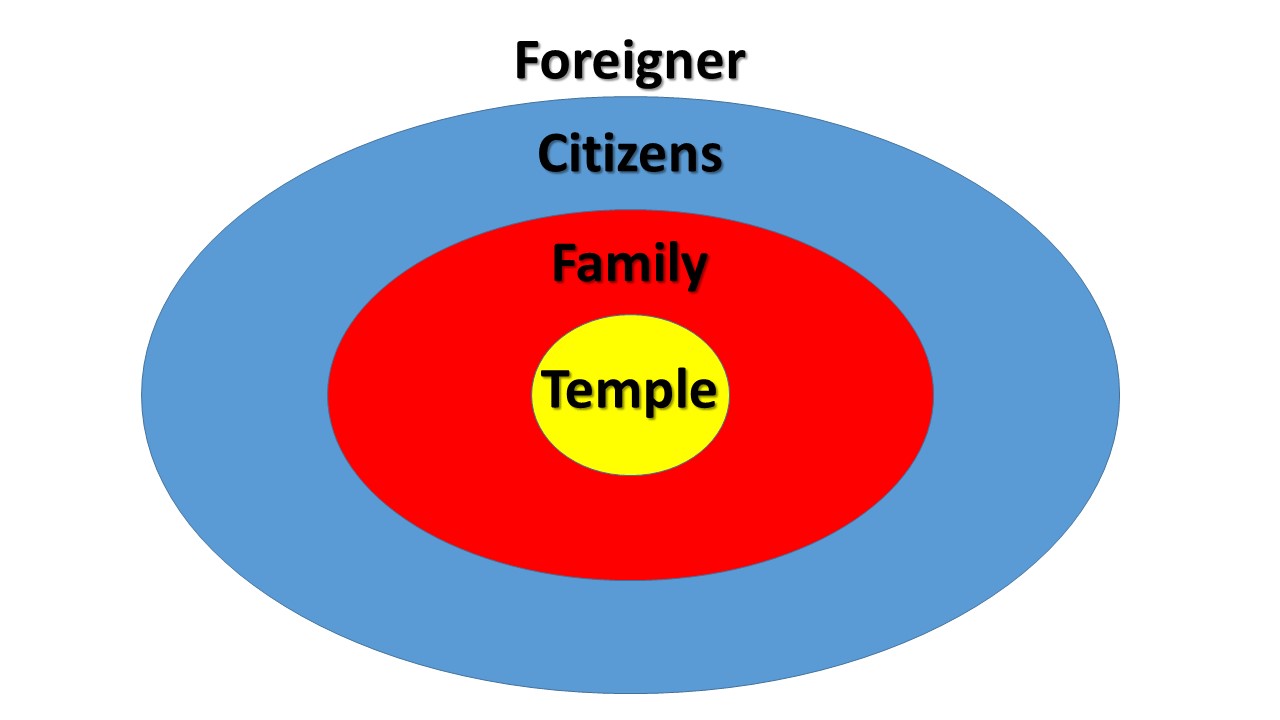
This diagram on the wall here (which looks like a bullseye) shows the three images of inclusion Paul uses in verses 19 to 21

–         Being a citizen in God’s kingdom (the outer ring) is closer to God than being a foreigner

–         Being a member of God’s family (the next ring in) is closer again than being a citizen

–         But being part of God’s temple (the bullseye) is the closest one can get to God, because to be God’s temple is to have the presence of God inside you

From verse 20 Paul expands on the new temple image

The foundation of the new temple is the apostles and prophets – essentially the teachings of the New Testament

–         As John Stott observes: the church’s foundation documents are the New Testament Scriptures. And just as a foundation cannot be tampered with once it has been laid and the structure is being built on top, so too the New Testament… can’t be changed by additions, subtractions or modifications [1]

–         If we try to build something outside the footprint of the New Testament then it won’t last


Verse 20 tells us Jesus is the cornerstone of the new temple – the one who holds the whole building together

Those who were here for the all-age Christmas service last year may remember these verses and how we built a wall out of shoe boxes at the front

–         Neville explained how a cornerstone, in Biblical times, was the largest, most solid stone in a building. It gave the building its shape and size.

–         If you took the cornerstone away, the whole building would fall down

–         More recently, buildings have cornerstones on each corner, supporting all the smaller bricks. The idea is the same.

–         As a cornerstone, Jesus is like a solid rock supporting us, a friend beside us who we can rely on – the one from whom we get our plumb line

That makes us the bricks (or living stones) of God’s new temple

–         In Christ we too are being built together to become a dwelling in which God lives by his Spirit.

–         Again we notice the Trinity in this image and our participation in the life of the Trinity

–         God the Son, is the cornerstone, we are the bricks and God the Father lives in us by his Spirit

This means the Christian church replaces the Jerusalem temple, which was destroyed by the Romans in AD70

–         We don’t replace Israel as such, but we do replace the temple building

–         So wherever you go in the world, particularly when you go with another believer, you take the presence of God with you

–         Although my aunt stopped going to church the church didn’t abandon her

–         One couple from the church, who loved Avis, stayed in touch with her and supported her through a difficult time

–         This couple embodied God’s presence for my aunt – they literally took the temple to Avis by visiting her and showing care for her

–         Is there someone you can take the presence of God to?


Conclusion:

This morning we’ve heard how Christ includes people in the very life of God

–         Through Christ we have a new access to God

–         Through Christ we become a new humanity under God

–         And through Christ we become a new temple for the presence of God


Questions for discussion or reflection:

1.)    What stands out for you in reading this Scripture and/or in listening to the sermon?

–         Why do you think this stood out to you?

2.)    Have you ever been excluded in a significant way?

–         What was this like for you?

–         Have you been able to forgive the hurt and move on?

3.)    Do you know what it is to be included (&/or reconciled) in a significant way?

–         What was this like for you?

–         Have you been able to include others too?

4.)    What is the difference (or relationship) between the ceremonial law and the moral law?

–         What does Jesus destroy and what does he fulfil?

5.)    Where do we see the Trinity in Ephesians 2:11-22?

–         What is our relationship to the Trinity, in Christ?

6.)    Looking at the bullseye, in the sermon notes above, where are you in relation to God?

–         Ask someone close to you if they agree. Where do they see you in relation to God?

–         Where would Paul say you were in relation to God?

7.)    Reflect on (or discuss) the various aspects of the temple image in verses 20-22. That is, the foundation, the cornerstone, the bricks, God’s Spirit

–         What are the practical implications with each of these aspects?

–         Is there someone you can take the presence of God to?


[1] John Stott, BST Commentary on Ephesians, page 107.

The Holy Trinity

Scripture: John 3:1-17

Title: The Holy Trinity

Structure:

  • Introduction
  • The Spirit’s role
  • The Son’s role
  • God’s love
  • Conclusion

Introduction:

The Spanish artist, Bartolome Murillo, has a painting of the Holy Trinity

–         ‘Trinity’ is a word theologians use to describe one God in three divine persons: God the Father, God the Son and God the Holy Spirit

–         We might think of the Trinity as a community of divine love or as the life of God

In Murillo’s painting God the Father is in heaven, as an older man with a beard, while Jesus is the boy (on earth) standing between Mary & Joseph

–         In between God the Father and God the Son is God the Holy Spirit in the form of a dove

What I like about this painting is it shows humanity participating in the life of God, through Jesus

–         This is essentially why Jesus came – so we could join the divine community (the holy trinity) and experience abundant life with God

This morning’s message is based on John 3:1-17, the lectionary reading for last Sunday, the 27th May – Trinity Sunday

–         I had originally planned to preach this sermon last week but decided to postpone it because I felt to bring a different message last Sunday

–         In John 3 a Pharisee by the name of Nicodemus talks with Jesus at night and through their conversation we catch a glimpse of the Trinity

–         We also hear how we might participate in this community of divine love

–         From John 3, verses 1-17 we read…

Now there was a Pharisee named Nicodemus, a leader of the Jews. He came to Jesus by night and said to him, “Rabbi, we know that you are a teacher who has come from God; for no one can do these signs that you do apart from the presence of God.” Jesus answered him, “Very truly, I tell you, no one can see the kingdom of God without being born from above.”  Nicodemus said to him, “How can anyone be born after having grown old? Can one enter a second time into the mother’s womb and be born?” Jesus answered, “Very truly, I tell you, no one can enter the kingdom of God without being born of water and Spirit. What is born of the flesh is flesh, and what is born of the Spirit is spirit.  7 Do not be astonished that I said to you, ‘You must be born from above.’ The wind blows where it chooses, and you hear the sound of it, but you do not know where it comes from or where it goes. So it is with everyone who is born of the Spirit.” Nicodemus said to him, “How can these things be?” 10 Jesus answered him, “Are you a teacher of Israel, and yet you do not understand these things?

11 “Very truly, I tell you, we speak of what we know and testify to what we have seen; yet you do not receive our testimony. 12 If I have told you about earthly things and you do not believe, how can you believe if I tell you about heavenly things? 13 No one has ascended into heaven except the one who descended from heaven, the Son of Man.  14 And just as Moses lifted up the serpent in the wilderness, so must the Son of Man be lifted up, 15 that whoever believes in him may have eternal life.

16 “For God so loved the world that he gave his only Son, so that everyone who believes in him may not perish but may have eternal life.

17 “Indeed, God did not send the Son into the world to condemn the world, but in order that the world might be saved through him.

May God’s Spirit illuminate this reading for us

In this conversation Jesus reveals to Nicodemus how a human being can participate in the life of God

–         Jesus begins by talking about the renewal or rebirth brought about by the Holy Spirit, then Jesus talks about his own role in revealing God and redeeming humanity. First let’s consider the role of the Spirit


The Spirit’s role:

We human beings were made to breathe air and to live above ground

–         If we wanted to go under water we would need to put on scuba gear

–         That would enable us to breathe under water for a little while but we couldn’t really live there under the sea – not without growing gills and changing internally so we could cope with the cold water

–         It would be similar if we wanted to live on Mars – we couldn’t survive on Mars without a space suit, there is too little oxygen and too little warmth

–         To be able to live on Mars naturally our whole body chemistry and physiology would need to undergo a fundamental change


In John 3 Jesus talks about the ‘Kingdom of God’ & ‘eternal life’ & ‘heaven’

–         In the context these three expressions are different ways of describing the same thing – life with God or life within the Trinity, God’s life

–         The way we come into this world, the way we are born naturally, we could no more live in heaven or in God’s kingdom than we could on mars or underwater

–         To be able to participate in the life of the Trinity we need to undergo a fundamental change – we need to be born again or born from above

–         (The Greek word used here can be translated both ways)

This concept of transformation is illustrated in nature by frogs and butterflies

–         To be able to live on land and breathe above water a tadpole must undergo a fundamental change

–         Likewise to become a butterfly a caterpillar must be reformed in a cocoon

–         So it is with us – to enter God’s life we must be reborn, but our re-formation is not something we can bring about ourselves

–         It is the Holy Spirit who transforms us and makes us able to enjoy heaven

Now this may seem old hat to us because we have had these words of Jesus for 2000 years – but for Nicodemus this was shocking news

–         Nicodemus was a Pharisee – someone who had taken a vow to learn and apply the entire Old Testament Law, plus all the other man-made rules the Pharisees had put around God’s Law

–         Nicodemus had grown up being taught and believing that he would get into God’s Kingdom by being a descendant of Abraham and following the rules – but Jesus was telling him, what he had devoted his whole life to wasn’t going to cut it

Going back to my previous analogies of living underwater or on Mars – it doesn’t matter how much I practice holding my breath I’m never going to be able to hold my breath long enough to live in the sea or survive on Mars

–         My body has to change to suit the environment

–         Same thing with living in heaven – it doesn’t matter how hard I practice keeping the Law, that won’t support eternal life

–         Heaven isn’t a list of rules to follow to the letter – it is a divine community of love to be enjoyed forever

–         Now don’t get me wrong – I’m not saying the Law is redundant now and we can do whatever we like

–         Many aspects of God’s Law are still helpful to us in this life

–         The point is: heaven is different to earth and if we are going to breathe the air of heaven we need to be changed by God’s Spirit

Nicodemus was having a hard time accepting this so Jesus goes out of his way to explain in terms that a Biblical scholar like Nicodemus would understand…

–         I am telling you the truth: no one can enter the Kingdom of God unless he is born of water and the Spirit.

–         To be born of water and the Spirit is a reference to cleansing & renewal

–         In Ezekiel 36:25-27 God says to the Jewish exiles…

I will sprinkle clean water on you and make you clean from all your idols and everything else that has defiled you. I will give you a new heart and a new mind. I will take away your stubborn heart of stone and give you an obedient heart. I will put my Spirit in you and I will see to it that you follow my laws and keep all the commands I have given you

In this passage Ezekiel was looking forward to the time when God would give his people a new heart and a new mind so they could love him and each other naturally, without having to hold their breath as it were

–         By alluding to this prophecy from Ezekiel, Jesus is pointing out to Nicodemus that the time of renewal (or being born again) is at hand

–         But this renewal – this total conversion experience – is a gift from God

How exactly the Spirit brings about this change in us is a mystery – there is no magic formula

–         We can’t tell the Spirit what to do any more than we can tell the wind what to do.

–         The Holy Spirit is a powerful and untameable movement of life

Okay, so that’s one of the things the Holy Spirit does – he brings about a fundamental change in us so we can participate in the eternal life of the Trinity


The Son’s role:

Jesus, the second person of the Trinity, has the same purpose only his role is slightly different: Jesus reveals God and redeems humanity

Nicodemus comes to Jesus at night – in the dark

–         If we give Nicodemus the benefit of the doubt this is most likely because he wanted to have a decent conversation with Jesus without being interrupted. During the day Jesus would be surrounded with people and it would be difficult to talk for very long

Elsewhere in the gospel of John, Jesus is described as the light of the world

–         What does light do? It reveals things – so we can see

–         Now physical light – from the sun in the sky – reveals physical things

–         But spiritual light – from Jesus the Son of God – reveals spiritual things

–         Nicodemus has been in the dark and when we are in the dark we can’t see

–         So in coming to Jesus, the spiritual light of the world, Nicodemus is stepping out of the darkness and into the light in order to see spiritual things – that is, the things of God


Imagine someone, you’ve never met or even seen before, who lives in a completely different country, making a proposal of marriage to you

–         (For the sake of this illustration those who are already married will need to imagine they are single)

–         The deal is you have to leave your old life behind and make a new life with them – follow them wherever they go

–         It sounds a bit dodgey doesn’t it – like some sort of internet scam

–         Most of us wouldn’t take up a proposal like that

But what if the person who was proposing marriage came to you in the flesh, so you could see what they were like and get to know them a bit – then you wouldn’t be making a decision in the dark, so it would be easier to trust them

–         The person’s presence shines light on their character and their motivation

–         As it turns out this person is gracious and true – they are powerful but also understated & kind

–         They don’t have any photos of the country they come from (so you can’t see where you’ll be living) but they do describe to you (by way of parables) what their country is like – a beautiful & peaceful place

–         What’s more you get the feeling they really love you – that they would even die for you

–         In the end you are faced with a choice: either reject the proposal and stick with life as you know it, or, trust the person and go with them

If you think about it, that’s pretty much what God is proposing: leave your old life behind and make a new life with him

–         But so we don’t have to make a decision in the dark Jesus came, from heaven to earth, to shine light on God – to show us what God is like so we would be better able to trust God and find redemption for our souls

–         Jesus is the light of the world who reveals God’s heart & mind, his character & motivation, in order to redeem humanity.

–         In verses 11-13 we read…

11 “Very truly, I tell you, we speak of what we know and testify to what we have seen… Notice Jesus says ‘we’, not ‘I’.

–         It’s not entirely clear who Jesus means by ‘we’ but perhaps he is referring to the divine we: God the Father, Son & Holy Spirit – it fits the context

–         …yet you do not receive our testimony. 12 If I have told you about earthly things and you do not believe, how can you believe if I tell you about heavenly things?

–         In other words, ‘Nicodemus, you just don’t get it. And you’re not getting it because you don’t really trust me, at least not yet. Trust, faith, belief precede understanding

–         13 No one has ascended into heaven except the one who descended from heaven, the Son of Man.

–         Jesus is basically saying: “I’m here to reveal God to you. I’ve been to heaven. I’m not talking in theory. I know what the life of God is like from the inside, from my own experience.”

The Son of Man is Jesus’ favourite way of referring to himself

–         It’s a phrase which has different layers of meaning

–         On the lips of Jesus it is often a veiled way of saying ‘Messiah’ and at the same time an identification with humanity

–         You see, in shining light on God, Jesus is also shining light on what it means to be human. Jesus reveals our purpose – he shows us what it looks like to be made in the image of God


In verses 14 & 15 Jesus goes on to talk about his role in redeeming humanity…

–         And just as Moses lifted up the serpent in the wilderness, so must the Son of Man be lifted up, 15 that whoever believes in him may have eternal life.

Once again Jesus is making it easy for Nicodemus to understand by referring to a story from the book of Numbers (which Nicodemus would be familiar with)

–         While living in the wilderness the people of Israel were attacked by venomous snakes and cried out to be saved

–         The Lord said to Moses, “Make a snake and put it on a pole; anyone can look at it and live.”

–         Moses did what God said and those who looked at the bronze snake were saved

Jesus is saying, “I’m a bit like that bronze snake – I am God’s means of salvation (his redemption) for people.”

–         Nicodemus wouldn’t have understood at the time but later, when he was taking Jesus’ body down from the cross, he would have realised Jesus was saying, “My crucifixion, my being lifted up on a pole, will save those who look to me in faith”


God’s love:

And so we come to perhaps the most famous verse in the Bible…

16 For God so loved the world that he gave his only Son, so that everyone who believes in him may not perish but may have eternal life.

17 Indeed, God did not send the Son into the world to condemn the world, but in order that the world might be saved through him.

Although God the Father is not explicitly mentioned in these verses, talk of God’s Son implies there is a Father

–         Here we see God reaching out through the Son to save the world

–         In the gospel of John the world means those who are opposed to God

–         Those who have rebelled against God – God’s enemies

–         God’s motivation is not to condemn the world but to save it

–         God doesn’t just love his friends – God loves his enemies as well

Once there was a wealthy land owner who grew all kinds of fruit on his orchard

–         Although he was wealthy he was also generous & kind

–         The people in the nearby village relied on this man for their livelihood

–         He provided paid employment for everyone and the whole valley prospered because of his enterprise

–         In all his dealings the landowner never left anyone out of pocket

–         Some people loved him but others were envious

One day a group of villagers decided they didn’t want to work for the orchardist anymore and, in the dark of night, they set fire to his fruit trees and then scurried home for fear of being caught

–         It was a senseless move really because they were cutting off their own living – without the trees they would be out of work

The wind picked up and the fire got out of control threatening the village

–         As the orchardist looked down the valley he had a choice to make – let the sleeping village burn (that would be justice) or send someone to warn the villagers and save them (that would be mercy)

–         The orchardist chose mercy and sent his son – the villagers knew his son and would surely listen to him


The son ran door to door waking people and warning them to escape

–         Those who had started the fire pretended to be asleep, ignoring the warning – they knew they had done wrong and thought the orchardist’s son had come to take revenge on them, when he had actually come to redeem them

–         But those who trusted the son and heeded his warning were saved and welcomed into the Father’s house


God is like the orchardist – he didn’t start the fire, his enemies did. But he didn’t stand by and do nothing either

–         God loved all the villagers enough to send his only son to save anyone who would believe in him


Conclusion:

Through his act of mercy in saving us, Jesus reveals the love of God

–         And through the power of the Holy Spirit we experience the renewal that is necessary for us to participate in the life of God (the divine community of love)


Questions for discussion & reflection

1.)    What stands out for you in reading this Scripture and/or in listening to the sermon?

2.)    What do you imagine ‘heaven’ or ‘eternal life’ or the ‘Kingdom of God’ to be like?

3.)    What role does the Holy Spirit have in preparing us for eternal life with God?

–         What does it mean to ‘born again’ or ‘born from above’?

–         Why did Nicodemus struggle to accept what Jesus said about being born again?

4.)    What role(s) does Jesus have in our salvation?

5.)    Thinking of the broader context of John’s gospel – what is the significance of Nicodemus coming to Jesus at night?

6.)    How does God make it easier for us to trust him?

7.)    What is the meaning of the bronze snake on the pole story, from Numbers 21?

8.)    What do verses 16-17 of John 3 show us about God’s heart (his motivation)?

–         What do you think God’s attitude is toward you? (E.g. Do you think he means you harm or good?)  Why do you think this?


Unity

Scripture: Psalm 133

Title: Unity

Structure:

  • Introduction – unity is diversity with order
  • The Trinity and us
  • Unity comes down from God above
  • Unity is for sharing
  • Conclusion


Introduction:

On the wall here we have a picture of a tapestry of the Lord’s Supper

–         A tapestry is a unity

–         It is not sameness which makes for unity – rather, unity is diversity with order

–         Although there are many different coloured strands they are all woven together in an ordered way to pleasing effect

–         Together the strands form a bigger picture which makes sense


In our house there are three women and one shower

–         One of the things that happens with this arrangement is that long strands of hair gather in the drain, causing a blockage, so that the water in the bottom of the shower rises to your ankles

–         Whenever this happens it is my job to unblock the drain, pulling all the hair out by hand – I don’t mind though, it makes me feel useful


The hair in the drain is the opposite of unity

–         Unlike the tapestry which has a variety of different strands woven together in an ordered way, the hair in the drain is pretty much all the same and it is clumped together in a tangled mess of soap scum

–         There is no order, no bigger picture, no meaning, no pleasantness with hair in the drain

–         Unity is diversity with order – unity is pleasing


This morning we return to our series on the Songs of Ascents

–         These songs were probably sung by Jewish pilgrims as they made their way to the temple in Jerusalem for various religious festivals

–         They are songs for the faithful as they gather together for worship


Our focus today is psalm 133

–         This song celebrates God’s gift of unity

–         From the New Revised Standard Version we read…


How very good and pleasant it is when kindred live together in unity! It is like the precious oil on the head, running down upon the beard, on the beard of Aaron, running down over the collar of his robes.

It is like the dew of Hermon, which falls on the mountains of Zion. For there the Lord ordained his blessing, life forevermore.


May the Spirit of Jesus illuminate this reading for us


The Trinity and us:

One of the prominent features at the front here is the organ

–         The organ is a unity – it has a diverse range of parts & pipes put together in an ordered way to make music which is pleasing


The organ is a metaphor for creation – creation is a unity, a diversity of different matter put together in an ordered and pleasing way


Today is Trinity Sunday, when we reflect on the mystery of the triune God: Father, Son and Holy Spirit

–         God is a unity – a diversity of three persons who are one


In a limited way the organ serves as a metaphor to help us understand the Trinity’s interaction with creation

–         I say ‘in a limited way’ because I’m very cautious about using any sort of analogy for God or the Trinity

–         God is holy – which (among other things) means he is different from us and indeed different from any created thing

–         God is beyond compare so no metaphor is adequate for describing God


Having said that, metaphors can be helpful to help our finite human minds form some concept of our infinite God and how we might relate with Him


Anyway, as I was saying, if the organ represents creation then the Trinity (Father, Son & Spirit together) designed and built the organ

–         The organ is not God – creation is not God – it was just made by Him


God the Father is like the organist and composer of the music

–         The Father writes the music and plays it on the organ (or through creation)


The gospel of John tells us that God the Son (who we know as Jesus) is God’s Word – so the Son is like the music God has composed

–         Just as music is an expression or embodiment of the composer’s soul, in a similar way, Jesus is an expression or embodiment of God Himself

–         Just as the music unites the choir, so everyone is singing from the same hymn sheet, so too Jesus unites the church and indeed all of creation – Jesus shows us which notes to follow


If we imagine that God the Father is the organist and Jesus is the music and we (in all our diversity) are the organ pipes, then the Holy Spirit is the wind passing through the pipes, making the sound God wills through us

–         We can’t make the music on our own – in fact we only find our meaning and purpose when we let God’s will be done in our life

–         Nor do we get to hear the whole song in our lifetime – we have to wait for eternity for that


Now in some ways this analogy is inadequate

–         Firstly, Jesus is more than just the music (as important as that is)

–         Jesus is a real person – the one who came to redeem & repair creation

–         It’s like the organ of creation was damaged by sin and Jesus (the organ builder’s Son) came to fix it


Likewise the Holy Spirit is more than just the wind blowing through the pipes (as important as that is)

–         The Spirit of God is also a real person

–         If we are the organ pipes, each one of us sounding a different note, then the Spirit is like the tuner who comes to adjust us when we get out of tune


Of course – an organ is not a living thing with free will

–         Some parts of God’s creation always do what they are supposed to at the right time – not so us humans, we are far more difficult to work with


In John 15 Jesus uses the image of the vine – the vine being a living organic unity

–         The Lord says to his disciples: I am the vine, you are the branches and God the Father is the gardener

–         Following this logic we might cautiously suggest the Holy Spirit is the sap or the life flowing from within the vine to the branches

–         As branches we come in different shapes and sizes but we are united by Christ, the main trunk of the vine

–         What’s more we are sustained and made fruitful by the life giving Spirit of Jesus in us


Unity comes down from God above:

Returning to psalm 133

–         This song is attributed to King David and it is essentially about unity


Although it is short (only 3 verses) psalm 133 uses two quite different images to convey the one idea that unity is a good and pleasing gift from God


Verse 1 begins with David describing the experience of unity from a human perspective

–         How very good and pleasant it is when kindred live together in unity.


On the sixth day of creation (in Genesis 1) the Lord God saw all that he had made and it was very good

–         Creation before the fall was a perfect unity – it was diverse but at the same time ordered in such a way that was good and pleasing


Unity from God is not unpleasant, like tangled hair and soap scum clogging up the shower drain

–         No – unity from God is good & pleasant, like a well ordered tapestry conveying a meaningful bigger picture

–         Or like an organ playing the right notes at the right pitch at the right time


The implication of verse 1 is: if it’s not pleasant then it’s probably not unity as God intended it


In verse 2 we are given the first image of unity

–         It is like the precious oil on the head, running down upon the beard, on the beard of Aaron, running down over the collar of his robes.


Now to us this image doesn’t seem all that pleasant

–         It actually sounds messy and inconvenient

–         If someone poured so much oil on your head that it ran down your face and onto your clothes you would probably want to jump in the shower and put your clothes in the wash


But in ancient Middle Eastern culture it was customary for the host to greet a guest by pouring oil on their head

–         It was a way of saying welcome, you have a special place of honour among us, we are pleased you are here

–         Oil on the head was a picture of generous hospitality – it was an expression of unity


We read of Jesus being anointed in this way on more than one occasion in the gospels, by women (because the men were preoccupied)


But the picture in verse 2 isn’t just one of hospitality – for the verse goes on to describe the anointing of Aaron, the high priest of Israel during the time of Moses

–         Aaron was anointed with a special kind of oil – one mixed with perfume

–         So the oil of unity is sacred and it has a pervasive aroma

–         Unity is a pleasant fragrance which cannot be contained and which everyone can enjoy [1]


Jesus is our high priest – he is the Christ or the Messiah

–         Christ and Messiah mean the same thing: anointed one

–         Jesus (the anointed one) is the head of the church and we are the members of Christ’s body

–         Although we are quite diverse in many ways we are united by Christ

–         Jesus brings order to our diversity and the oil of his Spirit is a pleasant fragrance which cannot be contained


The main thing to note in verses 2 & 3 of psalm 133 is that the oil of unity runs down – it descends from above, meaning that unity comes from God above

–         Unity is not manufactured by us from the ground up – it is a gift (or a blessing) bestowed by God from on high


We heard last week about the builders of the Tower of Babel

–         In the end their unity was revealed to be false for they were trying to manufacture it themselves from the ground up

–         That kind of forced unity never lasts

–         True unity is a blessing from God above – not a human achievement


Verse 3 offers a second simile for unity

–         It is like the dew of Hermon, which falls on the mountains of Zion.


Mount Hermon is the highest mountain in Israel, found in the north near Galilee

–         Hermon is proverbial for its heavy dew

–         The mountains of Zion refer to the much smaller mountains in the south of Israel on which the city of Jerusalem was built

–         Hermon and Zion were diverse geographically speaking (they were spaced well apart) and they were quite different in height

–         Yet little Mount Zion enjoyed the same gift as grand old Hermon – they both share the same dew from heaven above

–         High and low drink the same sweet refreshment. [2]

–         Like the labourers in Jesus’ parable, at the end of the day, we are all paid the same, regardless of how many hours we worked  

Perhaps also, as King of Israel, David is reflecting on what God has done in uniting the different tribes of Israel – bringing the north and the south together

–         David sees a diverse range of people all coming together to worship God at his footstool in Jerusalem and he appreciates the harmony of it all


In any case, unity is a life giving blessing from God

–         Just as oil flows down from the head and just as dew comes down from above, so too unity comes down to us from God above


The thing is though that God often blesses us with unity in unexpected ways

–         Just last Friday night there was a power cut in Tawa – it was a complete black out

–         But it was also a blessing to our family – it was something a bit different, something fun and unexpected that brought us together

–         We lit candles, gathered close, laughed and talked because there wasn’t anything else we could do

–         It was quite a lovely time of family unity and felt like a gift from God


Unity is for sharing:

As well as showing us that unity comes from God above, the two images in psalm 133 also show us that unity is not designed to be contained

–         Rather, unity is for sharing

–         The pleasant fragrance of the perfumed oil on Aaron’s head and shoulders cannot be contained – the aroma is for everyone

–         Likewise the dew of Hermon falls liberally on Zion as well – it is not funnelled off somewhere exclusive – it is for high and low alike


Given that unity is a gift from God and given that it may come to us in unexpected ways, when it does come we need to be careful to recognise it and share it, without getting in the way – without creating a blockage

–         We need to ask ourselves how can we be a conduit for God’s gift of unity


In Luke 12 Jesus tells a rather sobering parable about a man whose land yielded a bumper crop

–         This blessing from God above created a problem for the farmer

–         Instead of consulting with his neighbours though he ignored his community and tried to figure out the problem on his own

–         He said to himself: ‘What shall I do? I have no place to store my crops.’

–         Still talking to himself he said, ‘I know, I’ll tear down my barns and build bigger ones to store all my grain – then I’ll be able to retire early, put my feet up and take life easy.’


But God said to him, ‘You fool! This very night your life will be demanded from you. Then who will get what you have prepared for yourself?’


The tragedy is this man didn’t realise he was actually quite disconnected and God was trying to bless him with the gift of unity in the form of a bumper crop

–         If only he had talked with his neighbours he might have realised how his actions would only isolate him further

–         By holding onto the grain the farmer was driving the price up

–         If he had been less greedy and sold the grain at a lower price then the rest of the community would have benefited, especially the poor

–         Everyone would have enjoyed the pleasant fragrance of God’s special anointing on his land

–         High and low alike would have been refreshed by the dew of Hermon poured out on him

–         What’s more he would have enjoyed something far better than money – he would have experienced how good and pleasant it is to dwell in unity


By keeping it all for himself the man (ironically) rejected God’s gift of unity

–         He became a blockage to unity and God had little choice but to remove the blockage by taking back his life


Jesus told some really sad stories aye. That one was real tragic. I’m more of a happy ending kind of guy so let’s imagine this parable differently


Once there was a farmer who worked on his land from dawn till dusk six days a week

–         God had been good to him and blessed his hard work so that he was able to pay off his mortgage about 10 years sooner than he expected

–         But these kinds of gains come at a cost

–         As a consequence of working such long hours he didn’t have time for a wife and family – his was a relatively solitary life


He did reserve Sundays as a day off though when he would go into town to attend church in the morning before picking up some groceries from the supermarket on the way home

–         It wasn’t that he was particularly religious – he went to church mostly for the social contact (the cuppa and chat afterwards was his favourite part)


As the years went by the city expanded into the countryside and it was just a matter of time before property developers started eyeing up his farmland to build new homes for a hungry suburban market

–         One such developer offered the farmer 5x what he had paid for his land

–         It was a tempting offer – with no mortgage and this sort of cash in the bank he could retire before he was 50


That Sunday the preacher at church spoke about the parable of the rich fool in Luke 12

–         The farmer didn’t normally care for the sermon that much but this particular week he hung on every word

–         After reflecting on Jesus’ parable he decided not to get back to the developer just yet


The next Sunday, over coffee after the service, the farmer mentioned to one of the bankers in the congregation that he had been approached by a developer who was wanting to buy his land and turn it into a sub-division

–         The banker asked what the developer was offering and, on hearing a figure, explained how the land would be worth a lot more than that after it had been sliced up – The farmer had guessed as much

–         The banker asked if the farmer would consider subdividing the land himself


The following Sunday the farmer got into a conversation with a young guy in his 20’s who was saving to buy a house – it was tough to get a deposit together these days, especially with a large student loan

–         The farmer didn’t say anything about the developer’s offer this time

–         He was all of sudden conscious of a great divide between the two of them

–         So he offered the young guy some extra work on his farm

–         The young man was grateful and proved to be pretty good at fencing

–         To his surprise the farmer found he quite enjoyed the company

–         It had been a long time since he had worked with someone, it made the job seem more pleasant somehow


A few more weeks went by and the developer returned with an even bigger offer – but this time the farmer said ‘no’

–         Instead he made an offer of his own – not to the developer but to the young guy and his wife

–         He sold them a parcel of his land for half what the developer was offering him – which was about a quarter of the retail rate

–         To make the deal even sweeter he had a lawyer draw up a contract saying as long as they lived in the house they could pay him back interest free over a 20 year period


The couple still needed to borrow from the bank to build the house but the reduced cost of the land and the less onerous repayments made getting into their own home more affordable

–         The great divide he had sensed at first, between himself and the young man, was gone – the farmer felt closer to his neighbours


He did the same thing for others who were struggling, gradually selling pieces of his farm at below market rates

–         It meant reducing stock numbers a bit and being a bit smarter with his pasture management but it was workable because he was freehold


As the farmer shared his land a tight but diverse community developed so he became less isolated and more connected

–         He no longer needed to work 12 hours a day six days a week on his own – there were always willing neighbours ready to lend him hand

–         No one defaulted on their loans – partly because he was discerning about who he helped but also because a bit of grace usually motivates people to do the right thing


The farmer worked till he was 65 before taking his super and he lived comfortably in his retirement till his death at age 84


When asked by the pastor one day why he had helped so many people the farmer replied…

–         “When I look back on it I realise it wasn’t me who did it. I was isolated and alone before God blessed me with unity. All I had to do was get out of the way so God could do His thing.”


Conclusion:

Unity is diversity with order

–         Unity is pleasant

–         Unity comes down to us from God above, often in unexpected ways

–         Ultimately though unity is for sharing


Let us pray…

–         Father God, we thank you for your gift of unity through Christ the Son and the Holy Spirit

–         Help us to recognise your blessings when they come and to be a conduit for unity by sharing your good gifts

–         We pray this in Jesus’ name. Amen.


https://soundcloud.com/tawabaptist/11-jun-2017-unity

[1] Refer Derek Kidner’s commentary on ‘Psalms 73-150’, page 489

[2] Derek Kidner, Psalms 73-150, page 489.